Spielbericht 25.9.2002
Autor: Aaron
am Tisch: Peter, Hans, Andrea, Günther, Walter, Aaron
auf dem Tisch: Zaster, Canyon, Geister, Bluff
- Zaster
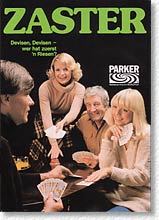
This game was released by Parker
in 1978 and comes in a fairly large box for a card game. It contains seven suits of
cards, each suit showing 9 identical cards of a European currency of the time with
different point values for the currencies. In addition, there is “Depreciation”
and an “Appreciation” card which complete the deck. The box also contains a
little hotel reception style metal bell – hence the size of the box.The game is played with as many currencies as there are players plus the two special
cards. All cards are delt to the players, i.e. 2 players hold 10 cards and the others 9
cards each. The aim of each player is to collect the set of cards of one currency. The
“Appreciation” card may be used as a joker and the “Depreciation”
card prevents one from finishing a round and yields minus 10 points to the player holding
it when the round finishes. The game is started by ringing the bell.Now players simultaneously start to announce how many cards (not the type of currency,
though)they want to trade. All players may exchange cards at the same time taking care
that only an identical number of cards and only a set of identical currency cards are
exchanged. As soon as a player holds all 9 cards of a currency (or 8 cards plus the
“Appreciation” card s/he rings the bell and finishes this trading round. That
player now receives the point value of that currency.Zaster is probably one of the first party-style games of the time and it plays fast and,
in particular, loud as all players trade at the same time shouting out the number of
cards they want to exchange – a kind of stock exchange atmosphere. We found this game a
little bit too “flat” even as a starter for a game session because of the
general lack of tactics. With many players the game can actually last pretty long as one
should play as many rounds as are required to let every player be start player once (the
2 players receiving 10 cards obviously have a slight advantage which is leveled out by
this).Westpark Gamers score: 5.7
- Canyon – with Grand Canyon Expansion Set
After having played Wizard in our previous session we
remembered this wonderful variant of the concept and played it with the great “Grand
Canyon” expansion set. Similar to last time when
we played this game we had a lot of fun. And again we had a close finish of two players
while the others were still struggling to negociate a narrow bend.Westpark Gamers score: 7.4
- Gespenster
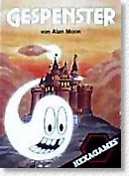
This is a rerelease of Alan R. Moon‘s “Black Spy” which
was published by Avalon Hill in 1981. It contains 5 differently colored sets of cards
numbered from 1 to 11, the exception being the white Gespenster (spectre) set, which has
5 additional sevens.Gespenster is a trick taking game like Hearts where players have to follow suit either by
color or by value. Since all white cards yield negative points (other colors count zero)
players try to avoid having to take a trick that contains one or more white cards.We found the game rather uninspiring and far too luck based.
- Bluff
Our usual closing game of a session whith nothing special to report this time.