Session Report 18.12.2002
Author: Aaron/Walter
at the table: Peter, Günther Walter, Aaron
on the table: Fische Fluppen Frikadellen, Mogul, Imperium
- Fische Fluppen Frikadellen
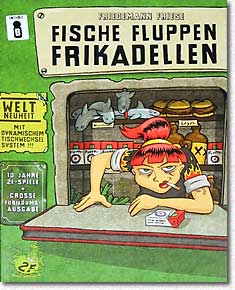
“Fische Fluppen Frikadellen” is this year’s Essen release of the man with
the green hair and creator of the F games: Friedeman Friese. This time players have the
task to acquire goods (fish, fags and French fries would be a good translation although
Frikadellen are in fact hamburgers, and in addition to the title: fusel and fennel) and
trade them in for fetishes. The player who acquires his/her third fetish wins the game.The game board is set up by randomly placing 12 kiosks on the designated spaces. Kiosks
come in three types: one type sells one of the F goods or buys another type of goods. The
next kiosk type trades a type of good into another type of good and the last type is the
kiosk trading in goods for fetishes.Kiosks are connected with pathways and waterways and players have three movement points
per turn to negotiate their route to the kiosks of their liking. Waterways usually
provide shortcuts between distant corners of the board but they require the usage of a
raft which sometimes needs to be called to the footbridge which costs movement points and
money.Players start with a defined amount of money (now guess what the currency is: Florints of
course) which they mainly use for buying goods at the kiosks. Once a player lands on the
field of a kiosk that sells/buys goods s/he may buy any amount of goods that the kiosk
has in stock at the current market price (there’s a rebate for buying more than one
unit). At the start of the game each such kiosk has 2 goods in stock. Alternatively, a
player may sell any amount of the good the kiosk can buy. These goods are returned to the
bank. A consequence of selling goods is a decrease of the market price of that good.If a player arrives at a kiosk which trades goods s/he can trade in up to two goods of
the kind kiosk accepts and receives 2 other goods for every good turned in. These 2 for 1
deals are very important in the course of the game.Each transaction at a kiosk triggers up to three secondary actions indicated on the
kiosk’s tile: either the market price of a good is increased or the player may
exchange the stock of two kiosks or a particular type of good is being produced and the
stock of the appropriate kiosk is increased.Players also have tokens which they can use during their turn. A token provides a one
time special ability like having more movement points or being able to exchange a good of
one type for another type, and, very nasty, closing a kiosk for one complete round. Each
time a player acquires a fetish s/he get an additional token.The game started rather fast paced with all players rushing to kiosks which have goods
for sale. Unfortunately, I was the fourth player in the first turn and was faced with the
situation that no such kiosk was in easy reach. In fact it took me quite some time to be
able to acquire my first goods as I was not willing to spend money on calling rafts for a
faster access to far away kiosks. Not a good tactic, I soon realized. At the time I had
reached a kiosk with goods, prices had already gone up and I had to spend too much money
for too few goods. Walter at that time was already far ahead with 4 or 5 goods and in
reach of his first fetish.Günther seemed to follow a strategy of acquiring lots of goods at low prices and only
exchanging them for a fetish once he reached the holding limit of 7 goods. Peter’s
strategy was to go for optimal good runs and to exchange/sell goods at favorable prices.
Soon I found myself left with very little money and only a few goods because all too
often were kiosks sold out or prices had gone up to prohibitive levels before I could
reach them. I therefore had to revert to an exchange strategy changing goods on a 2 for 1
basis. Luckily, I was able to find a good run between kiosks for this to work.Walter was the first to have two fetishes as well as sufficient goods to exchange them
for the third one and we thought that this would end in a clear win for him. Quite to my
surprise Günther was able to play one of his special ability tokens that allowed him to
buy a good from Walter leaving him one good short for his final exchange. At that point
it became clear that by cleverly playing against Walter we would most likely have a
chance to steal victory from him. This in fact left me with a slight chance to win the
game myself: in the meantime I, too had acquired two fetishes and had sufficient goods to
get the third one. However, my goods mix was not right (you need 5 goods in total, 3 of
one kind and 2 of the other) which prevented me from becoming a target for
countermeasures of my fellow players. The one thing they did not know was that I had a
special ability token which would allow me at any time during my turn to exchange one
good for another type and that would yield the required combination for my third fetish.
So I moved forward to the fetish kiosk and only needed one more turn when Peter decided
to stop playing aggressively against Walter and allowing him to make his final winning
move. That was close…I think that “Fische Fluppen Frikadellen” is one of the better games of
Friedemann Friese. It provides a lot of scope for different strategies. On the other
hand, in our game I felt that most of the time I was playing with minimal interaction
with other players. Once you have found out what strategy the other players are following
you can adopt you strategy accordingly and do your thing. There is also this effect of
bashing the leader close to the end which I do not like so much as you do not have
sufficient time (moves) to prepare for this appropriately.One thing I did not mention about the game: it is a 3 to 5 player game but can be played
with up to 15 players if you buy the complete set of three games (type A, B and C). They
differ in board layout and tile mix as well as providing different colored pawns and
players are able to move their pawns between board. Provided you have sufficient table
space and players this is certainly worth a try.Westpark Gamers’ Score: 7.0
- Mogul
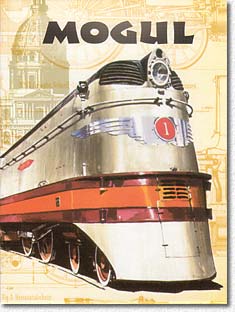
Mogul is a stock trading and auctioning card game. Players start the game with one share
and 6 money and their goal is to acquire victory points by selling shares.Auctioning is done in a very interesting though sometimes nerve wrecking way: the top
share is drawn from the draw pile, revealed and put up for auction. The start player (the
player who acquired a share in the previous turn) starts the auction by placing one coin
in the middle of the table. The next player has the choice of continuing the bidding by
also placing one coin or to drop out of the auction. Here the interesting bit starts:
whenever a player drops out s/he collects the coins in the middle of the table into
his/her own pocket. The next player then bids again (1 coin) to stay in or drops out as
well (collecting 0 coins!).The last remaining bidder has the choice of either taking the share or to sell shares of
the color indicated by the border color of the share currently up for auction. The last
but one bidder then executes the option not taken by the last bidder.Selling shares is the only way to receive victory points and there is one victory point
granted for every share of that stock on the table at the time of the sale, including the
shares of the other players. Since at the end of the game unsold shares count no VPs at
all and money is exchanged 5 coins for 1 point it is absolutely necessary to sell shares
at the best possible time. The game ends immediately when the CRASH card is being drawn
which has been shuffled into the draw pile among the last four cards.The bidding mechanism is so unusual that it does need some time to get used to it.
Already in the first round I found myself in the position that Günther sitting in front
of me decided to drop out and take the money and I had the choice to also drop out (for
nothing) or placing the first coin again. I decided for the latter only to be faced with
the situation that now Walter dropped out (now in front of me). Again I placed a coin and
Peter dropped out and I decided to take the share since there was no possibility to sell
shares. The result of the first round was that I owned two share now but only 4 coins,
all others had one share with Peter owning 5 coins, Walter 7 coins and Günther 8 coins.
Günther seemed to have liked the possibility to make easy money and he decided to drop
out again when it was his turn in the second round, leaving him with 11 coins! Only too
late did I realize that I would end up in the unfortunate situation that I had to drop
out of the auction because of lack of money at a point in time when there where no coins
in the pot!Fortunately, there is a rule which allows a player to exchange 2 victory points for 2
coins at the beginning of a round. Since I was broke I had to take that option which, in
the end, turned out to be so devastating that who ever has to do this will almost
certainly lose the game. This insight came to late for me and I did not have a chance to
even come close to the leader throughout the rest of the game.Although very much based on luck elements the game is full of suspense: will there be
coins in the pot when it’s my turn to drop out of an auction? What is the right time
to sell shares? Will there be another possibility at all to sell shares of a particular
stock? Some of these questions can be answered by closely observing the number of shares
of stock still in play. Other, like the possible reaction of the other players are much
harder to determine or predict.As a fast paced, short (45 mins.) game with elements of “Schadenfreude” Mogul
can be highly recommended.Westpark Gamers’ Score: 7.0
- Imperium
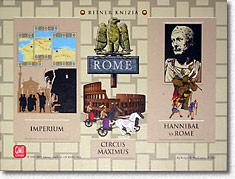
Anstatt den Spielabend mit 6-nimmt oder Bluff ausklingen zu lassen, nahmen wir uns auf
Günthers Empfehlung noch eine Runde Imperium vor. Angeblich dauert ein Spiel 20 Minuten.
Das war dreimal soviel Zeit, wie Peter bis zu seiner letzten U-Bahn übrig hatte. Bei den
Westparkern geht aber auch ein triviales Auktionsspiel nicht so schnell über die Bühne.
Peter hatte Glück, daß er sich nach 50 Minuten Spielzeit – als Sieger – auf den Weg
machen konnte.Das Spielbrett läßt zunächst mal eine überlange Spieldauer befürchten: es ähnelt ganz
dem klassischen “Civilisation”, das wir noch nie unter 4 Stunden beendet
hatten. Auf einer Landkarte rund um das Mittelmeer sind Länder und Provinzen
eingezeichnet, die von ferne ein bißchen die Vision des Geographieunterrichts in einer
altrömischen Grundschule aufkommen lassen. Daß Athen ohne “h” geschrieben
wurde, und daß das Dörflein “Cannae” zu einer ganz Unteritalien umfassenden
Provinz aufgewertet wurde, ganz zu schweigen von der Plazierung Ägyptens an der lybischen
Küste und ähnlichen Unschärfen, sollte einen großen Geist natürlich nicht stören.Das Spielgeschehen hätte man auch viel einfacher plazieren können, und es damit sogar
noch durchsichtiger gemacht. Denn das geohistorische Brimborium verdeckt nur das doch
recht lineare Spielprinzip. Man denke sich die Zahlen 1 bis 8 irgendwie zufällig in einem
Kreis auf dem Tisch verteilt, und schon hat man die Aufgabenstellung hundertprozentig
adaptiert. Es geht darum, möglichst viele, möglichst hohe und möglichst
nebeneinanderliegende Zahlen (Länder) in Besitz zu bringen.Wie macht man das?
Ganz einfach: Jeder Spieler ist mit einem Kartensatz mit den Zahlen 1 bis 8
ausgestattet. Davon wählt jeder jeweils drei Karten, sprich Zahlen, aus und bestimmt
damit die Zahlen im Kreis, auf die er einen Spielstein der eigenen Farbe zu legen
gedenkt. Alle Spieler decken gleichzeitig die gewählten Karten auf und legen dann die
entsprechenden Spielsteine auf die Zahlen im Kreis. Das wird bis zum Spielende wiederholt
und so verteilen sich allmählich die Spielsteine der Mitspieler je nach Vorliebe oder
Taktik unterschiedlich auf den Zahlen im Kreis.Nach jedem Setzenvorgang wird eine Zahl gewertet: Der Spieler mit den meisten
Spielsteinen auf der Zahl im Kreis hat die Zahl in seinen Besitz gebracht, d.h. er erhält
den Zahlenwert als Siegpunkte gutgeschrieben. Der Spieler mit den zweitmeisten
Spielsteinen erhält, je nach Zahl, die es zu werten gilt, 1 bis 2 Punkte weniger, der
dritte 2 bis 4 Punkte weniger und der vierte und letzte 3 bis 6 Punkte weniger. Es gilt
also, auf der Zahl, die gerade gewertet wird, eine Mehrheit zu erringen. Das geht
natürlich nur beschränkt. Jeder Spieler muß seine Auswahl auf bestimmte
Zahlenkombinationen konzentrieren, um wenigstens dort dominieren zu können.Nach der Wertung wird das Zahlenfeld geräumt: alle Spieler müssen ihre Spielsteine
wieder an sich nehmen. Nur der Spieler mit der Mehrheit darf einen Spielstein als
“Prokonsul” auf der Zahl stehen lassen. Der steht dann schon mal für die
nächste Wertung da, denn nachdem alle 8 Zahlenfelder gewertet wurden fängt die Wertung
wieder bei der ersten Zahl an.Der “Prokonsul” hat aber noch eine weitere “einnehmende” Bedeutung.
Der Spieler, der bei einer Zahlenwertung die Mehrheit errungen hat, bekommt zusätzlich
noch einen Siegpunkt für jeden eigenen Prokonsul in einer benachbarten Provinz (Zahl).
Dies ist ein Grund, warum man zusammenhängende Zahlen (Provinzen) favorisieren sollte.Peter hatte sofort erkannt, daß das unattraktive Zahlenfeld 1 neben dem maximal
lukrativen Zahlenfeld 8 etwas unscheinbar an der afrikanischen Küste lag und so dem
Blickpunkt der Mitspieler entgehen könnte. Er spekulierte darauf, daß er relativ
unbehelligt die 1 belegen und sich mit Körpereinsatz dann auch noch die 8 aneignen könne.
So kam es dann auch: Er konnte das 8er Feld dreimal erobern bzw. behalten und kassierte
dafür noch zweimal mit seinen lausigen Prokonsul auf der 1 einen zusätzlich Siegpunkt.
Das reichte insgesamt zum Sieg.Ich hatte mir die Zahlenreihe 3-7-2 an der illyrischen Küste ausgesucht. Es gelang auch,
auf der 3 Fuß zu fassen und dann noch die 7 zu erobern. In den nächsten Runden mußte ich
aber sehr viel zur Verteidigung der 7 investieren. Als ich dann noch mit Störmanövern auf
der 8 versuchte, den Kriegsschauplatz auf Peters Besitztümer zu verlagen, hatte ich
unnötig Pulver verschossen. Aaron machte mir mein 3er Feld wieder abspenstig und es
reichte in der Endabwertung nur zum zweiten Platz.Obwohl Imperium im Grunde ein einfaches Auktionsspiel ist, hatten wird doch deutlich
unsere Freude daran. Vielleicht lag es auch allgemein an der – durchaus nicht
selbstverständlichen – allgemeinen Harmonie in unserer kleinen Vierer-Runde.Westpark Gamers Wertung: 5,5 (von 10)