Session Report & Review 19.09.2003
Author: Moritz
at the table: Peter, Hans, Loredana, Moritz
on the table: Fürsten von Florenz, Titan – The Arena, Bluff
- Fürsten von Florenz (Princes of Florence)
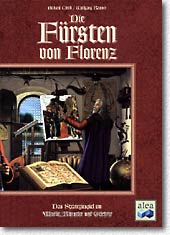
Some thoughts about strategy
It was interesting to play this game again, after Peter and me had thoroughly
“overplayed” it while training for the German boardgame championships two years
ago. Peter’s big shock came when his supposedly foolproof tactic of playing with the
“Gaukler” strategy was successfully countered with an astonishingly flexible
and unforeseeable strategy by the winning the player in the championship.“Fuersten” has been a bit out of the spotlight after a similar but perhaps
slightly superior game, “Puerto Rico”, has appeared on the scene. In both games
the fascination lies in the joy of developing a purposely “unbeatable” superior
strategy, only to discover that there is no valid basic strategy, as any successful
strategy has to be adaptable to the circumstances. In both games you have only relatively
few actions available in the game, and the player who most successfully uses these few
actions to his own benefit will be the winner, not the player who stays with his strategy
no matter what happens.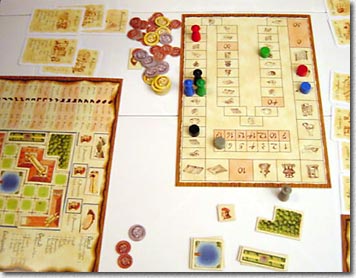
In “Fuersten” the “Gaukler” tactic is, theoretically, foolproof.
You buy a lot of entertainers at the beginning of the game, as well as
“Abwerbekarten” and additional “Personenkarten”, to shock every other
player with a barrage of successfully accomplished works in the last 3 rounds (usually
going for around 8 works in the whole game). But if the other players know this tactic,
they will make you pay dearly for your entertainers, and beyond a certain sum (1.200 Fl.
in our opinion), they simply don’t become viable anymore, as you’ll end up having
serious money problems (in our game, by the way, this tactic DID work, and gave Peter the
victory).We also speculated about a “Baumeister” strategy, which successfully carries
through what many players try to do unsuccessfully in their first game, buying three
“Baumeisters” and plastering your court with 7 or more buildings for additional
victory points, also buying as many bonus cards and prestige cards as possible to achieve
2-3 monster works for additional benefits. These two strategies have a good chance of
winning when playing with players who have a disorganized approach to the game. The
“Baumeister” strategy could even coexist with the “Gaukler” strategy
– both players would follow completely different goals and not even once conflict in the
bidding phase.view/add comments 
But they stand no chance against the “organized disorganized” approach,
which simply means doing what costs you least and benefits you the most (which is
admittedly not always easy to fathom). Everything you do depends on the other
player’s actions – and, in the end, this is the true social aspect of gaming which we
all love, otherwise we would be content with average and automated computer AI’s
(which, in the end, we aren’t). - Titan – The Arena
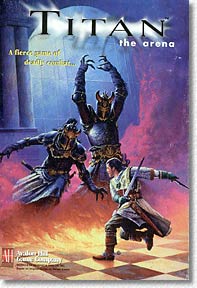
Bring through your bets! – How to win “Titan the Arena”
Although “Titan – the Arena” – this wonderful American variation on a design
by Reiner Knizia – is by no means a pure strategy game (the luck of the draw DOES play a
huge role), there are some obvious strategies and tactics that will help your bets to
survive.- THE LEFT PLAYER IS YOUR FRIEND
It is usually best to bet on the same monsters as the player on your left. Being the next
player in line gives him the first opportunity to foil your well-made plans and destroy
your favourite monster first. The more common interests you have the more chances your
monsters have of surviving. - THE RIGHT PLAYER IS YOUR ENEMY
Why? See above. If you let the player to your right constantly benefit of mutual bets,
s/he will mostly have the better of it. Therefore avoid mutual bets with your right
player. There is another benefit as well: if you play “destructive” cards (see
below) against the player to your right, there will be 1 (in a 3-player game), 2 (in a
4-player game) or 3 (in a 5-player game) possible “allies” to possibly end the
round before s/he gets a chance to act. The more other players there are the higher the
chance they will accept your offer of an ending of a round that benefits them. - PLAY DESTRUCTIVE CARDS BEFORE CONSTRUCTIVE CARDS
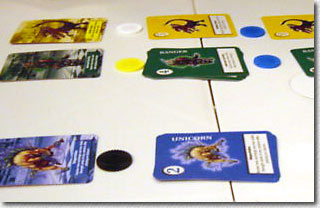 Constructive cards are high cards played
on your own monsters. This is the only benefit these cards have. They will usually
be an invitation for other players to downsize them with another card played on
them. This will mean that you will have to act again by playing ANOTHER high card on
your favourite monster. You will end up being dependent on the survival of your own
monster, never having the chance of influencing the game in another way (the
“offering” of a round end to other players is essential).If you play a negative “low” destructive card on other player’s monsters,
you achieve two things with one play only: you weaken their monster, forcing them to play
more cards to strengthen their monster, and strengthening your own monsters, which are
hopefully stronger than the new weaker monsters. You ACT, they REACT. Try to be the
ACTING player as often a possible, and you’ll keep in control of what’s
happening, and when combat rounds will end.This rule will have to be adapted towards the end of the game, when combat rounds are
short. It is then usually better to support your monster with a strong card, as each
player tries to end the combat round as quickly as possible. - WAIT BEFORE PLAYING YOUR SECRET BET
Usually most players try to play their secret bet as quickly as possible, but it is much
better to wait until you see an open bet by ANOTHER player on the monster you secretly
support, even better if it’s the player to your left! The chances of your secret bet
surviving will rise considerably. NEVER play a secret bet on a monster you also openly
support from the start. - TRY TO “CROSS BET” (not to be confused with “cross dressing”)
Don’t bet on the same old monsters you already support in the second (and further)
betting round. This will be an invitation for murder to the other players. It is clear
that the more players have an interest in a monster surviving the more it’s chances
of survival will be. Bet on a monster that another player strongly supports, and
don’t forget to look for the monsters the player to your LEFT supports. - DON’T “SPREAD BET”
Punters know that “spread betting” is the first step to bankruptcy. You want
to win, and you want to have the highest score possible. Concentrate on 3 monsters
maximum (including your secret bet), as only 3 monsters will survive, period. And these 3
shall be YOUR monsters. Weigh your bets so that they are evenly divided among these 3
monsters. Bets on a 4th monster are only very rarely feasible, only in desperate
situations were you want to avoid a total defeat should you go this road (or when of the
monsters you originally bet on died). - DON’T UNDERESTIMATE THE “REFEREE” CARDS
Most players are annoyed by owning referee cards instead of “real” cards
(especially the “Master referee”). But there are situations where no
“real” card you play benefits you because you have a bad hand. Save your
“master referee” card for exactly this situation and you will avoid playing
cards that benefit others. - THE NOBLE “ART OF OFFERING”
Always play cards (if possible) that give the players playing directly after you the
opportunity to fulfil their wish of ending the round with their monsters surviving. Of
course the trick is to offer them something that will also let YOUR monsters survive.
Knowledge of secret bets is essential for this – players might have played high cards on
a monster they don’t openly support, usually a sure sign of secret support. There
might even be “offer” situations where the player to your left will lose a
monster that he will accept losing – to make other, more important bets to him/her
survive (of course you want all YOUR bets to survive, hehe).
view/add comments Of course all this is theory, as you simply might not have the cards that will enable
you to do all of the above in the right situations. But following these guidelines as
closely as possible will ensure you a good place at the end of the game, even if it’s
not number one.Have fun!
- THE LEFT PLAYER IS YOUR FRIEND
- Bluff
Unusual game, no player ever lost more than one die (so we were always pretty close to
the truth). In the end Peter won with two dice against Moritz 1 die.