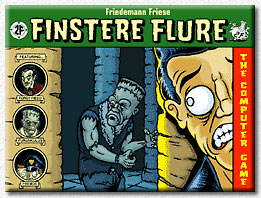
Finstere
Flure
Carefully the monster makes a step forward and looks down the corridors to its
left and right. Again: nothing! Another step forward along the endless looking dungeon and… yes!
To its right it discovers a human being and turns immediately towards it. Only a few more steps to
grab the more than welcome snack. But isn’t this the same guy the monster saw just a few
minutes ago? And what happened last time? The monster makes one more step forward and a sudden hiss
indicates that it stepped into the teleporter – again. Once the fog of hyperspace has cleared the
monster takes a new look: empty corridors! Damn – another hungry night. And faint cheering of
humans somewhere very far away…
What sounds like a sci-fi monster movie is actually the setting of Friedemann Frieses latest
game “Finstere Flure” (“Sinister Corridors”). A group of people controlled by
the players (3 per player in a five player game) tries to diagonally cross a dungeon to return back
to safety. However, danger lurks because of the monster roaming the dungeon. Depending on the setup
(beginners or advanced level) the dungeon holds a various amount of obstacles: slippery puddles of
blood, teleporters, movable rocks and monster redirectors.
Player figures move up to a fixed number of spaces printed on the piece and are flipped over
once they have been moved in a round. The backside of a player piece always shows a different
number of movement points, with front and back side adding up to seven. This results in identical
average speeds of all pieces but provide some tactical options when moving pieces.
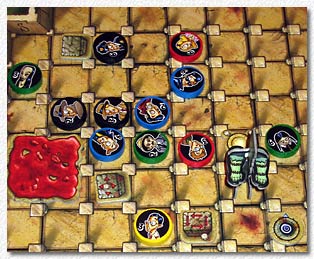
Each round players move one of their pieces by the indicated number of spaces, beginning with
the start player. Once all players have moved a piece the round continues with the start player
moving another of his pieces. This continues until all player pieces have been moved. Movement is
only allowed in horizontal and vertical direction. Blood puddles are slippery and irrespective of
their length count as one movement step only. Obstacles like rocks can be shifted provided the
space behind them is empty while teleporters may only be entered by the monster.
The monster’s movement follows a simple fixed algorithm: it makes a step forward, takes a
look to its left and right and continues into the direction of the closest player piece it sees. If
it doesn’t see one or there is a tie regarding the distance to two or more pieces it continues
to move forward. Once it enters the space of a player piece it “eats” the piece which is
returned to the player in the first half of the game (in the second half it is out of the game).
The number of spaces the monster must move is randomly determined by turning over a gravestone card
which either shows the number of movement points or a single or double cross indicating the number
of player pieces it should kill this turn spending not more than 20 movement points.
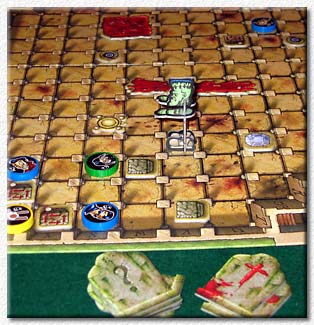
The movement of the monster is therefore predetermined by the obstacles in the dungeon and the
location of the player pieces therein. And this means, that players have full control about the
monster’s movement and in principle can move in such a way that they safely reach the exit of
the dungeon. The fun and tactics come into play when players try to steer the monster so that
opponents’ pieces are killed by the monster while at the same time lure the monster out of
their own path to freedom. As one can imagine this is something all players want (and need) to do
in order prevent another player winning the game by moving 2 (or 3 in a four player game) of his
pieces through he exit.
While at the start of the game players usually co-operate because the playing pieces are located
just too close together making it dangerous for everyone to lure the monster towards the group,
players will take their earliest opportunity so separate from larger agglomerations of player
pieces and at the same time steer the monster towards such groups. So even though the monster’s
movement algorithm is predetermined it is by no means clear which path the monster will take until
the last player has moved his pieces in a round. This provides sufficient chaos on the one hand
while making coalitions and king making possible on the other.
I had the opportunity to observe a 4 player game of “Finstere Flure” in Essen 2003. It was without the teleporters, the crystals and the
monster diverters (i.e. the beginners version) and compared to the advanced version we played I
have the feeling that the extra obstacles just add more chaos to the game as it becomes more
difficult to correctly plot the monsters moves in advance – resulting inevitably in oversights.
Another aspect is that in our game we managed (by chance) to use a good combination of teleporter
locations and the placing of one player piece to create a very predictable circular trip of the
monster without causing any danger to our pieces. This enabled us to cross about one third of the
board without any disturbance by the monster resulting in remarks by some players that there was
not enough challenge by the monster. That changed immediately, when the round trip path was broken
up and the monster had eaten the first pieces.
 My initial fears that the game would drag on endlessly with some of the Westpark
Gamers (recently, a game of Atta Ants took more than one hour
because of all the thorough thinking that was done) we were able to finish “Finstere
Flure” in just under an hour. Once Günther had moved his first piece through the exit into
safety he became “enemy no. 1” but it turned out to be far too difficult to precisely
steer the monster towards his remaining pieces. Whether this was due to his clever placing, the
unwillingness of others to create a suicide assassin or our lack of experience with the game is
somewhat unclear to me.
All in all “Finstere Flure” left us with some mixed feeling. No doubt the game
mechanics work very well, the game material is excellent (the “build your own monster”
material is a rather nice idea). My personal opinion is that the game seems to be a bit too chaotic
with five players and probably will appeal to me a lot more if played with four players or less. I
can hardly imagine how that game can be played with the maximum of seven players without becoming
an uncontrollable party game – not necessarily bad for a game but important to keep in mind.
Westpark Gamers ranking: 5.8 (out of 10)