Camelot Legends
by Moritz Eggert
The legend of King Arthur has been the theme of many games. From the now legendary
“role-playing-board-game” “Knights of Camelot” (TSR, Rahman brothers)
to the more recent card game “Quests Of The Round Table” (Gamesmiths) there
have been many attempts at creating a worthy gaming representation of the long-gone world
of chivalry, damsels in distress and dazzling tourneys. Even Knizia has done his version
of “King Arthur”, but it is one of his less successful attempts at an
electronic boardgame hybrid.
The King Arthur themed boardgames fall into two categories: Either ultra-complicated
fantasy simulations like the Rahman game, or rather flimsy affairs with dodgy rules like
“Quests Of The Round Table” (a game which we tried to “save” several
times). Until now there has never been a really satisfying game that does the theme
justice without either frying or underestimating your brains. With “Camelot
Legends” this gap might have been filled.
“Camelot Legends” is a card game, with very simply basic rules. There are
three places, represented by larger cards, which form the “adventure areas”:
Camelot, Cornwall and the Forest. Players collect knights, ladies and wizards (the
playing cards) and send them to the various places to fulfil quests/adventures which are
drawn regularly and placed on the adventure areas. These drawn quests can also sometimes
form new “areas” which can also be visited (it is for example possible to send
knights to Avalon where they can’t do anything but give extra victory points at the
end of the game).
Each player only has two actions each round. An action can be
- drawing a character card
- moving 1-2 cards from one location to another
- play a character card on a location.
After a certain number of quests have been drawn a “final” quest appears
which ends the game when it is solved. Each quest gives the solving player victory
points, as do certain titles or items like “High King”, “Excalibur”
or “Love Potion”, which can be acquired by various means (and lost as
well).
Each Knight (or Lady or King or magician) is rated in 6 “skills”, from 0 to
7. These skills are represented by icons which are a bit difficult to get used to, but
there is a player aid card which helps. To fulfil a quest you need to acquire a certain
number of “skill points” in one or more skills at the location where the quest
is to be solved. The random quests appear in equal fashion at each adventuring place, and
each adventuring place has predominant skills that are needed (although you never can be
sure). At the beginning of each player’s turn it is checked if s/he can fulfil any
quests, but only after the various special character card powers have been used.
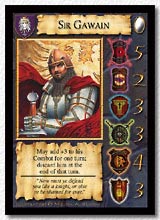 These special powers are the meat of the game.
There are a LOT of character cards, and the game designer has managed to give each of
these cards a unique set of skills and (always) a special ability that only pertains to
this very character, and which is also congruent with the “real” character in
the legends. So “Merlin” has magic powers that protect his party from attacks
of other cards, or “Tristan” is less powerful when “Isolde” is in
another adventuring group, but more powerful when he is together with her. One can tell
that a lot of work went into designing these special abilities, and the beautiful
character portraits together with the love for detail apparent throughout the game make
for a really nice representation of the myth, even though the game is basically quite
abstract. The characters even belong to different heraldic “factions” which
work better if played in a team. Many abilities influence other players’ characters –
it is possible to discard opponent characters or to charm them to bring them on your
side. In fact there are so many quite different and complex abilities that the game can
create analysis paralysis (at least if you make the mistake that we made: arrogantly
starting with the most advanced game which uses all cards and abilities).
Of course the luck of the draw is an important factor. If you continuously draw weak
knights you will certainly be at a disadvantage, as of course characters like
“Lancelot” or “King Arthur” are very powerful cards. It would have
been nice to have some kind of victory point/auctioning mechanism to balance this, but if
you’re not expecting a deeply tactical game this probably won’t create a problem.
Normally it is quite obvious which special abilities are best to use, but especially
later in the game there are a LOT of characters around, and keeping track of all their
abilities can be quite difficult. It is therefore good that the designer limited the
number of players to 4. The game is playable with 2 players, but works best with 3 or
4.
The rulebook is unusually well laid-out, and comes with a glossary of characters,
which certainly is a bonus for people interested in Arthurian legends. It also serves its
purpose to GET people interested.
As I already mentioned I would strongly recommend to start with the basic game for
inexperienced gamers and with the intermediate game (maximum) for experienced gamers. You
will understand what I mean when you first play!
“Camelot Legends” can be fully recommended for fans of Arthurian myth. It is
really one of the most beautiful and playable games around that abduct you into Arthurian
times. People looking for a good card game will not be disappointed, but they should like
games with special abilities. Collectors will love it for the great artwork (of high
quality even on the most unimportant cards). Fanatic “Eurogame” enthusiasts
might have to get used to the game mechanisms.
Explaining the game should not take more than 10 minutes, the actual playing time
should be between 45 and 90 minutes maximum. We liked it!