Ins
Innere Afrikas
by Peter Riedlberger
“Ins Innere Afrikas” (“Heart Of Africa”) is an eclectic piece of
game design meaning that it combines rather different gaming mechanisms. There are
purists who dislike eclectic designs per se. I definitely don’t belong to them as my
fondness for “Maya” shows.
A turn of “Ins Innere Afrikas” starts by auctioning off the right to use the
turn. The money paid by the high bidder is evenly distributed to the other players. Yes,
it’s the “Traumfabrik/Fabrik der Träume” mechanism. But there is one
difference: You can also bid with victory points if those little wooden cubes which are
used as money aren’t sufficient.
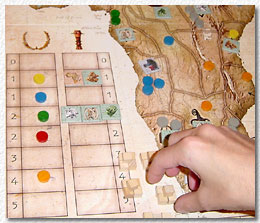
Then the high bidder moves his army, oops…, trader counters on a map of Africa. He
engages in combat, oops…, palavers with natives and other players. The whole trading
background seems to be made up in order to calm German pacifist feelings. In fact, this
part of the game feels like any typical wargame. Just one point to support the case: if a
player loses a “palaver” his counters must leave the area. If no escape path is
available all counters disappear (in wargames, you’d call this: annihilated).
So, how’s the “palaver” fought? Against natives (or neutrals, as the
rules call them) you draw a chit by random. This chit decrees what you have to swallow if
you want to win the palaver. If you outnumber the natives you can draw several times in
the hope to get an easier chit.
Against other players, you use a modified “Kuhhandel” system: secret
bidding; both players open their hands at the same time. If both take their stand, the
highest bidder wins and everything that was used to bid is distributed to the other
players (well, to be exact: to everyone except the active player). If one player chooses
to flee, he gets all the counters of the other player’s bet.
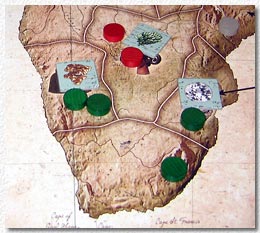 After having resolved all
“palavers” the active player (and only he) counts victory points. This is one
of several “Vinci” aspects: first, during the initial auction, you not only get
the right to take your turn but also two “activity chits” which allow for
one-time special abilities. The second is that you can (also) bid with victory points.
The third is this victory point counting at the end of turn, and the fourth is the
corollary of all this and constitutes the main problem of “Vinci”. This mars
“Vinci” as it does “Ins Innere Africas”: The complete calculability
of the end game.
I owe to Moritz the wonderful expression “analysis paralysis”: You can
calculate exactly how many victory points you are able to obtain. So every player will
bet exactly as much as he can in order to get 42 victory points (the victory condition).
That means LOTS of calculations for everyone, LOTS of downtime. This also means that the
final winning order hasn’t much to do with the course of the game.
“Ins Innere Afrikas” isn’t a bad game. But it isn’t very good
either. Actually, I wouldn’t know for whom I should recommend it. It’s much too
complicated for a family environment. Think only about those many different mechanisms.
Playing it with hardcore games will result in “analysis paralysis” like in our
case: the box said 90 minutes, we played more than 3 hours.
A note on the gaming material: On the one hand it is well done (beautiful artwork,
material in “Kosmos quality”). However, the symbols are annoyingly confusing.
Some cases in point: One rainbow coloured counter means: One VP for every two
traders. However, two rainbow coloured counters mean: Active player gets
two traders for free. One grey counter means: Move all neutrals from one
area to an adjacent area. Two grey counters with an arrow mean: Move all
your own traders from one area to an adjacent area. That’s not what I call
intuitive.
Worse still, they even mixed up one symbol. Several “palaver” chits (those
you draw if you wage “palaver” against natives) make you lose
“reputation”. However, they don’t show the “reputation” symbol
but the “goods” symbol.
Westpark Gamers ranking: 5.8 (out of 10 points)
Players were: Loredana, Andrea, Hans, Moritz, Peter