Transcript of our podcast from 11 May 2008 subscribe with iTunes subscribe with iTunes play now play now |
|
||||||||||||
|
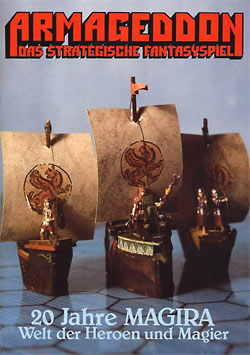
Armageddon
by Moritz Eggert
I once did a feature on the Dice Tower about why there are practically
no wargames produced in Germany. I don’t want to repeat these statements, suffice it to say
that there are practically no historical wargames coming from Germany, Udo Grebe Gamedesign, a
company which collaborates with GMT, being the exception that reinstates the rule.
The best widely known wargame in Germany is probably “Risk”, if you want to even call
it a wargame, and the German version has the players “liberate” the countries instead of
conquering them. “Axis and Allies” is known a little, but people would look at you
strangely if you proposed it during a normal games evening, even though it is more regarded as some
kind of family game in the US. Board War Games are a hobby for experts only, and most games have to
be imported. Still there are many enthusiasts for war games here in Germany, but they will
invariably be fluent English speakers and import their games. Interestingly enough this situation
only exists in board war games, there are actually quite a lot of computer wargames produced in
Germany, and World War II titles have become as popular as they are elsewhere, so in a way many of
the qualms about depicting World War II warfare have eroded over the time, but only in computer
games.
The situation is very different when one looks at roleplaying games, which somehow are connected
to wargames as I tried to show in my eulogy to Gary
Gygax. Germany was the first country outside the US to develop its own brand of Roleplaying
Game, called “Das Schwarze Auge”, which is known as “Realms of Arkania” in the
US because the literal translation “The Black Eye” just doesn’t sound as good in
English.
Miniature fantasy or SF wargaming have also always been popular here, and Warhammer and its
related brands are as fiendishly popular here as everywhere else.
But few people know that Germany was actually a forerunner in the genre of the Epic Fantasy
Board Wargame. Even before games like “Titan” and “Dragon Pass” were created
German Fantasy Fans played what was called “The Eternal Game”, or more commonly
“Armageddon – The Strategic
Fantasy Battle Game“.
This game has a peculiar story that I would like to tell here. In the 60’s SF pulp novels
became popular in Germany, and the most popular SF serial “Perry Rhodan” was created, the
longest running SF series in the world with now nearly 3000 issues. Eat that, Buck Rogers! In the
wave of this success the main pulp publishers also began to publish Fantasy novels of the Heroic
Fantasy style, based on muscle packed heroes fighting along scantily clad damsels in distress. Of
course this was also the time where “Lord of the Rings” became more and more popular and
soon the German fantasy fans looked for more complete worlds that had believable and consistent
cultures like Tolkien invented famously.
In the late 60’s some Austrian and German fantasy fans tried to emulate the American Society
of Creative Anachronism and wanted to create a consistent fantasy world that they would mutually
evolve and develop together. Some of the founding fathers of this society were also fantasy
authors, and they went about their work very seriously and thoroughly, like we German speakers
often do. So “Follow” was
created, the “Fellowship of the Lords of the Lands of Wonder” as it was called.
The founders of this society became the imaginary lords of various fantasy empires that
populated a world of their own creation, Magira. Clans were founded and slowly the numbers of members were rising and
the world had to be expanded to make room for new cultures. Today FOLLOW has around 400 members,
but it used to have more. The Internet and new lifestyles like LARP have eroded their numbers. The members
of this society meet regularly at cons called “Fantasy Fests”. During these cons they
decide about the political future of their world, Magira, dressed up in costumes indigenous to
their culture and very much trying to pretend living in a fantasy world. Although similar to LARP
(Live Action Roleplaying) on first glance this is quite different in reality, as the emphasis is
less on elaborate costumes but more on a consistent approach to simulate an ongoing complex fantasy
society.
In the months between cons each clan would develop their on history further by writing short
stories, historical articles, inventing languages and similar activities. The 60’s were the
time when the first hex and counter wargames were created, and this in turn influenced the founding
fathers of FOLLOW who had travelled to the US and knew of these games. This idea took form in a
home brewed rule set for a hex and miniatures wargame called “Armageddon”. With this rule
set it was now possible to simulate a huge fantasy world on several continents on a large political
scale. Once a year the lords of the various factions would meet at the Fantasy Fest and play what
they would call “The Eternal Game” for several days without unnecessary interruptions
like sleep to completely immerse themselves in their own fantasy world. What happens during these
gaming days is then carefully recorded so that one could continue at the same map situation next
year. In addition in game events were treated as “history”. This meant for example that
if a capital of a culture was captured they became a nomadic folk, forced to wander the plains
until they found a new home. This would of course affect their cultural history. Other cultures
begun to incorporate elements of conquered cultures, much like the Romans did in real history.
Technically the game can’t end, as one can always come back. This is why it is called the
“Eternal Game”. If you get eliminated you just have to wait for a while until your exiled
culture could start again somewhere. Empires rose and fell much like in “Rise and
Fall”.
Game play is extremely formalized. I already talked about players playing in costume as the
lords of their countries. They would have squires and generals who roll their dice or make battle
plans for them. Sometimes up to 20 players would stand around the board, completely involved.
Combat round where often played simultaneously for different situations because of this.
The game map itself is humunguous and has to be placed on 4 huge tables. “Campaign for North Africa” is
nothing against it. At some point a three dimensional version was lovingly created, with different
terrain elevations clearly visible and realistic models of towers, siege engines and capitals., As
the game was created at a time before lead miniatures were widely available, Airfix brand plastic
soldiers were used and also modified to look more like fantasy warriors. I have seen the original
board several times in person, and I have to say that it was pretty impressive.
I would love to say that the game itself is as impressive, but as the rules set is rather old it
doesn’t really hold up to contemporary wargames. Basically there are some paper-scissors-stones
mechanics at work, which make certain units stronger against specific other units and weaker
against others. Even though hexes cover 100 miles, it is possible for archers to shoot at distant
hexes, a rule which I always found very strange. The siege rules are very elaborate, and it is
possible to play out long sieges with siege towers and catapults. There are also some basic magic
rules that incorporate sorcerers and creatures. The feel of the game is very chess like – players
hover for openings in the opponent’s lines and go for the kill. Diplomacy is of course
important and necessary to be able to survive – you can’t beat ’em all like in Risk.
The game most similar to Armageddon is probably “Lankhmar” by TSR, which was also
created by its own author, Fritz Leiber, together with a friend, but Lankhmar has a much smaller
scale.
As you can tell by my report I was a member of FOLLOW once, because only then one had access to
the Fantasy Fest, which is not an open convention. In earlier times the rule set was used to play
out various play by mail campaigns or even stage your own alternative world battles at home – I had
a fully self-created Magira Map myself once, I wonder what happened to it. But I think nowadays
with the upvent of more exiting games game play happens solely at the Fantasy Fest.
You will probably never play Armageddon, but if you’re interested you can catch some impressive
pics of it if you look at “Armageddon – Das Strategische Fantasyspiel” on the Geek. The date for the
game’s creation is 1990 there, but that refers to the third printing of the game. As I already
said the game is much, much older, and is considered a hall-of-famer in the history of German
gaming. The game was always self-published and never produced by a professional game company, but
parts of the world were translated into Midgard, which is one of the oldest and most successful
German role playing games.
I hope you enjoyed this piece of unusual wargame history, and may all your hits be crits.