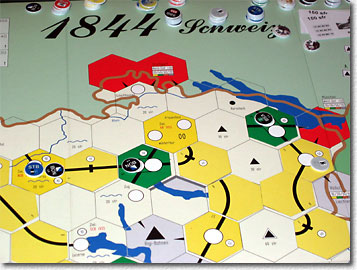
Preview of Helmut Ohley’s 1844
In time for Essen 2003 the 18xx family of railroad games, based on Francis
Tresham’s 1829, has received a new member: “1844 -Schweiz” for 3 to 7
players. Those not familiar with the 18xx games should have a look at our 18xx section if they want to learn more about the series.
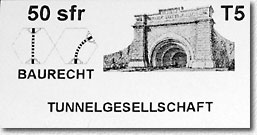
In 1844 the first railroad appeared in Switzerland and it ran from Strassbourg, France
to Basel. Helmut Ohley, the author of 1844 made the effort to implement the scenario
around the development of railroad companies during that time. Compared to other 18xx
games the author designed a number of new ideas derived from the real setting in
Switzerland. Due to the landscape Swiss railroad companies were forced to deal with many
mountains and to cross the Alps and hence one of the new elements is that players are
able build tunnels in the course of the game, which are operated by companies that
generate dividends by themselves.
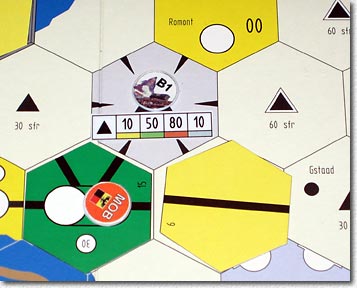
Another new concept is that of mountain railways, railroad companies that can be built
on specially designated mountains and which, in terms of dividends, count like major
cities for the other railroad companies. Mountain railways, too, generate their own
income.

A concept taken over from 1826 is the H trains, which travel a number of hexes rather
than a defined amount of cities/villages. Players can decide on which type of engine to
buy for their corporations with H-type engines being slightly less expensive than the
normal trains. Most engines now rust in two steps: normal engines become H-type and lower
H-type engines disappear altogether. The largest engine available is the 8E, an electric
engine which may skip the small villages on its route.
There are 7 private companies and 15 railroad corporations, 5 mountain railways and 5
tunnel companies. This makes it possible that even in a seven player game each player
should be able to become director of at least one of the corporations. Like in 1835 four
of the corporations will however unite to form the SBB major once the first 5 train has
been bought. In addition, four regional corporations exist, which can only run H trains
within Switzerland.
Overall, the larger amount of railroad corporations provides much more room for
strategies and tactics but also make the game mechanics less transparent for new players.
In particular, the fusion of the earlier corporations to become the SBB is something
which I feel to be very demanding in terms of devising a proper strategy. Like in 1835 I
always felt a bit out of control of the fate of an early corporation and the resulting
success of the SBB. Anyway, the reduction of corporations in mid-game provides a tough
decision base for all players.
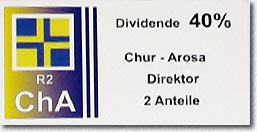
Another important fact is the distribution of shares across the corporation’s
certificates. Like in 1830, the major corporations have a 20% director’s share and 8
10% shares. The small regional corporations have a 50% director’s share and two 25%
shares and the early corporations have a 40% director’s share plus three 20% shares.
Buying the director share of a regional is rather attractive as the corporation floats
immediately and even an early corporation floats after only 2 certificates have been
bought. The SBB comes with 5% certificates which make the corporation a favourite for
stock manipulations in the end phase of the game.
The mechanism for handling the priority deal is a big improvement over 1830 since it
eliminates many manipulation possibilities. Priority deal now goes to the player with the
most money in hand, usually the least invested player.
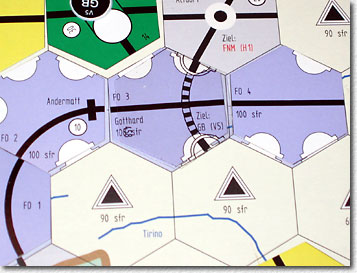
In order to achieve a track system that resembles history in its basic principles,
each corporation has been asigned a target city. Once a route exists between the home
town and the target city, the remaining 50% of the corporation’s cash are paid to its
treasury. While this is a nice mechanism to take care of history it yields track systems
which are much more independent from each other than with for example in 1830. No fights
for the best routes around Boston and New York here but rather a well organised,
structured way of track building. In our game there was also no real fight with station
markers as hardly any corporation had enough money to lay them in the mid and end phase
of the game.
This shortage of corporation treasury is on the one hand caused by many mountains and
rivers which need to be crossed and on the other hand by the constant need to buy trains.
As opposed to other 18xx games one train is removed from the bank (“sold to a
foreign country”) after each set of operation rounds. This speeds up the game and
makes it impossible for players to run a single engine for very long.
Especially the 5 and 6 trains rust too quickly and become (permanent) H trains with a
rather limited range. This makes building large diesel type routes unnecessary and, due
to the mountains, even unattractive. This may be historically correct but does not appeal
to any empire building style of playing.
On the other hand, the game is much less cut throat as e.g. 1830. Villages have green
tiles thus making the blocking of routes virtually impossible. And share prices drop by
one field when shares are sold, independently of the number of shares sold, making stock
scams much more unlikely.
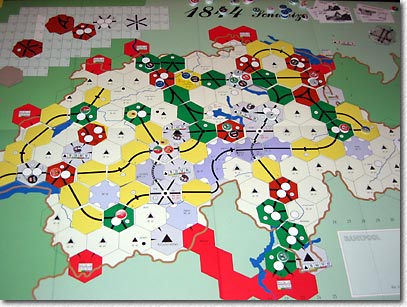
All in all, 1844 is a more than worthy member of the 18xx family. Helmut Ohley was
able to blend the characteristics of the Swiss railroad system into the 18xx concepts
very well and he managed to create a game with truly new and challenging mechanics.
Switzerland as a setting provides enough possibilities for this. Game play is very
balanced somewhere between empire building and cut throat stock market play. It appears
that there are a lot less “extreme” situations where a game can tilt in favour
or against a player, and ganging up on the leader seems to be more difficult, too.
A few words about the game material: looking at the professional quality of all
components it is hard to believe that 1844 is produced as a private effort. Compared to
Avalon Hill’s 1830 the components are of far better quality and even when looking at
the platinum edition of 1851 I still find that 1844 provides more value for money. And
last but not least: it comes with a full featured rule book, not just a “difference
list”, which makes it a true standalone game suitable just as like for novices and
experts of 18xx game series. Recommended!