24/7 – The Game

reviewed by Moritz Eggert

Jack Bauer grinned as he gripped the man who called himself Carey Grayson in his deadly armlock.
"So you hid the code in a game about me, have you? What is this evil plan of yours, and why do
you want to release the deadly Elvis virus in a wedding chapel in Reno and kill millions of
innocent Elvis impersonators?".

"No, all is a misunderstanding" screamed Grayson, "it's just a game, just a
game, you see…".

Jack Bauer pulled the steely-cold gun from his holster and pressed it to the cheek of the
trembling man.

"I know you're an evil terrorist in fact. Calling anything "24" the game is a
clear violation of copyright laws. This is why I might torture you to get information about your
world domination plans. In fact I might start with it this very moment."

"No, the name is 24-7, you know like 24 hours in a day, 7 days a week. It's just a
title! You see, my wife, she's not a geek gamer, but she enjoys gaming. I just wanted to create
a game that I can play with her, and that can be enjoyed by gamers and non-gamers alike, that is
simple to explain, and doesn't take hours to…"

"Stop! Why don't you shut-up and show me what the heck you're talking
about!".

"It's in the bag" said Carey.

Bauer pulled out the hefty box with a clock tower. Hell, it didn't even have a picture of
him on the cover. That was clearly a case of bad merchandising.

He noted that the box had a nice weight to it. There was a clinking noise inside. When he opened
it, carefully of course, because he feared a deadly trap might explode into his face, Bauer
quizzically looked at the contents.

"What, no cheap cardboard counters? No armies with SS-Runes, no map of the world? What is
this, an un-American game? What are these white domino like tiles for?"

"These are the white number tiles that are the basis of the game. You see we took great
care to produce them so that they would look and feel especially nice. We even included little
wooden holding boards like in Scrabble that you can place them in, one for each of the up to 4
players!".

"And why are they numbered from 1-10? And why does the board have a 7×7 grid? Is this some
secret code or something?"

"There are 40 tiles in total, one for each number. At the beginning of the game one tile is
randomly selected and placed in the middle, also 3 more tiles are removed, so that one never really
is sure if a certain tile will appear."

"You talk like a commie traitor, why would anybody want to hide that information?"

"You see, it makes the game more exciting. It is a simple but effective rule that works
great. We added it very late in the design process."

"What does one do with the number tiles?"

"Each player places one when it's his or her turn. You either place them orthogonally
or diagonally to already placed tiles. And you try to score by creating certain combos."

"Huh, I knew it – a combo to take over the world!"

"Not exactly – it's all in good fun. Gamers are peaceful people, you know? The most
coveted combo is to get a diagonal or orthogonal row of numbers that adds up to exactly
24."

"I knew it! Your secret plan!"

"…but there are also other combinations." continued Grayson, unperturbed.

"7 for example. Or a run of three, or 4, or 5. Or a set of 3 or 4. It's a little like
in Poker or that other great game by Sunriver Games, "Havoc – The Hundred Year's
War". A wonderful game, you should try that out some time…"

"Silent! What is this pad for? To jot down the locations of our nuclear power
plants?"

"No, it is to keep track of each player's score. The different combos that I mentioned
give points, we call them minutes, from 20 to 60, like 60 minutes per hour."

"Bah, Humbug! Everybody knows that an hour has only 42 minutes in which something happens,
the rest is commercials and toilet breaks, although never for me strangely enough….What are these
hourglass symbols for?"

"They double the score, a little like in Scrabble. When you place a scoring tile there you
simply get twice the score of what you scored. Even better, when you manage to create a 24 and a 7
scoring in one go you get a 60 point special bonus. That is a true killer move."

"Hah, now I know where you lied – with all these tiles it is easily possible to go beyond
24 as a sum, you were trying to deceive me!"

"This is where the beautiful red gem stones come in. When a 24 scoring took place these
stones are placed at both ends of the scoring row, therefore blocking the spaces for future tile
play. This can even be done tactically to hinder other players scoring in advance!"

Bauer fell silent. He knew this guy took him for an idiot. He removed the safety of his gun with
a loud click. "Okay, and now to your plan of world domination. Talk. Just talk. I count to 10.
1….2…..3……4….."

Grayson suddenly smiled unexpectedly.

Summary
Rules: bilingual (German and English), can be explained in 2 minutes
Game material: impeccably good
Game length: 20 minutes, and you want to play again immediately

"Not World Domination. We just wanted to create a great game for everybody. Light, but not
dumb. Short, but involving. Mathematical, but so that even a small kid will get it and nobody feels
excluded. A good closer game for a gaming evening. And I think we managed to do just that. We have
achieved our goal. To make something that it is worthwhile spending one's time with.

Speaking of which… I don't think you achieved that goal, my friend. Begone!"

And with this Grayson snipped his fingers and Jack Bauer disappeared in thin air, like a bad
dream.

And then I woke up.

"24-7 The Game" is a great light game of number tile scoring, a bit reminiscent of but
much better than Zatre (which plays much slower). Sunriver Games has again managed to produce a
winner!

Very recommended – for all kinds of gaming groups.

(Bad) Luck in Yspahan

(Bad) Luck in Yspahan

by Günther Rosenbaum

Yspahan, a game by Sebastian Pauchon, was released by Ystari in October 2006.

We already published a review ) of this game. This article is
about the interesting and definitely original dicing mechanism and the probabilities of different
dice roll results.

The Dice Placing Rules

It is obvious that dice on the “vase” line will not be seen very often!

Normally, you roll 9 dice. However, you are free to add up to 3 more dice by paying for
them.

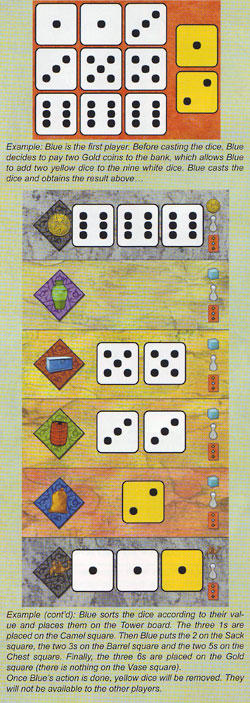
The cast dice are sorted: All 1s constitute one group, all 2s, …, all 6s. These groups are
placed on the board which is shown at the right hand side following these rules:

  • The dice group with the lowest value is placed on the lowest row, i.e. “camel”.
  • The next group is placed on the next row, i.e. “sack”.
  • and so on, until
  • the dice group with the highest value is always placed in the top row, i.e.
    “gold”

On the right hand side, you can see an example result. You’ll notice that below the
“gold” row, there can be gaps.

So, it’s time to ask some interesting questions:

What is the probability that the “vase” row gets one, two or three dice?

and

What is the effect of buying 1 to 3 dice in addition to the 9 default dice?

When optimising your strategy, it won’t hurt if you have some idea about those results, and
this is why I have created the tables which now follow. However, it should be clear that there are
several other factors in Yspahan which determine who wins. Besides, I did not take into account the
rule which allows you to add another die to an existing dice group in exchange for a special
card.

Notes on the tables

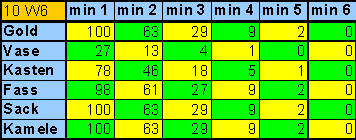
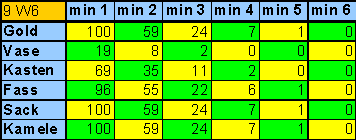
9 W6 min 1 min 2
Gold 100 59

This is the table for rolling 9 six-sided dice (9 W6). All quoted numbers are rounded
percentages of probabilities.

Since the group with the highest number is always placed on “gold”, the
probability for having at least one die there is 100%. (The latter statement is technically not
true. In case all dice show the same number, they are put on the camel row. However, this is so
improbable an event that the rounded probability for “gold” stays 100% in all considered
cases.)

The event of “at least 2 dice (i.e. 2, 3, 4 … or 9 dice) on the the
‚gold’ row” has a probability of 59%.

Attention:

If you notice a value of 100% in those tables, it is (the camels excepted) a rounded value being in
reality a number between 99,5% and 100%. Of course, for real gaming strategies, such details are
irrelevant, and that’s why I kept to rounded values.

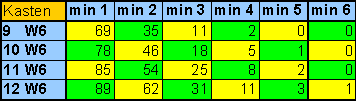
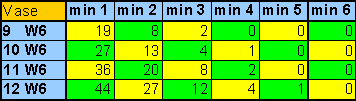
table 1

Probabilities when using 9 dice!
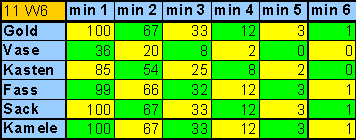
table 2

Probabilities when using 10 dice!
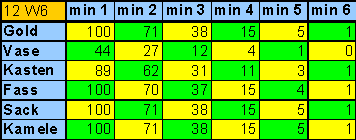
table 3

Probabilities when using 11 dice!
table 4

Probabilities when using 12 dice

At the start of the game, or when employing the “caravan strategy”, you will probably
go for “mass”. You won’t be picky about which spot to chose, as long as there are
really lots of dice on offer!

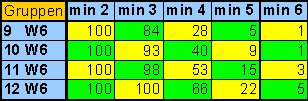
Therefore, I’ve put together another table:

table 5

Probabilities for dicing groups of a certain size!

Conclusions

Everyone is free to draw his own conclusions from the tables above, and to adjust his game play
accordingly. However, there are some remarks I have to make:

If the number of dice is constant, the probabilities of the lines for
gold, camel, sack and barrel are, more or less, the same! As a rule of thumb, expect a group of at
least 1, 2 or 3 dice with a probability of 1, 2/3 and 1/3.

This leaves the lines of chest and vase as, stochastically, somewhat
more interesting.

Here is another table. It shows how the probabilities are changing when you decide to pay for
adding dice to your default of 9 dice.

table 6

Probabilities of groups of dice on the chest line, depending on the number of dice used.
table 7

Probabilities of groups of dice on the chest line, depending on the number of vase used.

You will notice at first glance that paying for additional dice really does change those
probabilities!

And while we’re at it…

The victory point value on the game board is more or less like this:

  • Sack: 1 bis 1,33
  • Barrel: 1,33 bis 1,6
  • Chest: 2
  • Vase: 3 bis 4

2 cubes in the chest line yield 4 victory points – just as 1 cube in the vase line. Now, the
probability for having at least 2 dice in the chest line is invariably higher than having at least
one dice in the vase line. Hence, in the long-term average, cubes in chest line might seem somewhat
more advantageous than cubes in the vase line. However, don’t forget that I didn’t take
into account some rules (see above).

I wish all of you as much fun with this wonderful game as we’ve had when playing it!

Glück und Unglück in Yspahan

Glück und Unglück in Yspahan

von Günther Rosenbaum

Yspahan ist ein Spiel von Sebastian Pauchon, das im Oktober 2006 im Ystari-Verlag erschienen
ist.

Eine Rezension dieses Spieles ist auf unserer Homepage an anderer
Stelle
zu finden – hier möchte ich mich nur mit dem sehr originellen und innovativen
Würfelmechanismus beschäftigen und die Wahrscheinlichkeiten für das Auftreten verschiedener
interessanter Würfelkonstellationen berechnen.

Der Würfelmechanismus

Es ist klar, dass auf der zweitobersten Zeile mit der “Vase” nur selten Würfel
liegen werden!

Standardmäßig würfelt man mit 9 Würfeln – man kann aber gegen Abgabe von Gold bis zu 3 weitere
Würfel kaufen.

Der Würfelwurf wird nun sortiert: Alle 1er zusammen, alle 2er, …, alle 6er. Dann werden diese
Würfelgruppen auf das rechts abgebildete Tableau abgelegt:

  • Die Gruppe mit dem niedrigsten Wert kommt auf die unterste Zeile mit dem “Kamel”
  • Die nächst höhere Gruppe kommt auf die nächste Zeile mit dem “Sack”.
  • usw…
  • Die Würfelgruppe mit dem höchsten Wert wird allerdings ganz nach oben zu dem Gold
    gelegt!

Ein Beispiel von so einem Würfelergebnis sieht man im Bild rechts: Man erkennt hier, dass
unterhalb der Zeile “Gold” Lücken entstehen können.

Wie hoch ist jetzt aber die Wahrscheinlichkeit, dass auf der “Vase” ein, zwei oder
sogar 3 Würfel zu liegen kommen?

und

Wie erhöht sich diese Wahrscheinlichkeit, wenn ich zu den 9 standardmäßig zur Verfügung
stehenden Würfeln 1 bis 3 Würfel hinzukaufe?

Bei der Planung der eigenen Spielstrategie muss man diese Ereignisse in etwa abschätzen können –
daher werde ich die berechneten Wahrscheinlichkeiten hier aufführen. Bei der Planung muss man
natürlich berücksichtigen, welche “Gebäudeeigenschaften” man zusätzlich nutzen kann, und
dass man gegen Abgabe einer “Karte” die Größe einer Würfelgruppe künstlich um 1 erhöhen
kann.

Erläuterung zu den folgenden Tabellen

9 W6 min 1 min 2
Gold 100 59

Dies ist eine Tabelle für den Wurf mit 9 sechsseitigen Würfeln (9 W6); alle Zahlenwerte sind auf
ganzzahlige Prozentwerte gerundete Wahrscheinlichkeiten.

Da die Gruppe mit der höchsten Zahl IMMER auf das “Gold” gelegt wird (außer in dem
unwahrscheinlichen Fall eines Wurfes von lauter gleichen Zahlen), ist hier die Wahrscheilichkeit
100%, dass mindestens 1 Würfel dort liegt.

Mindestens 2 Würfel (also 2,3, 4, …oder 9) auf dem Goldfeld findet man noch mit einer
Wahrscheinlichkeit von 59%.

Achtung:

Wenn in den Tabellen der Wert 100% auftaucht, so ist dies immer ein gerundeter Wert und in
Wirklichkeit irgendetwas zwischen ca. 99,5% und 100%! Aber solche kleinen Unterschiede sind für die
Strategiediskussionen völlig uninteressant – daher werden hier alle Wahrscheinlichkeiten immer auf
ganze Prozent gerundet.

Tabelle 1

Wahrscheinlichkeiten für den Wurf mit 9 sechsseitigen Würfeln!
Tabelle 2

Wahrscheinlichkeiten für den Wurf mit 10 sechsseitigen Würfeln!
Tabelle 3

Wahrscheinlichkeiten für den Wurf mit 11 sechsseitigen Würfeln!
Tabelle 4

Wahrscheinlichkeiten für den Wurf mit 12 sechsseitigen Würfeln!

Am Anfang des Spieles oder wenn man die “Karawanenstrategie” verfolgt, braucht man
womöglich nur “Masse” – egal auf welchem der 6 Felder viele Würfel liegen, Hauptsache es
sind viele!

Daher die folgende Tabelle 5:

Tabelle 5

Wahrscheinlichkeit für den Wurf von großen Gruppen!

Schlussfolgerungen

Aus den obigen Tabellen mag nun jeder seine eigenen Schlussfolgerungen ziehen und seine
Strategien entsprechend anpassen. Auf einige Beobachtungen möchte ich aber trotzdem hinweisen:

Bei fester Würfelanzahl unterscheiden sich die Wahrscheinlichkeiten
in den Zeilen für Gold, Kamele, Sack und Fass nur geringfügig ! Als Daumenwert erreicht man dort in
etwa mit der Wahrscheinlichkeit 1, 2/3, 1/3 eine Gruppe von mindestens 1, 2 oder 3 Würfeln.

Interessant sind daher die “Kasten-” und
“Vasenfelder”.

Hier stelle ich noch mal in einer gesonderten Tabelle gegenüber, wie sich die
Wahrscheinlichkeiten verändern, wenn man zu den 9 Standardwürfeln zusätzliche hinzu kauft:

Tabelle 6

Wahrscheinlichkeit für Würfelgruppen auf dem “Kastenfeld” bei steigender Anzahl von
Würfeln!
Tabelle 7

Wahrscheinlichkeit für Würfelgruppen auf dem “Vasenfeld” bei steigender Anzahl von
Würfeln!

Bei diesen beiden Feldern verändert der Zukauf von Würfeln schon einiges an den
Wahrscheinlichkeiten ! (Daumenwert: knapp 10% pro Würfel bei den “min 1” Werten)

Übrigens

Der Siegpunktwert auf dem Spielplan ist in etwa:

  • Sack: 1 bis 1,33
  • Fass: 1,33 bis 1,6
  • Kasten: 2
  • Vase: 3 bis 4

Mit 2 Steinen im “Kastenfeld” erhält man 4 Siegpunkte – genauso viele, wie mit 1 Stein
im “Vasenfeld”. Die Wahrscheinlichkeit, mindestens 2 Würfel im “Kastenfeld” zu
erreichen ist aber durchweg größer, als mindestens 1 Würfel im “Vasenfeld” zu bekommen.
Also werden wohl langfristig im Mittel Steine im “Kastenfeld” etwas ertragreicher sein
als die Steine im Vasenfeld !

Viel Spaß noch bei diesem wirklich schönen Spiel.

“1860” – Railways on the Isle of Wight

“1860” – Railways on the Isle of Wight

reviewed by Aaron Haag

It was Queen Victoria’s love for the island south of the United Kingdom, just 30
km long and 20 km wide, which triggered the building of railways on the Isle of Wight. It
all started in “1860” when two British railway companies, the LSWR and the
LBSC, bitter rivals at the time, connected Cowes in the north with Newport in the centre
of the island and Ryde with Ventor down the east coast and Freshwater in the west.

Life was not easy for the presidents of the railway companies. Terrain was difficult,
especially in the southwest and the majority of the building materials had to be imported
from the mainland using one of the three ferry lines of the time. Traffic was a problem,
too, as most of the population lived either at the east coast or in the central city of
Newport, and the revenue generated was barely enough for the companies to survive.
Therefore, bankruptcy was not unusual and some companies even went bankrupt more than
once but still managed to survive.

This is the setting for the latest addition to the “18xx” series of games,
which are all based on the original design of Francis Tresham’s “1829”. The
object of all of these games is to invest cleverly in railway companies that build
railway networks to generate profit for their shareholders. Since its first release more
than forty years ago, “1829” has seen more than twenty successors using the
same basic game mechanics. All follow a common naming convention: the year of the first
railway operation in the respective area.

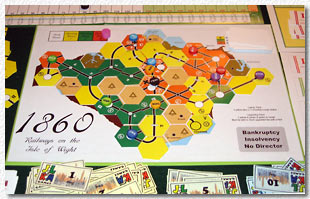
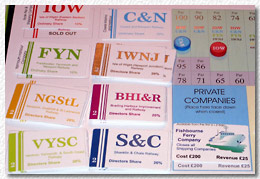
1860 board

Quite a few of the “18xx” games have been released as game kits by hobby
game designers and especially in recent years there has been no release of an
“18xx” game by larger publishers. While game kits often come with high quality
components and a well tested game system (e.g. see our preview
on “1895”
) they need several hours of assembly time because most of the
components need to be cut out, mounted or laminated.

In contrast, “1860” is produced by the small UK based games publisher JKLM
who until today has produced ten games; this is their first one of the “18xx”
series. As one would expect from a professional publication the game is – besides
punching out some tokens and tiles – ready to play. Most components seem to have been
produced using a colour laser printer, the material either being cardboard or plain
paper. The map is mounted on sturdy cardboard and all components rest perfectly flat on
the table. Credit is given to Chris Lawson for inspiring playing aids like the revenue
chart and the calculation tables on the company charters, which help speeding up game
play. It is also a nice idea to provide two different types of currency, one for the
companies, and another one for player money. Unintentional mixing of the two can no
longer happen and buying trains in the later phases of the game has no effect on the
length of the game.

The rules are well written and provide enough information also for “18xx”
novices. There is only a small glitch when they state, that the game comes with £500
notes, when in fact there are £200 notes provided. According to the publisher the latter
is correct. There is also a small omission in the description of the initial auction
round. This round also ends if no player wants to buy or can buy any of the remaining
stock of that round.

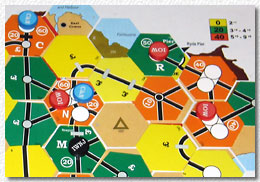
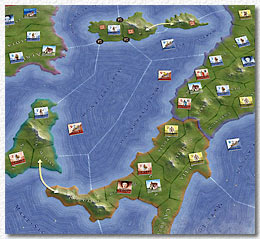
1860 board

Let us look at the main features, which differentiate “1860” from the other
games of the series. The first thing experienced “18xx” players will notice is
the small size of the map in terms of track hexes. There is space for 42 track tiles
only, less than in “1849 – Sicily” but still twice as many as in “1876 –
Trinidad”, both also island based games. Even more significant is the huge number of
37 cities, villages, and halts on the map. This leaves only 9 tile spaces without a stop.
Combine this with the total of eight railway companies and it is obvious that the
resulting railway network will be rather complex and the calculation of revenues will be
difficult. Hence, it is wise to make use of the revenue chart provided with the game
(note: by mistake the column for revenues ending on 80 has been omitted in the
chart).

Trains come in 8 different sizes and can travel between 2+1 to 9+5 (large + small)
stations. As 9+5 trains are available in an unlimited quantity railway companies are able
to travel across most of the map in the end game – station markers permitting – and will
rake in large revenues per operation round. This is also supported by the rule that a
company may pass through one, but only one, “tokened out” station per operation
round.

A combination of three stock market and company related features derived from the
historical background of “1860” makes the game unique. First, there is the
possibility that a player sells the Director’s certificate to the bank, thereby being
able to get rid of all stock of a company even if no other player holds more than 10% of
that company’s stock at the time. The railway company goes into receivership and
while in this state retains the complete income generated in operation rounds.
Eventually, the company will be attractive enough to find a player willing to buy the
Director’s certificate. This feature was already present in the original
“1829” game but has not been adopted by many “18xx” games since.

Secondly, if a company has lost all its trains and has insufficient funds to pay for a
new one it becomes insolvent, a new feature to the “18xx” series. Insolvent
companies use (“lease”) the smallest available train from the bank without
actually acquiring it but in return receive only half of the income generated in an
operation round. Insolvent companies do not pay dividends. There is no longer the need
for a director to finance the buying of a train out of his own pocket making the game
much less cutthroat than for example “1830”. However, if shares of a company
with no trains are sold during a stock round, the selling player receives only half of
the current stock price. Deciding on whether to keep or sell the shares of an insolvent
company is one of the tougher choices players are faced with during the course of the
game.

Finally, companies may go bankrupt. This concept is new to the “18xx”
series, too. In other “18xx” games players will go bankrupt if they have to buy
a train for one of their companies and have insufficient funds, thereby ending the game.
In “1860” company bankruptcy arises if the share price of a company reaches
zero either because the director has chosen not to pay any dividends for several
operation rounds or because dividends may not be paid due to the company being either in
receivership or insolvent. When a company goes bankrupt, all of its shares are returned
to the bank’s IPO and become available again for sale and re-floatation. Former
shareholders receive no compensation for lost shares in any way. Interestingly, bankrupt
companies keep all their assets (money and trains on the company’s charter and any
station tokens already placed on the map) making them very attractive for re-floating. A
formerly bankrupt company most of the time is a tremendously good deal as it not only has
a route with stations but also lots of money and possibly even a train or two.

1860 IPO

Looking at these three features and their effect on game play one may think that much
of the thrill and suspense in the correct timing of share transactions and train
acquisition has been eliminated. But during play one quickly realises that taking
advantage of these new features requires just as much good timing skills and proper
planning and strategy as in other “18xx” games.

The concept of “feeder lines” comes to mind here, which are used to provide
money and/or trains to other companies of the same player but which do not pay any
dividends to other players. Players deliberately shift money from one company to another
by buying nearly obsolete trains from a company for large amounts of money, giving that
company the opportunity to buy a better train while still paying dividends. In
“1860” the other company will eventually become insolvent and if timed
correctly, the player will be able to sell all stock of the company before this happens
and re-float it after it has gone bankrupt. None of this is as simple as it sounds and
requires a constant look at the stock market, the priority deal and of the availability
of trains, but if timed correctly it is a real moneymaker. Bankruptcy will eventually hit
one or the other company so it is wise to make the best out of it.

Three conditions signal the end of the game. Like in most “18xx” games it
ends if the bank runs out of money. However, the game also ends if a railway
company’s stock price reaches the top score of £340 making it an attractive
possibility to accelerate the game’s end. The third condition is unique to
“1860” and simulates the nationalisation of the railway companies on the Isle
of Wight. Nationalisation begins as soon as the first 9+5 train has been bought and all
companies own at least one train. From then on, no more stock rounds are played and at
the end of each operation round the two companies with the least revenue cease to
operate, maintaining their current stock price. As soon as all but two companies have
been nationalised this way the game ends. In our games this was the common type of ending
and it is wise to plan ahead for it by creating attractive routes for one’s companies
in order to prevent their early nationalisation.

“1860” offers a well-balanced combination of ideas which at the same time
makes it challenging for “18xx” die-hards and not too cutthroat for beginners.
The game components are of high quality and support the game play very well. For those
who are “18xx” aficionados this is a must-buy as it provides plenty of room for
new strategies; for those who want to get into the “18xx” series I can
recommend it as a good introduction into the game system.

15.11.2006: Razzien in “Salamanca”

Zwei Siemens-Manager und ein Sublieferant waren heute im WPG-Quintett angesagt. Spannend war die Frage, ob sie alle die heutige Großrazzia am Standort München überlebt hatten. Hatten sie! Mit weißer Weste standen alle pünktlich um 20 Uhr am Westpark auf der Matte.
1. “Salamanca”
Die Spieler legen Landschaftsplättchen in die Pampas und bauen Villen darauf. Dann grasen sie die benachbarten Wein-, Wald- und Wiesengrundstücke ab und machen damit Kohle.
Die bösen Mitspieler können mit Wühlmäusen oder Heuschreckenschwärmen die besten Ernten vernichten. Manchmal schickt man auch einfach sein Kondom (Conde = Pfalzgraf) vorbei, um sich von fremden Ernten den Zehnten abzuholen.
Kurz und gut: Villen zu bauen ist lebenswichtig. Das Kondom rundet ab. Bei diesen beiden Spielzügen hat jeder Spieler sein Schicksal in der Hand. Doch bei den Plagen und den weiteren Katastrophen unterliegt man hilflos den Ambitionen der Mitspieler. In einer 5er Runde beträgt die Fremdbestimmung also rund 80%.
Ganz lustig, wenn man alles nicht so erst nimmt.
WPG-Wertung: Aaron: 7 (8 Punkte für eine 3er Runde), Günther: 6 (eigentlich mehr wert), Loredana: 6, Peter: 5 (nach 6 Punkte beim ersten Eindruck), Walter: 6.
Walter schreibt eine Rezension.
2. “Kabale und Hiebe”
Peter wünschte sich ein halbstündiges Zwischenspiel. Was lag näher, als in unsere Kontroverse um das neue HiG-Spiel neue Gutachter einzubringen.
Peter stellte zunächst mal einen Anachronismus fest: Maiskolben stammen aus Amerika und waren im Mittelalter wohl noch nicht auf dem Speisezettel. (Nur als Randbemerkung.)
Ohne Denker spielte sich alles sehr viel flotter. Und dann sogar einigermaßen lustig. Auch wenn es nach wie vor für die Nicht-Gewinner einer gewissen Frust-Toleranz bedarf. Aaron gewann. Warum? “Ich habe es gespielt wie ‚Hol’s der Geier’!” (Das dürfte wohl bedeuten: Sich ganz locker auf wenige, lukrative Stiche konzentrieren.)
WPG-Wertung: Aaron: 7, Günther: 7, Loredana: 7, Peter: 7, Walter: 5 (legt einen Punkt dazu).
Moritz und Walter haben schon je eine Rezension geschrieben.
3. “Yspahan”
Nein, wir haben es nicht gespielt, wir waren ja eine 5er Runde und das Spiel geht nur bis 4 Mitspieler. Doch Peter hat es kurz vorgestellt, es ist sein neuer 10-Punkte Favorit und Loredana steht mit 9 vergebenen Punkten ganz dicht dahinter.
Das Spiel enthält einen neuartigen Würfelmechanismus zum Auswürfeln der zulässigen Spielaktionen. Günther hat schon seine Formelsammlung ausgegraben und wird demnächst ein Tableau mit den zugehörigen Wahrscheinlichkeiten veröffentlichen.
Noch keine WPG-Wertung.
Peter (!) schreibt eine Rezension.
4. “Bluff”
Im Endspiel 1:1 legte Loredana gegen Walter 1 mal die Eins vor. War das Naivität, Verarschung oder genialer Bluff. Wenn Loredana wirklich eine Eins gewürfelt hatte, so war das die einzige Vorgabe, mit der sie sofort und unweigerlich verloren hatte. Wenn sie aber keine Eins hatte …?
Schon vor einem Monat (18.10.) war Walter von Aaron mit der gleichen Vorgabe reingelegt worden. Damals hatte er eine Zwei, diesmal eine Drei. Was tun? Er zweifelte an und … hatte verloren, Loredana war wirklich mit einer Eins ins Rennen gegangen.
Verarschung war es von ihr sicherlich nicht gewesen, aber ob Naivität oder geninaler Bluff, das kann ich bis jetzt noch nicht unterscheiden. Über dem Epsilon-Durchgang durchs Unendliche liegt das ja auch ganz dicht beieinander.
Keine neue WPG-Wertung für ein Super-Spiel.

Italia

Italia

reviewed by Moritz Eggert

Phalanx continues to manage a successful line of Euro games and “geek” games, or even
a combination of the two, like in the excellent “War of the Ring”.

Since the time when Lew
Pulsipher
was inspired by the now forgotten hex and counter wargame “Ancient
Conquest” to create a comparatively simple wargame that creates what he calls a “sweep of
history” the mechanics of “Britannia” have been a fan favourite, and there are now
many variants of the game that recreate other place’s histories.

For an excellent overview on Britannia-like games please visit the website of one of the world-wide
leading “Britannia”-experts, Rick Heli.

Andreas Steding, designer of Italia I and II, has already created one of the best known
Britannia variants, the monster game “Hispania”, which recreates the history of Iberia,
today known as Spain. There are “Britannia” variants which simplify the basic system –
“Hispania” and “Italia” certainly do not go this road but rather add chrome and
special rules that give the players more choices but also more headaches.

“Italia” is – no surprise here – a recreation of the history of Italy from ancient
times. Unusual for a “Britannia” game it comes in two completely different versions that
cover two different time periods. The first one – another first – is especially designed for THREE
players, and once you consider the history depicted here it makes sense. In 10 rounds the players
play the rise and fall of the Roman Empire, from the Götterdämmerung of the Greeks to the final
days of the empire. One player will mainly be busy with the Romans, and his task is to hold and
expand the Roman position and deal with pesky revolts and upstarts. The other two players play all
the minor or big empires that constantly threatened Rome, most notably the Carthaginians with
Hannibal, whose campaign is actually a major event in the game.

board

The interesting thing is that the game system constantly forces the two non-Roman players to
either gang up against Rome – which certainly has some power to defend itself – or to go for quick
victory points against each other.

The second game, Italia II, recreates the history AFTER the fall of the Roman Empire, and is
designed, like most Britannia games, for 4 players.

I will not go too much into the rules here, but instead add a list of major differences between
the “Italia” and the “Britannia” system (it’s not a short list) below.

Summary of what is missing in Italia

(VERY minor grapes, as the production value of this game is very high – beautiful counters,
sturdy board, etc.)
  • A handy overview of when the units/nations of all players appear in which round – something
    that is usually found with any “Britannia”-style games. This info is only found on the
    nation cards themselves, which are covered with tiny print.
  • A turn order list of nations on the gameboard itself. This is only found on a separate sheet
    that is used to look up many other things.
  • Some nations easily amass more than 5 gold. There is a +5 counter for the money, but even with
    that only 10 gold can be recorded, large nations like Carthaginians and Romans easily exceed this
    limit.
  • Any kind of historic reference (i.e. what time period a turn represents) – this is a glaring
    omission that is kind of surprising when one thinks about the detail and chrome that went into this
    game.

Andreas Steding has added a lot of chrome to the “Britannia” game system here,
avoiding some overly complicated mechanics that made “Hispania” very long to play. Still,
this is “Britannia” on steroids – the decision making is much more difficult as there are
lots of things large nations can do on each turn: raiding, naval moves, building cities,
campaigning. The latter mechanic simulates the long campaigns of Hannibal and the like, something
like a mini game in the game as other players can react to the ongoing campaign moves, also
something that has not been seen yet in “Britannia”.

All this might be too much for some. “Italia” certainly isn’t a game that makes
“Britannia” more accessible for the common market, rather the opposite. But there are
many interesting ideas here – the campaign system for example.

Where the game shines is in its 3-player scenario (or rather “game” – as the 3-player
version is completely different from the 4-player version, there are different nations, even partly
different rules). This is the first time it has been done right, with basically two sides
representing the nations oppressed by the Romans that constantly struggle among themselves, and the
third player representing mostly the Romans in their struggle to dominate the peninsula.

Game material is top notch, as usual with the “Phalanx” line, which is always put
together with great care and love, although there are some strange omissions (like a historical
reference or an overview over when all nations/armies appear). The rules are not for the
faint-of-the-heart – even Britannia veterans will have some new concepts to struggle with, although
they will still feel at home. Recommended, but not for the casual gamer. You should have a day free
for your first game, 8 hours recommended.

MAIN DIFFERENCES BETWEEN “BRITANNIA” AS WE KNOW IT AND “ITALIA I/II”

NEW PLAYING PIECES

  • Consular Legions/Knights (2 hits, regenerate after combat)
  • Fleets (transport, naval supremacy bonus)
  • Elephants (scare/destroy additional units)
  • Cities (earn gold, give defensive advantage)

NEW LANDSCAPE

  • there are sea spaces in which battles can be fought
  • Marshland gives defensive bonus, but is no hindrance to movement
  • Highland works similar to “mountains” in “Britannia”

board

INCOME/SPENDING

  • All areas produce one “gold” (instead of population points)
  • Cities also produce one gold.
  • Gold can be saved indefinitely.

Income can now be spent on:

  • Infantry legions, fleets (4 gold)
  • Consular Legions (see limit in Italia I, 6.3), Knights, Elephants
  • City in standard area (6 gold)
  • City in “difficult” area, marshland or highland (8 gold)

NEW UNITS

May appear in “massing areas” which have to be left, otherwise pretty similar
(7.2).

POPULATION LIMIT (2 per space)

Does NOT exist!

STACKING LIMITS

Works very differently.

In short:

  • Cities/Leaders do not count against the stacking limit
  • Normal/marsh: 3
  • Highland/massing area: 2
  • Sea area: unlimited
  • Declaring as “capital” (like in “Britannia”, presence of a city is
    strangely enough NOT required): +1
  • Capital declaration can be changed at any time, like in “Britannia”
  • Rome is always the capital of the Romans

In addition:

  • When moving into combat: +1
  • When moving with a leader: +1
  • When doing a major invasion: +1

(all cumulative)

In a campaign:

  • Unlimited stacking with leader, or also for the other players during some “reaction
    moves”.

Stacking limits are pretty much always in effect, even in retreating.

MOVEMENT

  • highland stops like mountains, can be overcome with leader
  • Straits stop movement like in “Britannia”
  • marshland does NOT stop movement
  • naval transport: ships may carry 2 land units each, can do naval move if starting in a coastal
    space, and then do nothing but naval move, may stay on sea indefinitely
  • friendly cities negate terrain effects (work like Roman Roads in “Britannia”)
  • leaders increase movement by 1 (of their group)
  • units have different movement capabilities that are printed on the counters
  • Overrun like in “Britannia”
  • Ships move through each other, after all moves other players and the active player have to
    declare combat in spaces the active nation moved in. If anybody declares combat, combat takes
    place, otherwise no combat in sea areas (has to be done immediately after movement)

token

COMBAT

  • Units have different “to hit” numbers (printed on the counters), that have to be
    rolled on 10-sided dice, like in “Hispania”.
  • Elephants, Knights and Consular Legions have special abilities.
  • Cities don’t defend with dice, they just add defensive capabilities.
  • If victorious, city can be “sacked” and is destroyed (flipped to “ruin”
    side). The pillager gets 4 gold. A city that is “sacked” can’t be rebuilt in the same
    turn.
  • Rebuilding: remove one unit (not leader) in the ruined space when it’s your turn, city is
    rebuilt from ruins.

Modifiers to the hit roll:

  • highland/marsh -1 on roll
  • City is defending -2 on roll
  • Leader +2 (and this is CUMULATIVE – several leaders can create a super army!)
  • Naval Invasion (landing with ships) or strait combat (like in “Britannia”): +2 for
    the defender in the 1st round only
  • Fleets get +1 per transported unit
  • Naval Supremacy (if adjacent sea area/s to combat space contain/s fleets of the nation in LAND
    combat and total number of fleets of that nation is at least double the number of fleets of the
    nation it fights against in those adjacent areas – I know, it sounds complicated, but that’s
    how it is, folks…) +1
  • Raid combat (see below): one combat round only, and no modifiers to attacker, hits on a 7

Raid combat is a new concept and is directed at pillaging cities if at least one damage is
created. Defending land units are NOT hurt. If city is pillaged, attacker receives 4 gold, and the
city is “raided”, which is different from “sacking” in that it can be rebuilt
IMMEDIATELY out of turn sequence.

RETREAT

token

Like in “Britannia”, but Attacker can also retreat to OTHER spaces than the one he
entered from, if they are either free or occupied by his own people.

VICTORY POINTS

Nation victory points are much more complicated than in “Britannia” and often
differentiate between “areas” and “cities” controlled.

CAMPAIGNS

This is a new concept. At certain moments in history nations can start campaigns, basically a
huge stack of units (no stacking limit) with leader that has to be paid 1 gold for each move. After
each of these moves nations adjacent to the campaigning leader can, in turn order, do reaction
moves.

Either:

Move to Battle: move any number of units adjacent to the campaigner’s space into battle,
disregarding stacking limit.

Or:

Move and See: Move one stack to one adjacent space ANYWHERE on the board, without initiating
combat, or to join an already existing combat (either the space with the campaigning leader or an
overrun space).

ATTENTION: it seems stacking limit is in effect here!

It is also possible to leave the space the campaigner has just entered, thereby giving ground
(think of the real Romans reaction to Hannibal’s campaign).

Raiding in Overrunning spaces are possible, but only during a campaign (again think of
Hannibal).

“BLOCKING” is a new concept that benefits the campaigner: for 1 gold AND 1 unit
sacrifice he can prevent movement in ONE adjacent space to the campaigning leader.

SUBMISSION

In general different rules for each nation, like in “Britannia”. Otherwise very
similar. The subjugated nation’s income is halved and rounded UP, the subjugating nation gets
the rest.

Areas controlled by the subjugated nation do NOT count as controlled, only in certain
circumstances. Some nations get the possibility to REVOLT. They can be subjugated AGAIN after such
a revolt. Sometimes submission is FORCED when falling below a certain threshold of units/areas. It
is sufficient to simply move one unit into an area of a nation that has forced submission. No
combat will take place and the nation immediately submits.

token

ADDITIONAL RULES

ITALIA I

Is a 3-player game and totally different from the 4-player game (ITALIA II). It has completely
different nations and time periods, so one can say that Italia is 2 games in one, not one game with
a 3-player variant. Some gamers actually prefer the 3-player game to the 4-player game.

  • Rome can only be permanently occupied in Round 10, and is always automatically rebuilt.
  • Hannibal campaign has some special rules for elephants and unit drafting (see 13.2)
  • Game Turn 10 (the last) has only campaigns, and only three nations move, for all the other
    nations game turn 9 is the last one where they can act
  • Roman legions may defect to another player’s side if controlled by Marius or Sulla
    (leaders), see 13.4
  • Major Battles: is a new concept that describes battles with 3 or more units ON EACH SIDE. Some
    nations get extra points for winning major battles.

ITALIA II

Is a 4-player game.

  • Knights have 2 hits like Consular Legions, but may not retreat after receiving such a hit
  • Patrimonium Conversion: Twice per game the Patrimonium player can convert any one unit of
    another adjacent nation.

09.11.2006: Italia bei Moritz und Andrea

“Italia” by Phalanx- tried out with Hans and Andrea, 9.11.2006

Andreas Steding has added a lot of chrome to the “Britannia” game system here, but avoiding some overly complicated mechanics that made “Hispania” very long to play. Still, this “Britannia” on steroids – the decision making is much more difficult as there are lots of things large nations can do on each turn: raiding, naval moves, building cities, campaigning. The latter mechanic simulates the long campaigns of Hannibal and the like, something like a mini game in the game as other players can react to the ongoing campaign moves, also something that has not been seen yet in “Britannia”.
Where the game shines is in it's 3-player scenario (or rather “game” – as the 3-player version is completely different from the 4-player version), which is the first time this has been done right, with basically two sides representing the nations oppressed by the Romans that constantly struggle among themselves, and the third player representing mostly the Romans in their struggle to dominate the peninsula.
Game material is top notch, although there are some strange omissions (like a historical reference or an overview over when all nations/armies appear). THe rules are not for the faint-of-the-heart – even Britannia veterans will have some new concepts to struggle with, although they still will feel at home. Recommended, but not for the casual gamer.

07.11.2006: “1861 – Eisenbahnen im russischen Zarenreich”

Spiele der 18xx-Familie sind anders. Das fängt schon damit an, daß bei uns dafür gesondert eingeladen wird, damit die Ketzer, die hierfür nur 8 oder gar weniger Punkte vergeben, erst einmal wissen, was die Glocke geschlagen hat. Dann wird für 19 anstatt für 20 Uhr zusammengerufen, um der Hektik entgegen zu wirken, die ansonsten bei länger andauernden Planungsphasen der Gleisbauingenieure unweigerlich aufkommt.
Wenn dann noch ein Neuling dabei ist, wird er extra ein halbe Stunde vorher zitiert, damit er privatissime sed gratis vor dem eigentlichen Beginn der Auseinandersetzungen noch einen kleinen Überblick darüber bekommt, was ihn in den nächsten 4 bis 5 Stunden erwartet.
Diesmal trafen sich vier Zehn-Punktige und ein Neuling zum brandneuen “1861” über die Entwicklung der Eisenbahnen im russischen Zarenreich.
1. “1861”
Neben ein paar Regel-Modifikationen, die in jedem 18xx-Spiel verwendet werden könnten, besitzt “1861”, wie jedes andere geniale Kind dieser Spielefamilie, natürlich auch ein paar ganz eigene Elemente, die ihm ein unverwechselbares Gepräge geben.
Zwischen den 5 Privatgesellschaften und den 8 öffentlichen Gesellschaften gibt es 16 Minor Companies, die zuerst betrieben werden müssen und das Spielgeschehen der Aufbauphase bestimmen. Sie werden vom handelnden Spieler versteigert und können hinterher nicht mehr verkauft werden. Ihr Auktionspreis ergibt das Startkapital; ansonsten leben und arbeiten sie wie wir das bei jeder 18xx-Eisenbahnlinie gewohnt sind.
Der Aufbau der öffentlichen Gesellschaften dominiert den Mittelteil des Spiels. Die Gesellschaften sind alle gleichwertig, besitzen keine regionale Zuordnung und können an jeder Stelle der Landkarte beginnen. Sie können über den Aktienmarkt gestartet werden, doch gehen sie meist durch Umwandlung oder Verschmelzung aus den Minor Companies hervor.
Später gibt es noch die Russische Staatsbahn, die neutral von der Bank betrieben wird. Sie kauft Züge, wann immer sie kann und erzwingt so einen ständigen technischen Fortschritt. In der Staatsbahn geht alles auf, was zwischenzeitlich den Geist aufgegeben hat.
Sechs Stunden lang spielten und kämpften wir ums Überleben, um das Dolce Vita und um die Hegemonie auf den Gleisen. Für 1 Uhr hatten wir uns ein Zeitlimit gesetzt, da wurde gerade die Endphase eingeleitet. Wir brachen das Spiel ab, ohne unseren aktuellen Entwicklungsstand in eine theoretische Siegerreihenfolge zu extrapolieren. Jeder konnte plausible Gründe vorbringen, warum er selber zum Sieger zu küren sei.
Günther hätte in den Schlußrunden die weitaus höchsten Einnahmen verbuchen können, Wolfgang hatte die meisten Gesellschaftsanteile mit durchaus guten Entwicklungschancen und Walter thronte auf den höchstwertigen Aktien, die er in den Spitzenpositionen hätte halten können. Nur Arpad war etwas abgeschlagen, er hatte sich in der Anfangsphase mit manipulativen Lok-Verkäufen innerhalb seiner Gesellschaften zu sehr selbst von der Ader gelassen.
Es war keine Sekunde langweilig gewesen, auch wenn man schon mal Denkpausen und Erklärungseinschübe über sich ergehen mußte. Den Einstieg in “1861” haben wir geschafft. Das nächste Mal werden wir wohl einen ruhigen Sonntagsnachmittag im Winter für den Start einer neuen Herausforderung um die Eisenbahnen in Russland ansetzen müssen.
WPG-Wertung: Arpad.9, Günther: 9, Wolfgang 9, Walter 10
Walter schreibt eine Rezension.

1861

rezensiert von Walter Sorger

Die Spiele der "18xx"-Familie über die Entwicklung der Eisenbahn in den
verschiedensten Teilen der Welt sind alle Juwelen an Kampf, Raffinesse, Dynamik und Interaktion.
Alle Arten von Spielermentalität können sich hier austoben: Der Spekulant genießt seine Macht an
der Börse, der Empire-Builder ergötzt sich beim Aufbau eines weltumspannenden Streckennetzes, und
der Kaufmann schwelgt in seinen Erlösen und Umsätzen, er hat ständig seine Hände voller
Geldscheine. Ein brutaler Kapitalist ist erfüllt von der Hoffnung, seine Konkurrenz in den Ruin zu
treiben, ein starker Global-Player steigt selbstbewusst in diesen Kampf ein und notiert befriedigt
alle Hindernisse und Gefahren, die er gemeistert hat.

Diese geballte Herausforderung an Herz und Verstand hat vor über 30 Jahren unter dem Namen
"1829" das Licht der Welt erblickt; damals ging es um England und 1829 fuhren dort die
ersten Eisenbahnen. Um dieses Spiel hat sich eine richtiggehende Kultgemeinde gebildet und es
wurden neue Varianten entwickelt, mit denen die Spielidee und Regelwerkes auf jeweils ein anderes
Land übertragen wurden. Heute gibt es weltweit über 60 verschiedene Mitglieder der 18xx-Spiele, und
über zwei Millionen Einträge findet man bei Google allein zu den Stichwörtern "1829" +
"Game".

Eine eigene Seite "Who's Who
in the 18xx hobby and industry
" listet alle Personen auf, die sich um dieses Spiel
verdient gemacht haben. Ian D. Wilson, der Designer von "1861" ist noch nicht darunter,
seine Spielidee ist nagelneu und erst im Oktober auf der "Spiel 2006" in Essen
vorgestellt worden. Es geht um die Eisenbahnen im russischen Zarenreich. Aus seinen historischen
Studien nahm der Autor die Leitidee mit, die (unschuldigen) Präsidenten von bankrotten
Gesellschaften nicht vor die Hunde gehen zu lassen, sondern in den weiten Armen von Väterchen Staat
weich aufzufangen.

Die wichtigsten Regelbesonderheiten von "1861"

Minor Companies

Bevor der Rummel mit den Aktien losgeht, müssen sich die Spieler erst einmal mit den "Minor
Companies" herumschlagen. Diese Linien bestehen aus einem einzigen Anteil. Sie werden vom
handelnden Spieler versteigert und der Auktionspreis ergibt ihr Startkapital; ansonsten leben und
arbeiten sie wie wir von den üblichen 18xx-Gesellschaften gewohnt sind: Sie legen Gleise, kaufen
Züge, betreiben Zugverbindungen und kassieren Fahrgeld. Jeweils 50 % der Einnahmen bekommt der
Spieler, 50% behält die Gesellschaft, um damit künftige Lokomotiven finanzieren zu können.

16 solcher Gesellschaften gibt es insgesamt. Diese hohe Anzahl bringt es mit sich, dass jeder
Spieler gleich von Anfang an zwei Linien erwirbt und mit ihnen das Führen von
18xx-Eisenbahngesellschaften, das Konkurrieren um Gleisstücke, die Trennung von Privat- und
Firmenschatulle und den Wettlauf mit dem technischen Fortschritt üben kann.

Etwa ein Drittel der gesamten Spielzeit wird ausschließlich mit diesen Vorübungen verbracht.
Anschließend verschmelzen diese Minor Companies zu den richtigen "Public Companies", doch
nur wenn sie gut aus den Startlöchern gekommen sind. Verlieren sie beim Aufkommen der 4er-Züge
ihren einzigen 2er-Zug, so werden sie "nationalisiert", d.h. ihr früherer Besitzer
bekommt eine Entschädigung, ansonsten gelangt ihr gesamtes Hab und Gut an Gleiswerk und Bahnhöfen
in die Hände der "Russische Staatsbahn".

Public Companies

Der Aufbau der "Public Companies" dominiert den Mittelteil des Spiels. Diese
Gesellschaften bestehen durchwegs aus acht Anteilen zu je 10% und einem Präsidenten-Anteil zu 20%.
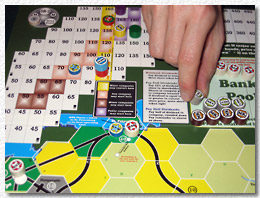
board
Sie sind in sich alle gleichwertig, besitzen keinerlei regionale Zuordnung und können an jeder
Stelle der Landkarte gestartet werden. Allerdings gehen sie meist aus den Minor Companies hervor
und übernehmen dann mit deren Besitz auch deren regionale Verbreitung.

Nach ihrer Gründung behält eine "Public Company" alle unverkauften eigenen Aktien im
Firmentresor, bekommt aber sonst keine weiteren Finanzmittel. Da sitzt ihr pekuniärer Gürtel schon
mal ganz schön eng. Um an liquide Mittel heran zu kommen, muss sie umgehend Käufer ausfindig
machen. Unter Umständen darf ihr Präsident jetzt nicht fremdgehen und seine Privatmittel in
lukrativen Gesellschaften der Mitspieler anlegen, sondern muss seiner eigenen Linie durch
Aktienkäufe über die anfänglichen finanziellen Engpässe helfen.

Im laufenden Betrieb kommt eine "Public Company" dann sehr schnell in Fahrt. Da sie
bereits den operativen Betrieb aufnimmt, wenn ausschließlich die 20%-Direktor-Aktie verkauft ist,
besitzt sie normalerweise eine erheblichen Anzahl der eigenen Gesellschaftsanteile und steckt so
innerhalb der Operationsrunden einen entsprechend großen Anteil des Streckenerlöses ein. Der
Präsident kann problemlos jeweils 100% der Dividende ausschütten: Er selbst bekommt den maximalen
Ertrag für seine Anteile und die Gesellschaft erhöht trotzdem ständig ihre Liquidität; ihr
Vorrücken auf dem Aktiontableau ist ebenfalls gesichert.

Beim Verkauf von Anteilen der "Public Companies" fällt der Kurs nur dann, wenn der
Präsident verkauft. Das Verkaufen von gegnerischen Aktienanteilen löst also keinen Kurssturz ein.
Damit unterbleiben die taktischen (oder miesnickeligen) Manipulationen auf dem Aktienmarkt und ein
braver Unternehmer wird von brutalen Spekulanten nicht klein gekriegt. Natürlich spart das auch
Spielzeit. Man muss sich vor solchen Eingriffen nicht schützen, noch braucht man sich darüber
Gedanken zu machen, wie man es selber anwendet. Allerdings geht hiermit auch ein Teil der Dynamik
und Spannung auf dem Aktienmarkt verloren.

Darlehen

Hat eine Gesellschaft nicht genügend Eigenmittel um benötigte Lokomotiven zu kaufen, so muss der
Präsident das fehlende Geld nicht aus seiner Privatkasse nachschießen, sondern die Gesellschaft
darf sich von der Bank Geld leihen. Damit wird das finanzielle Risiko gleichmäßig auf alle
Anteilseigener verteilt und der Präsident vor einem möglichen einseitigen Ruin bewahrt.

Betrügereien sind über die Darlehen nicht möglich. Nur die minimalsten Darlehensbeträge sind
erlaubt. Sie müssen auch frühest möglich zurückgezahlt werden, d.h. immer sofort, wenn die
Gesellschaft über Barmittel verfügt. Ansonsten werden pro Operationsrunde 10% Zinsen fällig.

Verstaatlichung

Geht einer "Public Company" die finanzielle Puste aus, ist z.B. gerade ihr letzter Zug
dahingerostet und kann (oder will) sie keine Darlehen aufnehmen, um sich einen neuen Zug zu kaufen,
so wird sie – ganz analog wie eine "Minor Company" – nationalisiert. Die alten
Anteilseigner bekommen von der Bank den aktuellen Kurswert ausgezahlt, ansonsten fällt ihr gesamter
Besitz an die "Russische Staatsbahn".

Auch diese Spielregel schützt die Kapitaleigner vor den katastrophalen Folgen eigener
Planungsdummheiten sowie vor den gezielten bösartigen Machenschaften der Mitspieler. Geht ein
Präsident in den betrügerischen Bankrott, indem er den gesamten Gesellschaftsbesitz verscherbelt
und sich dann noch schnell von allen seinen Anteilen trennt, so fällt der Kurs nicht ins Uferlose
und kein Miteigentümer braucht für teures Geld eine neue Diesellok zu kaufen. Die bankrotte
Gesellschaft gibt einfach ihren Geist auf und die Miteigentümer bekommen vom Staat immerhin noch
etwa 80% des aktuellen Wertes als Entschädigung. Verglichen mit entsprechenden schmerzlichen
Vorgängen bei "1830" ist das noch das reinste Honigkuchenschlecken.

Russische Staatsbahn

Die "Russische Staatsbahn" ist das Auffangbecken für alle lahmen und kranken und
verstorbenen Gesellschaften. Sie wird neutral von der Bank geführt, betreibt die geerbten
Streckenverbindungen und steckt die Erlöse zu 100% in die Firmenkasse. Sie kauft neue Lokomotiven,
wann immer sie dafür Geld hat und erzwingt so einen ständigen technischen Fortschritt, mit dem sie
gegebenenfalls auch willensschwache Präsidenten von "Public Companies" unter Druck setzen
kann.

Sobald der erste 8er-Zug verkauft ist, wird das Spielende eingeläutet. Jetzt werden noch 3
Operationsrunden absolviert, dann kommt die übliche Abrechnung und der Mitspieler mit dem meisten
Kapital aus Barmitteln und Aktienwerten hat gewonnen.

Die Herausforderungen von "1861"
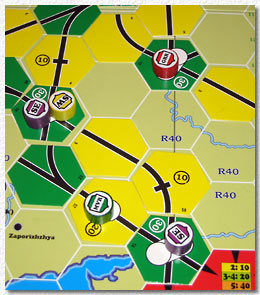
boardDas Faszinierende an den Spielen der 18xx-Familie ist, dass jede Partien anders verläuft,
obwohl kein einziges Zufallselement darin enthalten ist. Zu groß ist die Handlungsfreiheit der
Spieler, zu stark sind die Querbeziehungen innerhalb der verschiedenen Spieleraktionen, zu
unbekannt und unerforscht ist der schmale Pfad der besten Entwicklung.

Trotzdem besitzt jede Spielvariante unverwechselbare charakteristische Merkmale, die es zu
erkennen und zu berücksichtigen gilt. Ich habe jetzt noch keine Erfahrungswerte auf Lager, will
aber anhand einiger Fragestellungen aufzeigen, in welche Richtung die Auswertungen von
"1861" gehen müssten, um dieses Spiel besser in den Griff zu bekommen. Selbst wenn diese
Fragen weder heute noch morgen jemals beantwortet werden, vermitteln sie doch kleinen Eindruck von
der beeindruckenden Vielfalt freier Spielerentscheidungen.

  • Wie viel sind die "Minor Companies" wert? Soll man glücklich sein, sie für den
    Mindestpreis von 100 Rubel erwerben zu können oder sollte man hier wohldosiert mehr Kapital
    reinbuttern, um eine starke Linie auf die Schiene zu setzen, die auch die wirtschaftlichen
    Turbulenzen der Gründerzeit erfolgreich meistert? Wie weit ist dies abhängig von den Investitionen
    der Konkurrenz, insbesondere von der Relativposition auf dem Aktientableau? Soll man vielleicht
    diversifizieren und sich sowohl teure als auch billige Linen zulegen, um sie flexibler operieren
    und später gezielter verschmelzen zu können?

  • Soll man versuchen, alle seine "Minor Companies" am Leben zu erhalten und sie in
    "Public Companies" umwandeln oder soll man einige von ihnen sanft entschlafen lassen? In
    den Zeiten schneller technischer Neuerungen, ist jede "Minor Company" ein Klotz am Bein.
    Wenn man beweglich sein will, wenn man an der Spitze der Fortschritts stehen will und seine
    Mitspieler durch den ersten 4er-Zug vor gewaltige finanziellen Probleme stellen will, darf man
    selber nicht so viele hungrige Kinder durchfüttern müssen.

  • Soll man alle seine "Public Companies" solide und konservativ führen, oder kann man
    einige von ihnen ausbluten lassen, ja sogar zugunsten der eigenen Lieblingslinien leer plündern und
    das bankrotte Wrack der Staatsbahn überlassen?

  • Wie viel Anteile seiner Lieblingslinie soll man kaufen und zu welchem Zeitpunkt? Mit jedem
    verkauften Anteil steigt ihre Liquidität und sie kann immer die neuesten Züge kaufen. Allerdings
    ist ihr früher Kurs noch niedrig und das eingenommene Kapital entsprechend begrenzt. Weiterhin
    kassiert sie für jeden verkauften Anteil keine Dividenden mehr und bedarf dann früher oder später
    doch noch einer Kapitalspritze. Das Nicht-Ausschütten der Streckenerlöse heißt aber: ausgefallene
    Einnahmen für die Eigner und sinkender Kurs sowie niedrigere Priorität auf dem Aktientableau.

All diese Rätsel sind heute selbstverständlich noch ungelöst. Selbst für grobe
Ja/Nein-Entscheidungen fehlen überall praktische oder theoretische Grundlagen, von einer
abgesicherten Feinjustierung der internen Zusammenhänge ganz zu schweigen. Jeder Spielabend bringt
neue Erfahrungen und zugleich die Erkenntnis, dass das weite Feld der Spielentfaltung eigentlich
unerschöpflich ist. Ein ganzes Spielerleben lang hält das an.

"1830" oder "1861"?

"1830" und "1861" unterscheiden sich wie die Klischees ihrer Heimatländer
USA und Russland. Während die "Amerikaner" den nackten, brutalen Kapitalismus propagieren
und ausleben, wo jeder Mensch dem anderen ein Wolf ist, haben die "Russen" ein soziales
Netz in die Spielergemeinschaft eingezogen, das jeden auffängt, wann immer er ins Straucheln gerät;
hier ist jeder Mensch dem anderen ein Schaf.

Die krassen Räuberelemente aus 1830 sind deutlich abgeschwächt. Wem es früher Spaß gemacht hat,
einem Mitspieler eine ausgeplünderte Gesellschaft von die Füße zu werfen – und wem macht das keinen
Spaß?! – der wird hier etwas vermissen. Doch dafür kann ein Spieler mit deutlich weniger
Spielpraxis nicht so schnell in den Untergang getrieben werden. Der Konkurrenzkampf untereinander
findet über Strecken und gute Gesellschaftspräsenz statt; er kennt keine Opfer, sondern nur
Sieger.

Auch der Effekt von "1830", dass in den ersten Runden sich nicht jeder Spieler eine
eigene Linie zulegen kann, sondern dass einige Spieler auf Gedeih und Verderb von einem a priori
feindlichen Präsidenten regiert werden, ist vermieden. Es gibt genügend Linien und jeder bekommt
von Anfang an eines dieser begehrten Objekte in seine Managerfinger. Alle sind gleich, nur manche
sind gleicher. Allerdings entfällt damit auch die konstruktive Spannung zwischen Präsidenten und
Nicht-Präsidenten, die bei "1830" vom ersten Augenblick an das Spielgeschehen belebt.

Die Versteigerung der "Minor Companies" eliminiert das einzige Zufallselement von
"1830", nämlich die ausgeloste Sitzreihenfolge und damit die Asymmetrie beim ersten
Zugriff auf den Aktienmarkt. Bei "1861" kann jeder Spieler bei jeder Linie mit bieten.
Zusätzlich darf er sich auch noch überlegen, wie lange er freiwillig dabei bleibt. (Dass
Versteigerungen gegenüber reinen Kaufaktionen allerdings mehr Zeit kosten und damit die
Anfangsphase verlangsamen, steht dabei auf einem anderen Blatt.)

Zurück zur Frage: "1830" oder "1861"? Unter lauter Spielerhaien würde ich
das alte "1830" vorziehen. Das schnelle Geld, die schnellen Pleiten, das ständige Suchen
nach Gelegenheiten, den schärfsten Konkurrenten in die Knie zu zwingen, die ständig lauernden
tödlichen Gefahren auf dem Aktienmarkt, bei der technischen Innovation und beim Streckenbau geben
"1830" einen besonderen Kick. Ich war in meiner Jugend schon lange rot genug, so dass ich
heute ohne moralische Skrupel die blaue Philosophie der Besserverdienenden vertreten kann.
(Wenigstens im Spiel!)

Doch unter kleineren Fischen, unter Spielern mit sehr unterschiedlicher Praxis, mit deutlichen
Vorlieben als Empire-Builder und mit Freude am Schalten und Walten als Unternehmer und
Generaldirektor, da ist "1861" sehr viel ergiebiger. Nach einem 6-stündigen
"1861"-Abend mit einem Neuling erhielt ich den Brief: "Sag allen liebe Grüße. Der
letzte Spielabend war sehr schön. Zwar etwas lang aber wirklich sehr schön." Einen solchen
Brief hätte es in 20 Jahren "1830" nie geben können.
06.11.2006: Mehr neue Essen-Spiele

Gestern Abend traf sich eine vergnügte WPG-Runde bei Hans im Glück, bestehend aus Günther, Moritz, Loredana und mir. Wir spielen:

1. Baumeister von Arkadia http://sunsite.informatik.rwth-aachen.de/cgi-bin/luding/GameName.py?lang=DE&frames=0&gamename=arkadia

Laut Günther “eines der besten Spiele von Essen”. Entweder ist die diesjährige Spielequalität mager, oder selbst dem Günther ist nicht mehr zu trauen. Das Spielprinzip ist “Leg ein Plättchen, und wenn alle Felder drumrum besetzt sind, wird gewertet”. Nur wenige Zusatzregeln machen dies (unwesentlich) interessanter. Ich würd's nicht unbedingt noch mal spielen wollen. Das Spiel funktioniert, aber es gibt besseren Zeitvertreib. In der letzten Runde zog Günther an Moritz, an der an seinen sicheren Sieg glaubte, vorbei.

2. Yspahan
http://sunsite.informatik.rwth-aachen.de/cgi-bin/luding/GameName.py?f=00w%5EE4X&gamename=yspahan

Laut Günther “sehr schönes Familienspiel – im positiven Sinne”. Das sagt mein Brettspiel-Idol in seiner höflichen Art normalerweise über stark glücksabhängige Spiele, die man auch gut mit Nicht-Spielern spielen kann (Kniffel oder so). In der Tat würfelt man auch bei Yspahan mit vielen Würfel, aber das war's auch schon mit den Ähnlichkeiten. Yspahan ist ein echtes, gutes, forderndes Brettspiel der Sorte, wie ich sie liebe: Es gibt verschiedene Methoden, Punkte zu machen, und es ist nicht evident, welche die effizienteste ist. Es gibt die Möglichkeit, Fertigkeiten zu entwickeln. Kurz: Wer Goa mag, mag auch Yspahan. Als Familienspiel würde ich Yspahan überhaupt nicht bezeichnen — dafür ist es viel zu komplex. Ich bin schrecklich stolz auf meinen überlegenen Sieg und bin froh, wenigstens einem Hersteller blind trauen zu können: Ystari, die Spieleschmiede, die bislang wirklich nur Spiele nach meinem Geschmack hatte. (Jetzt will ich endlich Ys spielen!)

3. Bison
http://sunsite.informatik.rwth-aachen.de/cgi-bin/luding/GameName.py?f=00w%5EE4X&gamename=bison

Ein Kiesling/Kramer-Spiel, aber trotzdem schlecht. Man legt eine Landschaft aus Plättchen und kriegt Punkte, wenn man seine Männchen draufstellt. Ich hab's selbst gekauft (leider) und stell' jetzt gleich mein ungepunchtes Exemplar bei Ebay rein.

4. Null und nichtig
http://sunsite.informatik.rwth-aachen.de/cgi-bin/luding/GameName.py?f=00w%5EE4X&gamename=nichtig

Ein kleines Amigo-Kartenspiel: Es gibt Karten in fünf Farben. Wer den Stich macht, legt die Stichkarten offen nach Farben sortiert aus, wobei pro Stapel immer noch die oberste sichtbar ist (logisch). Was am Ende sichtbar ist, das zählt als Punkte. Liegt bei mir also eine rote 10, will ich keinen Stich, in dem die rote 0 ist. Es gibt keinerlei Zugabezwang, die höchste Karte sticht. Das sind schon fast alle Regeln. Schnell zu spielen, auch für Kinder geeignet, das, was ich Familienspiel nennen würde. Ich würd's nicht noch mal spielen wollen, in der Zeit hätte man sich besser mit Bluff amüsiert.

Fazit: Yspahan wird gekauft, der Rest bewegt sich bei mir punktemäßig zwischen 4-6.

"Was lag auf den Tisch?"