
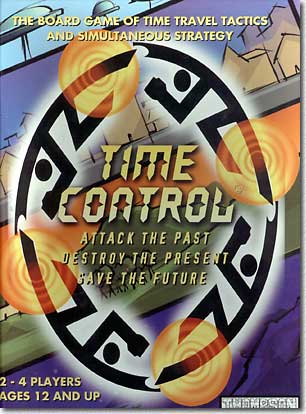
A review and a possible „fix“
“Time Control” has been one of the most dissed games in boardgamegeek history – this has to do with the fact that the designer sent out many free games to possible reviewers, a practice which is normally laudable but which backfired in this case. We as the “Westpark Gamers” had also received a copy, but as it arrived relatively late we already had word from the various boardgamegeek reviews (by usually reliable reviewers) that this game was truly awful. Therefore we never really got around to play it (or rather didn’t dare, to be honest).
This reviewer will not try to rectify the view that is dominant about “Time Control” – the game suffers from many flaws and has certainly not been playtested enough (or perhaps not at all). But while reading the rules (second, optimized version, still with many unclarities) I found that some of the ideas in the game were neat and interesting. I also felt sorry for the game designer, who had apparently gone to great length to present and print his game professionally (you can certainly not say that the game is ugly looking, although tastes differ). Also, I am a fan of the “time machine” genre, of which there are only very few good games (and only one true masterpiece, the totally underrated and out of print “Time Agent” by TimJim games). So before we finally decided to test this game, I already changed some of the rules that I was sure wouldn’t work (therefore sparing us the aggravation that the other testers felt while trying “to make it work”). But more about that later…
To give you some idea what the game is about, here is a short description:
Each player represents a time agency which tries to keep reality safe from “time waves”, accumulated problems that wander “up” to the present from the past, created by the other players agents. Each player therefore is master of his own “alternate reality”.
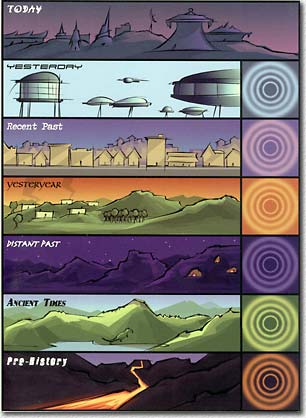
There are 7 time zones: today, yesterday, recent past, yesteryear, distant past, ancient times and pre-history. Today is where your agents are safe, and from which you send them to the past, to your own, and ultimately also to other players time zones. There are 4 kinds of agents: normal ones, brawlers (good at beating the crap out of other agents), scientists and historians (which are good in influencing and changing the time waves).
First players deploy their agents on various time zones on their own board (movement is linear, you can only move towards pre-history, from which you “snap back” to the present). Now the most problematic phase of the game begins: the “free for all”, which simply doesn’t work. In the original rules every player can do whatever he wants whenever he wants, he just has to announce it, and see if somebody opposes it. The latter happens when another player tries to take “time control” , saying “before you do this I do that”, to which of course another player can chime in say “and before you do that, I do this”, etc. ad nauseam. At some point you try to get out of this mess by resolving these “time duels”, which are akwardly done by the rules: you either spend time chips (numbered 1-21) OR you play a “Fate” time chip which enables you to blindly draw a card from -15 to +15 (or an automatic win card – sic!). Confused already? Even more confusing is the fact that you can always re-duel (in fact every player involved in the duel could do that), and that you lose only the highest time chip spent, the others are kept.
Theoretically every player can be active until all his agents are “busy”, moving/activating one at a time. Agents are moved to other boards to create “create” tokens, which in turn create a time wave that after the first round moves up to the present step-by-step to create more “create tokens” and finally problem cards, which oust a player from the game if he accumulates enough of them. Agents can also try to rectify these problems by flipping the create tokens to their “solve” side (when in the same zone) – “solve” tokens who reach the present can get rid of “problems”. Of course you can also attack other agents, again using the clumsy duel rules.
And have I already said that time waves also attack agents, again using the duel rules??? Although the duel faintly reminds one of the classic “Cosmic Encounter”, it is absolutely overdone to use it for nearly every mechanism in the game – in “Cosmic” playing the duel cards is always decisive and much more rarely done.
And the biggest problem is: The first turn never ends! Agents keep on being active (you start with 12), as some actions, even sometimes fights, don’t “busy” them, therefore ending their activities. This means that we look at at least 48 if not more actions by four players, most of which will be duelled about. And most of which will involve yet another duel! And reduelled. And reduelled again. For all eternity (perhaps fitting the theme, perversely).
All play reports said the same: They were playing the first round for what seemed like ages, and then stopped because they simply were bored witless.
All this doesn’t sound like a lot of fun. This is why I tried to change it!
When we finally played I already used the optional rules that I created, and lo and behold, suddenly the game wasn’t half bad! Players even admitted having “fun”! :-)
After experimenting a bit more this is my attempt at an easy rules fix that makes “Time Control” a much better, perhaps even interesting game. I am actually sure that the designer, who I applaud for being calm about all the bad reviews, would have changed the rules to this had he tried out the game a bit more with neutral playtesters. Everybody at our playing agreed that this game “deserved another chance” – I leave it to you if you are willing to give it a try!
Main problems with the game:
- The “free for all” rule creates endless confusing duels which are repetitive and take forever.
- Victory conditions involve kicking out every other player of the game – not a good idea if turns take that long!
- Game is much too long for its relatively light content.
And here is my attempt at a fix:
SETUP
- Remove the 4 problem cards “Bureaucratic” (2x) and “Narcissism” (2x) they are not needed at all.
- Remove the “fate” tokens from the time control tokens. They are not needed. Remove the “Fate” card from the “Fate” deck. The “Fate” deck will not be used, only for checking the results of individual battles.
- Get a few 6-sided dice – they are needed.
- Get 4 markers to show “1st”, “2nd”, “3rd” and “4th” player, as the turn order will constantly change.
GAME PLAY
One major change: At the beginning of the game there is a time duel, using the time control tokens. If there is a tie between two players, these two duel again, but they cannot use the tokens they already played. The highest bidding player becomes “player 1”, the second highest “player 2” etc.. Tokens that are played are lost, even if several were played.
Now the playing order for the game has been established, which is adhered to strictly, until somebody opposes it (see below).
Playing “interrupts”: Every player does one action at a time, as per the original rules. But before he actually puts the action into effect every player can “interrupt” his action, and try to duel for “time control”. The first player to announce this challenge plays a duel with the challenged player, using the “time control” tokens. The higher value wins, ties are repeated like above. If the challenging player wins, he now takes over the former position of the challenged player. He now does one action of his choice, which cannot be interrupted again by other players! If the challenged player wins, he proceeds to do his original action (which cannot again be interrupted by other players).
Example: Player 1 announces and does an action. Then player 2 announces another action. Player 1 wants to interrupt and is the first to do so. Both players play a time duel. Player 1 wins and now becomes in effect player 2, giving him two actions in a row, while player 1 misses a turn. When it is player 3’s turn, either player 1 or player 2 (or player 4) could interrupt again, therefore changing the turn order again.
All Time Control tokens used for duels are lost and can only be regained through the “Cash in” rules of the original rules, which remain as written!
The will never be any “reduels” – the first duel counts!
FIGHTS BETWEEN AGENTS
Agent’s duels are simplified as thus: Every player simply rolls a 6-sided die, trying to beat the other player’s roll, ties are won by the attacker. The losing player draws a fate card to see the combat result (as in the original rules), which also refers to the attacker (again, as in the original rules).
All other agents by one of the fighting player’s which are in the exact same time zone, add +1 per active agent, even if already busied. These “helping” agents will NOT be busied after the combat!
This modifier is optional, the player can choose to involve only a few, even none of his other agents (he has to specify which). But all agents who were involved in a combat suffer the same negative result when losing (not when winning – so already busied agents won’t suddenly become active again!).
“Sabotage” and “Aid”:
- “Sabotage” is trashed, there is only “Aid”.
- “Aid” is given when agents of other players announce to help with their agents, if they are present in the same time zone as the combat. This means they give their “+1” bonus/ses to one of the involved players. This is asked for in the momentary turn order (after the attacking player): Players can give aid if present, or refuse. If they give aid and the combat is successful for their side, they can resurrect one “time control” token (regardless of how many agents participated) that has already been used. There are no negative side effects when their side is losing.
- The player who receives aid can refuse to receive it, but once he uses the modifier (deciding before rolling) he also has to accept the fact that aiding players regain time control tokens, if he wins.
TIME WAVE ATTACKS
These attacks are handled as combats above, but there is no “aid” this time. Time waves roll 1 die, adding 1 for each token present above one, regardless of it’s kind (for example: the time wave consists of 3 “create”’s and 1 “solve” – it rolls 1 die, adding 3 to the result.
Defending agents roll a die at a time for each of their agents present, adding 2 if the agent is still active, and nothing if the agent is busied.
Results of successful time wave attacks are handled by drawing a fate card, as in the original rules.
WINNING CONDITIONS
Players are never kicked out of the game. Instead they accumulate “problem” points for problem cards drawn. These problem points are kept, even if the problem card is later “solved” (use poker chips or write them down).
You get:
- 1 problem point for each problem card drawn
- 1 additional problem point if you draw a problem type that you already have as a card (meaning you still own the unsolved problem). This is cumulative: if for example you draw a technological problem and already have 2 technological problems, you would get three problem points in one go.
The first player to accumulate 10 problem points ends the game immediately. Now the player with the fewest problem points wins the game. If there is a tie, add all remaining time control tokens of the players involved, checking who has more. If there is still a tie, count the agents of the players involved, checking who has the most left. If there is still a tie, both (or more) players win!
All other rules are as in the original game.
Note: These rules are still a work in progress. I would be interested in how you liked them, and if you have other suggestions. In our opinion they made for a quicker, more interesting game, that brings out the qualities of the original design idea much more than the original rules.
ATTACK THE PAST
DESTROY THE PRESENT
SAVE THE FUTURE!
©Westpark Gamers, 2003, Moritz Eggert
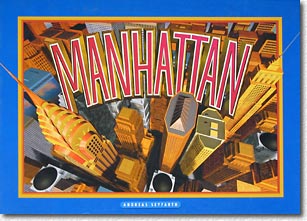 In „Manhattan“ geht es darum, Häuser bzw. Türme zu bauen: möglichst viele, die meisten in einzelnen Städten, und am besten den aller höchsten.Zu den Regeln/Spielablauf:Zu diesem Zweck ist der eher funktionale als hübsche Spielplan in 6, jeweils 3×3 Quadrate große Städte, aufgeteilt. Die tragen Namen wie Kairo, Frankfurt oder eben auch Manhattan.
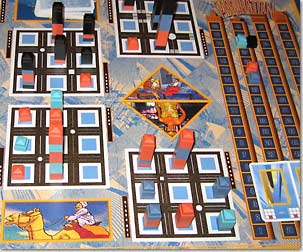 n oft nur zwei Möglichkeiten ein Bauteil zu setzen, da man oft eine Karte doppelt hat und eine zweite Karte nur auf Quadrate verweist auf denen man nicht bauen kann, da dort bereits große Türme stehen auf die man nicht setzten darf (weil eine andere Farbe zu viele Stockwerke hat). Das bedeutet aber auch, dass die Züge recht flott gehen und man schwer gezielt gegen jemanden spielen kann. Dieses wiederum verhindert einen starken Kingmaker-Effekt.
 e table. The two newcomers to the game were quite intrigued by the „real life“ appeal the game seems to convey: players are dealing with the commodity market, are drilling for crude oil and are busy in refining crude and selling petrol. All business transactions are influenced by the current economic climate, which may change every time doubles are rolled. This already points to a serious problem of the game: the element of luck has a much to large an influence. Almost everything in the game is controlled by the roll of two six-sided dice: finding an oil well, pumping crude, refining crude and selling petrol at gas stations.
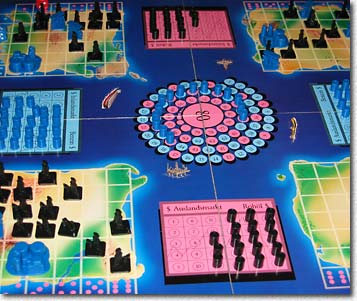 In our game we rolled almost no doubles for the first half of the game, causing to economic climate to stay moderate with medium equipment prices and an ever decreasing petrol price. In this situation turn order becomes a significant element once a double is rolled and prices suddenly change dramatically: those how can now sell petrol are very well off as well as those (more often than not the same players) who have sufficient money available to take advantage of the now dropped equipment prices. If you are really hit by bad luck the economic climate changes again before you even had a chance to take advantage of it.This not being enough the game also uses „event cards“, which can cause all sorts of positive or negative effects on players. Although a potential event is revealed before it actually comes in effect there is not too much sense in planning ahead here. Events, too are controlled by the dice and it is by no means certain that a revealed event will actually happen, it might just as well be replaced by another event card.
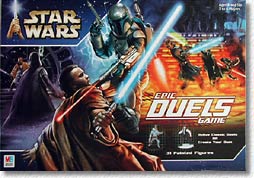
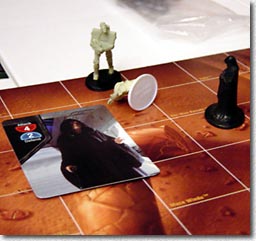 Although Mace was able to damage Count Dooku considerably he couldn’t prevent being killed – sadly the clone troopers didn’t fare better. Yoda was able to give Dooku the finishing blow, but Dooku’s robots had survived and annoyed the hell out of Yoda with sneaky shots from the distance. In the end Yoda was only able to scratch the emperor (who simply healed himself again and again), and succumbed to the concentrated use of the emperor’s „3 damage cards“.
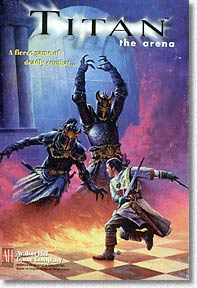
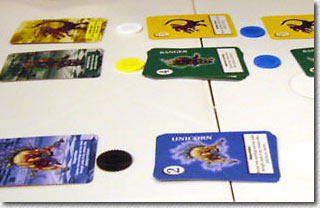 Constructive cards are high cards played on your own monsters. This is the only benefit these cards have. They will usually be an invitation for other players to downsize them with another card played on them. This will mean that you will have to act again by playing ANOTHER high card on your favourite monster. You will end up being dependent on the survival of your own monster, never having the chance of influencing the game in another way (the „offering“ of a round end to other players is essential).If you play a negative „low“ destructive card on other player’s monsters, you achieve two things with one play only: you weaken their monster, forcing them to play more cards to strengthen their monster, and strengthening your own monsters, which are hopefully stronger than the new weaker monsters. You ACT, they REACT. Try to be the ACTING player as often a possible, and you’ll keep in control of what’s happening, and when combat rounds will end.This rule will have to be adapted towards the end of the game, when combat rounds are short. It is then usually better to support your monster with a strong card, as each player tries to end the combat round as quickly as possible.
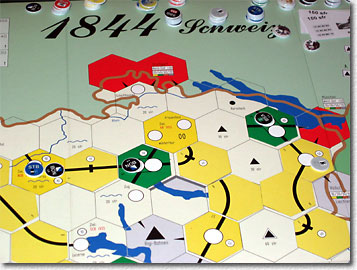

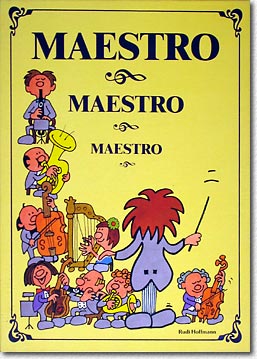 Just a few short word about Maestro, a Rudi Hoffmann attempt that has been one of the nominees of „Spiel des Jahres“ in the year 1989. Each player owns an agency of musicians. A maximum of 10 artist tiles can be placed in the agency (up to 3 per turn drawn randomly from a sack). Each musician plays a instrument and its the players‘ task to place their musicians on one of the 10 pieces (from Darius Milhaud’s duo Scaramouche to Rudolf Kummerer’s septet Alpenjägermarsch) that require these musicians.
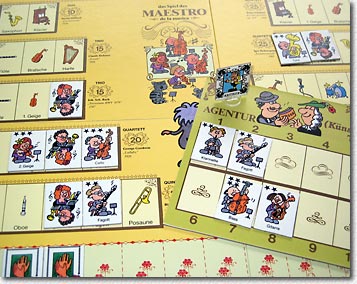 Sounds simple enough and not very challenging in terms of tactics but there are a few things which make the game more demanding than one first thinks. First of all, the agencies are split into a public and a private section, allowing players to hire artists from the public parts of all other players‘ agencies. This makes filling the slots a little tactical (and risky) as players want to place important (i.e. rare) musicians in the private slot of their agency. On the other hand these slots yield a lot more negative VPs when still filled with artists at the end of the game.
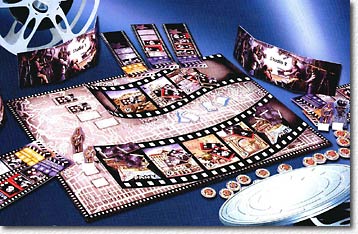 The game is played in four rounds and each round has 6 auctions and 2 parties. The two to three artists available at each of the six auctions of a round are randomly drawn and are revealed at the start of a round so each player is able to decide on a suitable bidding strategy for the complete round. The artists available at the two parties (one artist per player) are not revealed in advance and they are not auctioned off but are selected by the players in sequence based on the number of already hired actors of a player.At the start of the game each player receives money for bidding in an auction and after each auction the money bid is paid by the highest bidder and distributed equally amongst the other players (any modulo is saved for the next auction). As soon as a player has filled all available slots and the VPs have been assigned they draw the next movie from an open pile.
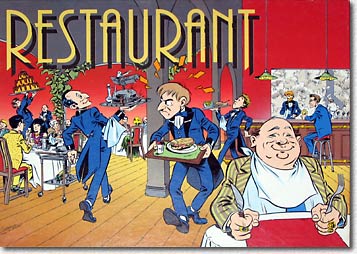
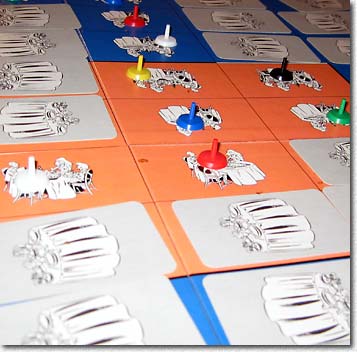 Many problems become apparent in the description already. The worst aspect of the game is the fact that the luck of the card draw is actually heightened by being able to use them twice (you keep all your cards and go through them again). The „Jump“ and „Go Twice“ cards are the worst offenders. „Jump“, for example, not only gives you the ability to spread your pawns to other areas of the board, no, you can use it again to safely place your cards on your tables in the next phase (which otherwise is very difficult to achieve). This makes the drawer double lucky (and the other players look on sheepishly). In our game I only drew menu cards and two reservation cards. Most of the cards were stolen by other players with their „fast food“ cards, until I could use the reservation cards to protect the other cards. The second phase started with Peter and then Guenther played a jump card to place an order in a dead end, thereby ending the game without giving anybody the chance to do anything. As he had earned the most points in the round before, he therefore also became the winner. My reservation cards now pushed my negative points to the max, and I didn’t even get to have a turn!
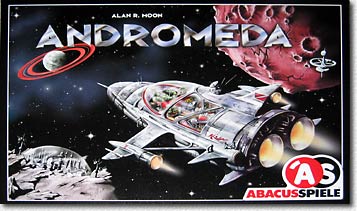
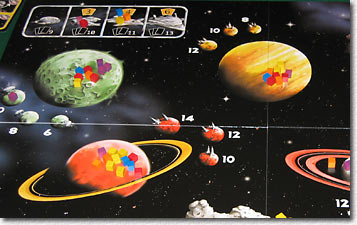 At the start of each turn, you complete your card hand to 9 cards (or more, depending on technological advances). As you can guess by now, the winning strategy of this game is (apart from shaking the Gate in a way that your cubes exit) drawing identical cards of the planet you are interested in. Okay, there is a way for trading cards between the players. However, it is highly formalised. The starting player of each turn offers one planet card. All other players must offer him a different (i. e., different from his offer) planet card in return. Then he offers a second card, and the others must offer another card which neither matches his first or second card. This can be repeated once (or twice, with a certain technological advance). The starting player now has to change this offer with the one of another player, who in turn can accept the starting player’s offer or turn to another player’s offer instead and so on.
 Was gilt es zu beherzigen?
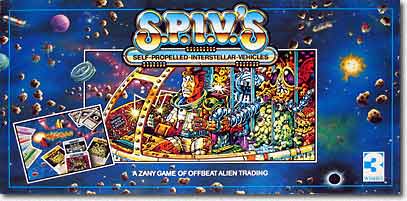
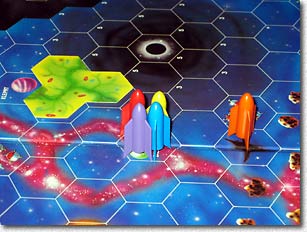 Jeder Spieler besitzt ein Raumschiff mit 4 „Cargo-Holds“, also Frachträumen. Ziel des Spiels ist es, allerlei skurrile Aliens auf den Planeten einzusammeln und auf den Raumstationen zu verkaufen. Es gibt 3 verschiedene Sorten von Aliens, mechanische, organische und steinerne, die wiederum in vielfacher Form daherkommen.