Westpark Gamers

Neueste Einträge

Spiel 2003 – Search for the uncommons

Sebastian and I travelled to Essen on Saturday, which means getting up early to catch the first flight out of Munich. This year our plan was to search for and play games of foreign or small publishers as all games of the major German publishers would be available soon through plenty of online stores. And coming from Munich we will have the chance to play these games at the Munich „Spielwiesn“ beginning of November anyhow.

Jim Doherty of Eight Foot Llama Due to very good connections at Düsseldorf airport and Essen main station we arrived earlier than usual at about 9:40 at the Gruga gates. Queues had already developed outside, but quite to our surprise not at the ticket offices as in the years before but rather at the entrance itself. We guessed that a lot more visitors were making use of the possibility to buy tickets in advance.

At 10 o’clock sharp the doors were opened and the crowds started to rush inside. Except for a brief visit at some of the game material suppliers‘ booths looking for small wooden disks to complete my „Marchants d’Empire“ (to no avail – none were small enough) we decided to ignore halls 12, 11 and 10 for the morning and moved straight in to hall 9.

There we found the booth of „Eight Foot Llama“ and a very friendly Jim Doherty, who played his „Monkeys on the Moon“ with us. Sebastian liked it very much while I had some minor doubts because I got the impression that the game didn’t have much depth (having played it twice since I have changed my mind, though). Nevertheless, I decided to buy a copy in addition to Jim’s first game „Who stole Ed’s pants„, which I remembered having had a favourable review in the print edition of „Spielbox“. Jim’s latest release „The Penguin Ultimatum“ didn’t attract our attention as we believed it to be a children’s game – wrong, as we now know.

Marcel-André Casasola Merkle with Attribute

Our next visit was to the Lookout Games booth where we had the chance to meet Marcel-André Casasola Merkle, who was busy with explaining the English release of „Attribute“. At that time hall 9 had become very crowded already and it was time to move on. We decided to go to hall 6 – the hall of fantasy games and role-playing. Sebastian wanted to check the various sellers of „Magic the Gathering“ cards in order to strengthen his card deck. Our first stop was at the Fanpro booth – not only because of the spray painted barely dressed girl posing as a warrior but also to have a look at their „Mageknight“ offerings. As always, the hall was crowded with people in fancy, fantasy style clothes looking anything from frightening to rather cute. Have a look here and you will know what I mean…
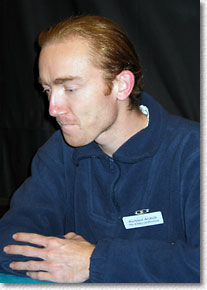
Richard de Rijk playing Atta AntsWhile Sebastian was flipping through lots of Magic card folders at the various booths I roamed the hall in search for some interesting games when my eyes caught sight of the „The Real of Fantasy“ booth. They had their fantasy game „Anera’s Arena“ on display plus their new game „Atta Ants“ by Richard de Rijk. After a brief explanation we had a game with three players and I was immediately fascinated by the game. Since the game material is of high quality and the game comes at a very reasonable price I bought one immediately.

My next stop was at the „DragonLords“ booth which took me some time to find (the numbering system of the booths seemed to me to be not always intuitive). There I wanted to have a look at „Crystal Powers“ the expansion set to „Quest for the Dragonlords“, which actually was playtested by some of the Westpark Gamers. The guys at the booth were very friendly and enthusiastic about their game and judging by the amount of visitors they had I think they were quite right to be so.

Crystal Powers Expansion Set

Feeling hungry – it was 2 pm by now, we started our way back to halls 10 to 12 to grab some food there and to rest our already aching legs. On our way we passed the Winsome Games booth where we hoped to meet Helmut Ohley. As we were told all of the 1844 game copies he brought to Essen had been sold by Saturday and apparently he was now roaming the halls himself.

On our way to hall 12 we passed by a little booth (can’t remember who it was) where they sold the German „Cosmic Encounter“ Avalon Hill/Hasbro version for a mere 15 Euros. At that price I could not resist as I like the game a lot. And not being a real collector I am more interested in the game itself rather than being upset about the ugly and cumbersome game material AH/Hasbro decided to use as „enrichment“. The only unfortunate thing is that this release is a four player game only (as opposed to the original EON release).

Die wilden FussballkerleHaving had something to eat we started to look for a free table to take a little rest and play one of the new games of the major German publishers. But not really to our surprise we had difficulties finding a place to sit. During our search we met Günther, also one of the Westpark Gamers, playing „Die wilden Fussballkerle“ at the Amigo booth (booth really is an understatement as Amigo always covers a big part of hall 10 with lots and lots of tables). He and his companion were not really happy with the game, which came as a surprise to me as it got some good reviews. Sebastian and I were lucky to grab a free table at Amigo and found ourselves playing „Coyote„, which was explained to us by one of the „KidultGame“ hostesses there. The game requires that all players wear a headband (photo) making them look rather funny and Sebastian became very embarrassed about the way he looked and was glad when the game was over.

Coyote

Then I remembered that „Doris & Frank“ were supposed to have published an expansion set for their „Urland“ so we continued on to their booth. Unfortunately, I had forgotten that the expansion merely was a set of new genes, so we moved on to Cwali’s booth to have a look at their new games. We had a brief look at „Logistico“ with an explanation by one of the guys at the stand (not Cornel) and decided that it’s not something we want to buy.

Opposite the Cwali booth was Mike Lasher’s „Globopolis“ on display – much smaller than last year’s. Mike didn’t look all that happy and a quick chat with him revealed that sales figures of Globopolis still aren’t what he had expected.

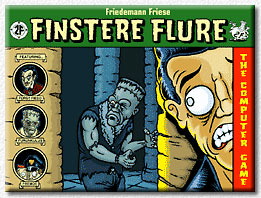
At the other end of the hall I had a look at Friedmann Friese’s 2F booth and his new game „Finstere Flure“ while Sebastian decided to play „Magic – The Gathering“ against a few rookies at the Amigo stand. Since all playing slots for the rest of the day had been booked I had to content myself with just watching a group play the game with Friedemann providing instructions and hints. The game definitely looked interesting but since I had seen a copy in Günther’s bags I decided against buying one.

Alhambra playing area in hall 9By now it was 6 pm with just one hour left and I picked up Sebastian to have a look at the „BeWitched“ booth right next to 2F’s. In the morning I had seen Andrea Meyer there explaining and playing her new game „Schwarzarbeit„. By the time we arrived at the booth she had left but the very friendly folks from Drübberholz were still available. First we got a short introduction into „Schwarzarbeit“ by Martina Hellmich after which we played a shortened version of the game with only cards from A to M. Maybe it was because it was already quite late (we had gotten out of bed at 5 am that day) but neither Sebastian nor I were able to follow the game enough to make good decisions. I suspected that the game really is a brain teaser with the amount of deduction and good memory required. Although I won in the end, „Schwarzarbeit“ did not convince me to be a game I’d like to play often. Martina was then joined by Thorsten Gimmler and Hartmut Kommerell and we decided to have a go at their game „Ludoviel„. This card game about games requires a good amount of knowledge about games to be able to play it and I believe that it may be very attractive to real geeks.

By the time we had finished „Ludoviel“ it was time to leave as the fair was about to close its doors. Again, the „Spiel“ fair was a very enjoyable but also demanding event for us. We didn’t see as many new releases as in some of the past years but the general atmosphere was rather pleasant and it seemed to be more relaxed than in earlier years.

Spielemesse Essen 2003 – Ein Bericht mit Augenmerk auf "Freak-Spielen"

Wie immer bin ich in Essen auf der Suche nach Spielen, die es in unseren Münchener Spieleläden nie geben wird, ganz im Gegensatz zu den großen deutschen Neuerscheinungen, die einem dann in jedem Obletter um die Ohren gehauen werden. Und natürlich interessiert mich besonders alles, was mit SF, Fantasy, oder Horror zu tun hat. Hier also mein kleiner persönlicher Bericht…

Dwarven Dig cover

Leider konnte ich nur einen einzigen Tag auf der Messe verbringen, und das war ausgerechnet noch der Sonntag, der schlimmste Tag bei dem schon alles ausverkauft ist, und sich Massen von LARP’ern und kreischende Kinder durch die Hallen drängen. Da mein Zug auch noch Verspätung hatte, verlor ich noch gut eine halbe Stunde, also versuchte ich erst mal im Schnelldurchgang einen Eindruck zu bekommen. Natürlich führte mich mein Weg sogleich in Halle 6 (wo die meisten ausländischen Spiele präsentiert werden, und sich vor allem die Fantasy Fans aufhalten), um mein alljährliches Ritual zu beginnen: Die Suche nach dem Spiel „7 Ages“ der australischen Firma ADG, eine Art „Advanced History of the World“ mit riesigem Spielplan und tollen Regeln, das schon seit Jahrzehnten angekündigt wird, aber nie erscheint. Diesmal waren noch nicht einmal die ADG’ler selber da, sie ließen sich von ein paar Kosimfreaks vertreten, die dann auch fröhlich verkündeten, das Spiel erscheine „ganz bestimmt“ nächstes Jahr (so wie auch schon die letzten 20 Jahre- nun gut, ich übertreibe). Nachdem dieser wichtige rituelle Teil also über die Bühne gebracht war, hatte ich den Kopf frei für anderes, und konnte mich in Ruhe umsehen. Alte Bekannte wie „Kenzer & Company“ („Dwarven Dig“ war schon ausverkauft, aber gut, es soll nicht spitzenmäßig sein…) und die Jungs von „Quest for the Dragonlords“ waren natürlich wieder da. Letzte präsentierten stolz ihr neues Expansion-Set für „Quest for the…“, Quest for the Dragon Lords playtester listund siehe da, da sind auch die „Westparkgamers“ verewigt, als Spieltester!

Robert Johannesen (Spieldesigner) war über unsere detaillierten Spieleberichte immer noch so begeistert, dass er mich sofort zum Essen einlud, und dabei gleich so nebenbei fragte, ob ich nicht Lust hätte, einige Tausend Spiele für ihn zu lagern und in Deutschland zu vertreiben. Es könnte ja sein, dass ich Lust hätte, mich „beruflich zu verändern“. Nun, vielleicht ein anderes Mal, lieber Robert ;-)

Aber im Ernst, ich freute mich zu hören, daß „Quest for the Dragonlords“ so ein riesiger Erfolg ist, denn hier handelt es sich nicht um eine große anonyme Firma, sondern um ein echtes Freakprojekt, in das viel Liebe und privater Schweiß hinein geflossen ist. Tatsächlich war der Stand der „Dragonlords“ geradezu umlagert von Fans, die Expansion-Set wie Basis-Spiel in Mengen kauften, und das nur wegen des positiven „Word of Mouth“. Ich hatte Glück, überhaupt noch ein Spiel zu bekommen!

Insgesamt war ohnehin zu beobachten, dass nach den 2 letzten eher mageren Jahren wieder ein deutlicher Auftrieb im Spielgeschäft zu beobachten war, was mir auch alle Aussteller, mit denen ich sprach, bestätigten. Dieser Erfolg hängt natürlich auch mit vielen neuen innovativen Spielkonzepten zusammen, die sich erfolgreich vermarkten lassen, aber nicht notwendigerweise Sammelkartenspiele sind. Zwar dominierten letztere immer noch das Geschehen, vor allem „Yu-Gi-Oh“ (das neue Pokémon) und „Lord of the Rings“, weniger war dagegen vom Genre-Veteranen „Magic-The Gathering“ zu sehen (und auch deutlich weniger Einzelhändler, die Karten zum Tausch anboten). „Lord of the Rings“ allein hat wohl der Spielebranche zu dem jetzt spürbaren Aufwind verholfen, denn sicherlich sind viele über die Filme überhaupt erst in das Hobby eingestiegen.

Gestiegen war auch die Zahl der „Verramscher“ – an einem Stand wurde das zugegebenermaßen üble Sammelkartenspiel „Star Trek – TOS“ sogar zum Preis von 2,-EUR pro Boosterschachtel angeboten (also zu ca. 2% des alten Preises). Manche etwas älteren Spiele waren sogar überhaupt nicht mehr existent, noch nicht einmal bei den Sammlern und Privatverkäufern!

Am interessantesten unter den neuen Sammelkartenspielen wirkte das Spiel „Cnihee“, das sich auf den zweiten Blick als ein extrem textlich überdesigntes „Behind“ (fishtank games) entpuppte (falsch rum von mir gelesen).

Die „andere“ Sammelszene dominieren dagegen momentan eindeutig die „Wiz-Kids“ mit ihren inzwischen 4 Sammelfigurenreihen „Mage Knight“, „HeroClix“ etc., aber diese Spielidee bekommt auch Konkurrenz vom „Lord of the Rings Collectable Miniatures Game“ und dem neuen „Dungeons & Dragons Collectable Miniatures Game“, die beide allerdings noch eher bescheiden auftraten. Von ersterem ließ ich mir ein paar Packungen aufschwätzen, leider sehen die Figuren toll aus!

Das groß gehypte „Shadowrun“-Figurenspiel war dagegen nur mit der Lupe zu finden (obwohl die Figuren riesig sind).

Tiefpunkt des Sammelwahns war irgendein doofes Spiel mit Plastikschlüsseln, die man ineinander schraubt, und dann ist einer der Schlüssel kaputt. Den Namen habe ich Gott sei Dank vergessen.

Zu bemerken war weiterhin der Vormarsch der „LARP“er, also der Live-Rollenspieler, selten sah ich so viele Plastikschwerter und selbst gemachte Kettenhemden wie diesmal! Irgendwann wird ganz Deutschland nur noch damit beschäftigt sein, Fantasywelten zu „leben“, das ist sicher. Ich hab das ja früher auch gemacht, aber irgendwann ist man zu alt dafür.

Rückkehr der Helden box

Was gab es nun spielerisch zu entdecken? Am meisten fiel „Rückkehr der Helden“ von „Pegasus Press“ auf, eine Art Versuch, ein neues „Talisman“ zu kreieren. Auf einem modularen Board versuchen Spieler Abenteuer zu bestehen und Unholde zu besiegen, mit dem Ziel, so stark zu werden, dass die „Namenlosen“ besiegt werden können, die den Spielsieg bringen. Das ganze klingt bekannt, ist aber hier wohl mit Liebe umgesetzt worden, und sieht gut aus, Erinnerungen an „Magic Realm“ werden wach (obwohl das Spiel sicher nicht so kompliziert ist ist, und sich eher an ein junges Publikum wendet). Auf der Messe schien es sich gut zu verkaufen (es gab verschieden teure Versionen zu erstehen, manche sogar mit bemalten Figuren), und Pegasus sei der Erfolg gegönnt, denn viele gute Spiele dieser speziellen Gattung gibt es leider nicht.

Ähnlich sah das Spiel eines mir bisher unbekannten Kleinverlages aus („Giochi Rari“ aus Italien), das Spiel „Mamoonia„, scheinbar eine Art Wiederbelebung des legendären „Wizards“ von Avalon Hill, wurde in einer gigantischen Schachtel mit reichhaltigem Spielmaterial zum erstaunlich billigen Preis von 39,-EUR angeboten. Der recht große Stand war aber stets wie ausgestorben – die beiden Spieledesigner saßen grummelnd und unkommunikativ in der Ecke – ob sie wohl was verkauft haben? Ich musste natürlich auch hiervon eine Exemplar haben, vielleicht war ich der Einzige, der was kaufte….

Komplett ausverkauft war dagegen „Warcraft – The Boardgame“ (Fantasy Flight), das zweite von gleich drei neuen Computerspiellizenzen (die anderen zwei waren eine Brettversion von „Age of Mythology“, und Klaus Teubers (!) „Anno 1503“). Seltsam auch, dass man von allen 3 Spielen fast nur Gutes hört!

Ein weiterer Blickfang bei „Fantasy Flight“ war auch „A Game Of Thrones“ (nach einer in Deutschland nicht ganz so wie in Amerika bekannten Fantasybuchserie), das einen sehr guten Eindruck machte. Auch hiervon musste ich eins mitnehmen, ist doch klar, hat doch „Fantasy Flight“ in letzter Zeit doch sehr an Qualität zugenommen, immerhin ist sogar ein Reiner Knizia mit mehreren Spielen im Verlag vertreten (die er in Deutschland, immer noch Fantasyentwicklungsland, vielleicht nicht ganz so leicht raus gebracht hätte, basieren sie doch auf recht liebevoll ausgearbeiteten Fantasywelten).

„The Hell Game“ (veröffentlicht bei „Udo Grebe Game Design„) ist wiederum ein Fanprodukt – das Spiel war in den letzten Jahren als Prototyp beworben, man bemühte sich um 1000 potentielle Käufer, und voilà, hier war es. Erfreulich war zu bemerken, daß sich der Autor sehr viel Mühe mit der Gestaltung der Karten gegeben hat, auf das Spiel darf man auch wegen seiner dämonischen Thematik gespannt sein. Kritik folgt in Bälde!

Zombies 3.5Dass ich mich auch dazu hinreißen ließ, „Zombie 3.5“ („Twilight Creations Inc.“) zu kaufen – mehr Ereigniskarten für ein Spiel, das gerade wegen seinen Ereigniskarten nicht funktioniert, mag hier kontrovers diskutiert werden, ich tat’s trotzdem. Immerhin hatte „Twilight Creations“ einer Art Messepremiere, die wohl auch nicht erfolglos war.

Auffällig war, dass Wargames im Kommen sind – Es gab erstaunlich viele und äußerst professionelle Neuerscheinungen in diesem Gebiet, und man bemüht sich wohl auch, immer mehr von den altbekannten Regeltextwüsten und Hexfeldorgien wegzukommen. Auffällig waren aber auch „Zwitterspiele“ wie „Nero“ oder „Das Zeitalter Napoleons„, die neue Konzepte umsetzen, und auch politische und wirtschaftliche Simulationen sind. History of War boxGroßer Trend sind einfache, aktionsreiche Kartenspiele zum Zweiten Weltkrieg – und das auch aus Deutschland! Vor einigen Jahren wäre das noch als extrem „politisch unkorrekt“ empfunden worden.

An einem skurrilen japanischen Stand redeten zwei rührende Japaner in vollkommen unverständlichem Englisch auf mich ein, doch ihre tollen Fantasy-Kartenspiele anzuschauen (die mit üblicher Manga-Graphik daherkamen). Das eine war allen ernstes auf Japanisch, „but with English translation of cards on shit of paper“ – Die Vorstellung, dieses Spiel zu spielen, und irgendwelche Hieroglyphen mit denen auf zahllosen kopierten Blättern zu vergleichen, schreckte mich aber doch etwas ab. Das andere Spiel war allerdings zweisprachig auch auf den Karten selber, das erstand ich dann auch: Masquerade cover„Masquerade“ von „Yuhodo“. Die beiden Japaner hörten gar nicht mehr auf, vor Freude mit dem Kopf zu nicken über diesen Verkauf. So kann man Menschen leicht glücklich machen!
Überall stark beworben wurde „King Arthur“ von Knizia (das „sprechende“ Ravensburgerspiel mit Computerstimmengimmick), aber das Teil war mir doch zu grosse zum Schleppen. Und es wird eh bald überall zu haben sein. Genauso wie wohl auch Martin Wallace’s „Der Fluch des Pharaohs“ von Kosmos. Sein neues Spiel „Princes of the Renaissance“ (Warfrog) dagegen wollte ich mir auf keinen Fall entgehen lassen. Wallace wird immer mehr zum fleißigsten Designer neben Knizia, und seine Spiele können mit dem „Meister“ auch sehr gut mithalten (und es sind auch schon erstaunlich viele „Klassiker“ dabei). Wallace war wie immer erstaunlich uneitel als Spieleerklärer am Warfrogstand tätig.

Finstere Flure

Carefully the monster makes a step forward and looks down the corridors to its left and right. Again: nothing! Another step forward along the endless looking dungeon and… yes! To its right it discovers a human being and turns immediately towards it. Only a few more steps to grab the more than welcome snack. But isn’t this the same guy the monster saw just a few minutes ago? And what happened last time? The monster makes one more step forward and a sudden hiss indicates that it stepped into the teleporter – again. Once the fog of hyperspace has cleared the monster takes a new look: empty corridors! Damn – another hungry night. And faint cheering of humans somewhere very far away…

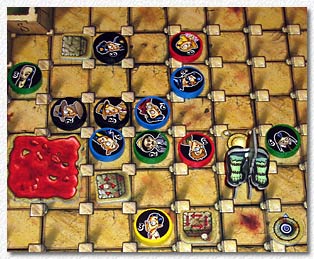
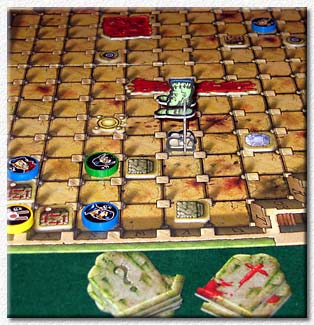
What sounds like a sci-fi monster movie is actually the setting of Friedemann Frieses latest game „Finstere Flure“ („Sinister Corridors“). A group of people controlled by the players (3 per player in a five player game) tries to diagonally cross a dungeon to return back to safety. However, danger lurks because of the monster roaming the dungeon. Depending on the setup (beginners or advanced level) the dungeon holds a various amount of obstacles: slippery puddles of blood, teleporters, movable rocks and monster redirectors.

Player figures move up to a fixed number of spaces printed on the piece and are flipped over once they have been moved in a round. The backside of a player piece always shows a different number of movement points, with front and back side adding up to seven. This results in identical average speeds of all pieces but provide some tactical options when moving pieces.

Finstere Flure board

Each round players move one of their pieces by the indicated number of spaces, beginning with the start player. Once all players have moved a piece the round continues with the start player moving another of his pieces. This continues until all player pieces have been moved. Movement is only allowed in horizontal and vertical direction. Blood puddles are slippery and irrespective of their length count as one movement step only. Obstacles like rocks can be shifted provided the space behind them is empty while teleporters may only be entered by the monster.

The monster’s movement follows a simple fixed algorithm: it makes a step forward, takes a look to its left and right and continues into the direction of the closest player piece it sees. If it doesn’t see one or there is a tie regarding the distance to two or more pieces it continues to move forward. Once it enters the space of a player piece it „eats“ the piece which is returned to the player in the first half of the game (in the second half it is out of the game). The number of spaces the monster must move is randomly determined by turning over a gravestone card which either shows the number of movement points or a single or double cross indicating the number of player pieces it should kill this turn spending not more than 20 movement points.

Finstere Flure board

The movement of the monster is therefore predetermined by the obstacles in the dungeon and the location of the player pieces therein. And this means, that players have full control about the monster’s movement and in principle can move in such a way that they safely reach the exit of the dungeon. The fun and tactics come into play when players try to steer the monster so that opponents‘ pieces are killed by the monster while at the same time lure the monster out of their own path to freedom. As one can imagine this is something all players want (and need) to do in order prevent another player winning the game by moving 2 (or 3 in a four player game) of his pieces through he exit.

While at the start of the game players usually co-operate because the playing pieces are located just too close together making it dangerous for everyone to lure the monster towards the group, players will take their earliest opportunity so separate from larger agglomerations of player pieces and at the same time steer the monster towards such groups. So even though the monster’s movement algorithm is predetermined it is by no means clear which path the monster will take until the last player has moved his pieces in a round. This provides sufficient chaos on the one hand while making coalitions and king making possible on the other.

I had the opportunity to observe a 4 player game of „Finstere Flure“ in Essen 2003. It was without the teleporters, the crystals and the monster diverters (i.e. the beginners version) and compared to the advanced version we played I have the feeling that the extra obstacles just add more chaos to the game as it becomes more difficult to correctly plot the monsters moves in advance – resulting inevitably in oversights. Another aspect is that in our game we managed (by chance) to use a good combination of teleporter locations and the placing of one player piece to create a very predictable circular trip of the monster without causing any danger to our pieces. This enabled us to cross about one third of the board without any disturbance by the monster resulting in remarks by some players that there was not enough challenge by the monster. That changed immediately, when the round trip path was broken up and the monster had eaten the first pieces.

Finstere FlureMy initial fears that the game would drag on endlessly with some of the Westpark Gamers (recently, a game of Atta Ants took more than one hour because of all the thorough thinking that was done) we were able to finish „Finstere Flure“ in just under an hour. Once Günther had moved his first piece through the exit into safety he became „enemy no. 1“ but it turned out to be far too difficult to precisely steer the monster towards his remaining pieces. Whether this was due to his clever placing, the unwillingness of others to create a suicide assassin or our lack of experience with the game is somewhat unclear to me.
All in all „Finstere Flure“ left us with some mixed feeling. No doubt the game mechanics work very well, the game material is excellent (the „build your own monster“ material is a rather nice idea). My personal opinion is that the game seems to be a bit too chaotic with five players and probably will appeal to me a lot more if played with four players or less. I can hardly imagine how that game can be played with the maximum of seven players without becoming an uncontrollable party game – not necessarily bad for a game but important to keep in mind.

Westpark Gamers ranking: 5.8 (out of 10)

©2003, Aaron Haag

Maya

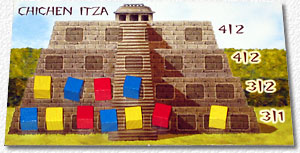
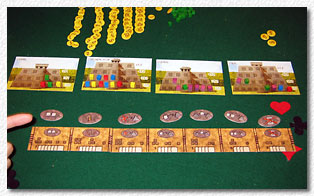
Games can’t get more German than this. If you’re fond of little wooden cubes and cherish a certain predilection for obtaining majorities, this game is for you. I’ll try to draw a rough outline of the game. I deliberately won’t attempt to mention every single rule.

As you expect from an El Grande style game, there are two different phases: Gaining cubes and placing cubes. The gaining cube phase has the players put face down cards at different places. Those different places pay a different number for cubes for the first, the runner-up and sometimes lower scorers. Additionally, they give special abilities to the winner (like: „place one cube immediately for free“ or „in the placing phase, miss one turn if you want“). As a rule of thumb, the more powerful the special abilities are, the less cubes you can earn at that place.

Each player has the same set of numbered cards which are, as already said, played face-down. Contrary to games with similar mechanics („Corruption“, „Caesar und Cleopatra“) which tend to be more or less luck-driven, Maya introduces two different backsides for those bid cards. This means you can see whether a player is really interested, even if you cannot know whether he played 6, 7, or 8. Or, you see that he only played 3, 4, or 5 and so he is probably satisfied with a third place.

Aaron complained after the game this approach still involves too much luck. Well, yes. It’s frustrating to lose a place by one point (or even the tie-breaker rule). On the other hand, games need some luck element. In any case, it’s a much quicker and much less chaotic way to gain cubes than „Venezia’s“ built-in pigeon wargame. And I was impressed that in our 5 player game players always got 7-9 cubes (with 9 being quite rare) – this implies thorough game testing.

The placing phase has some interesting new ideas, too. Most surprising perhaps is the tie rule. Imagine two players with two cubes each and three players with one cube each. In most games, the 2 players would share the victory points for the first and the second place. In Maya, both get the full number of victory points for the first player, and, even more astounding, those 3 players get all the number of victory points for the runner-up. In most games there are scoring areas which you can completely ignore. But in Maya, it is always possible to get points with just one cube. This makes the game more thrilling.

All El Grande style games need a mechanism for removing cubes. In Maya, each player who scored loses a cube (so in our example, each and every player loses one cube, leaving a single cube of those two players who have two cubes each before).

And there is another surprising element: The scoring areas are different levels in the pyramids which afford more victory points the higher up you get. All first levels have to be covered before you can place in any second level and so on. You are not allowed to put a cube in a level if there aren’t any cubes of yours in every lower level of the same pyramid. This means: often, you just put one cube in a pyramid to keep your options for high levels. But woe on you if you happen to score with your single cube – remember it gets removed, and if it was indeed your last in that particular level, all cubes from higher levels are removed as well.

It can be very confusing to read descriptions of games you haven’t played, and this was perhaps already confusing enough. However, my main point is that Maya offers a dazzling variety of tactical choices, and I tried to convey that. Perhaps I am a little bit over enthusiastic (compare how other WPGs scored the game) but for me it is the best El Grande style game at this time.

Westpark Gamers ranking: 7.8 (G: 8, P: 9, A: 6, H:7, W:7)

©2003, Peter Riedlberger

Princes Of The Renaissance

Review by Moritz Eggert

One of the games that I awaited most in Essen was this new offering from Martin Wallace, who is increasingly becoming one of the best and prolific game designers in the gaming world. So it was easy to talk everybody into trying out this game immediately after the fair.

„Princes of the Renaissance“ (or PotR) is thematically very close to games like „Princes of Florence“ or „Age of Renaissance“ – Players are noble families in Renaissance Italy who vie for power and influence in the various large cities of the time. The game covers three decades of intrigue and war, and each decade equals one round with an undetermined number of player actions (a decade ends when all 4 event cards of the decade have been auctioned off). After the third decade, victory points are counted (quite an involved process – but more about that later) and the winner is decided.

First each player selects a noble house of the 6 available ones – each family has one small special ability connected to one of the game mechanisms, two families can buy artists (most of the events are artists who give you victory points or raise the status of cities) one gold cheaper for example. As you buy perhaps 2 or 3 in a complete game this is not really that big an advantage – you save only 2-3 gold!

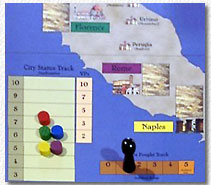
Then the game begins: On the relatively small board the 5 major Italian cities of the time are depicted: Venice, Rome, Naples, Florence and Milan. Each city has a marker which shows its status at the beginning of the game: Status can range from 3 (lowest) to 10 (highest). Princes of the Renaissance - correct setupATTENTION: The first edition misses any mention of where these makers start – These are the correct starting positions: Venice 7, Florence/Milan 6, Rome/Naples 5!
Each city has 6 tiles connected to it which can be bought after a player auctions them off. These tiles work a little like shares in 1830 – The city status will change during the game through wars and artists, and at the end of the game the value of the city’s status will be transformed into a point value between 10 and 2 that will be the net value of each of the owned tiles. A player can buy a maximum of 6 tiles of up to three different cities, so great care has to be taken when buying tiles.

In addition all tiles have some special ability, which is historically flavoured. Merchants earn money, the Borgia family excels in treachery and gets free treachery tiles (see below), some historical personalities give bonuses with certain army tiles, and so on. The different abilities are quite daunting at first play (one has a selection of 5×6 tiles plus the pope tile at the beginning of the game), and you should take your time to look at and explain all the city tiles before starting the game, as they are the most important element of the game.

Each player takes one action when it’s his/her turn. One can either buy one tile of the various groups of army tiles (these give bonuses in defence or attack when war looms) or one of the random treachery tiles, using the two currencies of the game, influence (square tokens) and money (round tokens). Treachery tiles function like event cards that give players advantages – one tile paralyzes one army tile in war through bribe, another prevents the next player from bidding higher than you, and so on.

Or one can auction off a city or event tile – the first bid of a city tile has to be double its influence, so successful cities become increasingly expensive! The third option (apart of simply passing) is starting a war, which is always very exciting. The warmonger determines an attacking city and a defending city. Then „condottiere“ rights are auctioned off, first for the attacking city, then for the defending city. Each condottiere also earns the value of the city in money as a fee for fighting, but this can only be collected at the end of the decade. Now each combatant rolls a die, adding the various bonuses of his armies and special abilities. The higher result wins – now the winning city gains one status (or two, if the result was double that of the defender), and the losing loses one (or 2) status. In addition the winning condottiere gets one „victory“ marker, the more you have of them the more dramatic the victory point gain.

There can be a maximum of 4-5 wars per decade (depending on the number of players), but it is also possible to have a couple of „extra“ wars by playing certain treachery tiles.

Players can either „push“ the decade end by auctioning off the 4 event tiles, or delay it as long as possible. But before long money and influence run out, and the actions become increasingly limited – so one moves on to the next decade. Now each player gets his basic allowance in money and influence, which can be increased by income from wars and income from special tiles owned (for example „Merchants“).

A special tile deserves to be mentioned: The Pope, which is a single tile that „leaves“ the player after one decade. The Pope gives the special ability of being (once per decade) able to assist another player in a war without being part of it. The Pope becomes especially interesting in the last decade, when he gives 3 extra Victory points.

After the third decade the game ends. Now each city tile gives VP’s as explained above, but also other tiles like artists might give extra points. The player with the most and second most money gets 6 or 3 VP’s, the player with the most influence 4. The Victory counters from wars also increase the tally considerably, if you have lots of them.

So how does it play? As with many of Martin Wallace’s games, there are many ways to win. One can play the game as a kind of historical stock market game, watching the city tiles that other players buy and trying to be on the sunny side of business. Or you act aggressively, building a large army that attacks the cities of your enemies to destroy their value. Or you act treacherous, deviously stealing influence and money from other players via the use of special abilities and treachery tiles.

The rules are elegant and simple (they come on 4 pages, one of which is a long example of play), and the first game should take around 3 hours with 4 players. But be warned – it is very difficult to decide what to do sometimes, as the choices are overwhelming (especially in the first rounds of play). Even our experienced group seemed a little befuddled at first. But quickly the game runs at a good pace, as the actions of each player usually don’t take long, and there is loads of interaction through the bidding and the treachery. Through the complicated victory point calculation the winner can be something of a surprise, which is not necessarily bad.

Comparable games that come to mind are „Republic of Rome“ (through the role of wars) and even „Puerto Rico“, as there seem to be many strategies that can be realized by the careful selection of city tiles and their special abilities. The only complaint was that some of the treachery tiles were considered a bit annoying – The „Pope“ cost reduction tile was useless after the pope was acquired, and the „steal 3 gold“ or „steal 2 influence“ were regarded as bringing too much needless „little“ aggression into the game – Walter was especially annoyed by them! Also the game’s graphic design, although generally good, was considered confusing – the German and English tiles use different colour codes for the gold symbols for some reason, and the army tiles confusingly use squares differently than in the rest of the game, which doesn’t make them easy to decipher. And of course there is the omission of the city start status on the board itself. But „Warfrog“ is a small company that tries very hard (and successfully) to produce professionally looking games in sturdy boxes, so these are minor complaints, especially when you compare them to the sometimes incredibly awful typo orgies of Euro Games for example.

Our first game was not yet an extensive insight into the game, certainly one would play the next game very differently, and the one after it probably as well. This is, all things considered, certainly the sign of a good and lasting game design. In our opinion: Highly recommended!

Westpark Gamers rating: 7.5 (on a scale of 1 to 10)

©2003, Moritz Eggert

Session Report 25.10.2003 – Spiel 2003

Booth: The Realm Of Fantasy

On the table: Atta Ants

The Saturday in Essen’s Spiel fair tends to be the busiest day of all and there was no difference this year. In the past I had avoided staying in hall 6 for too long – the fantasy gamer’s hall – as it is usually packed with people (and because I am not too interested in fantasy games anyway). This year was different, though, due to the fact that my son was looking for extensions to his Magic – The Gathering card collection. As in previous years he was quite impressed by the folks in the hall as many, many dress up in fantasy game style; some looking really frightening while others, especially the girls (am I really developing into a dirty old man?), were looking rather cute.

While Sebastian was flipping through the folders of the card dealers I spent my time roaming the hall. And there I found this small booth of „The Realm of Fantasy„, a Dutch fantasy game mail order company. Richard de Rijk, the founder of TROF presented his two games: „Anera’s Arena“ published already two years ago and his brand-new game „Atta Ants„. This little game about leaf cutting ants immediately caught my attention so I sat down and had an introduction into the game.

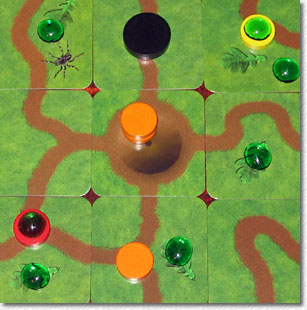
Atta Ants is a 2 to 4 player game with a variable board layout. During the setup phase 8 tiles (good quality cardstock) are placed around a central „ant nest“ tile. The tiles represent terrain around the ant nest. Most of the tiles have brown „tracks“ printed on them, which represent the preferred route of roaming ants. Some of the tiles carry atta ant food, represented by an oak leaf while others have a little spider printed on them – spiders are the enemy of the atta ants as they feed on them.

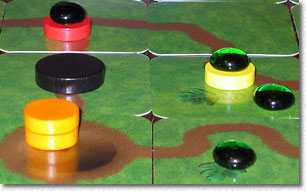
Each player has 6 ants represented by colored wooden disks. Once the initial board has been setup by laying down the first nine tiles, each player places 2 of his ants in the central nest. In addition all tiles with a spider illustration receive a larger black disk representing a spider (there is a maximum of four spiders). Any tiles with leafs receive 2 glass tokens representing food.

Atta Ants - board

The players‘ task is it to collect the food tokens with their ants and to bring the food back to the nest. For each food token returned to the nest the player may place one new ant into the nest. The first player who has placed all 6 ants on the board wins the game. Alternatively, the game ends once all 24 terrain cards have been placed. In this case the player with the most ants on the board wins. This would be all too easy were there not movement restrictions and the deadly enemies of the ants.

Each round begins with the start player adding one new tile to the board. New tiles must extend any existing ant paths and must match with already existing tracks. Once the tile is placed the start player moves his ants: Ants may travel a distance of up to 2 tiles on the ant paths or 1 tile through the „rough“. At any time during its movement an ant may pick up one food token, either from the ground or from another ant. The round then continues with the next player moving his ants. Once all players have moved their ants the start player completes the round by moving the spiders. Spiders move only one tile and into the direction of the tile holding the most number of ants (excluding the nest). If there are more tiles like this, spiders will move towards the closest one; if there is more then one possible route the start players decides which route the spider will take. If a spider ends its movement on a tile with ants it will eat all of them and the ant tokens are removed from the board and given back to their respective players. The startplayer position then moves on in a clockwise fashion.

Atta Ants by TROF

On the booth we had a three player game and on the same day I played three more two player games in the evening with Sebastian. What is surprising to me is how different the game works in a two vs. a multi-player setting. While with two players the game can become quite a brain teaser when considering the right routes to take for your ants and the spiders. The game has a completely different „flavor“ with three (and possibly four) players. With more then two players it is of course much more difficult to precisely plan ahead and to build „traps“ for the opponent’s ants. It is much more important to stay clear of the spiders and to correctly time the picking up of food so Richard de Rijkthat other ants cannot steal it from your.

The friendly girl at the booth pointed out that a good move is to set up a „delivery chain“ which makes it possible to move food into the nest in just one turn (I leave you to sort this one out by yourselves) and it seemed to me that this may be vital for winning the game. Another important thing to consider is to actively „steer“ the spiders: As spiders always move into the direction of the tile(s) with the most ants on them it can be very wise to move one of your ants onto a tile which holds already some opponent’s ants. Particularly in a two player game this is one of the tactical moves you can make when you are NOT the start player. In a multiplayer game it can be wise to team up with one opponent for „spider steering“.

All in all, „Atta Ants“ is a very nice game. It has high quality components, can be explained and played in under 45 minutes and last but not least works very nicely as a two player game as well as a multi-player game. I’m curious to see how it will work with the rest of the Westpark Gamers.

Westpark Gamers score: 7.0

©2003, Aaron Haag

Session Report 22.10.2003

at the table: Walter, Hans, Aaron, Moritz

on the table: Shipwrecked

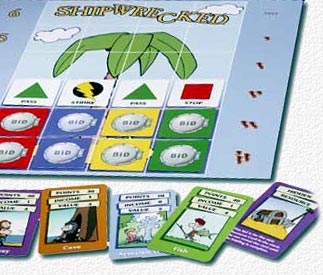
Ein Versteigerungsspiel um Karten, die einerseits Punkte für den Sieg und andererseits Einkommen für die nächsten Versteigerungen liefern. Eine Versteigerung läuft in 1 bis 6 Runden ab, in denen jeder Spieler jeweils eine Gebot-Karte ausspielt. Es wird nicht offen geboten, sondern die Karten werden verdeckt ausgelegt, wobei sich die verschiedenen Karten nach Art von „Stein-Schere-Papier“ gegenseitig ausstechen.

Shipwrecked Material

Wer eine Stop-Karte legt, kann die Versteigerung beenden. Er hat die Versteigerung aber nur gewonnen, wenn in dieser Runde keiner eine Strike-Karte gelegt hat, und wenn kein weiterer Spieler eine Stop-Karte gelegt und dabei in den vorhergegangenen Runden mehr Pass-Karten gelegt hat.

Wer eine Strike-Karte legt, hat die Versteigerung gewonnen, wenn ein anderer Spieler eine Stop-Karte legt UND mit dem Wort „Stop“ die Versteigerung beendet. Und wenn natürlich kein weiterer Spieler eine Strike-Karte gelegt hat. Wer eine Pass-Karte legt, sammelt nur Tie-Breaker-Pluspunkte, für eine spätere Runde, in der er die Stop-Karte legen und sich gegenüber seinen Stop-Konkurrenten durchsetzen will.

Es geht also im wesentlichen um ein psychologisches Glücksspiel, bei der man die Taktik seiner Mitspieler im Einsetzen von Strike-Stop-Pass-Karten richtig einschätzen muß und seine eigenen Karten passend dagegen setzen muß.

Wir haben kurz mal überlegt, ob das Spiel unserem Standard-Absacker „Bluff“ das Wasser reichen kann. Kann es nicht. Hier wird nicht gerechnet, es wird nicht gelogen, es wird nicht geschoben, gedrückt und geblufft. Man kann lediglich versuchen zu erraten, mit welcher Kartenreihenfolge die Mitspieler ihre Versteigerungsambitionen verfolgen werden. Und man muß versuchen, asynchron darauf zu reagieren. Das ist alles. Aber das Spiel ist locker und leicht und wurde als Absacker grundsätzlich positiv aufgenommen.

Westpark-Gamers Wertung: 6,0

©2003, Walter Sorger

Session Report 22.10.2003

at the table: Walter, Hans, Aaron, Moritz

on the table: Marchants d’Empire (Merchants Of Empire)

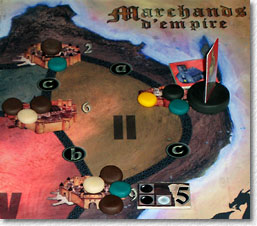
Der Spielanleitung gemäß befinden wir uns, Jahrtausende zurück, im Landes des allmächtigen Gottes Phaos. Nach der braunen Wüstenfarbe des Spielfeldes, der Ausstattung mit Handelsstraßen und Edelsteinen usw. könnte es aber genausogut im mittelalterlichen vorderen Orient spielen. Der Name „Euphrat und Tigris“ war halt schon vergeben und „Bagdad“ hat im Augenblick keinen so guten Klang wie zu den Zeiten von 1001 Nacht.

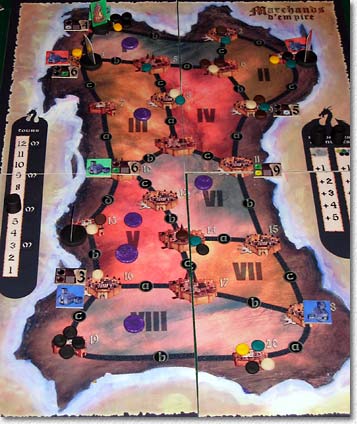
Auf den Spielplan sind größere und kleinere Städte um eine Hauptstadt herum plaziert und mit Straßen verbunden. Zufallsverteilt werden auf einige Städte verschiedenfarbige Glaskugeln (sinnbildlich für Kohle, Bronze, Silber, Edelsteine und Gold) und Vertragskarten gelegt. Die Spieler haben je einen Pöppel (genannt Karawane), mit dem sie sich über die Handelstraßen von Stadt zu Stadt bewegen, Glaskugeln aufnehmen und damit die Verträge einlösen.

Die Bewegungen der Spieler werden nach dem Robbo-Ralley-Prinzip abgewickelt: Jeder Spieler besitzt 6 Aktionskarten, die entweder die Richtung vorgeben, in der sich ein Spieler bewegen will (muß), oder die eine Handlung anzeigen, die der Spieler in der Stadt ausführen will. Die Aktionskarten muß jeder Spieler für sich ordnen und verdeckt vor sich hinlegen. In einer Spielrunde werden die Karten dann einzeln in der eingestellten Reihenfolge aufgedeckt und der Spieler führt die entsprechende Aktion aus. Entweder bewegt er sich oder er nimmt eine Glaskugel auf oder er erfüllt einen Vertrag.

Als Erfüllung des Vertrages kann der Spieler:

  1. die Vertragskarte behalten und den aufgedruckten Wert (2-9 Punkte) Kapital gutschreiben lassen.
  2. die Vertragskarte abgeben und dafür einen Tempel errichten, mit dem er sich himmlische Schätze erwirbt.
  3. die Vertragskarte abgeben und dafür Repräsentanten in den umliegenden Gebieten aufstellen, mit denen er seinen politischen Einfluß erweitert.

Wenn jeder Spieler seine 6 Aktionskarten aufgedeckt und ausgeführt hat, ist eine Runde vorbei. Für jeden erfüllten Vertrag und für jede Stadt, deren Glaskugeln vollständig entfernt wurde, wird gewürfelt, wo ein neuer Vertrag bzw. wo ein neuer Satz von Glaskugeln aufs Spielbrett gebracht wird. Wer Glück hat, bekommt die Güter dieser Welt gleich vor die Nase gesetzt; wer Pech hat, muß erst meilenweit dafür gehen.

Nach 12 Runden ist das Spiel zu Ende und es wird der Sieger ermittelt. Hierzu wurde ein bemerkenswertes mehrstufiges Filterverfahren entwickelt, bei dem jeweils immer ein Spieler durchfällt. Der am Schluß übrig bleibende Spieler ist der Sieger. Die ganze Siegesstrategie besteht also darin, bei allen Ausscheidungskriterien nicht der letzte zu sein.

Als erstes scheidet der Spieler mit den wenigsten Tempeln aus. Dabei zählen nicht alle Tempel gleich, sondern Tempel in größeren Städten liefern mehr Punkte. Bei insgesamt Punktegleichheit scheidet der Spieler mit dem kleinsten Tempel aus. Herrscht auch hier Gleichheit, scheidet der Spieler mit den wenigsten Tempeln aus.

Als zweites verabschiedet sich der Spieler mit dem geringsten politischen Einfluß. Hier gibt es genaue Rechenverfahren, wie die Mehrheit der Repräsentanten in den jeweiligen Gebieten in Polit-Punkte umgerechnet wird. Und es gibt ebenfalls Unterregeln, die bei Unentschieden angewendet werden müssen, um doch noch einen Verlierer zu bestimmen.

Als dritter und letzter scheidet der Spieler mit dem geringsten Kapital aus. Das Kapital setzt sich aus den gesammelten Vertragspunkten sowie aus einer ganzen Reihe von anderen Punkten zusammen, die man nach jeder Runde als Monopolist von Glaskugeln erwerben konnte. Für Unentschieden gibt es hier bis zu 9 Unterkriterien (z.B. die Mehrheit im Besitz von Glaskugeln einer Farbe), die mit Sicherheit zu einer Endausscheidung führen. Wer hier dann die Nase vorn hat, ist Sieger.

Wir habe bei unserem ersten Spiel gleich zwei entscheidende Spielregeln übersehen und damit unabsichtlich dem Spiel einen Großteil seines gewollten Konkurrenzkampfes genommen.

  1. Es sollen nur dann nur neue Sätze von Glaskugeln aufs Spielbrett gebracht werden, wenn ein Satz vollständig abgeräumt wurde. Wir dagegen haben für jede einzelne abgeräumte Glaskugel gleich einen neuen Satz plaziert. (Bis der Vorrat leer war!) Das hatte zur Konsequenz, daß die Glaskugeln nie eine verknappte Ressource darstellten, um die wir kämpfen mußten. Sie fielen uns eher wie die gebratenen Tauben im Schlaraffenland einfach so in die Hände.
  2. Wenn neue Glaskugeln auf Spielbrett gebracht werden, so soll auf jedem Fall die Hauptstadt eine Portion davon abbekommen (falls sie keine mehr hat). Damit soll der Kampf um das privilegierten Zentrum gefördert werden. Wir verteilten ausnahmslos alle Kugel-Sätze zufällig über das ganze Brett. So erzielten wir natürlich eine viel größere Streuung, und jeder konnte sich ziemlich unbehindert von den Mitspielern ein Gebiet heraussuchen und es abgrasen.
  3. Tatsächlich waren es sogar drei Fehlinterpretationen, da wir das Eliminierungsverfahren ebenfalls nicht ganz korrekt angewendet haben – ansonsten hätte ich nämlich den zweiten statt des dritten Platzes belegt [ah].

Nur bei Befolgung der Original-Regeln entsteht im Zentrum ein Kampf um Prioritäten und Mehrheiten, der ein wesentliches Element dieses Spieles ausmacht. Bei uns waren alle Güter in Hülle und Fülle vorhanden und unsere Überlegungen beim Spielablauf bezogen sich ausschließlich auf die komplexen Siegbedingungen. Dafür, daß es keine Anzeigetafel gibt, auf der die Zwischenstände aufgezeichnet sind, tappt jeder Spieler bei seinen Planungen doch ziemlich im Dunkeln. So schätzten wir am Ende den Zufallseinfluß dieses Spieles auf bis zu 70 % ein, ein Wert, der für die trivialen Zugmöglichkeiten entschieden zu hoch ist. Wir müssen das Spiel unbedingt noch mal mit genauer Regelbeachtung wiederholen.

Inzwischen haben wir Marchands d’Empire noch einmal mit der korrekten Regelauslegung gespielt. Unsere Erfahrung damit beschreibt Walter hier.

Westpark-Gamers Wertung: 6,25

©2003, Walter Sorger

Session Report & Review – 22.10.2003

Maestro – Eine musikalische Kritik

Nachdem wir vor kurzem eine ausführliche Kritik dieses Rudi Hoffmann – Klassikers veröffentlicht haben, möchte ich mich hiermit, auf Walters Anregung hin, allein auf eine „musikalische“ Kritik beschränken. D.h. also: „Maestro“ mit den Augen eines Musikers betrachtet!

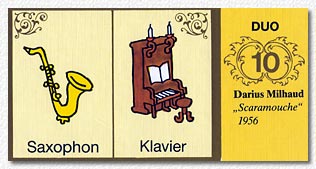
Milhaud

Diese Betrachtungen betreffen natürlich weniger das Spiel selber, als vielmehr das Spielbrett und die dort auffindbaren, äußerst seltsamen Abbildungen, die für den Laien zwar wie Musikinstrumente aussehen, in Wirklichkeit aber aus einer äußerst seltsamen Parallelwelt stammen, in der Musik höchstwahrscheinlich nicht von Menschen, sondern von seltsam missgebildeten Aliens gespielt wird. Und in der „Laura Branigan“ noch immer ein Begriff ist, den jeder kennt.

Fangen wir links oben an: Milhaud’s „Scaramouche“ für Saxophon und Klavier. Sehen wir einmal davon ab, dass „Scaramouche“ in Wirklichkeit für 2 Klaviere ist, so können wir doch die beiden abgebildeten Instrumente erkennen. Das Saxophon ist ein Saxophon, trotz merkwürdigem Untersatz unter dem Schalltrichter (vielleicht war hier ein Alphorn Modell?), und das Klavier sieht nun wirklich hundertprozentig aus wie das Klavier in Walters Wohnung. Nur auf einem Podium würde es überraschen, denn da stehen ausschließlich Flügel, also die größere Version des „aufrechten“, hier abgebildeten Klaviers.

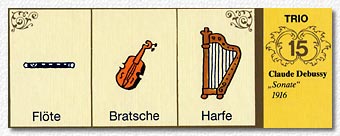
Debussy

Kommen wir zu Debussys „Trio“ – tatsächlich für die abgebildete Formation geschrieben, allerdings hat eine echte Bratsche 4 statt 3 Saiten (alle Saiteninstrumente haben auf dem Spielbrett 3 statt 4 Saiten – aber das ist wahrscheinlich aus ähnlichen Gründen der Fall wie bei Walt Disney, da haben die Bewohner von Entenhausen auch immer nur 4 Finger anstatt 5). Skurrilerweise haben die abgebildeten Saiteninstrumente auch alle nur ZWEI Stimmschrauben – Jede Stimmschraube stimmt also 1.5 Saiten, was schon eine Leistung ist!

BachUnd eine Flöte hat ein ganz wichtiges Utensil, das man „Mundstück“ nennt. Ohne das kann man die Flöte nämlich gar nicht blasen! Auch Harfen pflegen für gewöhnlich Pedale zu haben, und zwar deren 7. Sonst kann man nämlich darauf nie Debussy, sondern nur irische Volksmusik spielen, und die wird ja dann doch irgendwann fad…
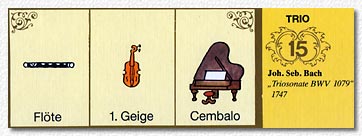
Was kommt jetzt? Triosonate von Bach. Immerhin richtig, dass hier Cembalo anstatt Klavier gespielt wird, allerdings sieht das Cembalo aus wie der Flügel, der bei Scaramouche nicht mitspielen durfte.

Gershwin

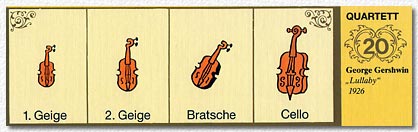
4 Dreisaiter bilden dann das Quartett „Lullaby“ von George Gershwin, das besonders apart auffällt, denn es gibt gar kein Streichquartett von Gershwin. Dieser Missstand ist insofern verwunderlich, da es ca. 5 Millionen andere Streichquartette gibt, die man hier hätte nennen können, von Haydn bis Mozart, und von Beethoven bis Schubert. Um nur einige von hunderttausend Namen zu nennen…

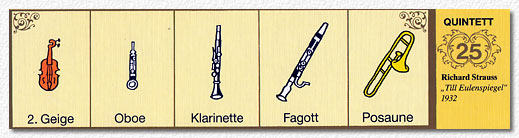
Mein Lieblingsstück ist das jetzt folgende: „Till Eulenspiegel“ von Richard Strauss, in einer neuen Fassung, die die Musikwissenschaft schockieren würde: Holzblastrio unter Zusatz von allein ZWEITER Geige (nur so nebenbei: wenn nur eine Geige spielt, kann es nie aber auch wirklich nie die zweite sein) und dem vollkommen zu dieser Besetzung unpassenden Instrument…Posaune????

StraussVielleicht geht das, denn die abgebildete Posaune kann von einem Menschen nicht gespielt werden, nur von einem kopflosen Schlossgespenst, das keine Probleme damit hat, dass dort, wo der Kopf hinmüsste, ein Rohr ist. Da Gespenster aber nicht blasen können, ist das eben nicht schlimm, nur ein Ton kommt halt nicht raus. Noch „geiler“ ist natürlich das Fagott, das in dieser Form nur in Australien gespielt werden kann, denn es steht schlicht und einfach auf dem Kopf! Dort wo man hier rein blasen müsste, ist in Wirklichkeit der Fuß des Fagotts.
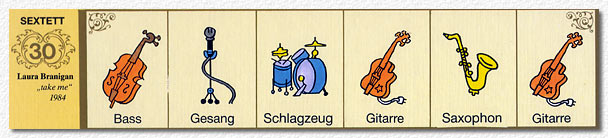
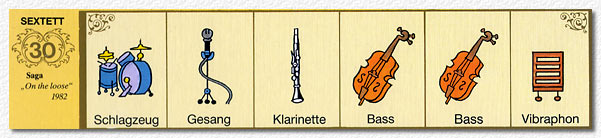
Auf der nächsten Spielplanhälfte begeben wir uns nun in vollkommen seltsame musikalische Gefilde. Und das nicht wegen des Forellenquintetts von Schubert, denn da stimmt die Besetzung ausnahmsweise. Auch nicht wegen Tscherepnins „Sommermusik“, einem quasi nie gespielten Werk eines eher zweitklassigen russischen Komponisten, das Hoffmann hier verewigt hat. Vielleicht wird es so selten gespielt, weil die Trompeten hier die Ventile unten anstatt oben haben müssen???

Branagan

Nein, es ist das „Opus Summum“ des Spielplans, das beliebte Stück „take me“ der berühmten Sängerin Laura Branigan (!!!!). Wie bitte? Noch nie gehört? Nun, es ist, sagen wir mal: eher unbekannt. Vielmehr…äh… gar nicht bekannt. Vielmehr…gar nicht existent???? Wer auch immer Laura Branigan sein mag, ihr wurde hier etwas gutes getan, noch in 1000 Jahren werden Spieler sich um dieses Brett versammeln, und sagen „Hey, Laura Branigan, das war doch mal so ne geile Sängerin, legen wir doch mal ihre Scheibe auf“, und aufgelegt wird sie, die Scheibe, und Spieler werden ihre Applauskarten im Rhythmus des Welthits „take me“ spielen, und dabei sinnend vor sich hinschunkeln. Vermutlich wird es bis daher aber gar keine Menschen mehr geben. Nicht wegen Atomkrieg oder so, nein, es reicht die abgebildete E-Gitarre zu spielen, da ist man auch ohne tolle Branigan-Mucke wie „unter Strom“….

Saga

Das nächste Stück ist wiederum eine Erinnerung an ganz schlimme 80er Jahres-Zeiten, nämlich an den entsetzlichen Protzrock der grauenhaften Band „Saga“. Dass diese allerdings in der vollkommen bizarren Besetzung Gesang, zwei (!!!) Bässe, Klarinette und Vibraphon auftraten, war mir nicht mehr ganz so klar, aber so wie deren Musik klang, kann das schon stimmen. Nachdenklich macht uns der Künstler mit der Abbildung eines, wie soll ich sagen, unbekannten Objektes, das uns in quasi „Magrittescher Weise“ auf das Unrecht in der Welt aufmerksam macht, indem es sich der althergebrachten Gestaltung eines Abbildes als etwas ideell dem Abgebildeten ähnlichen radikal verweigert. Ich kann nur sagen, daß das abgebildete Objekt alles mögliche ist, aber „ceci n’est pas une vibraphone“, das ist sicher.

Denn Abschluss bildet irgend so ein doofer Marsch (Militarismuskritik?), aber der Schlagzeuger wird nicht so einen Lärm machen mit seiner Schiessbude, bei der die Bassdrum auf der einen, und die Hi-Hat auf der anderen Seite ist. Oder waren hier ursprünglich zwei Musiker vorgesehen?

Wie auch immer, angesichts der Phantasie von Rudi Hoffmann und seinem Illustrator kann ich nichts weiter tun, als den Hut zu ziehen, oder vielmehr die letzte Applauskarte aus dem Sack!

©2003, Moritz Eggert

Session Report 10.10.2003

at the table: Walter, Thomas, Andrea, Moritz

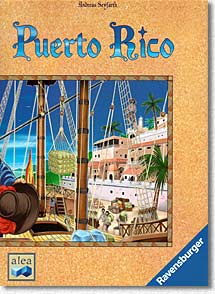
on the table: Puerto RicoPuerto Rico cover

Andrea was really eager to play „Puerto Rico“ again, which was absent from our gaming table for quite a while. 4 players being the ideal number we readily agreed. Of course we were also longing for being able to cruelly flog slaves into submission, being the evil Germans that we are. And of course this is only a joke ;-).

The game began with Walter taking the settler to get a quarry. As there were 3 coffees laid out, and I was a maize player, the coffee/maize tactic basically jumped at me, as coffee would be rare in the future. Andrea imitated me.

The game went ideally for me in the first 6 rounds or so. First I was able to make quite a good profit with the neglected gold digger and the small market, so I could quickly buy the coffee mill. For a couple of rounds I was the only person to sell coffee, so I upgraded to the big market. Thomas went for the diversity tactic and the manufacture, Walter went for the quarry/building tactic, Andrea pretty much imitated what I did.

Because I was clearly leading the game, the last rounds were not so profitable for me (the others got more careful with their choices), and I made some wrong decisions about acquiring large buildings (because of my guaranteed money flow I actually bought 3 of them in the end), so Andrea caught up pretty well. But in the end she didn’t manage to beat my quite high score of 63 and made second place.

Thomas and Walter (3rd and 4th place) were nearly tied, but didn’t fare so well. Again the game went never exactly as planned for anybody, and always remained interesting.

And, we treated our slaves like kings, and gave them their freedom at the end of the day!

©Moritz Eggert