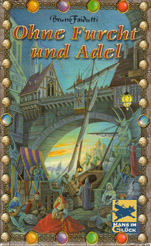
OHNE FURCHT UND ADEL (CITADELLES)
Publisher: Hans im Glück
Author: Bruno Faidutti
Tester: Aaron Haag
Game Tested: German 2000 edition, 1st rule release
Scenario: Set in a mediaeval surrounding each player aims to build the
strongest and most valuable city. A city is composed of districts of different attributes
and values. Assuming the role of one of seven possible characters in the game a player
performs the actions of that character to build and extend his or her city.
The Game: The game basically is a card game played using character cards and
district cards. At the start of the game each player receives four district cards from
the shuffled deck plus two gold coins (the coins are made of plastic, look nice and can
be stacked easily). The character cards are distributed amongst the players in a similar
fashion as in the game Verräter (which is actually referenced in the rules because of this): the
deck of character cards is shuffled, cards are discarded in order to leave just one more
character card in the deck than players in the game. The cards are then passed around for
each player to select a character, starting with the current king.
Following this, the “character action round” begins. There is a fixed
sequence in which the characters act: the assassin, the thief, the magician, the king,
the priest, the merchant, the architect and finally the mercenary. Each character has one
special ability which he can use in his turn in addition to the normal actions common to
all characters. The common actions are to either take a district card by selecting one of
two cards drawn from the face-down district deck or to take two gold. Then, if he wants
to, the player builds a new district in his town by playing one of the district cards
from his hand open in front of him and paying the amount of gold printed on this card.
Districts cost between one and six gold, the costs usually reflecting the value of the
district at the end of the game (there are actually two exceptions where a district at
the end of the game counts 2 more than the building costs).
The special abilities of the characters add tactical opportunities as well as
uncertainty to the game:
- Assassin: may announce that he kills another character. The player playing the
assassinated character may not act at all during this round. - Thief: may announce that he steals all gold from a character. The player
playing that character hands all his gold to the thief at the beginning of his turn. - Magician: may announce that he wants to exchange all his district cards with
those of another player or any number of his cards with the deck. - King: gets one gold for each yellow district in his town and he plays king in
the next round, meaning that he is the first one to select a character. - Priest: his districts are save from the actions of the mercenary and he gets
one gold for every blue district in his town. - Merchant: gets one extra gold plus one gold for each green district in his
town. - Architect: gets two extra district cards from the deck and may build three
instead of just one district per turn. - Mercenary: may destroy one district of another player paying the districts
value minus one in gold to the bank (i.e. value 1 districts are free) and he get one gold
for every red district in his town.
The final round of the game starts when one players has managed to have eight
districts in his town at the end of his turn. The game ends once all characters have
completed this round.
Playing Time: The rules are explained in less than 10 minutes, the game plays
in about 60 to 150 minutes depending on the number of players. A six player game usually
lasts 2 hours.
Similar Games: Verräter (Marcel-André Casasola-Merkle)
Westpark Gamers’ Opinion: The rules state that the game can be played by
three to seven players. Although there are sufficient cards in the game to actually do
this I believe the game suffers if played with more than five players. First of all the
playing time becomes way to long for a simple game like this – two to two and a half
hours – if played with six or more players. Secondly, with so many players nearly all of
the characters are in play most of the time. This leads to a situation where it is almost
inevitable that players try to hit the current leader and are able to do so. This makes
the game drag on for longer than it actually should. The final scores reflect this, too:
more often than not the scores are very close with the winner being the player who just
happened to get a lucky draw, scoring the four extra points for building eight districts
first.
With fewer players there is a lot more planning involved in order to get the timing
right for building that eighth district. Although the element of luck is somewhat higher
with respect to the availability of characters this actually improves the game. Now it
needs some thinking ahead to be able to get that architect character right at the moment
you need it to finish the game early. I believe that four or five players is what you
want to play this game with.
The character selection process is what makes the game so much fun. You can never be
absolutely sure which character has been selected by a particular other player, although
very often there seems to be an obvious choice for most players. But what if this obvious
choice is too obvious to the player concerned and he or she deliberately chose a
different one? Therefore you are faced with the problem of constantly thinking ahead of
your fellow players – who are exactly doing the same…
Aaron’s Rating: 8 (out of 10)
Westpark Gamers’ Rating: 7.5
|
Links to further information: |
|
|
Bruno Faidutti’s webpages about Ohne Furcht und Adel with a FAQ, the English |
|