Game Session Report 4.9.2002
Author: Moritz
at the table: Walter, Peter, Hans, Günther, Moritz
on the table: Sternenhimmel, Titan – the Arena, Forum Romanum, Adel
verpflichtet
This evening was full of German games, two of them with the „most german of all
german game inventions“ – the „Kramerleiste“ (“Forum
Romanum” and “Adel verpflichtet”), and two of them (“Forum
Romanum” and “Sternenhimmel”) with the “most german of all german
gaming principles”: scoring with the majority in areas!
- Sternenhimmel
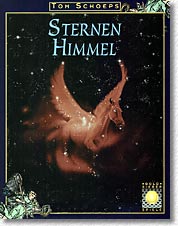 This “majority in areas” scoring principle takes an
almost freeform approach in this game, as circles of star signs are randomly placed until
all have been scored (meaning: all players have placed a numbered token – or
“star” – on each space of the star sign). As star signs go, some of them are
longish affairs (like the “snake” or the “scorpion”), some of
them consist only of four spaces (“libra”). The larger the sign, the more
points it will bring upon it’s “completion” – the player who owns
the majority gets the most points, but has to “pay” all other players who
didn’t make 1st or 2nd place (one per placed token). This makes 2nd place the most
interesting prospect, as it usually only gives 2 points less than the leader gets –
without having to pay the others!Spaces on the signs come in two groups: “secret” (value of token is hidden)
and “open”. Each player has a selection of tokens, mostly numbers (the
highest being 10), two doublers (doubling the value of all surrounding tokens) and
“black holes” (destroying all surrounding counters). The latter two are
mostly placed on the secret spaces – If a player starts to surround a
“secret” token with numbered tokens you can be pretty sure he has a doubler
placed there. And other players can profit as well! The design of the starsigns makes for
different tactical situations, “node” points become more important than
“line” – points etc.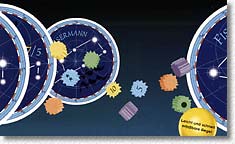 But the problem is the “freeform” aspect – it
can happen (it did happen to me) that you invest in star signs that will not be
“cleared” by other players (usually it is desireable to place the LAST token
on each sign, as this gives the most control of the scoring) – they simply place
their tokens on other signs. This means your tokens are not freed for other uses – as
long as the sign is not totally occupied the tokens remain on the board. If the group –
and this is simple “peer pressure” – decides to let a player
“hunger” on a sign, they can block him out for several rounds. Of course in
our game this was partly my own fault, as I placed too powerful combinations (apparently)
that didn’t make it attractive for other players to “invest”.The bigger problem though is the simple repetitiveness of it all: place a
“secret” token – it is either a black hole or a doubler (mostly).or
place an open number token. That’s all. With more convoluted star signs the outcome
is totally random, as you can never really be sure who places what on the secret spaces.
And then you feel slightly bored by the strange use of the “star” theme (and
attractive playing materials) for a totally abstract game with little strategy.Not a winner….
Westpark-Gamers score: 4.6
- Titan – the Arena
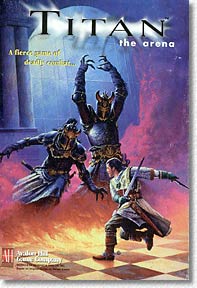 Günther kannte dieses Spiel noch nicht (obwohl er natürlich
die „Knizia-Urversion“ durchaus kannte). Immer wieder wird dieses Spiel gerne
bei uns auf den Tisch gebracht – es ist perfekt in seiner Mischung aus Komplexität,
Abwechslung und Spiellänge. 8 Monster kämpfen in einer imaginären Arena – die
Spieler repräsentieren die Wettenden, die ihr Geld auf die Monster setzen. Es wird
mehrere Runden geben, in der jeweils ein Monster ausscheidet. Am Spielende bleiben 3
Monster übrig, und die überlebenden Wetteinsätze werden gezählt (Wetteinsätze auf
sterbende Monster werden vernichtet). Jeder Wetteinsatz wird auf ein Monster in einer
bestimmten Runde gesetzt (ein anderer Spieler kann dann nicht mehr setzen), und zählt
mehr, je früher er eingesetzt wurde (natürlich ist die Chance, daß der Wetteinsatz
überlebt, bei früherem Setzen geringer). Es ist auch möglich, in der ersten
„Kampfrunde“, geheime Einsätze auf ein einziges Monster zu machen, die zählen
am meisten am Ende. Man macht immer EINEN Wetteinsatz und spielt EINE Karte (nicht
notwendigerweise auf das selbe Monster).Jedes Monster hat 11 zugeordnete Karten (von 0 – 10). Nur diese Karten können unter
das Monster gelegt werden, es zählt immer die oberste Karte. Nachdem alle Monster in
einer Runde eine Karte „besitzen“, wird das Monster mit der niedrigsten Karte
entfernt. Natürlich ist das kein einfacher Prozess, denn die Spieler versuchen je nach
Wettinteresse Monster zu stärken und zu schwächen. Es gibt auch einen Satz Jokerkarten,
die auf jedes Monster gelegt werden können, und 2 Spezialkarten, mit denen man gespielte
Karten regenerieren, und geheime Wetteinsätze entdecken kann.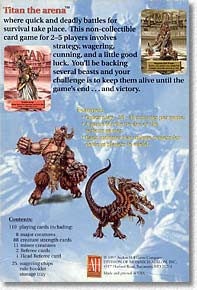 Der eigentliche Gag des bisher recht abstrakten (Knizia!) Spiels
ist aber eine Weiterentwicklung Don Greenwoods von Avalon Hill: Jedes Monster hat eine
Spezialfähigkeit, die von einem Spieler ausgelöst werden kann, wenn er a) die meisten
offenen Wetteinsätze auf dieses Monster hat, und b) eine Karte auf dieses Monster spielt.
So ermöglicht die Hydra das Ausspielen einer weiteren Karte, der Troll kann gespielte
Karten früherer Runden wieder auf die Hand nehmen, der Ranger zieht 3 Karten usw. Obwohl
diese Fähigkeiten im Spiel seltener eingesetzt werden, als man auf den ersten Blick
glaubt, so geben sie doch die entscheidende Würze, die dieses Spiel so unterhaltsam und
spannend macht. Beim Platzieren der Wetteinsätze spielt natürlich die Zugreihenfolge eine
grosse Rolle: Spiele ich gegen einen Spieler, der direkt nach mir dran ist, so wird er
mir höchstwahrscheinlich die Tour vermasseln. Viel schöner ist es, den Abschluss einer
Kampfrunde „vorzubereiten“ (man kann es ja wirklich selten alleine steuern),
und erfolgreich darauf zu spekulieren, daß der linke Nebenspieler mit den selben
Interessen auf jeden Fall „dicht macht“.Wir haben dieses Spiel sicherlich schon knapp 20 mal gespielt, und es verliert nie seinen
Reiz, daher:Westpark Gamers Bewertung: 8.25
- Forum Romanum
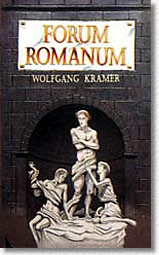 This is again a typical German „majority in an area
scoring” – game, with a geometrical twist. Forget the Roman Theme, this is a
very abstract “Advanced TicTacToe” with no relation to history or senators,
like “Republic of Rome”.Players have a set number of tokens which they can place anywhere on the board (after all
tokens are placed, they can move any token to anywhere). The rectangle map is diveded
into 7 “houses” (square areas), with an overlay of vertical and horizontal
lines, and two diagonal lines. Each of these “areas” is scored, after all
tokens in it have been placed. The winner is rewarded points, the others get nothing, the
players who have NO token in the area are punished with negative scores (especially
negative if they are the only one, who does not have a token). As the various areas
overlap (for example you could place a token that fills up a house, but at the same time
a vertical, a horizontal and even a diagonal line), you have to think ahead, and
sometimes surprising scorings take place, especially in a 5 or 6 player game. After an
area is scored it is marked with a token and cannot be scored again, but still a token
placed there could be important for another scoring, so you have to think about what
token to remove and when. Deadlocks are not scored, but at the end of the game (when all
areas have been filled at some point) they are rewarded as if there were several winners
in each area (mostly decisive in winning). So basically you place tokens, are surprised
by sometimes unforeseen scorings, and attempt to have enough tokens in the final areas to
get a good “deadlock scoring” – that’s all!The game keeps your interest because of the “gobang” element, but is not
really very exciting. And Wolfgang Kramer went on to create much more interesting
“majority scoring” games, like “El Grande”.Westpark-Gamers-Score: 5.4
- Adel verpflichtet
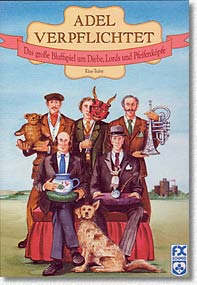 One of the most famous “German
Style”-games, and rightfully so, as it is still enjoyable and fresh more than a
decade after it’s publishing.Players represent Art collectors who collect “series” of hopefully long
(large) collections that they can exhibit. Cards are labeled A-F, and also have a date as
a tiebreaker (oldest exhibits win, if two players tie in the size of exhibits).
Exhibitions are a series of cards, and have to be played in an alphabetic series (so you
could not play A-D-F, but for example A-A-B-C-D-F).There is a “race track” around the board, with an ingenious twist: Depending
on the position of the leading player the scoring for the exhibitions is different. This
encourages purposefully falling back for tactical reasons and using the new position of
the leader to surpass him again. At the end of the game there is a final exhibition in
which the largest and 2nd largest collection wins additional points on the track, mostly
deciding the winner.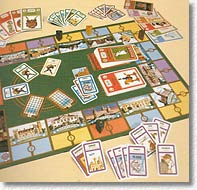 Doesn’t sound very interesting yet, but there is more:
Each round each player secretly plays a card to show where he will go: either the
“Auktionshaus” (auction house”, for acquiring art cards) or the
“Schloss” (castle, for making an exhibit). The two places are dealt with
seperately: in the auction house players try to play the highest “cheque” to
acquire one of two open art cards, but halt!, you can also play a thief to steal the
highest played cheque. Two or more thieves block each other out, and yes, the
cheques/thieves are played face down, at the same time!The castle is more complicated, you can make an exhibit (the largest and the second
largest are awarded spaces on the track), you can play a thief who can steal a picture
from EACH exhibit, and you can play a detective, who only comes into action if there was
a thief (the thief is taken temporarily out of the game) and gains you spaces on the
track depending on your actual position (the farther you’re behind the more spaces
you gain). If there was no thief: well, what a bummer!Again, this is a guessing game, as all players play their cards secretly.
“Adel verpflichtet” really is a fun game, with elements of bluffing,
prediction and possibilities for naughtiness. Generally it is adviseable to play
“against the flow”:if you predict most people will make an exhibit it will be
good to be the only one in the auction house (to get a very cheap art object). Also one
can try to predict the cards played in the castle – players desperate for art
objects are very likely to play a thief, as in the final analysis it is impossible to win
the game without a good collection. If everybody predicts, something totally
unpredictable can happen, like everybody playing detectives, which is of course good fun.A game to be recommended for anybody who is interested in “German style”
games – you can tell it is good by the fact that it is popular in the UK and US,
although the name of the game is totally unpronounceable for English speakers”!Westpark-Gamers-Score: 6.75