Session Report 22.01.2003
Author: Moritz
at the table: Walter, Aaron, Günther, Andrea, Moritz
on the table: Emerald, Puerto Rico, Bluff
- Emerald
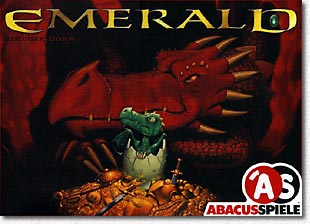
This game has been around for some time, but gets additional exposure in German gaming
circles right now as it is part of the 4 games to be mastered for the German championship
in boardgaming 2003 (the other games are “Sticheln“,
“Medina” and – what else could it be – “Puerto Rico“).Inclusion of this game has been a matter of discussion, as it is a very light family
game with only very shallow tactical elements, also dependent on luck a lot (usually the
games in the selection are less luck oriented). The game board consists of a single track
starting in a city and leading to a dungeon of sorts, occupied by the unavoidable dragon.
Players get a number of knight pawns dependent on the number of players (with 5 players 4
for example), and try to collect gem (worth 1 VP each, 4 extra points if you are the
first to collect all 4 colours, 4 VPs for each majority in a colour at the end of the
game) and gold cards (1 to 5 VPs) on the way to the inner sanctum. Movement is very
simple and known from other games as a routine: The number of spaces you can move is
determined by the number of pawns in your space, including your own. This means that you
try to reach populated spaces to advance quickly, making your way alone will take a long
time.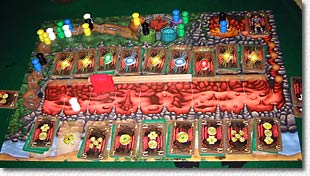 At some point you reach the dungeon – landing on a dungeon space
gives you the choice to take one of either the open gold or gem cards (or none, if the
stacks are empty). But beware of the dragon – its movement is actually one of the
ingenious mechanics of the game. There is a “dragon stick” which marks the 4
spaces the dragon is searching at the moment. Every time a player lands a pawn in one of
these spaces, the dragon moves by means of a die roll (1,2 or 3 spaces), and is
“reflected” by the border of the stick if it would go beyond it. At the same
time the stick is moved one space to the right until it reaches the end of the track,
where the dragon will guard the entrance to the treasure hoard. After the dragon moves,
it will “eat” one of the knights that are standing on the space it lands on (if
there are several the moving player decides which), but if the knight sacrifices a
treasure card (gems don’t interest the dragon for some reason) he will survive. As
the game is basically about gaining VPs through cards it sometimes absolutely okay if you
let your knight die – giving up your 5 VP card might be worse. Therefore it is also good
to have low VP cards handy- each player will encounter the dragon at some point or
another!The first 4 pawns that reach the treasure hoard get 5 bonus points each, the fourth one
to reach it ends the game. Another possibility for sudden death is that one player loses
all knights but one – if you have many VP cards you can enforce the end in this way a
little: “let them be eaten!”.We played the game 2 times to get some feeling for the strategy, or what little there
is. As you have only 4 pawns in a 5 player game, you make 2 choices out of 4, sometimes
less if choices might be obviously awful and to be avoided, and also because taking cards
always ends your turn – you can never take two cards in a row! Movement is mandatory, you
cannot go less spaces than you have to. Usually you will try to concentrate on 3 knights
and get them to the good cards as quickly as possible. The other knights will wither away
at the starting space.It doesn’t make much sense to avoid the dragon – although there are moves which put
you at higher risk than other moves at some point you will have to face the danger
of being eaten, and whether that happens or not is pure luck, not skill. Of course you
will be safer when travelling in numbers and having a low score on hand, as the dragon
moving player will then gobble up the weightier player (in points, not pounds). To a
certain extent you can foresee the moves of the other players and make your decisions
based on that, but basically you are played by the turn order and the moves of the other
players. We found that the starting player always won, and always was the first to cash
in the extra VP cards of the treasury.Although this is a fun game for the whole family and even for “non-gamers” I
don’t think it will hold the attention of any true freak for a long time. The big
plus is that games are very short, around 45 minutes, and can be played out of the box,
with little preparation.View/add comment 
Slightly recommended – forget the fantasy theme, though, the game could also be a about
making your way through Camden Town, the dragon then being a bobby searching you for
illicit drugs or something. - Puerto Rico
Some strategy tipsP.R. is one the best documented new games on the web right now – we have already
reviewed it, so I will try to give some strategic advice based on my now considerable
experience with the game. Hopefully I can add a grain of wisdom to the immense material
out there!I have become a bit disillusioned with the game recently. Although I still think it is
great, I have my doubts about how much of a “strategy” can be applied
successfully (like in “Princes of Florence” or even
“Settlers” where you basically follow a semi-solitaire strategy). But on
the other hand this is one of the charms of the game, and adds to its replay value,
whereas games of “Princes of Florence” have recently turned into clashes of
pre-set strategies. I haven’t yet decided which I like better.What every player of P.R. must learn is that there is no valid
“building” strategy, for example. No combination of buildings that you
plan ahead is of any use, even if they are ingeniously devised. I have seen each strategy
win and fail in equal measures, but what you want is a strategy that gives you a good
chance to win, not one that you simply think is clever. In fact, I would argue that there
should be no strategy in P.R. at all, rather “advanced tactics” depending on
turn order, strategies deployed by other players and sometimes even luck (selection of
plantations is a huge luck factor).P.R. is totally dependent on the choices that other players make. It is therefore in
nature a very chaotic and unpredictable game. The other players make the game and they
ruin your plans… usually. The beauty is that they can also help you, if you foresee
what they will do.Here are some tactical rules that will definitely help you win:
1) Don’t come into the game with ANY strategy.
It won’t work, believe me. Watch what the other players do, and act accordingly.
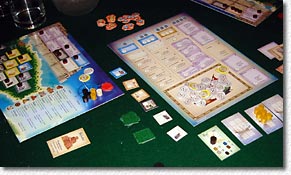 Be constantly on the watch for their strategy – basically you want to
be in the middle of it: If the player to your right goes for quick victory points you
should do the same. For example, leaving one player alone with a certain strategy is
usually a bad idea, especially if it’s the “end the game quickly with as many
VPs as possible” strategy. If you follow a similar tactic and succeed this
particular player might think twice about ending the game quickly as you might have an
equal or even bigger number of VPs. On the other hand, if the player is already
“imitated”, don’t do it – three players following the same route will
usually cancel each other out. Any combination of buildings can be the winner in a
certain game, it just depends on the players and their actions.2) The LEFT PLAYER RULE
Rick Heli brings it down to a simple point in his excellent short description of the
game at “spotlightongames.com
“…When deciding what crops to grow, the workings of the ship and the trader make
it wise to avoid what your right hand neighbour grows and to strongly consider growing
what your left hand neighbour does….”I would call this most important advice. Why? Growing the same crops as your left
neighbour is one of the few ways in which you can actually play aggressively against a
player, and your left neighbour is your best victim. This is because of the turn order,
which is always 1,2,3,4, then 2,3,4,1, then 3,4,1,2 then 4,1,2,3 for example. If you are
player number two you will be ahead of player number 3 (your left neighbour) 3
times out of 4 when roles are selected, which means you have a pretty good chance of
shipping/selling goods before her or him.This of course also explains why you should avoid the plantations of the right
player – who is of course possibly after you as you are after your left neighbour.Try to copy your left neighbour as closely as possible, but only in plantations
and factories. Apart from that your tactics should be the absolute opposite of the left
player. Why? See the “RIGHT PLAYER RULE” below!3) The RIGHT PLAYER RULE
The right player will go before you ¾ of the time (in a 4 player game). Which gives you
the possibility to see what s/he does, and then somehow imitate it (not the
plantations, see above). With somehow I mean “not exactly”. Of course you
should rule out imitating dumb moves, for a start (I have seen weak players win games of
P.R. against the top-pro’s because they had an equally weak right neighbour).
But the buildings the right player builds should be closely watched. If your
right neighbour buys a building that is triggered by the “settler”
phase, you should consider building it as well (if possible), or another building that is
triggered by the same phase. Chances are s/he bought it for a reason, and will possibly
play this role on her/his turn – and you will profit from it as well! I have closely
followed this rule in my last experimental games, even sometimes buying buildings I
thought I had little use for, or which seemed weird in my specific setup (getting the
right feel for this is the closest this game comes to “skill”). I never
regretted it – sure enough I always profited from my right player taking certain roles
which I also benefited from, and then I was free to take roles that only benefited me
afterwards! The game usually rewards the second player, especially when shipping
for VPs!Watch closely, and most importantly: be flexible!
4) The SAVINGS RULE
This is a more obscure tactic that doesn’t seem obvious at first. The rule is:
“When you buy buildings in the builder phase, already consider what you are able
(not what you “want”) to buy in the next phase – it might come sooner
than you think!”. This means sometimes buying “cheap” buildings when you
could actually buy more expensive ones. I see it happening very often that good players
trigger phases that as few as possible other players can benefit from (a basic rule of
thumb that is mostly followed). Usually it happens that one player triggers the builder
phase, all players dump their money into expensive buildings, and then the player who has
the most money will immediately become builder again next turn (this might even happen
directly afterwards, when the turn ended with the builder phase) to buy another
building with his savings, whereas the other players just dumbly stare. Don’t let
that happen – try to always buy a building in the builder phase. Even the meagre
“1” building might be worth many more points with certain large buildings. If
only buildings are available that you don’t think fit into your strategy,
change your strategy. When you are always able to buy buildings and never miss out
a phase, you will have an edge on other players, believe me!Always save some money, if possible! Always consider taking the gold digger, even if
it’s only worth one buck.5) The FIRST TURN
What should you do when you’re first? It’s not easy to “imitate” when
there is nothing there to imitate. I personally think there is only one answer: take the
settler and take a free quarry. Quarries always come in handy in any game
(although one might argue how many you need – I think you’ll be fine with no more
than two, personally), nobody else will be able to get one, and you will have an edge
when “imitating” a quarry strategy of your right player later on. If
there are too many maize plantations lying around you might consider taking the gold
digger instead, though, but that case will be rare. Also, if you’re lucky, somebody
might play the “mayor” and give you the possibility to populate the quarry
before the first builder phase, therefore giving you the same edge that the builder role
would have brought you at the start.View/add comment These tactics can form the basis for a more serious delving into the game. Guenther, our
most successful P.R. player certainly knows them well – he always uses them and wins 80
percent of the time!Good gaming.
- Bluff
Strange that the two gaming groups “Westbank” and “Westpark”-gamers
have one affliction in common: the call of the dice (or, shall we say, the SCOURGE of the
dice?). Since we experimented with different seating orders (usually we always sit at the
same places of the table) results have varied wildly, this time Andrea won twice in a
row, whereas Walter, who very often wins, came always in last.PETER, IF YOU READ THIS…..COME BACK!