Game Session Report – 29.01.2003
Author: Walter
at the table: Hans, Günther, Andrea, Moritz, Peter, Walter
on the table: Outpost, Bluff
- Outpost
To begin at the end: around midnight, when after four hours’ play it was clear who
had won, the atmosphere was just as objective and free from aggression as it had been at
the beginning. Peter spared us a sample of his collected paradoxes and we were able to
get on with the game without any diversions. We rather generously gave the game an
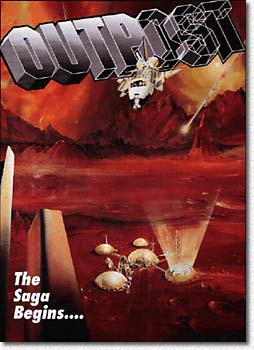
overall rating of 6.8.What sort of a game is Outpost? Despite the flowery language in the playing instructions
it is just an ordinary business and auction game. The fact that the scenario has been
transferred to outer space, and that we are made the commanders of a space station,
doesn’t change the basic principle of the game: each player bids for Upgrade Cards
(UCs), buys factories with which he makes a profit, and reinvests his income until the
first player has acquired a certain quantity of the means of production and thus has won
the game.Of course there are certain interdependencies between the UCs (just as in Civilization):
they award bonus points for the acquisition of certain additional UCs, they are
conditions for buying certain factories or else they reduce the restrictions which each
player is subject to (eg. the maximum number of workers employed in the factories, or the
maximum number of production cards retained in the hand).The production cards represent the profit that a factory produces, that is, the owner
gets one production card per factory – the more expensive the factory, the higher the
value of the corresponding production card. This value is however not in each case a
fixed amount, but is distributed around an average value. If you are lucky you draw
production cards with high values, if you are unlucky then you don’t. To call this
random factor a “clever mechanic” (as Mark Green
does) is a very friendly remark. In my opinion the effect is simply somewhat chaotic.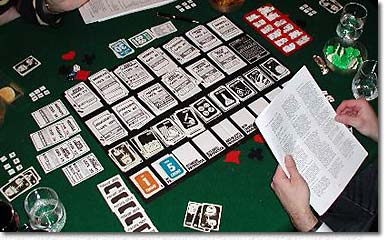 There are some more obstacles in the way of total
predictability, eg. not all the UCs are available in any given round of play.
Instead this is determined by a throw of the dice in a particular phase of the game.
If someone backs the wrong horse when making his game plan, he can quite easily be
unable to buy his intended UCs for the duration of several rounds.It has not yet been established what the optimal order is in which one should bid for or
buy the UCs and the factories – and thank heaven for that. If this were the case we could
forget the game entirely. As it is each player can still search for his own best winning
strategy. From the start Peter saved up determinedly for the titanium factory. When he
was able to afford it, he was already so far behind the field regarding the amount of his
means of production that he was in no position to seriously hinder the modest
water-workers. In his analysis Brian Bankler confirms that this strategy does not pay off.
Nevertheless Peter finished in third place.Moritz based his speculations on the scientist UC. This card is not very expensive and
provides its owner with an additional production card in each round of play.
Unfortunately the scientists very seldom came on to the market in our game. Moritz
finished up among the also-rans, along with the other newcomers Andrea und Walter.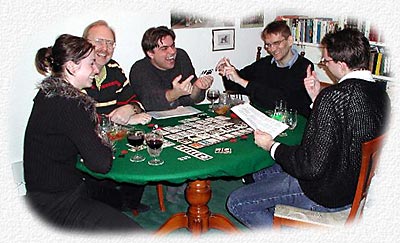 Together with Günther and Hans I
decided upon the more obvious waterworks strategy, that is, we built up our water
production facilities for an affordable price and so were able to start earning
fairly well fairly quickly. Somehow I managed once to forget to claim a bonus and
another time I made a mistake in payment to my own disadvantage. Finally I wasted
time by reducing my restrictions as a precautionary measure, instead of
concentrating on more valuable factories – just too many mistakes to keep me on the
road to victory. Hans however managed to finish in second place.Günther, who knew the game the best, was able to chalk up a win without any effective
challenge. He began with the waterworks, then skipped over the titanium phase and then
before anyone could blink an eye he was in possession of several New Chemicals. These
provided him with so much income that it was clear he was going to be the winner several
rounds before the end. Green’s claim that “the game is remarkably well balanced
with the lead changing hands every turn” does not correspond at all to our
experience. The income increases exponentially and whoever is in the lead can’t be
caught by the others even if they join forces. With no problems Günther was able to win
the auction for both the Moon-Bases as soon as the throw of the dice made them available
and won the game with 84 Victory Points.Westpark Gamers’ Rating: 6.8
- Bluff
To complete the evening we played two rounds of Bluff. There were no spectacular details.
Twice Hans started the final with an preponderance of 4 vs 1 dices, once against Andrea
und once against me. He had no problems to bear the palm.What seems remarkable is that Moritz, who used to win continually, doesn’t have such
a clear run now that Andrea no longer sits in the position immediately following his.
Could it perhaps be that he can influence his wife more easily than the other
Westpark-Gamers? We will just have to wait and see!