DESERT STEAM
A preview of “1895 – Namibia”
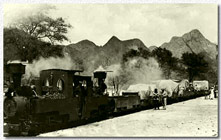 1895 is located in Namibia or “Deutsch-Suedwest
Afrika” as it was called at the time. Namibia is situated south of the equator at
the west coast of Africa and being a country dominated by the Namib Desert there are not
that many cities and possible routes for railroad lines. An interesting
“feature” of Namibia is the “Caprivi Zipfel”, a strip of land in the
north east of Namibia presenting an additional challenge to railway operators. We will
see later how the game deals with this.
Railway building in Namibia began with some smaller mining rail lines in 1895 and
developed full speed in 1897 when the German Colonial Authority launched a project to
build the “Staatsbahn” (state railway) from Swakopmund to Windhoek.
HERE I STAND
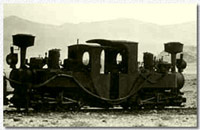
Even earlier, in 1894, the German artist Troost intended to revolutionize the
transportation in the desert by replacing the tedious ox-wagons by a steam traction
engine hauling several wagons which operated out of Swakopmund. 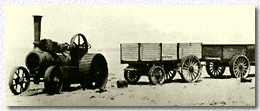 The engine was imported from its manufacturer Dehne
near Halberstadt, Germany and was landed at Walvis Bay. Three months later it was
delivered to Troost at Swakopmund. It had practically been pushed the entire distance
because of its tendency to dig itself into the deep sand every time an effort was made to
move it under its own power. Service was started and the traction engine did surprisingly
well once it had passed the coastal sand belt, but eventually the desert was stronger,
and it blew a tube which could not be replaced. Later the people of Namibia called it
“The Martin Luther”, after his famous quote “Here I stand and I cannot do
otherwise.” 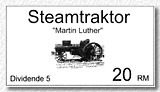 Today, the first steam traction engine to
operate in Namibia has been restored and declared a national monument.
It does not come as a surprise that an 18xx game situated in Namibia includes the
Martin Luther as the very first “private company” available for purchase. What
is a surprise though is the fact that the Martin Luther is the only private company
available in the game. Its sole purpose is to act as a tie-breaker in case no player is
willing to buy stock or obligations as the owner of the Martin Luther cashes in 5 Marks
dividends at the beginning of each operation round (throughout this article it is assumed
that readers are familiar with the 18xx game concepts; readers not familiar with the
basics of the 18xx series should have a look at our 18xx
section).
MUCH OBLIGED
Once the Martin Luther has found its owner obligations became available for purchase
via auctioning. Obligations are a new element to 18xx and constitute a players obligation
to connect two cities with railway tracks. The player who successfully bid on an
obligation, receives one free 10% share certificate of the corresponding corporation. At
the time of auctioning these share certificates have no value and cannot be sold. They
only become dividend paying shares once the track between the two cities has been build.
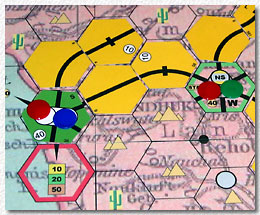 This happens irrespective of the fact
which corporation laid the final connection between the two cities. Another benefit the
owner of an obligation gets is the option to buy the president’s certificate of the
corresponding corporation once it is available for purchase. This option may even be
executed if the certificate becomes available during the turn of another player. In this
case, if the player owning the obligation wants to buy the president’s certificate
s/he may do so immediately and out of sequence provided s/he holds sufficient money in
hand – no shares may be sold to raise money at this point.
While obligations present the advantage of receiving a free share and the purchase
option for the presidency these advantages are linked to challenging conditions: only
building a predefined railway connection valuates the free share and executing the
purchase option requires sufficient money in hand at the right point in time.
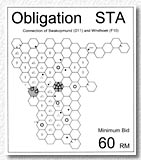 There is a rough correlation between initial price of an
obligation and the length of the route to be built but it turns out to be a rather tough
decision of how much, if anything, one bids for an obligation. In our game we had the
situation that I was “forced” by Walter to execute the purchase option at an
extremely bad moment. I was short on cash at the time and had to set the initial price
for the corporation in question to the lowest possible value. This combined with the
following purchase “war” to keep the presidency forced me to sell some of my
much more valuable stock.
Günther, on the other hand, purchased an obligation but chose to not buy the
corresponding presidency. Unfortunately, the corporation’s target route for
activating the obligation’s free share was the longest route on the map: right into
the Caprivi Strip to the eastern-most end of Namibia. The consequence of this was that
Walter as the president of the corporation had no intention to build the awkward track
while Günther was left for a long time with an inactive share counting towards his
certificate limit.
Obligations need not be bought to continue the game.
If all players pass on a single obligation the obligation is removed from the game and
the next obligation comes up for auction. If the last obligation is gone corporation
shares become available.
SOLD OUT
The five corporations also come up for sale in a predefined order. The buyer of the
president’s (20%) share sets the price for a 10% share. 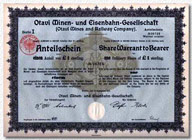 There is only one share price and no distinction between initial
offering price and bank pool price, a rule we liked already much in 1951 and which we
adopted for 1830 (see our Walter variant). Once 60% of
the shares of a corporation are sold, including the still inactive share coming with a
sold obligation, the corporation floats. All remaining shares are then transferred to the
treasury of the corporation together with 5 times the initial share price (6 times the
share price if the obligation has not been sold). Any subsequent shares bought from the
corporation’s treasury cost the current price indicated on the stock market chart and
the money is paid to the corporation.
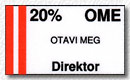 There is one aspect during the stock market
round which was new to us and we found an excellent idea: a player is allowed to own up
to 100% of the shares of a corporation. However, for any share bought in excess of 60% a
player must pay a 20% commission to the bank and the certificate limit for each player is
set 13 so that never all shares can be sold out. This puts players in the position to
completely control a corporation and not being dependent on robber baron style players
and their stock market manipulations. In our game this was used by Walter to his
advantage when he decided to disinvest in all of my shares and instead investing in 100%
of the shares of one of his two corporations. Unfortunately for him, in mid-game he
overlooked the threat of his route being devastated by a cleverly placed token of another
corporation with the consequence that dividend payments were severely impacted for a
while. Overall, we found the concept of being able to buy ALL shares of a corporation for
a 20% premium to be a perfect enhancement of the game system.
BOARDING THE H-TRAIN
 This leads us to the operation rounds. By deliberately
providing only a limited supply of brown tiles and the fact that as soon as they become
available corporations may build two yellow tiles per operation round instead of one the
duration of the endgame is significantly shortened. A fact we liked a lot as it prevents
those tedious waiting times when one player is trying to still find a worthwhile
extention of his routes. Also the well-balanced overall supply of money in the bank
supports this concept.
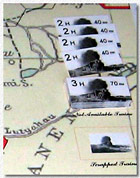
Trains come in the H-variant, traveling their designated number of mid-hex distances
rather than a given number of stations. There are 8 different trains available, starting
with the tiny 2H up to the giant 16H, which can cover nearly any north-south route of the
map. Supply of trains is very limited, though. All but the 2H (4) and 3H (3) trains types
have only 2 trains, except for the 16H, which has an endless supply. Scrapping of
obsolete trains occurs whenever a train with twice the size is first bought, i.e. 8H
trains scrap 4H trains and results in 10H, 12H and 16H trains being saved from scrapping.
Even with our empire building style of game play this led to a very dynamic mid-game in
terms of train acquisition; sometimes making it difficult to get at least one run out of
a newly purchased train. The amount of dynamics in train acquisition and operation is
something we have not seen before in an 18xx game and which definitely is another
highlight of 1895.
WORKING IN A COALMINE
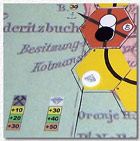
Another new feature is the two mines on the map, one coal mine and one diamond mine.
If connected to a route a corporation collects additional income when using that route.
Different to the normal income of a corporation the mine income may not be used for
dividends but is paid into the corporation’s treasury straight away. We found this to
be a very welcomed extra income for a corporation virtually at no extra cost other than
using a route along a mine field.
AND IN THE END
In the end Günther won the game by a small margin. This is remarkable in so far as
Günther was the player with only one presidency and who had the additional handicap of a
reduced certificate limit due to the blocked share, which came with the obligation.
Walter and I both owned two presidencies, Walter owning 100% and 50% of his corporations
and I owning 80% and 60% of my corporations. In retrospect the forced floating of my
second corporation at a very low share price only to keep the benefits of the obligation
was definitely a mistake and probably cost me the game.
CONCLUSION
1895 is a 3-player game, designed to last 2 hours or less if played without a
moderator program (the configuration file for Lemmi’s 18xx moderator program is
already available on Adam’s homepage). As with most 18xx games the designer took care to
reflect the historical development of the railway system in the respective country with
some accuracy. Four of the five railroad corporations in the game are real railroad
companies of that period. Most likely, trackbuilding also follows historical routes due
to the obligation’s target cities and the cleverly placed fields with extra costs
(terrain) or benefits (mines).
 The idea to design a short 3-player variant of an 18xx game has
been implemented very well indeed. 1895 is highly dynamic both in the bank round, due to
the low certificate limit as well as in the operation rounds, due to the limited supply
of trains of a single type. The concept of obligations works very well and provides an
extra dimension to the game which we found challenging both in determining the right
price for them as well as using their benefits to a player’s best advantage. Comined
with the excellent production quality of the game (map, tiles, certificates and trains
are laminated) makes 1895 a highly recommended game. Walter gave it a ranking of 10 (out
of 10), which puts 1895 in line with his much liked 1830. For me 1895 is a excellent
addition to the 18xx series, especially due to the fact that it is a short, 3-player game
and still has a lot of dynamics and challenges. But the “suspense factor” of
1830 is still my favorite; hence my ranking is 9 out of 10.
Our thanks go to Adam Romoth
(designer) and Helmut Ohley
(co-designer and producer) for making it possible to play “1895 – Namibia” a
few months before the scheduled re-release date in October, in time for “Spiel
2004” in Essen. The improvements made to the inital design released in 2002 are
considerable and resulted in an overall enhancement of the game.
Details about the games availability can be found here soon.