Piranha Pedro

Piranha Pedro

reviewed by Moritz Eggert

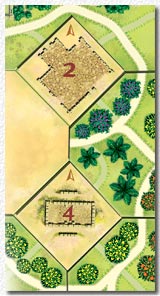
Piranha Pedro (with a sombrero-are there piranhas in Mexico, I wonder???) sits on his
little island and wants to leave it. Problem is: There are piranhas out there, and LOTS
of water, which can only be overcome with stepping stones. Basically Piranha Pedro is
like Sisyphos, as his journey from the island always ultimately ends in failure (= end of
a round). Poor s.o.b.!

Each player has 12 cards with 1-3 stone symbols, 3 for West, North, South, East
direction. They also have a pile of stepping stones in front of them (four at the
beginning, more are less after each round depending on what cards you played). Each
player plays his/her card secretly and after that, they are revealed in changing turn
order. If a player played a 3 East card for example, Piranha Pedro would move 3 spaces in
an eastern direction (actually N,W,S,E are shown as symbols corresponding to game board
sides), if he passed water spaces the player playing the card would have to expand
stepping stones. If the player runs out of them or if Piranha Pedro steps on the
eponymous Piranha, the round is over and a new round begins. If the same player fails
twice, the game ends immediately and ALL other players win, so this is a good game to
build up your self-esteem after a long series of lost “St. Petersburg” games,
for example.
“Piranha Pedro” is a bit like a very simple “Robo Rallye” – you
can never be sure what the other players are up to with poor ol’ Pedro, and where
exactly he is going to end up. The beginning spaces of the island are safe havens, and
you might try to move Pedro around in circles a little to avoid spending stones. A
beloved tactic is to unexpectedly move Pedro to the edge of the gameboard, because then
the chance rises that one of the players accidentally moves him over the edge (another
death for Pedro – I guess he drowns in a glass of wine or falls from the table).

“Piranha Pedro” is lovingly crafted: The stepping stones are real pebbles,
and Pedro stands proud as a little wooded figure. The rules are explained in comic book
form, which is certainly an innovation (but not the first game to do so – see
“Snit’s Revenge”). It is a simple game with good player interaction, and it
equally works when playing together with kids. One might get tired of Pedro’s
shenanigans after a while (because there is not really a lot to it), but as a quick break
game this certainly serves its purpose.

Explanation: 2 minutes (or read the comic)

Playing time: 20 minutes
Casanova

Casanova

reviewed by Moritz Eggert

This game is not, as one would expect from the title, about beds, but rather about
BETS (apparently real-life Casanova’s second obsession).

This is a deceivingly simple game, that actually turns the intrepid gamer a little off
when he reads the rules, as there doesn’t seem to be much of a game in it.

Each player has 13 cards (numbered 1-13). Each round consists of the starting player
declaring if he is going to roll 1, 2 or 3 dice, then each player selects one of his
cards secretly. Then the dice are rolled, and each player places one coin as a bet. The
starting player now has the possibility to either “declare” and reveal all
cards (in this case the player who played the highest card that is either equal to or
below the actual dice roll wins the bet) or to “raise”, which works like in
poker, with each player either passing or raising. This is done 12 times, and then the
game ends.

And that’s it!

Strangely enough, the game is much more tactical as the first impression suggests. The
fact that you only play 12 of your 13 cards, and that the cards the players already
played are open creates some second-guessing, and can even result in “sure”
bets, if the dice do not roll too far from the average outcome. But even though this
results in slightly amusing little game this is not more than VERY slight fare for the
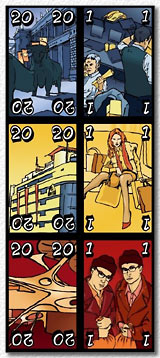
family crowd, even if the cards’ graphics are nice and unusually elaborate. I wonder
if beds wouldn’t have been a better theme, and if some players felt cheated after
buying this game because of the promising title.

Explanation time: 1 minute

Playing time: 20 minutes

17.02.2005: Betrayal at House on the Hill, Paladin, Windschatten

Betrayal at House on the Hill

This game works relatively well as a traditional exploration/character advancement game, but really kicks into gear when it comes to the second part, where one player will be the evil traitor and the other players fight together to overcome one of 50 totally different evil scenarios. Some of them play like little wargames, others demand deduction and skill. Great fun for everybody involved, as the game really depicts the theme well, and the scenarios have been lovingly crafted to represent every imagineable haunted house story/cliché.The replay value is high, as the endgame is always different, but the exploration stays a bit samey. The game would profit from expansions, which could easily be integrated. Great design with wonderful atmosphere, easy to pick up, relatively short playing time – what doth the geek wanteth more?

WPG ranking: Basti: 8, Andrea: 9, Moritz: 9, Aaron: 8

Paladin

What might have been a mildly interesting game is ruined by the fact that the paladin cards are drawn at random, and that there is no game mechanic that can overcome the malady of drawing low cards. Imagine playing “Corruption” (a similar, much superior game) with randomly drawn money cards instead of equal hands for each player. Players place their cards trying to overcome adventures, but this is handeld in a totally abstract and uninspired way. What is essentially a very boring game is not saved by the fact that it is also very simple and easy to explain.

WPG ranking: Basti: 3, Andrea: 3, Moritz: 3, Aaron: 3

Windschatten

Amazingly good as an advertising game (that came free with a certain brand of mineral water), but if you had bought it you probably wouldn't have been wowed. This is a solid racing game design that takes elements from many similar games and weaves them together to form a relatively satisfying little game. But don't expect anything radically new here. Might lure some health freaks to become gamer geeks.

WPG ranking: Basti: 4, Andrea: 4, Moritz: 5, Aaron: 5

02.02.2005: Piranha Pedro, Flaschenteufel, Casanova, Fairy Tale, Bluff

1) Piranha Pedro
Jeder Spieler zieht verdeckt eine Karte, gemäß der eine gemeinsame Spielfigur jeweils in eine der 4 Himmelsrichtungen um 1 bis 3 Spielfelder weit gezogen wird. Solange die Spielfigur auf Land bleibt, ist es gut, wenn sie ins Wasser gerät, muß der Spieler Steine aus seinem Vorrat unterlegen. Wer als erster alle seine Steine losgeworden ist, beendet als Verlierer das Spiel.
Die meiste Spielqualität (äächt!) bringt hier die Schadenfreude, wenn man seinen Nachfolger durch eine unerwartete Vorlage weit ins Wasser schicken konnte.

WPG-Wertung: Andrea , Günther , Moritz ,Walter: unisono 6 Punkte
Ich werde einen Report schreiben.

2) Flaschenteufel
Gelungenes Stichspiel mit vielen antagonistischen Elementen. Einen (Siegpunkt-)Stich gewinnt einerseits die absolut höchste Karte, andererseits (falls vorhanden, dann mit Priorität) die relativ höchste Karte unter einem definierten Limit. Das definierte Limit sinkt immer weiter nach unten.
Wer wegen des Limits gewonnen hat, bekommt den “Flaschenteufel”; wenn er ihn bis Spielende nicht wieder loswerden konnte, zählen alle seine Stiche überhaupt nicht.
Lustig, auch ein bißchen taktisch, zum überwiegenden Teil aber abhängig von einer glücklichen Kartenausteilung.
Ein Nachfolge-Kandidat von “6 nimmt” für die Wochenend-Ausflüge mit meinem Schwager.

WPG-Wertung: Andrea 7, Günther 7, Moritz 7,Walter 6.
Motiz wird einen Report schreiben.

3) Casanova
Reihum bestimmt jeder Spieler, ob mit 1, 2 oder 3 Würfeln gewürfelt wird. Vor dem Würfeln zieht jeder Spieler verdeckt eine Karte aus seinem Kartensatz (Zahlen 1-13), mit der er das Würfelergebnis möglichst gut erreichen, aber nicht überschreiten möchte. Der beste Rater bekommt den Einsatz.
Moritz war unglaublich gut: in mehr als 50% aller Fälle landete er einen Volltreffer. (Trotz Glück in der Liebe!)

WPG-Wertung: Andrea 3, Günther 4, Moritz 5,Walter 4.
Moritz wird einen Report schreiben.

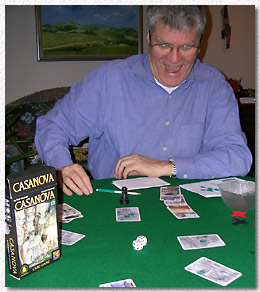
Nach dem Spiel wurde für ein Foto noch schnell eine Spielsituation zusammengetürkt. Das Foto enthält 2 Fehler:
a) Auf einer der Spielkarten liegen 2 statt nur 1 Wetteinsatz.
b) Unser Arpad steht neben MIR.
Günther hatte die Idee, als nächstes WPG-Rätsel Fotos mit Spielsituationen zu veröffentlichen, die eine Reihe von sachlichen Unrichtigkeiten enthalten, und die es zu entdecken gilt. (Aber erst nach der St. Petersburg-Serie!)

4) Fairy Tale
Ein japanisches Karten-Sammelspiel aus dem Hause “Masquerade”. Neuartiges und bemerkenswertes Karten-Verteil-Prinzip. Etwas undurchsichtig, welche Kartenkombinationen möglich sind und am Ende die meisten Punkte bringen. Hier kam uns das Spiel in der ersten Begegnung noch ziemlich Spanisch vor.
Moritz meinte abschließend, mit den Expansion Rules wäre es noch bedeutend interessanter …

WPG-Wertung: Andrea 3, Günther 5, Moritz 6 (will noch mal eine außerordentlich freundliche japanische Begrüßung wie bei “Masquerade” erleben), Walter 3 (Gedächtnis- und Übersichts-Probleme!)
Motiz wird einen Report schreiben.

5) Bluff
Zum ersten (?) Mal ein Endspiel von 4 Spielern mit je einem Würfel. Moritz legte zwei Vierer vor. Günther hätte mit zwei Fünfen das Spiel für sich alleine entscheiden können. Er wollte das natürliche Alles-oder-Nichts aber nicht riskieren sondern lieber mit ein paar Freunden gemeinsam untergehen: er zweifelte an und schickte damit sich und alle anderen, außer Moritz, zur Hölle.
Höhepunkt eines schon allein durch unsere eigene gute Stimmung gelungenen Abends.

Die Gärten der Alhambra

Die
Gärten der Alhambra

reviewed by Moritz Eggert

This game has been published under the title “Karat” a couple of years ago,
and Queen Games has used the recent success of “Alhambra” to
publish this game again with beautiful artwork reminiscent of its “sister”
game. But game wise this has little to do with “Alhambra”, in fact “Die
Gärten…” is a truly abstract tile laying game.

The large game board is filled with empty, semi-octagonal spaces that surround square
building spaces of different numerical (VP) value. These buildings are placed at random,
but the values are open from the start. Each player now in turn plays one of the
octagonal tiles that are designed in a way that 4 of them surround a building space.

Each octagon has flowers on each side, in equal quantity, but in different orders. The
flowers represent the player’s “influence” on the various buildings. If a
building is surrounded by 4 octagons it is immediately scored, and the player with the
highest number of flowers adjacent to the building wins the points. In the (often
occurring) situation that two players have the same amount of flowers present, the player
with the next highest number of flowers gets full points, and the others nothing. This
can even mean that a player with NO flowers present can get points (if the three other
players cancel each other out that is).

These are, not even in a nutshell, the complete rules of “Die Gärten der
Alhambra”. Gärten der Alhambra boardGame play is not as easy, as the board becomes cluttered very quickly,
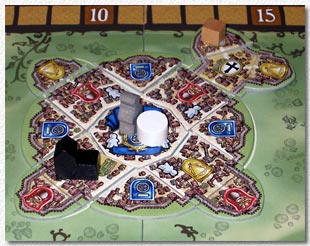
and it is easily overlooked what repercussions each play has. The buildings at the rim of
the board are attractive as they can be quickly scored, but these plans are also easily
foiled by making playing a matching numbered tile easier. You can have two kinds of tiles
in your hand – if you draw a high one you will try to bolster your expected scoring
buildings, if you have a low one you might use it to score a building by making a play
safe for you but bad for the other players. Rarely you’ll have the exact tile that
you need or want!

The game ends after all tiles have been placed, a running score is tallied and one
player wins.

The game, although physically attractive, holds one big caveat for the ambitious
player, and that lies in the fact that you are “played” by the placement of the
other players. In fact up to three quaters of your VP will be achieved through actions no
at all your doing!. As each player first of all cares for him/herself, the placement of
your own coloured flowers will very often be what you want. However, in which order the
OTHER 3 flower colours are placed on the tile and which players will profit from their
placement is very often a result of pure chance, even if you might achieve one or two
naughty and damaging plays. This is especially true in the endgame, when open spaces
become rare and tiles are simply played as they come. In the several games we played the
winner was always the player who profited most from this undirected placement, in fact
you could have thrown the dice instead of playing the game in a way. But it is probably
easy to devise variants. The game offers two: In the first variant each player has three
available tiles (which gives your play a bit more of direction), in the second two
players play with each having TWO colours. The latter variant can actually be very
challenging and can be full heartedly recommended to the pro-gamer, whereas the
“normal” game is probably more fit as a “relaxed” family game, for
which it’s easy rules make it work well.

The game can be explained in less than 5 minutes, actual playing time is 45 minutes to
an hour.

Frantic Frankfurt

Frantic Frankfurt

reviewed by Moritz Eggert

From time to time, a game comes along that tries to approach “real time”
gaming, i.e. games that play in a frantic hurry, like the early “Zaster” or
“Falling” by Cheapass Games. In these games there is not a strict turn order in
which each player patiently awaits what the others are doing, instead everybody plays at
once.

This is especially true of “Frantic Frankfurt”, a new offering of
“Kronberger Spiele”. The game plays like a collective patience, each player has
to get rid of his/her cards as quickly as possible. Each player has 4 decks of various
cards in front of him/her of which only the upper one can be seen. One important element
is that each player plays with only ONE hand (the other presumably holding a mobile phone
to buy stocks), so one has to play a card before looking at the next card. Players play
on open decks on the table, with only two rules: if you play a different coloured card,
it has to be higher than the card you play it on, and if you play an equal coloured card
it has to be even if the card below is odd, or vice versa.

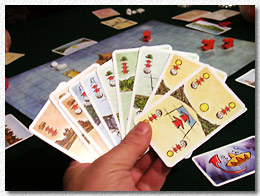
Frantic Frankfurt cards

One would be astonished how difficult it is to follow these two easy rules during
actual play. In fact, each player experiences what I would call a
“player’s” block often, being completely paralyzed for the moment because
the others hectic play foils all your plans or simply overwhelms you. As the first four
cards in front of you are open, the first plays can be planned pretty well, but after
that chaos reigns.

Players will fall in two categories: Those who are slow and play their cards
correctly, or those who simply play the cards as they come without correcting mistakes.
And herein lies the big problem of the game – as everything happens simultaneously (to
the extent that cards AND hands might get damaged in the process) mistakes do happen and
it cannot always be reconstructed who the culprit was. In fact it is a valid, even
successful strategy to play your cards very quickly without any care before anybody can
react. In the worst case, somebody else notices it and then both you and s/he spend some
time arguing while somebody else wins instead. This would work as a computer game if
their is an infallible neutral instance, but as a multiplayer game this game mechanic
might be questionable at best, especially because the game doesn’t really use any
kind of punishment for discovered mistakes (like stopping the game and drawing an extra
card, for example).

In Essen the person who presented the game simply said to me “The moment you
think about playing a card wrongly you already lose time”. In our experience sloppy
play was thoroughly rewarded, as the game played so quickly (one round can last under a
minute) that it is nigh impossible to keep track of the mistakes of your fellow
players.

Nevertheless, the game created some enjoyment and excitement at the game table,
although one simply gives up after a while, as it is too much for the brain to handle.
The unsuccessful graphics evoke some kind of stock market frenzy, but luckily, the game
plays too fast for you to really bother looking at the cards. After one play the cards
already showed some sign of damage, although one should think that for a game like this
they should have been designed sturdier.

“Frantic Frankfurt” can be frantically explained in under 5 minutes, a
series of games (several rounds) plays in 10-15 minutes.

26.01.2005: 1860

1) 1860
5 Stunden lang vergnügten wir uns in einer Dreierrunde (Aaron, Günther und ich) mit uns und mit einem der jüngsten Enkelkinder aus der 18xx -Familie: “1860”.
Neue Regeln, neue Herausforderungen, aber wie bei jedem Mitglied der Familie: – alles logisch, alles stimmig, alles gekonnt zusammengebraut.
Wir kämpfen alle noch mit der richtigen Einstellung zu den unvermeidlichen Insolvenzen. Jeder besitzt noch zuviel Skrupel, einen Offenbarungseid normal wie einen warmen Regen über sich ergehen zu lassen.
Günther konnte seine unerreichte Erfahrung und Übersicht auf dem 18xx-Sektor auch hier zu einem unangefochtenen Sieg umsetzen.

Keine WPG-Wertung, wird aber wohl bei allen zwischen 9 und 10 Punkten liegen.

Flandern 1302

Flandern 1302

reviewed by Moritz Eggert

How would it be if German games suddenly weren’t allowed to use the seasoned
principle of “place tiles/pawns to gain majority in areas” and “gain VP in
these areas and keep track of them on a victory point track”? The propagation of
this principle through games like “El Grande” is perhaps the biggest
achievement of German game design: the possibility to create a situation of fierce
competition without resorting to wargame principles of destruction and conquest, the
embodiment of the principles of democracy in gaming terms.

“Flandern 1302”, the new game from Queen Games, certainly doesn’t invent
the wheel in this respect, many might feel a slight tinge of “done that, seen
that” when reading the rules. But this doesn’t necessarily make it a bad
game.

In fact, “Flandern 1302” has some things going for it. The board and tile
design is especially beautiful, and there is a certain pleasing feeling when completing
the various cities with various unusually shaped tiles.

The players act as guild masters in medieval Flanders. The play of cards gives players
the possibility to place tiles of his/her affiliated guild. The cards determine the
possible cities in which tiles can be placed. Some of the cities already have a city
centre in the colour of the player, but it is this player’s decision to use this
advantage or not. Interestingly there is also a “neutral”, grey colour, which
can actually win a majority and even get points (handy if you’d rather have
neutrality win than another player). The latter mechanic somewhat offsets the kingmaker
effect that games of this sort sometimes have, especially when the selection of tiles
becomes limited and you may be forced to play tiles to another player’a
advantage.

Flandern 1302 board

Of course there are the usual shticks that make these kind of games interesting. It is
possible to place tiebreakers (“Zunftmeister”), heighten the value of the city
through church tiles, and to play cards for better hand management. A new idea is that
cities can be enlarged for possible more points but also more competition. As is usual in
these games one can never be everywhere at once, so it is good to not spread yourself too
thin. A winning move can be to save the right tiles and be the only payer who can
continue to play at the end, but this is not easily achieved.

That’s already all there is to this game – some people might call it too simple,
others will enjoy that this game can be quite quickly played and enjoyed as the abstract
tile-laying game that it is.

If you don’t have enough of this kind of games yet, “Flandern 1302” can
be wholeheartedly recommended. It is a solid design with no major flaws apart of the
usual group dynamic effect that sometimes makes area competition games a bit
unsatisfying. But a solid design it is. Others might prefer to wait for the next gaming
revolution – but who knows how long we will have to wait for it? There could be worse
things than playing a game of “Flandern 1302” while waiting for it.

Sicilianos

Sicilianos

rezensiert von Walter Sorger

Ein frech-fröhliches Kartenspiel mit dem Charakter eines Stichspiels. Die Spieler
erwürfeln sich reihum Karten verschiedener Stärke (Zahlenwerte 1 bis 11) in sechs
verschiedenen Farben. Sobald ein Spieler glaubt, in einer bestimmten Farbe stärker zu
sein als alle seine Konkurrenten in beliebigen anderen Farben, kann er zu einem Stich
ansetzen. Er spielt verdeckt eine Karte seiner Dominanz-Farbe vor sich aus und legt einen
Geldschein als Einsatz dazu. Jeder Spieler ist jetzt aufgefordert,

  1. um diesen Stich zu kämpfen oder
  2. zu passen und nicht mehr ins Spielgeschehen eingreifen, bis der Stich entschieden
    ist.

Den Kampf um den Stich aufzunehmen heißt, eine Karte in einer anderen Farbe
auszuspielen und ebenso einen Geldschein als Einsatz dazu zulegen. Die Stich-Kämpfer
können jetzt reihum einzeln solange Karten in der von in ihnen begonnenen Farbe
dazulegen, wie sie Lust haben. Wer am Ende die stärksten Karten (Summe der Zahlenwerte)
ausgelegt hat, gewinnt den Stich. Als Belohnung darf er sich seinen Geldschein-Einsatz
auf seinem Siegpunkte-Konto gutschreiben lassen. Zusätzlich gewinnt er eine Bonus-Karte,
die ihm in der Schlußabrechung weitere Siegpunkte bringt.

Die Verlierer des Stich-Kampfes gehen leer aus, alle ausgespielten Karten werden
eingezogen und die Runde wird mit einem neuen Stich oder mit dem Erwürfeln neuer Karten
fortgesetzt.

Bis hierher klingt das alles sehr brav und harmlos. So ist es aber dann doch nicht.
Nicht, daß die einzelnen Karten “Mitglieder von sizilianischen Mafia-Clans”
sein sollen, und daß der Kampf um den Stich als “Bandenkrieg” tituliert wird,
bringt die Spannung. Es sind ein paar Elemente eingebaut, mit denen gewollt und gekonnt
Pfeffer ins Spiel gebracht wird.

  • Es gibt niedrig-wertige Karten, die eine beliebige höherwertige Karte eines
    Konkurrenten eliminieren können. “Wegbomben” heißt das auf Gut-Sizilianisch.
    Wer viele hohe Karten einer Farbe gesammelt hat, kann also keineswegs sicher sein, damit
    sein Schäfchen schon im Trockenen zu haben. Kleine Bömbchen der Konkurrenz können ihn da
    schnell aus der Fassung bringen.

  • Die niedrigste Karte einer Farbe heißt “Bodyguard”. Damit kann man seine
    hochkarätigen Paten vor einer Bombe der Gegner schützen. Auch die Bombenleger sollen kein
    leichtes Spiel haben.

  • Es gibt “Überläufer”-Karten, mit denen man sich nicht direkt am Bandenkrieg
    beteiligt, sondern mit denen man den Stichkampf eines ausgesuchten Mitspielers
    unterstützt. Gewinnt der Partner den Stich, wird man an der Beute beteiligt; verliert er,
    dann geht man mit ihm zusammen leider leer aus.

Dieses chaotische Stichkampf-Kartenspiel enthält mehr taktischen Elemente, als es das
billige Erwürfeln und Ausspielen von Karten im ersten Augenblick vermuten lassen.

  1. Es ist natürlich immer von Vorteil, ein gutes Gedächtnis zu haben. Wie viele Karten
    und von welcher Farbe die Konkurrenten jeweils in der Hand halten, ist offen sichtbar. Ob
    aber hohe oder niedrige Werte darunter sind, das kann man u.U. aus den in der
    Vergangenheit gespielten Karten ableiten. Es hilft jedenfalls in der Bewertung der
    Gewinnchancen bei einem Bandenkrieg.

  2. Kartenpflege: Immer wieder mal hält man ein absolutes Looser-Blatt in der Hand. Das
    kann man nur aufbessern, wenn man sich eifrig in Bandenkriegen beteiligt. Schließlich
    bekommt jeder Spieler am Anfang 10 Geldscheine zugeteilt, die er ohnehin bis zum
    Spielende aufgebraucht haben muß, ansonsten zählen sie negativ. Die kleineren Wert davon
    gezielt einsetzen, um schlechte Karten loszuwerden und um die Gegner in verlustreiche
    Kriege zu ziehen, gehört zu gutem Spiel.

  3. In einer 5-er Runde kann jeder nur 2-3 Bandenkriege gewinnen. Hier muß man unbedingt
    auf die richtigen Pferde zu setzen, d.h. man muß entweder geduldig auf den richtigen
    Zeitpunkt sparen oder unverzüglich eine ausgeblutete Nachkriegssituation bei den
    Mitspielern ausnutzen. Dann aber mit voller Kraft, d.h. mit dem höchsten Geldbetrag in
    den Kampf ziehen.

  4. An den ausgelegten Primärkarten einer Farbe und am eingesetzten Geldschein kann man
    (vielleicht) ablesen, welche Ambitionen die Gegenspieler in einem angefangenen
    Bandenkrieg haben. Die “richtige” Reihenfolge beim Ausspielen der Karten
    einzuhalten, z.B.:

    • die hohen Karten zum Abschrecken,
    • die kleinen Karten zum Bluffen,
    • den Bombenleger als Köder
    • oder alles mal in der umgekehrten Reihenfolge

    ergibt schon reichlich Spielraum sowohl zum Protzen als Goliath als auch für Finessen a
    la David.

“Sizilianos” wird die Denker unter den Spielern nicht befriedigen können.
Doch es spielt sich flott, witzig und spannend. Chaos, Kampf, Mauschelei, Verrat und ein
bißchen Taktik bestimmen das Geschehen. Kingmakerei ist ein natürlicher Bestandteil der
Spielregeln, wird aber keineswegs als anrüchig oder ärgerlich empfunden, sondern als
passend integriert in den Spielablauf. Das sagt doch schon ziemlich viel über den
Charakter des Spieles.

Am Tisch: Aaron, Basti, Loredana, Peter, Walter

Danger

Danger

rezensiert von Walter Sorger

Warum gehen erwachsene Menschen zum Black-Jack-Spielen in die Spielbank? Die geldige
Atmosphäre kann es ja nicht sein, der Duft des Geldes steigt doch nur von den Chips auf
den Roulette-Tischen auf. Um die Black-Jack-Theken herum sitzen dagegen dumpf-brütende
Kartendimpfl, erfüllt vom Glauben, klüger zu sein als Generationen von
Casino-Mathematikern vor ihnen, und sicherer erkennen zu können, wann man mit dem
Nachfordern von Karten aufhören muß. Vom Millionenumsatz her, der mit diesem Kartenspiel
gemacht wird, sollte es faszinierend sein!

Ein gleich vierfaches Black-Jack-Erlebnis bietet “Danger”: Jede der vier
Kartenfarben wird hier für sich gesammelt und gewertet. Die Spieler erhalten reihum
jeweils eine Karte und müssen sie im zugehörigen offenen Kartenstapel dieser Farbe vor
sich unterbringen. Überschreitet der Kartenwert aller Karten in einem Stapel die Zahl 15,
geht der Stapel verloren und die gesamte Kartenfarbe für den betroffenen Spieler wird
gesperrt.

Ein Spieler kann sich gegen diesen Totalverlust wehren, indem er vor dem Zuteilen der
Karte einen Stapel schließt und damit für diese Farbe keine Karten mehr annimmt. Der
aktuelle Wert dieses Kartenstapels ist dann die Zahl an Siegpunkten, die sich ein Spieler
für die betreffende Kartenfarbe gutschreiben kann. Gewonnen hat, wer am Ende die höchste
Summe an Siegpunkten aus den vier Farben erzielt hat.

Wer in einer Kartenfarbe zu gierig über das gesetzte Limit hinaus geraten ist, bekommt
dafür also gar nichts. Wer allerdings als Angsthase zu früh eine Kartenfarbe schließt,
ist auch nicht auf der sicheren Seite: Von allen Kartenstapeln, die überlebt haben, wird
in jeder Farbe der niedrigste von der Wertung ausgeschlossen. Ein bißchen Risiko gehört
schon zum Leben.

Erhält ein Spieler eine Karte in einer Farbe zugeteilt, deren Stapel er bereits
geschlossen hat, dann wird die Karten auf einen offenen Ablagestapel gelegt und der
nächste Spieler ist an der Reihe. Hier bietet “Danger” gegenüber Black-Jack
sogar eine 100% größere Handlungsfreiheit: Der Spieler kann nämlich entscheiden, ob er
als nächstes eine unbekannte Karte vom Verteilstapel oder die offene Karte vom
Anlagestapel nimmt. Eine analoge Regel bei Black-Jack käme einer Revolution im
Spielcasino gleich.

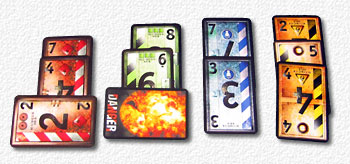
Danger cardsAnsonsten gibt es bei “Danger” nicht viel zu
entscheiden:

  1. Karten aufnehmen (Null-bis-Eins Auswahl-Möglichkeiten)
  2. Karten auf den richtigen Stapel legen (Null Freiheiten)
  3. Überzogene Stapel entfernen (Null Freiheiten)
  4. Gut bestückte Kartenstapel schließen (dies entspricht dem
    Original-Black-Jack-Handlungspielraum in der Größenordnung von Null-Komma-Eins
    Freiheiten)

Gesamtergebnis: Für Kinder ein schnelles und manchmal lustiges Vergnügen. Für
Erwachsene auch, vor allem wenn sie sich ein gewisses kindliches Gemüt in ihre reiferen
Jahre hinübergerettet haben. Millonenumsätze in den Casinos der Welt können sich nicht
irren.

Ich persönlich gehe in der Spielbank aber doch lieber an den Roulette-Tisch. Schon
allein wegen dem Duft. Es müssen ja nicht unbedingt meine Millionen sein, die da
abkassiert werden.

Am Tisch: Aaron, Günther, Peter, Walter

"Was lag auf den Tisch?"