Spielbericht vom 29.07.2004

Spielbericht vom 29.07.2004

Sankt Petersburg cover
Autor Michael Tummelhofer
Verlag Hans im
Glück
erschienen 2004
Spielerzahl 2 – 4
Spielzeit 60 Minuten

Sankt
Petersburg

Im Westpark nichts Neues. Alle Augen schauen nach wie vor begehrlich nach Sankt
Petersburg und träumen von göttlichen Eingebungen, die sie hier zum Größten machen.

Günther hat eine vorzügliche Umsetzung des Spiels in eine Computer-Version geschaffen.
Für die Computer-Gegner gibt es eine Reihe von Einstellungsparametern, mit denen man sie
von aufrechten Bauwerkern bis zu strammen Adeligen ausrichten kann. Hier kann jeder von
uns seine Strategien entwickeln und testen. Die eingebauten Verhaltensmuster sind bereits
so stark, dass man seine Computer-Gegner schon mal bewusst auf die falsche Fährte zwingen
muss, um vor dem Schlafengehen noch ein paar Siege einfahren zu können.

Auch unseren Phantasten Moritz hat das kapitalistische Fieber gepackt. Mit gewohnter
Selbstsicherheit drohte er uns eine “Killerstrategie” an. Ob sie uns allerdings
vom Markt fegen könnte oder ob seine Worte nur ein bisschen Pfeifen im dunklen Walde
waren, hat er nicht so deutlich durchblicken lassen.

Lange Rede kurzer Sinn: Wir fingen den Abend mit einer Runde Sankt Petersburg an. Und
als das Spiel voller Kampf und Konzentration, voller geballter Aktivitäten im Bauwerke-
und Adelsbereich nach einer guten Stunde über die Bühne war, waren alle – der Sieger
sowie die drei Verlierer – sofort bereit zu einem Revanche-Spiel. Das kommt in
WPG-Kreisen höchst selten vor!

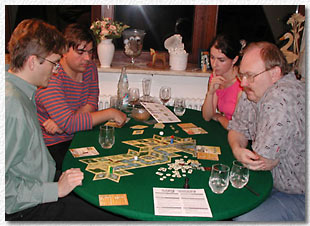
Günther, Aaron und ich gingen abwartend ins Spiel. Die aufgelegten Karten und das
Verhalten der Mitspieler sollten entscheiden, ob wir uns mehr den Bauwerken oder mehr dem
Adel zuwenden sollten. Moritz verfolgte, wie angekündigt, seine – noch geheime
“Killerstrategie” und drei Augenpaare versuchten bei jedem Zug zu erkennen,
wohin seine Reise führen sollte. Aber Sankt Petersburg fügt sich nicht freiwillig in die
Pläne der Kontrahenten. Mal bietet der Markt nicht die erwarteten Karten, mal schnappen
die Mitspieler ganz schnöde die wenigen Objekte der Begierde einem vor der Nase weg. Ganz
offensichtlich lief es nicht gut für ihn. Ja für keinen, außer für mich, der ich in der
zweiten Runde bereits die super-adelige Hofdame erstehen konnte und damit allen
Geldsorgen entronnen war. Sie bringt jedes Mal am Ende der Adelsphase ihre 6 Rubel ein,
womit man alle seine Ambitionen auf dem nachfolgenden Handwerkermarkt befriedigen kann,
ohne dafür Geld vorhalten zu müssen. Selbst dass ich mich im Laufe des Spieles noch
einmal unnötig in überteuerte Handwerker verstrickte, konnte meinen Sieg nicht mehr
aufhalten.

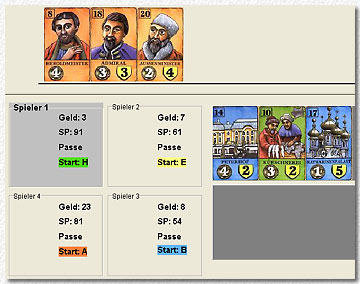
partial screenshot computer version of Sankt PetersburgIm zweiten Spiel bekam
Günther in der ersten Runde bereits die bewusste adelige Dame in seine Finger. Er hatte
auch vorsorglich (!) genügend Geld gespart, um sie sofort aufdecken zu können. Damit war
sein Sieg schon mal auf die Schiene gesetzt. Er musste zwar noch aufpassen, dass seine
weiteren Weichenstellungen nicht ins Abseits führten, aber für den abgeklärten Entwickler
der Computer-Umsetzung war das eine überschaubare Aufgabe. Moritz kämpfte mit Händen und
Füßen, mit Bauwerken und Adeligen und Upgradern aller Art gegen Günthers reichliche Geld-
und Siegpunkt-Zuflüsse, es reichte aber nur zum zweiten Platz. Gaaanz knapp!

Hätte er in seinem ALLERLETZTEN Zug fünf Strafpunkte geopfert und dafür den letzten
Adeligen vom Markt genommen und eingebunkert, dann hätte er Günthers Ausbeute beim
Adelsbonus um sieben Punkte kürzen können und wäre mit seiner Upgrader-Dominanz sogar
noch Sieger geworden. Es gibt in Sankt Petersburg immer wieder neue Phänomene, die alte
(oder brandneue) Denkgewohnheiten über den Haufen werfen können. Ein tolles Spiel!

Als gemeinsames Fazit bleibt die weitere Erkenntnis: Viele Wege führen nach Rom.
Einige frühzeitige lukrative Einkäufe auf dem Handwerkermarkt und ein beglückendes
Angebot einer gewissen Dame sind sichere Meilensteine dahin.

Session Report/Spielbericht 20.07.2004

Session Report/Spielbericht 20.07.2004

Fliegen
Designer Philippe des Pallières
Publisher Asmodée
Editions
released 2003
Players 2 – 5
Spielzeit 30 minutes

Fliegen (Commes les mouches)

Philippe des Pallières and Hervé Marly (lui meme – games) made a first appearance with
their successful “Die Werwölfe von Düsterwald” at Essen 2003 (a variation of the
party game “whodunit”). This is their second game, also coming in a small and
handy box with only a handful of cards, but this time also with 27 very realistic plastic
flies!

The game plays like a variant of “Liar’s
Dice
” – there are 12 bidding rounds (one for each of the 12 cards that can be
gained). Players are “lords of the flies” who try to land their flies on
various objects depicted (very realistically) on the cards. These can be old camemberts
or even cow dung (which brings the most points). Each player starts with 5 flies. You can
bid any secret number of flies (even zero) by putting them secretly in your hand. After
every player has selected his number of flies, the starting player now begins his bid by
stating how many flies he thinks the players have bid in total, then the other players
follow, in any order (sometimes it is good to wait a little, especially if you have many
flies in your hand). Then the flies are revealed, and the player with the exact or
closest guess gets to have the card. If there are several players who guessed exactly the
one who bid the most flies wins. All flies bid are lost to the players, but each exact
guess “regenerates” one fly.

Most cards to be bid on are positive victory points, but there are also some negative
points that you can place on other players (a slightly unfair “kingmaker”
element that could be remedied by making the negative cards positive as well). There are
also 3 “special” cards, the fly spray, the eggs and “Mireille”, the
sly fly. The spray lets you eliminate flies held in one particular hand (after the bid
but before revealing), the eggs give you as many flies as players as a bonus and Mireille
joins your other flies in your hand, but can be removed after revealing them to change
the end result if necessary.

After 12 rounds the player with the most points wins (unused flies also count as one
point!!!).

After explaining the rules the experts of the Westpark gamers looked quizzically at
me. You have 5 flies, there are 12 bidding rounds, only very few points to gain (after
subtracting the negative points) and unused flies each give a point? So why actually bid
flies at all? And this is what happened – we were all reluctant to use any flies in the
first rounds, and so “0” was the most common successful guess, which made the
first few rounds pretty boring. Then it became a bit more interesting when the higher
cards appeared, with some players daring to use 1 or (god forbid) even 2 flies! But most
of the time we were all pretty greedy with the flies, and rightfully so.

We wondered if the decision to have only 5 flies per player had to do with the small
box and lower production costs… there are very few design reasons against more flies
per player, which would make for a more dynamic and less calculable game, but as it is
this game is good as a small, short diversion, but nothing that will wow you or keep your
interested in the years to come.

One particular card (see picture) looked very funny when turned upside down – was it
done on purpose? We leave the interpretation to your imagination… those French…
always something dirty on their mind :-)

Game length: 30 minutes (tested with 4 players)

Explaining the rules: 5 minutes

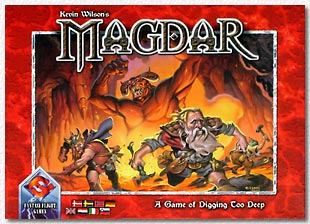
Magdar
Autor Kevin Wilson
Verlag Fantasy
Flight Games
erschienen 2003
Spielerzahl 2 – 4
Spielzeit 45 Minuten

Magdar

Ein weiteres in der Reihe “kleiner” Spiele von Fantasy Flight, von denen wir
schon viele auf dem Tisch hatten (“Orcz“,
Arena Maximus“, “Drakon“).
Allen diesen Spielen ist gemein, dass sie typisch amerikanische Fantasythemen mit eher
“deutschen” Spielmechanismen verbinden, mal mehr, mal weniger erfolgreich.
Diesmal sind die Spieler Zwerge, die versuchen Edelsteine und Mithril aus einem Berg zu
schürfen, bevor der böse “Balrog” (hier aus Lizenzgründen: Magdar) sie
erwischt.

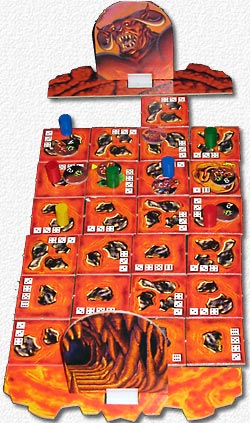
Jeder Spieler besitzt zwei Zwerge, die jeweils eine Aktion haben. Das Spiel besteht
aus maximal 32 Geländeplättchen in 4 Reihen, die in einem Rechteck angeordnet werden. Auf
der einen Seite lauert “Magdar”, auf der anderen Seite befindet sich der
Höhlenausgang. In einer Aktion kann ein Spieler 1) seinen Zwerg entweder auf irgendein
beliebiges freies Feld oder den Ausgang bewegen (damit die Edelsteine/Mithril in
Sicherheit bringen), oder 2) nach Mithril schürfen (überall möglich, wo noch nicht nach
Edelsteinen geschürft wurde) oder 3) nach Edelsteinen schürfen (überall möglich, wo man
sich maximal 3 Felder von Magdar entfernt befindet und noch nicht Mithril geschürft wurde
– die gefundenen Edelsteine sind um so wertvoller je näher man sich an Magdar befindet).
Mithril schürfen dauert zwei Züge, Edelsteine können bis zu einem Wert von “32”
aufgewertet werden (in den Schritten 2,4,8,16,32).

Nach den 2 Aktionen (pro Zwerg eine), wird für Magdar gewürfelt. Auf allen
Höhlenplättchen befinden sich Würfelsymbole, zum Beispiel “2,3,4” oder
“1,6”. Der Spieler kann nun jeweils das Magdar am nächsten befindliche
Höhlenplättchen mit dem von ihm gewürfelten Symbol entfernen, auch wenn ein Spieler
darauf steht (dieser Zwerg kommt zurück zum Höhleneingang). Hiermit rückt Magdar immer
näher bis letztlich keine Höhlenplättchen übrig sind und das Spiel endet. Nun gewinnt der
Spieler mit den meisten Edelstein-Punkten – der Clou ist allerdings, dass Edelsteine nur
in der Kombo mit einem Mithrilstück etwas “wert” sind, sonst zählen sie
nicht.

Magdar board

Wir spielten auch sogleich mit den Fortgeschrittenenregeln, die folgende zusätzliche
Aktionen erlauben:

  • fremde Zwergenschürfstellen können von angrenzenden Feldern erobert werden, wenn man
    eine “6” würfelt
  • ein Schutzkreis kann erschaffen werden, der die Zerstörung eines Feldes durch Magdar
    einmal verhindert
  • ein Köder kann gesetzt werden, der Magdar zwingt, ein bestimmtes Feld zu zerstören,
    wenn er kann.
  • Zwerge können zum “Berserker” werden, dann gelingt ihnen die Eroberung
    schon ab einer “4”.

All diese neuen Fähigkeiten kosten jeweils eine “Aktion”.

Außerdem haben einige Höhlenplättchen Sondereigenschaften: Auf einigen sind die
Edelsteine wertvoller, auf anderen weniger, manche zerstören gleich ganze (vertikale)
Reihen falls Magdar sie platt macht, andere bergen den Hort der Salamander mit einem
wertvollen Einzeledelstein. Das Basisspiel ist etwas zu simpel, die Zusatzregeln ergeben
aber ein leicht spiel- und erklärbares Spiel.

Wie man beim Lesen der Regeln ahnt, handelt es sich durchaus um ein fieses Spiel. Was
am Ende der eigenen Runde noch als sicheres Feld schien, kann nach einem Durchgang schon
auf der Zerstörungsliste stehen (oder gar schon zerstört werden). Da Magdar jede der 4
Reihen anfressen kann, ist es durchaus möglich, dass eine Reihe schnell angefressen wird,
während eine andere erst einmal unbehelligt bleibt. Natürlich wird man versuchen, die
Schürfstellen der anderen Spieler zu zerstören, oft gibt es aber mehrere Möglichkeiten,
und ein Element des “Kingmakerns” kommt ins Spiel. Nicht immer kann man etwas
zerstören, bei einem Wurf von einer 1 oder 6 ist dies wesentlich seltener möglich als zum
Beispiel bei einer 2,3,4,5. Dennoch geht das Spiel sehr zügig voran, nach maximal 45-60
Minuten wird es vorbei sein.

Da es sich recht flott spielt, kommt durchaus Stimmung auf. Walter bemerkte richtig,
dass es eine richtige Taktik ist, erst einmal nach Mithril zu schürfen (was am Anfang des
Spiels sehr ungefährlich ist, da man sich möglichst weit von Magdar entfernt platzieren
kann). Hat man 2-3 Mithril-Klumpen kann man sich ganz auf das wesentlich gefährlichere
Edelsteinsuchen konzentrieren – umgekehrt ist es schlechter, denn Mithril ist gerade
gegen Spielende sehr schwer zu bekommen, weil es zwei Runden dauert, bis es
“abgeschürft” ist. Das Glückselement ist natürlich hoch, das Ärgerelement
ebenso. Wer aber Sinn für solche Spiele hat, wird nicht enttäuscht, wenn auch nicht
unbedingt überwältigt sein. Für ein lockeres, schnelles Spiel zwischendrin taugt
“Magdar” aber durchaus.

Spieldauer: 45-60 Minuten (bei 4 Spielern)

Regelerklärung: 5-10 Minuten (MIT Sonderregeln, Basisspiel maximal 5 Minuten)

A Very Good Year

Development Notes for 1830

By Bruce Shelley

Our design staff heard the first news of 1830’s existence during “Origins” in 1982. Tom Tresham, the brother of 1830 designer Francis Tresham, had come to the convention representing an English game distributor and we questioned him at length for game news from England, especially regarding his brother. By this date we had already purchased CIVILIZATION from Francis and had been playing his 1829 games about British railroads for many years. The idea of an 1829-type game about American railroads appealed to us immediately, and we told Tom to pass on the word that we were very interested in seeing 1830.

The 1830 proponents on our staff at this time were Mick Uhl, Alan Moon, Richard Hamblen, Rex Martin and myself. My own interest traced back to the first Michigan “Origins”, when I stumbled across a mixed group of gamers from MIT and Penn playing the first 1829 game. I was immediately fascinated by the topic and mechanics, and quickly knew “I’ve got to get this game.” I soon did and 1829 became regular fare at the meetings of the UVA game club to which I belonged. My future colleagues at Avalon Hill had come across 1829 on their own a couple of years before this, and although they liked it very much, they did not believe it was a sellable product in the United States.

Not being the patient sort, I wrote to Francis after the ’82 Origins on behalf of Avalon Hill reiterating our interest in the 1830 project and offering to help in any way I could. Francis responded enthusiastically, beginning a long and enjoyable transatlantic correspondence. He had been hoping to sell the 1830 game to us all along, and was pleased to find strong support already in place.

In the fall of 1982, then, we were excited by the prospect of soon having an 1830 prototype in hand, and seeing it in print quickly thereafter. However, this was not to be. 1830 was not published until the early spring of 1986, almost four years after we had first heard of its existence. Over this time period the project had many ups and dawns, including the nadir in the fall of 1984 when 1830 was all but dead.

The first major delay was quite simple to understand. In the fall of 1982 the game was not finished. Although Francis had a game that was being playtested, he was not yet sufficiently satisfied to submit it. In Baltimore, we were quite anxious to get a prototype to examine, but Francis felt this would not be helpful and continued his development in England. The help we could give in this stage was mostly research on aspects of North American railroads and general encouragement. I recall sending information on possible private companies, suitable colors for the railroad pieces, and even designing a sample president’s certificate. Word finally arrived that Tom and Francis were coming to Origins ’83 in Detroit and were bringing an 1830 prototype to leave with us.

I don’t believe I have looked forward with more excitement to any event in my gaming experience than I did to meeting Francis and seeing his 1830 prototype. By now I felt we had become good friends through our correspondence and I had the highest regard for his earlier games. Our meeting was a great thrill for me, and I think also for the entire Avalon Hill entourage, as both Tresham brothers proved to be quite charming and good company.

My first exposure to the 1830 prototype was no less a success. The map and pieces looked much as they do today. We immediately arranged a playtest for the afternoon, and thereafter played it several more times before the convention ended. For our early playings we concentrated on learning the rules and components, and we all enjoyed it very much. I enthusiastically recommended it to Tom Shaw and was backed up by others who had had a chance to play. The convention ended too quickly for me, and the Treshams could not stop in Baltimore on their way home as they (and we) had hoped. I returned home with the prototype and quickly arranged to show it to the local enthusiasts who hadn’t gone to Detroit.

My memory of what this first prototype was like is a little hazy as it did not remain in its original form for long. Also, that first copy was returned to England during the game’s dark days. The largest differences between this early game and what was published are as follows:

1) On the stock market there were no orange and brown zones, and the highest prices reached $1000 instead of $350 (in the same number of spaces).

2) You could not buy stock in your choice of railroads after the private companies were sold. Instead, the companies were sold in order-PRR, NYC, CP, B&O, C&O, ERIE, NYNH&H, B&M. Shares in the NYC could not be bought until all PRR shares had been bought. Shares in the CP could not be bought until all NYC shares had been bought, and so on.

3) Initial share prices were fixed-PRR ($100), NYC ($90), CP ($82), B&O ($76), C&O ($71), and all others $67. Tokens were placed on the Stock Market in a specific box marked for each railroad.

4) Private Companies could be sold to railroads for up to five times their printed value. Printed values were higher; I recall the Camden & Amboy was $210 and the B&O was $265. (Thus, the C&A could be sold to a railroad for up to $1050.)

5) The PRR and NYC had no 20% certificate, just ten 10% shares, one of which was the president’s certificate. The NYNH&H had a 30% president’s certificate, a 20% certificate, and five 10% certificates. The B&M had a 40% president’s certificate, two 20% certificates, and two 10% certificates.

6) The map was very close to the published map, some important differences being no bypass track around the PRR home base in hex H-12 and the printed track on the New York hexagon connecting to hexes F-18 and G-17 instead of F-20 and H-18 as they do now.

Back in Baltimore we began playtesting in earnest. It took a few playings to get the rules down and get together a cadre of experienced players. As our playing continued through the summer and fall, our dissatisfaction with pans of the game increased. The wide open play of 1830 was a radical departure from the stately elegance we were familiar with from 1829. Bankruptcies were a common occurrence. To a large extent, a player’s fate in the game was out of his own hands.

Our first major concern dealt with the selling of the private companies for up to five times face value. The holders of the big private companies would sell for all they could get and then buy up stock. Players not in a position to do this seemed to be at a clear disadvantage, as the others would fill their stock portfolios much earlier. I have notes on one playtest where two “3” trains had been bought. During the stock round following the purchase of those “3” trains, every remaining company in the game (#4-#8) were floated. This resulted in almost every company share selling for less than $40, and a wild scramble for trains thereafter.

This sudden acceleration of the game seemed to lead to other distortions. So many railroads would be floated so quickly that we would find ourselves purchasing “5” trains before they were really useful. In another playtest we had a situation where the trains came out so suddenly that the “4” trains operated for only one operating phase. In other cases, the player purchasing the last “4” train never got to operate it all, as his purchase was immediately followed by purchases of all the “5”s, one “6”, and a Diesel.

The extremely high stock values also seemed unsatisfactory, as they made share dividends substantially less important. The smart play seemed to be a consistent payment of dividends, regardless of the amount, to drive up the stock price. Obtaining a larger train was not worth any reduction in stock price because the last couple of jumps in the price ($100 per turn as I recall) could not be made up by any increase in train size. Thus, there was too little emphasis on board play towards winning. The value of track routes and rolling stock had a much reduced relation to winning compared to stock values. Diesels were only bought as an offensive ploy, to remove all “4” trains from play and possibly force other players to buy diesels out of their pocket. We rarely saw more than three diesels purchased, and usually only one was purchased intentionally.

Our final major criticism concerned map play, including the relation of the order of the railroads and the interaction of the tiles and map. In our opinion after several playtests, incentives built into the game resulted in rail nets and operations that often bore little resemblance to historical fact. For example, the Canadian Pacific as the third railroad to operate, invariably laid track straight for Albany and placed a token there at its first opportunity. This guaranteed access to New York. With these connections the CP had little incentive ever to build track in Canada, and the later New England railroads were limited in their development. Also, the Baltimore & Ohio had access to such lucrative routes in its immediate vicinity that there was little incentive to build west. Historically, of course, the B&O was founded to connect Baltimore with the Ohio River Valley and siphon off some of the trade traveling to New York via the Erie Canal. The B&O never built past Washington, but in the game the first tile usually played by the B&O connected it to Richmond through Washington. Of all the rivers included on the map, the Ohio River was absent. We thought this was an error as the PRR, B&O, and C&O were all trying to reach this river and the important trade this would open up. Another example is the C&O railroad which begins play in Cleveland. The C&O began life as the Virginia Central, a major Confederate artery during the Civil War, and was renamed the C&O in 1868. Its headquarters was in Richmond until relocated in Cleveland by J.P. Morgan. Like the B&O, the C&O was trying to connect the eastern seaboard with the growing west. But in our game, the C&O was already west, and spent most of its time building east.

By November of 1983 we had detailed our dissatisfactions to Francis, and I believe they came as a shock to him. Our correspondence increased but we found it took at least a month for a letter to be received, considered, and answered. We looked for extraneous factors that might have influenced our different perceptions of the game. For example, in my experience with the Treshams, they played a very gentlemanly game, concentrating on having fun but not apparently driven to win. I found myself and fellow American players to be very aggressive and analytical, constantly stretching the rules looking for an advantage. Francis also always played in games of three or four players, while we usually had five or six. There was some concern that a larger number of players destabilized the game. In a smaller game every player should have a early chance to operate a railroad. In a larger game, however, some players would have to wait. Refuting my assertion that American players were aggressively trying to win, we found players without a railroad to operate would do whatever they had to do to get a presidency, regardless of the effect on their chances to win. This phenomena worked to destabilize the game, driving down stock prices and accelerating the retirement of trains.

Francis and I also found we had a different idea of how the game should play. I was looking for more of the measured pace of 1829 where the game progressed through a slow evolution of stages. Francis wanted to intentionally do something different from 1829 (he did not consider his second version of 1829 as successful as the first), and he wanted to capture some of the wide open free-for-all entrepreneurship that embodied the building of American railroads. We were both interested in having the game playable in under four hours and keeping the number of components to a minimum.

Still anxious to get the game in print, and believing we were still on the verge of making a great game, I decided to make changes to the game where I thought necessary. I thought this would help, especially considering the difficulty in communicating with England. I was hoping to actually demonstrate solutions to what we perceived to be wrong, where my arguments were not succeeding. Mick Uhl and I concentrated mainly on the map and tiles. We thought that a few changes on the map could improve the historicity of the game by providing incentives for a more historical development. Looking now at a surviving copy of the map we made at this time I see several changes of this type that were not incorporated in the final game. For example, I added the Ohio River which wandered through eight hexes of the map’s southeast corner, plus several important river cities-Cincinnati, Wheeling, and others not named. The PRR base hex had no track bypass and the hex immediately to the east of the PRR base is a mountain hex. This forced most railroads wishing to go west to cross a mountain. The new cities on the Ohio, plus making Chicago a 20/100 and the Gulf a 40/80, were to hopefully provide incentive for westward expansion. Both Albany and Philadelphia were also made river hexes.

We also felt this was a good time to get some other opinions. I made up two playtest kits using Francis’s rules and our map. I believe I also modified the stock market prices and possibly the order of the railroads. The games were sent to two friends, Gerald Lientz of Charlottesville, Virginia, and Steve Simmons of Woburn, Massachusettes. Gerald was a long-time member of the UVA game club and an excellent 1829 player. Steve was one of the people who had been playing 1829 when I first saw it in Michigan, and later had the pleasure of beating me twice in 1829 tournaments. I knew both Gerald and Steve had access to groups of experienced gamers, and were reliable. I was beginning to be concerned that the experiences and styles of play of the groups playing with Francis and myself were being unduly influenced by his and my personal participation. An outside playtest is normally conducted to look for bugs in a game after it is considered finished. In this case I was hopefully looking for support for our changes, and general opinions of the game. I believe I included descriptions of what had been changed as a point of reference. I was prepared for opinions in favor of Francis’s ideas as well, and awaited the first reports.

The results of these playtests were mixed, and therefore did little to advance the game. Both groups enjoyed the game and played it often, but both found several parts of it unsatisfactory. I believe both were thinking like me, dominated by their experience with 1829. I was soon receiving lists of suggested changes from both, and both began playtesting using their own modifications. So, while the playtesters were generally enthusiastic, they weren’t happy with either Francis’s version or our modifications, and were busy designing a third and fourth version.

When news of these playtests and our unhappiness reached Francis he was understandably alarmed. Instead of writing, our next communication was by phone. I can’t recall exactly how our conversation went, but the essential points were that we were unhappy with the game and could not recommend it in its current form. This was a real blow for Francis I’m sure, as he had believed the game was ready for production. But everyone who had played it in the States disagreed. At this point (late fall of 1984) 1830 was just about dead. Management was not happy with me because I had spent so much time on the game with nothing to show for it. I was not happy because this was the most interesting game project I had ever been involved with, and I had been looking forward to seeing it in print. Francis’s disappointment needs no description.

In November I mailed to Francis a final list of our objections. The major problems in our opinion were the selling of private companies, the retirement of trains, and the economic and geographic incentives for unhistorical development of the railroads. As discussed earlier, the ability to sell a large private company for five times its listed price worked to destabilize the game. In its early stages, players not holding one of the big three (Mohawk & Hudson, B&O, and Camden & Amboy) would try and block the others from getting control of a corporation. This was generally impossible, and certainly not fun. Instead of offensively building an empire, we were concentrating on keeping someone else from gaining a big advantage.

The problems with the retirement of trains centered on the “4” trains. For their cost they appeared to be a bad bargain, often remaining in play for only a short time. Rapid retirement of the “4” trains occurred most often when five or six people were playing, because then the presidencies were more spread out. Most players could get only one. Train problems became more acute because players didn’t have the luxury of manipulating the trains of two or more corporations for their mutual benefit.

I have already discussed what we didn’t like about the map. While the playtesting was going on we experimented with a few additional ideas. One I liked was adding an additional row of hexes at the map’s bottom. In this row we added the city of Richmond, placing there the base of the C&O. Several hexes west of Richmond in the new row we placed a city which was actually to represent the Virginia coalfields. With this configuration all railroads in the game started east of the Appalachian Mountains except the Erie, and the only gap in the mountain range was through central New York where the Erie Canal and New York Central were historically built.

We also experimented with new geography in the upstate New York area around the Erie base hex. We had found a lot of congestion there in play. Several surviving prototype maps show a number of configurations for what became hexes D-14 and E-11. None of these experiments were found to be an improvement over Francis’s design so ours were abandoned.

Francis had asked me whether the game was salvageable and at the end of my November letter I replied yes, but added that changes would have to be made to make the game fun and interesting to enough people in Baltimore to convince myself and management. I felt that 1830 should be moved closer to 1829 in style of play, and gave examples of three radical suggestions that could be tried: remove the ability to sell private companies; add more trains, money, tile variations, railroads (to give the players more options and decisions in play); or remove the train purchasing requirement for a railroad with no train. I wanted to give the players more options to ponder, and eliminate some of the jarring game conditions that were difficult to foresee and plan for. I wanted to emphasize rewards for consistent good decision making.

Back with the November letter went the original 1830 prototype left with us at the Detroit Origins. I was certainly disappointed to see it go. Francis responded in late December and again in January saying that he would try a few more playtests. If nothing worked out he was going to consider a complete new design, perhaps on the entire United States or just the western railroads. He also mentioned he had seven additional railroad games in some stage of development! (To my knowledge and regret, none of these has yet been published in England.)

Several months now passed with no additional news. Sometime in the spring we received word from Francis that he believed he had revitalized 1830 and that he would be bringing a new prototype with him to Origins ’85. He did not provide any details of what had been done, so we could only wait and see. When Francis and the new prototype arrived, we were pleased to find that the new game appeared to be substantially improved. The first days of the convention were spent in playtests and discussions. By Sunday we were sufficiently convinced of the success of the prototype that we took some time off to visit the B&O Railroad Museum. Again the game was left with us, and we were to continue playtesting. Assuming no more serious faults were found, we were hoping to publish 1830 at the next opportunity in our production schedule.

1830 was saved by several simple changes, most worked out by Francis and one, I believe, from myself. Francis’s critical idea was to eliminate the strict order of appearance for each railroad, and to instead allow stock to be bought in any corporation. The consecutive order of appearance rule derived from his earlier games. By discarding this rule, 1830 was dramatically opened up as a game. Instead of focusing on minor decisions such as which tile to lay where, the player now focused on the major decisions of what railroads to begin. Once the private companies were sold, stock in all of the railroad corporations was available. To me, this offered the player the options I was looking for, and the variety of combinations possible seemed to assure each game would be different.

A second change from Francis was a limit on the sale of private companies. Now they could be sold for a maximum of twice face value, and this seemed a good compromise. A sale for the maximum possible gain remained a dirty trick to the general loss of other stockholders, but it didn’t necessarily wreck the buying railroad or vault the seller into a dominant position. Francis later felt even the double face value limit was too high, but we were happy with it and got our way. This new limit allowed some representation of the “sharp practice” that characterized early railroad building, but did not massively disrupt play as the old “five times” limit did.

Other changes from Francis dealt with the private companies. In the original versions only the big three companies had special features (basically the same they have now). Francis added the current features of the Champlain & St Lawrence and the Delaware & Hudson. These changes were an immediate success. We found these two private companies became attractive as they could be important assets to railroads operating in their area. The C&StL is valuable mainly to the Canadian Pacific, but the D&H can be used to materially benefit almost every railroad in the game. We found it especially helpful to the C&O, Erie, B&M, and New Haven. For some it offered a route out of the northeast toward the west, and for others it offered access into New York. The D&H became a very desirable property, and the objective of spirited bidding.

Francis also redesigned the stock market scale into its current format. We were pleased with this because we felt it brought the relative importance of stock value and cash (dividends) back into balance. It was no longer clearly more beneficial to drive up stock prices, or to ignore stock values and go for big trains and dividends. Each railroad had to be considered according to its situation. Diesels were only desirable for those corporations with good prospects for income.

My own contribution at this stage concerned the par price of railroad stock. (If this was not actually my idea, I apologize to the real originator.) In Francis’ revised game, any stock could be bought, but the par price was already fixed ($100 per share for the Pennsylvania RR, $90 for the New York Central, etc.). I thought, why not let the purchaser of the president’s certificate set his own price? This idea gave the players another tough decision, as the par price determined not only the per share price, but also the amount of capital the railroad would begin operating with. A player could tailor the par price to fit his objectives and his pocket book. The lower the price the easier it would be to find buyers for the stock and the quicker the railroad could begin operating. However, the lower the price the less money the new railroad would have in its beginning treasury. Higher priced stock generally made less relative share value increases over the course of the game. As I recall, this idea of variable par prices was accepted by all parties almost immediately and proved successful.

These changes were worked out during Origins and during continuing correspondence through the Fall. In this manner we arrived at the game as it now exists. Our other objections now either disappeared with the new rules or faded in importance in light of the game’s success. We found it fun to play again, and the problems posed for successful play were challenging. Two old objections not specifically addressed were the retirement of the “4” trains and some of the game’s geography and history. The “4” train problem still remains to some extent, but as the game appears to be much more stable than in its previous versions, we accepted this. In my experience, players anticipate problems with the last “4” train and plan accordingly. Our geographic and historic objections lost their importance once the game was found to work to our satisfaction. As long as the previous versions were not successful, we pressed for having these historical and geographical changes incorporated as well. Now there was no need for change, and we compromised our objections.

From this point the story of making 1830 is an easy ride. I was given the “go ahead” by management in late 1985. It was my job to edit the rules based on Francis’ manuscript and incorporate all the last minute modifications. With the help of our artist, Charlie Kibler, Francis’ original art and graphic work was converted to finished art. I selected the locomotive pictures that appear on the private company cards and train cards, and tried to find locomotives that were historically appropriate. The layout of the game board was just one of many contributions from Mick Uhl. The box cover was based on my design and painted by Jim Talbot. 1830 finally came rolling off the presses in the spring of 1986.

My personal taste in games is for those that 1) reward skill and good decision-making, 2) offer many challenges and interesting decisions, and 3) have simple mechanics allowing players to concentrate on strategy, not the rules. I believe 1830 incorporates all three of my principles. The decision making in 1830 centers on strategic problems, such as which railroad to start or invest in, and at what price. The tile play is somewhat restricted compared to Francis’ earlier games, both to keep the game short and to keep the number of components down. But this is more than made up for by the strategic decisions that are required. The lurking specter of bankruptcy (absent in some earlier games) and the potential for dirty tricks add a nice element of uncertainty and danger. Various new rules for stock price movements give the stock market a large role. Stocks are continuously bought and sold, changing each player’s fortunes.

Despite the difficulties we encountered in bringing 1830 about, I am very proud of having contributed in some way to its creation. I think it is an excellent game, and it remains one of my favorites. Judging from the comments of those of you who have written us concerning 1830, you agree with me. With your continued support, I hope we can bring you more interesting games of this sort in the future.

THE PRIVATE COMPANIES AND RAILROADS OF 1830

What follows is a brief discussion of each private company and railroad in 1830. These are my opinions and I would not be surprised to find that other players disagree with me. Perhaps the discussion of each will be most valuable to new players with no previous basis for opinion. I have rated the railroads for suitability in two categories: one being one of the initial railroads started; and two, operating a Diesel Train profitably. An “A” is the highest rating, “C” the lowest. I also note which other railroads make good complements when run by the same player.

Private Companies:

Schuylkill Valley Navigation & Railroad: The SVN&RR is nothing special but is better than having no private company. I pass on this at my first opportunity and bid on something more desirable. If I’m offered it again, I usually buy it. This company pays the highest relative return and can probably be sold for $40 later in the game to one of your railroads.

Champlain & St. Lawrence: The C&SL matches up very nicely with the Canadian Pacific, but has little value to any other railroad. If you plan to run the CP buy the C&SL. Or, if you end up with the C&SL, consider trying to float the CP (get 60% of the stock bought by yourself and/or other players so it will begin operating) in the first stock round. Again, I usually pass on this company at my first opportunity in order to bid on something better. I never pass it on my second opportunity. It pays the same relative return as the SVN&RR, with the added value to a CP president, and can be sold for up to $80 with little pain to the buying railroad.

Delaware & Hudson: The D&H is perhaps the most interesting private company due to its special feature. By buying it, any railroad can set up a separate railhead in the D&H hex and should obtain access into or out of New York. This feature should be especially valuable to presidents of the C&O, Erie, B&M and New Haven. Your railroad probably won’t be able to afford paying $140 for it, but $70 to $100 is possible. There are usually two or more bids for this company, and anything less than $100 is probably a fair price.

Mohawk & Hudson: The M&H is the least valuable of the big three, and possibly less valuable than the D&H. I will probably buy it if it is available but I don’t recall bidding on it. The owner of the M&H has a tough decision because the development of the New York Central can’t go too far without access to hex D-18. So if the owner plans on running the NYC well, he will probably have to forego the M&H revenue. I normally trade the M&H certificate for an NYC share just before I need to lay a tile in D-18, but selling the M&H has is attractions as well. Another option is to develop the NYC without incorporating hex D-18 and try and keep the revenue coming in as long as possible. Later in the game look to trade the M&H for an NYC share in the Bank Pool or any remaining in the initial offering.

Camden & Amboy: In my opinion, the C&A is the most valuable private company. Besides the fact that it pays a good revenue and can be sold for up to $320, the icing on the cake is the free share of Pennsylvania RR stock. Some day I mean to record the return value of this free share by adding up the dividends it earns plus its final value. This company is normally the object of spirited bidding so if you ever have the opportunity to buy it at face value, don’t hesitate. The C&A usually goes for $175 or more in my experience, and I don’t think $200 is too high, though I’ve never seen it sell for that much. Selling the C&A to a railroad you control for $320 and then selling out so that someone else can try and pick up the pieces is the second most nasty ploy possible in 1830. If you hold more than one share in a railroad controlled by the owner of the C&A be careful of where the priority deal card ends at the end of a stock round, or better yet, never own more than one share in this player’s railroads.

Baltimore & Ohio: I normally don’t bid on the B&O, but will buy it at face value given the chance. Standard play in my experience has been to set the par price of B&O stock at $100 to discourage early investment, and then sit back collecting $30 per operating phase. The B&O Railroad is then started at your leisure, having recouped much of your investment. Unfortunately, other players often will force your hand by buying at least four shares of the stock in the first stock round. This will force you to close the private company, cutting off the revenue. The B&O has a lot of potential, so an early start is not a disaster. Since my heart is for an early start and good development of the B&O (my favorite real world railroad), but my mind says collect the revenue now and run the B&O later, I usually am content to let someone else make the decision.

Railroad Corporations:

PENNSYLVANIA RR (starting railroad-B, diesel-A, complements-C&O, B&O): I don’t like to get the PRR running right away because its opportunities for earning revenue are less than other railroads. It is handicapped by its base with a revenue of “10”, and the restricted development possible when only yellow tiles are available. However, in the middle and end games, the PRR is ideally situated to build a long and lucrative diesel route from New York to Chicago. A nice “6” Train route is also possible-Chicago, H-4, H-10, H-16, H-18, New York. You will probably need to place tokens in H-10 and H-16, and possibly H-18 if you can’t negotiate to keep this tile open. Control of either the C&O or the B&O as well as the PRR can be a very strong position.

NEW YORK CENTRAL (starting railroad-B, diesel-A, complements-CP, Erie, NYNH&H): I don’t buy the presidency of NYC unless I own the M&H private company; and I don’t like to start the NYC right away because in my experience it earns too little revenue. However, to realize the NYC’s full potential of running to Chicago an early start is very helpful. It is possible for the NYC to earn a good income early by ignoring New York and instead build to Boston along the coast of Long Island Sound. Another advantage of this route is it delays the need for access to hex D-18. The disadvantage of this development is it may preclude the western expansion necessary to support a diesel. The NYC has good prospects for later development and can reach Chicago by several routes. However, to reach Chicago the NYC will have to build a lot of track. Getting control of the Erie or CP can greatly help the NYC expand. The NYC will probably need to place tokens in New York and D-14, and possibly D-10 if headed west that way.

CANADIAN PACIFIC (starting railroad-A, diesel-B, complements-NYC, Erie): I have had a lot of success starting the CP right away, especially when I hold the C&SL private company. It is then possible to quickly get two “2” trains and a “3” train running very lucratively. I usually plan for a “5” or “6” train and content myself with running the railroad for dividends thereafter and driving the stock value to the top of the chart. The high value of the CP’s base is big asset in this regard. If the NYC is late in getting started, the CP has the potential to build south to E-19. Place a token here as soon as possible and thereby gain access to New York. Not only does this help the CP, but it will hurt another railroad which would otherwise have expected to occupy that strategic position (probably the NYNH&H or B&M). A more ambitious plan for the CP is to build for Chicago north of the lakes in anticipation of running a diesel. For this to succeed you will probably need the help of second railroad. I have rarely seen CP development make a diesel worthwhile.

BALTIMORE & OHIO (starting railroad-A, diesel-A, complements-C&O, PRR): The B&O is a very solid railroad capable of earning a lot of money. It is the only railroad that may trace a route through Baltimore, an ability that gives it unique flexibility when operating a Diesel train in the Middle Atlantic area. I believe the highest revenue I have ever seen scored was for a B&O Diesel. The high value of its base (compared to the PRR for example) also gives it an advantage when just beginning. If I own the B&O private company I prefer to delay the start of the railroad and collect some private company revenue. Much of the track the B&O will be using later on will be built by the C&O and/or PRR. If I don’t have the B&O private company, I’m usually willing to buy a share or two of B&O stock to get it going early and force the closing of the private company. The B&O can set up good routes for any train, but the president should be planning to run a Diesel. Successfully running the B&O requires some negotiation skill, as at least two other railroads (the C&O and PRR) will be wanting to use much of the same route. The B&O will probably want to run through H-10, H-16 and H-18, and can’t place tokens in all of them.

CHESAPEAKE & OHIO (starting railroad-A, diesel-B, complements-B&O, PRR): Possibly the best railroad in the game, the C&O is almost always one of the first railroads started. It can quickly earn high dividends and with decent management can keep earning them all game. Its consistently high revenues mean its stock value should be high as it won’t have to forego dividends as often as other railroads might. Compared to most other railroads, it should have relatively less trouble financing trains. Although I only rate it “B” for diesel suitability, it would rate “A” if the C&O president also controls the B&O or PRR. I rate it a “B” because it doesn’t have easy access to New York from either the north or the south, and doesn’t have the flexibility around Baltimore that the B&O does. Consequently I don’t think it can expect to earn the revenue that the PRR and B&O may. I look to run the C&O from Chicago to New York (south), but New York (north) is a possibility through control of the D&H private company. First track is usually built towards the Gulf or Chicago, and both offer interesting possibilities. Careful negotiations will be needed to keep open C&O routes, as it will be competing with the B&O and PRR for routes and can only place two tokens outside of Cleveland.

ERIE (starting railroad-C, diesel-C, complements-NYC, CP): The Erie is seriously handicapped because it may not place any tiles until the first “3” has been bought. Because of this and the attraction of other railroads, the Erie is tough to get going. Often the president will find it necessary to buy 60% of the stock himself. I have seen the Erie end up with the most valuable share price and be the largest holding of a winning portfolio, but I don’t expect that to happen often. It is possible to make the Erie work well, but it is not easy. Once started the Erie has one strong point, its base is a 40-point city. If it can be floated early, the Erie has the potential to make money and grow. It can especially benefit from owning the D&H private company and placing a token in E-16 to gain access to New York. I usually see the Erie working its way into the double city at D-10 and from there connecting to CP track to western Canada or Montreal.

NEW YORK, NEW HAVEN & HARTFORD (starting railroad-A, diesel-C, complements-NYC, B&M): The NYNH&H can make money quickly by building track to Boston along the coast of Long Island Sound and placing a token in the city in hex F-22 as soon as possible. It may then operate two “2” trains and a “3” train for a good revenue. As part of this plan, I bring out the NYNH&H at a fairly low price, $67 or $71. This is enough capital to buy my trains, tokens, and cross the river in hex F-22, and the shares should sell well. If all ten shares are bought, you should have a nice gain in their value within a few turns. The high revenue means not only high dividends, but it is possible to quickly rebuild the treasury to finance future train needs. I look to run this railroad ultimately with a “5” Train and, if it starts early, it should have one of the highest stock values. A more ambitious plan for the NYNH&H is difficult to implement because of two major handicaps, its lack of tokens (only one may be placed outside New York) and the competition from other railroads in the congested northeast.

BOSTON & MAINE (starting railroad-A, diesel -C, complements-NYC, NYNH&H): Most of the above comments for the NYNH&H apply as well to the B&M with a few provisos. First, I consider the B&M the lesser railroad of the two because of its base in Boston, versus the other base in New York. New York has better long term prospects for development of a rail net than is offered by Boston, which is blocked on two sides by mountains. Second, the B&M is only an “A” as a starting railroad if the NYNH&H isn’t started. I don’t think that both can simultaneously pursue the same plan with success, and I would bet on the B&M being the loser. As in the real world, people’s perceptions greatly influence the decision of what stocks to buy. The B&M is perceived as a weak sister to the NYNH&H, making it difficult to convince other players to buy and hold the stock. The B&M serves best as second or third presidency for a player already controlling one of the northeastern railroads. I don’t recall it ever being the most valuable holding in a winning portfolio.

PLAYER’S NOTES

Elsewhere in this issue is “All Aboard” by Ed Fahrmeier, a member of the nearby game group WARTHOG (Washington Area Retinue of Tacitly Highly Organized Gamers). Along with many other achievements, Ed has been awarded the title “Dr. ChooChoo” in recognition of his skill in playing railroad games. I understand he rarely fails to win a game of 1830, an enviable record within his group of very competent game players.

I mention Ed and his record as evidence that 1830 rewards skillful play. He apparently has the ability to consistently make correct decisions about his stock purchases and railroad operations. Despite the fact that 1830 has no dice, random events, or similar mechanics (the only random element is the seating order for the players), while playing there is a tendency when things go wrong to claim bad luck. The reckless player can find himself suddenly president of a railroad with an empty treasury and nearly obsolete equipment, or have to dig deep into his own pockets to finance train purchases. Ed’s consistent success is evidence that it is possible to manage and build a valuable portfolio of railroads and stocks while avoiding the disasters that can trap the unwary. In the following player’s notes I have listed a number of principles to follow and tactics to employ while playing 1830. They will be most helpful to new and inexperienced players, but even old hands may find a helpful idea.

HAVE A PLAN: Many of the more important decisions you will have to make when playing 1830 are made as the game is just beginning. Specifically, you will need to decide what private companies you would like to own and how much you are willing to pay. After that, and assuming you have enough cash remaining, you will need to decide which railroad to invest in during the first stock round. Since you can’t know for certain which private companies you will end up with, planners must prepare for several contingencies. Decide whether you will start the Canadian Pacific right away if you get the C&SL. Decide whether or not to start the NYC if you get the M&H. Decide where you will set the par price of the B&O if you get the B&O private company. Look upon the private companies as the starting hand you are dealt with. Before you begin play have a plan as to which railroad you would like to start, or how to otherwise invest your money, based on what “cards” you are dealt.

BUY A PRIVATE COMPANY: Always try and buy at least one private company. I rate the Private Companies in order of desirability as follows: 1)Camden & Amboy; 2) Delaware & Hudson; 3) Baltimore & Ohio; 4) Mohawk & Hudson; 5) Champlain & St Lawrence; and 6) Schuylkill Valley. The D&H is not as desirable if you don’t plan to use it to help a railroad. The B&O is not as desirable if the B&O railroad is floated immediately. I generally only bid on the C&A or D&H. For their cost, any private company is a good investment and a player without one begins at a disadvantage.

WHICH RAILROAD TO START: I rate the railroads in order of preference as follows:

1) C&O; 2) B&O; 3) CP; 4) PRR; 5) NYC; 6) NYNH&H; 7) Erie; and 8) B&M. This list would change according to what railroads you already control, what railroads your opponents control, what private companies you own, and at what stage the game is in. If the game is just beginning, you don’t want to try and start the Erie. If you own the C&SL, that is an incentive to start the CP. In the first stock round it will probably be easier to entice investors to buy NYNH&H stock rather than PRR or NYC stock, even though the second two railroads have better long-term prospects.

PAR PRICES: When you are about to purchase the president’s certificate of a new railroad, the par price should be determined by three factors: how much cash you have and thus how many shares you can afford to buy; how much capital you think the railroad needs; and how many shares you will need other players to buy. You want to buy as many shares as you can to make it easier to keep your presidency and to make it worthwhile to run your company well. Capital requirements are difficult to assess, but as a general rule, I believe the later a railroad starts, the more capital it will need. The earlier a railroad starts, the easier it is to manage with less capital. The lower the par price, the more attractive the stock will be to other players. I generally start companies at $71-$82 in the early and middle game, and at $100 in the end game.

RUN A RAILROAD: In order to have a chance at winning, you must be the president of at least one railroad. I have never seen a player win who wasn’t. Besides the fun of operating a railroad and the control over the destiny of the railroad’s stock, the president’s certificate represents two shares of stock. Assume two players each hold 16 certificates, but one has three presidencies and the other holds only one. In this case one player would actually have 19 shares of stock paying dividends and increasing in value while the other had only 17 shares. Other things being equal, the player with two additional shares would be expected to beat the second player. Getting control of a railroad has the obvious additional benefit of denying the presidency to another player, especially one who stands to gain by controlling more than one railroad in a region. For example, control over any two of the B&O, C&O or PRR, is a strong position as the two can work together to build and keep open lucrative train routes. When considering the purchase of a presidency look to obtain such combinations or to deny them to others.

KEEP FULLY INVESTED: It is important to quickly get your money working. Cash in your hand does not earn interest, and can only increase your wealth by being invested in shares that grow in value and pay dividends. At the end of a typical game the cash and stock values of player holdings will be worth around $25000 to $30000. This means each $ I of the $2400 distributed to the players at the start will grow to $10 to $12. If you have enough cash on hand to buy a share of stock in an operating company, it is generally wise to buy. You can often measure how you are doing in the game by comparing the number of shares (not certificates) of operating railroads you hold to the number held by others. If you hold several shares less than another player you are probably not winning.

DIVERSIFY YOUR PORTFOLIO: Your portfolio is your holdings of stock certificates. It is a mistake to only hold stocks in railroads you run. While it may be dangerous to hold more than one share in a competitor’s railroad, there is little risk in holding only one. An ideal portfolio would consist of 4-6 shares in each railroad you control and one share in each other railroad. In some cases holding more than one share will be desirable and in others you won’t want any stock at all. Being able to distinguish these cases comes with experience. The strength of diversification is the spreading of risk and the fact that usually one stock or another will be paying dividends and giving you some income. If you are holding only your own shares, there may be times when you won’t pay dividends and thus won’t have any income. Too, holding shares in other railroads gives you stock market flexibility. Often you won’t want to sell your own shares if they are overpriced since in the long run holding the presidency is so important. But you can buy and sell stock in other railroads as you see fit. Remember that selling shares reduces their market value, and moving in and out of several different railroads in one stock round drives down the value of all you sell.

AVOID UNWANTED PRESIDENCIES: You don’t want to be given the presidency of a railroad with no train, or one in otherwise poor condition, because you may find yourself called upon to spend your own money to buy that railroad a train. This can cause your bankruptcy, or at least knock you down in the final standings. You can be given such a presidency when you are holding two or more shares in the railroad and the previous president sells enough shares to leave you as the current largest shareholder. There are two ways to prevent this. The easiest is to never hold more than one share ( 10 % ) of a railroad of which you are not the president. If no other player holds two or more shares, the presidency cannot be transferred.

The second way to avoid an unwanted presidency is less certain. For this method you must watch the position of the priority deal card and never allow the current president to be in a position to trade before you. As long as you will have an opportunity to buy or sell before the current president, you can sell down to only one share or less. If it looks like the priority deal card will end in a bad position, sell out your stock rather than take the risk. If the current president of the railroad you are concerned about buys immediately after you in order, then you will be safe so long as you are not the last player to buy or sell.

WATCH THE PRIORITY DEAL CARD: Ideally you want to always be the holder of the priority deal card. In this position you can never be stuck with the presidency of a crippled railroad and you have the first opportunity to buy or sell stock. You don’t want to be the last person to buy or sell in a stock round if you can avoid it. It is sometimes preferable to pass on buying one more share and instead sit on your cash temporarily to keep the priority deal card in a more favorable position for the next stock round. Holding the priority deal card can be a strong temptation to pull a dirty trick and a dump a presidency. (I rarely yield to this temptation as I think every railroad in the game can be profitably managed. I have also seen players turn supposedly crippled railroads into valuable assets. If you are tempted to dump a railroad on someone else, be as certain as you can that this is a good move. Presidencies are very valuable assets and you shouldn’t give one away without good reason.)

PLOY #1-SELLING TRAINS: When one player gets control of at least two presidencies, the ability to buy trains from each other often makes each railroad stronger. Such railroads are more flexible and efficient in keeping adequate trains on hand. Other players must be aware in this situation that the capability also exists to loot one railroad to the benefit of another. This is simply done by railroad A buying, say, a “4” train from the bank, and then having railroad B buy the same “4” train from A for $1. This is usually only worth considering if you plan to get out of control of a railroad and if the priority deal card is positioned such that by your stock sales you will be guaranteed to force the presidency on to another player. To my mind the nastiest ploy possible in 1830 is to buy away a railroad’s only train and then force the presidency on another player when his only option is to buy a Diesel out of his own cash.

Selling trains can be useful when you are operating a “feeder line” (see #14 below) and using it to buy trains which are then bought by another of your railroads. I have also seen trains sold between railroads when a player judges that railroad A’s train would be more useful with railroad B, either because railroad B has a better route, or because he has more stock in railroad B.

PLOY #2-SELLING PRIVATE COMPANIES: Selling a private company to a railroad can be beneficial to the player, the railroad, or both, depending on the price, the time of the sale and any special attribute that may accrue to the railroad. If the sale occurs soon after the purchase of the first “3” train, and if the price is reasonable (around face value), and if the railroad derives some real benefit from the acquisition (access to a certain hex, for instance), then the sale can’t be considered a ploy, but rather good business. An early sale at a reasonable price means the railroad will be able to recover much of the cost before the private company is closed down. However, a late sale or a sale at a high price is a definite ploy, as the player has substantially enriched himself at the expense of other stockholders. As you play 1830 you must keep aware of the potential for yourself and other players to sell a private company. The larger the company the greater the temptation for “sharp practice. ” Never put yourself in a position to suddenly be running a railroad that has just bought the Camden & Amboy for $320. I rarely find a good reason to pull off this kind of ploy, as I have found that selling a company at a fair price early derives a sufficient benefit to the player and gives the railroad time to recover most of its expense. But I like having the possibility present because it adds a nice bit of uncertainty to the game.

PLOY #3-SELLING STOCK: You can improve your position in a game by judiciously selling shares in another player’s railroad and driving down its value. Consider the situation where the player you consider your closest competitor holds six shares of stock in a railroad in which you also hold two shares. The share price is $275 and is marked in the top row of the Stock Market. You anticipate the game will continue only three more operating rounds so you sell your two shares for $275 each, driving the price down to $200 per share. Assuming both shares are bought by other players and the railroad pays dividends in each of the remaining three operating phases, the maximum share value the stock can reach by the game’s end is $300. Without your sales (and no other sales) the share value would have reached $350. By selling you have cost your competitor $300 (or $420 if both shares are not bought by other players). You will have lost $25 per share in stock value increase ($275 to $300) plus the dividends you didn’t collect. Assuming that shares in other railroads were available to buy you will recoup some, if not all, of your losses, and should have improved your chances of winning relative to the player whose stock you sold. In order to make this ploy work you must hold at least two shares of the stock you wish to drive down, and there must be other shares available to buy.

DON’T UNDERESTIMATE STOCK VALUE: A common error among new players is to overestimate the importance of earning large dividends and having Diesel trains running on as many railroads as possible. I have heard of games where all stock values are very low when the game ends, as every railroad continually passed its dividend to build up its treasury to pay for larger trains. As long as everyone in the game is thinking similarly there is nothing wrong with this strategy, but I have found that several railroads are not suited for operating a Diesel and can do very nicely with a “5” or “6” train. Once a suitable train has been purchased, let these railroads pay dividends continually instead of trying to raise additional capital for other railroads you control. A railroad whose share price is over $300 and pays a $25 dividend per operating round will do more to win the game for you than a railroad with a $100 value that finally manages to pay a dividend of $50 per share, but only for the last three operating rounds. There is only $12000 cash in the bank, and when all five Diesels are operating (plus all the “5” and “6” trains) that $12000 will be drained out of the bank in no more than six operating rounds, possibly in only three. If one or more railroads have taken a more conservative approach and have been operating with a smaller train and driving up their share prices while the others have been forcing their share prices down to finance bigger trains, the players holding a majority of the high value shares will be better off. The routes required to make a Diesel tremendously profitable are also susceptible to being blocked by tokens from competitors, undoing any advantage that may have been gained. From my experience you will need a balance of shares paying a high dividend (usually those from railroads operating a Diesel) and shares with a high value. Having a portfolio heavy in shares of one type or the other will not beat a more balanced holding.

THE FEEDER LINE: This is a name I use for a railroad whose stock price is in the Yellow zone or worse on the Stock Market. While normally not desirable, some benefits can be derived from this situation. By paying out dividends only occasionally, the share price can be kept in the colored zone, and the money paid into the treasury can be used to not only keep the railroad going, but also to place tiles in mountain or river hexes, or to buy additional trains to be bought thereafter by other railroads you control. While in the colored zones, the shares in this railroad do not count towards the limit of certificates you are allowed to hold. For example, in a four-player game where you could normally hold only 16 certificates, you could hold not only the 16 allowed, but an additional six in the feeder line (or more if the price is in the orange or brown zone). By carefully manipulating the price, the share values can be kept in a colored zone until near the end of the game. When the final operating phases are taking place, pay dividends to earn your maximum return because the position of the share price no longer matters.

I call this ploy the “feeder line” because it feeds cash or other assets into your other railroads. I would not deliberately set out to make a railroad a feeder line, but I understand that in some groups it is done regularly. The creation of a feeder line more often is the result of a ploy dumping a crippled railroad into another player’s hands. Seeing no immediate way of restoring the railroad to its former value and soundness, the new president converts it to a feeder line. The value of a feeder line is diminished if you can’t otherwise fill out your portfolio, or if for various reasons you can’t use it to significantly benefit other railroads.

SWALLOWING THE PILL: Since I first started playing 1830, to be stuck buying a train or a substantial part of one out of your own pocket has been considered a serious, if not a terminal, setback to your chances of winning. I have since heard of several instances where players have done so deliberately and have gone on to win. Their strategy is to continually drive up their share prices and maximize the dividends they pay out. The money they lose out of pocket to pay for a train is apparently more than made up for in higher share values, and they ultimately get the larger train as well. I have never taken part in a game where this has been done successfully, but no less an authority than Francis Tresham assures me that it is quite possible and he credits one of his best playtesters with its conception. It may be that the “swallowing the pill’; strategy, like the “big train” or “feeder line’ strategies, only works so long as the other players let you get away with it or give you the opportunity. I still believe in the “balanced portfolio” strategy, but will be looking at this new idea in the future. There is always something new to learn in a game as elegant as this.

KNOW YOUR COMPETITORS: This principle is not a revelation to game players, but 1830 can reward players who can accurately predict how others in the game are going to proceed. I have found that one type of player, whom I call the “empire builder,” can be counted on to make one railroad he controls the jewel of his portfolio and will strive continuously to make this railroad successful. If you can identify this railroad or predict which it will be, you can safely buy as many shares of it as you wish and ride his coattails. This player would rather accept defeat than willingly admit he did a bad job and dump it. Another player I see a lot of is the “trickster.” This player gets his kicks from the various plays he can pull off, and probably figures (correctly) that he has no chance in an orderly game where the premium will be on patience and planning. He attempts to create as much chaos and uncertainty as possible. Nothing makes this player happier than buying the first “4” train (usually when he has no use for it) just to force the retirement of all “2” trains. Never buy more than one share of a railroad the trickster controls, but be aware that his ploys can still affect you indirectly. Every game should have at least one trickster to add a little uncertainty.

(this article was first published 1987 in Avalon Hill’s periodical GENERAL, volume 23, issue#6 and is reproduced here with the permission of the author)

All Aboard

A Ride On The 1830 Express

By Edward Fahrmeier

Here’s the pitch – 1830 is a great railroad game. It isn’t really similar to any other game (except 1829, its English cousin); it is well-designed and it has many interesting features. It is one of the best games around for four to six players in which opportunities to win are present throughout much of the game, even for players who make mistakes in the early stages of the game. Experience and skill allow good players to recognize and seize opportunities that aren’t always available in the beginning. 1830 is also one of the best multi-player games in that “ganging up” on the leader to prevent a win is relatively difficult to engineer. And solid alliances with other players aren’t usually necessary to enjoy the game.

There are alliances between players or between corporations, and there are some economic struggles; but because of the interlocking character of ownership of the corporations, it is seldom possible to make moves that benefit only one player at the expense of all the rest. More typically, the long term benefits and costs to each player of each move are difficult to predict in such a complicated economic environment. The first-time player, however, is at a disadvantage among experienced players simply because the “old hands” have an improved sense of recognizing the opportunities. Chance is involved only in the determination of the arrangement of players for the share dealing phases of the game. (An experienced player might have some advantage in being placed to deal immediately after a novice, who is more likely to buy and sell the wrong stocks; likewise, a novice player is disadvantaged by dealing immediately after an experienced player since fewer “good deals” will be available.)

This game has a nice “feel” to it. Careful planning and analysis pay off, yet there is enough variety spawned by the various players’ actions to present continuous interesting challenge. Each player is likely to have very different ideas about which actions are in his own best interest. The fewer the players, the more sedate the game. With only four players, each player has much , ore control over his own fate than in a five-player game. A six-player game is particularly tricky in that each has so little money and control, yet is immediately faced with difficult decisions. Games with fewer players are recommended for introducing novices to this classic railroad game.

As to the finer points of play, I have some specific suggestions in the following areas: the private companies, the special characteristics of each corporation, general strategies for running corporations, understanding some of the critical limits built into the game, and various thoughts on schemes, swindles and scams. With this as an introduction, even the novice player can become a “rail baron” after a few games. And enjoy himself immensely in the process.

The Private Companies

In general, the private companies are good investments; but they must be unloaded before they lose their worth or become liabilities because of certificate-holding limits. The face value of these companies are approximately correct in games with four or fewer players, but in five- or six-player games there are other factors to consider. Simply stated, purchasers of the three most expensive private companies are more at the mercy of other players with excess cash (due to their not buying these expensive items). A player buying the Camden & Amboy for, say, $200 has only $200 left to buy shares in the first round, and some other player is likely to gain the presidency of the Pennsylvania. Setting a par value of $67 per share is obviously going to hurt the C&A holder as compared to setting par at $90. Similarly, while a high par value of the Baltimore & Ohio shares will protect one’s initial investment, other players can turn to cheaper stocks leaving the B&O president with just a private company.

Looking at each private company, we’ll start with the Schuykill Valley (SVRR). Buy at $25 or less, particularly if the purchase results in an opportunity to get another private company you want immediately and at a relatively low price. The revenue for the SVR isn’t bad, but better companies are available via the bid system. The other inexpensive private railroad, the Champlain & St. Lawrence (C&St.L) has adequate revenue also, but there are better investments unless you want to control the Canadian Pacific.

The Delaware & Hudson (D&H) can be critical because of its control of the station marker in the D&H hex. The Chesapeake & Ohio needs this station to get into New York City early in the game and the New York, New Haven & Hartford (NYNH&H) needs this station to head west. The PennsylvaniaCanadian Pacific or B&O could also make use of this hex to place a station marker; corporations with the most station markers have the most to gain by placing a $100 station in such a good location for only the price of the D&H and the $120 for placing a tile in the mountains. This is definitely a fun company to have, and its worth is more than its face value.

The Mohawk & Hudson is a good investment at face value, but the hex it commands isn’t very valuable to any corporation except the New York Central. Since it has to be exchanged for the NYC share rather than sold to a corporation, its resale is limited to individual players. I don’t think it is worth a premium price.

The Camden & Amboy (C&A) is a great investment at face value since even a par value of $67 for the Pennsylvania results in $25 a turn on a $93 investment. As a result, the C&A is often sold for a premium in a bidding war. However, as I have noted, a high purchase price for the C&A can result in embarrassment for the C&A owner. The resale value for the C&A is generally quite good and the corporation that gains control of the C&A-usually the PA or the B&O-can place the tile to its advantage in reaching New York City. Like the D&H, the C&A gives its owner some valuable options.

As a private company, I think the Baltimore & Ohio (B&O) has relatively little to recommend it. The $30 it earns each turn won’t make up for the retardation of early growth and the possibility that the Pennsylvania will make the corporate life of the B&O cramped. Eventually, other players will make the B&O float as a corporation and the private company will end. Of course, buying the B&O private company is the only way to get the president’s certificate, but the par has to be high enough to protect one’s initial investment. A player has to want the B&O corporation to buy this company, but I don’t think a good player should pay much over face value for the company.

The private companies usually get distributed evenly among the players, but it is possible for a player to either be heavily invested in private companies or to be cut out completely. Heavy investment in private companies usually gives control of the early starting corporation railroads to others. Good cash flow leads to some fine chances to start a corporation in Turns 4 or 5 because one is likely to have more ready cash than the other players, but liquidation of the few corporate shares one has will probably be necessary to make any big move. Unloading the C&A at this time to a corporation is also a great way to get cash.
In contrast, players buying no private corporations have the best chance to control the corporation of their choice. Since cash flow will generally be low at first, these players will have to either sit tight on long term investments or plan massive share liquidations to raise cash for further major moves. Since such major moves should only be made if the first corporation is in horrible financial trouble, timing must be perfect for such a move to succeed. Let’s look at the corporations now for a better understanding of what can go wrong.

The Corporations

The Pennsylvania (PA) is disadvantaged by low revenues in the early stages of the game, but it typically is the dominant railroad in the game. It almost always gets started in the first turn. The PA has sufficient station markers, and two of them should be played in Pittsburgh and Philadelphia quickly. The PA should get into New York City and Chicago, and it should be able to use big engine power at the end of the game. Both a “5” and a “6” are ideal, but a diesel usually can be profitable. The PA can usually make an “alliance” with either the C&O or the B&O for purposes of route enhancement. Its own interests should be carefully protected by its president, however.

The New York Central (NYC) is very disadvantaged at the beginning of the game. It has the worst available routes on the board until the “3” engines are in play, and thus it is poor choice for a first railroad. This corporation has to make its way into territories of other railroads to do well. The best possibilities are around Buffalo and Toronto or Chicago since simple blocks will keep the NYC out of Philadelphia and its environs. Local cooperation is usually necessary to exploit any area of the board. There are possibilities, but this railroad is difficult to play well.

The Canadian Pacific (CP) is a nice little isolated railroad-deadly dull to own and run. It is well suited for the lean-engined, steady-dividend, highstock-value strategy to be discussed later. The corporation can also be run in the manner of an expansion-minded NYC, particularly if it buys the D&H. This play fills the New York area with hostile railroads and makes life difficult for all.

The Baltimore & Ohio (B&O) can have a very cramped game unless it breaks into the PA territory early. An early grab of Philadelphia is a joy and should be attempted if the B&O has a chance. The B&O has to defend itself against a PA-C&O alliance by getting a station marker on the “H” tier or above. Shares are usually good investments if the corporation is going to be started immediately, but I find the price for becoming president a bit steep.

The Chesapeake & Ohio (C&O) is the great tracklaying railroad. It has good revenues early in the game, but like the PA, it always seems to need more engines, more money, or both. Running the C&O is a roller coaster ride. Investors will typically dump the stock after five or six turns to buy other stocks in anticipation of the C&O stock value decline due to frequent withholding of dividends in Turns 6 through 11. Of course, this corporation can be run leanly, but the C&O is a diesel-type of railroad and, as a result, timing of the purchase of new equipment is very critical. The best time to save is when revenues are high.

The Erie: does your spine tingle when you hear the word? It should – beware the Erie. It’s a lot safer to be president of the Erie than to invest in it, particularly if the president of it also controls another company. If the Erie starts late in the game with a par of $100, you can be sure that a diesel is going to be bought and that diesel will be sold to another company with smarter investors. The Erie is a nice second or third railroad to control; its success depends on the friendly assistance of other corporations.

The New York, New Haven & Hartford (NYNH&H) is another nice local railroad. With a little luck it can place its station marker in a nearby spot like the D&H or the NYC hex and set up a tidy “5” engine run into New York City (south) or Boston. There are even good breakout possibilities to the west, but saving for a diesel with this railroad doesn’t usually make much sense. The tile placements to the northeast and west of New York City are critical for the future of this railroad. Try to keep the NYC president from making trouble, and you’ll likely do well enough with it.

The Boston & Maine (B&M) is another nice railroad, but its breakout potential is even less than that of the NYNH&H. In addition, mountain crossings are usually necessary. It is a fine second railroad to run, particularly when the NYC or NYNH&H is the other corporation controlled.

If I can’t get my favorites, I’ll take the best of what is left available; being president of several railroads is what the game is about. At the beginning of the game there is usually only enough capital to start three or four railroads. If the president’s share in one of the more lucrative corporations isn’t available, it makes sense to buy single shares rather than buy the president’s share of another corporation if there isn’t enough capital to get yours started anyway. Investor confidence is an important element in 1830, as the experienced players are likely to get better financial backing.

Corporate Strategy

The design of 1830 is such that carefully and competitively run corporations have the: highest stock values at the end of the game. For such corporations, dividends might be lower on a particular turn than far more grandiose corporations, but the dividends are steadier than those for corporations that save to invest in big engines and long lines. Let’s look at the economies.

Suppose corporations “A”, “B” and “C” have identical stock value of $126 on the highest row of the Stock Market Chart. Each has enough money to buy a “5” train. Corporation A buys the “5” and operates it for dividend distribution of $25 per share until the end of the game in, say, ten turns. Each share would then be worth $350, plus the $250 per share paid out for dividends. Corporation B saves two turns and, by then (as if by magic), a diesel is available and he has a “4” train to trade; he buys the first diesel. His revenue is, say, $50 a turn for eight turns, but his shares are worth only $250 each on the market. There are some important “ifs” in this calculation, but the return per share in this scheme is $650 – a small gain over Corporation A (which had $600 per share value at the end). Corporation C meanwhile buys a “5” engine, and saves for four turns to buy a diesel as well. Once the “5” and the diesel are at work, the dividends are $75 per share, but only for six turns. The total dividends are $450; including the share value of $180 makes for a total per share return of $630. If the game goes on longer than ten turns from the hypothetical point suggested, the corporations equipped with diesels are favored, but a shorter game tends to favor the conservative corporation (A).

1830 is so finely tuned as to make the decision of whether to save for diesels a very important one. Factors in this decision are whether the game will last long enough to make the diesel worthwhile, and whether the high revenue routes will still be available for it. The revenue estimates in the above calculations are by no means certain, and poor timing of saving and of purchasing new engines can lead to great disaster. Railroads that often can use a diesel profitably are the NYC, C&O, PA and B&O. The others are usually limited by territory, track or station markers.

No one strategy is perfect, but the conservative approach has a good chance to win if the quality of the player’s stock portfolio is high. On the other hand, a more opportunistic player who gains control of two or three corporations (possibly even a corporation with very low share values so he can exceed the certificate limits) often can win with proper management of his trains and lines.

One of the most difficult aspects of the game for novices lies in anticipating the changing conditions of the game. These changes simulate gradual modernization and increased complexity. The game is divided into phases in accord with the complexity of the tiles and the quality of the engines for sale. For me, there are three distinct stages of the game, which I’ll refer to simply as the opening, the middle and the finishing stages.

The opening stage includes the initial stock purchasing and initial tile laying operations of the game. Engines are plentiful and cheap (the “2”, “3” and “4” types); dividends are small but regular; and private capital is reinvested to buy more stock. The game looks simple at this point and of rather low complexity. Heavy investment in trains usually results in higher dividends, but a railroad often becomes cash poor if this is done.

The real challenge of 1830 lies in the middle stage of the game. It is marked by increasing scarcity of engines and high prices for the “5” and “6” trains now available. Often there is much action in the stock market as players jockey to improve their overall positions. Players often will sell shares of stock of corporations with high value and relatively little cash return in order to start new corporations, while holding on to corporations with good runs. The number of turns a corporation must save in order to purchase a new engine is critical for its eventual value, and presidents who start to accumulate too late sometimes have to dip into their own private capital. Games are won or lost at this stage; the absence of an engine almost always spells disaster for a corporation and the player who controls it. The purchase of the two “6” trains and the first diesel are likely to be made by the corporations run by players with a little good luck (sequence of turns is important) and a lot of accurate planning. These purchases inevitably squeeze all the remaining corporations.

The finishing stage of the game begins after the first diesel is sold. Successful companies are now fully equipped and merely laying a few more tiles, while the “also-rans” are still scurrying to amass capital to buy diesels. Since there are only three “5” trains and two “6” trains, the purchase of a diesel or two is inevitable, and only the first player to do so will get a cheap one. Seldom do diesel purchases made after the first turn in which they become available pay off, but players often have no other choice.

Another critical area, although less serious than that of engine purchase, is that of tile placement. Some blocking maneuvers with the non-station green and brown tiles are available to clever players who want to limit access to particular areas. Close study of the tiles available before it is the corporation’s turn to move is sometimes warranted. More obvious is the proper play of station tiles. Promoting tiles in the 57 to 14, or the 15 to 63, sequence in ones’ own routes results in a small but important edge in revenues and access. Placing the right tile of the 64 to 68 set on the Camden hex can be very significant for the PA and B&O, for example. The Erie and Toronto hexes can be exploited well or poorly (tile 67 is particularly appropriate for Toronto). Last but not least, the 1, 2, 55, 56 and 59 tiles are of tremendous importance in the development of the New York City area. A thoughtful player will spend some time analyzing the possible placements with an eye toward eventual route building.

Another critical area of play is that of station marker placement. Most corporations have enough markers (with the exception of the B&M and the NYNH&H). I have seldom seen the PA, NYC, CP or Erie use all their station markers, while the B&O and C&O often need all of theirs. I must admit I prefer “open” games with restrained usage of station markers; this leads to big, productive diesel runs for my trains. But some games will inevitably see “station wars” commence as players place stations to block the access of other corporations to their lines.

A final critical topic is that of certificate limits. The certificate limits are, of course, lower as the number of players increases towards the maximum. A six-player game is usually very challenging as one must work with fewer resources. One “legal” (i.e., not breaking the game rules) way to gain an advantage is to hold as many president’s certificates as possible, thereby increasing the actual number of .shares held. A person with two or three president’s certificates becomes a favorite to win on shares alone, so other players must strive to prevent any player from running three railroads simultaneously. The other “legal” way to increase the number of shares held is to buy shares currently in the yellow and brown areas of the Stock Market Chart. How to succeed at this brings us to our next topic.

The Schemes, Scams and Swindles of Scoundrels

(This information is intended for honest players who need to know how to protect themselves from those who shouldn’t be allowed to play with gentlemen and ladies. Honest.)

Players running only a single railroad can usually be trusted not to ruin their own chances by mismanaging operations on purpose (although sometimes a little advice is necessary to prevent shooting off toes; that’s the role of other interested stockholders in a corporation). But players running two or more corporations can never be trusted. The most obvious ploy is to run one railroad to help another at its own expense. Sometimes irate minority shareholders can do something about it. However, the more subtle operator may need to be turned out also. If a player holds six shares in one corporation and three in another, watch for signs that the second corporation is withholding dividends to buy an engine while the first always pays dividends. A switch is in the offing. The second corporation will buy a new engine, but it will be quickly bought by the first corporation at a reduced price. The second will then simply keep on saving or will be dumped onto the market. The best defense against this is to wrest control of the second corporation away from its evil president before the switch is made. This usually requires the good guys to hatch a takeover bid; convince the other shareholders that you are indeed the deserving new president.

A second version of this scam is to gain control of one company deep into the brown or yellow areas of the Stock Market Chart. These stock shares aren’t worth much, but often there are possibilities for these low valued corporations in buying engines for rich sisters or themselves. Values are kept low so that shares don’t have to be sold to meet limits but there is no harm in timing dividend payments so that the stocks don’t emerge from the yellow area until just after the last stock buying round. A partial defense against this scheme is not to buy minority shares of corporations without engines or shares of corporations which are obviously going to be abused. A second defense is to gang up on these corporations to minimize revenues by blocking routes.

A third version of such a scheme is a true swindle. This is to start a railroad like the Erie relatively late in the game; set share value at $100; and then convince everybody to buy a share or two, but not enough to take away the presidency. Three shares (the president’s certificate plus another share) are usually enough to pull this one off. If the Erie does float, the $1000 (with an added $100 of personal money) buys a new diesel for a small investment of private capital. The diesel is transferred at once; no track is ever laid. And no other engine is ever bought. With a little luck, the villain will even get to unload his three shares for $76 each. The best defense here is not to invest; the second is to build a line into Buffalo so that the Erie has a run and must buy an engine. A lot of cooperation may be needed to accomplish this task for an unwilling president.

The scheme of selling shares to lower stock values usually has the effect of reducing the options of the remaining players holding that stock to sell and then buy something else. However, this usually doesn’t affect the long term value of the stock a great deal, and can actually assist the long term investor to pick up these shares cheap. If the seller has a better deal available elsewhere, the selling must be done; but such trading should be evaluated in terms of long term gain for oneself rather than temporary pain to others.

Final Thoughts for Successful Play

Winning 1830 depends a lot on careful planning and taking advantage of opportunities when they occur. Resorting to the worst swindles may result in a victory in a particular game, but since each of us usually plays with the same few players repeatedly, reputations develop. There is a considerable advantage to any player who can get others to invest in the corporations he controls, particularly in the initial share dealing round. Later diversions of corporate funds should be on the conservative side so as to be dismissed as merely good business sense. Always remember that the free enterprise system that made America great is being simulated in your dining room.

(this article first appeared in issue #6 volume #26 of Avalon Hill’s “GENERAL”)

Spielbericht vom 07.07.2004

Spielbericht vom 07.07.2004

Autor: Walter

am Tisch: Aaron, Hans, Loredana, Peter, Walter

auf dem Tisch: 6 nimmt, La Citta

6 nimmt
Autor Wolfgang Kramer
Verlag Amigo
erschienen 1994
Spielerzahl 2 – 10
Spielzeit 40 Minuten

6
nimmt

Unseren altbewährten Absacker “6 nimmt” nahmen wir diesmal zum Warming-Up.
Dieses kleine Spiel besitzt nach wie vor einen ungebrochenen Spielreiz. Es ist einfach zu
lernen, aber vielfältig in seinen Abläufen. Von drei bis zehn Mitspielern spielt es sich
gleich kurzweilig. Auch notorische Nicht-Spieler können in eine lockere Abend-Runde
integriert werden. Man darf überlegen, muß es aber nicht. Und wenn es einen mal böse
erwischt und man mit Strafochsen nur so überschüttet wird, dann ist die Schadenfreude
aller groß, rein und unschuldig.

Bei 5 Mitspielern wartet in “6 nimmt” ein besonderer Teufelskreis, den es
unbedingt zu vermeiden gilt: Wenn an allen 4 Reihen jeweils 5 Karten liegen, dann steht
man vor dem Dilemma, a) mit einer hohen Karte eine wohl definierte Reihe oder b) mit
einer niedrigen Karte eine Reihe nach freier Auswahl abräumen zu müssen. In jedem Fall
kassiert man – einer der Mitspieler – 5 Karten voller Strafochsen. Wenn nun alle vier
Reihen hohe Abschlußkarten haben, die keiner mehr überbieten kann, dann muß man nach dem
Prinzip “Höchste niedrige” eine möglichst hohe Karte ausspielen und hoffen, daß
einer der Mitspieler drunter bleiben muß und dafür die Strafochsen kassiert. Jetzt aber
kommt’s: Der Pechvogel mit dem niedrigsten Kartenwert kassiert. Seine Karte fängt
eine neue Reihe an. Alle anderen Spieler, die auch alle unter den ausliegenden
Höchstwerten geblieben sind, legen ihre Karten hinter die Anfangskarte des Pechvogels. Im
Nu haben wir wieder 4 Reihen mit 5 Karten und alle Abschlußkarten sind gleichfalls wieder
unerreichbar hoch.

Wer jetzt keine Kartenpflege betrieben hat, sondern mit ausschließlich niedrigen
Karten (wenigstens niedriger als diejenigen seiner Mitspieler) ins Endspiel gerät,
kassiert jede Runde. So ging es mir in den letzten 5 Runden. Meine Karten lagen mit
Werten zwischen 22 und 45 gar nicht mal so dramatisch niedrig, doch diejenigen meiner
Mitspieler lagen alle jeweils höher. Mit 47 Strafochsen in einer einzigen Austeilung war
den Sudden Death nicht zu vermeiden.

Wo war der Fehler?

La Citta
Autor Gerd Fenchel
Verlag Kosmos
erschienen 2000
Spielerzahl 2 – 5
Spielzeit 2 Stunden

La
Citta

La Citta war eines der herausragenden Spiele des Jahres 2000 und zugehörige Reviews
und Kritiken gibt es via Luding wie Sand am Meer. Überwiegend “hat es
eingeschlagen”; der englischsprachige Tenor reicht von “super” bis zu
“very good”. Trotz dieser guten Start-Resonanz ist es heute ziemlich ruhig um
dieses Spiel geworden. Konnte es sich gegenüber seinem großen Bruder, den Siedlern,
letztendlich doch nicht behaupten?

Die Spiel-Mechanismen vereinigen in sich eine ganze Reihe verschiedener
Herausforderungen, die ein strategisches Spiel zu einem großen Spiel machen:

  • Planung einer Zivilisation
  • Durchsetzen der Planung bei ständigen Engpässen an Ressourcen
  • Flexibilität in Ansprüchen und Prioritätensetzung
  • Konkurrenz und Machtkampf gegen den Mitspielern
  • Glücksfaktoren, die mit planvollem Einsatz entschärft werden können

Dazu kann man auch kommentieren: “Zu viert oder gar zu fünft ist es jedoch enorm
komplex, unübersichtlich und schwierig – einfach nicht mehr Spiel genug, sondern
Arbeit.” (Harald Schrapers in “Games we play”) Noch dazu eine Arbeit, die
sich über 2-3 Stunden hinzieht.

Uns von den WPG aber bringt ein solcher Kampf immer wieder zusammen. Und ein
abendfüllendes Programm ist keine Abschreckung, sondern ein Versprechen. Wir kommen ja
auch nicht zusammen, um kurz vor dem Schlafengehen noch so eben ein bißchen Zerstreuung
zu finden.

Aaron beklagte sich über den Zufallseinfluß beim Aufdecken der Aktionskarten. Recht
hat er. Es ist ja auch ein offenes Geheimnis, daß er seit Jahren von schlechten
Würfel-Ergebnissen benachteiligt wird.

Peter wollte nicht gestreichelt werden, obwohl er den Sieg sicher in die Scheune
eingefahren hatte. Und obwohl dies zweifellos eine Leistung des Überlegenen war.
Vielleicht bekam er seine Streicheleinheiten etwas später zuhause.

Dichtung und Wahrheit in Sankt Petersburg

Dichtung und Wahrheit in Sankt
Petersburg

Jedes gute Brettspiel für uns Sterbliche braucht neben der
selbstverständlichen strategischen Grundausrichtung eine unberechenbare
Zufallskomponente, die etwas Wirbel in die ewige Besten-Rangliste bringt. Warum? Damit
der Sieger mit geschwellter Brust nach Hause ziehen und dort stolz verkünden kann:
„I am the Greatest!“ Und damit der Verlierer etwas Balsam auf die Wunden der
geschlagenen Schlachten träufeln und sich und die Seinen damit trösten kann: „Heute
habe ich Pech gehabt!“

Die Diskussion über die Gründe für die Plazierungen des Abends gehen
dann weg von der schwächsten Stelle des Menschen, von seinem Verstand, und richten sich
auf die tendenziell sachliche Erörterung von Planbarkeit und Glück in den Mechanismen der
Spieles. Und das ist gut so!

In diesem Sinne ein gutes, wohl ausgewogenes Brettspiel ist Sankt
Petersburg. Für hartgesottene Strategen wirkt es zunächst etwas brav und determiniert.
Dann erkennt man, daß die Abläufe doch komplexer sind, als man es sich ursprünglich
vorgestellt hat, und daß die Gründe für Sieg und Niederlage doch nicht so eindeutig
feststellbar sind, wie es das auf den ersten Blick durchsichtige Design vermuten läßt.
Und dann artikuliert sich ein Sieger mit der Überzeugung: „Ich bin der
Beste“, gleichbedeutend mit der Aussage: „Ihr bin der Klügste“ und die
Verlierer verteidigen sich mit: „Du hast Glück gehabt“, und meinen damit:
„Bilde dir bloß nicht ein, uns intellektuell überlegen zu sein!“

Wie steht es nun diesbezüglich mit Peter und Sankt Petersburg?
Vergleiche dazu auch den WPG Spielbericht vom 19.5.2004.

Der Grobablauf in „Sankt Petersburg“ sieht wie folgt
aus:

1.      
Regelmäßig werden Karten unterschiedlicher Bedeutung (Handwerker, Bauwerke, Adelige und
„Upgrader“) auf den Markt gebracht.

2.       Die
Spieler kaufen reihum und ohne „gegnerische Einwirkung“ jeweils eine Karten
vom Markt und legen sie öffentlich vor sich aus. Das geht solange, bis alle Spieler
passen.

3.      
Statt Karten zu kaufen, kann man sie auch „bunkern“, d.h. man nimmt sie ohne
Bezahlung vom Markt und legt sie in seinen „Bunker“. Bezahlen muß man sie
erst, wenn man sie wieder daraus hervorholt und auslegt.

4.       Die
Spieler sind in ihren Geldmitteln beschränkt. Sie können sich nur eine sehr begrenzte
Anzahl von Karten leisten.

5.      
Genauso viele Karten, wie vom Markt genommen wurden, werden anschließend an neuen Karten
wieder auf den Markt gebracht.

6.      
Karten die zu lange unverkauft auf dem Markt liegen, werden entfernt. Auch dafür werden
neue Karten nachgezogen.

7.       Der
Startspieler für die erste Kaufmöglichkeit wechselt nach jeder Marktphase.

8.       Die
öffentlich ausliegenden Karten bringen Geldmittel und/oder Siegpunkte ein.

9.       Am
Ende zählen ausschließlich die Siegpunkte, nicht aber Geldbesitz oder Einnahmen, für den
Sieg.

Im vorliegenden Artikel will ich auf Einzelheiten des Spielablaufes
in „Sankt Petersburg“ näher eingehen und die grundsätzlichen Mechanismen
darlegen, sowie die Einflußmöglichkeiten der Spieler analysieren. Die Aussagen beruhen
einerseits auf eigener Spielpraxis, sind aber auch durch umfangreiche Rechnereien und
eine Excel-basierte Simulation untermauert. Irrtümer sind nicht ausgeschlossen,
Korrekturbeiträge erwünscht! Wer in meiner Darstellung Lücken oder Denkfehler findet, die
zu wesentlich verfälschten Ergebnissen führen, ist herzlich eingeladen, die Sankt
Petersburger Spielergemeinde auf den rechten Weg zurückzuführen.

Zum Verständnis wird eine gewisse Vertrautheit mit dem Spiel
vorausgesetzt, für die man sich das Spiel am besten kauft und ein paar Runden
durchspielt. Auch Mathematik kann ich dem Leser nicht ersparen. Über Formeln und
Graphiken kann aber jeder hinweglesen, für den die Zeit dafür zu schade ist. Am Ende
kommt noch einmal eine verständliche Zusammenfassung der Ergebnisse, die für jeden von
Interesse ist, der in Sankt Petersburg gewinnen will.

Bei den angeführten Zahlen und Formeln wird davon ausgegangen, daß
Karten und Gold beliebig gestückelt werden können, es gibt also z.B. 0,4 Bauwerke und
0,25 Adelige. In meiner Runde spielen 4 Mitspieler mit. Auf geht’s!

1. Handwerker

Ein paar Thesen und Tatsachen zum üblichen Spielablauf:

1.       Das
Spielbrett wird zu Beginn mit 8 Handwerker-Karten gefüllt.

2.       Alle
zur Verfügung stehenden Handwerker werden jeweils sofort gekauft. Jeder Spieler kauft
dabei den billigsten zur Verfügung stehenden Handwerker. Am Ende hat jeder Spieler hat
jeder 2 Karten in Besitz.

3.       Alle
gekauften Handwerker werden sofort offengelegt.

4.       In
den weiteren Runden kommen bedeutend weniger Handwerker auf den Markt, pro Spieler nur
etwa 1 Karte.

5.       Aber
immer werden alle Handwerker-Karten unverzüglich gekauft und offen ausgelegt.

Warum ist das so? Warum soll das so sein?

Handwerker bringen den höchsten Geld-Ertrag ein. Sie haben bei
Spielbeginn eine durchschnittliche Rendite von fast 59 %, die im Laufe des Spieles
durch Rabatte noch wesentlich gesteigert werden kann. Investitionen in Handwerkern
bringen mit Zins und Zinseszinsen wesentlich mehr ein, als Investitionen in Bauwerke, für
die man immer nur den regelmäßigen Ertrag in Siegpunkten einsteckt.

Die folgende Rechnung bezieht sich auf ein Grundkapital
K0 von 1 Rubel. Es werden folgende Bezeichnungen verwendet:

p       =    die aktuelle Verzinsung einer
Karte. Bei Schäfern beträgt sie z.B. 0,75; bei Handwerkern insgesamt im Durchschnitt
0,589.

s0         =    die
erzielbare Siegpunkt-Quote für die siegpunkt-starken Karten des Marktes. Bei den
Bauwerken insgesamt beträgt sie im Durchschnitt 0,265.

r        =    Anzahl der Runden, die
(nach einer Aktion noch) gespielt werden.

Wenn ich meinen gekauften Handwerker bis
zum Schluß arbeiten lasse (sowieso) und die daraus erzielten Zins-und-Zinseszinsen erst
im letzten Augenblick mittels Siegpunktkarten in Siegpunkte verwandele, erhalte ich
daraus in der ersten Runde mein Startkapital von p Rubeln, das sich noch (r-1) Runden
lang verzinst, insgesamt also folgende Siegpunkte:

x

Wenn ich mein 1 Rubel Kapital dagegen
sofort in Bauwerke umsetze und regelmäßig die Siegpunkte dafür kassiere, so erhalte ich r
Runden lang je s0 Siegpunkte dafür, insgesamt also:

x

Der Unterschied der Handwerker-Politik
gegenüber einer Bauwerks-Politik schlägt sich demgemäß in folgender Formel nieder:

x

Dazu kann man auch eine hübsche Kurve malen, um sich anzuschauen,
wie die Siegpunkt-Differenz mit steigender Anzahl von Runden immer größer wird. Im
Prinzip kommt folgender Kurvenform zustande:

x

Man sieht, daß bei einer genügen großen Anzahl noch zu spielender
Runden der Handwerker jedem Bauwerk überlegen ist. Wenn es aber ans Spielende geht, dann
zählen nur noch die Siegpunkte; da darf man keinen Cent mehr auf dem Geldmarkt
verschwenden.

Das nächste Diagramm zeigt für jeden Handwerkertyp eine Kurve nach
obiger Formel. Hieraus kann man ablesen, bis zu wieviel Runden vor Schluß sich eine
solche Karte (gegenüber einer reinen Siegpunkte-Politik) noch lohnt:

x

Man sieht: Holzfäller lohnen sich immer, Schiffbauer nur dann, wenn
noch mindestens 5 Runden zu spielen sind.

Die nachfolgende Tabelle drückt die Erkenntnisse aus obigem Diagramm
in Zahlen aus. Es ist aufgezeigt, bis zu wieviel Runden vor Schluß ein Handwerker
lukrativ ist:

Handwerkertyp

Kosten

Ertrag

pro Karte

Zinsrate

p

Kauf bis Runde r

vor Schluß

Holzfäller

3,0

3

1,00

1

Goldgräber

4,0

3

0,75

2

Schäfer

5,0

3

0,60

3

Pelzjäger

6,0

3

0,50

4

Schiffbauer

7,0

3

0,43

5

Gegen Ende des Spiels ändern sich Zinsverhältnisse. Durch den Rabatt
werden die Handwerker billiger, ihre Zinsrate kann über 100 % steigen. Jetzt interessiert
die Frage, welchem Rabatt muß man für eine Handwerkerkarte bekommen, bzw. welchen
Zinssatz p muß ich erzielen können, damit die Karte auch in den letzten Runden noch
lohnenswert ist. In der folgenden Grafik ist festgehalten, wie viele Runden noch
mindestens zu spielen sind, damit sich eine Handwerkerkarte vom Markt zu kaufen lohnt. Es
ist eine Kurvenschar für verschiedene Werte von p dargestellt.

x

Man kann darin z.B. ablesen, daß eine Karte mindestens einen
Zinsertrag von 0,75 erbringen muß, damit sie sich in der vorletzten Runde noch lohnt.
Nachfolgende Tabelle listet auf, welchen Rabatt ein Handwerker benötigt, damit er in den
Vorschlußrunden noch attraktiv bleibt. Die Zahl 2 in der Spalte „Rest-Runden“
bedeutet, daß ein Handwerker noch 2 Runden lang Gewinn abwerfen muß, damit er sich in der
Endphase des Spieles rentiert.


Kein Rabatt

Rabatt = 1

Rabatt = 2

Rabatt = 3

Handwerkertyp

Zinsrate

p

Rest-

Runden

Zinsrate

p

Rest-

Runden

Zinsrate

p

Rest-

Runden

Zinsrate

p

Rest-

Runden

Holzfäller

1,00

1

1,50

1

3,00

1

3,0

1

Goldgräber

0,75

2

1,00

1

1,50

1

3,0

1

Schäfer

0,60

3

0,75

2

1,00

1

1,50

1

Pelzjäger

0,50

4

0,60

3

0,75

2

1,00

1

Schiffbauer

0,43

5

0,50

4

0,60

3

0,75

2

Man sieht, daß sich Handwerker meist bis zur vorletzten Runde
lohnen, insbesondere dann, wenn man sie mit Rabatt kaufen kann. Das beantwortet jetzt die
Frage, warum Handwerker in Sankt Petersburg immer weggehen wie warme Semmeln. Erst gegen
Ende des Spiels, wenn abzusehen ist, daß die Handwerker nur noch 1-2 Runden ihren Ertrag
abwerfen können, bleiben sie liegen. Aber zu diesem Zeitpunkt gibt es sowieso nur noch so
wenige auf dem Markt, daß ihre Unverkäuflichkeit kaum mehr auffällt.

2. Bauwerke

Wenden wir uns jetzt den Bauwerken zu. Zunächst wieder ein paar
Fakten zum Spiel:

1.       Alle
Bauwerke haben etwa die gleiche Bedeutung, sie bringen keine Geld-Einnahmen, dafür aber
Siegpunkte.

2.      
Teure Bauwerke haben eine höhere Siegpunkt-Quote, aber in den ersten Runden ist nicht
genügend Geld für den Kauf vorhanden.

3.      
Bauwerke werden immer genügend aufgedeckt oder bleiben aus vorherigen Runden unverkauft
liegen.

4.      
Bauwerke sind zu keiner Zeit Mangelware. (Eine Ausnahme davon ist allenfalls die letzten
Runde, wenn alle Spieler ihr überflüssiges Kapitel investieren müssen.)

Wie sieht nun die obige Handwerker-Rechnerei sinngemäß für die
Bauwerke aus?

Schauen wir uns erst einmal ihre Wirkung an. Bis auf die
Sonderkarten, auf die ich jetzt nicht näher eingehen will, bringen sie einen Ertrag
zwischen 0,25 und 0,3 Siegpunkten pro eingesetztem Rubel. Kaufen oder Nicht-Kaufen, das
ist hier die Frage. Was sind die Alternativen zum Kauf von Bauwerken?

a)       Wir
können das Geld sparen und in der nächsten Runde dafür lieber Handwerker erwerben.

b)       Wir
können Adelige kaufen

c)       Wir
können Upgrader kaufen

Handwerker haben die bereits erwähnte hohe durchschnittliche
Ertragsquote. Dafür wirtschaften sie im Vergleich zu den Bauwerken eine Runde weniger,
denn für mein gutes Geld kann ich die Handwerker erst in der nächsten Runde anwerben und
arbeiten lassen, die gekauften Bauwerke bringen dagegen sofort Siegpunkte ein.

Kommen wir gleich zur Formel. Wir gehen wieder von einem
Grundkapital K0 aus. Wir führen die neue Variable s für die aktuelle
Siegpunkt-Quote einer Bauwerke-Karte ein und erhalten die Formel:

x

In einer Graphik dargestellt ergibt das folgendes Bild:

x

Das Bild sagt uns nichts Neues. Es gibt nur wieder, daß sich
Bauwerke gegenüber den Handwerkerkarten erst in der zweiten Spielhälfte Runden lohnen.
Und das gilt unisono für alle Bauwerke. Wir sollten in der ersten Spielhälfte jeweils
soviel Geld zurückbehalten, daß wir damit die nächsten uns angebotenen Handwerker sofort
kaufen und offen auslegen können.

Aber ist diese Alternative überhaupt das Gegenstück zu den
Bauwerken? Nein, ganz klar nein. In der Regel haben wir in der nächsten Runde ohnehin
genügend Geld, alle Handwerker zu kaufen, die sich uns anbieten. Das Geld, das wir für
Bauwerke NICHT einsetzen, können wir mangels Masse auf dem Markt in Handwerkern gar nicht
anlegen; wir müssen zweifellos einen Großteil davon in Adelige und Upgrader investieren.
Die wesentliche Frage an diesem Punkt des Spieles lautet darum: In welche Objekte wird am
günstigsten investiert. Dazu müssen wir uns erst einmal einen Überblick darüber
verschafften, was sich sonst noch alles auf dem Markt abspielt.

3. Adelige

Zunächst wieder ein paar Fakten zum allgemeinen Ablauf:

1.      
Adeligen sind immer
Mangelware. Da wir nicht über genügend Geldmittel verfügen, um alle Bauwerke vom
Spielbrett aufzukaufen, blockieren diese die freien Plätze dort. Nach der Startphase
kommen jeweils nur etwa 2-4 neue Adelige auf den Markt.

2.      
In den ersten Runden haben
alle Spieler zu wenig Geld, teuren Adel zu kaufen und gleich offenzulegen. Jeder kann
sich nur billigen Adel leisten.

3.      
Alle Adelskarten, die nicht
gekauft werden können, werden von allen Spielern umgehend eingebunkert.

4.      
Für das Bestreben
VERSCHIEDENE Adelige zu kaufen gibt es ab der Mitte des Spieles höchstens 1-2 Adelige,
die zu diesen Plänen passen. Wenn dann die anderen Mitspieler vor mir am Zug sind, kann
ich meist gar keinen einzigen davon ergattern.

Die Adeligen insgesamt bringen einen durchschnittlichen Zins von
0,303 pro Rubel und eine durchschnittliche Siegpunkt-Quote von 0,049 Punkten pro Rubel.
Damit können sie in ihren Erträgen weder mit den Handwerkern noch mit den Bauwerken
konkurrieren. Wenn es nur um die primären Siegpunkte ginge, könnte man den Adel getrost
links liegen lassen.

Das entscheidende Kriterium aber, warum Adelige eine echte
Alternative darstellen, ist der Adels-Bonus am Ende des Spieles. Dieser steigt
quadratisch mit der Anzahl der erworbenen VERSCHIEDENEN Adeligen. Die Formel dafür
lautet:

x

Wenn ein normal veranlagter Spieler bei Spielende etwa 4 Adelige
erworben hat, bekommt er dafür 10 Siegpunkte. Wenn er sie zum Durchschnittspreis gekauft
hat, dann haben sie ihn etwa 39 Rubel gekostet und bescheren ihm damit eine Quote von
0,253 Siegpunkten pro investiertem Rubel. Wohlgemerkt, die Quote bezieht sich auf das
gesamte Spiel, und nicht auf eine einzelne Runde wie bei den Bauwerken. Die gleiche Summe
von 39 Rubel in stinknormale Bauwerke angelegt und 2 Runden lang dafür Siegpunkte
kassiert, bringt bereits 39 × 2 × 0,26 = 20,28 Siegpunkte ein. Hinter dieser Zahl kann
man die 10 Bonus-Punkte glatt vergessen.

Hat sich ein Adels-geiler Spieler aber 8 Adelige zugelegt hat, so
bekommt er dafür 36 Siegpunkte. Zum Durchschnittspreis kosten sie ihn in Summe etwa 79
Rubel. Das entspricht dann einer Siegpunkt-Quote von 0,455 pro Rubel und Spiel. Zusammen
mit den Basis-Quoten an Siegpunkten und Ertrag für Adelige, ist das schon ein recht
ansehnliches Ergebnis.

Wir müssen uns vor Augen halten, daß der Durchschnittswert für die
zu erwerbenden Adelkarten steigt, je mehr verschiedene Adelige ich erstehen will. Ich muß
ja alles kaufen was im Angebot liegt, und die billigen Karten werden mir garantiert von
meinen mißgünstigen Mitspielern weggeschnappt.

Da die Bürgerlichen aber grundsätzlich nur in den unteren
Preiskategorien einsteigen, ist es durchaus noch realistisch, daß ich für alle Adeligen
tatsächlich nur den Durchschnittspreis bezahlen muß. Wir berechnen daraus die
Adels-Bonus-Quote, das ist die Anzahl an Siegpunkten, die ich pro Rubel erhalte, den ich
in den Adel investiert habe:

Anzahl Adelige

Gesamt-Kosten

(Rubel)

Adels-Bonus

(Siegpunkte)

Adels-Bonus-Quote

(Siegpunkte pro Rubel pro Spiel)

1

9,9

1

0,101

2

19,8

3

0,152

3

29,7

6

0,202

4

39,6

10

0,253

5

49,4

15

0,303

6

59,3

21

0,354

7

69,2

28

0,404

8

79,1

36

0,455

Um diese Bonus-Quote, die einmal pro Spiel gezahlt wird, mit den
Geld- und Siegpunkt-Erträgen zu vergleichen, die bei Bauern und Handwerkern für jede
Runde bezahlt werden, wollen wir jetzt einmal alles über einen Kamm scheren und folgendes
Modell entwickeln:

Eine Karte bringt pro Runde einen bestimmten Geldbetrag und eine
bestimmte Anzahl von Siegpunkten. Den Geldbetrag lege ich zu den Bedingungen des Marktes
sofort in ertragsstarke Karten an und wandele sie gegen Ende des Spiel, wiederum zu den
Bedingungen des Marktes, in Siegpunkte. Bei Adelskarten addiere ich die Bonus-Punkte
hinzu. Dann normiere ich das Ganze, indem ich es durch die Summe der investierten Rubel
und durch die gespielte Rundenzahl dividiere. Die folgende Formel drückt diese
Überlegungen aus; sie zeigt die Ertragskraft einer Karte eines bestimmten Types pro Runde
und pro investiertem Rubel:

x

Nach den bisherigen Ermittlungen haben wir für die aufgeführten
Variablen folgende Zahlenwerte einzusetzen (die sich auch nach der Untersuchung der
weiteren Karten nicht wesentlich ändern werden):

s0

Siegpunkt-Quote
des Marktes:

0,250

s

Durchschnittliche Siegpunkt-Quote eines Kartentyps:


s Handwerker

0


s Bauwerke

0,265


s Adelige

0,049

p0

Geldertrags-Quote des Marktes

0,60

b

Bonus-Quote für
den Adel, abängig von der Anzahl erworbener Adeliger

siehe Tabelle oben

r

noch zu
spielende Rundenzahl

variabel

Zeichnen wir jetzt die dazugehörigen Kurven für die Ertragskraft von
Handwerkern, Bauwerken und Adeligen (letztere werden noch über die Gesamtzahl aller
erworbenen Exemplare unterschieden), so erhalten wir daraus folgendes Diagramm:

x

Was können wir daraus entnehmen?

1.      
Durchschnittliche Handwerker lohnen sich nur, wenn man sie frühzeitig, d.h. mindestens 5
Runden vor Schluß erwirbt, (das wußten wir schon).

2.      
Bauwerke haben eine konstante Ertragskraft (das ist trivial). Ihr Wert liegt höher als
der von 4 durchschnittlichen Adeligen.

3.      
Adelige lohnen sich erst dann, wenn man mindestens 5 verschiedene davon erwirbt.

4.      
ERTRAGSSTARKE Adelige lohnen sich auch in den ersten Runden. Hier übersteigt ihre per
Zins erzielbare Ertragskraft leicht die konstante Quote der Bauwerke.

Die Schlußfolgerung 4 beantwortet auch die Frage: „In welcher
Reihenfolge soll ich mir Adelige aussuchen, wenn mehrere zur Verfügung stehen.“ In
den ersten 2-3 Runden spielt der Geld-Ertrag die größte Rolle. Je höher der Ertrag, desto
besser. In der späteren Spielphase wird diese Entscheidung ausschließlich durch die
aktuellen Karten in meinem Besitz und in dem meiner Mitspieler bestimmt. Betreibe ich
Adelspolitik, muß ich mir (irgend)einen der ganz wenigen passenden Adeligen vom Markt
aussuchen. Stehe ich auf Bauwerke, so muß ich versuchen, einem adligen Konkurrenten den
besten oder gar einzigen Brocken wegzuschnappen. Eine generelle Antwort dazu kann ich
hier nicht geben.

Ob die erwähnten 5 Adeligen aus Schlußfolgerung 3 aber schon zum
Sieg reichen, ist natürlich nicht gewährleistet. Glückliche Erwerbungen bei lukrativen
Handwerken und gekonntes Umsetzen in Siegpunkt-Karten können die Basislinie schnell um
ein paar Hundertstel nach oben schieben. Als Anhaltspunkt für eine erfolgreiche
Adelspolitik ist diese Zahl auf jeden Fall aber gut zu gebrauchen.

Dagegen ist keineswegs sichergestellt, daß ich
die erstrebte Anzahl überhaupt erwerben kann. Das hängt von zwei Randbedingungen ab:

1.       Wird
die erstrebte Anzahl von Adelige insgesamt angeboten?

2.      
Kommen überhaupt genügend VERSCHIEDENE Adelige auf den Markt?

Die Antwort zur Frage 1 bestimmen sehr stark meine Mitspieler durch
ihr Kaufverhalten. In der Regel kann man hier ein sicheres „Nein“ anbringen.
Meine Mitspieler werden mit Vorliebe alle Adeligen aufkaufen, die mir viele Punkte
einbringen können. Durch „taktisches Kaufen“, d.h. durch gewolltes Erwerben
von zusätzlichen (ansonsten bedeutungslosen) Karten vom Markt, bevor die neuen Adeligen
ausgelegt werden, kann ich allerdings die Anzahl neu-ausgelegter Adelskarten erhöhen und
damit die Erfolgeschancen meiner Adelspolitik verbessern.

Weiterhin gibt es unter den Bauwerken eine Karte, die
„Sternwarte“, mit der ich mir verdeckt aus einem beliebigen Stapel
(Handwerker, Bauwerke, Adel, Upgrader) eine Karte ziehen und bei Gefallen erwerben kann.
Wenn ich diese Karte konsequent auf den Stapel mit den Adelskarten anwende, kann ich
damit die Gesamtzahl von Adeligen, die ich erweben kann, mit großer Wahrscheinlichkeit in
die notwendige Größenordnung bringen. Ich behaupte sogar (ohne Beweis), daß diese Karte
für eine erfolgreiche Adelspolitik unerläßlich ist.

Die Antwort zur Frage 2 ist abhängig von zufälligen Streuungen beim
Aufdecken von Karten und ebenfalls von den Ambitionen meiner Mitspieler. Durch das
Spielelement Upgrader kann ich hier aber der Mißgunst von Schicksal und Konkurrenz ein
gutes Stück entgegenwirken. Damit kommen wir zur letzten Karten-Kategorie.

4. Upgrader

Bei den Upgradern muß man zwischen den 3 verschiedenen Typen
unterscheiden, auf die sie angewendet werden.

a) Handwerker-Upgrader

Sie haben ausschließlich die Wirkung, Geldquoten oder
Siegpunkt-Quoten unter den Handwerkern zu verschieben. Es gelten die bereits bekannten
Formeln, die besagen, mit ab welcher Runde und bei welchem Zinssatz vom Geld auf
Siegpunkte umgestiegen werden sollte. Das zugehörige Diagramm sieht wie folgt aus:

x

Ohne große Überraschung können wir feststellen, daß sich die
Kürschnerei mit ihrer Siegpunkt-Quote von 0,5 bis zur letzte Runde (einschließlich)
lohnt. Die geld-orientierten Gewerbe wie Schreinerei und Goldschmiede muß man bis
spätestens 3 bzw. 5 Runden vor Schluß erworben haben. Danach sollte man besser die Finger
davon lassen.

b) Bauwerke-Upgrader

Eine analoge Betrachtung ergibt sich bei den Bauwerken. Hier besitzt
man zusätzlich noch die Freiheit, das Basis-Objekt, gegen das man aufrüstet, unter allen
erworbenen Bauwerken aussuchen zu können.

Im Endergebnis der Analyse sollte eine Matrix zustande kommen, in
der für jede Bauwerke-Upgrader-Karte gegenüber jeder Bauwerke-Basiskarte die Anzahl von
Rest-Runden angegeben wird, bis zu der sich ein Upgrade noch lohnt. Als Norm-Alternative
zum Upgrade bietet sich eine Investition in Standard-Bauwerken an. Ich habe mir diese
Fleißarbeit erspart. Für viele Kartenpaare ist diese Aussage direkt offensichtlich.

Es ist klar, daß die ertragsstarken, aber siegpunkt-schwachen
Upgrader wie Mariinskij-Theater, Bank und Hafen am Ende total abfallen und Defizite
produzieren. Ein Austausch lohnt höchstenfalls in den ersten 3 Runden. Bei den andern
Upgradern fallen noch die siegpunkt-starken Karten wie die beiden Paläste und die
Erlöserkirche auf. Sie bringen bis zum Spielende leichte Vorteile mit sich. Eine
nennenswerte Verbesserung der Siegpunkt-Bilanz ist mit ihnen aber keineswegs verbunden.
Das folgende Diagramm zeigt die Gesamt-Bilanz der Bauwerke-Upgrader gegenüber einem
Bauwerke-Durchschnitt:

x

Es bleibt die Erkenntnis, daß Bauwerke-Upgrader kleine besonders
lukrativen Investition darstellen. Damit wird auch meine obige Behauptung untermauert,
daß die Ertragskraft der siegpunkt-starken Karten sich im Laufe des Spieles nicht
wesentlich ändert.

c) Adels-Upgrader

Beim Adel kann ich wie bei den Bauwerken eine beliebige offen
ausliegende Adelskarte durch einen Upgrader ersetzen. Wie auch bei den Bauwerken gibt es
ertragsstarke Upgrader, die unbedingt in den ersten 3-4 Runden aufgedeckt werden müssen,
damit sie sich überhaupt lohnen. Dies sind vor allem der Heroldmeister und der
Baumeister. Die übrigen haben lediglich einen minmalen Einfluß auf die Siegpunkt-Quote
und verschieben sie um einige Bruchteile nach oben oder unten. Das folgende Diagramm
zeigt die Gesamt-Effekte der Adels-Upgrader gegenüber einem Durchschnitts-Adeligen:

x

Bemerkenswert an diesen Kurven ist, daß sie bei 4 Runden vor Schluß
alle im Minus liegen, d.h. der Upgrade eines Adeligen bringt an Siegpunkten letztendlich
weniger ein, als wenn ich die gleiche Summe in Bauwerke investiere. Warum sollte ich dann
überhaupt einen Upgrader ausspielen?

Es gibt drei wichtige Gründe dafür:

1.       Ich
kann Geld investieren, das sonst vielleicht nutzlos herumliegen würde. In der
Schlußabrechung geht es ja nicht um die Quoten, sondern um die Absolutwerte der Punkte.
Lieber ein schlechter Upgrader als überhaupt keinen Punkt.

2.      
Durch den Upgrade einer Adelskategorie, von der ich zwei Karten habe, und die beim
Adels-Bonus nur einmal gezählt würde, kann ich daraus zwei verschiedene Adelige machen
und dadurch beim Adels-Bonus ganz erheblich dazugewinnen. Deswegen kann ich es mir mit
einer Adelspolitik auch leisten, einige Adelige gleichen Typs zu kaufen. Ich muß die
berechtigte Hoffnung haben, einen davon am Spielende durch Upgrader zu einem für den
Adels-Bonus zählenden verschiedenen Adeligen zu machen.

3.      
Taktische Kaufen: Durch Kaufen von Karten des Marktes kann ich freie Plätze auf dem
Spielbrett schaffen, auf die in der nächsten Phase neue Karten gelegt werden können.
Besonders als Startspieler kann ich mir dadurch eine größere Auswahl verschaffen. Und als
Spieler weiter hinten in der Reihenfolge kann ich dafür sorgen, daß auch für mich eine
Karte des neuen Typs zum Kauf übrig bleibt. Diese Überlegungen sind ein wichtiges
taktisches Element in Sankt Petersburg und bringen eine gehörige Portion Interaktion mit
sich.


d) Gesamtschau der Upgrader

In der Upgrader-Analyse bleibt jetzt noch die Frage offen
„Falls mehrere Upgrader aus dem Markt angeboten sind, und ich für keinen eine
natürliche Neigung entwickelt habe, welchen soll ich dann kaufen, wenn ich mein Geld
unbedingt investieren will.“ Die Antwort ist natürlich abhängig von den Runden, die
noch gespielt werden müssen. Das Modell dazu sieht wie folgt aus:

Ich führe einen Ugrade durch und bekomme dadurch regelmäßig neue
Siegpunkte und einen neuen Zinsertrag. Das gewonnene Geld lege ich umgehend wieder auf
dem Markt in siegpunkt-starken Karten an. Als Verlust muß ich das abbuchen, was mir die
ausgetauschte Karte eingebracht hätte. Weiterhin kostet das Upgraden Geld, das ich sonst
anderweitig hätte anlegen können. Ergebnis dieser Abläufe ist eine Formel, die die
relative Ertragskraft einer Upgrader-Karte ausdrückt:

x

Hierbei bedeuten:

S = Anzahl der Siegpunkte, die mein Upgrader pro Runde
einbringt.

Sv = Anzahl der Siegpunkte für die Karte, gegen die ich
ihn austausche (=Vorgänger)

K = Preis meines Upgraders (brutto)

Kv = Ursprungspreis der Vorgänger-Karte

E = Geldbetrag, den mein Upgrader pro Runde einbringt.

Ev = Geldbetrag, den der Vorgänger pro Runde eingebracht hat.

s0 = Siegpunkt-Quote, mit der ich all mein Kapital kurz
vor Spielende in Siegpunkte verwandeln kann.

p0 = Standard-Zinssatz des Marktes, mit dem ich mein Geld
investieren kann.

r = Anzahl von Runden, die noch gespielt werden.

Für jeden Upgrader berechnen wir jetzt die zugehörigen Parameter für
ihn und für seine passenden Vorgänger. Für Bauwerke und Adel wird dabei der Durchschnitt
aller Basis-Karten, die für den jeweiligen Upgrade möglich sind, herangezogen. Wir setzen
die Werte in obige Formel für die Ertragskragt ein und erhalten eine schöne Kurve über
seinen wechselnden Nutzeffekt im Laufe des Spiels. Das nachfolgende Diagramm enthält alle
diese Kurven für alle Upgrader. Ich gestehe, das Bild wirkt ein bißchen unübersichtlich.
Schließlich wollten aber 25 verschiedene Upgrader-Karten darin berücksichtigt werden.

x

Wer mit dieser Graphik nicht zurecht kommt und lieber genaueres
Zahlenmaterial gesehen hätte, der möge sich bitte schriftlich an mich (WPG) wenden. Ich
werde ihm dann die Zahlenkolonnen schicken, aus denen Excel diese Kurven gezeichnet
hat.

Verlassen wir jetzt die Kartenanalyse und schauen wir uns an, was an
taktischen Elementen in Sankt Petersburg noch übrig bleibt. Ein Punkt wurde schon
häufiger angesprochen, jetzt will ich meine Erkenntnisse dazu noch mal zusammenfassen:
die Startspieler.

5. Vorteile der Startspieler

Der
Startspieler bei den Handwerkern hat keinen nennenswerten Vorteil. Er kann sich beim
Kaufen von Handwerker-Karten gegenüber den Mitspielern bestenfalls 3 Rubel sparen. Dieser
minimale Preisvorteil gleicht sich in den nächsten Runden sofort wieder aus. Er ist kein
Grund, auf dem Markt besonders tätig zu werden. (Es sei denn, man wäre in der
Zugreihenfolge Letzter und bekäme in der nächsten Phase u.U.. überhaupt keinen Handwerker
angeboten. Diese Situation sollte man in den ersten beiden Runden vermeiden und dann
lieber doch noch eine Karte vom Markt nehmen.)

Der
Startspieler in der Bauwerke-Phase hat ebenfalls keinen nennenswerten Vorteil. Die
Bauwerke unterscheiden sich kaum voneinander und normalerweise gibt es immer genügend
davon auf dem Spielbrett. Meist sogar auf der zweiten Stufe, wo sie noch um einen Rubel
billiger zu haben sind. Ich würde für ein Bauwerk unter keinen Umständen taktisches
Kaufen einsetzen.

Der
Startspieler in der Adeligen-Phase hat dagegen einen ganz erheblichen Vorteil vor seinen
Mitspielern. Hier ist in der Regel die Auswahl geeigneter Karten auf dem Markt sehr
gering und gerade bei fortgeschrittenem Spiel passen zu einer Adelspolitik immer weniger
der ausgelegten neuen Karten. Manchmal nur eine einzige davon. Nur der Startspieler kann
seine Bedürfnisse damit befriedigen – selbst der nicht immer. Dies spitzt sich
besonders in der letzten Runde zu. Eine einzige Karte kann da schon mal 6 oder 7
Siegpunkte wert sein.

Wenn ich
dagegen keine Adelspolitik betreibe, dann kann ich diese Startspieler-Position nicht zu
meinem Vorteil einsetzen, aber wenigstens zum Schaden meiner Konkurrenten. Gerade in der
Schlußphase muß ich ausrechnen, welcher Mitspieler von einer neuen Karte am meisten
profitieren könnte. Diese muß ich dann – sofern ich keine eigenen lukrativen
Alternativen verfolgen kann – unbedingt an mich nehmen. Das kann zwar einen
Kingmaker-Effekt nach sich ziehen, aber damit müssen wir in Sankt Petersburg leben. (Ich
würde dies dem phantastisch gut ausbalancierten Spiel insgesamt auch nicht negativ
anrechnen.)

Der
Startspieler bei den Upgradern ist in einer ähnlichen Position wie der bei den Adeligen.
Besonders wichtig ist es, wenn man doppelte Adlige im Blatt hat, für die man unbedingt
einen Austausch braucht. Bei erfolgreichem Austausch kann man sein Punktekonto schnell
noch mal um 7 Punkte nach oben heben. Und das meist sogar fast kostenlos, da beim
Upgraden ja nur die Differnz gezahlt werden muß. Als Nicht-Adeliger Startspieler muß man
versuchen, seiner adeligen Konkurrenz gerade dieses Geschäft zu
vermasseln.

6. Der Markt in Sankt Petersburg

Ich habe bisher eine ganze Reihe von Aussagen zur Marktlage in Sankt
Petersburg getroffen, ohne sie im einzelnen durch Analysen gestützt zu haben. Dazu
zählen:

1.       Nach
der Einschwungphase kommen pro Runde nur etwas 1 Handwerker pro Spieler auf den
Markt.

2.       Es
gibt immer genügend Bauwerke auf dem Markt.

3.       Es
gibt immer zu wenig Adelige und Upgrader auf dem Markt.

4.       Ein
Spiel führt in der Regel über 7 Runden

Voraussetzung für diese Abläufe ist natürlich, daß sich alle Spieler
„vernünftig“, d.h. marktgerecht verhalten. Dazu zählt:

1.      
Jeder kauft alle angebotenen Handwerker-Karten

2.      
Jeder kauft Bauwerke-Karten, solange seine Geldmittel ausreichen.

3.       Die
Spieler verfolgen unterschiedliche Adels-Strategien. Der eine kauft alles, was auf dem
Markt ist, der andere läßt alles links liegen.

4.      
Jeder bunkert ein paar Karten, wenn er dafür gerade nicht genug Geld hat.

Wenn man dieses „vernünftige“ Verhalten in Abrede
stellen will, kann in Sankt Petersburg jede beliebige andere Marktsituation auftreten.
Wenn z.B. kein einziger Spieler jemals eine Karte kauft, dann ist das Spiel nach 7 Runden
zu Ende, weil alle Handwerker-Karten vom Spielbrett verworfen wurden; keine andere Karte
war jeweils auf dem Markt. Solche Verhaltensweisen sind natürlich absurd und wir brauchen
darauf nicht Rücksicht zu nehmen. Wer hier gegen den (unsinnigen) Strom schwimmt, wird
sowieso Sieger.

Gehen wir also zurück zu verschiedenen Ausprägungen
„vernüntigen“ Verhaltens. Wenn in den ersten Runden alle Handwerker-Karten
gekauft werden, dann kommen jeweils gleich viele neue Bauwerke-Karten auf den Markt, also
8 Stück. Da alle Spieler zusammen mit der Summe ihrer Geldmittel nicht alle Bauwerke
bezahlen oder in ihren Bunker bringen können, ist es unvermeidlich, daß ein paar Bauwerke
auf dem Spielplan liegen bleiben. Diese nicht verkauften Bauwerke blockieren die Anzahl
der nachzuziehende Adeligen und im gleichen Maße die Anzahl der nachzuziehenden Upgrader.
Entsprechend weniger Handwerker werden in der nächsten Runde aufgedeckt.

In ein Simulationsmodell eingetragen, führt das
„vernünftige“ Kaufverhalten etwa zu folgendem Marktverlauf:

x

Man sieht: Handwerker und Bauwerke pendeln sich auf 3 bis 5 neue
Karten pro Runde ein. Der Zugang beim Adel sinkt schnell auf Werte unter 3 und von den
Upgradern kommen in der zweiten Spielhälfte überhaupt keine nennenswerten Zahlen auf den
Markt. Der Bunker ist nach der 3. Runde bereits voll und wird erst am Ende wieder
geleert.

Die übrig bleibenden Karten im Stapel zeigen folgenden Verlauf: Bis
auf die Upgrader gehen alle Kartentypen gleichmäßig zu Ende, nach der 7. Runde ist
Spielschluß.

x

Wird dagegen von der strategischen Kaufeinstellung her bei den
Bauwerken Zurückhaltung geübt, dann kommt pro Runde eine gleichmäßige Anzahl von
Bauwerken, Adeligen und Upgradern ins Spiel. Zudem verfügt jeder über genügend Geld, alle
angebotenen Karten sofort zu kaufen und offenzulegen. Der Bunker wird deutlich weniger
gefüllt. Dieser Marktverlauf wird im folgenden Diagramm wiedergegeben.

x

Die Anzahl der Restkarten im Stapel sinkt für alle Kartentypen
gleichmäßig herab. Von der Bauwerken wurde einige verworfen, so daß diese Kartenart am
schnellsten zu Ende geht. Das Spiel ist nach der 6. Runde beendet. Zurückhaltung beim
Bauwerken ist demnach eine brauchbare Methode, die Anzahl von Spielrunden zu
verkürzen.

x

Nach dieser ausführlichen Analyse der Spielmechanismen jetzt eine
Zusammenfassung der Ergebnisse zu Spieltips im Klartext:

Spieltips zu St. Petersburg

1.      
Kaufe (zumindest in den ersten 5 Runden) jeden Handwerker, den du kriegen kannst.

2.       Lege
alle gekauften Handwerkerkarten sofort offen.

3.      
Spare in den ersten 4 Runden soviel Geld ein, daß du in der nächsten Handwerkerrunde die
dir zustehende Karte kaufen und sofort offenlegen kannst.

4.       In
der letzten beiden Runde lohnen sich Handwerkerkarten nur noch, wenn sie pro Runde gleich
oder mehr Geld einbringen, als sie kosten.

5.      
Ansonsten: Keep fully
invested. Lege all dein Geld an und decke alle Karten auf, die du dir leisten
kannst.

6.      
Gegen Spielende gehen die
verfügbaren Karten für Bauwerke und Adelige aus. Achte darauf, daß du dein Geld
rechtzeitig in diese Karten investierst, damit es am Ende nicht ersatzlos
verfällt.

7.      
Wenn du Bauwerke kaufen
willst, kaufe das teuerste Gebäude, das du dir leisten kannst. Die Rendite pro Gebäude
steigt mit dem Preis.

8.      
Taktisches Kaufen (Kaufen oder Bunkern von zusätzlichen Karten, nur damit in der nächsten
Markt-Phase mehr Karten aufgedeckt werden) lohnt sich nur für den Startspieler, der
Adelspolitik betreibt und nur dann, wenn gerade Adeligen- resp. Upgrader auf den Markt
kommen sollen.

9.      
Taktisches Kaufen lohnt sich bedeutend weniger für die nachfolgenden Spieler. Um die
eigenen Kauf-Chancen zu erhöhen, müssen sie notwendigerweise die Auswahlmöglichkeiten
aller Spieler vor ihnen verbessern.

10.    Wenn du in der
Zugreihenfolge am Ende stehst, überlege dir, ob es sich nicht lohnt, statt vom Markt
lieber von deinem Bunker zu kaufen. Dann hast du später wieder mehr Luft für taktischen
Kaufen, wenn du Startspieler geworden bist.

11.   
Es gibt eine Geld-Taktik und
eine Punkte-Taktik. Geld-Taktik bestimmt den Anfang, am Ende muß du auf die Punkte-Taktik
umgeschwenkt sein. Der richtige Zeitpunkt für den Umstieg liegt nach der dritten
Runde.

12.   
Es gibt eine
Bauwerke-Strategie und eine Adels-Strategie.

Definition: Bei einer Adels-Strategie kaufst du möglichst viele, verschiedene Adelige
ein. Du versuchst auch, durch taktisches Kaufen das Adelsangebot zu vergrößern. Bei jeder
Gelegenheit (z.B. mittels Sonderkarten) versuchst du, deinen Adeligen-Besitz zu
erweitern. Du kannst auch Adelige gleichen Typs kaufen. Aber du mußt rechtzeitig dafür
sorgen, daß du entsprechend viele Adels-Upgrader bekommst, um die doppelten Adeligen in
verschiedene umzuwandeln.

Bei einer BauwerkeStrategie kümmerst du dich nicht besonders um Adelskarten. Du
investierst lieber in siegpunkt-starke Karten. Adelskarten kaufst du nur, wenn du
überflüssiges Geld investieren muß. Dann kaufst du die billigsten und beliebig viele
gleiche Adelige. Eine Ausnahme davon gibt es nur, wenn du zufälig mal einem adligen
Mitspieler eine gute Karte vor der Nase wegschnappen kannst.

13.   
Die Bauwerke-Strategie
funktioniert immer. Es gibt immer genügend Bauwerke auf dem Markt. Du bist nicht davon
abhängig, daß bestimmte Bauwerke in bestimmen Runden aufgedeckt werden.

14.   
Die Adels-Strategie
funktioniert nur, wenn

·           
du in der Zugreihenfolge richtig liegst.

·           
du frühzeitig die „Sternwarte“ erwerben kannst.

·           
deine Mitspieler dir nicht zuviel Konkurrenz machen.

·           
zum richtigen Zeitpunkt die richtigen Adeligen und Upgrader aufgedeckt werden. (Das ist
absolut zufallsabhängig.)

·           
du in der LETZTEN Runde für den Kauf Adeliger / Upgrader eine günstige Start-Position
hast.

15.   
Entsprechend bist du bei
einer Adels-Strategie viel deutlicher vom Glück und von deinen Mitspielern
abhängig.
Wenn dir das Schicksal nicht gewogen ist, scheitert diese
Taktik

16.   
Jedes Spiel dauert etwa 7
Runden. Durch gezieltes Kaufen oder Nicht-Kaufen kann man das Spiel um maximal 1 Runde
verlängern oder verkürzen.

17.   
Achte bereits beim Start
darauf, in welcher Startposition du in der voraussichtlich letzten Runde sein wirst und
versuche das Spiel entsprechend zu verlangsamen oder zu beschleunigen, damit du in der
Endphase diesbezüglich richtig liegst.

18.   
Als Bauwerker versuche in der
letzten Runde, den Adeligen den goldenen Fisch von der Angel zu holen. Als Adeliger bete
darum, daß zum Schluß noch ein ordentlicher Brocken auf den Markt kommt, der dein
Siegpunkt-Konto fast kostenlos nach oben schnellen läßt.

19.   
Die „Sternwarte“
ist für eine erfolgreiche Adels-Strategie unabdingbar. Dabei muß du diese Karte unbedingt
in den ersten beiden Runden erwerben können. Bekommst du sie in diesen Runden nicht, dann
verzichte auf den Adel.

20.   
Wenn du die Sternwarte
erworben hast, dann suche dir konsequent Adelige aus. Hast du bereits – mehr oder
weniger freiwillig – mehrere gleiche Adelige ohne eine passende Anzahl von
Upgradern, dann greife mit der Sternwarte konsequent nach den
Upgradern.

21.   
Lege alle mit der Sternwarte
gezogenen Adels-Karten zunächst in deinen Bunker. Kaufe für dein Geld lieber offen
ausliegende Karten. Deine Mitspieler können schlechter gegen dich operieren, wenn sie
nicht wissen, welche Adeligen du auf der Hand hast.

22.   
Jede der beiden Strategie
KANN zum Erfolg führen. Halte aber stets alle Möglichkeiten als Alternativen offen und
bewerte, ob die zufällig gezogenen neuen Karten dir eine davon
nahelegen.

Nach all
diesen vielen Worten kommen wir zurück zur Ausgangsituation. Zeigt ein Sieg in Sankt
Petersburg, daß man ein kluger Kopf ist, klüger als alle anderen? Auch wenn man nicht
alle hier aufgeführten Zahlen und Kurven im Kopf behalten kann, die großen Linien der
kommenden Entwicklung muß man kennen und entsprechend handeln, um zu gewinnen. Wer hier
nicht aufpaßt, kann seine Sieges-Chancen mit einem einzigen Fehler zu Grabe tragen. Und
wer sich durchsetzt, hat garantiert keinen, oder zumindest die wenigsten Fehler gemacht.
Das beweist doch Verstand!

Es
gehört aber auch eine gute Portion Glück dazu. Welche Karten werden mir angeboten, wenn
ich Startspieler bin? Gerade die Adels-Strategie ist davon abhängig. Ich muß diese
Strategie zwar nicht einschlagen, aber sie ist zweifellos erfolgreich, wenn das Glück es
gut, oder wenigstens durchschnittlich mit mir meint. Ja, wenn …

Im Übrigen bin ich der Meinung, daß Peter ein Spitzen-Petersburger
ist.
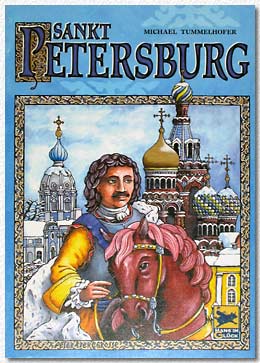
The Coalfields

(this article first appeared in issue #6 of “Games International” in June 1989. It is reproduced here with the permission of the author)

The Coalfields

by Alan R Moon

This variant will open up the board quite a bit. While the new hexes are added to the south map edge, the north is also increased in value by making it easier to run into and through New York. This balances the value of all the corporations and puts the emphasis back on the player to non the corporation in the best possible manner. In addition, all the corporations, with the exception of the Erie, now begin in the east, and must make their way west together.

  • Add two more rows of hexes to the southern map edge as shown on the next page. The Deep South hex on the mapboard becomes the new C&O base hex in hex K13.
  • Treat the old C&O base as a normal grey city hex.
  • The Norfolk & Western is added as the ninth railroad.
    • It is available at the beginning of the game.
    • Its base hex is Norfolk.
    • There are nine shares; a 20% President’s Certificate and eight single share certificates.
    • The N&W has three tokens.
  • The Pennsylvania’s base hex is changed to a different, permanent grey hex. All routes may be traced through this hex, the Pennsylvania base station does not prevent a route being traced through this hex. Any corporation may begin or end their route by
    counting the Pennsylvania station as in the nomral rules of play, but only the Pennsylvania itself can count the base station as an intermediary stop on a run. The station is considered to be anywhere within the hex, and this can change within a turn
    from player to player or from turn to turn as needed.

New hexes and tiles:

  • Baltimore and Boston have the same, new green hex.
  • Baltimore and Boston have different, new brown hexes.
  • New York has a different brown hex.
  • Grey hex D24 is changed.
  • Hex F20 is changed from a double small city hex to a single large city hex.
  • There is a special brown tile for hex G17. When the Brown tiles become available, the yellow tile in hex G17 (no matter which one was placed) can be promoted to this brown tile. All routes run through this hex must count it as one city, value $20.
  • Hex K3 is a new large single city hex.
  • Hex K15 is changed to a river hex which which costs the corporation that initially lays a tile $40.
  • Hexes K11, L6 and L8 are mountain hexes. Each costs $120.
  • Hex L9 is a mountain hex with a single large city. It costs $120 to build tile 57.
  • The Chicago hex is changed. Routes may now be run through this hex. It does count as a city on the route.
  • Hex M10 is the Coalfields. Each corporation which wishes to run into/through this hex must pay the $140 blasting cost to build the route to the mines. It does count as a city on the route, and any route can only pass through it once per run.
  • Hex N 13 is the new Deep South.

Train changes:

  • Add one more 4 train.
  • Use the optional 6 train.
  • Add two 7 trains (4-6-6-4 Challengers). They cost $710. These become available after the first 6 train is bought.
  • Diesels now cost $750 with a tradein and $900 without.
  • Trains that become obsolete are not removed until after the owning corporation’s next Operating Turn.

Tile Mix:

  • Add two yellow 57 station tiles.
  • Add one green 14 station tile.
  • Add one green 15 station tile.
  • Add one brown 63 station tile.

Increase the number of certificates each player can hold by one, regardless of the number of players in the game.

Optional rule: add $8000 to the bank. This will guarantee at least three more operating rounds in the game and will make the decisions of whether to buy a diesel or 7 train more important.

Take a ride

This variant can also be used with the ‘Take A Ride On The Reading’ variant published in the General, Volume 23, Number 6, to create 10 railroads, as follows:

  • The Reading station is located and treated per the rules in `Take A Ride On The Reading’.
  • The Norfolk & Western now has only eight certificates: two 20% share certificates (one is the President’s Certificate) and six 10% share certificates.
  • Add two 4 trains instead of one and two 6 trains instead of one.
  • Increase the number of certificates each player can hold by two instead of one.
  • Add a minimum of $4,000 to the bank. Up to $12,000 can be added if players desire it.
  • All other rules in the first part of this article supersede those in ‘Take A Trip On The Reading’.

Another interesting variant would be to use both the Reading and Norfolk & Western and drop the Erie from the game.

New tiles and board changes: coalfields.zip

Spielbericht vom 02.06.2004

Spielbericht vom 02.06.2004

Autor: Walter

am Tisch: Günther, Hans, Peter, Walter

auf dem Tisch: Goa, Sankt Petersburg

Goa cover
Autor Rüdiger Dorn
Verlag Hans im
Glück
erschienen 2004
Spielerzahl 2 – 4
Spielzeit 60 Minuten

Goa

Vier entschlossene Kolonialherren machten sich ans Werk, ihre imperialen Pläne in Goa umzusetzen. Hans versuchte sich in seiner lange angekündigten Geld-Strategie: Alle Energie in die Förderung der Geld-Quellen stecken und über die Dominanz der Finanzmittel alles aufkaufen, was Gewinn verheißt. Peter und ich verfolgten die theoretisch untermauerte Flotten-Strategie: So schnell wie möglich den Schiffbau auf Vordermann bringen und damit reichlich Spielraum gewinnen, um später alle anderen Produktionsmittel je nach Marktlage zu entwickeln.

Günther setzte auf Expeditionen; diese unterliegen zwar gewissen Zufallseinflüssen, erlauben aber ein sehr flexibles Eingehen auf die Gelegenheiten in Markt und Produktion.

Hans scheiterte sofort. Geldpolitik führt in Goa nicht zum Sieg. Das zeigte sich bereits nach wenigen Runden. Hans gab seine Anfangsstrategie auf und versuchte dann, auf die jeweilige Spielsituation angemessen zu agieren. Der Zug zum Sieg war aber schon abgefahren.

Günther war mit dem Verlauf seiner Expeditionen auch nicht immer glücklich. Die gezogenen Expeditionskarten sind oft eine gute Ergänzung zu einer definierten Entwicklungspolitik, aber kein Ersatz dafür. Relativ schnell diversifizierte er seine Investitionen, mit einem Schwerpunkt auf Kolonisten. Des weiteren versuchte er, die verschiedenen Schnäppchen des Marktes zu erhaschen. Das reicht in Goa gegen scharfe Konkurrenten aber nicht zum Sieg.

Ich kam mit meinen Schiffbau nur sehr schwer aus den Startlöchern. Ich hatte mich zu wenig um Nelken gekümmert, für jeden Fortschritt in der Produktivität beim Schiffsbau werden aber immer wieder Nelken benötigt. Wer sich hier nicht von Anfang an bestimmte Mindestquellen erschließt, verliert viel von der möglichen Dynamik in diesem Bereich.

Peter war im Gegensatz zu mir mit seinem Schiffbau sehr erfolgreich. Im Nu waren seine Werfen auf Stufe 4, und er heimste dafür die vorgesehene Prämie ein. In der mittleren Spielphase sah er schon wie der überlegene Sieger aus. Dann ruhte er sich allerdings auf seinen Lorbeeren aus und gab seine konsequente Kolonialpolitik auf. Er überließ mir sogar die Prämie für die Werft-Stufe 5 und kaufte auf dem Markt so protzig ein, als gelte es, einer jungen Geliebten zu imponieren. Mit diesen Nachlässigkeiten mußte er eine Menge Federn lassen und das Hauptfeld fand wieder Anschluß. Mit nur einem Punkt Vorsprung konnte er seine Spitzenstellung ins Ziel retten. Ein Sieg war es schon, aber keineswegs ein überlegener. Hi Peter, war das eine gekonnte Punkt-Landung?

Sankt Petersburg cover
Autor Michael Tummelhofer
Verlag Hans im
Glück
erschienen 2004
Spielerzahl 2 – 4
Spielzeit 60 Minuten

Sankt
Petersburg

Am Beginn der Session stand meine Behauptung, hinter die Geheimnisse von Sankt Petersburg gekommen zu sein:

  1. Das Spiel wird über die Adels-Strategie gewonnen.
  2. Das Spiel dauert 6 Runden
  3. Es gewinnt derjenige Spieler, der in der letzten Runde Startspieler ist.
  4. Demnach gewinnt der Spieler, der zu Beginn an dritter Position sitzt.

Sofort waren alle bereit, diese Thesen in einer Spielrunde mit der Aussagekraft des ersten Augenscheines zu verifizieren. Oder zu wiederlegen.

Peter bot sich als freiwillig als Startspieler, d.h. auf einer Position, in der er nach meine Thesen zum Verlierer verurteilt war. Günther wurde zweiter, ich kam auf die dritte Position, in der ich ja meine Behauptungen unter Beweis stellen sollte. Für Hans blieb die vierte und letzte Position übrig.

Alles verlief anders als vorausgesagt.

  1. Unser Spiel dauerte 8 anstatt 6 Runden.
  2. Hans aus der letzten und Peter aus der ersten Startposition teilten sich den Sieg. Günther und ich landeten abgeschlagen auf den hinteren Plätzen.

Wie das?

Natürlich mußte ich meine Thesen sang- und klanglos zurücknehmen. Es hat zwar der Startspieler der letzten Runde gewonnen (geteilter Sieger), aber das Spiel dauerte glatte zwei Runden länger aus behauptet und gewonnen habe beide Sieger über die Bauwerke-Strategie und nicht über die Adeligen.

Als Strafe (was die unzähligen aufgewendeten Freizeitstunden betrifft) oder als Trost (Zahlenspielereien mit Excel machen halt auch Spaß), habe ich mir vorgenommen, die Spiel-Mechanismen von Sankt Petersburg mal einer genaueren Analyse zu unterziehen. Hier das Ergebnis.

Session Report 26.5.2004

Session Report 26.5.2004

at the table: Hans, Andrea, Günther, Walter, Moritz

on the table: Lost Valley, Zug um Zug, Bluff

Author: Moritz


Lost Valley
Designer Roland Goslar, Tobias Goslar
Publisher Kronberger
Spiele
released 2004
Players 3 – 4
Playing Time 75 minutes

Lost
Valley
(first impressions)

First we decided to test this brand new game from the Goslar’s (Walter
graciously decided to just watch to make this possible. Although he was a mean
ice-block-roller in the end game!).

Players are prospectors who explore the lost valley (of Klondike?). The game combines
a realistic approach with abstract and logical rules: Each player has a backpack for
“raw materials” (food, timber, tools) and 6 more spaces for wares (whiskey,
cart, boat, horse, rifle, axe, fishing rod, sieve, dynamite). The cart gives 4 more
spaces for raw materials. Like in the computer game “Diablo” some objects
take more space, for example timber and the sieve, so each player has to decide what
objects are most important to her/him.

All players start at the main trading post (others can appear through exploration).
The exploration itself is handeld very nicely – players can decide where to put the
diamond shaped land tiles and river tiles that they discover. As the diamond tiles
don’t always leave room for a complete tile there are also special
“triangle” tiles to fill these enclosed spaces. These diamond tiles are
usually more interesting – in our first game we completely overlooked the methods
to specially create the “triangles” which is something that should be
explored more in future games.

Tiles depict different landscapes – Gold can be found as “river
gold” or “mountain gold” and is placed face down in values of 1-2
(river) or 3-4 (mountain). “River gold” needs water, but can also be found on
land tiles – players have to build canals (by using timber) to get at the latter
variety. They expend one “food” when looking for it, and a
“sieve” doubles the amount of gold counters gained. “Mountain”
gold is only found on mountain tiles and needs a working mine which first has to be
built. Also getting mountain gold costs one timber in addition to the food (and using
dynamite doubles the find).

Lost ValleyGetting gold nuggets is the object of the game – but
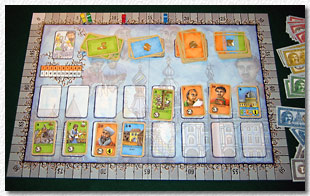
you can also use gold to buy additional equipment at trading posts.

Food is in issue – you need it for getting gold nuggets. You can hunt (by
rolling a die against the animal – plus 3 if you buy a gun), as certain tiles have
(hidden, various food values) animals on them. Fishing at the river is also possible
– the fish trap and fishing rod come in handy here.

Timber is necessary for mountain gold and canals – you can get it in wood
spaces, easier if you use a sawmill (which has to be built first) and/or an axe.

Players move along the tile edges – very slowly if by foot, and quicker if using
the boat or the horse. It is not possible to block movement of other players, but
non-river locations can only be occupied by ONE prospector, so you can protect certain
spaces by simply standing there. This is sometimes necessary as EVERYTHING you build can
be used by everybody – if you build a mine other players can use it as well!

This very often results in races to gather the most gold from a specific location
before others do (all gold locations can be depleted after the initially placed counters
are gone). Therefore the game is mostly about the most efficient use of a limited number
of actions (each turn every player has only ONE action). To get an edge in this you can
also use “whiskey” (a very nice idea), which gives you an additional move OR
an additional action.

The game ends in two ways: 1) When the river has been fully explored the
“source” is placed together with an ice block. Now every player rolls the die
after his/her turn – on a 5 or 6 the ice block moves towards the original trading
post, when it reaches it, the game ends. 2) When any player reaches the original trading
post with 10 gold counters.

In any case all formerly secret gold counters are revealed and counted, who now has
the most “nuggets” printed on these counters wins. In our game we had a
probably unusual end: 3 players ended up with 19 nuggets in the lead! As there seems to
be no tiebreaker mechanic this probably means all three have won!

The game has beautiful components (although good storage probably needs a couple of
extra ziplock bags). Game aids as well as rule book come in several languages (German,
English, French). The rule book itself is a very good example of how to do it right: only
4 (small) pages with clear and precise rules, all well illustrated directly next to the
rule to avoid any misunderstandings. Very well done! This is one of these rule books that
you can practically sight read to your fellow players without having to read it yourself
before – it will take 15 minutes maximum to get into the game.

The game mixes elements of action management (Puerto Rico, Goa), discovery
(Carcassonne, Die Entdecker) and even adventure/simulation games like “Valley of
the Mammoths”. Turns go quick as player actions are limited – there is
interaction (without obvious “kingmaking”) and some (but not too much) luck
(hunting, nugget count). The theme should appeal to adults and kids as well, the only
danger being a disappointment for the latter when they discover that behind the theme
lies a pretty unforgiving mechanic that needs perfect resource management to win.


The game’s “strategy tips” say that one should not hover far from the
other players, which seems to be true, as basically the game makes the players into
hyenas who lurk around until some poor soul builds the next mine or canal. One has to
count the available gold counters and make sure that his action management results in
getting more of the share than the others – only then should you build before the
others do. As this is something that you have in your own hands the game is both
challenging and rewarding, but also very often frustrating. But “wanting to do more
than you actually can do” seems to be the sign of a good game, isn’t it?

Recommended!


Zug um Zug
Designer Alan R. Moon
Publisher Days of
Wonder
released 2004
Players 2 – 4
Playing time 45 Minuten

Zug um
Zug

Another play of this worthy successor to “Transamerica” (with nicer bits
and more tension). Guenther won with best hand management. Lots of conflict around
certain routes ensued, but was only revealed in the end game. After the game I
contemplated a possible killer tactic: The deck seems to be limited – what if one
player simply refused to build at the start (preferably choosing very easy low point
score routes at the start) and simply collected 2-3 colours necessary for his routes
until they are completely depleted? He then could play his hand in the endgame without
any interference from the other players while they would not be able to disturb him at
all. This seems to be an interesting approach in the 5-player game, where one goes pretty
quickly through the deck….

Next time I’ll try it!


Bluff (Liar’s Dice)

Nothing new here – Andrea won easily against Hans in two end duels. Guenther
made gaming history by losing all his 5 dice in one bad guess….

Sankt Petersburg

Sankt
Petersburg

“Sankt Petersburg”, das Spiel meine ich, hat seinen Namen von der Stadt
bekommen, die der russische Zar Peter vor 300 Jahren in den Sümpfen der Newa aus dem
Boden stampfen ließ. Das muß ein quirliges Leben gewesen sein, als Handwerker und Bürger,
Verwalter und Adlige in wenigen Jahren ein “Paris des Ostens” aufbauten. So hat
es sich der Autor Michael Tummelhofer vorgestellt.

Hier im Spiel kommen eher die Kaufleute unter den Spielern zur Geltung. Die
verschiedenen Rollen von damals liegen als einfache Spielkarten offen auf dem Tisch und
können gekauft werden, um dann eine definierte Rendite abzuwerfen. Handwerker sind billig
und bringen pro Runde Geld ein. Mit einer ziemlich guten Kosten-Nutzen-Relation.
Verwalter (oder besser: administrative Gebäude) kosten deutlich mehr, und bringen in der
Regel kein Geld ein, lediglich Prestige, sprich Siegpunkte. Und diese entscheiden das
Spiel. Am Ende ist das Geld nichts mehr wert, nur noch die umgesetzten Siegpunkte
zählen.

Am meisten Siegpunkte stecken in den Adeligen: außer Geld und den ständigen
Siegpunkten pro Runde liefern sie am Ende noch einen Bonus, der quadratisch mit der
Anzahl der gekauften Adeligen wächst. Ein einzelner Adeliger bringt 1 Siegpunkt, zehn
Adelige bringen 55 Siegpunkte Der Sieg wird also regelmäßig über die Mehrheit an
Adeligen-Karten entschieden.

Wo steckt dann das Problem? Da könnte sich ein tüchtiger Kaufmann doch relativ einfach
eine Optimierung ausrechnen (lassen), nach welchem Schema er die verschiedenen Karten
erwerben mußt und schon wäre das Spiel entzaubert. Das ist – glücklicherweise – nur zu
einem kleinen Bruchteil richtig. Es sind nicht alle Karten gleichzeitig verfügbar,
sondern es werden jeweils nur maximal 8 Karten aufgedeckt und stehen zum Erwerb an. Alle
anderen Karten bleiben verdeckt auf ihren Stapeln. Also muß man sich zunächst mal mit dem
vorhandenen Angebot an Karten auseinandersetzen und hieraus die jeweils besten
herausfischen. Erst wenn keiner mehr kaufen will, wird für jede verkaufte Karte eine neue
Karte aufgedeckt.

Das ganze läuft in vier Phasen ab. In der ersten Phase werden nur neue Handwerker
aufgedeckt und am Ende werden alle im Besitz befindlichen Handwerker gewertet, d.h. es
gibt Geld. In der zweiten Phase kommen neue Gebäude ins Spiel und am Ende werden nur die
Gebäudekarten gewertet, d.h. es gibt Siegpunkte. In der dritten Phase geht es um Adelige
und in einer vierten Phase um Austauschkarten”, das sind solche, mit denen man einen
bereits in Besitz befindlichen Adligen im Rang, spricht in seiner Geld- und
Siegpunkt-Ausschüttung, hochrüsten kann.

Sankt Petersburg

Einige Karten haben noch Sonder-Eigenschaften sie bringen beim Erwerb bestimmter
Karten einen Kostenerlaß. Mit anderen Karten kann man eine gewisse Menge Geld in
Siegpunkte verwandeln. Eine Karte erlaubt es, sich pro Runde eine Karte aus einem der
verdeckten Stapel anzuschauen und sie bei Bedarf zu kaufen. Das ist insbesondere sehr
nützlich, wenn man damit seine Mehrheit an Adeligen für die Schlußwertung ausbauen
will.

Jetzt gibt es noch zwei taktische Elemente, die im Spiel eine bedeutende Rolle
spielen: Beim Erwerb einer Karte bringt jede bereits im Besitz befindliche Karte der
gleichen Sorte einen Preisnachlaß von einer Einheit. Z.B. kostet der erste Holzfäller
drei Rubel, der zweite kostet zwei und der dritte nur noch einen. Es ist also durchaus
ein kaufmännisches Ziel, Karten gleicher Sorte zu erwerben.

Das zweite taktische Element ist “Bunkern” von Karten: Man muß eine
erworbene Karte nicht sofort vor sich offen auf den Tisch legen, man kann sie – OHNE den
Geldbetrag dafür zu bezahlen – zunächst verdeckt in die Hand nehmen und sie erst zu einem
beliebigen späteren Zeitpunkt bezahlen und auslegen. Damit kann man natürlich eine
momentane Geldknappheit überbrücken. Viel wichtiger aber: man kann für die
Schlußabrechnung lukrative Karten für sich reservieren, ohne damit seine Liquidität zu
beanspruchen. In jedem Fall ist es erstrebenswert, Austausch-Adelige zu bunkern, um damit
ganz am Ende das Adeligen-Kontingent zu verbessern und damit die daraus resultierenden
Bonuspunkte zu erhöhen.

Ist Sankt Petersburg ein taktisches Spiel? Natürlich, denn es kennt ja keinen Würfel,
sondern nur freie Entscheidungen der Mitspieler. Allerdings sind die Freiheitsgrade beim
Vorgehen – auf den ersten Blick – doch sehr eingeschränkt. Man kann nur Karten kaufen
oder nicht. Keine Versteigerung, kein Preiskampf, keine Auseinandersetzung um
Prioritäten. Wer am Zug ist, entscheidet ganz unbeeinflußt von allen anderen allein nach
seinen finanziellen Mitteln, und ggf. noch nach seinen Vorlieben.

Daß man am Anfang Handwerkerkarten erwirbt, weil diese das meiste Geld einbringen und
das Geld eigentlich immer knapp ist, ist unabdinglich. Daß man die jeweils billigste –
und damit renditenstärkste – Handwerkerkarte erwirbt, versteht sich von selbst.
Irgendwann muß man natürlich auf Siegpunkte umschalten. Und daß in den Adeligen die
meiste Musik steckt, habe ich schon oben erwähnt. Es geht also nur darum, den richtigen
Zeitpunkt zu erwischen, wann man vom Handwerk auf den Adel umsteigt. Nach geschlossener
WPG-Auffassung möglichst unter Auslassung der Gebäudekarten.

Natürlich müssen dafür Adeligenkarten im Angebot sein. Und hier liegt ein weiteres
spielentscheidendes Geheimnis von Sankt Petersburg. Am Ende jeder Phase werden auf die
offenen Plätze neue Karten gezogen. Der jeweils wechselnde Startspieler hat dann die
freie Auswahl. Wenn ich nicht Startspieler werde, dann sollte ich mir genau überlegen, ob
ich von den ausliegenden weniger lukrativen Karten überhaupt noch eine Karte erwerbe.
Unser 1830-Motto “keep fully invested” zählt hier überhaupt nicht. Mit jeder
Karte, die ich in dieser Situation noch kaufe, vergrößere ich die Chance des neuen
Startspieler, ein Super-Karte ins Angebot zu bekommen. Also eher die Finger weg
lassen.

So summieren sich die kleinen taktischen Handlungsspielräume an Ende doch zu einem
beträchtlichen Ausmaß an Taktik und Strategie. Zugleich verläuft das Spiel friedlich,
flott, aufbauend und harmonisch. Unser erster positiver Eindruck ist nach wiederholtem
Spiel noch gestiegen. Wir halten es für empfehlenswert.

WPG-Wertung : 7,5

"Was lag auf den Tisch?"