Archiv der Kategorie: Spieleabende

BRITANNIA

britannia

BRITANNIA

Hersteller: Avalon Hill (vergriffen); deutsche Ausgabe: Welt der Spiele

Autor: Lewis Pulsipher

Getestet: Deutsche Ausgabe, Welt der Spiele

Spielerzahl: 3 – 5 (nur 4 ist empfehlenswert)

Tester: Moritz Eggert

Dieses legendäre historische Spiel ist bis heute populär und vielgespielt. Simuliert
wird die Geschichte Britanniens, vom Einfall der Römer bis zur Schlacht von Hastings.
Jeder Spieler verkörpert eine vorgegebene Auswahl von Völkern, die jeweils zu
unterschiedlichen Zeitpunkten unterschiedliche Spielziele haben, was sich wiederum in
Siegespunkten niederschlägt. So müssen die Römer zum Beispiel möglichst ganz Britannien
mit ihren Kastellen übersäen, die Waliser dagegen bekommen vor allem Punkte für das
Halten von Wales gegen die zahlreichen Eindringlinge. Natürlich ist dies vor allem ein
“Kampfwürfelspiel”, wie es der inzwischen schon legendäre
“Foto-Sauter-Man” (das ist jetzt sehr insiderig…) nennen würde, jedoch kommt
es anders als bei Risiko nicht auf die Eroberung der ganzen Karte an, sondern auf die
Abstimmung kurzfristiger und langfristiger Spielstrategien. So bringen bestimmte
Vorgehensweisen kurzfristig viele Punkte, gefährden jedoch längerfristig den Fortbestand
eines Volkes. Bei erfahrenen Spielern spielt auch das Verhandlungselement eine große
Rolle, so wird zum Beispiel ein Grossteil des Spiels durch die Weise bestimmt, wie die
Sachsen und Angeln sich gegen die Dänen abstimmen (oder auch nicht). Die Würfel bringen
weniger ein Glückselement als ein Unschärfeelement ins Spiel – mit einem eleganten
Kampfsystem wie bei Vinci würde der Spielablauf zum Beispiel zu vorhersehbar werden.

Die verschiedenen Farben sind traditionell etwas unausgewogen – so hat Lila (Römer) am
Anfang viel zu tun, bis zum Ende des Spieles dann eher weniger, Rot gewinnt meistens,
etc.. Dennoch hat das Spielprinzip bis heute nichts von seiner Faszination verloren.

Spieldauer: ca. 30 Minuten Regelerklärung, dann 6-7 Stunden

Ähnliche Spiele: History of the World, Vinci, Maharaja, Rus, Hispania, Rise and
Fall, Barbarian Kingsdom & Empire, etc., etc.

Moritz’ Bewertung: 10 (von 10)

Westpark Gesamtbewertung: noch nicht bewertet

Weiterführende Informationen:

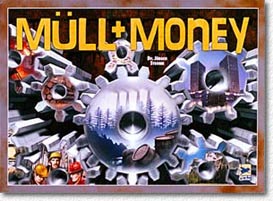
MÜLL + MONEY (Industrial Waste)

MÜLL + MONEY (Industrial Waste)

Müll+Money

Publisher: Hans im Glück

Author: Dr. Jürgen Strohm

Tester: Aaron Haag

Game Tested: German edition 2001

Scenario: Resources, production, innovation, growth and profits and last but
not least Müll – the German word for waste – are the key ingredientes of this game. Each
player tries to max out the interlinked parameters of his production plant by applying
suitable strategies and tactics.

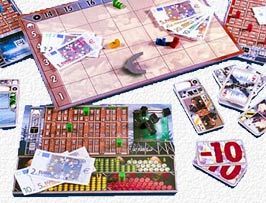
The Game: Each player starts with a production plant which needs five work
force units and five resources to produce and which generates 5 units of waste. The five
work forces and the first five resources are part of the start set-up. The products of
one production cycle sell for initially 14$ million.

At the beginning of each round the start player deals sets of three cards openly
taking care that a set only contains unique cards (i.e. no duplicate types). The number
of card sets is determined by the number of players plus one. The start player is the
first to select a set and the other players follow in clockwise order.

The cards are the motor of the game and when it is a player’s turn he plays one of
the cards of his set and executes the corresponding action.

Resource auction:
The player auctions off resources. The number of resources is determined by the
amount of resources his plant needs for production. The auction starts with the
player left to the auctioneer and the auctioneer is the last to bid. If he has the
highest bid he pays the money to the bank but if any other player bids highest the
auctioneer receives the money instead of the bank.

Production:
The plant produces and immediately sells if it has a sufficient amount of resources
and work force units available. The player receives the current production price and
increases the amount of waste in his waste store by the amount indicated by the waste
marker of his plant.

Productivity:
The player may improve one of his plants productivity indicators by one: work units
required to produce, resources required to produce or waste generated when producing.
Increasing productivity costs $5 million and also increases the number of victory points.

Work force:
The player may increase or decrease the number of work forces of his plant.

Income:
The player may increase the income of his plant when it produces by $1 million. As
soon as one player’s plant reaches an income per production of $20 million the game
finishes after completing the current round.

Waste removal:
The player may decrease the number of waste units in his plant’s store by one.

Waste trafficking:
The player removes one waste unit from his plant’s store and all other players
must increase their store by one waste unit.

Consultant:
The player may make a “double action” playing this card together with any
of his other cards. The corresponding action is performed twice, except for production,
which generates an additional profit of $5 million instead. Alternatively, the player may
use the consultant to repay $10 million of a loan.

Bribe:
This card can be used in case of an environmental catastrophe and decreases the
damages to be paid to $1 million.

A round continues until no player wants to play any of their cards – it is allowed
that a player keeps one of his cards for the next turn. This is particularly useful if
one has a bribe card. Playing this card only makes sense during an environmental
catastrophe which happens immediately once the respective card is drawn when the start
player creates the card sets. All player that have excessive waste in their plant’s
stores must pay damages between $5 million and $10 million. This can be reduced to $1
million by playing a bribe card at that point in time. At the end of a round players have
to pay for their work forces (irrespective of whether or not they produced in this round)
and the start player position shifts one position in clockwise direction.

Once the last round of the game has been completed players count their victory points.
Increases in productivity yield additional victory points as well as increases in the
plants income. Interestingly, the money in player’s hands only counts half but any
loans reduce the victory points by the full amount.

Playing Time: Rules are explained in about 15 minutes – playing time is about
75 minutes.

Similar Games: Schoko & Co. (Yves Hirschfeld, G. Monnet), McMulti (Crude), Modern Art (Reiner Knizia)

Westpark Gamers’ Opinion: When I played the game for the first time it
reminded me very much of “Schocko & Co.”, one of the finalists of the 1988
Spiel des Jahres award.
There you also had the task to optimize the various parameters of production so that
income is maximized. In “Müll + Money” I found it hard to time my actions right
though, because one’s options are very dependent on the set of cards available for
selection. If you are sitting right to the start player you are faced with the
“leftovers” of all the other players because you are the last to select and
there are only two remaining sets. On the other hand, next turn you will be the first to
select your set and you may want to prepare the next move now. Maybe your work force is
still high and you want to decrease it to save costs. If there is a “work
force” card still available this could be a good point in time to do so. However,
next round you will need to select a set of cards that contains a
“productivity” card in order to adjust your plant productivity accordingly.
Reducing the work force before improving productivity is a risky business and should only
be tried in situations like this unless you do want to become unable to produce.

Müll+Money

In my opinion the resource auctions are the key to winning the game. As with Reiner
Knizia’s “Modern Art” you can generate a lot of money by clever
auctioning. Many times I have seen situations where a player gets resources virtually for
free by first auctioning a set and cashing in and then buying the next set resources with
exactly the money received from the first auction. This can be exploited by two players
who work together in two subsequent auctions with one player selling to the other for a
previously agreed (too) high price. There is nothing the other players can do about this
other than avoiding the situation that these two players both receive auction cards in
their sets. So maybe you want to establish a house rule that disallows any negotiations
about resource prices.

It could be a sound strategy to go for the auctions and productivity cards only, with
the goal to generate cash and victory points by selling resources to other players and by
increasing productivity and plant income respectively, leaving production (and costly
waste generation) to the other players. As an additional benefit you are pushing for an
early end of the game by quickly moving the plant income marker to the $20 million area
harming those who took an early loan. A similar strategy worked in the first release of
“Dicke Kartoffeln” by Doris Matthäus & Frank Nestel
where the goal of the game was to generate money by growing and selling potatoes. Here
the alternative strategy was to grow lots of worms (normally used as fertilizer) and
selling them to the bank or the other players instead of using them on one’s
fields.

I believe this game has a lot of potential for a wide range of different tactics and
strategies and it’s replay value is correspondingly high. The web of interlinked
parameters is big enough to provide ample possibilities for people who like business
simulations. As usual for “Hans im Glück” games the components are of impeccable
quality.

The English version of the game has been published by Rio Grande Games under the name of
Industrial Waste“.

Aaron’s Rating: 7 (out of 10)

Westpark Gamers’ Rating: not yet rated

Links to further information:

Luding Link for Müll+Money

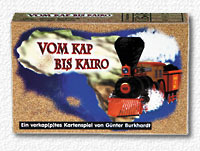
VOM KAP BIS KAIRO (From Cape To Cairo)

VOM KAP BIS KAIRO (From Cape To Cairo)

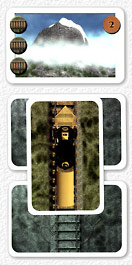
Kap bis Kairo

Publisher: Adlung

Author: Günter Burkhardt

Tester: Aaron Haag

Game Tested: German 2001 edition, 1st rule release

Scenario: Two to four players each try to build a railroad track through Africa
– from Cape to Cairo. The track needs to be built through different types of terrain –
from “easy” Savanna to “difficult” river crossings.

Kap

The Game: As with all Adlung games this one is a card game, too and as usual
comes with German, English and French rules. Each player receives a train card and a
treasury of 100 points which are later on used for bidding (there are no bills, tokens
etc. provided so each player needs a pen and a piece of paper to keep track of his
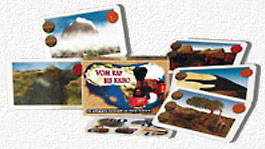
points). The second type of cards are the terrain cards which on their backside show a
piece of track.

The game is played in two types of turns: a terrain bidding turn and building turn.
Whenever a player begins his turn with no terrain card in front of his train he starts a
bidding turn: he draws as many terrain cards from the facedown draw pile as there are
players in the game and all players secretly bid points for the first choice. The highest
bidder chooses the first card, reduces his point tally accordingly and places the card in
front of his train (or at the end of a terrain card sequence should there be already
cards in front of the train). Terrain cards show the type of terrain, a point value and a
number of “bonus” tracks. Each type of terrain needs a different amount of
tracks to be covered starting with the Savanna requiring 6 tracks up to the river
requiring 10 tracks. Any bonus track printed on the terrain card(s) in front of the train
count towards that requirement. As a consequence terrain cards with three bonus tracks
(the highest bonus possible) usually go for a higher price than the ones with no track at
all.

Now Kapa building turn starts: the player who received the first card draws
another card from the draw pile. This time the terrain is not important but the
number of bonus tracks printed on the card. The player then decides if he takes that
card to cover the terrain immediately in front of his train. He may only do so if
the number of bonus tracks on terrain cards in front of his train plus the card he
just drew adds to at least the amount of track required for covering the card. Any
missing track may be made up by subtracting 10 points each from one’s point
tally – a very costly investment and only really worth it if one can finish (and
win) the game by doing so. If the player decides that the investment is just too
high he passes and the next player adds one additional card from the draw pile and
checks if he is able or willing to build using the set of both drawn cards. If not
the next player follows in clockwise order. Eventually, a player will build on his
terrain card by placing the terrain card in front of his train face down, moving the
train on top of that card and collecting the number of points printed on the card.
Any track cards used for building are discarded.

Once a player has moved his train on the eighth terrain card the game is over and that
player wins the game.

Playing Time: Rules are explained in about 5 minutes – playing time is about 30
minutes.

Similar Games: Don (Michael Schacht), Kuhhandel (Rüdiger Koltze)

Westpark Gamers’ Opinion: The game requires clever bidding tactics based on
ones own terrain “portfolio” and the other players’ terrain patterns. At
the same time one needs to keep a close eye on one’s point tally: its no good to save
on points because they are not used for determining the winner. On the other hand it is
all too easy to spend too much on that “easy” Savanna only to find oneself
short of points to be able to quickly build across the mountains or a river immediately
ahead of the train. As soon as you are two or more covered terrain cards behind it will
be very hard to win. More often than not I found myself in the unfortunate position to
have spent too many points in the early rounds leaving all those very valuable Savannas
with three bonus tracks that appeared later to other players.

As with many good card games one always has the feeling to be able to control
one’s fate in this game, however there is a good portion of luck involved here as
well. Nevertheless, the game is fun to play and since its very short playing time is an
ideal starter for an evening of gaming or a perfect “last game” after a long
evening of 1830 or alike.

Aaron’s Rating: 8 (out of 10)

Westpark Gamers’ Rating: 7.25

Links to further information:

Luding Link for Vom Kap bis Kairo


Adlung’s webpages about Vom Kap bis Kairo


Funagain’s link to Vom Kap bis Kairo

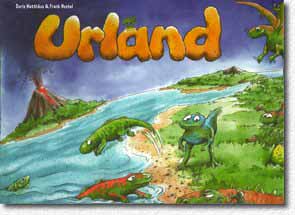
Urland

Urland

Urland

Publisher: Doris & Frank

Author: Doris Matthäus, Frank Nestel

Tester: Aaron Haag

Game Tested: 2001 Essen release

Scenario: 350 million years ago the ichtos (short for ichtyostega) prepared for
leaving the oceans and to populate the continents. Which ichtos will conquer the Urland
by clever propagation and the use of new genes?

The Game: This tenth game of Doris & Frank uses a similar setting as
Ursuppe published 1997. Again creatures controlled by 3 to 5 players try to survive and
make the best out of their genes. But this is the only similarity between the two games –
Urland uses completely different game mechanics and rules.

As with all Doris & Frank games the game components are very well done and of high
quality (e.g. 30 wooden Ichtos in 5 different color; three blank cards for creating own
genes) and as usual the gene cards and play aids come in an English and German
version.

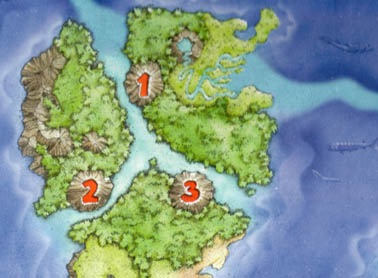
board

The board is divided into 3 continents each separated into islands (three, four and
five, respectively) by little straits. The surrounding ocean is subdivided into 5 areas.
Players start their Ichtos in 4 randomly selected islands plus 3 Ichtos in each of the
ocean areas and their task is to propagate and move them to land trying to establish a
majority on the islands.

Each round starts with the distribution of 3 roles to the players: the start player
(“environment player”), the dummy and the ichto player(s). The environment
player secretly selects an island that will score this round by choosing one out of three
island chips he is randomly dealt. The remaining to chips are then passed on to the
“dummy” player who may have a look at them but who is not allowed to reveal
them to the ichto players. These actions conclude the turn of the environment player and
the dummy player for the complete round, i.e. they will not move any Ichtos on the board
in that round. Now it is the turn of the Ichto player(s) who are allowed to perform 2
Ichto actions. There are four actions types to chose from: propagation, move onto land,
move between water areas and retreat (i.e. take Ichtos from board back into stock). Genes
provide extra abilities which can be used during the action phase but they come into play
only after some rounds have been played.

Once the Ichto players performed their Ichto actions the environment player reveals
the number of the island that scores by placing the chip he kept on that island. Scoring
is straight forward: any minority Ichto colors are returned to its player. Of the
remaining Ichto colors the majority holder gets 3 points and the other(s) two points. In
case there are identical numbers of Ichtos of each color present all get 2 points. Points
are recorded on a score track similar to Ursuppe.

In the next round roles shift in clockwise order, the dummy player becomes the
environment player and gets one randomly selected island chip so that he can select the
next island to score again from a total of three chips (the two he received from the
environment player in the previous round plus the one he just drew). The round then
progresses as described above. Eventually, an environment player will not be able to draw
an island chip as all but the two he received in the previous round have been placed on
the board. This condition completes an epoch and volcanoes erupt on the two remaining
islands decreasing the Ichto population there to just one per color present. Immediately
before the volcanoes erupt one of the islands is randomly selected for final scoring in
this epoch. Each volcano cases the straight between two islands to disappear thereby
reducing the number of land areas available for the rest of the game.

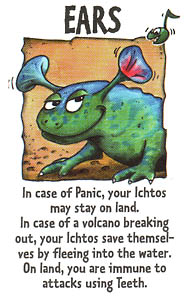
genes

Genes come into play three times during the game when the first time a player reaches
12, 16 and 21 points, respectively. At the beginning of the game 4 genes out of the 11
available are placed face up for all players to see. Once the above condition occurs the
players start a bidding process for these genes. From the Ichtos not on the board players
secretly select a number they want to use for bidding. Players reveal their bid
simultaneously and the highest bidder must new select one of the genes on display and
remove the amount of Ichtos he used for bidding from the board plus one Ichto for
each gene he may already possess. The second highest bidder may now either select a gene
and pay or he may pass this right on to the next highest bidder. Once a maximum of three
genes have been acquired three new genes are drawn and put on display possibly increasing
the overall amount of genes to chose from.

The game ends as soon as one player reaches 30 points on the score track (the current
scoring round is however completed for all players). A final scoring round follows with
points awarded to the player with the most Ichtos an the board and to the player with the
most Ichtos on land areas.

Playing Time: The game can be explained in 10 minutes and played in about 60 to
90 minutes.

Similar Games: Ursuppe, El Grande, Evo, Vendetta (thanks Frank!).

Westpark Gamer’s Opinion: It was no surprise that the game plays completely
different than Ursuppe – the game mechanics are too different for that. The concept of
two players not taking an active part in the movement (i.e. Ichto action) phase is new to
me and it works surprisingly well. Being the dummy in a round may appear a bit boring as
there really isn’t anything you can do that round, hence the name. We first thought
that we misread the rules because this seemed so unusual but the rules state this quite
clearly (as does the German FAQ). Once we got used to this it seemed normal and one of the
mechanisms that make the game challenging.

Because of the ever changing roles during the game proper timing is the most
important factor for devising a sound strategy. Two consecutive Ichto action rounds in
which you have the possibility to rearrange your Ichtos on the board but have no
influence on where scoring takes place are following by two rounds in which you cannot
move your Ichtos but have control about the scoring location (environment player) or have
no control at all (dummy). Therefore most of the time one has to think ahead and consider
what one wants to do in the next round and prepare whatever is necessary to do this in
the current round. At the beginning of an epoch chaos is predominant as it is almost
impossible to judge which location will score. This chaos decreases round by round until
close to the end of an epoch certainty prevaeils and you are able to prepare your move
very precisely. Unfortunately, this is true for all players and again timing is in issue
here when it is necessary to consider which roles you are going to have in the last and
one but last round of an epoch.

Genes come into play very slowly, a lot slower than in Ursuppe. A maximum of nine
genes are in play (only six in a three player game) therefore having more than two genes
per player is clearly an exception. Again, careful planning is required to be able to
acquire genes because you need Ichtos off the board to be able to bid. On the other hand
these Ichtos are desperately needed on the board for propagation and scoring and even
worse, for paying for the genes! This results in a clever “self-regulation” in
so far as you cannot bid high even if you have a high number of Ichtos in stock because
this may result in near self-extinction on the board. On the other hand if you are strong
on the board you could pay a high price but you are unable to bid high as your Ichto
stock is depleted.

The genes themselves seem to be well balanced – so far we could not detect a
particularly strong one which would result in a certain victory. Gene combinations are
not as important as in Ursuppe and anyhow they occur rarely because of the low number of
genes in play. At times “Muscles” seemed a bit strong as well as “Warm
Blood” but we need to play more often to find if these really influence the game too
much.

Overall I really liked the game. The timing strategies are quite challenging and there
is still a lot for us to discover in terms of tactics. The game mechanisms are a bit
abstract but this is very well counterbalanced by the fun theme, the gene abilities and
last but not least the wonderful comic-style graphics of the game components.

I am still not sure whether or not I like the score track rule where positions
occupied by other players are not considered when moving forward. This clearly favors
players who are behind, yet not too far behind. This mechanism was also used in Ursuppe
and I found it a bit too strong there. In Urland the effect seems to be less obvious but
there may still be situations when this rule can only be regarded as a nuisance. There is
also an additional element of luck in the game in the form of a thirteenth land area
“Panic” chip which when drawn by the environment player requires that the land
area with the highest Ichto population must be completely abandoned and all Ichtos be
moved to adjacent water areas. This slightly favors the weakest player as he is the one
to chose the water area in case there is more than one.

Comparing Urland with Ursuppe, Urland can first of all be played in a shorter time. It
can also be explained in less time and playing seems to be not as difficult either.
However, winning the game is a different matter altogether: here I think that Ursuppe and
Urland hold an equal amount of challenges and both require experience and sound
strategies to win. To me Urland is a highlight of this year’s game releases and a
wonderful addition to what may become Doris & Frank’s “Ur” series.

Aaron’s Rating: not yet ranked

Westpark Gamers’ Rating: not yet ranked

Links to further information: Luding link to Urland
Doris&Frank’s English FAQ for Urland
Doris&Frank’s German FAQ for Urland
Doris&Frank’s
Homepage
Funagain Urland page

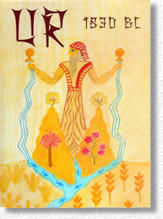
UR – 1830 BC

Ur 1830BC

UR – 1830 BC

Publisher: Splotter Spellen

Author: Joris Wiersinga, Jeroen Doumen

Tester: Aaron Haag

Game Tested: 2001 edition, German rules

Scenario: Splotter Spellen published this limited edition (1500 copies) game by
J. Doumen and J. Wiersinga for all those 18xx lovers that like the game principles of the
series but may want to play a game with a theme different from railroads (do they
exist?). Hence, the game is about owning land and building irrigation systems in
Mesopotamia.

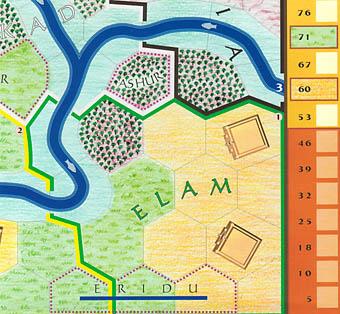
The Game: The game components are very nicely done. Besides the map board there
are lots of tokens for indicating ownership of land and irrigation systems as well as
wooden tokens for distributing the amount of water flowing along the rivers and canals. I
have a minor quarrel about the state treasury cards, the equivalent of the 18xx corporate
charters: it would have been very nice if these had been printed using the same colors as
those used for the tokens. Instead, they are black and white with in indication of where
the state is on the map board (one needs to looks at the map board to find out which
state uses which token color). A nice little extra is the portraits of the game designers
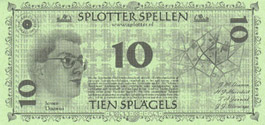
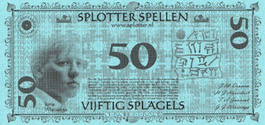
(and the game’s illustrators) on the banknotes provided.


For all those familiar with the 18xx game system there should be no problem in
understanding the rules at first reading. The game components are actually bilingual
(English/German) and the game comes either with a German or an English rule book. I had a
look at both rule books in Essen and they seemed to be very well translated and I can
confirm this now for the German rules.

x

Following, I will provide a basic overview about the game by comparing the mechanics
to those of 1830.

States vs. Railroad Corporations

Instead of buying shares of railroad corporations player buy land areas in one of the
six states in Mesopotamia. Each state has between ten and twelve such areas which
actually came as a surprise to me as I expected to see ten areas per state similar to the
10% shares in the other 18xx games. Judging by a first look it seems that the states with
more than 10 areas have lower value terrain. As soon as six areas of a state are sold to
the players the states changes from “rising” to “founded” similar to
railroad corporations being floated. The owner holding the most shares of a state is the
king of the state who later on decides about the distribution of the states income.

Independent Nations vs. Minor Railroads

x

Similar to the minors in the 18xx series players acquire so-called “independent
nations” which provide a moderate income as well as some special attributes. Exactly
as in 1830 these nations are auctioned to the players in the equivalent of the first
stock round. Independent nations may be “assimilated” by states later on in the
game similar to corporations buying minors in 1830 thereby providing their ability to the
assimilating state. As in 1830 the independent nations cease to exist in a later era
(phase) of the game.

Land Areas vs. Shares

Land areas are offered to the players at a price depending on the terrain rather than
the states. This is one of the major differences to the 18xx series with the consequence
that selling land areas usually impacts more than one state. The four types of terrain
are: hills, forest, plains and dessert. A fifth type are cities, which have prices
depending on the terrain type they are in. Buying and selling of land areas and cities
follows similar rules as share buying and selling in the 1830 stock rounds, i.e. selling
of areas leads to a decrease in the corresponding terrain price (independently of the
state). In addition, players may bid on the “Primagenitur”, the equivalent of
the priority deal. Money bid on it is temporarily out of the game and cannot be used for
buying land areas or cities. At the end of the “stock round” the Primagenitur
is handed to the highest bidder and the money used for bidding is returned to the
bidder.

Irrigation Canals vs. Tracks

Here is another major difference between the 18xx series and Ur: instead of using
track tiles players “build” the irrigation system by drawing canals, starting
from the rivers land inwards using a felt pen with water soluble ink (Staedler Lumocolor,
provided with the game). The ink dries immediately and comes off equally easy using a
moist cloth leaving no traces on the board. For all of you who do not particularly like
the idea of drawing on the board I suggest you follow Mark’s
suggestion and buy little blue wooden sticks which can be used as canals instead. Canals
are build following a simple set of rules similar to the track laying rules but there is
no “upgrading” of canals.

Workers/Waterworks vs. Trains/Tokens

x

Canals are built by workers (diggers) which are bought from the bank similar to the
trains in 1830. Depending on the type of worker they can build canals of a particular
length per worker ranging from 1 hex to infinite length (the equivalent of the diesel).
The worker cards actually have two purposes: they either function as worker or as
waterworks (either reservoirs or pumps). Waterworks are required to pump the water
through the irrigation canals and again they can do this only for a particular amount of
water (reservoir) or a particular length of canal (pump). In comparison to 1830
waterworks also act similar to the station tokens there because the king of the owning
state decides in which directions water flows which reaches the works.

Independent of the type (worker or waterworks) the cards become obsolete similar to
trains in 18xx. And also similar to 1830 a state must own at least one worker at the end
of its “operation round”.

Harvest vs. Dividends

Once all states have performed their building actions the “rain season”
starts and water starts rushing down the three rivers of the map. There is a fixed amount
of water that actually flows through the rivers, depending on the era (equivalent to the
phase in 18xx games). The kings of the states owning the waterworks decide on the route
the water takes through the canals built similar to the president deciding about the
route of a train of his corporation. The owning state of the last waterworks pumping
water to a land area or city receives a share of the harvest for her services from the
bank. Additionally the owner of an irrigated area receives a small income, too. The kings
of the states then decide what happens to the harvest they received which can either be
distributed amongst the owners of the state’s land areas (the share holders in 18xx)
or be put in the state’s treasury. In the latter case the king must destroy one of
his lowest valued waterworks as a penalty.

Land Prices vs. Share Prices

Irrigating land areas or cities also has a positive effect on the land area’s
price: each region (i.e. adjacent land areas) of one terrain type which is irrigated is
counted and the respective terrain price is increased accordingly.

End of Game

The game ends if either one of the player causes a revolution (goes bankrupt) or if
all water flowing down the rivers is distributed to the land areas leaving no water
reaching the southern end of the river.

Playing Time: Explaining the rules to someone familiar with the 18xx series
should take about 15 minutes; for a newcomer to the series expect at least 30 minutes.
The game is played in about 3 to 4 hours depending on the number of players.

Similar Games: 1830 or any other game of the 18xx series

Westpark Gamers’ Opinion: The game intrigued me quite a bit when I saw it
in Essen. It has enough similarities to 1830, one of my all-time favorites. On the other
hand there are interesting new elements like the possibility to draw track, i.e. canals,
without being limited by the availability and layout of track tiles. Also the mechanics
of using the same cards form workers and waterworks sound challenging, leaving you with
the new tactical decision of either being able to build canals or to be able to pump
water through them.

Compared to 1830 the concept of buying land areas instead if shares generates a
completely new feeling and requires a change in strategies. In our first game I found it
difficult and challenging to decide which land areas to buy in which nations. First of
all there is the same dilemma as in 1830 that you do not want to invest in nations that
will not be founded (i.e. float). On the other hand since land prices are based on
terrain rather than nation the price of a land area bought may rise even if the nation it
belongs to has not been founded. Therefore, in Ur – 1830BC players may buy land based on
their assumptions about which type of terrain will be irrigated most.

It could even be a sound strategy to not help another player to found a
nation if that player will become king but rather invest in terrain elsewhere, because it
is not at all certain that the player in question will actually irrigate your areas. If
this strategy alone enables one to win the game is doubtful though, since the bulk of the
money is still earned by collecting the harvest of nations with many irrigated areas.

Becoming king of a nation early in the game seems to be even more important than being
president of a corporation in the early phase of 1830. Waterworks similar to station
markers cannot be changed after being placed but different to 1830 they are sold with
increasing capacities. Therefore, the first waterworks placed only have a very small
capacity and will hinder a nation building a wide-scale irrigation system later on in the
game. Nevertheless, similar to 1830, if these small works are placed strategically well
they will have a big impact on the later phases. In order to generate large harvest
incomes a king must select the river areas where to place reservoirs very carefully. You
need one or two larger reservoirs to be able to pump sufficient water to the fields of
your nation. Therefore, different to 1830 placing a small reservoir actually hinders
further development also of ones own nation.

Another subtle difference to 1830 is that waterworks may be placed by the king of a
nation anywhere on the board irrespective of whether the area is part of his
nation or not or if that area is already irrigated (i.e. if track has been laid in 1830).
The only condition is that if an area is owned by another player that player has to agree
to the placement. This seems to make being king early in the game even more important as
is enable one to strategically place waterworks almost anywhere.

After having played the game once I say that the similarities with 1830 or any 18xx
series game certainly exist. The different theme of the game however provides a different
feeling altogether – at least to me. At no time did I have the feeling to play just
another 18xx variant. This is even increased by the fact that the game – in my opinion –
needs completely different and new strategies than 1830. While playing I found an
enormous amount of decision making and choosing of different tactics and the game session
reminded me a lot of my first 1830 session in that respect. Playing the game was a lot of
fun then as well as playing Ur – 1830BC now and I am equally keen to find out the
possible strategies that lie in this gem of a game. To do so requires to play the game a
lot more and I am looking forward already to our next Ur session.

Aaron’s Rating: 7

Westpark Gamers’ Rating: 6.2

Links to further information:

Luding Link for Ur 1830BC


Nick Wedd’s
18xx Rules Differences List
(now also including 1830BC)


Splotter
Spellen’s Ur webpage

“6 nimmt” Review der Westpark Gamers
“6 nimmt” Review der Westpark Gamers

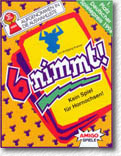
6 nimmt

Hersteller: Amigo

Autor: Wolfgang Kramer

Getestet: Deutsche Ausgabe, 1994

Tester: Walter Sorger

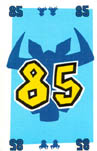
Szenario: Abstraktes Kartenspiel mit 104 Karten, auf denen je eine Zahl von 1
bis 104 aufgedruckt ist. Zusätzlich steht auf jede Karter eine Anzahl von
“Hornochsen”, die als Minuspunkte für den “Erwerber” diese Karte
gewertet werden.

Das Spiel: Die Karten werden gemischt. 2 bis 10 (!) Spieler erhalten je 10
Karten; 4 Karten kommen in die Mitte des Tisches und bilden den Anfang von 4
Kartenreihen. Die übrigen Karten werden zur Seite gelegt.
6nimmt

Alle Spieler wählen nun gleichzeitig jeweils eine Karte aus ihren Handkarten, ziehen
sie verdeckt heraus, und – wenn alle gezogen haben – legen sie offen auf den Tisch. Wer
die niedrigste Karte gezogen hat, beginnt. Er muß seine Karte an eine genau definierte
Stelle der 4 offenen Kartenreihen auf dem Tisch anlegen: an die Reihe, deren letzte Karte
einen niedrigeren Zahlenwert aufweist als seine, und deren Zahlenwert gegenüber seiner
Karte die kleinste Differenz aufweist.

Paßt die Karte eines Spieler als sechste Karte an eine Kartenreihe, so muß der Spieler
die ausliegenden 5 Karten dieser Reihe wegnehmen (deren “Hornochsen” für ihn
als Minuspunkte gezählt werden) und mit seiner Karte diese Reihe neu beginnen.

Besitzen alle Kartenreihen einen größeren Zahlenwert als die Karte des Spielers, so
muß der Spieler eine beliebige der 4 Kartenreihen wegnehmen und mit seiner Karte eine
neue Reihe beginnen.

Dann kommt der Spieler an die Reihe, der die zweitniedrigste Karte gezogen hat, und so
weiter. Wenn alle Spieler ihre gezogene Karte untergebracht haben fängt ein neuer Zug an
und die Spieler ziehen – wie oben – verdeckt die nächste Karte aus ihren Handkarten.

Nachdem alle Spieler ihre 10 Karten gespielt haben, wird abgerechnet. Die Anzahl der
Hornochsen jedes Spielers werden als Minuspunkte notiert. Bei mehreren Spielrunden
verliert derjenige Spieler, der als erster mehr als 66 Hornochsen erworben hat.

Spieldauer: Regelerklärung ca. 5 Minuten, danach ca. 30 Minuten

Ähnliche Spiele: Hornochsen (Spielvariation vom gleichen Autor), Hol’s der
Geier
(resp. Weniger ist mehr)

Kommentar der Westpark Gamers: Ein schönes Spiel zum Warming up oder um einen
heißen Spielabend ausklingen zu lassen. Sehr flexibel ist die Anzahl der Spieler, denn
das Spiel kann tatsächlich befriedigend zu zweit angefangen werden. Ebenso stehen sich 10
Spieler nicht im Wege: da alle gleichzeitig denken und die jeweils nächste Karte
auswählen können. Das Spiel läuft mit jeder Anzahl von Teilnehmern flott über die
Bühne.

Die Spielanleitung empfiehlt ein Mindestalter von 10 Jahre. Nach meiner Erfahrung kann
aber auch schon mit aufgeweckten Kindern ab 6 Jahren gespielt werden; man muß ja keine
exakte Arithmetik beherrschen, es reicht allein bestimmen zu können, welche von zwei
Zahlen die größere ist. Notfalls braucht man nicht einmal diese Fähigkeit, denn das kann
ein klügerer Mitspieler kundtun.

Altersmäßig (und intelligenzmäßig) ist das Spiel nach oben hin nicht limitiert. Man
kann es mit beliebig viel Kalkül und Planung füllen. Allerdings ist nicht sicher, ob man
mit tiefgründigen Überlegungen bessere Ergebnisse erzielt als mit einem rein
gefühlsmäßigen Vorgehen, ja gar mit einer strengen Zufallsauswahl. In unseren ersten
Spielevents hat Thomas jedesmal aggressiv die Zufallsthese in den Raum geworfen, wenn er
seine hundert Hornochsen einkassiert hat.

Ich bin allerdings ein strikter Vertreter einer geduldig geplanten Strategie. Zunächst
einmal gilt es zu vermeiden, mit seiner nächsten Karte die Reihe mit den vielen
Hornochsen zu kassieren. Hier gilt unser Schlagwort “Höchste niedrige”, d.h.
von allen Karten, die an eine Kartenreihe mit bereits 5 ausliegenden “teuren”
Karten paßen, soll man die höchste wählen. Damit die anderen Mitspieler eine größere
Chance haben, eine dazwischenliegende Karte zu ziehen und somit zuerst dran sind, die
Kartenreihe für sich zu erwerben.

Diese Taktik ist nach kurzer Zeit natürlich trival und keiner hat vor dem Mitspieler
hierin einen echten Vorteil, außer dem der ausgeteilten Handkarten. Es sind aber auch
nicht die kurzfristigen taktischen Züge, über die das Spiel entscheiden. Denke weniger
daran, wie Du mit Deiner nächsten Karte viele Hornochsen vermeidest, entwickele besser
eine Vision, in welcher Reihenfolge Du alle Karten Deiner Hand loswerden
willst. Es gibt natürlich kein Patentrezept, ungeschoren davonzukommen, aber jede Hand
hat Problemfälle, die es zu analysieren und zu entschärfen gilt.

Hast du viele hohe Karten, dann solltest du deine Karten so ziehen, daß jeweils eine
möglichst hohe Differenz überbrückt wird und alle Kartenreihen auf möglichst hohe
Anfangswerte gesetzt werden. Dann stehen die Mitspieler mit niedrigeren Kartenwerten
unter Druck.

Hast du sehr hohe Karten mit dicht beeinanderliegendem Zahlenwert (ab 100), dann
kannst du versuchen, dir “Hoch-Nischen” bauen. Das sind Kartenreihen mit
wenigen Karten und hohem Anfangswert, an denen du allein oder wenigenstens gering
gefährdet die dritte, vierte und fünfte Karte anlegen kann.

Hast du viele niedrige Karten, dann solltest du versuchen, dir
“Niedig-Nischen” zu bauen. Das sind Kartenreihen mit niedrigen Zahlen, die
unvermutet erzeugt werden – z.B. beim vorzeitigen Abräumen einer hohen Kartenreihe – , so
daß sie von den “reichen” Mitspielern nicht sofort hochgetrieben werden.

Kleine Karten möchte man oft möglichst schnell loswerden, weil sie sonst irgendwann
als niedrigste Karte eine ganze Kartenreihe einbringen. Ich halte dies in strenger
Konsequenz nicht für richtig. Die Kartenreihe, die du mit seiner niedrigsten Karte
kassierst, kannst du dir beliebig aussuchen. Sie hat meistens einen sehr geringen
Hornochsenwert. Deshalb solltest du davor keine Angst haben. Dagegen kannst du mit einer
niedrigen Karte einer schwierigen Situation ausweichen, wo mehrere Kartenreihen mit hohem
Hornochsenwert drohen, und du mit der “Höchste niedrige”-Taktik nicht sicher
bist. Weiterhin kannst du mit niedrigen Karten gezielt die “Hoch-Nischen” eines
Krösus wegräumen. Deshalb: Never use the last bit!

Hast du “schlechte” Karten (was immer das ist) und hohe Hornochsenkarten,
dann solltest du versuchen, wenigstens von deinen eigenen Hornochsenkarten möglichst
wenig mitzubekommen. Indem du sie z.B. an Kartenreihen anlegt, die du garantiert nicht
kassiert. Auch deine eigene letzte Karte kassierst du niemals selber!

Dies sind lauter Ratschläge, die alle nicht “totsicher” sind. Sie zeigen
aber das breite taktische und strategische Feld auf, in dem “6 nimmt” gespielt
werden kann. Als Freund der Chaos-Theorie kannst du aber auch deine Handkarten gut
mischen und blind der Fortuna die Gewinnstrategie überlassen …

Walters Bewertung: 8.0

Westpark Gesamtbewertung: 8.0
Weiterführenden Informationen: Luding Link zu “6 nimmt”
Hier gibt es eine
online Version des Spiels.

RETTE SICH WER KANN

RETTE SICH WER KANN

title

Publisher: Walter Müllers Spielewerkstatt

Author: Ronald Wettering

Tester: Aaron Haag

Game Tested: 1993 edition (OOP)

Scenario: Having fought for hours with heavy seas the crew of the Santa Timea
finally gives up and abandons ship. The last words of the captain still ring in their
ears as the crew boards the lifeboats: “Rette sich wer kann” (trans.
“Every man for himself”). While they watch the Santa Timea sink officers and
crew suddenly realize that the years of negligence pay their toll as the first leak
springs: the boats are not at all suitable for a long journey! Luckily enough, three tiny
islands are visible in the distance and fighting with the heavy waves seven boats try to
reach the safety of their shores.

The Game: The game begins with the crew boarding the life boats. Three to six
players in turn place one of their officers and sailors into a boat that still has seats
available. Once boarding is completed players are faced with a random selection of
sailors in these seven boats. Each of the boats only has to move three spaces to reach
the safety of an island but movement as well as all other decisions are strictly based on
democratic majority votes. All votes are open so there is ample possibility for
diplomacy, back stabbing and revenge. An important role is given to the turn leader, the
man “with the stick”, as he will break any ties. So timing is an issue when
planning a coup.

Voting is performed by selecting the desired color (boat or crew) secretly on a little
wheel and revealing the vote simultaneously with all other players. Each player has three
times the possibility to solely decide the outcome of a vote, overruling all of the other
votes, by selecting the “captain’s hat” instead of a color on the little
wheel. There is a nasty catch to this though: if more than one player decides to use this
“wild card” they cancel each other out.

Each round begins with deciding which boat is to spring a leak. If the boat decided
upon by the majority still has vacant seats one of these vacancies is filled with a blue
“water” token. Every now end then players select a boat with no vacancies in
which case one of the men aboard has to leave the boat immediately and is replaced by the
leak. This again is resolved by a majority vote but this time only those players having
men in the boat in question are allowed to vote. Each sailor has one vote, each officer
two, so its good advice to avoid having minority in a boat. Its also a good idea to
“support” your valuable officers with at least one sailor in case you have to
select one of your men to leave a boat.

After the leak has been placed the boat is checked for safety: it will immediately
sink if there are more leaks than remaining men aboard who will provide ample food for
the waiting sharks.

The next decision the players face is which boat should move? Again all players
secretly select a color (or the hat) and the vote is resolved as explained above. After
only three moves a boat reaches the shores of one of the islands and all men aboard jump
to their safety, yielding victory points for their players.

Now comes the final phase of each round, which adds spice (and chaos) to the game.
Starting with the turn leader each player has to take one of his men off one of the boats
if possible, since it is not allowed to take more than one man out of each boat. Then,
beginning with the player who last made one of his men jump out this player decides into
which boat his man should climb back into. It is not allowed to climb into the same boat
the man had just left. This again may lead to a situation where a crew member is unable
to re-board leaving him to instantly drown. If this happens all boats are checked for
their safety again, i.e. whether there are at least as many men aboard as there are
leaks. Even unattractive boats with many leaks suddenly become the only option to prevent
one’s man from sure death – a bird in the hand …

After about an hour’s play all boats have either sunk or reached an island and the
game ends.

Playing Time: The rules are explained in less than 10 minutes, the game plays
in about 60 to 90 minutes depending on the “negociation skills” of the
group.

Similar Games: Flusspiraten (Klaus Zoch, Walter Müller), Intrige (Stefan Dorra), Adel verpflichet (Klaus Teuber)

Westpark Gamers’ Opinion: The game is real fun if you don’t take things
too serious. Negotiations can be swift and players who like double crossing and revenge
will have the time of their life. Sometimes it may be hard to stop those two players who
decided to gang up on the others and who constantly help each other. Due to the clever
mechanism of changing boats in the last phase of every turn there is however sufficient
opportunity for the other players to break the alliance by having these men end up in
boats with mainly “hostile” crew.

More often than not your are faced with the proposal to sacrifice one of your
“hat” votes just to prevent the leader(s) to move a particular boat. As hard as
it may sound but this very often is the only chance to prevent early victory of a player.
The problem is: will the group reward this sacrifice later on or will they kick your men
overboard at the next opportunity? (“Oh, sorry about that – yes, you’re
right, you did us a favor earlier. We shouldn’t really have done this!”

followed by an evil grin). Alliances shift constantly and back stabbing and revenge are a
predominant element of the game.

As you can imagine this game needs the right set of players to enjoy. No hurt feelings
here or the game will not be enjoyed. Some tactical whining comes in handy though
(“Why me again, I’m last anyway…” as Moritz likes to say) just to
be able to prepare for the winning coup later on. Saving those valuable “hat”
tokens for later can be a tremendous advantage, too – so take all your negotiation skills
and convince the other players that someone else should vote with the “hat”.
All in all it is better to not expose oneself as the early leader giving all other
players a clear choice of whom to kick out of a boat next round.

Like all games from Walter Müller’s Spielewerkstatt the game components are of
excellent quality. Ships, men, “leaks”, hat tokens and turn leader log are of
high quality colored wood; only the voting “wheel” is a bit cumbersome to
assemble due to the double sided selotape used (I’d recommend taking a very close
look at how this is intended to be assembled as it is hard to correct any mistakes).

Aaron’s Rating: 6 (out of 10)

Westpark Gamers’ Rating: 6.5

Links to further information:

Luding Link for Rette sich wer kann


Funagain link for Rette sich wer kann

SUPREMACY

SUPREMACY

Supremacy

Hersteller: Supremacy Games

Autor: ?

Getestet: Amerikanische Ausgabe, ohne Expansion Sets

Spielerzahl: 2 – 6 (ab 4 gut)

Tester: Moritz Eggert

Dieses Spiel war gerade in den 80er Jahren recht berühmt, und ist eines der
meisterweiterten Spiele überhaupt. Es gibt mehr als ein Dutzend
“Expansions”.

Im Grunde geht es um das alte Ziel der Weltherrschaft – jeder Spieler übernimmt eine
“Superpower” und versucht die Gegner wirtschaftlich wie militärisch zu
bezwingen. Das Spiel ist von seiner Weltsicht sehr den 80er Jahren verpflichtet, aber
noch erstaunlich aktuell, denn auch heute sind Nuklearraketen wie Laserabwehr leider noch
immer “zeitgenössische” Themen. Das Design dagegen ist 70’s-artig,
allerdings durchaus attraktiv, und für ein amerikanisches Spiel recht reichhaltig.

Das Spiel versucht mit relativ simplen Regeln ein komplettes Weltgefüge zu simulieren,
was im “Basis-Set” nur teilweise gelingt. So suchen die Spieler nach den 3
großen Welt-Ressourcen (Grain, Oil, Minerals), und versuchen dann, die entsprechenden
neutralen Länder zu erobern. Man kann seine gefundenen Ressourcen auch auf dem Weltmarkt
verkaufen, was jeweils drastische Kursstürze und -steigerungen zur Folge hat, sodass es
zum Beispiel einem Spieler möglich ist, seine Ölreserven für 200 Millionen Dollar pro
Einheit zu verkaufen, während der nächste Spieler schon in der selben Runde nur 5
Millionen Dollar pro Einheit bekommt. Die Spielreihenfolge wird komplett ausgewürfelt,
was manchmal nicht fair scheint.

Das normale Kampfssystem ist einfach aber elegant, leider meistens für den Angreifer
recht mühsam und teuer. Viel einfacher ist es da, Atombomben zu entwickeln, denn die
kosten bei ihrer Verwendung fast nichts. Leider wird natürlich auch das angegriffene Feld
komplett zerstört, was Atombomben zur Lieblingswaffe der Spieler macht, die es ökonomisch
nicht “reißen”. Da die einzige Verteidigung gegen die Atombomben, sogenannte
L-Stars, exakt das Doppelte kosten, nimmt das Atombombenwerfen irgendwann so überhand,
dass das Spiel durch “nuklearen Winter” endet, bei 12 zerstörten Feldern –
niemand hat gewonnen.

Das mag als moralische Lektion zwar durchgehen, ist als Spiel in dieser Form
allerdings nicht unbedingt erbaulich. Wir waren uns allerdings alle einig, dass das Spiel
Potential hat, das vielleicht durch die Expansion-Sets verwirklicht wird. Daher ist das
Urteil über “Supremacy” vielleicht noch nicht endgültig…

Spieldauer: ca. 30 Minuten Regelerklärung, dann ca. 3-4 Stunden bis zum fast
unvermeidlichen nuklearen Winter – alle verlieren!

Ähnliche Spiele: Risiko, Material World

Moritz` Bewertung: 6 (von 10)

Westpark Gesamtbewertung: 4.8 (letzte Bewertung am 26.9.2001)

Weiterführende Informationen:

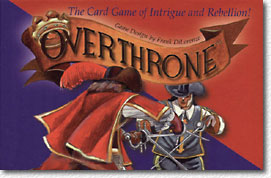
OVERTHRONE

OVERTHRONE

Overthrone

Hersteller: R&R-Games

Autor: Frank diLorenzo

Getestet: Amerikanische Ausgabe

Spielerzahl: 2 – 6 (gut ab 4)

Tester: Moritz Eggert

Nettes kleines Kartenspielchen, das die Zeit der Musketiere und französischen
Hofintrigen heraufbeschwört. Jeder Spieler kontrolliert einen Adeligen und versucht, sich
bei den unvermeidlich immer wieder stattfindenden Rebellionen möglichst viele Provinzen
zu sichern, denn die bringen Punkte. In jeder Runde hat man viele Handlungsoptionen, die
jedoch sehr stark von der aktuellen Kartenhand abhängen – es handelt sich also um ein
sehr stark glücks- und chaosorientiertes Spiel. Man kann Musketiere zum Erobern anderer
Provinzen losschicken, versuchen, andere Personen oder Höflinge zu bestechen (beim
Eingliedern in die eigene Machtstruktur lösen viele dieser Personen besondere
Handlungsmöglichkeiten aus), oder auch einen Adeligen zum Duell herausfordern. Danach
spielt jeder Spieler eine Karte aus, die, wie in einem traditionellen Stichspiele, einem
zu mehr oder weniger Karten verhelfen. Der König wandert ständig, kann jedoch durch
Rebellionskarten oder Kirchendekrete den “Besitzer” wechseln. Sicherlich kein
Klassiker, aber durch das Spielen auf Siegespunkte verändert sich die Spieldynamik, die
ähnliche Spiele wie “Honour of the Samurai” oder das grottenschlechte
“Gangland” zu reinen Kingmaker-Spielen macht. Die Spieldauer passt auch dazu –
also keine schlechte Unterhaltung zwischendurch, aber nichts für Kartenstrategen.

Spieldauer: ca. 20 Minuten Regelerklärung, dann 1 bis 1 1/2 Stunden

Ähnliche Spiele: Honour of the Samurai, Gangland, MagBlast

Moritz` Bewertung: 6 (von 10)

Westpark Gesamtbewertung: 4.75 (letzte Bewertung 26.9.2001)

Weiterführende Informationen:

ROYAL TURF

Royal Turf

ROYAL TURF

Publisher: Alea

Author: Reiner Knizia

Tester: Aaron Haag

Game Tested: 2001 edition, basic rules

Scenario: Horse racing on the royal turf of Ascot. Two to six players aim to
win as much money as possible by betting on horses. Different to real horse racing each
player has some means to take influence on the performance of the seven horses during the
race. The player having made the most money after three races wins the game.

The Game: As in real life each of the seven horses has different strengths and
weaknesses. These are assigned during the initial game setup by allocating points to all
of the four attributes “speed”, “endurance”, “handicap” and
“jockey”. The points are assigned by randomly drawing a card for each horse.
Each attribute can have a point value of 1 to 14, with the overall “strength”
of all horses being equal. Players are therefore faced with horses that may be relatively
strong in one attribute but considerably weak in others or horses that show an average
performance in all four attributes. With this information players use tokens to place
bets. Each players has three tokens, i.e. places three bets with one token counting
double. Bets are placed openly and in sequence so that players are able to apply a
certain amount of tactics here.

Royal Turf

The attribute cards plus a die are the motor of the game. The die shows a symbol for
each of the four attributes – the “speed” symbol printed on three sides and the
remaining three attributes on each of the other three sides. On a player’s turn (s)he
rolls the die and decides which of the seven horses to move forward by the number of
spaces corresponding to its strength of the attribute just rolled. Once a horse has been
moved it may not be moved again until all others horses have.

When three horses have crossed the fiishing line the race is over and players pay or
get paid for their bets: players who were unfortunate enough to bet on the last horse pay
100 pounds, players who bet on any of the first three horses get money paid from the
bank. The amount paid depends on the position of the horse and the number of players that
placed a bet on it. Three races are played to determine the winner and the last race pays
double rates which keeps the final score open until the very end.

Reiner Knizia published a predecessor of this game in 1995 with Gibson Games under the
title of “Turf – Horse Racing”.

Playing Time: The game is easily explained and equally simple to play. Playing
time is about 45 minutes.

Similar Games: Turf – Horse
Racing
(Reiner Knizia), Favoriten (Walter Müller), Derby (Dirk
Henn)

Westpark Gamers’ Opinion: This is a good game for starting or finishing a
gaming session. It plays fast, is easily explained and is good fun for all players. The
tactical possibilities are limited to placing the bets so that one is not too exposed –
being the sole player having a bet on a horse makes that horse almost certainly the sure
loser. The best part of the game is the “diplomacy” phase just after a player
has rolled the die: convincing that player to move a particular horse usually leads to
some nice discussions, threats and schadenfreude. The larger the group of players the
more this aspect is dominating as the direct influence on the movement of horses
decreases. In smaller groups this influence increases as each player moves horses more
often. This game is certainly more of a family type game than a strategy heavyweight but
played in the right group this game is quite fun.

Aaron’s Rating: 7 (out of 10)

Westpark Gamers’ Rating: 7.17

Links to further information:

Luding Link for Turf Horse Racing


Luding link for Royal Turf