Archiv der Kategorie: Spieleabende

Session Report & Review 04.06.2003

Session Report & Review 04.06.2003

Author: Peter

at the table: Walter, Günther, Peter und Aaron

on the table: Stephensons Rocket, New England

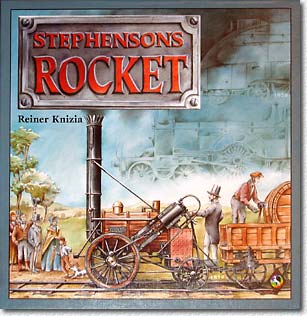
  1. Stephensons RocketStephensons Rocket

    Stephensons Rocket is game by Reiner Knizia, my favourite game designer. My favourite
    game of his is Euphrat & Tigris. At the first glance, you might think that those
    games resemble each other. At least, that’s what I thought. In fact, they don’t
    (at least, that’s what I think now). I do adore Euphrat & Tigris, but I am not
    too fond of Stephensons Rocket. I’ll expound this.

    As Euphrat & Tigris, Stephensons Rocket is highly cybernetic, i. e. there are lots
    of different gaming mechanism that interlock like gears in a sophisticated device.
    I’ll try to explain some of them so that you might get an idea what I’m thinking
    of.

    There are different railroad lines. Whenever you build one tile for them (like in 1830
    or most other railroad games), you get one share (yes, shares are recompenses for
    building – you don’t buy them). Whenever you try to build other players might contest
    the direction you’re trying to build to. The decision is which the railroad advances
    is determined by bidding shares. This means two things: Whoever has done most building
    work on the railroad has better odds to determine its further course. But when you force
    your will, you pay with your shares, and this will make things easier for other players
    with shares.

    However, shares are not only used for determining the direction of the railroad line.
    Whenever two lines merge into one big line, players with shares for the lesser lines get
    winning points (called “dollars” in the game, and available in sets of 1.000 –
    this reminds of arcades game times when shooting an alien spaceship gave you 10 or 100
    points, never 1). Players count the cities connected by the lesser railroad, and the
    player with most shares immediately scores as many (multiplied by 1.000 of course)
    victory points, the second player half of that. This means: Force your way, and you
    won’t get victory points.

    Stephensons Rocket board There are three kinds of cities: Those that act as
    starting points of the different railroad lines and which have no further meaning.
    Then those that trigger a scoring when reached. You get as many points as in the
    case of a merger (i. e., number of cities x 1.000), but first and second are
    determined otherwise: This time, its not about the number of shares but about the
    number of railroad stations of your colour which are on the track. Stations are
    built in your turn instead of advancing a railroad line. Of course, you’ll try
    to merge your line with many of your stations in the biggest line available in order
    to get a majority there (or, if not possible, try to avoid such a merger at all
    costs). More and more railroad lines merge and whoever has the majority in the big
    lines has good chances to win the game. This resembles of course the growing
    kingdoms of Euphrat & Tigris.

    And things are even more complicated than this. The third kind of city has three markers
    each. Those markers have two meaning: First, whenever such a city is reached by a
    railroad line the players with markers score a modest amount of victory points. Second,
    those markers represent different goods. At the end scoring, players get rather many
    victory points for majorities in the different types of goods.

    Things intertwine at such a rate that every single action has more impacts than anyone
    could probably track. At least, I cannot. I am not a bad Euphrat & Tigris player, and
    I could always tell you how the other players are doing. In all Stephensos Rocket games
    we had so far, no-one was right about the approximate winning order. The rules say that
    players don’t show their money (i. e. points scored so far) to the others. But even
    if you do, this won’t change much since players get so many points in the final
    scoring that the intermediate results don’t matter that much. In every game we had so
    far the player taking the last move decided who wins, not because of malice but because
    of necessity. Things get crowded at the end, and finally it’s your turn and you
    either merge line A to line B, or line C, or avoid the merger. This might have hardly any
    impact to your personal score but it decides the game.

    Just one example: In a game I played at a boardgame club, I was the only player who knew
    the game and had a plan. One player understood what I was doing and did his best to
    thwart my schemes. He was last. I was third. And I was the one to decide with my very
    last turn which of the other two players should win. Both of them did not have any
    discernable strategy for the first third (or half) of the game but were lucky enough to
    have their lines advanced by others.

    Verdict: There is no dice rolled, no card drawn yet the game hardly controllable. You
    (or at least, I) cannot even approximately keep track of how you and others are doing.
    The final scoring submerges all previous game play like a deluge. Since its result
    depends on mergers which are decided at the very last moment, it can hardly be predicted.
    Stephensons Rocket is highly recommended to any player who complains about luck in board
    games. There is no random factor at all yet experience won’t improve your chances of
    winning the game very much.

Session Report & Review 21.05.2003

Session Report & Review 21.05.2003

Autor: Moritz, Aaron

am Tisch: Loredana, Günther, Peter, Moritz und Aaron

auf dem Tisch: Alhambra, Amun Re

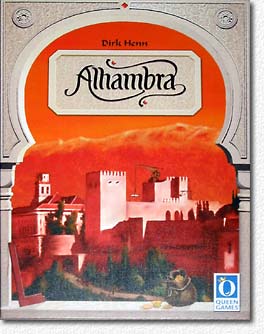
  1. AlhambraAlhambra

    This new offering is part of the selection for „Spiel des Jahres“, this is
    why Guenther nudged us gently to play it…

    The game is similar to other German games (well, aren’t ALL German games similar
    to other German games???) and immediately creates associations with “Princes of Florence” (each player builds his own
    “Alhambra” palace, in arabic Spain) and Carcassonne (Tiles have to be placed in a tricky way, you try to build
    a “long wall” instead of a long road).

    And of course the long list of games where you have to have the majority in a specific
    attribute (buildings in “Alhambra”).

    Nothing new – how does it play?

    Each player gets a hand of numbered cards in 4 colors (the different kinds of money used
    in arabic Spain), valued 1-9. The drawing mechanism brings a little luck into the game:
    Each player draws up to the exact limit of 20, if s/he doesn’t hit 20 exactly s/he
    may surpass the sum, resulting in different sized hands for each player.

    On a small board 4 building tiles are placed at random (and constantly replaced). Each
    can be acquired with only one specific kind of money, so the building next to the
    “yellow” money symbol can only be bought with “yellow” money.
    Building prices range from 3-13. There are seven kinds of buildings, some are very rare,
    some are very common. Hidden in the money draw pile (and therefore functioning as a
    random scoring) are two scoring cards, a final scoring happens at the end of the game,
    when all buildings have been sold. The more common buildings give you more points, as it
    is more difficult to have the majority with them. The first scoring round only scores the
    leaders (with scores ranging from 1 to 7), the second scoring round scores the leaders
    and runner-up’s (leaders now receive more than double the sum before, the runner-up
    the basic sum), the final round includes a third place as well with equally raised
    stakes. If 2 or more players are tied, they receive the sums of both scores divided by
    their number and rounded down.

    Each player has only one action (normally).

    S/he can:

    1. Take any of the open and constantly replenished 4 money cards
    2. Take a combination of money cards up to the value of 5 (rarely achieveable!)
    3. Buy a building with the correct money cards
    4. “Destroy” an already built building (goes to “reserve”)
    5. “Rebuild” a destroyed building somewhere else
    6. “Exchange” a building with a building from the reserve that
      fits

    One unique mechanism needs attention: You have to use the cards you have when buying
    buildings (no change), so most of the time you have to overpay because your cards
    don’t match the exact price. If you however manage to EXACTLY pay the price, you
    get an ADDITIONAL action. Theoretically you can gain a string of actions in this way, so
    it very often makes sense to sit back and improve your card hand instead of building or
    buying at all costs – It might pay off in later rounds when you suddenly have a lot
    of actions available!

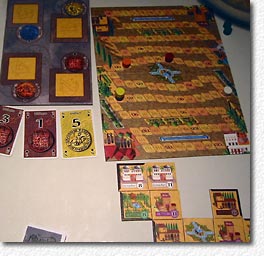
    Alhambra Building buildings is not easy: they all have to be orientated in
    one direction, walls have to be next to walls (all square building tiles have none,
    one, two or even three walls), and you have to be able to access all placed tiles
    from your central “start” tile. Your longest series of walls give extra
    points every scoring round. If you acquire a building that can’t be placed
    right now, you have to put it in reserve, hoping to build it another time (which
    eats up one action, though). In my opinion it is mostly better to accumulate cards
    instead of buying a building you can’t immediately build – cards
    INCREASE your options, whereas the reserve building takes away TWO actions. In fact
    our reserve space was rarely used in our first game.

    All actions are very important, as the game is over pretty quickly, and very often you
    won’t be able to achieve what you wanted to. The final scoring round gives the most
    points, and is therefore most important.

    That’s all there is – no surprises, really.

    The sentence to sum up this game is: it works. It is not overly complicated and plays
    quickly because of limited options. The tension lies mostly in the management of your
    card hand, or if another player gets a specific building before you can pay for it. It is
    satyisfying to pull off a string of actions, but that’s about it. There is very
    little to none player interaction (you look at what the others have built and plan your
    own buys based on that info, that’s about it), and the excitement factor is not
    really high.

    Guenther was the only one of our group who reacted enthusiastically to this game (even
    saying that it had a chance for “Spiel des Jahres”, the others liked it, but
    not in a very “emotional” way.

    Our rating for this session: 6.2

    Moritz Eggert

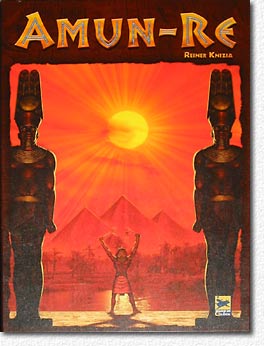
  2. Amun ReAmun Re

    Amun-Re is this year’s “Hans im Glück” major Nürnberg release (besides
    another Carcassonne extension) and like “Euphrat & Tigris” it is by Reiner
    Knizia. This time the setting is ancient Egypt during the time of the Pharaohs and
    players take on the role of rival dynasties.

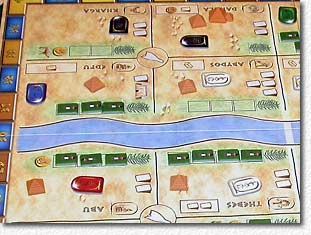
    The game board is an abstract map of 15 provinces in Egypt, divided into
    “lower” and “upper” Egypt indicated by a horizontal line that
    separates the board into a “south” and a “north” section. The board
    is further divided by the river Nile, creating four separate areas on the map. These four
    sections take an important role in the scoring phases of the game as certain sets of
    provinces may grand extra victory points. The main source of victory points however are
    pyramids built in provinces; hence the objective of the game is to acquire provinces and
    to build pyramids in them. Both require income which is earned by selling crops. On the
    other hand, growing crops requires farmers, which can be hired for money – and we are
    right in the middle of this great resource management game.

    The game is divided into two halves – the old and the new kingdom, and each kingdom is
    played in three rounds with each round having 5 phases:

    Phase 1: Revealing the province cards

    As many provinces as there are players are randomly selected in order to be put up for
    auction in phase 2. Since each province has different properties players already now have
    some input for making up their minds about the strategy they will follow during the game:
    provinces have different amounts of farmer spaces or they allow different amounts of
    power cards to be purchased, some provide free gold or power cards and others provide
    free building material.

    Phase 2: Acquisition of provinces

    One by one the provinces are now put up for auction: beginning with the start player
    each player selects a province and bids the amount of money s/he will pay if successful.
    Once all players have made their bid any player having been outbid must select a new
    province and bid again. This continues until each player has won a province. Here, and
    throughout the rest of the game prices increase in distinct steps: 0, 1, 3, 6, 10 and so
    on.

    Phase 3: Buying resources

    Players now acquire resources for their provinces. There are three types of resources:
    power cards, farmers and building material. For each type of resource the complete number
    of resources must be bought at once making large numbers prohibitively expensive (e.g. 2
    farmers cost 3 gold, 3 farmers cost 6 (1+2+3) gold. The amount of resources a player may
    buy is limited by the numbers depicted on the provinces.

    While the power cards are maintained by the player (no hand limit) the farmers and
    building material must be distributed amongst the provinces. As soon as a province
    contains three building materials these are converted to a pyramid.

    Phase 4: Offering to Amun-Re

    Amun Re Players now secretly select a number of gold cards and simultaneously
    reveal them. The sum of all gold cards played amended by the possible “-3”
    cards (each player gets one of these at the start of the game) is then used to determine
    the value of the offer and the appropriate position of the temple marker on the temple
    track. This marker indicates the amount of gold paid for farmers and pyramids in phase 5
    (the higher the sacrifice the higher the income paid).

    The player who offered the highest amount to Amun-Re is rewarded with three resources of
    his choice – power cards, farmers and/or building stones. The player who offered the
    second-highest amount receives two items, while everyone who sacrificed at least one gold
    receives one item. Any player who played a -3 card “steals” 3 gold from the
    treasury, but does not receive a free gift from Amun-Re due to his affront. All gold
    sacrificed is returned to the bank, while -3 cards are retrieved by the players having
    played them.

    Phase 5: Harvest and other income

    Now players receive income based on the number of farmers they have in their provinces
    and the position of the temple marker. In addition players receive gold for some of the
    provinces, indicated by a corresponding symbol. Some power cards which can be played in
    this phase grand an extra income, too.

    Phase 6: Scoring

    This phase is only played at the end of turn 3 (end of the old kingdom) and at the end
    of turn 6 (end of the new kingdom and end of the game).

    Each player now receives victory points based on the status of their provinces:

    • 1 point for every pyramid built
    • 3 points for each set of pyramids (a set of pyramids is equal to one pyramid in each
      of the 3 provinces)
    • 5 points for the province with the most pyramids on either side of the Nile
    • bonus points for temples in provinces
    • bonus points for certain power cards (if played)

    At the end of the old kingdom all resources except for the temples and the building
    stones are removed from the board and the game continues with playing the new kingdom.

    At the end of the game – when the new kingdom has been played and scored – extra victory
    points are granted to the three players holding the most gold.

    And how does it play?

    Amun-Re is a resource managing game par excellence and in some respects it
    “feels” slightly familiar with Reiner Knizia’s “Euphrat &
    Tigris”. Money is the most important resource with respect to flexibility of actions
    while VPs are generated by provinces, temples and power cards, all of which need money
    for their acquisition. Therefore, players find themselves in a permanent dilemma of
    spending money on farmers to generate more money or to spend money on building stones and
    power cards to generate VPs. Although the rules are clear and strait forward this dilemma
    makes the game rather complex – another resemblance to “Euphrat & Tigris”.
    That’s why we don’t give it a high chance of receiving the “Spiel des Jahres
    2003” prize but it is my personal favourite for “Deutscher Spielepreis
    2003”.

    Here are some hints for good resource management in Amun-Re:

    Go for the money

    During the first half of the game (when playing the old kingdom) it is a good idea to
    generate money with high priority – especially in a five player game, where all provinces
    will be played. This is because the old kingdom will generate far less VPs than the new
    kingdom (only about 1/3) and you need money to bid on the “good” provinces of
    the new kingdom. Which provinces are good for you is determined by the number of pyramids
    having been built in any one province. Don’t get nervous if you are behind in VPs
    when the old kingdom dies – chances are that your fellow players are short of money now.

    Get those Power Cards

    Acquiring power cards early has a lot of benefits. On the one hand you might get one or
    more of those cards which yield special bonuses for certain sets of provinces. If you
    have the fortune to receive these cards during the old kingdom you can follow a matching
    strategy during the new kingdom. And secondly, it is a lot better to have e.g. a Master
    Builder card in your hand that you cannot play (you are only allowed to play one type of
    card per turn) than letting another player have it who may be able to play it. And
    remember: prices increase depending on the number of cards you buy, so buying small
    numbers regularly saves money!

    Watch those sets

    Distribute your pyramids equally between your provinces as this will pay extra VPs for
    complete sets at the end of a kingdom. A safe set of pyramids (yielding 3 VPs) is better
    than an insecure “most pyramids” bonus of 5 points, so consider carefully where
    you place your building stones.

    Our current rating: 7.9

    Aaron Haag

Spielbericht & Review 13.05.2003

Spielbericht & Review 13.05.2003

Autor: Moritz

am Tisch: Andrea, Günther, Moritz und Walter

auf dem Tisch: Elemental

  1. ElementalElemental

    Dieses kleine Spielchen wurde quasi von der Spielewelt unbemerkt von der inzwischen mit
    Rollenspielen und Comics sehr erfolgreichen Firma Kenzer&Co. herausgegeben. Dies geschah in einer Winzausgabe, die
    die meisten Brettspieler direkt übersehen würden, bestand sie doch nur aus einem winzigen
    Pappspielplan und einer Seite Counter zum Ausschneiden (was ohnehin sehr unbeliebt ist!).
    Die Regeln nehmen gerade mal eine halbe Seite ein, dennoch hat es dieses Spiel durchaus
    in sich.

    Wer weiss, wie bekannt dieses Spiel jetzt wäre, hätte man es in ähnlich edler Form wie
    zum Beispiel „Gipf“ herausgebracht? Auf jeden Fall gehört es nicht in die
    Gattung der Fantasyspiele, sondern in die Gattung der abstrakten Setzspiele.

    In „Elemental“ setzt jeder Spieler abwechselnd einen Stein auf einem recht
    kleinen Spielplan mit Viereckraster. Ziel des Spiels ist es, entweder am Spielende am
    meisten Steine auf dem Brett zu haben (wenn niemand mehr setzen kann), oder eine
    „Rose“ zu vollenden, ein grosses sternförmiges Gebilde aus mehreren Steinen.
    Dazu ist sehr wenig Platz, und die anderen Steine meistens im Weg. Wo jetzt der Clou des
    Spieles liegt, ist die Tatsache, das bestimmte Steinkombinationen
    „elementare“ Effekte verursachen, die das Spielgeschehen ganz schön
    aufmischen. So wird zum Beispiel eine freie Zickzacklinie von eigenen Steinen zur
    „Flutwelle“ die sich jede Runde um eins in eine einmal gewählte Richtung
    bewegt, und alle Steine auf dem Weg zerstört.

    Eine andere Möglichkeit ist ein Feuerball (ein kleines Dreieck), das alle Steine in
    einer bestimmten Richtung zerstört. Sicher dagegen ist ein „Berg“ (4 Steine
    im Quadrat), der ist unzerstörbar und bildet eventuell später die Basis für eine Rose.
    Schließlich kann man noch, ähnlich wie bei „Reversi“, gegnerische Steine
    umwandeln, indem man jeweils links und rechts 2 Steine in eine Linie bringt. Schließlich
    kann man Gebilde auch kombinieren, zum Beispiel ist der Vulkan beliebt, eine Kombination
    aus Berg und Feuerball, oder auch der Todesstern, 4 Steine als Kreuz, also in alle
    Richtungen Feuerbälle feuernd.

    Wie spielt sich das Ganze nun?

    Zuerst einmal ist man sehr verwirrt von den vielen Möglichkeiten, die sich in einem Zug
    ergeben können, und man muß sich erst langsam an das Spielprinzip gewöhnen. Jede Runde
    ist irgendwas überraschendes los, und das Spielfeld ändert sich schnell und unerbittlich.
    Durch den Chaosfaktor ist es jedoch auch kein ödes Denkspiel, in dem Alle stundenlang
    grübeln (obwohl tatsächlich keinerlei Glückselement vorhanden ist!). Unser Spiel war
    recht schnell, nach einer halben Stunde vorbei, und das zur allgemeinen Überraschung (ich
    glaube Günther war selber überrascht, daß er seine Rose vollenden konnte). Durch die
    Geschwindigkeit ist das Spiel sehr kurzweilig, darüberhinaus ist es schnell erklärt, und
    macht als Mehrspielerspiel wirklich Spass, weil es kein wirkliches Gegeneinanderspielen
    ist, mehr ein Suchen nach dem grösstmöglichen Chaosfaktor, und da trifft es halt mal den
    einen und mal den anderen. Auch ist kein Spieler wirklich aus dem Spiel – irgendwo
    ist nach grossem Steineverlust wieder ein Eckchen frei, wo man wieder neu beginnen kann,
    und man kann dann auch immer noch das Spiel beeinflussen, sogar gewinnen!

    Wer also abstrakte Setzspiele mag, wird dies Spiel sicherlich auch mögen. Darüberhinaus
    ist eigentlich kein besonderes Spielmaterial nötig, jede Spielesammlung gibt genügend
    Steine her, die das „edlere“ Spielen ohne Pappcounter ermöglicht.

    Wer weiß, vielleicht hat das Spiel ein längeres Leben, als man vermutet – Es
    bleibt abzusehen…

    Kommentare anschauen/eingeben

    Kein absoluter Klassiker, aber einen Versuch wert.

    Unsere momentane Wertung: 6.5

    Moritz Eggert

Spielbericht & Review 07.05.2003

Spielbericht & Review 07.05.2003

Autor: Walter

am Tisch: Aaron, Andrea, Günther, Hans, Moritz, Peter und Walter

auf dem Tisch: Outpost, 6-Tage-Rennen, Bluff

  1. OutpostOutpost

    Eine lauschige Mai-Nacht auf der Terrasse am Westpark bedeutet schon eine deutlich
    erhöhte Lebensqualität. Wenn dazu noch alle WPGs versammelt sind und wir mit Lust und
    Laune unsere Spielsession durchziehen können, kann ich nur konstatieren: “La vita e
    bella!” Auch wenn die hohe Teilnehmerzahl eine Einschränkung in der Spieleauswahl
    mit sich bringt.

    Mit Outpost fing der Abend an. Zu Einzelheiten der Spielregeln verweise ich auf unseren
    Session-Report vom 29.1.2003 oder auf die Literatur im
    Internet. Hier will ich zunächst mal ein paar Tips abgeben, die aufzeigen, dass dieses
    Spiel in jedem Fall sehr stark strategisch orientiert ist und nicht so sehr vom Zufall
    abhängt, der einem bei der Zuteilung der Gewinn-Scheine innerhalb gewisser
    Schwankungsbreiten bevorzugen oder benachteiligen kann.

    1. Verachtet mir die kleinen Karten nicht. Leistet euch bei jeder Gelegenheit auch
      Mitarbeiter für die Erz-Gruben. Die jeweiligen Einnahmen zwischen 1 und 5 Dollar sind
      besser als gar nichts. Und wenn dieser Betrag jede Runde ausgeschüttet wird, summiert er
      sich schnell weit über die zehn Dollar hinaus, die für einen Arbeiter ausgegeben werden
      müssen.

      Auch in der Endphase sind die kleinen braunen Erz-Karten nützlich, dienen sie doch
      vorzüglich dazu, die geforderten runden Summen für alle Arten von Anschaffungen exakt
      aufzubringen, ohne unnötige Überzahlungen machen zu müssen.

    2. Spart kein Geld! Bis auf die Schlußrunden lohnt sich das in den seltensten Fällen.
      Jeder ist in der Lage, mit seinen laufenden Runden-Einnahmen die für ihn notwendigen
      Investitionen zu tätigen. Dann lieber mit dem übrigen Geld noch einen Mitarbeiter (vor
      allem!) oder noch ein Wasserwerk kaufen. Die tragen bereits in der nächsten Runde Früchte
      und haben sich in kürzester Zeit amortisiert.

    3. Kauft immer die teuersten Fabriken, die ihr euch von euerem aktuellen
      Runden-Einkommen leisten könnt. (Spart aber nicht darauf; siehe oben.) Je teurer die
      Fabriken, desto höher der relative Ertrag. Eine Erzgrube kostet einschließlich Arbeiter
      20 Dollar und bringt durchschnittlich 3 Dollar, das sind 15% Rendite. Ein Wasserwerk
      bringt bei 7 Dollar Einnahmen rund 21% Rendite, eine Titanfabrik bei 10 Dollar Einnahmen
      etwa 23%. So steigt das immer weiter, auch wenn die Kosten für die notwendige
      Infrastruktur (Sonderkarten) anteilig berücksichtigt werden müssen.

    4. Geht nicht zu früh auf Titan aus, denn dazu müßt ihr vorher noch die notwendige Heavy
      Machinery Investition tätigen, die euch finanziell bemerkbar zurückwirft. Wenn man diese
      Anschaffung nämlich voll in die Renditenrechnung der ersten Titan-Fabrik eingehen läßt,
      so wirft diese nur gut 15% ab, dafür steht dieser Wert für jede weitere Titan-Fabriken
      dann bei 25%.

    5. Kauft die frühen Sonderkarten genau in der Reihenfolge, wie ihr sie braucht. Nodule
      geht vor Warehouse, denn die Mitarbeiterzahl müßt Ihr konsequent nach oben fahren können.
      Dagegen bringt ein erweitertes Handlimit gar nichts, da ihr eure Einnahmen sowieso
      konsequent wieder reinvestiert.

    6. Achtet in jedem Fall auf die gerade im Handel befindlichen, und auf die jeweils noch
      verfügbaren Sonderkarten. Ihr braucht unbedingt eine Möglichkeit, eure Mitarbeiter-Anzahl
      zu erhöhen, d.h. ihr braucht ein Nodule. Überlaßt diese nicht eueren Konkurrenten für
      billiges Geld. Oder deckt euch damit ein, sobald sie wohlfeil sind.

    7. Es gibt für jeden Spieler genau einen optimalen Zeitpunkt für den Erwerb eines
      Nodules: Ihr müßt schon am oberen Mitarbeiter-Limit sein und solltet über gute Einkünfte
      verfügen, d.h. 3 Wasserwerke und 2 Titan-Fabriken besitzen. Ist das allgemeine Interesse
      an den Nodules sehr hoch und sie gehen weg wie warme Semmeln, müßt auch ihr schneller
      zugreifen. Dann sind simple 4-5 Wasserwerke eine ausreichende Finanz-Basis. Man sollte
      sie leicht nach 5 Runden erreicht haben können, während die Titanisten dazu mindestens 2
      Runden länger brauchen.

    8. Sind euch aus wohl kalkulierten Finanzbetrachtungen aber alle Nodules durch die
      Lappen gegangen, dann müßt ihr schleunigst Robots anstreben, um die fehlenden Arbeiter
      durch Roboter ersetzen zu können. Liegen keine Robots vor, dann hilft nur noch die
      Outpost-Karte.

    9. Ein kleiner psychologischer Trick beim Versteigern der Sonderkarten: Seid ihr erste
      in der Spielerreihenfolge, dann bietet auf Karten, die ihr zwar gebrauchen könntet, die
      aber nicht unbedingt eurer vorrangiges Wunschobjekt sind. Der Mensch ist auf nichts so
      gierig wie auf das, was die anderen haben wollen. Wenn er einem etwas Wegschnappen kann,
      verliert er dabei leicht die rationale Kontrolle über sein Handeln. Ergebnis: der gierige
      Erwerber hat erstens erhöhte Summen ausgegeben und scheidet zweitens auf grund seiner
      geschwächten Finanzkraft als Konkurrent für das wahre Objekt euerer Begierde aus. (Aber
      das wissen sicherlich schon alle!)

    In den fortgeschrittenen Runden gibt es dann mehr Finanzkämpfe um die Art zu
    ersteigernder Karten, um die taktische Beteiligung daran, um den Preis, auf den man
    hochtreibt und dergleichen trockene Überlegungen. Dazu sind die üblichen
    Versteigerungstechniken zu beachten. Das ist eigentlich alles. Wenig? ZU wenig?

    Selten hat ein Spiel in unseren Reihen so gravierende Fronten gezogen zwischen
    Befürwortern und Gegnern. Moritz war bereits in der Anfangsphase ins Hintertreffen
    geraten und ließ mit wachsendem Rückstand keinen guten Faden an dem Spiel. 3 vergebene
    Punkte drücken seine tiefste Verachtung aus. Aaron war auch nicht gnädiger. Da er der
    einzige Neuling war, entzogen sich notwendigerweise viele spielentscheidende Feinheiten
    seiner Aufmerksamkeit. Aus diesem Grunde sind seine 3 Punkte noch verständlich. Günther
    ist ein erfahrener Stratege und deutlichster Propagandist für dieses Spiel. Obwohl er nur
    auf einem Mittelplatz landete, vergab er hervorragende 8 Punkte. Dem schloß ich mich auch
    an, obwohl oder weil wir noch in der Lernphase sind. Wenn wir es alle im Detail
    verstanden haben, wird es für mich sicherlich einen Teil seines Reizes verlieren.

    Es gab hinterher eine erbitterte Diskussion unter den verschiedenen Parteien, die ich
    hier unbedingt subjektiv kommentieren möchte. Stellvertretend für die Gegner steht der
    Name Moritz.

    1. Moritz behauptet, das Spiel sei in den ersten drei Runden entschieden. An der dann
      erzielten Reihenfolge werde sich bis zum Ende nichts entscheidendes mehr ändern,
      insbesondere ist der Führende nicht mehr von seiner Spitzenposition zu vertreiben.

      Stellungnahme: Dies ist nur bedingt richtig. Natürlich hat das Spiel exponentiell
      steigende Umsätze, wer schon früh vorne ist, kann seine Vorteile leicht immer weiter
      ausbauen. Aber:

      1. Normalerweise sind die Unterschiede in den ersten Runden keineswegs gravierend. Wie
        fängt denn eine zielgerichtete Outpost-Session unumstößlich an?

        In der ersten Runde passiert nichts, die Einnahmen zwischen 10 und 15 Dollar reichen für
        jeden weder zu einem neuen Wasserwerk noch zu einer Erz-Grube plus benötigtem Arbeiter.
        In der zweiten Runde reicht es für jeden genau zu einem Wasserwerk und für einige weinige
        Glückliche noch zu einem Arbeiter. Bei allen Spielern erlösen jetzt die 2 Wasserwerke und
        die 1-2 Erzgruben ca. 20 Dollar. Normalerweise kann sich jeder noch ein drittes
        Wasserwerk leisten. Aber keinen weiteren Mitarbeiter. Er wirtschaftet in der vierten
        Runde mit genau 3 Wasserwerken. Wer extrem Pech hat, erzielt in der dritten Runde nur 13
        Dollar und kann sich kein weiteres Wasserwerk mehr leisten. Dafür aber einen zusätzlichen
        Mitarbeiter. Er wirtschaftet dann mit 2 Wasserwerken, 2 Erzgruben und 4 Mitarbeitern.
        Diese Differenz kann nicht sehr groß sein, alle Spieler liegen nach der vierten Runde
        immer noch sehr dicht beieinander.

      2. Deutliche Positions-Unterschiede in den ersten Runden sind nicht zufallsbedingt,
        sondern resultieren aus deutlichen Fehlern. Nur wer hier gegen elementare Grundsätze
        verstößt, gerät ins Hintertreffen. Das ist ein allgemeines Prinzip bei streng
        strategischen Spielen, daran kann ich nichts Anrüchiges finden.

      3. Strategische Spiele sind immer so, dass Anfangsvorteile ins Ziel gebracht
        werden können, und sich nicht irgendwann im Spielablauf in Luft auflösen. Das ist doch
        klar! Nur bei stark zufallsabhängigen Spielen oder bei Kingmaker-Spielen ist die
        Anfangsposition nicht von Belang. Da versteckt man sich auch mal gerne hinter einer
        schwach-erscheinenden Maske, nur um die Neider und Kämpfer auf andere Kriegsschaupätze zu
        locken.

        Ich finde es gut so, daß eine erfolgreich erkämpfte Spitzenposition auch mit Geschick
        gehalten werden kann. Wohlgemerkt: mit Geschick! Nicht quasi von alleine. Auch bei
        Outpost muß der Spitzenreiter immer höllisch aufpassen, um auf die gerade anstehenden
        Herausforderungen auch angemessen zu reagieren. Seine Konkurrenten können ihn bei
        Versteigerungen durchaus auch mal bluten lassen. Geschenkt bekommt er nichts. Aber auch
        nicht von Spells, Orcs, Würfeln oder Kingmakern weggenommen. Das spricht eher für das
        Spiel.

      4. Output hat die schöne Spielregel, daß nach jeder Runde die Gewinnposition der Spieler
        ermittelt wird und damit die Spielreihenfolge der Spieler bestimmt. Bei uns hat die
        Reihenfolge unter den ersten 3 Spielern bis zum Schluß oft genug gewechselt. Auch
        Kommentare anderer Spielgruppen berichten von diesem Phänomen. Da kann doch an der obigen
        Behauptung nicht viel dran sein.

    2. Moritz findet, daß das Spiel zu “solitär” abläuft, d.h. jeder Spieler
      wurstelt so vor sich hin, und unter den Spielern findet zu wenig Interaktion statt.

      Stellungnahme: Natürlich kennt das Spiel keine Koalitionen, keine Kämpfe (außer bei
      Versteigerungen), man kann niemandem berauben, erobern oder totschießen. Und wenn es um
      den Erwerb von Fabriken und Belegschaften geht, kann jeder unabhängig vom andren für sich
      seinen Zug zu Ende führen. Aber:

      1. Sind Versteigerungen nicht a priori ein Spielelement mit Interaktion, das keineswegs
        “solitär” abläuft? Bis der allerletzte Spieler seinen Zug abgeschlossen hat,
        kann man bei Outpost an allen Versteigerungen mitmischen (es sei denn, man hat frühzeitig
        sein Pulver verschossen), die Preise hochtreiben und versuchen, sich selbst noch ein
        Schnäppchen zu erwerben. Das läuft durchaus eine gehörige Portion Interaction ab.

        Mein lieber Moritz, ich kann sogar bösartig feststellen, gerade weil Du dich
        “solitär” mit mir über die Qualitäten dieses Spieles gestritten hast, hast Du
        es verpaßt, in die Versteigerung zwischen Aaron und Andrea einzugreifen. Das war eine
        schlichte Fehleinschätzung. (Daß Du dabei regelwidrig ganz übergangen wurdest, steht auf
        einem anderen Blatt!)

      2. Auch wenn man nichts mehr erwerben kann, muß man immer ein Auge darauf werfen,
        welcher Spieler welche Karten für wieviel Geld ersteigert oder nicht bekommen hat. Daraus
        kann man ungefähr ihre nächsten taktischen Maßnahmen ableiten, wieviel Geld sie haben und
        welche von den übrig gebliebenen Karten einen immer höheren Beliebtheitsgrad, sprich
        Versteigerungswert haben.

    Das ist zwar nicht so viel Interaktion, wie wenn ich mit körperlichen und geistigen
    Drohgebärden, mit Verlockungen, Versprechungen oder Jammerei die Mitspieler zu meinen
    Gunsten beeinflussen kann. Aber es ist trockene, strategische Selbstverständlichkeit.

    Kommentare anschauen/eingeben

    Die unterschiedlichen Meinungen prallten unvermittelt aufeinander. Wenn die laue
    Mai-Nacht die Gemüter nicht so euphorisch gestimmt hätte, wären unschönen Szenen nicht
    ausgeblieben. So aber standen immer die gemeinsame Spielfreude und der Wille zur
    konstruktiven Auseinandersetzung im Vordergrund. Hans konnte am nächsten Tag sogar das
    Resümee ziehen: “Ich fand es einen schönen Abend, gerade weil wir so lebhaft
    diskutierten”.

  2. 6-Tage Rennen6-Tage Rennen

    Es war schon 23 Uhr, und bevor wir uns an ein Absacker-Spiel machten, konnten wir noch
    ein “ernsthaftes” 7-Personenspiel angehen. Wir entschieden uns für das
    “6-Tage-Rennen”, ein Promotionsspiel des Radrennenveranstalters Holtmann V.I.P.

    Eine sehr gute Analyse dazu, die sich absolut mit unseren Erfahrungen deckt, findet man
    bei Fairplay.

    Bei 7 Spielern läßt es sich nicht vermeiden, daß sich das Feld gleich in der zweiten
    Runde auseinanderzieht. Mindestens 3 Spieler stehen nebeneinander auf dem gleichen Feld,
    und wem es gelingt, mit einen großen Satz auf dieses Feld zu gelangen, der wird gleich
    nochmals um das Dreifache seines Einsatzes weiterbefördert. Das reicht für die erste
    Sprint-Wertung und manchmal auch noch für die zweite. Dann aber muß man sparen. Alleine
    schafft man das Ziel nicht. Hoffentlich kann sich noch ein weiterer Mitfahrer auf eine
    ähnliche Höhe katapultieren, so daß man dann gemeinsam das Ziel anvisieren kann.

    Mir gelang der erste große Satz über insgesamt 21 Felder. Dann kam, o Glück, sogar noch
    Günther in meine Nähe und wir hätten uns gemeinsam absetzen können. Ich war aber etwas zu
    geizig. Die gemeinsame Fortbewegungsgeschwindigkeit hängt nämlich vom Abstand der beiden
    Fahrer ab, den ich diesmal einstellen konnte. Weil ich Günther nicht die zweite
    Sprint-Wertung gönnte, wählte ich nur einen Abstand von drei Feldern, die uns gemeinsam
    zu langsam vorwärts brachte; die Meute holte uns wieder ein.

    Was ist das Fazit? Das Ergebnis hängt stark von der Reihenfolge an, in der man antritt.
    Und auch von der Gutmütigkeit eines Mitspielers, einem anderen einen super Zug zu
    ermöglichen. Wer tut das schon?

    Kommentare anschauen/eingeben

    Der Rest ist für mich ziemlich undurchsichtig, zumindest unkalkulierbar. Ganz anders als
    ein richtiges 6-Tage-Rennen.

  3. Bluff

    Zum Ausklang gab es noch ein paar Runden Bluff. Im ersten Durchgang schafften wir
    gemeinsam 24 Fünfer, ehe Aaron zu Unrecht anzweifelte und einen Würfel abgeben mußte.
    Peter konnte vor seinem frühzeitigen Aufbruch mal wieder gewinnen.

    Ansonsten gab es einige enttäuschte Gesichter bei Spielern mit glücklichen Würfen, die
    ihrem Wurf entsprechend hohe Vorgaben machten, die der Nachfolger aber nicht akzeptierte.
    Das übrige Feld lag auch statistisch ziemlich daneben und als “glücklicher”
    Startspieler mußte man gleich drei Würfel abgeben.

    Kommentare anschauen/eingeben

    Moritz kam dabei die Idee, Strategie-Vorschläge zu Bluff zu verfassen! Der Tenor geht in
    folgende Richtung: die eigenen freiwilligen Vorgaben müssen so positioniert werden, daß
    der Nachfolger sie noch für plausibel hält, der Rest der Runde aber nicht. Das erstere
    ist leicht, das letztere hingegen nicht. Schaun mer mal.

Game Session Report & Review 29.04.2003

Game Session Report & Review 29.04.2003

Author: Aaron, Moritz

at the table: Günther, Walter, Moritz, Aaron

on the table: Magna Grecia, Pueblo

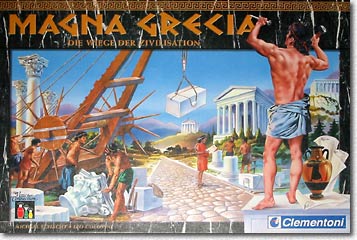
  1. Magna GreciaMagna Grecia

    It’s 2500 B.C. in southern Italy and we are Greek settlers busily trying to develop
    Magna Grecia – the cradle of civilization as the game’s subtitle puts it. In front of
    us lies a map of the area with a number of already established small settlements and our
    task is it to develop these villages to flourishing cities: cities with markets and roads
    to other cities.

    The more road connections a city has to other cities the more trade its markets will
    generate and hence the more valuable the markets are at the end of the game. However,
    only active markets can generate points. To become active, a market must be either in a
    player’s own city or in a city which has a direct road to one of that player’s
    cities. Besides markets cities themselves can generate points at the end of the game if
    they connect to any of the randomly placed oracles on the map.

    Player sequence is determined by twelve cards, each representing a complete round of the
    game. Each card show the players’ turn sequence and the actions which may be
    performed by the players in that round. The principle actions are a) to place road tiles,
    b) to establish or expand cities by placing city tiles and c) to re-supply tiles from
    stock. Each card shows how many tiles of a kind a player may place or take.

    The card system is fair and only “semi random”: all players are three times
    each first, second, third or fourth player in a round and the quantity of tiles available
    is one each of high, medium and low. The cards are arranged in three sets of four with
    each player receiving each turn sequence once per set. The cards are placed face up and
    the card for the current round is handed to the players in sequence. This provides some
    limited possibility for planning ahead as both the quantity of tiles and the players’
    sequence of the next rounds are visible, too.

    Development of Magna Grecia starts at the edge of the board and the road and city system
    develops towards the center of the map. It is obvious that cities located in the center
    of the map will most likely end up with a lot more connections to other cities than those
    at the edge of the map. That’s why players will quickly try to build roads towards
    the center and at the same time they will start to place markets in villages at the
    center of the map hoping that these villages will be come proliferating cities towards
    the end of the game.

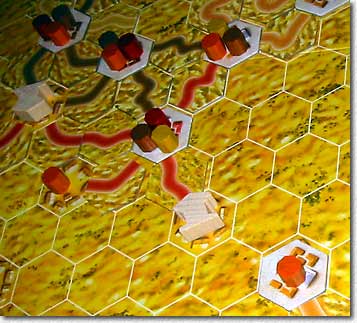
    Magna GreciaThis sounds easier than it is because in order to
    become an active (i.e. point generating) market it must be in the immediate vicinity
    of one’s own city. And in order to establish a city anywhere on the map one must
    build a road to the corresponding village. By mid-game the center of the board
    usually becomes rather crowed and building the required road system to interconnect
    the desired cities becomes increasingly difficult. The more so as there is ample
    possibility of roads being cut off by other players.

    While road building is free players must pay points for establishing or expanding cities
    as well as for placing markets on villages or “foreign” cities. This makes it
    necessary that players “cash in” some of their markets already in mid-game by
    deactivating them (turning them sideways). This immediately generated the market’s
    value in points for the player. Of course players will try to make sure that they only
    cash in those markets that are in cities which will not increase their number of road
    connections.

    Careful consideration is required here as not only may a possible growth in connections
    be overlooked but also does this allow other players to build markets in that city at a
    lower price (the price to be paid for placing a market depends on the city size and the
    number of markets active in a city).

    “Magna Grecia” requires tough strategic and tactical decisions by its players
    and is hardly influenced by random “luck factor”. Starting with the decision to
    either go for a “market focused” or an “oracle focused” strategy up
    to the decisions about which markets to establish and how to develop one’s road
    system makes the game very challenging.

    Interestingly, the final score in our game was very close for the top three scorers
    (within 5 points) and all scores were in the 40’s and lower 50’s on a
    “Kramer track” which ends at 49! My interpretation is that we did not play
    offensive enough to exploit the full scope of the game’s possibilities. Only in
    retrospect did I discover the true depth of the game.

    All of this suggests that “Magna Grecia” is one of the highlights of this
    year’s games. And in fact our score for the game suggest this, too. However, there
    was one low score of 5 (out of 10) and it is mine, the reason of which I want to briefly
    describe:

    Playing “Magna Grecia” involves a lot of counting (road connections, markets,
    city tiles, and distances) in order to determine one’s “best possible
    move”. While I find this acceptable in a two player game I dislike this in
    multi-player games, since it tends to create a lot of idle time for the non-active
    players. It took us 150 minutes to play the twelve rounds – this is 12 minutes per round
    or 9 minutes of idle time for each player per round. However I must admit that we played
    the game not quite to the rules as we accidentally did not place the turn cards face up and
    therefore it was not possible for us to precisely plan ahead for the next round. This
    would have provided the idle players with some food for thought but might also have
    increased the average turn duration of the active player as this additional bit of
    information must be taken into account as well when executing one’s turn.

    View/add comments here

    If idle time doesn’t bother you too much and if you like strategy games based on
    tile placing “Magna Grecia” is definitely to be recommended – not as a family
    game but as a game for serious gamers.

    Westpark Gamers score: 7.0

    Aaron Haag

    01-05-2003

  2. PuebloPueblo

    This relatively recent offering has not created a lot of buzz, which seems understandable
    as it is basically a very abstract “builder” game. But it has some interesting
    twists, which make it worth a second look. And the game material is fun – huge plastic
    blocks that wake the child in us.

    Forget the Native-American theme (which is a nice flavour, but not in any way necessary
    for the game)- this plays like a kind of 3D-boardgame-Tetris (remember the good
    ol’days?).

    A square board is divided into 4 smaller squares, surrounded by a track for the
    “shaman”, who is in fact a fancily named scoring pawn. Another board is purely
    for scoring (slightly confusing, as it uses wild colors, and the direction of the track
    is inside out. Actually it happens easily that you move the pawn in the wrong direction,
    and not all the spaces are numbered, so you might not realize your mistake!).

    Each player owns 4 ½ double blocks of “3D-Tetris blocks” (more with less than
    4 players), one in her/his own color, another in a “neutral” color. Together
    these two build a “pair” which form a perfect cube, and you can only
    “open” a new block after you have finished the old one. This means that you
    have to take turns playing your own and the neutral color.

    The blocks themselves are all the same, each the exact half of a cube. They can be
    placed on the ground of the board, or atop each other. But no “Villa Paletti”
    or “Bausack” shenanigans here, this isn’t a dexterity game! Each placed
    piece has to rest completely on 3 sides, so there can never be any
    “overhanging” parts. This limits the choice of playable spaces somewhat, a
    variety of forms could have made the game more interesting, but also even more intense.
    Even in this simple form one can spend quite a while thinking about the best placement.

    The basic idea of the game is this: Each player first plays a piece, THEN moves the
    shaman 1-4 spaces. The shaman always looks down the row where he is placed after
    movement, towards the middle of the board. Each color he sees is NEGATIVE for the player,
    the higher it is when seen the worse. Seeing a first level color gives 1 negative point,
    2nd level 2, etc.. As the game follows the three dimensional laws of obstruction the
    shaman can only see one color per level, the others will be obstructed.

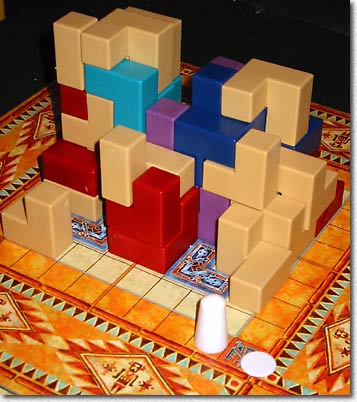
    Pueblo When the shaman ends his move on the exact corner space of the surrounding
    track, he looks at the “pueblo” from ABOVE, but only at one of the 4
    corresponding squares. Now each color space gives 1 negative point for the respective
    player.

    And that’s it -after all players have played all their pieces, the shaman makes his
    final (and most deadly) round – now EACH square of the surrounding track is counted
    (takes quite a while), so the final position of the pieces is of utmost importance.

    It is obvious that this is an advanced game of hide and seek: You want to play your
    color pieces in a way which makes them “invisible” by hiding them behind other
    or neutral pieces – more difficult than it sounds!

    Also the present position of the shaman has to be taken into account – If you place a
    prominent colored piece close to the future spaces of the shaman’s movement, you can
    bet your tipi on the fact that other players will make use of this and give you lots of
    negative points.

    The problem is that this can not always be avoided….

    This is the basic game, easy, but challenging enough. We were of course foolish enough
    to try the “professional” version, which brings two new rules to the game.

    First: now there are “holy” spaces, designated by 1-4 counters, which can
    never be used for building upon. This limits the building option severely, and makes for
    a high rise pueblo with noticeably higher negative scores, as there are fewer
    possibilities to hide.

    Second: Two times in the game, there is bidding (with negative points) for the turn
    order, highest bidder selects first. Usually you want to go earlier, so your pieces have
    a better chance of being built upon and thus being hidden later on.

    I personally like the second option with the bidding, the first option simply heightens
    the hidden luck element in the game – the movement of the shaman! With the limited
    building option you will be forced to take risks with your building, if the other players
    now conspire against you (and they often will!), you will lose many more points than in
    the basic version. Also, the reduced space actually limits your playing possibilities
    severely, so having more options in the basic game is actually the TRUE professional
    version. Strange that the game designer didn’t reflect on that…The corner
    spaces are also now totally unimportant, as this kind of scoring will now be much less
    effective in comparison to the high-rise scoring.

    But our opinions differ on that, Walter preferred the “advanced” version, but
    than he hasn’t played the basic version. I would certainly only play without holy
    spaces but with turn bidding if I ever replay this game.

    All in all this is a very decent offering – The game is abstract without being dry, the
    building element is fun, and the game is easily explained without lacking tactical depth.
    It would also certainly appeal to non-gamers, and family gamers.

    I could have imagined a more interesting game with different building parts, but that
    might have been a cost decision – more forms for the plastic pieces would have cost more.
    Also the game might get old more quickly than other games with replays, I’m pretty
    sure that there is only “one right way” to play, and once you have found that,
    it becomes repetitive.

    View/add comments here

    Decide for yourself and have fun building your very own plastic politically correct
    pueblo!

    Westpark Gamers score: 6.75

    Moritz Eggert

    30-4-2003

Spielbericht vom 24.4.2002

Spielbericht vom 24.4.2002

Autor: Moritz

am Tisch: Andrea, Günther, Hans, Moritz, Peter, Walter, Aaron, Thomas

auf dem Tisch: Kings & Castles, Dschunke, Die sieben Weisen, Bluff

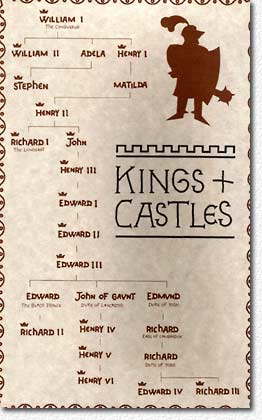
  1. Kings & CastlesKings & Castels

    Zum ersten Mal in Achterbesetzung: Daher die Entscheidung, jeweils parallel 4er-Spiele zu
    spielen. Während die Profi-Crew Günther, Peter, Walter und Aaron sich sofort an die
    obligatorischen deutschen Neuheiten machte, wagten sich die hartgesottenen 4 (Hans,
    Thomas, Andrea und Moritz) an das beständig von Hans gewünschte “Kings and
    Castles”, ein vollkommen unterschätztes und kaum bekanntes neues Spiel der
    Ragnar Brothers (auch
    Erfinder von “History Of The World”). Das Besondere an diesem Spiel: der
    Kampf ist vollkommen abstrakt, d.h. es wird nicht gewürfelt (wie bei “Vinci”). Und: man spielt nicht nur seine
    eigenen, sondern alle anderen Fraktionen, je nachdem was man in jeder Runde aus dem
    Beutel zieht (die Armeen aller Spieler werden hierbei bunt gemischt). Nicht nur von
    der Thematik her erinnert das Spiel an “Britannia”, denn es geht um die Geschichte Englands.
    Jeder Spieler verkörpert in 3 Epochen jeweils 2 englische Könige mit unterschiedlichem
    Herrschaftsgebiet, z.B. Frankreich, Irland, Schottland etc.. In diesem Gebiet kann man
    mit seinen eigenen und fremden Truppen beliebig Gebiete erobern (so denn man genügend
    Truppen hat), zusätzlich in einem anderen Gebiet, allerdings nur mit den Truppen der
    Gegner, oder den schwarzen, neutralen Truppen. Da es wie so oft bei Spielen dieser Art
    um die Punktwertung durch Gebietsbesitz geht (3 mal im Spiel kann man sich entscheiden
    zu werten, dabei zählen die eigenen Besitztümer doppelt, die der anderen Spieler
    einfach), möchte man den anderen Spielern natürlich nicht im eigenen Zug punktstarke
    Felder erobern. Stattdessen probiert man meistens, die einem zur Verfügung stehenden
    fremden Einheiten gegeneinander aufzureiben, oder auch Felder, die man im gleichen Zug
    selber erobern möchte, zu schwächen. Gleichzeitig muss man die fremden Steine aber
    auch loswerden, sonst zieht man in der nächsten Runde weniger Einheiten auf.

    Jede Runde ist man also vor einem kleinen Dilemma, das manchmal wie eine Rätselaufgabe
    scheint (“wenn ich mit diesen Einheiten das Feld erobere, erobere ich gleich danach
    mit den anderen Einheiten dasselbe Feld noch mal, woraufhin ich dann wiederum mit den
    eigenen Einheiten….”). Am Ende entscheidet aber weniger das Glück beim Ziehen
    (erstaunlicherweise) sondern eine komplexe Gruppendynamik, wer aufs Siegertreppchen
    kommt.

    In diesem Spiel dominierte Hans von Anfang an durch eine brilliante Anfangskombination,
    ganz zum Schluss konnte aber Andrea ihn noch um ein paar Punkte überholen. Thomas meinte
    nur: Das müssen wir noch mal spielen! Und sprach damit der Gruppe aus der Seele (was auch
    die gestiegene Punktwertung dieses Spiels erklärt).

    Strategie-Tipps zum Spiel gibt’s hier.

    Westpark-Wertung: 7.5

  2. Bluff

    Am Schluss gab es noch mit den 6 Verbliebenen eine obligatorische Runde
    “Bluff”. Aaron und Walter kamen wie meistens in die Endrunde, am Ende konnte
    aber ausnahmsweise mal Moritz seine Siegesstatistik durch einen wertvollen “6er
    Sieg” aufstocken. Daher sind dies nun die “besten” Bluff-Spieler im
    Moment: 1) Arpad (von den Spuiratzn) 2) Thomas (von den Westpark-Gamers) 3) Moritz

    Westpark-Wertung: 7.73

Spielbericht und Review vom 23.04.2003

Spielbericht und Review vom 23.04.2003

Autor: Walter, Moritz

am Tisch: Andrea, Hans, Aaron, Peter, Walter, Moritz

auf dem Tisch: The Roaring 20’s, Das Tal der Mammuts

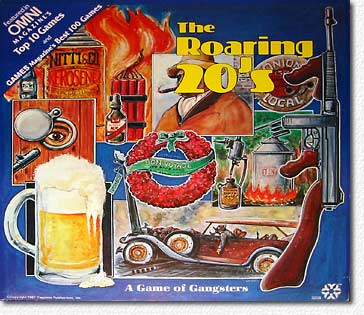
  1. The Roaring 20’s

    The Roaring 20's
    Moritz packte mal wieder eine Neuerwerbung aus, und mit der ihn auszeichnenden Genialität
    ging er daran, uns die englischen Spielregeln aus dem Stegreif heraus in verständliches
    Deutsch zu übersetzen. Bei den üblichen WPG-Rückfragen zu Regel-Details musste er leider
    immer passen, da er sich erst selbst durch die Beschreibungen hindurchkämpfen musste, und
    die Antworten selbst noch gar nicht kannte. Nach 20 Minuten waren wir durch die vier
    Druckseiten Regelwerk hindurchgekommen und hatten eine vage Vorstellung davon, was uns
    jetzt erwartete.

    In einer amerikanischen Großstadtszenerie (aus welchem Jahrzehnt auch immer) wird die
    ungebrochene Dominanz der Verbrechersyndikate nachgespielt: alle Mitspieler sind
    Gangster; jeder muss seine Beute, ausgedrückt als Geldsumme, vom Ort seines Verbrechens
    bis zu seinem Unterschlupf transportieren. Jeder zieht zufällig eine Karte, auf dem die
    Lage seines Unterschlupfes vorgegeben ist. Das ist der Zielort. Jeder zieht zufällig drei
    weitere Karten, auf denen die möglichen Positionen seines Verbrechens eingetragen sind.
    Eine davon darf er als Startposition für seinen Auftrag auswählen. Natürlich sollte er
    diejenige auswählen, die am günstigsten zu seinem Ziel liegt. Für den Transport der Beute
    bekommt jeder ein Fahrzeug, mit dem er sich für alle sichtbar auf den Straßen des
    Stadtplans vorwärts bewegt. Maximal zehn Felder pro Zug.

    Reihum abwechselnd spielt jeweils einer der Mitspieler den Polizeikommissar und ist
    damit Chef über eine Flotte von zehn Polizeieinsatzfahrzeugen, mit denen er die Gangster
    am Einfahren der Beute hindern soll. Jedes Polizeifahrzeug darf sich pro Zug um acht
    Felder bewegen. Die Gangster bekommen also in bezug auf die Reichweite ihrer Fahrzeuge
    einen kleinen Vorteil, dafür liegt der Vorteil in bezug auf Masse klar auf Seiten der
    Polizei.
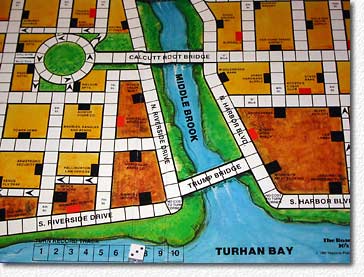
    The Roaring 20's Allerdings ist ein einzelnes Polizeifahrzeug
    noch kein Hindernis für einen Kriminellen, er kann ohne jegliche Einschränkung daran
    vorbeifahren. Erst zwei Polizeiautos, auf einem einzigen Feld übereinander
    gestapelt, bilden eine Sperre, die nicht passiert werden darf. Um einen Gangster
    aber ganz unschädlich zu machen, bedarf es schon vier Polizeifahrzeuge, die bis in
    unmittelbare Nähe des Betroffenen vorrücken müssen. Da tut sich ein Gesetzeshüter
    schon schwer, alle Verbrecher zur Strecke zu bringen. Kurz gesagt, durchschnittlich
    drei Viertel der Kriminellen können ihre Beute ungehindert nach Hause bringen.

    Wen es aber erwischen soll, das hängt zum einen von der Ausgangslage ab, die war ja mehr
    oder weniger zufällig über das Stadtgebiet plaziert ist, zum anderen aber auch von den
    persönlichen Beziehungen zur Polizei: diese ist nämlich bestechlich. Vor jeder Runde kann
    jeder Gangster einen Betrag spendieren, mit dem er sich das Wohlwollen des Gendarmen
    erkaufen kann. Damit kann sich der Wachtmeister darüber hinwegtrösten, dass er in dieser
    Runde mittels Verbrechen keinen Gewinn erzielen kann. Leben und leben lassen. Eine
    Garatie für Straffreiheit ist die Bestechung aber nicht. Soweit klingt alles gut und das
    Spiel scheint vernünftig. Überdurchschnittliche Bewertung.

    Jetzt aber kommt der Knackpunkt.

    Die Fahrstrecke, die ein jeder Gangster vom Tatort bis zu seinem Unterschlupf
    zurücklegen muss, ist von der Länge und von der Stadtlage rein zufällig. Wenn man die
    richtigen Karten gezogen hat, muss man gerade mal drei Felder weiter ziehen und ist nach
    seinem ersten Zug bereits zuhause. Wenn man Pech hat, muss man quer durch die Stadt
    fahren, und hat evtl. keine Chance gegen zehn Polizeifahrzeuge. Die Beute, die ein jeder
    als Siegesprämie einsteckt, ist auch zufällig. Wer Glück hat, bekommt für seine
    unbehinderte 3-Felder-Fahrt 25.000 Dollar, wer Pech hat, kämpft um den zehnten Teil
    dieser Summe gegen den gesamten Polizeiapparat in der Innenstadt. Was hat sich der Autor
    bei diesem Prinzip gedacht?

    Damit das ganze aber nicht so offensichtlich unlogisch über die Bühne geht, hat jeder
    Spieler noch zwei Ereigniskarten, mit denen er das Ergebnis der Beutezüge beeinflussen
    kann. Z.B. kann er kostenlos aus dem Gefängnis freikommen, falls ihn die Polizei erwischt
    haben sollte. Dies ist mindestens 1.000 Dollar wert, aber nur, wenn man im Gefängnis
    gelandet ist. Oder er darf ein Polizeiauto aus dem Weg räumen. Das kann etwas wert sein,
    wenn einem die Polizei dicht auf den Fersen ist. Für die Mehrheit der erfolgreichen
    Verbrecher bringt diese Karte aber nichts. Nach einer Super-Karte aber kassiert man am
    Ende der Runde die Beute eines Mitspielers, die dieser gerade sicher nach Hause gebracht
    hat. Das kann dann schon 25.000 Dollar wert sein. Und den überraschten Mitspieler kostet
    es auch nochmal 25.000 Dollar, macht insgesamt 50.000 Dollar Unterschied, oder? Das ist
    ca. zehn Prozent der insgesamt zur Verfügung stehenden Geldsumme oder die Gesamtausbeute
    von sieben Runden biederer Kriminalität!

    Macht es Sinn, einem mitspielenden Gangster, der sich vielleicht durch ein geschicktes
    Täuschungsmanöver erfolgreich zu seinem Unterschlupf durchgekämpft hat, die verdiente
    Beute abnehmen zu dürfen, nur weil man zufällig die richtige Ereigniskarte auf der Hand
    hat? Und weil der Gegenspieler nicht zufällig eine Karte gezogen hat, mit der er dieses
    Hijacking abwehren kann? Ist das nicht ziemlich frustrierend für einen von beiden? Meint
    der Spieleautor wirklich, dass allein unberechenbares Chaos eine gute Spielidee abgibt?

    Hier geht es um die prinzipielle Frage, warum wir spielen und welches für jeden
    Mitspieler der Erwartungshorizont eines Spielabends ist. Ich sehe das unverzichtbar so:

    Wenn ich ein kluges Spiel spiele, dann möchte ich für mich Vorteile sehen, wenn ich
    klüger bin als die anderen. Bei einem Gedächtnisspiel möchte ich aus meinem Gedächtnis
    Kapital schlagen, bei einem Verhandlungsspiel aus meinem Diplomatiegeschick, bei einem
    reinen Glücksspiel aus Fortunas Begünstigung und bei einem Kampfspiel aus meiner
    Kampferfahrung, aus meinem Löwenmut oder aus meiner Fähigkeit zu taktischem Jammern. Wann
    immer ich mich auf ein Spiel einlasse, möchte ich von vorneherein taxieren können, ob und
    welche Spielereigenschaften jetzt gefragt sind.

    Was bietet diesbezüglich “The Roaring 20’s”? Ungerechtigkeit in der
    Schwierigkeit der gestellten Aufgabe, Unlogik beim jeweilige erzielbaren Erlös, Willkür
    in der staatlichen Verbrechensbekämpfung, Unberechenbarkeit bei den asynchronen
    Einflußmöglichkeiten der Mitspieler. Was lernen wir denn aus diesem Spiel? Die Welt ist
    bösartig und korrupt, Verbrechen zahlen sich in der Regel aus, Planung und Geschick
    zeitigen keinerlei Früchte und die Polizei ist immer auf der Seite der größeren
    Dollarbeträge.

    Weil wir im Formum der
    WPG
    nun mal gerade dieses Thema diskutieren: Dieses Spiel ist in höchstem Grade
    “politically incorrect”. Auch weil der Autor in der begleitenden Beschreibung
    zur jeweiligen Aufgabenstellung bedenkenlos zu jeglicher Art von Einbruch- und
    Diebstahls-Deliken vorgibt und zynisch dazu auffordert, dabei das Wachpersonal umzulegen
    oder die Konkurrenten aufzuhängen.

    View/add comments here

    Nach anderthalb Runden Spiel verloren wir die Lust und brachen ohne Einspruch eines
    einzigen Spielers ab. Nur Moritz bedauerte, dass seine Neuerwerbung keinen Blumentopf
    gewinnen konnte.

    Die Westpark-Gamers vergaben die mäßige Wertungsnote von 2,5.

    Walter Sorger, 25.4.2003

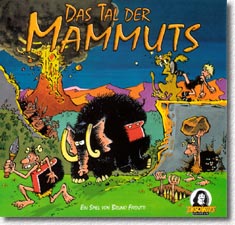
  2. Dominating the Das Tal der
    Mammuts
    “ (“Valley of the Mammoths”)

    Valley of the Mammoths Some tips for winning strategies

    Of course “Tal der Mammuts” is not a clear-cut strategy game. Luck plays a
    huge factor in being successful in building a huge and prosperous tribe. Many an event
    card can ruin your best laid plans. But because there are some wargame elements in this
    game (very light ones, by the way), some tested strategies which work in games of this
    kind will better your chances in surviving the stone-age battle. And if you are already
    dependent on luck, why not better your chances by playing well?

    1) Choosing your starting space

    This might well decide if you win or lose, so it is a decision you should not make
    lightly. Many factors have to be taken into account. Of course it is preferable to be as
    far away of other players as possible (but see “my best friend is my
    neighbour” below), so spaces close to the rim of the board are more interesting
    than central ones, where everybody will be your enemy. You should always choose a plain
    hex as a starting space, chances are good it will see a crop if you use the initial
    planting rule. Later in the game it will be much more difficult to see your crop grow,
    actually I’ve yet to see a game with many high-yielding crops, it just
    doesn’t happen. Food is MOST IMPORTANT (see below), so use the chance.The actual
    rim spaces are not good, this is were animals will appear, and they WILL appear. With 4
    animals drawn each round (and many more through event cards) it is nearly certain that at
    some point they will appear in your rim village and trample your crop. On the other hand
    you want to be close to the animals, so you can hunt them. So I would suggest a space
    which is close to the rim, but not directly at the rim. If you play with the
    (recommended) fire rule, you might want to be close to the volcano as well (but not
    necessarily directly next to it). Being close to a river is a two-edged sword –
    your village should not be far away from river spaces, so you can send your people
    foraging, but being next to the river has a 33.3% chance that your village will be
    destroyed at some point in the game. But at some point a village of yours will be
    destroyed by SOMETHING anyway, it might as well be this one- after you milked it of
    it’s benefits.

    If you take all these factors in account, there will be VERY FEW spaces that are
    interesting on the board. If you can, take one of them, most likely they will be taken
    already.

    If you have to place a village close to another player, make sure that your direct
    neighbour is a good friend (this game has many “Diplomacy” elements). Be good
    to your neighbour, never attack him (only if it is necessary for YOUR victory, at the end
    of the game). You might even consider leaving him the one or other space you desire for
    harvest or hunting. But see below…..

    2) “My best friend is my neighbour”
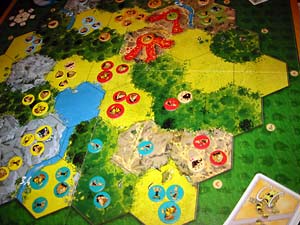
    Valley of the Mammoths Oh yes, your neighbour is your best ally. Be soooo
    good to him. He wants the space closer to the center of the board? Well, let him
    have it! It simply means that your enemies will have to attack his units first
    before they get to you! Your neighbour is your “wonder wall” who
    protects your crop and your villages. You might lose a man or two to starvation
    because you leave him the better spaces. Look vulnerable, just not too much. Wait
    for the right moment. Attack your former friend when he is the most exposed.
    Isn’t this game mean?

    But seriously, the real reason for being friendly to your neighbour is that waging a war
    early on in the game can mean certain defeat. I have often seen grudge battles fought
    with masses of warriors (nyah, nyah, you abducted my lonely woman, nyah, nyah, so I know
    eradicate your village). Very often these battles will be fought against bad odds,
    thereby risking extinction of your tribe. You have so little units, so little resources,
    that any war which doesn’t possibly bring you INSTANT victory is silly. A skirmish
    here and there (see “food”) doesn’t hurt, but don’t overdo it. Be
    weaker than the leader, but stay much stronger than the weakest, and you will fare well
    for your “ end move” (again, see below)

    3) The scourge of the event cards

    “Das Tal der Mammuts” has horribly devastating event cards. There are so
    many ways to kill units, drown them, raze them by fire, bury them under stones, that
    there simply is no way to avoid them. You WILL suffer, one way or the other. But if your
    micromanagement of cards and manpower is ok, your chances of survival will rise.

    Some basic things to ponder about:

    1. Keep those strong combat cards. The various booster cards for combat are the most
      valuable cards in the game. Keep them for the moments when the going gets tough – if you
      have one or two for the endgame, even better! Don’t waste them on skirmishes or
      grudge combats!
    2. USE the cards that devastate your enemies, they will do the same to you. But leave
      your CLOSE neighbour(s) alone!
    3. The “canoe” card that lets you cross rivers is better used as a defense
      against the flood, if you have an exposed village. Many other cards have defensive and
      offensive qualities, the defensive are the ones to look out for!

    4) Gang up on the animals… or don’t…

    Sometimes it looks wise to have as many warriors as possible attack that mammoth, while
    leaving the bear grazing next to it in peace.

    If there is no other animal around, the gang tactic is of course good, but if you can
    reach more animals in one turn, it is actually wiser to distribute your attacks to raise
    your chances. The combat system is unforgiving, and even a big majority can lose a fight
    if the dice roll the wrong way. Why not try your luck?

    Distributing is good – see it that way: If you lose one of these battles, you only
    lose one or two warriors – AND YOU HAVE TWO MOUTHS LESS TO FEED. You might even
    risk them on purpose – if they are successful they have “earned their meal”,
    and the whole tribe will profit, if not, these weak and feeble warriors will not endanger
    your food resources anymore. This truly is “survival of the fittest”!

    5) Food – the overlooked problem

    The game is most realistic in one point – winter is unforgiving and hard. Most
    players, especially in games with larger groups of people, underestimate the scarcity of
    food in winter. Having your people die of starvation is never elegant – these are
    wasted opportunities. They better had killed something before (or given birth, which is
    much, much more important than killing things – this is a moral game after all!).

    It is possible to calculate roughly how much food you will probably get, so you can
    pretty much calculate how many of your tribe might die. If you begin the winter with only
    4 food you’re in for many, many deaths. Better have them attack a strategic hex
    before they die anyway, don’t you think? You might even launch a stupid attack that
    will most probably fail miserably on purpose. It makes you look weaker for the moment,
    and you get rid of these hungry mouths. And if you DO suceed – even better! Just
    don’t overdo it – you want to have a considerable portion of your tribe
    survive for the next summer round. The earlier you send your warriors on suicide missions
    the better, they save more lives if they die early in the season, as strange as that
    sounds.

    6) The end move

    This game never lasts too long – I guess an average playing time is two years
    (game time, not REAL time, in case the casual reader wonders). When players have 2
    villages and enough people the end move can happen any turn, and will happen. The player
    who is strong but vulnerable WILL be attacked at this point, and might have to forfeit a
    victory after such an attack. As in many games that mix “economics” and war,
    neither being the most aggressive attacker nor being the most busy defender will be good
    for winning the game.

    Set up your final move carefully – Try to be behind in villages so you don’t
    have to move first and then suffer the consequences with all sorts of nasty cards and
    moves played against you. If possible an ideal end move could look like this: You have 2
    villages that are well defended, because they are in reach of other players. Sneakily you
    move two “couples” (perhaps a “gay” couple among them, even
    sneakier!) in far away places in which nobody would usually build villages, like volcano
    spaces or rim spaces. It is important that other players can NOT reach these spaces in
    one move. They might be on to you immediately, but now all they can do is attack your
    well defended cities (for which you have hoarded combat cards, hehe) in the next round,
    if you survive, you’ll win!. If they get TWO moves against you, the far away
    villages will not have much hope, but if you moved last or second to last in the round
    BEFORE the final round this won’t happen. If your neighbour still loves you, s/he
    might actually be in the way of the attackers as well, but this is rare, because then
    s/he can also attack YOU!

    View/add comments here

    Nothing is certain in the “Valley of the Mammoths”, and especially not
    victory, but following these guidelines will certainly better your chances the next time
    you step into this cursed but strangely endearing valley.

    And don’t ask me about the best strategy to get “the fire” if
    you’re not close to the volcano – there isn’t one!

    Have fun!

    Moritz Eggert, 26.4.2003
Spielbericht und Review vom 23.04.2003

Spielbericht und Review vom 23.04.2003

Autor: Walter, Moritz

am Tisch: Andrea, Hans, Aaron, Peter, Walter, Moritz

auf dem Tisch: The Roaring 20’s, Das Tal der Mammuts

  1. The Roaring 20’s

    The Roaring 20's Once again Moritz unwrapped a new
    acquisition, and with his own special talent he began to translate the rules of the
    game from English into understandable German off the cuff. Unfortunately he did not
    know the answers to the usual detailed WPG questions about the rules and had himself
    to struggle through the description. After 20 minutes we had all made our way
    through the four printed pages of rules and had a vague notion of what was in store
    for us.

    The game is set in an American city – the decade is of no great consequence – where crime
    syndicates are in full control. All the players are crime bosses; each one must transport
    his loot, expressed as a sum of money, from the scene of the crime to his own hideout.
    Each player draws a card at random, which gives the site of his hideout: this is his
    destination. Each one draws three more cards, which give the possible locations for his
    crime. He can choose which one of these is the starting point for his assignment. He
    should of course choose the one most convenient for his destination.

    Each player has a car to transport the haul: he can drive this across the map of the
    city in full view of all the others, with a maximum of ten squares per move.

    Each player in turn takes over the role of Police Chief and is thus in charge of a fleet
    of ten police cars with which he should prevent the mobsters from bringing home their
    loot. Each police car can move up to eight squares in one turn. The mobsters thus have a
    small advantage regarding how far their vehicles can travel, whereas the police clearly
    have the weight of numbers on their side.

    The Roaring 20'sAdmittedly one police car alone does not pose
    a problem to a criminal: he can drive past it without any restrictions. It takes two
    police cars, piled up together on one single square, to create a barrier which can
    not be passed. To put a mobster completely out of action requires as many as four
    police cars which have to be moved to the area immediately surrounding their target.
    The law enforcers thus have a very hard time in putting all the criminals out of
    action. In short, three quarters of the mobsters will on average be able to bring
    home the loot without problems.

    But which ones are going to get caught? That depends on the one hand on the starting
    positions, which are scattered across the area of the city more or less at random, but on
    the other hand also on the personal relationships with the police, who are not above
    taking bribes. Before each round, each crime boss can donate an amount with which he can
    obtain the goodwill of the police force. This provides the Police Chief with some
    consolation for the fact that he will not be making a profit from crime in this round –
    live and let live. This bribery does not however provide a guarantee of freedom from
    punishment.

    So far, so good: it sounds like a reasonable game, worth a rating above average.

    But we now come to the decisive point.

    The journey, which each mobster must drive from the location of the crime to his hideout,
    is completely random, in terms both of length and of the circumstances in the city.
    Someone who has drawn the right cards needs only to move along three squares and has
    reached home on his first move. Someone who is less fortunate must drive right across the
    city and has quite possibly no chance against ten police cars. The reward earned for
    success, that is, the value of the spoils, is also random. With good luck an untroubled
    3-square journey can bring in 25,000 dollars; but with bad luck a player must struggle
    against the entire police force of the city for the sake of a sum only one tenth as big.
    What was the author thinking of when he dreamed up this principle?

    In order to cover up to some extent the lack of logic in these developments, each player
    also has two event cards, with which he can influence the result of the plundering. For
    example, you can get out of jail for free, should you have been caught by the police.
    This is worth at least 1000 dollars, but only if you have landed in jail. Or you can
    clear a police car out of your way. This is worth something, should the police be hot on
    your heels, but the card is worthless for the majority of successful criminals. However,
    with the aid of a super-card at the end of the round you can carry off from an opponent
    his complete booty which he has just brought home safely. This can be worth as much as
    25,000 dollars. This means the rival who has been taken by surprise also loses 25,000
    dollars, making a net difference of 50,000 dollars. This is around ten percent of the
    total amount of money in circulation, or the entire proceeds from seven rounds of average
    criminal activity!

    Does it make sense to be able to take a hard-earned prize away form a competing crime
    boss – a haul which perhaps he has successfully brought home by means of clever deceptive
    tactics – just because one happens to hold the right event card? And also because the
    opponent has not happened to draw a card with which he can ward off this hijack?
    Isn’t this completely frustrating for one of the two of them? Does the author of the
    game really think that unpredictable chaos can on its own generate a good basis for a
    game?

    These are questions of principle: what are the reasons for playing and what expectations
    does each player have when he sits down for an evening of games? I have my own decided
    point of view on this, which goes as follows:

    If I am playing a game of intelligence, then, should I act more intelligently than the
    others, I want to see an advantage. In a memory game I want to be able to make capital
    out of my powers of memory, in a game of negotiations out of my diplomatic skills, in a
    game of pure luck out of the favour of fortune, and in a game of combat out of my
    experience in battle, my lion-hearted bravery or my aptitude for tactical lamentation.
    Whenever I decide to play a game, I want before I start to be able to assess which of my
    qualities as a player are going to be in demand.

    What does “The Roaring 20’s” have to offer in this respect? Unfairness in
    the difficulty of the task to be accomplished, a lack of logic in the respective prizes
    to be won, randomness in the fight against crime on behalf of the authorities,
    unpredictability in the asynchronous way one’s competitors can have an effect. What
    does the game teach us? That the world is malicious and corrupt, that crime usually does
    pay, that neither planning nor skill are rewarded, and that the police are always on the
    side of those who have the most dollars.

    As we now happen to be discussing this subject in the forum of the
    WPG: this game is “politically incorrect” in the extreme – this is also
    apparent in the accompanying description of the various assignments to be undertaken, in
    the way the author without any scruples suggests all kinds of crimes of burglary and
    theft, and cynically encourages bumping off security guards or stringing up one’s
    rivals.

    View/add comments here

    After one and a half rounds of play we had had enough and called it a day without a
    single objection. Only Moritz had regrets: he would not be winning any prizes with his
    new acquisition.

    The rating awarded by the Westpark-Gamers was a mediocre 2.5.

    Walter Sorger, 25.4.2003 (translated by Mike Eggleton)

  2. Dominating the Das Tal der
    Mammuts
    “ (“Valley of the Mammoths”)

    Valley of the Mammoths Some tips for winning strategies

    Of course “Tal der Mammuts” is not a clear-cut strategy game. Luck plays a
    huge factor in being successful in building a huge and prosperous tribe. Many an event
    card can ruin your best laid plans. But because there are some wargame elements in this
    game (very light ones, by the way), some tested strategies which work in games of this
    kind will better your chances in surviving the stone-age battle. And if you are already
    dependent on luck, why not better your chances by playing well?

    1) Choosing your starting space

    This might well decide if you win or lose, so it is a decision you should not make
    lightly. Many factors have to be taken into account. Of course it is preferable to be as
    far away of other players as possible (but see “my best friend is my
    neighbour” below), so spaces close to the rim of the board are more interesting
    than central ones, where everybody will be your enemy. You should always choose a plain
    hex as a starting space, chances are good it will see a crop if you use the initial
    planting rule. Later in the game it will be much more difficult to see your crop grow,
    actually I’ve yet to see a game with many high-yielding crops, it just
    doesn’t happen. Food is MOST IMPORTANT (see below), so use the chance.The actual
    rim spaces are not good, this is were animals will appear, and they WILL appear. With 4
    animals drawn each round (and many more through event cards) it is nearly certain that at
    some point they will appear in your rim village and trample your crop. On the other hand
    you want to be close to the animals, so you can hunt them. So I would suggest a space
    which is close to the rim, but not directly at the rim. If you play with the
    (recommended) fire rule, you might want to be close to the volcano as well (but not
    necessarily directly next to it). Being close to a river is a two-edged sword –
    your village should not be far away from river spaces, so you can send your people
    foraging, but being next to the river has a 33.3% chance that your village will be
    destroyed at some point in the game. But at some point a village of yours will be
    destroyed by SOMETHING anyway, it might as well be this one- after you milked it of
    it’s benefits.

    If you take all these factors in account, there will be VERY FEW spaces that are
    interesting on the board. If you can, take one of them, most likely they will be taken
    already.

    If you have to place a village close to another player, make sure that your direct
    neighbour is a good friend (this game has many “Diplomacy” elements). Be good
    to your neighbour, never attack him (only if it is necessary for YOUR victory, at the end
    of the game). You might even consider leaving him the one or other space you desire for
    harvest or hunting. But see below…..

    2) “My best friend is my neighbour”

    Valley of the Mammoths Oh yes, your neighbour is your best ally. Be soooo
    good to him. He wants the space closer to the center of the board? Well, let him
    have it! It simply means that your enemies will have to attack his units first
    before they get to you! Your neighbour is your “wonder wall” who
    protects your crop and your villages. You might lose a man or two to starvation
    because you leave him the better spaces. Look vulnerable, just not too much. Wait
    for the right moment. Attack your former friend when he is the most exposed.
    Isn’t this game mean?

    But seriously, the real reason for being friendly to your neighbour is that waging a war
    early on in the game can mean certain defeat. I have often seen grudge battles fought
    with masses of warriors (nyah, nyah, you abducted my lonely woman, nyah, nyah, so I know
    eradicate your village). Very often these battles will be fought against bad odds,
    thereby risking extinction of your tribe. You have so little units, so little resources,
    that any war which doesn’t possibly bring you INSTANT victory is silly. A skirmish
    here and there (see “food”) doesn’t hurt, but don’t overdo it. Be
    weaker than the leader, but stay much stronger than the weakest, and you will fare well
    for your “ end move” (again, see below)

    3) The scourge of the event cards

    “Das Tal der Mammuts” has horribly devastating event cards. There are so
    many ways to kill units, drown them, raze them by fire, bury them under stones, that
    there simply is no way to avoid them. You WILL suffer, one way or the other. But if your
    micromanagement of cards and manpower is ok, your chances of survival will rise.

    Some basic things to ponder about:

    1. Keep those strong combat cards. The various booster cards for combat are the most
      valuable cards in the game. Keep them for the moments when the going gets tough – if you
      have one or two for the endgame, even better! Don’t waste them on skirmishes or
      grudge combats!
    2. USE the cards that devastate your enemies, they will do the same to you. But leave
      your CLOSE neighbour(s) alone!
    3. The “canoe” card that lets you cross rivers is better used as a defense
      against the flood, if you have an exposed village. Many other cards have defensive and
      offensive qualities, the defensive are the ones to look out for!

    4) Gang up on the animals… or don’t…

    Sometimes it looks wise to have as many warriors as possible attack that mammoth, while
    leaving the bear grazing next to it in peace.

    If there is no other animal around, the gang tactic is of course good, but if you can
    reach more animals in one turn, it is actually wiser to distribute your attacks to raise
    your chances. The combat system is unforgiving, and even a big majority can lose a fight
    if the dice roll the wrong way. Why not try your luck?

    Distributing is good – see it that way: If you lose one of these battles, you only
    lose one or two warriors – AND YOU HAVE TWO MOUTHS LESS TO FEED. You might even
    risk them on purpose – if they are successful they have “earned their meal”,
    and the whole tribe will profit, if not, these weak and feeble warriors will not endanger
    your food resources anymore. This truly is “survival of the fittest”!

    5) Food – the overlooked problem

    The game is most realistic in one point – winter is unforgiving and hard. Most
    players, especially in games with larger groups of people, underestimate the scarcity of
    food in winter. Having your people die of starvation is never elegant – these are
    wasted opportunities. They better had killed something before (or given birth, which is
    much, much more important than killing things – this is a moral game after all!).

    It is possible to calculate roughly how much food you will probably get, so you can
    pretty much calculate how many of your tribe might die. If you begin the winter with only
    4 food you’re in for many, many deaths. Better have them attack a strategic hex
    before they die anyway, don’t you think? You might even launch a stupid attack that
    will most probably fail miserably on purpose. It makes you look weaker for the moment,
    and you get rid of these hungry mouths. And if you DO suceed – even better! Just
    don’t overdo it – you want to have a considerable portion of your tribe
    survive for the next summer round. The earlier you send your warriors on suicide missions
    the better, they save more lives if they die early in the season, as strange as that
    sounds.

    6) The end move

    This game never lasts too long – I guess an average playing time is two years
    (game time, not REAL time, in case the casual reader wonders). When players have 2
    villages and enough people the end move can happen any turn, and will happen. The player
    who is strong but vulnerable WILL be attacked at this point, and might have to forfeit a
    victory after such an attack. As in many games that mix “economics” and war,
    neither being the most aggressive attacker nor being the most busy defender will be good
    for winning the game.

    Set up your final move carefully – Try to be behind in villages so you don’t
    have to move first and then suffer the consequences with all sorts of nasty cards and
    moves played against you. If possible an ideal end move could look like this: You have 2
    villages that are well defended, because they are in reach of other players. Sneakily you
    move two “couples” (perhaps a “gay” couple among them, even
    sneakier!) in far away places in which nobody would usually build villages, like volcano
    spaces or rim spaces. It is important that other players can NOT reach these spaces in
    one move. They might be on to you immediately, but now all they can do is attack your
    well defended cities (for which you have hoarded combat cards, hehe) in the next round,
    if you survive, you’ll win!. If they get TWO moves against you, the far away
    villages will not have much hope, but if you moved last or second to last in the round
    BEFORE the final round this won’t happen. If your neighbour still loves you, s/he
    might actually be in the way of the attackers as well, but this is rare, because then
    s/he can also attack YOU!

    View/add comments here

    Nothing is certain in the “Valley of the Mammoths”, and especially not
    victory, but following these guidelines will certainly better your chances the next time
    you step into this cursed but strangely endearing valley.

    And don’t ask me about the best strategy to get “the fire” if
    you’re not close to the volcano – there isn’t one!

    Have fun!

    Moritz Eggert, 26.4.2003
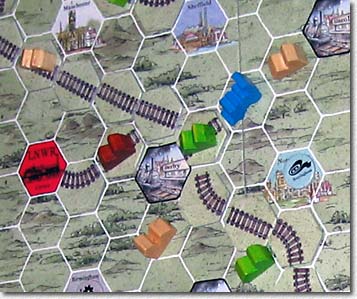
Spielbericht und Review vom 23.04.2003

Spielbericht und Review vom 23.04.2003

Autor: Walter, Moritz

am Tisch: Andrea, Hans, Aaron, Peter, Walter, Moritz

auf dem Tisch: The Roaring 20’s, Das Tal der Mammuts

  1. The Roaring 20’s

    The Roaring 20's
    Moritz packte mal wieder eine Neuerwerbung aus, und mit der ihn auszeichnenden Genialität
    ging er daran, uns die englischen Spielregeln aus dem Stegreif heraus in verständliches
    Deutsch zu übersetzen. Bei den üblichen WPG-Rückfragen zu Regel-Details musste er leider
    immer passen, da er sich erst selbst durch die Beschreibungen hindurchkämpfen musste, und
    die Antworten selbst noch gar nicht kannte. Nach 20 Minuten waren wir durch die vier
    Druckseiten Regelwerk hindurchgekommen und hatten eine vage Vorstellung davon, was uns
    jetzt erwartete.

    In einer amerikanischen Großstadtszenerie (aus welchem Jahrzehnt auch immer) wird die
    ungebrochene Dominanz der Verbrechersyndikate nachgespielt: alle Mitspieler sind
    Gangster; jeder muss seine Beute, ausgedrückt als Geldsumme, vom Ort seines Verbrechens
    bis zu seinem Unterschlupf transportieren. Jeder zieht zufällig eine Karte, auf dem die
    Lage seines Unterschlupfes vorgegeben ist. Das ist der Zielort. Jeder zieht zufällig drei
    weitere Karten, auf denen die möglichen Positionen seines Verbrechens eingetragen sind.
    Eine davon darf er als Startposition für seinen Auftrag auswählen. Natürlich sollte er
    diejenige auswählen, die am günstigsten zu seinem Ziel liegt. Für den Transport der Beute
    bekommt jeder ein Fahrzeug, mit dem er sich für alle sichtbar auf den Straßen des
    Stadtplans vorwärts bewegt. Maximal zehn Felder pro Zug.

    Reihum abwechselnd spielt jeweils einer der Mitspieler den Polizeikommissar und ist
    damit Chef über eine Flotte von zehn Polizeieinsatzfahrzeugen, mit denen er die Gangster
    am Einfahren der Beute hindern soll. Jedes Polizeifahrzeug darf sich pro Zug um acht
    Felder bewegen. Die Gangster bekommen also in bezug auf die Reichweite ihrer Fahrzeuge
    einen kleinen Vorteil, dafür liegt der Vorteil in bezug auf Masse klar auf Seiten der
    Polizei.

    The Roaring 20's Allerdings ist ein einzelnes Polizeifahrzeug
    noch kein Hindernis für einen Kriminellen, er kann ohne jegliche Einschränkung daran
    vorbeifahren. Erst zwei Polizeiautos, auf einem einzigen Feld übereinander
    gestapelt, bilden eine Sperre, die nicht passiert werden darf. Um einen Gangster
    aber ganz unschädlich zu machen, bedarf es schon vier Polizeifahrzeuge, die bis in
    unmittelbare Nähe des Betroffenen vorrücken müssen. Da tut sich ein Gesetzeshüter
    schon schwer, alle Verbrecher zur Strecke zu bringen. Kurz gesagt, durchschnittlich
    drei Viertel der Kriminellen können ihre Beute ungehindert nach Hause bringen.

    Wen es aber erwischen soll, das hängt zum einen von der Ausgangslage ab, die war ja mehr
    oder weniger zufällig über das Stadtgebiet plaziert ist, zum anderen aber auch von den
    persönlichen Beziehungen zur Polizei: diese ist nämlich bestechlich. Vor jeder Runde kann
    jeder Gangster einen Betrag spendieren, mit dem er sich das Wohlwollen des Gendarmen
    erkaufen kann. Damit kann sich der Wachtmeister darüber hinwegtrösten, dass er in dieser
    Runde mittels Verbrechen keinen Gewinn erzielen kann. Leben und leben lassen. Eine
    Garatie für Straffreiheit ist die Bestechung aber nicht. Soweit klingt alles gut und das
    Spiel scheint vernünftig. Überdurchschnittliche Bewertung.

    Jetzt aber kommt der Knackpunkt.

    Die Fahrstrecke, die ein jeder Gangster vom Tatort bis zu seinem Unterschlupf
    zurücklegen muss, ist von der Länge und von der Stadtlage rein zufällig. Wenn man die
    richtigen Karten gezogen hat, muss man gerade mal drei Felder weiter ziehen und ist nach
    seinem ersten Zug bereits zuhause. Wenn man Pech hat, muss man quer durch die Stadt
    fahren, und hat evtl. keine Chance gegen zehn Polizeifahrzeuge. Die Beute, die ein jeder
    als Siegesprämie einsteckt, ist auch zufällig. Wer Glück hat, bekommt für seine
    unbehinderte 3-Felder-Fahrt 25.000 Dollar, wer Pech hat, kämpft um den zehnten Teil
    dieser Summe gegen den gesamten Polizeiapparat in der Innenstadt. Was hat sich der Autor
    bei diesem Prinzip gedacht?

    Damit das ganze aber nicht so offensichtlich unlogisch über die Bühne geht, hat jeder
    Spieler noch zwei Ereigniskarten, mit denen er das Ergebnis der Beutezüge beeinflussen
    kann. Z.B. kann er kostenlos aus dem Gefängnis freikommen, falls ihn die Polizei erwischt
    haben sollte. Dies ist mindestens 1.000 Dollar wert, aber nur, wenn man im Gefängnis
    gelandet ist. Oder er darf ein Polizeiauto aus dem Weg räumen. Das kann etwas wert sein,
    wenn einem die Polizei dicht auf den Fersen ist. Für die Mehrheit der erfolgreichen
    Verbrecher bringt diese Karte aber nichts. Nach einer Super-Karte aber kassiert man am
    Ende der Runde die Beute eines Mitspielers, die dieser gerade sicher nach Hause gebracht
    hat. Das kann dann schon 25.000 Dollar wert sein. Und den überraschten Mitspieler kostet
    es auch nochmal 25.000 Dollar, macht insgesamt 50.000 Dollar Unterschied, oder? Das ist
    ca. zehn Prozent der insgesamt zur Verfügung stehenden Geldsumme oder die Gesamtausbeute
    von sieben Runden biederer Kriminalität!

    Macht es Sinn, einem mitspielenden Gangster, der sich vielleicht durch ein geschicktes
    Täuschungsmanöver erfolgreich zu seinem Unterschlupf durchgekämpft hat, die verdiente
    Beute abnehmen zu dürfen, nur weil man zufällig die richtige Ereigniskarte auf der Hand
    hat? Und weil der Gegenspieler nicht zufällig eine Karte gezogen hat, mit der er dieses
    Hijacking abwehren kann? Ist das nicht ziemlich frustrierend für einen von beiden? Meint
    der Spieleautor wirklich, dass allein unberechenbares Chaos eine gute Spielidee abgibt?

    Hier geht es um die prinzipielle Frage, warum wir spielen und welches für jeden
    Mitspieler der Erwartungshorizont eines Spielabends ist. Ich sehe das unverzichtbar so:

    Wenn ich ein kluges Spiel spiele, dann möchte ich für mich Vorteile sehen, wenn ich
    klüger bin als die anderen. Bei einem Gedächtnisspiel möchte ich aus meinem Gedächtnis
    Kapital schlagen, bei einem Verhandlungsspiel aus meinem Diplomatiegeschick, bei einem
    reinen Glücksspiel aus Fortunas Begünstigung und bei einem Kampfspiel aus meiner
    Kampferfahrung, aus meinem Löwenmut oder aus meiner Fähigkeit zu taktischem Jammern. Wann
    immer ich mich auf ein Spiel einlasse, möchte ich von vorneherein taxieren können, ob und
    welche Spielereigenschaften jetzt gefragt sind.

    Was bietet diesbezüglich “The Roaring 20’s”? Ungerechtigkeit in der
    Schwierigkeit der gestellten Aufgabe, Unlogik beim jeweilige erzielbaren Erlös, Willkür
    in der staatlichen Verbrechensbekämpfung, Unberechenbarkeit bei den asynchronen
    Einflußmöglichkeiten der Mitspieler. Was lernen wir denn aus diesem Spiel? Die Welt ist
    bösartig und korrupt, Verbrechen zahlen sich in der Regel aus, Planung und Geschick
    zeitigen keinerlei Früchte und die Polizei ist immer auf der Seite der größeren
    Dollarbeträge.

    Weil wir im Formum der
    WPG
    nun mal gerade dieses Thema diskutieren: Dieses Spiel ist in höchstem Grade
    “politically incorrect”. Auch weil der Autor in der begleitenden Beschreibung
    zur jeweiligen Aufgabenstellung bedenkenlos zu jeglicher Art von Einbruch- und
    Diebstahls-Deliken vorgibt und zynisch dazu auffordert, dabei das Wachpersonal umzulegen
    oder die Konkurrenten aufzuhängen.

    View/add comments here

    Nach anderthalb Runden Spiel verloren wir die Lust und brachen ohne Einspruch eines
    einzigen Spielers ab. Nur Moritz bedauerte, dass seine Neuerwerbung keinen Blumentopf
    gewinnen konnte.

    Die Westpark-Gamers vergaben die mäßige Wertungsnote von 2,5.

    Walter Sorger, 25.4.2003

  2. Dominating the Das Tal der
    Mammuts
    “ (“Valley of the Mammoths”)

    Valley of the Mammoths Some tips for winning strategies

    Of course “Tal der Mammuts” is not a clear-cut strategy game. Luck plays a
    huge factor in being successful in building a huge and prosperous tribe. Many an event
    card can ruin your best laid plans. But because there are some wargame elements in this
    game (very light ones, by the way), some tested strategies which work in games of this
    kind will better your chances in surviving the stone-age battle. And if you are already
    dependent on luck, why not better your chances by playing well?

    1) Choosing your starting space

    This might well decide if you win or lose, so it is a decision you should not make
    lightly. Many factors have to be taken into account. Of course it is preferable to be as
    far away of other players as possible (but see “my best friend is my
    neighbour” below), so spaces close to the rim of the board are more interesting
    than central ones, where everybody will be your enemy. You should always choose a plain
    hex as a starting space, chances are good it will see a crop if you use the initial
    planting rule. Later in the game it will be much more difficult to see your crop grow,
    actually I’ve yet to see a game with many high-yielding crops, it just
    doesn’t happen. Food is MOST IMPORTANT (see below), so use the chance.The actual
    rim spaces are not good, this is were animals will appear, and they WILL appear. With 4
    animals drawn each round (and many more through event cards) it is nearly certain that at
    some point they will appear in your rim village and trample your crop. On the other hand
    you want to be close to the animals, so you can hunt them. So I would suggest a space
    which is close to the rim, but not directly at the rim. If you play with the
    (recommended) fire rule, you might want to be close to the volcano as well (but not
    necessarily directly next to it). Being close to a river is a two-edged sword –
    your village should not be far away from river spaces, so you can send your people
    foraging, but being next to the river has a 33.3% chance that your village will be
    destroyed at some point in the game. But at some point a village of yours will be
    destroyed by SOMETHING anyway, it might as well be this one- after you milked it of
    it’s benefits.

    If you take all these factors in account, there will be VERY FEW spaces that are
    interesting on the board. If you can, take one of them, most likely they will be taken
    already.

    If you have to place a village close to another player, make sure that your direct
    neighbour is a good friend (this game has many “Diplomacy” elements). Be good
    to your neighbour, never attack him (only if it is necessary for YOUR victory, at the end
    of the game). You might even consider leaving him the one or other space you desire for
    harvest or hunting. But see below…..

    2) “My best friend is my neighbour”

    Valley of the Mammoths Oh yes, your neighbour is your best ally. Be soooo
    good to him. He wants the space closer to the center of the board? Well, let him
    have it! It simply means that your enemies will have to attack his units first
    before they get to you! Your neighbour is your “wonder wall” who
    protects your crop and your villages. You might lose a man or two to starvation
    because you leave him the better spaces. Look vulnerable, just not too much. Wait
    for the right moment. Attack your former friend when he is the most exposed.
    Isn’t this game mean?

    But seriously, the real reason for being friendly to your neighbour is that waging a war
    early on in the game can mean certain defeat. I have often seen grudge battles fought
    with masses of warriors (nyah, nyah, you abducted my lonely woman, nyah, nyah, so I know
    eradicate your village). Very often these battles will be fought against bad odds,
    thereby risking extinction of your tribe. You have so little units, so little resources,
    that any war which doesn’t possibly bring you INSTANT victory is silly. A skirmish
    here and there (see “food”) doesn’t hurt, but don’t overdo it. Be
    weaker than the leader, but stay much stronger than the weakest, and you will fare well
    for your “ end move” (again, see below)

    3) The scourge of the event cards

    “Das Tal der Mammuts” has horribly devastating event cards. There are so
    many ways to kill units, drown them, raze them by fire, bury them under stones, that
    there simply is no way to avoid them. You WILL suffer, one way or the other. But if your
    micromanagement of cards and manpower is ok, your chances of survival will rise.

    Some basic things to ponder about:

    1. Keep those strong combat cards. The various booster cards for combat are the most
      valuable cards in the game. Keep them for the moments when the going gets tough – if you
      have one or two for the endgame, even better! Don’t waste them on skirmishes or
      grudge combats!
    2. USE the cards that devastate your enemies, they will do the same to you. But leave
      your CLOSE neighbour(s) alone!
    3. The “canoe” card that lets you cross rivers is better used as a defense
      against the flood, if you have an exposed village. Many other cards have defensive and
      offensive qualities, the defensive are the ones to look out for!

    4) Gang up on the animals… or don’t…

    Sometimes it looks wise to have as many warriors as possible attack that mammoth, while
    leaving the bear grazing next to it in peace.

    If there is no other animal around, the gang tactic is of course good, but if you can
    reach more animals in one turn, it is actually wiser to distribute your attacks to raise
    your chances. The combat system is unforgiving, and even a big majority can lose a fight
    if the dice roll the wrong way. Why not try your luck?

    Distributing is good – see it that way: If you lose one of these battles, you only
    lose one or two warriors – AND YOU HAVE TWO MOUTHS LESS TO FEED. You might even
    risk them on purpose – if they are successful they have “earned their meal”,
    and the whole tribe will profit, if not, these weak and feeble warriors will not endanger
    your food resources anymore. This truly is “survival of the fittest”!

    5) Food – the overlooked problem

    The game is most realistic in one point – winter is unforgiving and hard. Most
    players, especially in games with larger groups of people, underestimate the scarcity of
    food in winter. Having your people die of starvation is never elegant – these are
    wasted opportunities. They better had killed something before (or given birth, which is
    much, much more important than killing things – this is a moral game after all!).

    It is possible to calculate roughly how much food you will probably get, so you can
    pretty much calculate how many of your tribe might die. If you begin the winter with only
    4 food you’re in for many, many deaths. Better have them attack a strategic hex
    before they die anyway, don’t you think? You might even launch a stupid attack that
    will most probably fail miserably on purpose. It makes you look weaker for the moment,
    and you get rid of these hungry mouths. And if you DO suceed – even better! Just
    don’t overdo it – you want to have a considerable portion of your tribe
    survive for the next summer round. The earlier you send your warriors on suicide missions
    the better, they save more lives if they die early in the season, as strange as that
    sounds.

    6) The end move

    This game never lasts too long – I guess an average playing time is two years
    (game time, not REAL time, in case the casual reader wonders). When players have 2
    villages and enough people the end move can happen any turn, and will happen. The player
    who is strong but vulnerable WILL be attacked at this point, and might have to forfeit a
    victory after such an attack. As in many games that mix “economics” and war,
    neither being the most aggressive attacker nor being the most busy defender will be good
    for winning the game.

    Set up your final move carefully – Try to be behind in villages so you don’t
    have to move first and then suffer the consequences with all sorts of nasty cards and
    moves played against you. If possible an ideal end move could look like this: You have 2
    villages that are well defended, because they are in reach of other players. Sneakily you
    move two “couples” (perhaps a “gay” couple among them, even
    sneakier!) in far away places in which nobody would usually build villages, like volcano
    spaces or rim spaces. It is important that other players can NOT reach these spaces in
    one move. They might be on to you immediately, but now all they can do is attack your
    well defended cities (for which you have hoarded combat cards, hehe) in the next round,
    if you survive, you’ll win!. If they get TWO moves against you, the far away
    villages will not have much hope, but if you moved last or second to last in the round
    BEFORE the final round this won’t happen. If your neighbour still loves you, s/he
    might actually be in the way of the attackers as well, but this is rare, because then
    s/he can also attack YOU!

    View/add comments here

    Nothing is certain in the “Valley of the Mammoths”, and especially not
    victory, but following these guidelines will certainly better your chances the next time
    you step into this cursed but strangely endearing valley.

    And don’t ask me about the best strategy to get “the fire” if
    you’re not close to the volcano – there isn’t one!

    Have fun!

    Moritz Eggert, 26.4.2003

Spielbericht und Review vom 23.04.2003

Spielbericht und Review vom 23.04.2003

Autor: Walter, Moritz

am Tisch: Andrea, Hans, Aaron, Peter, Walter, Moritz

auf dem Tisch: The Roaring 20’s, Das Tal der Mammuts

  1. The Roaring 20’s

    The Roaring 20's Once again Moritz unwrapped a new
    acquisition, and with his own special talent he began to translate the rules of the
    game from English into understandable German off the cuff. Unfortunately he did not
    know the answers to the usual detailed WPG questions about the rules and had himself
    to struggle through the description. After 20 minutes we had all made our way
    through the four printed pages of rules and had a vague notion of what was in store
    for us.

    The game is set in an American city – the decade is of no great consequence – where crime
    syndicates are in full control. All the players are crime bosses; each one must transport
    his loot, expressed as a sum of money, from the scene of the crime to his own hideout.
    Each player draws a card at random, which gives the site of his hideout: this is his
    destination. Each one draws three more cards, which give the possible locations for his
    crime. He can choose which one of these is the starting point for his assignment. He
    should of course choose the one most convenient for his destination.

    Each player has a car to transport the haul: he can drive this across the map of the
    city in full view of all the others, with a maximum of ten squares per move.

    Each player in turn takes over the role of Police Chief and is thus in charge of a fleet
    of ten police cars with which he should prevent the mobsters from bringing home their
    loot. Each police car can move up to eight squares in one turn. The mobsters thus have a
    small advantage regarding how far their vehicles can travel, whereas the police clearly
    have the weight of numbers on their side.

    The Roaring 20'sAdmittedly one police car alone does not pose
    a problem to a criminal: he can drive past it without any restrictions. It takes two
    police cars, piled up together on one single square, to create a barrier which can
    not be passed. To put a mobster completely out of action requires as many as four
    police cars which have to be moved to the area immediately surrounding their target.
    The law enforcers thus have a very hard time in putting all the criminals out of
    action. In short, three quarters of the mobsters will on average be able to bring
    home the loot without problems.

    But which ones are going to get caught? That depends on the one hand on the starting
    positions, which are scattered across the area of the city more or less at random, but on
    the other hand also on the personal relationships with the police, who are not above
    taking bribes. Before each round, each crime boss can donate an amount with which he can
    obtain the goodwill of the police force. This provides the Police Chief with some
    consolation for the fact that he will not be making a profit from crime in this round –
    live and let live. This bribery does not however provide a guarantee of freedom from
    punishment.

    So far, so good: it sounds like a reasonable game, worth a rating above average.

    But we now come to the decisive point.

    The journey, which each mobster must drive from the location of the crime to his hideout,
    is completely random, in terms both of length and of the circumstances in the city.
    Someone who has drawn the right cards needs only to move along three squares and has
    reached home on his first move. Someone who is less fortunate must drive right across the
    city and has quite possibly no chance against ten police cars. The reward earned for
    success, that is, the value of the spoils, is also random. With good luck an untroubled
    3-square journey can bring in 25,000 dollars; but with bad luck a player must struggle
    against the entire police force of the city for the sake of a sum only one tenth as big.
    What was the author thinking of when he dreamed up this principle?

    In order to cover up to some extent the lack of logic in these developments, each player
    also has two event cards, with which he can influence the result of the plundering. For
    example, you can get out of jail for free, should you have been caught by the police.
    This is worth at least 1000 dollars, but only if you have landed in jail. Or you can
    clear a police car out of your way. This is worth something, should the police be hot on
    your heels, but the card is worthless for the majority of successful criminals. However,
    with the aid of a super-card at the end of the round you can carry off from an opponent
    his complete booty which he has just brought home safely. This can be worth as much as
    25,000 dollars. This means the rival who has been taken by surprise also loses 25,000
    dollars, making a net difference of 50,000 dollars. This is around ten percent of the
    total amount of money in circulation, or the entire proceeds from seven rounds of average
    criminal activity!

    Does it make sense to be able to take a hard-earned prize away form a competing crime
    boss – a haul which perhaps he has successfully brought home by means of clever deceptive
    tactics – just because one happens to hold the right event card? And also because the
    opponent has not happened to draw a card with which he can ward off this hijack?
    Isn’t this completely frustrating for one of the two of them? Does the author of the
    game really think that unpredictable chaos can on its own generate a good basis for a
    game?

    These are questions of principle: what are the reasons for playing and what expectations
    does each player have when he sits down for an evening of games? I have my own decided
    point of view on this, which goes as follows:

    If I am playing a game of intelligence, then, should I act more intelligently than the
    others, I want to see an advantage. In a memory game I want to be able to make capital
    out of my powers of memory, in a game of negotiations out of my diplomatic skills, in a
    game of pure luck out of the favour of fortune, and in a game of combat out of my
    experience in battle, my lion-hearted bravery or my aptitude for tactical lamentation.
    Whenever I decide to play a game, I want before I start to be able to assess which of my
    qualities as a player are going to be in demand.

    What does “The Roaring 20’s” have to offer in this respect? Unfairness in
    the difficulty of the task to be accomplished, a lack of logic in the respective prizes
    to be won, randomness in the fight against crime on behalf of the authorities,
    unpredictability in the asynchronous way one’s competitors can have an effect. What
    does the game teach us? That the world is malicious and corrupt, that crime usually does
    pay, that neither planning nor skill are rewarded, and that the police are always on the
    side of those who have the most dollars.

    As we now happen to be discussing this subject in the forum of the
    WPG: this game is “politically incorrect” in the extreme – this is also
    apparent in the accompanying description of the various assignments to be undertaken, in
    the way the author without any scruples suggests all kinds of crimes of burglary and
    theft, and cynically encourages bumping off security guards or stringing up one’s
    rivals.

    View/add comments here

    After one and a half rounds of play we had had enough and called it a day without a
    single objection. Only Moritz had regrets: he would not be winning any prizes with his
    new acquisition.

    The rating awarded by the Westpark-Gamers was a mediocre 2.5.

    Walter Sorger, 25.4.2003 (translated by Mike Eggleton)

  2. Dominating the Das Tal der
    Mammuts
    “ (“Valley of the Mammoths”)

    Valley of the Mammoths Some tips for winning strategies

    Of course “Tal der Mammuts” is not a clear-cut strategy game. Luck plays a
    huge factor in being successful in building a huge and prosperous tribe. Many an event
    card can ruin your best laid plans. But because there are some wargame elements in this
    game (very light ones, by the way), some tested strategies which work in games of this
    kind will better your chances in surviving the stone-age battle. And if you are already
    dependent on luck, why not better your chances by playing well?

    1) Choosing your starting space

    This might well decide if you win or lose, so it is a decision you should not make
    lightly. Many factors have to be taken into account. Of course it is preferable to be as
    far away of other players as possible (but see “my best friend is my
    neighbour” below), so spaces close to the rim of the board are more interesting
    than central ones, where everybody will be your enemy. You should always choose a plain
    hex as a starting space, chances are good it will see a crop if you use the initial
    planting rule. Later in the game it will be much more difficult to see your crop grow,
    actually I’ve yet to see a game with many high-yielding crops, it just
    doesn’t happen. Food is MOST IMPORTANT (see below), so use the chance.The actual
    rim spaces are not good, this is were animals will appear, and they WILL appear. With 4
    animals drawn each round (and many more through event cards) it is nearly certain that at
    some point they will appear in your rim village and trample your crop. On the other hand
    you want to be close to the animals, so you can hunt them. So I would suggest a space
    which is close to the rim, but not directly at the rim. If you play with the
    (recommended) fire rule, you might want to be close to the volcano as well (but not
    necessarily directly next to it). Being close to a river is a two-edged sword –
    your village should not be far away from river spaces, so you can send your people
    foraging, but being next to the river has a 33.3% chance that your village will be
    destroyed at some point in the game. But at some point a village of yours will be
    destroyed by SOMETHING anyway, it might as well be this one- after you milked it of
    it’s benefits.

    If you take all these factors in account, there will be VERY FEW spaces that are
    interesting on the board. If you can, take one of them, most likely they will be taken
    already.

    If you have to place a village close to another player, make sure that your direct
    neighbour is a good friend (this game has many “Diplomacy” elements). Be good
    to your neighbour, never attack him (only if it is necessary for YOUR victory, at the end
    of the game). You might even consider leaving him the one or other space you desire for
    harvest or hunting. But see below…..

    2) “My best friend is my neighbour”

    Valley of the Mammoths Oh yes, your neighbour is your best ally. Be soooo
    good to him. He wants the space closer to the center of the board? Well, let him
    have it! It simply means that your enemies will have to attack his units first
    before they get to you! Your neighbour is your “wonder wall” who
    protects your crop and your villages. You might lose a man or two to starvation
    because you leave him the better spaces. Look vulnerable, just not too much. Wait
    for the right moment. Attack your former friend when he is the most exposed.
    Isn’t this game mean?

    But seriously, the real reason for being friendly to your neighbour is that waging a war
    early on in the game can mean certain defeat. I have often seen grudge battles fought
    with masses of warriors (nyah, nyah, you abducted my lonely woman, nyah, nyah, so I know
    eradicate your village). Very often these battles will be fought against bad odds,
    thereby risking extinction of your tribe. You have so little units, so little resources,
    that any war which doesn’t possibly bring you INSTANT victory is silly. A skirmish
    here and there (see “food”) doesn’t hurt, but don’t overdo it. Be
    weaker than the leader, but stay much stronger than the weakest, and you will fare well
    for your “ end move” (again, see below)

    3) The scourge of the event cards

    “Das Tal der Mammuts” has horribly devastating event cards. There are so
    many ways to kill units, drown them, raze them by fire, bury them under stones, that
    there simply is no way to avoid them. You WILL suffer, one way or the other. But if your
    micromanagement of cards and manpower is ok, your chances of survival will rise.

    Some basic things to ponder about:

    1. Keep those strong combat cards. The various booster cards for combat are the most
      valuable cards in the game. Keep them for the moments when the going gets tough – if you
      have one or two for the endgame, even better! Don’t waste them on skirmishes or
      grudge combats!
    2. USE the cards that devastate your enemies, they will do the same to you. But leave
      your CLOSE neighbour(s) alone!
    3. The “canoe” card that lets you cross rivers is better used as a defense
      against the flood, if you have an exposed village. Many other cards have defensive and
      offensive qualities, the defensive are the ones to look out for!

    4) Gang up on the animals… or don’t…

    Sometimes it looks wise to have as many warriors as possible attack that mammoth, while
    leaving the bear grazing next to it in peace.

    If there is no other animal around, the gang tactic is of course good, but if you can
    reach more animals in one turn, it is actually wiser to distribute your attacks to raise
    your chances. The combat system is unforgiving, and even a big majority can lose a fight
    if the dice roll the wrong way. Why not try your luck?

    Distributing is good – see it that way: If you lose one of these battles, you only
    lose one or two warriors – AND YOU HAVE TWO MOUTHS LESS TO FEED. You might even
    risk them on purpose – if they are successful they have “earned their meal”,
    and the whole tribe will profit, if not, these weak and feeble warriors will not endanger
    your food resources anymore. This truly is “survival of the fittest”!

    5) Food – the overlooked problem

    The game is most realistic in one point – winter is unforgiving and hard. Most
    players, especially in games with larger groups of people, underestimate the scarcity of
    food in winter. Having your people die of starvation is never elegant – these are
    wasted opportunities. They better had killed something before (or given birth, which is
    much, much more important than killing things – this is a moral game after all!).

    It is possible to calculate roughly how much food you will probably get, so you can
    pretty much calculate how many of your tribe might die. If you begin the winter with only
    4 food you’re in for many, many deaths. Better have them attack a strategic hex
    before they die anyway, don’t you think? You might even launch a stupid attack that
    will most probably fail miserably on purpose. It makes you look weaker for the moment,
    and you get rid of these hungry mouths. And if you DO suceed – even better! Just
    don’t overdo it – you want to have a considerable portion of your tribe
    survive for the next summer round. The earlier you send your warriors on suicide missions
    the better, they save more lives if they die early in the season, as strange as that
    sounds.

    6) The end move

    This game never lasts too long – I guess an average playing time is two years
    (game time, not REAL time, in case the casual reader wonders). When players have 2
    villages and enough people the end move can happen any turn, and will happen. The player
    who is strong but vulnerable WILL be attacked at this point, and might have to forfeit a
    victory after such an attack. As in many games that mix “economics” and war,
    neither being the most aggressive attacker nor being the most busy defender will be good
    for winning the game.

    Set up your final move carefully – Try to be behind in villages so you don’t
    have to move first and then suffer the consequences with all sorts of nasty cards and
    moves played against you. If possible an ideal end move could look like this: You have 2
    villages that are well defended, because they are in reach of other players. Sneakily you
    move two “couples” (perhaps a “gay” couple among them, even
    sneakier!) in far away places in which nobody would usually build villages, like volcano
    spaces or rim spaces. It is important that other players can NOT reach these spaces in
    one move. They might be on to you immediately, but now all they can do is attack your
    well defended cities (for which you have hoarded combat cards, hehe) in the next round,
    if you survive, you’ll win!. If they get TWO moves against you, the far away
    villages will not have much hope, but if you moved last or second to last in the round
    BEFORE the final round this won’t happen. If your neighbour still loves you, s/he
    might actually be in the way of the attackers as well, but this is rare, because then
    s/he can also attack YOU!

    View/add comments here

    Nothing is certain in the “Valley of the Mammoths”, and especially not
    victory, but following these guidelines will certainly better your chances the next time
    you step into this cursed but strangely endearing valley.

    And don’t ask me about the best strategy to get “the fire” if
    you’re not close to the volcano – there isn’t one!

    Have fun!

    Moritz Eggert, 26.4.2003