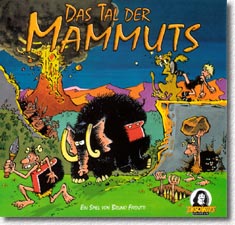
Das Tal der Mammuts
Valley of the Mammoths
Publisher: Eurogames/Jeux Descartes
Author: Bruno Faidutti
Tester: Aaron Haag
Game Tested: 1st release 2001
Scenario: Will your tribe be the first to vanquish its enemies? Can it
prosper, multiply and seize vast territory? Are you ready to battle rival tribes and
confront ferocious beasts? To hunt, fish, forage and farm in order to provide the
necessary food for the survival of your tribe? Then welcome to the Valley of the
Mammoth… and good luck! This quote from the English rules nicely describes
what this game is all about: controlling a tribe of humans in prehistoric times with the
aim to not only avoid starvation (difficult!) but also extend your control of the map
board by setting up camps.
The Game: Ten years after the first release of this game (“La Vallée des
Mammouths”, 1991, Ludodélire) the German version became available at Spiel 2001 in
Essen. An English release (“Valley of the Mammoths”, 2001, Eurogames Descartes USA) is
also planned and should be available by the time you read this. Compared with the French
version there have been some slight modifications to make the games more balanced and in
some respects easier to play (e.g. animals all have the same strength now).
The games is set up on a board with 37 hex spaces depicting three types of regions
(plains, forests, mountains). As a nice touch the board comes in two pieces and is
printed on both sides using different regional setups – so there are a total of 4
different maps to play on. Each of the two to six players controls a tribe of 10 warriors
and 6 females of which at the start of the game 5 warriors and 2 females are placed in a
camp on the board . The players then receive 5 fate cards each. Fate cards provide a
tribe with one-time abilities or options and may be used when the appropriate turn is
played. The player’s task is to set up a total of four camps on the board and keep
them for one complete round. The first player achieving this goal wins the game.
The game is played in turns consisting of up to 10 phases each. The actions in a phase
vary depending on the current season of the year: each game year is divided in a three
turn summer season followed by a three turn winter season.
The phases of a turn are:
- Events
Depending on the season a summer or winter event is drawn from the appropriate event card
pile. Most of the events have a negative effect on all tribes on the board, some
affecting only a particular region or have a lasting effect for a whole season. For play
balance events are not drawn in the first two turns of the game. - Arrival of new animals
New animals arrive on the map by randomly drawing them from a sack. Their numbers vary
depending on the season (and the number of players) with less animals arriving during the
winter turns. Each animal drawn has a defined starting location at the border of the map. - Movement of animals
The roll of a die determines the direction in which all animals move across the board.
Depending on the type of the animal (wolf, tiger, bear, bison, rhino or mammoth) they
move a different number of hex spaces and are able to traverse different regions.
Whenever an animal moves into a hex occupied by humans its movement stops. - Movement of tribes/setting up camps
Starting with the strongest tribe on the board (number of camp then number of tribe
members are considered) players may move there tribe tokens one or two hex spaces on the
map. If any enemy tokens (animals or enemy tribes) are in the same hex a token may only
be moved if the enemy is outnumbered because a player must leave at least as many tokens
in such a hex as there are enemies present. Instead of moving a player may set up a new
camp if there are at least one warrior and one female and no enemy tokens in a hex space. - Combat
Combat takes place in hexes occupied by different tribes or by tribes and animals.
Combats are resolved by die rolling with a modifier for each warrior, animal or camp.
Combats between tribes are resolved first and finish when there are only warriors of one
tribe left in the hex concerned. Females finding themselves in a hex with enemy warriors
and no warriors of their own tribe are replaced with a female token of the
“capturing” tribe. Camps may be captured in a similar way. After all tribe
combats have been resolved combat with animals takes place. Killed animals provide food
points which can be used in the next phase. - Survival
In this phase the tribe first collects food points when occupying hex spaces in forests
(gathering) or near water (fishing) or for harvesting any previously cultivated plain
hexes with camps. Then they consume food points. Each tribe member requires one food
point to survive the turn. If insufficient food points are available the player must
remove any surplus tribe members from the map. - Births
At the end of each season (not at the end of each turn) up to two females per camp give
birth to new tribe members. The gender of the new member is determined by a die roll with
a small chance (roll of a 6) that twins are being born. New-borns are immediately
considered adults. - Cultivating land
In the last turn of winter tribes may cultivate any plain hexes with camps at the cost of
one food point. - New fate cards
Players with less than 5 fate cards may drawn one new card from the fate card pile. Fate
cards usually provide an advantage to a tribe by either strengthening the own tribe or
harming enemy tribes. - End of turn
The season marker is now moved one space clockwise. If a player controls four camps that
player must notify the other players about this condition. If the same player still
controls four camps at the end of the next turn that player wins the game.
Playing Time: The game can be explained in 15 minutes and played in about 60
minutes to 3 hours depending on the number of players and the type of players (fighters
vs. builders).
Similar Games: La Vallée des Mammouths, Vinci,
Ursuppe
Westpark Gamer’s Opinion: In many respects this a typical Faidutti game
with a strong strategical component plus some equally strong chaotic elements added (the
fate and event cards). Players who like this kind of mixture will definitely like this
game. The potential for clever strategies is quite high and as long as one does not mind
too much to be hit by some ill fate or event at the worst possible time this game
provides a lot of fun.
Because some of the fate cards can have quite a big effect on the game (e.g.
“Kindbettfieber” i.e. childbed fever or “Steinschlag” i.e. falling
rocks) 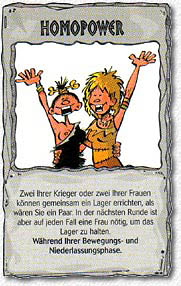 it may be a good idea to quickly go through them
before the very first game.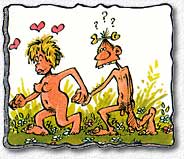 This is also recommended for those
(non-Europeans?) who may have problems with the cards’ wonderful cartoonish
graphics (e.g. “Freund”, i.e. “friend”) or theme (e.g.
“Homopower”). Actually, the German “Homopower” card (which
allows a player to establish a camp without the necessity to have members of
different gender present) translates to “Domestic Partners” in the English
version. So its more in line with Lemmon/Matthau’s “The Odd Couple”
and rest assured: in the game females are still required to keep the camp for longer
than just one turn or to propagate ;). And there is a sufficient number of cards in
the deck so you can take out which ever you find inappropriate for whatever
reason.
We found it quite hard to keep one’s tribe strong enough as the food supply is
very sparse. Some bad events during the winter season actually can reduce a tribe to a
mere couple. Combat between tribes therefore is not a common event and usually only
happens once one tribe has become so strong that some of its members will not survive
anyway. In this case its better to loose warriors in combat rather than due to
starvation.
There is certainly room for a number of different strategies: from “empire
building” and avoiding combat with other tribes as much as possible but instead
concentrating on setting up camps and collecting food to agressively “attacking
everything that moves” with the aim to take over as many enemy females and camps as
possible. I still have to see the empire building strategy to really work (I lost twice
trying to do this being unable to defend the 4 camps I set up). Also keep in mind that
the game tends to take considerably longer if all players are of the empire building
kind. I personnally believe that the game is much more fun when played agressively.
There is an optional rule about the usage of fire which I strongly recommend you use.
It makes the game only a little more complex but adds an advantage to combat with animals
which in my opinion is necessary to generate sufficient food. On the other hand this is
counterbalanced by the fact that now 1.5 food points are consumed per tribe member per
turn. Another variant also dealing with food availability is called Health
Food and is described on Bruno Faidutti’s web pages.
There seems to be a second edition of the rules that state that the game is to be
played with three to six players instead of the two to six mentioned in my 1st release
rules book. The game can be played with 2 players without any problems, however, due to
the fact that there is a lot more room for expansion, fights will occur less often than
with more players, which may suit those “empire builders”.
One word about the German Eurogames edition: although the quality of the game
components is quite high I must say that this game again is a typical Eurogames title. I
wished that they would get the rules right with the first release of a game. The German
rule book has some serious translation errors regarding the camp set-up, fire-taking and
food gathering. The correct rules are that camps may be set up and fire may be taken as
long as there are no enemies in the same hex and fishing provides only one
food point if a hex is located at a river and a lake. Luckily, Bruno Faidutti provides an
errata
page on his web site.
There is also a tiny flaw with a small number of games of the Eurogames edition: the
crop markers are printed incorrectly showing only one ear of grain on both sides. This
can easily be corrected by marking one side with a bold 2 (or by writing to Eurogames who
will send you a correct set of tokens). One small additional hint here while you are
marking the crop tokens: we also marked the animal tokens with their movement points,
movement ability through terrain and their food points. This speeds up the game a little
as you do not have to look up these values in the rules every time you need them.
Alternatively, you may want to print out Pierre-Nicolas Lapointe’s very nicely done
help card.
Aaron’s Rating: 7 (out of 10)
Westpark Gamers’ Rating: 7.67
| Links to further information: | Westpark Gamers’ Strategy Tips |
| Bruno Faidutti’s page with english rules, a FAQ and rules errata |
|
| Luding link for Das Tal der Mammuts |
 Of the 22 cards each player receives 6


 The public’s opinion and the artists styles are
 Spielt sich schnell und flott, wie so oft bei