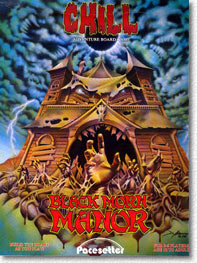
CHILL: BLACK MORN MANOR

CHILL: BLACK MORN MANOR

Chill

Hersteller: Pacesetter (Deutsche Ausgabe bei Schmidt-Spiele unter dem Titel
“Höllenhaus”)

Autor: Troy Denning

Getestet: Amerikanische Ausgabe von 1985 (Pacesetter), Out-of-Print

Tester: Moritz Eggert

Szenario: Es ist Nacht und die Werwölfe heulen wieder. Das Absolut BÖSE hat
sich in einem höllischen Anwesen verkrochen, und es ist unsere Aufgabe, es zu vernichten
oder dabei zu sterben. Wir sind die “Envoys” , die Gesandten des Guten, und wir
werden versuchen, den Gegenstand zu finden, mit dem das Ungeheuer am richtigen Ort zur
richtigen Zeit vernichtet werden kann. Wir arbeiten zusammen, und wir gewinnen zusammen,
auch wenn wir uns eventuell gegenseitig behindern…Ein Anderer übernimmt die Rolle des
ersten “Minions”, also Diener des BÖSEN! Nur sie/er weiß, welcher Natur das
Grauen ist, das dieses höllische Anwesen und seine Anwohner plagt (zur Auswahl stehen 12
verschiedene, Vampire, Zombiemeister, Geister, Fledermauslord, und, und, und…). Und
sein Ziel ist es, den einzigen Gegenstand, mit dem er zur Strecke gebracht werden kann,
so schnell wie möglich aus dem Anwesen zu entfernen, koste es was es wolle. Aber
gottseidank (oder teufelseidank) bleibt das Böse nicht allein – die durch Angriffe von
Vampirfledermäusen, Geistern und anderen Monstern aller Arten geplagten
“Envoys” verlieren nämlich nach und nach ihren Bezug zur Realität. Sie können
zwar nicht getötet werden, aber irgendwann verlieren sie ihre “Willpower” ganz
und werden selber zu “Minions”, also Gehilfen des BÖSEN. Das plagt zwar die
geschrumpfte Schar der “Envoys”, aber auch den ehemals einzig Bösen, denn im
Gegensatz zu den Guten denken die “Minions” gar nicht daran, sich untereinander
zu helfen. Nein – allein gewinnen wollen sie, jeder für sich! Der original Böse hat nur
einen kleinen Vorteil: Er allein weiß, um welchen Gegenstand es geht, und er wird dieses
Wissen nicht weitergeben. Nur schade, dass die neuen “Minions” jederzeit die
Familiengruft besuchen können, um eben dieses Geheimnis zu erfahren…

Das Spiel bezieht sich sehr frei auf das gleichnamige Horrorrollenspiel
“Chill” von “Pacesetter”, das – im Gegensatz zu diesem Brettspiel –
eine Neuauflage bei einem anderen Verlag erlebte.

Das Spiel: Das Spiel gehört zu der Gattung der Spiele, bei denen das Gelände
nach und nach aufgebaut wird. Alle Spieler dürfen pro Runde maximal 2 “tiles”
setzen, wobei bestimmte Regeln zu beachten sind (gleiche Teile zu gleichen, falls als
“set” bezeichnet, das Haus muss immer mindestens einen Eingang haben und
weitergebaut werden können). Die Guten starten in der einen Ecke, und versuchen erst
einmal zum Haus vorzudringen, denn dort können erst einmal nur “Anwesen”-Teile
angelegt werden, also Rasen, Friedhof, Heckentiere, etc.. Der Böse startet auf der Gruft
und versucht wiederum, das Haus auf möglichst unzugängliche Weise zu bauen, um Zeit zu
gewinnen. Beide Spielergruppen können aber jederzeit auch bei der anderen Seite anbauen,
sodass der Prozess nie berechenbar ist. Die Teile haben einen
“Gefährlichkeitsfaktor” – wenn die Zahl hoch ist, fällt es dem Bösen leicht,
sich darauf zu bewegen, wenn die Zahl niedrig ist, den Guten. Der Bereich um den
Eingang/Ausgang tendiert dazu, “gut” zu sein, das Haus selber ist natürlich
äußerst gefährlich und “böse”.

Ein besonderes Feature des Spiels ist der jeweils vom “Master”, also dem
UNGEHEUER abhängige Kartenmix (manche Karten kommen nur mit bestimmten Mastern ins Spiel,
sodass erfahrene Spieler anhand der Karten langsam erraten können, wer der Master sein
könnte). Die meisten Karten schaden den “Envoys” und werden dementsprechend vom
Bösen gespielt, es gibt aber auch Karten die nur dem Bösen schaden, und neutrale Karten,
die jeder benutzen kann. Es ist durchaus möglich, Karten, die man selber nicht benutzen
kann, auf der Hand zu behalten, um sie dem Anderen vorzuenthalten. Wichtig sind natürlich
die Gegenstände, von denen man immer maximal einen tragen kann (fallengelassene
Gegenstände kommen als Counter aufs Spielfeld und können von anderen Spielern aufgenommen
werden. Gegenstände gehen also nie verloren!).

Jeder dieser Gegenstände ist einem Ort oder einer Handlung zugeordnet, die meistens,
sollte der Gegenstand tatsächlich dem BÖSEN schaden (und es gibt in jedem Spiel nur EINEN
Gegenstand, der dies kann), einen Kampf zur Folge hat. Dies geht dann ein bisschen wie
bei “Cluedo”: ” Ich bin mit dem Mahagoni-Speer im Schlafzimmer. Ist der
Batlord der Mörder…äh Master?”. Wenn ja wird gekämpft, bzw. gewürfelt. Wenn nicht,
dann ist dieser Gegenstand fortan quasi nutzlos, es sei denn, er bringt einen Vorteil im
Kampf. Der BÖSE darf übrigens nicht lügen, das wäre ja noch schöner! Der Kartenstapel ist
schnell aufgebraucht und bekannt. Hier beginnt dann auch das taktische Element dieses bis
dahin eher glücksbetonten Spiels: Von nun an ist es nämlich durchaus wichtig, zu planen,
da man nun weiß, wie manche Karten sich auf den Spielverlauf auswirken werden. Dies
erfordert bei jedem Master auch vollkommen neue Taktiken, sodass der Spielreiz auch bei
mehreren Spielen hoch bleibt.

Böse geworden Gute können übrigens wieder dem Guten zurückgewonnen werden, wenn Sie
aufgrund eines Kampfes (der natürlich auch unter den Spielern möglich ist), in die
Kapelle geschickt werden. Meistens wollen die das aber gar nicht, denn die Bösen gewinnen
ja allein, die Guten “nur” in der Gruppe. Es ist eine erfolgversprechende
Taktik, möglichst lange gut zu bleiben, bis es einigermaßen klar ist, wer der Master ist,
sich dann den Gegenstand zu schnappen und durch gezielt hoffnungslose Kämpfe dem Bösen zu
verfallen – Exit und Sieg! Meistens wechseln alle Spieler mehrmals die Seite.

Spieldauer: Sehr unterschiedlich je nach Master. Ein Spiel dauerte unter einer
Stunde, das nächste 3! Es handelt sich aber nicht um ein “Ewigkeitsspiel”.

Ähnliche Spiele: Nightmare House, Cluedo

Kommentar der Westpark Gamers: Dieses Spiel kam mit unterschiedlichen
Spielertypen sehr unterschiedlich an. Es ist eindeutig kein “Walter”-Spiel,
d.h. es gibt ein durchaus starkes Glückselement, und ein Großteil des Spaßes besteht aus
der Chaotik der Geschehnisse und des persönlichen Hineinversetzens in dieselben. Auf dem
Spielfeld ist viel los und die Interaktion zwischen den Spielern ist stark. Die Guten
können und sollten sich durchaus absprechen, und ein Teil des Spielspasses besteht darin,
dass die Bösen es eben nicht tun, bzw. nicht tun sollten. Die meisten Partien arten
irgendwann in eine Art Wettrennen aus – vor allem wenn der Gegenstand bekannt geworden
ist. Aber auch das ist natürlich alles andere als langweilig. Es gibt aber auch durchaus
Raum für Taktik, und sogar Strategie. Die allmähliche Kenntnis des Kartensatzes ist ein
wichtiges Element, auch wenn es leider doofe und umständliche Karten gibt, die, da sie
zwangsläufig immer wieder auftauchen, manchmal sogar eine Art Teufelskreis erzeugen
können.

Mir gefällt das Spiel gut, aber Leute, die das (in diesem Fall sehr unernst gemeinte)
Horror-Genre hassen, oder sich mit Chaos und schnell wechselnden Spielsituationen nicht
anfreunden können, sollten die Finger hiervon lassen. Alle anderen werden trotz billiger
Aufmachung (nur amerikanische Ausgabe!) ihren Spaß haben, und ein etwas vernachlässigtes
und interessantes Spiel zu schätzen lernen.

Moritz’ Bewertung: 8 von 10

Westpark momentane Bewertung: 6.5 (letzte Bewertung am 11.7.2001)

Weiterführende Informationen:

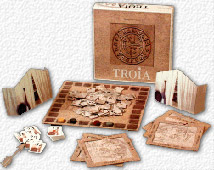
TROIA

TROIA

Troia

Publisher: DaimerChrysler

Author: Thomas Fackler

Tester: Aaron Haag

Game Tested: basic rules, published 2000

The Game: Two to four archeologists have the task to search for artifacts at an
excavation site in Troy. The site is represented by 64 tiles that are placed as one large
pile on the map board at the beginning of the game. Each tile is marked with a symbol
representing the (historical) layer to which it belongs and an indication of whether or
not it represents an artifact. Since all tiles are randomly oriented in the pile some lay
face up and other lay face down. While the layer symbol is printed on both sides the
artecact indicator is only printed on one side of a tile. Tiles on top will cover more or
less of the tiles at the bottom of the heap.

Each round players play cards simultaneously to indicate the action they want to perform
during their turn. They either can play an “excavate” card allowing them to
take up to 5 accessible tiles (i.e. tiles that are not covered by other tiles) from the
pile or explore up to 5 tiles (i.e. look at both sides of an already
excavated tile). A second type of cards allows a player to “publish” up to 5
explored tiles. Publishing is done by placing the tile(s) on the layer board representing
the layer where the tile was excavated (again indicated by the layer’s symbol).
Points are awarded for such publications and the player with the highest points at the
end of the game wins. Normal tiles count one point, artifacts two points. A bonus of one
point per tile published in a turn is given to the player with the “largest”
publication, i.e. the publication that consists of more adjacent tiles than are already
placed on a layer board.

Playing Time: The game can easily be explained in 10 minutes and played in
about 60 minutes.

Similar Games: Drunter & Drüber (Hans im Glück)

Westpark Gamer’s Opinion: Typical for Thomas Fackler games the game
components are very well designed but of not so exclusive materials than his more
expensive games. The component design yields to the atmosphere of the game very nicely.
However, playing the game is a completely different matter. Although players have
basically a choice of different actions there is in fact hardly a situation where it is
not downright clear what a player should do. After the first two to three rounds the
layer boards have usually filled up so that much that it is very hard to get the bonus
points for the largest publication. The luck element is quite high as it is out of the
players control which tiles are accessible when its his or her turn let alone the fact
that about half of the tiles on the pile are turned face down and not revealing if they
are artifacts. One of the largest drawbacks of the game is, surprisingly, the component
design itself. The location where a tile is placed on its layer board is indicated by
thin lines representing the terrain profile. These lines are printed on both the tiles
and the layer board in a very light grey color and show a rather complicated pattern. As
a result, players spend quite some time in determining where their explored tiles will be
published – far too much time in fact. The game is a not so difficult family game with
quite an educational touch (it comes with a very well done booklet about the Troia site)
but definitely not a game for the more serious type of gamer.

Aaron’s Rating: 4 (out of 10)

Westpark Gamers Rating: 3.8

Links to further information: Board
Game Geek Troia page
Funagain page with player reviews of Troia
Luding link for Trioa

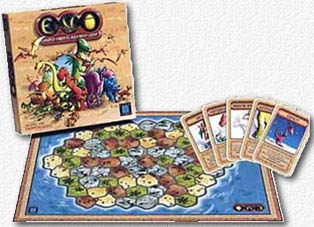
Evo

Evo

Evo

Publisher: EuroGames

Author: Philippe Keyvaerts

Game tested: German Edition, 2001

Tester: Moritz Eggert

Scenario: 6 million years B.C. (take or give some): A huge (or small, depending
on the number of players) island with various landscape types. An ever-changing climate
that makes some of these areas inhabitable, some of them barely inhabitable, some of them
deadly for everybody. A comet threatening to extinguish everybody (=ending the game). And
before we forget it: Some weird pelted one-legged dinosaurs with umbrellas (really!) that
are going to kick each others butts – and no Raquel Welch in sight…

The Game: Every player starts with one dinosaur, trying to survive and multiply
as effectively as possible, as at the end of each round surviving dinosaurs give victory
points. The climate changes through a directional random table, so all dinosaurs are
forced to constantly change their position on the board to survive (the problem being
they can initially only move ONE space). Sometimes this makes for interesting tactical
decisions (what move will give me the best options next turn?) and of course may also
result in bloody confrontations with other dinosaurs (that are resolved through a simple
dice roll).

Of course nobody has a chance surviving this ordeal without….genes (with a tip of
the hat to God, and Doris & Frank, the designers of Ursuppe). Every round a number of
genes equal to the number of players is drawn. Each player, in an ingenious and
interesting victory point – bidding system that forces players to bid non-sequentially,
can acquire one gene per round, that will give all of his dinosaurs special abilities,
like more movement (feet), more biting power (horns), quickness (tail), more reproduction
(eggs) and the like. As a little side note one should mention that one gene is very funny
in play, as the German word for “tail” (Schwanz) can also mean….ehm….the
male reproductive organ. And as the length of this very trait decides who will be first
in a given round the game table booms with discussions who has the longest….whatever.
Of course this detail might be lost in other translations…. The only really chaotic
gene is the event card gene, that enables one to draw additional cards from a deck that
messes with play considerably, especially with the weather. This is actually the biggest
luck element in the game, as some cards are much more useful than others (for example
giving surprise victory points at the end of the game). Knowing these cards is part of
the skill in repeated playing – for example there is one card (flood) that kills most of
the dinosaurs on a shore hex – you’ll not stay on the shore if you experience this
card once (otherwise there is no real reason to wander landwards). But the first time
playing this card will greatly annoy you, I tell you!

Most of the time dinosaurs will evade each other quite peacefully, battles only occur
at the end of the game, or if a dinosaur has no chance of surviving at all if not
attacking a certain area. The game has a preset basic length, depending on the number of
players. After that the chance that the comet ends the game increases every round
(depending on a d6 roll), but you won’t be able to calculate it exactly. The
dinosaur…eh..player with the most victory points wins.

Playing Time: Explaining the rules probably not longer than 15 minutes. Playing
the game should take 1 ½ hours, maximum 2. Different from other Euro-Game-editions this
time the rules are clear and crisp. I should mention one possible confusion, though. A
German game magazine correctly noted in it’s review that about 50% of players
won’t grasp the climate changing system, although it is not complex at all. Or is it?

This is how it works: There are four zones, from left to right: Yellow (desert), green
(plains), hills (brown) and mountains (grey).The climate pawn, which moves randomly,
shows which coloured region will be mild (ideal), the directly adjacent regions are
either cold (if to the right) or warm (if to the left). A region that is 2 or 3 spaces
away from the climate pawn is either too cold or too warm to live in. But the left
direction of the board is always the “warm” direction (as the right is always
the “cold” one)- the board is not a circle! Some people intuitively perceive
the board as a kind of mobius strip, which gets them all confused in the head, you see…
This is how it really works: If the pawn rests on the grey/mountain space (the far right)
for example, there will be no “colder” space, as grey is already the
“coldest” possible space. And the hills will be “warm”, whereas the
plains and desert will be too hot. If the pawn sits on “plains” (2nd from the
left), the desert (yellow) will be warm, and the hills/brown will be cold. The mountains
will be too cold now. Easy, huh? Now that I try to explain it it sounds very confusing,
albeit it is very simple. Well – it’s in the genes to “get it”, I
guess…

Similar Games: Ursuppe, La vallée des mammouths

Westpark Gamer’s Opinion: Although this is only the second game he
published in Germany, a certain style of Philippe Keyvaerts is already transpiring:
taking a good idea (like “History of the world” for his excellent
“Vinci”), streamlining and simplifying it, bringing in a pinch of really good
new ideas, and making it interesting for the casual or die-hard gamer alike. So
“Evo” is much simpler than it’s “foremother”, the also highly
enjoyable “Ursuppe”, but in a way more elegant and accessible in it’s
mechanics. Having said this I found that the games we played tended to be similar in
development, much more than “Vinci” with it’s countless variations of
cultures. The dinosaur genes are pretty straightforward, and there are less interesting
possibilities to explore than in Ursuppe (where players strove to find the
“ideal” combination of genes). But then ,”Evo” is much shorter than
Ursuppe, and in a way more tactical as movement is even more limited than in
“Ursuppe”. And it is never boring one minute (although it CAN be frustrating,
like “Vinci”). A good game, not a classic, but very good indeed.

The victory point table (called the “Kramer-Leiste” in Germany out of
affection for the game designer who first used it prominently) is WAY to small, though
(the markers are 3 times as big as the positions you put them on). Bummer, we thought
Euro Games had good it right this time! But Keyvaerts is a guy to watch, that’s for
sure.

Moritz’ Rating: 7 (out of 10)

Westpark Gesamtbewertung: 7.5

Links to further informationen: Bruno Faidutti’s opinion about Evo.
A list of
Dinosaur and Evolution Games
.

PRINCESS RYAN’S STAR MARINES

PRINCESS RYAN’S STAR MARINES

Star Marines

Hersteller: Avalon Hill (das alte)

Autor: Marc McLaughlin (siehe auch “Viceroys“-Kritik)

Getestet: englische Version (out of print) 1997

Tester: Moritz Eggert

Szenario: : Die ferne Zukunft – Oder der feuchte Traum eines amerikanischen
Militärfetischisten. Es gibt immer noch Marines, und sie sind – anders als in der
Wirklichkeit – auf der Seite des Guten. Ein “Evil Overlord” (die “Black
Guard”) hat die schöne und irgendwie wichtige Prinzessin Ryan entführt. Die Aufgabe
der Marines ist es, diese in einer waghalsigen Aktion zu befreien. Schritt für Schritt
wagen sie sich ins Territorium des Bösen, wobei ihnen allerlei Ungeziefer und wirklich
böse Gegner im Wege stehen. Am Ende gewinnen die Marines (bis zu 6 Spielern) oder der
Guard-Spieler (maximal einer, oder auch keiner, denn das Spiel kann auch die Aufgabe des
Bösen locker übernehmen, daher eignet sich “Princess…” auch gut als
Solitärspiel). Und unter den Marines gewinnt derjenige, der dann auch noch das Zimmer
rät, in dem die Prinzessin festgehalten wird (so wie Prinzessin Leia im Gefängnistrakt
von “Star Wars”…als Star Wars noch gut war).

Das Spiel: Auch wenn meine Kurzbeschreibung oben etwas gelangweilt klingen
sollte, das Spiel ist super! Durch das Thema sicherlich nicht jedermanns Sache, aber es
ist eines der wenigen Kooperationsspiele die tatsächlich Spaß machen. Die Marines sind
nämlich nicht so gut, wie es erst scheint, sie können sich durchaus auch gegenseitig das
Leben schwer machen (obwohl dies natürlich dem “Guard”-Spieler nur nützt). Auf
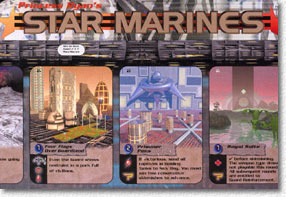
dem graphisch aufwendig gestalteten Spielplan bewegt sich die einzige Spielfigur Richtung
Palast, wobei grundsätzlich immer 2 Wege zur Auswahl stehen. Jeder dieser Wege führt
durch gänzlich unterschiedliches Territorium, hier funktionieren mal keine Energiewaffen
(d.h. die dementsprechenden Kampfkarten dürfen nicht gespielt werden), dort darf sich der
Böse nicht “verstecken” (also Stärkekarten verdeckt spielen, was immer
besonders unangenehm ist). Hier müssen die Marines erst einen Todesparcours durchlaufen
(“the gauntlet”) bevor sie kämpfen dürfen, dort finden sie Waffen, die äußerst
nützlich sind.

Wenn man sich für einen Weg entschieden hat, ist es nicht sicher, daß man wirklich an
dem erwarteten Ort ankommt: Jede “Location” kann nämlich durch eine nur dem
Guard bekannte Ortskarte ersetzt werden, wenn der Zufall (oder manchmal auch der
Guard-Spieler) es will, und dann ist das Staunen recht groß. Dadurch ist der Spielverlauf
stets unvorhersehbar.

Grundsätzlich versuchen die Marines mit einer “Kartenhand” (also ohne
Waffenkarten nachzuziehen) und jeweils 3 kontrollierten Marines mit unterschiedlichen
Spezialeigenschaften möglichst weit zu kommen, denn jedes “regrouping”
(Waffenkarten nachziehen, tote Marines ersetzen, etc.) kostet wertvolle Zeit, und wenn
die wertvollen 15 Timechips aufgebraucht sind, haben die Marines verloren (die Regeln
haben hier übrigens eine Unklarheit: haben die Marines verloren, wenn der letzte Timechip
aufgebraucht wird, oder erst, wenn ein Timechip verlangt wird, und die Marines keinen
mehr haben???).

In den meisten Locations spielt der Guard eine Karte, die die Marines mit Waffenkarten
schlagen müssen, und hierbei kommt ein interessantes Element ins Spiel: Nur der Marine,
der im Falle eines Sieges den insgesamt “höchsten” Kampfwert gespielt hat,
bekommt Promotion Points (zum Aufrüsten) und eine “Dispatch”-Karte (bringt
zusätzliche Optionen). Und auch nur er (oder sie) darf jeweils dem Guard-Spieler eine
Ja/Nein-Frage bezüglich des Prinzessinenaufenthaltes stellen. Nicht immer will man aber
die höchste Karte spielen, man kann auch den ranghöchsten Soldaten (und der bestimmt
immer, wo’s langgeht, oft auch gegen den Willen der Anderen) mit einer niedrigen
Karte hinterhältig killen, um selber Anführer zu werden.

Spieldauer: Regelerklärung ca. 15 Minuten (viele Details können während des
Spielens “nacherklärt” werden), Spieldauer so um die 2-3 Stunden.

Ähnliche Spiele: Siehe “Kommentar”!!!!

Kommentar der Westpark Gamers: Das Spiel kam bisher in unseren Runden immer
sehr gut an, obwohl es in der Spieleszene eigentlich nur unenthusiastische Kritiken bekam
(was allerdings auch an der etwas einfallslosen Thematik und einem gewissen Glückselement
liegt, manches ist auch zu komplex für den Durchschnittspieler, obwohl das Spiel nicht
wirklich überladen ist wie sonst einiges von AH). Die Herausgabe des Spiels wurde von dem
Konkurs und darauf folgenden Aufkauf von AH durch Hasbro überschattet, es ist das
drittletzte Spiel, das überhaupt erschien. Auch der hohe Preis hat nicht viel zur
Verbreitung beigetragen – dieser erscheint umso merkwürdiger, als man eigentlich nur für
ein grosses Spielbrett zahlt: die Karten sind von eher schlechter Qualität, und es fehlen
sogar die dringend benötigten “Timechips” und eine “Währung” für die
Promotion Points.

Aber egal: Selten hatte ich so viel Spaß beim Spielen wie als Guard-Spieler, als sich
meine Freunde Aaron, Walter und Peter als Marines gegenseitig die Suppe versalzten. Als
Marine ist man auch ständig ins Spiel involviert, es gibt keine “Runden”, keine
Spielerreihenfolge, keinen Leerlauf, wenn man auf den Zug des Anderen wartet. Die
ständige Action macht Spaß, und die Kooperation ist interessant und wirkt nicht
aufgesetzt, wie bei manchem fehlgeleiteten Sozialarbeiterkitsch in gewissen Spielen aus
den 80ern. Einige Spielmechanismen sind sehr innovativ, und insgesamt handelt es sich um
ein nur “slightly flawed overlooked gem”.

Und noch was: Wer sich bei der obengenannten Sppielbeschreibung an den umstrittenen
“Herr der Ringe” von Reiner Knizia erinnert fühlt…hat recht! Ich würde meinen
Marine-Hintern darauf verwetten, daß Reiner dieses Spiel kennt, und sich dadurch zu
“Herr der Ringe” hat inspirieren lassen, es gibt einfach zu viele
Ähnlichkeiten! Sicherlich würden manche sagen, daß die Änderungen von Knizia das
Spielprinzip verbessert haben, aber ich mag einfach die “rauhere” und weniger
gutmenschenartige Version besser: Und das ist eben “Princess Ryan’s Star
Marines”. Und das taktische Element ist, wenn man ganz genau hinguckt, bei der
Prinzessin wesentlich interessanter als bei “HDR”.

Absolut empfohlen!

Moritz’ Bewertung: 9 von 10

Westpark momentane Bewertung: 7.25

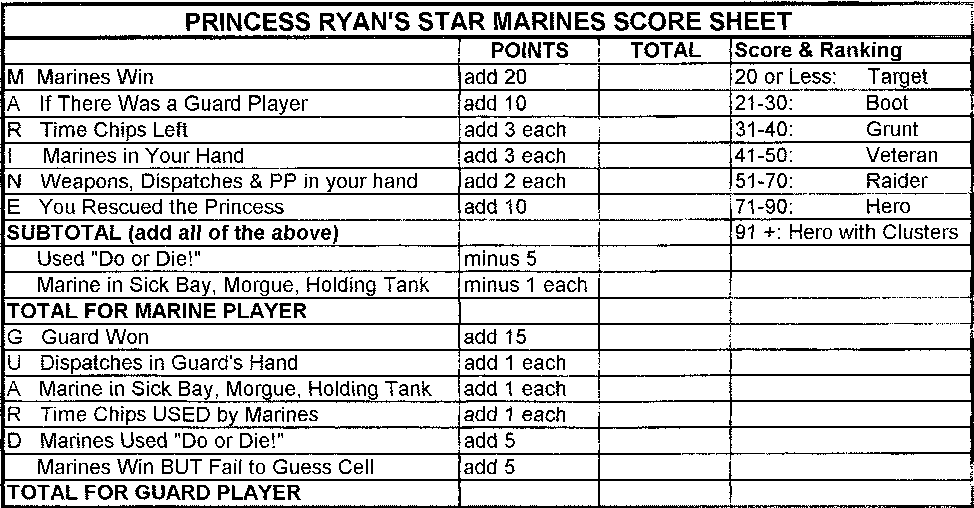
Weiterführende Informationen: Für den Hardcorespieler empfehle ich sehr die in einer der letzten
“Generals” veröffentlichte Punkteabrechnung, die das Spielende deutlich
interessanter macht. Da dieser Artikel schwer zu finden sein dürfte, hier eine gescannte
Kopie der Abrechnungsschablone, die ziemlich
selbst erklärend ist.
http://grognard.com/titlep.html (einige weitere Kritiken auf englisch)

Junta

Junta

Junta

Publisher: ASS

Author: Vincent Tsao (original design); Ben Grossman / Eric Goldberg (revised
rules)

Tested: German edition, 1986

Tester: Walter Sorger

Scenario: A Republica of Los Bananas somewhere in the world. The players
represent political powers within a state and try by hook or by crook to divert the main
part of the public budget to their own private Swiss bank account.

The Game: The game board shows the important political quarters of a modern
capital (presidential palace, parliament, police districts, barracks, embassies, central
bank etc.). The game takes 9 to 11 rounds, in each round cash is put into circulation.
When the whole stock of money is exhausted the game is over. Winner is the player with
the highest amount of money in his bank account.

One player is El Presidente, an office in which he is elected democratically. The
president assigns the remaining 6 positions (Ministry of Internal Security, Air Force,
Navy or one of 3 Generals) to the other players. He is free in his decision, each player
gets at least one and at most two offices.

This demonstrates the first partiality of the president. The president assigns the
positions not uniformly among the players, but prefers those, who seem to be loyal; those
player with which he attempts to feather his nest.

His “feathers” are the randomly drawn 8 to 24 million Pesos Foreign Aid,
which form the public budget. The president distributes this money amongst all the
players in an absolutely arbitrary manner. He may keep all the cash for his own or he may
give all or part of it to one or several other players. This demonstrates the second
partiality of the president and is called his budget proposal. It is voted on, and of
course the hurt players vote against it. If the budget passes, it is divided up amongst
the fortunate players. If it fails, the Minister can force it through with gun power.

Such a proceeding does not make friends. But Junta is not a game for friends.
Everybody plays at his own bill. Alliances are concluded for short-dated aims only, and
they last only so long as no other profitable goals are found. These may be an
assassination attempt against a rich ally or a coup attempt against the governing
junta.

Any player may initiate an assassination attempt against one other player. This
happens by ordering an assassin to a specific location (bank, head quarter, home, lover,
night club) to kill the denominated office person. The assassination attempt is
successful, if the wanted person really moves to the chosen location. In this case the
agent gets all the cash on hand of the victim.

A coup attempt may be initiated by any player. Before the coup starts each player must
declare whether he chooses the rebel or the loyalist faction. Thereupon is a little war
game, consisting of 6 turns, in which each side struggles to gain control over the
majority of the 5 ‘key’ areas of the capital. After the appropriate number of
turns the coup is terminated and the result is counted.

If the coup is successful, the declared rebels vote on a new El Presidente. If the
coup fails, the governing junta remains in power. The winning side can execute one
person. An executed victim looses all his collected political influence and the president
gets the cash in his hand.

The money the players get during the game doesn’t count for the winning balance at
the end of the game. To determine the winner, only the money on the Swiss bank account is
evaluated. And how do you manage to it get there? In going to the bank and crediting your
cash to your Swiss account. This sounds quite simple, but it isn’t. In political
turbulent times the bank is closed or takes lunch hour and is inoperable for your
transaction. Additionally the assassins lie in ambush in the bank, and there is no more
lucrative target than a partner with much cash.

Playing time: 3 hours, plus rules explanation

Similar games: Republic of Rome, Kreml, Risiko

Westpark Gamer’s Opinion: As preparation for a junta session the game
instructions give the advice to write 100 times “Junta is only a game”. This a
very useful advice because Junta is really only a game. A good game – for good players,
permitted for players over 18 years (like love). It is an ingenious transformation of the
political intrigues in a Republica of Los Bananas into a game scenery. You need sense of
humour (and esprit) to enjoy the immorality and anarchy of this outlined society. Your
companion in storming the president’s palace immediately points to you to be executed
after his election for president, if your are worth to be inherited. Such is life.

The mechanisms of the game are mature and well proportioned, even if fortune (the
president) may distribute the wealth of the state very inequitably. The player, who
obviously was favoured by fortune is immediately a target of the envy. He is closer to
the brink of death than the harmless ‘have-not’, who may gain sudden richness by
committing an assassination or a rebellion.

And how do you win this game? Peter tried it as president with psychical pressure,
with terror against everybody – and often he was successful. Moritz trusted in the
Minister of the Internal Security; in this position he may commit one additional
assassination attempt per round. I don’t know (exactly) which are the principles of a
winning strategy. I dream of a great coup de main, a screened waiting for the
opportunity, where my turn is the last and I can assassinate a rich play mate, who just
assassinated a rich mate … . And this of course in the bank, where I can immediately
move all my booty to my Swiss account, before I have no chance to do this against the
joined gang in the next round. For this I must be able to determine the turn order. And
for this I have to be president and nominate the player left to me as Minister of the
Internal Security …

Walter’s Rating: 9 (out of 10), because of the ingenious mapping of a junta
democracy.

Westpark Gamers Rating: 8.8

Links to further information: Bruno Faidutti’s “Junta” Review
Funagain web page about “Junta”
Luding Link to “Junta”

Junta

Junta

Hersteller: ASS

Autor: Vincent Tsao (ursprünglicher Entwurf); Ben Grossman / Eric Goldberg
(Weiterentwicklung)

Getestet: Deutsche ASS Ausgabe, 1986

Tester: Walter Sorger

Szenario: Eine Bananenrepublik irgendwo auf der Welt. Die Spieler
repräsentieren politische Gruppierungen innerhalb des Landes und versuchen auf Biegen
oder Brechen den größten Teil des Staatshaushaltes auf Ihre Seite bzw. auf ein privates
Konto im Ausland zu bringen.

Das Spiel: Das Spielbrett zeigt die politisch wichtigsten Quartiere einer
modernen Hauptstadt (Präsidentenpalast, Abgeordneten-Kammer, Polizei-Reviere, Kasernen,
Botschaften, Zentralbank, Millionärs- und Elendsviertel u.ä.). Das Spiel verläuft in 9
bis 11 Spielrunden ab, in denen jeweils Geld in Umlauf gebracht wird. Ist der gesamte
Vorrat an Spielgeld ausgegeben, so endet das Spiel. Sieger ist derjenige, der das meiste
Geld auf sein Schweizer Konto gebracht hat.

Ein Spieler ist Präsident, ein Amt, in das er in der Regel demokratisch gewählt wurde.
Der Präsident vergibt die übrigen 6 Regierungsämter (Minister für innere Sicherheit,
Kommandeur der Luftwaffe, Admiral der Marine und 3 Generalsposten) an die anderen
Mitspieler. Er tut dies in freier Entscheidung, wobei jeder Spieler mindestens ein Amt
und höchstens zwei Ämter bekommen kann. Hier zeigt sich die erste Vorliebe des
Präsidenten: Er verteilt die Ämter nämlich nicht gleichmäßig auf alle Spieler, sondern er
bevorzugt diejenigen, die ihm treu zu sein versprechen und mit denen er in der nun
folgenden Junta-Phase sein Schäfchen ins Trocken bringen will.

Sein “Schäfchen” sind die zufällig gezogenen 8 bis 24 Millionen Pesos
Staatshaushalt die der Präsident als “Entwicklungshilfe” einstreicht. Dieses
Geld verteilt der Präsident absolut willkürlich an die Mitspieler. Hier sind der
Verteilung keinerlei Grenzen vorgegeben. Der Präsident kann alles ausnahmslos für sich
behalten; er kann aber auch alles oder einen Teil davon an einen oder an mehrere Spieler
weitergeben. Die Aufteilung des Etats an die Spieler zeigt die zweite Vorliebe des
Präsidenten und nennt sich “Staatshaushalt vorschlagen.” Natürlich sind immer
ein paar Spieler gegen die vorgeschlagene Verteilung, aber wenn die Mehrheit der Spieler
dafür ist, dann ist der Staatshaushalt angenommen. Falls aber eine Mehrheit gegen die
vorgeschlagene Verteilung ist, so kann der Minister des Inneren den Haushalt mit Gewalt
durchsetzen.

Ein solches Vorgehen schafft natürlich keine Freunde. Aber Junta ist auch kein Spiel
unter Freunden. Jeder spielt für sich. Allianzen werden nur für kurzfristige Ziele
eingegangen und halten nur solange, bis sich lohnendere Ziele auftun. Das kann z.B. ein
Attentat gegen einen reichen Verbündeten oder ein Putschversuch gegen die regierende
Junta sein.

Ein Attentat kann jeder Spieler kann innerhalb der “Terror-Phase” einer
Spielrunde auf einen anderen Spieler ausüben. Dies geschieht durch die Ankündigung:
“Ich schicke einen Attentäter zum Ort X (Bank, Hauptquartier, Zuhause, Freundin,
Nachtclub), um ein Attentat auf den Spieler Y durchzuführen.” Das Attentat ist
erfolgreich, wenn der betroffene Spieler sich tatsächlich an dem angekündigten Ort des
Attentats aufhält. In diesem Fall bekommt der Beauftragende des Attentats das Bargeld des
Opfers.

Ein Putsch ist ein Aufstand gegen den Präsidenten-Clan und kann von jedem Spieler
ausgelöst werden. Ist der Putsch initiiert, dann entscheidet sich jeder Spieler, auf
welcher Seite er in den Kampf zieht: ob er sich den Aufständischen anschließt oder ob er
regierungstreu bleibt. Anschließend führen die Truppen der einzelnen Regierungsämter
(eigentlich sind es alles Kriegsämter) die Putsch-Phasen durch, bei denen es darum geht,
die Mehrheit der Schlüsselpositionen in der Hauptstadt zu erobern. Gekämpft wird durch
Würfeln. Bei jeder geworfenen 6 wird eine gegnerische Truppeneinheit entfernt.

Siegen die Aufständischen, so ist der Präsident abgesetzt und die Rebellen wählen
unter sich einen neuen Präsidenten. Siegt die Präsidentenseite so bleibt alles beim
alten. Nach jedem Putsch kann die siegreiche Seite einen Spieler der Gegenseite
erschießen lassen (Natürlich wird nicht der Spieler erschossen, sondern der Amtsträger
den er repräsentiert. Bei der nächsten Runde sind alle Spieler bzw. Amtsträger wieder
munter und fidel.) Ein “erschossener” Spieler verliert seinen gesamten
angesammelten politischen Einfluss. Sein Geld erhält der Präsident.

Alles Geld, das die Spieler im Laufe der Zeit bekommen, ist zunächst mal nur Bargeld.
Es zählt zur Siegesabrechnung am Ende des Spieles nicht mit. Zum Sieg zählt nur das Geld
auf dem Schweizer Konto. Und wie kommt das Geld auf dieses Konto? Indem man es zur Bank
bringt. Das klingt zunächst ganz einfach. Ist es aber nicht. In politisch unsicheren
Zeiten ist die Bank geschlossen oder hat “Mittagsruhe” und nimmt keine
Einzahlungen entgegen. Weiterhin lauern in der Bank die Attentäter, und es gibt kein
begehrteres Opfer als ein Mitspieler mit viel Bargeld.

Spieldauer: 3 Stunden, zuzüglich Regelerklärung

Ähnliche Spiele: Republic of Rome, Kreml, Risiko

Kommentar der Westpark Gamers: Als Vorbereitung auf ein Junta-Spiel gibt die
Spielanleitung den Tip ‘Schreiben Sie 100 mal “Junta ist nur ein Spiel” auf
ein Blatt Papier.’ Dies ist ein sehr nützlicher Tip, denn Junta ist wirklich nur ein
Spiel. Ein gutes Spiel – für gute Spieler, freigeben ab 18 Jahre (wie die Liebe!). Es ist
eine geistreiche Umsetzung der politischen Winkelzüge in einer Bananenrepublik auf eine
Spiel-Szenerie. Man braucht Humor (und Esprit), um die absolute Moral- und
Gesetzlosigkeit der skizzierten Gesellschaft zu goutieren. Derjenige, der gerade noch im
Schulterschluss mit Dir den Präsidenten-Palast erstürmt hat, stellt Dich gleich im
Anschluss daran vor ein Erschießungskommando, um Dich zu beerben. So ist das Leben.

Die Spielmechanismen sind ausgereift und ausgewogen, so ungleich das Schicksal (der
Präsident) auch die Güter des Staates verteilen mag. Wer offensichtlich gut bedacht
worden ist, zieht sogleich die Neider auf sich und steht näher an der Schwelle des Todes
als der Habenichts, der über ein Attentat oder einen Putsch zu plötzlichem Reichtum kommt
und diesen womöglich auch noch unangefochten zur Bank bringen kann.

Und wie gewinnt man dieses Spiel? Peter versucht es als Präsident durch psychischen
Druck, durch Terror nach allen Seiten – und ist damit oft erfolgreich. Moritz glaubt an
den Minister der Inneren Sicherheit, als der er einmal pro Runde ein zusätzliches
Attentat versuchen kann. Ich weiß nicht (sicher), welche Prinzipien zur Siegstrategie
gehören. Aber ich träume von dem ganz großen Coup, d.h. von dem bedeckten Abwarten auf
die Gelegenheit, wo ich als letzter und harmloser Mitspieler ein Attentat auf denjenigen
ausübe, der seinerseits gerade ein erfolgreiches Attentat auf einen reichen Mitspieler
durchgeführt hat, der auch gerade … . Und dies alles natürlich auf der Bank, wo ich
meine Beute sofort einzahlen kann, bevor ich in der nächsten Runde gegen die gesamte
Meute keine Chance mehr hätte. Dazu muss ich die Spieler-Reihenfolge genau vor Augen
haben. Und dafür sollte ich Präsident sein und den Spieler links von mir zum Minister des
Inneren ernennen …

Walters Bewertung: 9 (von 10), wegen der geistreichen Abbildung einer
Junta-Demokratie.

Westpark Gesamtbewertung: 8.8

Weiterführenden Informationen: Bruno Faidutti’s “Junta” Review
Funagain-Seite mit Spieler-Kommentaren über “Junta”
Luding Link zu “Junta”

Cartagena

cartagena

Cartagena

Publisher: Winning Moves

Author: Leo Colovini

Tester: Aaron Haag

The Game: This game is inspired by the escape of pirates from the fortress of
Cartagena in 1672. Each player controls a group of six prisoners which need to be led
through an underground tunnel to the waiting boat. Movement of the pirates is achieved by
playing cards from the player’s hand. Each player starts with a set of 6 randomly
dealt cards. The tunnel (prepared by randomly laying six large tiles at the beginning of
the game thereby offering a large variety of tunnel layouts) is marked with 6 different
symbols with each symbol appearing 6 times (once per tile) throughout the tunnel. A card
played carries one of these symbols and the player moves one of his/her pawns to the next
unoccupied symbol in the tunnel. If there are no vacant symbols left on the way to the
boat the pawn is moved on the boat. The first player whose 6 pirates have successfully
escaped to the boat wins the game.

A players has one to three moves per turn with a move being either playing a card and
moving a pirate forward or moving a pirate back into the direction of the start position
to a symbol occupied by one or two other pirates. In the latter case the player collects
one or two new cards (depending on the number of pirates on the symbol moved to).

The game offers to variants: one where all cards (hand cards and draw pile) are
concealed and another one where the hand cards and the next 12 draw cards are face up for
a more tactical game.

Playing Time: The game can easily be explained in 5 minutes and played in 30 to
45 minutes.

Similar Games: Ausbrecher AG (Ravensburger)

Westpark Gamer’s Opinion: We played the more tactical “Tortuga”
variant with face up cards. The first problem we encountered was that it is not possible
to plan ones move ahead. Each player has to wait for his/her turn before figuring out the
best possible move. Luckily, we have no players in our group who want to find their
“perfect move” by contemplating their position for minutes on end. This is
certainly a problem with the Tortuga variant because of the many unconcealed cards. The
tactical decisions are limited to grabbing the more important symbol cards from the open
cards layout and to avoid moving backward to a symbol occupied by one pawn only (because
you will get only one new card but open a possibility for another player to collect 2
cards by moving backward to the symbol you just drew to). We felt that a third variant
where the player’s hands are concealed but the draw cards are face up would not limit
the “tactical” decisions but at the same time reduce the turn time of each
player.

Aaron’s Rating: 3 (out of 10)

Westpark Gamers’ Rating: 4.0

Links to further information: Luding “Cartagena” reference page
Funagain page with player reviews of Cartagena

VICEROYS (mit COLOMBUS, Expansion Set)

VICEROYS (mit COLOMBUS, Expansion Set)

Viceroys

Hersteller: Task Force Games

Autor: Marc McLaughlin

Getestet: Englische Ausgabe, 1. Auflage, 1986

Tester: Moritz Eggert

Szenario: : Nach der Renaissance stürzen sich die verschiedenen europäischen
Mächte (bis zu 7 im Grundspiel, mit “Columbus” bis zu 8) auf den Rest der Welt,
um diesen möglichst effizient zu versklaven, missionieren und auszubeuten – eine
realistische Darstellung der menschlichen Geschichte also…

Jedes der Länder hat andere Startbedingungen und Spezialfähigkeiten. So ist zum
Beispiel Portugal sehr gut in der Erforschung von unbekannten Erdteilen (man denke an
Vasco da Gama) und England verfügt über eine überlegene Flotte; Spanien kann Galleonen
verwenden, und China baut fleissig an der grossen Mauer.

Columbus ExpansionGespielt wird auf einer authentischen und alten
niederländischen Karte, die mit einem Gitternetz überzogen wurde (das ist zwar ein
schöner “touch”, aber leider ist die Druckqualität der Karte relativ schlecht,
und da es im Spiel wichtig ist, was “Land” und was nur “Wasser” ist,
kann man sich auf endlose Diskussionen über kleine, kaum zu erkennende Inselchen gefasst
machen). Das Spiel hat 3 verschiedene Ausgangsmöglichkeiten, über die am Anfang
entschieden wird: Eine beliebige Spieldauer (“um 12 Uhr ist Schluss”), eine
“sudden death”-Methode (ab einer bestimmten Runde kann das Spiel per Würfelwurf
jederzeit enden) und eine feste Spieldauer (10 Runden). Bevor angefangen wird, sollten
die Teilnehmer viel Sitzfleisch mitbringen – die Regeln haben es in sich, und sind über
ein dickes, kleinbedrucktes und über 50 Seiten langes Regelwerk verteilt. Die
Zugreihenfolge ist jeweils zufällig bestimmt, und wird jede Runde neu gezogen. Man kann
mit seinen Schiffen unbekannte Länder erforschen, Kolonien errichten, Krieg gegen
Eingeborene führen, etc. Alle Aktionen ergeben potentiell Siegespunkte, die erst am
Schluss des Spiels berechnet werden. Eine lustige (aber leider unpraktikable) Idee ist
es, die verschiedenen Spielaufgaben (Verwaltung des Geldes, Verteilung der Karten, etc.)
mittels richtiger “Ämter” an die Spieler zu verteilen, wofür diese in Spielgeld
auf höchst unterschiedliche und oft umständliche Art entlohnt werden.

Wer am Schluss am meisten Siegpunkte hat, gewinnt. Im Regelheft gibt es ausserdem noch
ausgedehnte Solitärszenarien und Varianten für 2 und mehr Spieler, deren
Siegesbedingungen jeweils unterschiedlich sind.

Das Spiel: Nun, wir haben es hier mit einem “Monsterspiel” zu tun. Es
gibt viele, viele kleine Counter, die sich auf dem viel zu kleinen Spielplan türmen und
ständig umfallen. Es gibt viele Regeln, und dann noch viele Subregeln, und dann noch
Subregeln zu den Subregeln. Das Spiel dauert laaaaaaang. Dagegen ist grundsätzlich nichts
einzuwenden, aber die Thematik hätte auch zum Teil simpler umgesetzt werden können, ohne
den Spielspaß zu verringern. Hinzu kommt, daß manche Nationen wie Russland oder China
hoffnungslos benachteiligt wirken. Ihre Armeen sind schlechter, UND sie betreiben
praktisch keine Seefahrt (und das ist fast der einzige Weg, Punkte zu machen!). Das
Expansion Set “Columbus” fügt wieder Erwarten nicht etwa Columbus, sondern
China und noch mehr Zusatzregeln ein.

Spieldauer: Erklärung MINDESTENS eine Stunde, bei Anfängern noch viel mehr.
Spieldauer ca. 15 Minuten pro Spieler pro Runde (siehe oben).

Ähnliche Spiele: “Age of Exploration” (sehr ähnlich, aber noch
glücksbetonter und mit Konzentration auf den Entdeckeraspekt), “New World”
(Konzentration auf Amerika, nicht uninteressant und weniger komplex),
“Conquistador” (mehr ein traditionelles Wargame) und “Spanish Main”
(vom 1830-Altmeister Francis Tresham – ein Beispiel wie die Thematik äußerst elegant und
spielbar umgesetzt werden kann – leider nur für 4 Spieler).

Kommentar der Westpark Gamers: Bei den “
Münchener Spuiratzn

fanden sich die “usual suspects” ein, insgesamt 7 wirklich erfahrene Spieler,
die vor keinen Regelschwierigkeiten zurückschrecken. Dennoch schafften wir in über 5
Stunden gerade mal 3 Runden des Spiels. In diesen 3 Runden passierte zwar
zugegebenermaßen recht viel, aber die Wartezeiten der einzelnen Spieler waren zum Teil
übermäßig lang. Und das, obwohl wirklich keiner sich blöd anstellte! Viel Zeit wurde für
die Ausübung der “Ämter” verwendet. So erhält zum Beispiel ein Spieler
jedesmal, wenn Eingeborene (aber nur unter bestimmten Umständen, siehe Regel xy/344
Subparagraph 398) angetroffen werden, 1 Krone (die Währung des Spiels), was jedesmal den
Spielfluss unterbricht. Ein anderer wiederum bekommt beim Schlichten von Regeldisputen
Geld von den Disputanten (was mich, der dieses Amt innehatte, natürlich verleitete,
ständig solche Regelkonflikte zu erzeugen!). All dies ist zwar ganz nett, aber einfach
hypertroph für ein Spiel, das eh schon komplex ist. Wenn man dann bedenkt, daß jeder
Würfelwurf (und bei dem Spiel wird sehr viel gewürfelt, wobei schlechte und gute Würfe
oft allein spielentscheidend sind) erst anhand dutzender Modifikationen (“+2 für
Subregel 5.678/A”, etc.) berechnet wird, kann man sich denken, daß der Spielfluss
eher stockend ist. Auch mit Experten, die das Spiel schon mehrmals gespielt haben, sollte
man also eine Viertelstunde Spieldauer pro Spieler und pro Runde ansetzen (das heißt,
wenn man die volle Länge von 10 Runden spielen will, würde man 17 ½ Stunden ansetzen
müssen). Nun: “Advanced Civilization” kann eventuell auch so lange dauern, aber
letzteres ist ein äußerst befriedigendes strategisches Spiel mit wenig Glückselementen.
Was ich damit sagen will: Für ein Spiel, in dem Glück eine so große Rolle spielt, ist die
Spieldauer zu lang. Und ein Wargame ist es auch nicht, denn dafür ist das taktische
Element zu gering, Denn selbst ein aussichtsloser und dummer Angriff kann durch nur ein
bißchen Glück und entsprechende Ereigniskarten gewonnen worden…

Trotzdem waren sich alle einig, daß das Spiel einiges Potential als Simluation besitzt
(wenn es auch keine realistische und vor allem nicht historische Simulation ist) und
eventuell in geringerer Spielerzahl, vielleicht sogar mit 2 Spielern, mehr Spaß machen
kann. Wer viel Zeit hat, kann die Solitärvariante probieren, in der beliebig viele Gegner
auf ziemlich komplexe Weise simuliert werden. Ich habe das mal angespielt, und es war
nicht ohne Reiz, allerdings fast noch zäher als mit Mitspielern…

Moritz’ Bewertung: 5 von 10

Westpark momentane Bewertung: 4.6

Weiterführende Informationen: Web-Grognards
(hier handelt es sich um eine englische Beschreibung/Kritik des Spiels, die wesentlich
positiver als unsere ausfällt)

Birth of a dynasty


(This article was originally published in “Games
International”, issue #13 and is reproduced here with the permission of Brian
Walker, the former GI editor)

DESIGNER’S NOTES

Birth of a dynasty

Derek Carver explains the design of his game of competing
dynasties, published by Games Workshop as Blood Royale.

Blood Royale box

Ideas for new games present themselves in a variety of ways. Sometimes, though rarely,
as complete games, sometimes as a system devised, perhaps, with playing cards or
counters, around which a theme is subsequently developed, and sometimes as a scenario
which has the potential of being made the subject of a good game.

If Blood Royal (in common with many people, I prefer to drop that final
mysterious ‘E’) came into any of the categories it was the third one.

In my earlier game – Warrior Knights -I was enthusiastic about the idea of
games during the course of which the players ‘assembled’ and used their skills to
vote on issues which would greatly affect subsequent play. Although such an idea had
great appeal for me it wasn’t sufficient for a game in itself and a much wider game
had to be developed around this core concept. Much the same thing happened in Blood
Royal
.

Unlike many gamers, I would not call myself a history buff, but I do enjoy reading
history, and I had also been an avid watcher of the TV series The Plantagenets,
having visited many of the locations as a result of my fascination with this period. The
history of the Middle Ages illustrates that not everything was achieved purely by
conquest (although military might was a great bargaining factor in one’s favour).
Prolonged campaigning was not easy. There was considerable diplomacy, often sealed by a
marriage contract. Here, I felt, was the substance for a game. I wanted to make a game
where each player was a monarch who would produce children, marry them off to the
family’s advantage, secure trade routes and wage war. Each player was Henry II, if
you like.

SURVIVAL CHANCES

From the start I decided the only realistic way forward would be to include an element
of role-playing in the game. I therefore gave each ‘character’ a character sheet
in the true role-playing tradition. The die-rolls recorded on this sheet determined 1)
how healthy the character was, 2) how strong in battle or diplomatic cunning, and 3) how
attractive to the populace. The first was an indication of survival chances – especially
important to the women who, it was hoped, would produce a number of children, hopefully
some strong males. The second is self explanatory, women being able to confer their
qualities on their husbands. The third quality reflected the character’s general
popularity. A popular king could roam Europe with less fear of rebellion breaking out at
home and an attractive princess was always to be hope for.

This all meant that the characters in the game also had to die from time to time so
instead of being only Henry n, the English player, for example, would have to represent
the more abstract concept of the entire dynasty, and this gave the game its original name
– Dynasties. Thus, the game differed from normal role-playing in that instead of players
being their character they would in this game control many characters, all
different.

Each player starts the game with a king, a queen, and two children, all of specified
age. Dice rolls are made to determine the sex of each child and rolls are also made to
determine the three characteristics of each member of the family. Each is given a
character sheet recording year of birth and so on, and the players also have to choose
their dynastic name and names for each of the characters. This meant that from the start
the game was peopled by seemingly real and quite different characters
(‘different’ because of their individual qualities). The only unreal thing about
it is that at the start each player controls families all of the same age, but this
situation doesn’t last for long.

FEWER CHILDREN

Play is in five year segments, starting with 1300. A survival die roll has to be made
for each character every five years. Their survival chances vary, of course, according to
age, childbirth, and fitness (the original die roll 1) mentioned above).

One of the many changes that took place during the early days was the reduction in the
number of small children that were around. Originally more children were born, but quite
a few died before they reached the age of 15, which is the age they are of any interest
to us in terms of the game. So in order not to make die rolls and fill out character
sheets for children that didn’t survive to 15 the system was adjusted. Fewer children
were born, but those that were born were guaranteed to survive to 15. We ended up with
the same number of young adults but saved a lot of time and paper in the process.

So this was the core idea. The early problem was what to do with the idea. We
couldn’t sit around the entire evening manipulating these royal families; we had to
do something with them.

The first problem was that history did not have a four to six player game in mind,
each with more or less equal chances. While England hasn’t changed much
geographically speaking, the rest of Europe has, and there was no Germany and no Italy as
such. Unlike Warrior Knights where I felt the correct answer was to create a
fictitious country, with Blood Royal I knew I could only maintain the historical
‘feel’ I was aiming for if I set my game firmly in medieval Europe, so I had to
create Kingdoms of Germany and Italy, and also give each country in the game the same
number of provinces. This doesn’t seem to have bothered people as much as I thought
it would (although I don’t know what German and Italian players think about it!). But
even with my cavalier attitude to history and geography there was no way in which I could
easily bring in a sixth power, so I restricted the game to a maximum of five.

So – I had already departed from history, but the general feeling in the game was all
right.

THRASH AND BASH

What next? I didn’t want it to be a thrash and bash wargame. I decided I wanted it
to be centred on the securing of trade and trade routes plus income from taxes. The
latter was pretty simple – I allowed players to collect taxes from each province they
owned with the option of double taxing. The latter increased the chances of the highly
taxed provinces going into rebellion – a calculated risk, in other words, which is a
concept that always appeals to me and about which more anon.

For the trading I hit upon an idea which I must confess to being rather pleased with
and which could, in itself, have been the core idea for another game. Wanting it kept
simple, I devised a system of three basic commodities (what they are called is
unimportant – let’s call them A B and C). Each country had to acquire these
commodities and transport them to their capital to be ‘cashed in’. But they could
cash them in only in sets of three (ABC). In the full five player game there are only
three of each type around the board, which means there are not enough for each player to
have a set each time. Also no single country produces one of each (they might produce two
As and a C, for example). This means that in order to secure the missing item(s) players
had either to trade, secure them by contract (about which more later), or capture the
province in which a desired ‘missing’ item is produced.

Additionally there are around the board two somewhat more luxurious commodities – two
Ds and one E. If, instead of trading in a set of just ABC, you can acquire ABC and
D you get much more for them, and if to this you add the true luxury item E you get
considerably more. On their own the Ds and the E are worth nothing; they have to
supplement the basic set. These commodities are placed on the board in their producing
province at the beginning of each five year period unless there is a specific occurrence
that prevents this.

ROYAL FAMILY

This trading aspect of the game hasn’t changed since the early days. It worked
well and provided the framework I needed. We now had a royal family that had to ensure
its own continuation and it needed to obtain commodities. It also needed income. If it
had some strong royal males plus a strong army it could go out and capture the producing
provinces by force. In the same way it could wage combat in order to secure its trade
routes. If necessary a country could build a string of castles. A castle means it
doesn’t matter what happens to the province in which it is located: goods can still
be transported through that otherwise enemy province, the castle ensuring safe passage
for troops and trade goods. But warfare was an uncertain business. Kings especially could
not normally safely leave their capital to indulge in prolonged foreign wars. If they
were generally popular and were doing well it was easier but if they were not too high in
the popularity stakes and also weren’t being too successful in their campaigning
there was always the possibility of domestic unrest looming over them. And if they
don’t at once rush back to quell it rebellion had a nasty habit of spreading.

So securing what they want by other means became important and here another major
aspect of the game comes into play – the royal marriage. For each player it is essential
to ensure the continuation of his dynasty. If he doesn’t do so control could go to
another player who can trace his monarch’s ancestry back.

Also an unmarried king cannot produce princes to lead his armies. So wives are in
demand – especially beautiful and healthy ones. (Even so, there are a lot of desperate
marriages between pretty nasty boys and somewhat sickly girls, I might add!) Most
marriages also seal a ‘Marriage Contract’ and if, for example, you are seeking a
girl to marry the King’s eldest son you can put your demands pretty high, because the
player controlling the potential future queen’s family stands to gain quite a bit
financially when she ascends the throne. These all-important contracts can concern
non-aggression, military support, money, trade rights, trade routes, land, or a mixture
of the lot. They have to be carefully worded because their terms become binding for as
long as both parties to the marriage survive. Players are not allowed to break the terms
of a marriage contract: they would have to arrange the death of one of the parties
first.

QUILL TO PARCHMENT

So crucial is the clever negotiation of these contracts that they presented one of the
early problems in the game. A new player could be totally at the mercy of an old hand who
easily tied him up into a contract that he subsequently came to realise he could well
have done without. (France is always best played by such a persuasive player.) This is
why a change was made so that at the start of the game the children are too young to be
married at once. This at least gives an inexperienced player time to see what it’s
all about before he puts quill to parchment.

One of the features of the game is that during each five year turn each player has to
announce to the rest of the players what has happened to his dynasty – who has died, who
has been born and the description of a child, and so on. The death of a king or queen is,
of course, a major event and the records are searched to establish the next in line in
those rare cases where it is not immediately obvious. It is even possible for a
player’s kingdom to pass to another player who has the only direct heir, but this is
rare. Legitimate claimants to the throne can be passed over, but from then on they
provide a nuisance factor in the game that other players can exploit.

There were a few other aspects that were slowly modified during the early days (or
years) but that was the game in essence.

As it stood it presented one important problem as I saw it, although it wasn’t one
that seemed to worry many of the groups that came to know it and made copies. To obtain
the full feeling of this continuing and developing dynasty it was essentially an ongoing
game. During the course of a three hour game the most one could expect is that the king
or queen (or both) might die and the next in line ascend the throne but it wouldn’t
go much farther than that. The true essence of the game, though, was the continuation of
the family and its ramifications as it married into other dynasties and produced
children. This meant that it either had to be played for a long time or it was best
played as an ongoing game by the same group (the winner each session being the player who
had best improved on his starting position). This is the way it was often played.
Chronicles were kept and huge family trees maintained. It has been turned into a play by
mail game in Austria and there they publish the appropriate dynastic announcements with
proper obituaries on the death of an important Royal Personage. This is what the whole
thing is about.

HISTORICAL EVENTS

Blood Royale

So this was how the game stood when Games Workshop came on the scene. They had
recently done an excellent job with my Warrior Knights and I was happy to let them
have Dynasties as it was then called. They knew the game and were attracted to the idea
of incorporating role-playing features into a traditional boardgame.

The first thing they decided to change was the name. They were rather frightened to
use Dynasties because of the popular TV series. At the first meeting I tossed in Blood
Royal
as an alternative title, which was finally adopted but with an additional
‘E’. I have noticed that continental players, obviously disliking the mixture of
languages, refuse to acknowledge this final E.

Unfortunately we then started to run into a bit of trouble and our good relations took
a temporary downturn. Warrior Knights had been published precisely as I invented
it. Well, that is not 100% correct – a few changes were made to assist production but not
only were they all made by me or with my approval, but I also felt they were
improvements. The GW developer for Warrior Knights was Albie Fiore, who had also
worked on my Dr Who (one of GW’s first boardgames) and he subsequently worked
on my Whirlwind (FASA). By this time he had left Games Workshop and the in house
developer of Blood Royal was somebody different, and he wanted to expand the game
and introduce more historical events. Although my contract allowed me to veto any changes
to the original I had respect for the enthusiasm and undoubted abilities of the
developer, even though I feared the additions would lengthen an already long game. But
the big problem was that in the main the proposed additions (and they were all
‘additions’ as opposed to changes) were not the sort of rules I would have
invented. Not that they were bad in themselves, they simply reflected the sort of game
the developer would have invented and not the sort of game I like.

Let me give an example to illustrate the different approaches. Games Workshop wanted
to introduce a series of historical events in the form of chance cards. These were to be
events that often affected (usually adversely) one player. Of course, they were not as
crude as ‘Go to Jail’, but you know what I mean. They also mirrored historical
events. While I was not totally against the idea of these events I wanted them to have
considerably more interest and add to the fun of the game. I also wanted them to be
different from the sort of thing people are used to. My feelings are that historical
events happen because a certain regime either takes a certain action (one out of a number
of possibilities) at a certain time, or decides to take no action at all. If at a
particular moment a contrary decision had been made the course of history would have been
changed in some way. What we see as history, therefore, is the result of one decision out
of a number of possible decisions taken at the time and in my game we were living in
the time
.

INTELLIGENCE REPORT

So, to get back to the game, I suggested that firstly, we should try to restrict
events so that they affect all players, and secondly, that the event should be in
the form of an intelligence report listing what could happen in, say, two to three turns:
i) if no action was taken, ii) the chances of averting this occurrence if more money was
directed into the area (money that might be in short supply), iii) the chances of
suppressing the event by stationing troops in the area, and so on. The ‘chances’
would be expressed in terms of die roll odds. After all, these are the sort of questions
a ruler would have to ask at the time and he would decide on the action to take in the
light of the replies, the odds of success, and the effect on his exchequer, stability,
and so on. So in game terms it would mean that the player would do what he thought most
expedient and possible and he would have to await the outcome. At the same time other
players who have no love for him (and no contract preventing intervention) could,
possibly, lessen his chances of success by taking certain actions themselves.

The developer saw my point but sadly our minds didn’t run along the same lines.
Certain modifications were made, but generally speaking I thought the event cards at the
end of the day didn’t really reflect the original thinking I was aiming for. I
preferred to offer the game as I invented it and leave it to enthusiasts to extend it as
they wished as a result of play and the preferences of their own group.

As it was clear that we were thinking quite differently and time was being consumed it
was finally agreed to publish the game in my basic form with the new rules being included
as ‘Optionals’ to be used or discarded by the purchaser as he or she wished. In
this way I was able to give Game Workshop carte blanche with these additions,
without further reference back to me. It is pertinent to add at this stage that it is
rare for publishers to agree to allow an inventor to veto any changes. He normally has no
control whatsoever over the product that finally arrives on the shelves, which might be
quite unlike his original. An amazing situation when you come to think about it.

FOREIGN PRINCES

The solution reached was quite satisfactory. As far as the production was concerned
they made a truly superb job of it. I must admit that I took exception to the box cover,
which didn’t reflect the feel of the game at all, and it was rather sad that GW
scored an own goal by deciding to suggest names for foreign princes and princesses –
presumably for the benefit of players whose knowledge was limited in this regard- and
getting them wrong! But these are peripherals. No inventor could be anything but
delighted with the quality of the product offered, right down to such often overlooked
details as the magnificent presentation of the rules, which excellently carried through
the historical feel of the game. These are the qualities that show Games Workshop at
their best, and they deserve every compliment.

In its basic form Blood Royal presents a system that is ideal for building on
and I know a number of groups have developed additional rules bringing in the power of
the Church, rules that have qualities that appeal to their particular group and have
stood the test of playing over a period, being slowly refined in the process. This is
excellent and what I hoped would happen.

While one must be pleased in one respect, it is also a pity that Blood Royal
appeared just before GW made the decision to turn exclusively to the fantasy games with
which they are normally associated and which (as a result of their White Dwarf
readership) had been far more profitable for them than their ventures into non-fantasy
and comic strip themes. Having made this decision it reflects greatly to their credit
that they pushed ahead with Blood Royal in the quality that they did, it being no
small investment.

CIVILIZING INFLUENCES


(This article was originally published in “Games
International”, issue #12 (January 1990) and is reproduced here with the permission
of Brian Walker, the former editor of GI)

Strategy Seminar

Steve Jones dons his toga and provides a comprehensive guide to the great
game of aspiring cultures.

CIVILIZING INFLUENCES

In purely abstract game terms, Civilization is a steeplechase race game; I
shall elaborate upon this theme as the article develops. Looked at in this light, the
game may seem quite ordinary. What elevates it to a classic is a combination of two
things: the subject matter (or the ‘chrome’ aspect of the game), and the
wonderfully balanced and rich structure of the rules. The latter moulds the game into one
with elevated player interaction in ways which are complex, subtle and shifting, and yet
are always under the players’ collective control. In my opinion, Civilization
is quite simply the best multi-player board game ever invented.

The subject matter of the game is an attractive and evocative one. It concerns the
growth and development of the ancient civilisations around the shores of the
Mediterranean Sea, and in the Middle East.

Each player starts off in control of a nomadic Stone Age tribe which then proceeds to
develop a highly advanced classical civilisation over the course of millennia. The object
of the game could not be simpler: it is to gain a state of overall advancement, involving
cultural, economic and political factors, faster than anyone else. Although this makes
the game into a race, it is vitally important to realise that it is one conducted on
several different levels.

It is also important to realise that it is a game which megalomaniacs always lose. War
is available as an instrument of policy, but the game is so structured as to make it into
a blunt and relatively inefficient one. The more efficient means available to combat your
opponents are, to a greater or lesser extent, subtle, hidden, indirect, sophisticated,
and ‘civilised’.

THE KNOWN WORLD

The game consists of a map board, an Archaeological Succession Table (AST),
eleven sets of trade cards, sixteen sets of civilization cards and seven sets (nine in
the Avalon Hill version) of faction counters. The map board consists of three leaves
(West, Central and East) depicting a region stretching from Sardinia in the west to the
head of the Persian Gulf in the east, and from the upper Nile Valley in the south to the
southern Ukraine in the north. Hartland have recently released an expansion kit
containing a fourth leaf (WXB) which extends the map westwards to take in Iberia.

The map is divided into land and sea zones in much the same way as Diplomacy
and Risk. The sea zones are subdivided into two types: coastal and open. The land
zones each have a population carrying capacity indicated by a number. Some of the land
zones also contain natural city sites. The map features, in addition, four flood plains
and three volcanoes; there is a fifth flood plain on the WXB extension leaf.

The faction counters each consist of fifty six tokens, nine cities and four ships. One
token is used as a marker on the AST, and the remainder may be used to represent either
population on the board or money in the player’s treasury. Depending upon the number
of players in the game, the players are limited to a specific number of tokens each. This
last is a deliberate design feature in the game. The main problem that the players
continually face is one of limited resources. The subdivision of the each player’s
finite number of tokens among population on the board, money in his/her treasury, and
his/her stock (tokens currently not in play) is a brilliant design mechanism for creating
this shortage.

During the course of the game, there is a constant flow of tokens between a
player’s stock on one hand, and the board and his/her treasury on the other.
Furthermore, this flow is more or less under the player’s control. Nevertheless,
players will find themselves facing problems, and occasionally windfalls, depending upon
where their tokens are currently located. There are many subtle aspects to the management
of the token flow, and players should acquaint themselves with these.

COMMODITIES

There are seventy four trade cards in the game. Of these, sixty six represent
eleven commodities which have values from one to nine. The remaining eight cards
represent calamities (more commonly known as disasters), and these all have value zero.
The commodity cards are initially stacked, face downwards, in nine decks, each deck
corresponding to the value of the commodities in it, and the calamity card of the
appropriate type is placed at the bottom of each deck except the first.

The eleven commodities are Ochre, Hides, Papyrus, Iron, Salt, Grain, Cloth, Bronze,
Spice, Gems and Gold; the first two have value one, the second two have value two, and
the remaining seven have the values ranging from three to nine in order. When more than
one card of a given commodity is held the net value of the collection is greatly
increased. The formula for finding the total value of several cards of the same commodity
is to multiply the square of the number of cards held by the commodity value; for
example, five grain are worth (5×5) x 4 = 100.

During the course of the game, each player takes the top card from each trade deck for
each city he/she has, and uses these to construct packages for trade with the other
players. Through trade, the aim is to increase the net value of the commodities held in
hand, and to use these to purchase civilization cards. The trade system is one of barter
involving trade cards alone. Any number of trade deals may be made between the players,
two at a time. In each trade deal, each player must offer at least three trade cards,
correctly quote the total value of the package and correctly give the commodity of one of
them; outside of these restrictions, anything can be said about the package. This last is
important because trading does carry risks: some of the disaster cards can be passed on
in a trade deal.

DISASTERS

The eight disasters are Volcano/Earthquake, Famine, Civil War, Flood, Epidemic, Civil
Disorder, Iconoclasm & Heresy, and Piracy. The first four are so-called red-backed
disasters and affect the players who pick them up. The last four, on the other hand, are
so-called black-backed disasters and can be passed on to another player through a trade
deal; the disaster then affects that player!

As the names suggest, it does not help your aspiring civilisation to be affected by
one of these disasters. Players will find it essential to acquaint themselves with the
effects of the disasters, how to lessen their effect, how to direct them at their
opponents, and how to reduce the chances of receiving one. In practice, it is impossible
to avoid disasters completely. This is because an individual disaster does not affect
only the player who received the card; that player may also, depending upon the exact
nature of the disaster, ‘distribute’ its effects among the other players! This is
just another one of the wonderful balancing mechanisms in the game.

If trade cards constitute the major currency in Civilization, civilization cards must
be considered to be the raison d’etre of the game, and the focus of all
actions. There are seventy two civilization cards representing sixteen different aspects
of civilisation. They are divided into four colour groups representing broad areas of
human knowledge/endeavour. Most cards are members of only one group, but some are members
of two. The groups are Arts (blue), Crafts (orange), Sciences (green) and Civics (red).
The sixteen card types are Mysticism, Cloth Making, Pottery, Drama & Poetry, Music,
Architecture, Astronomy, Metalworking, Agriculture, Coinage, Literacy, Engineering,
Medicine, Law, Democracy, and Philosophy. They each have a value of between 30 and 240;
the purchase price is equal to the card value but, in practice, it may be decreased by
cards already held.

Each type also has an effect on play, usually by modifying some aspect of the normal
rules. They are obtainable by exchanging trade cards and treasury of at least the same
value. They can be relatively costly, and there may be a shortage of the various types
depending upon the number of players in the game. If the latter is the case, you will
find yourself competing with your opponents for a very limited resource, particularly so
in the case of the more expensive cards. This has a considerable effect upon long term
strategy, of which more anon.

RACE TRACK

The AST is the race track of the steeplechase alluded to earlier on. It is essentially
a non-linear timeline consisting of fifteen time steps, plus start and finish
positions, and covering the period from 8000 BC to 250 BC. The non-linear nature of the
timeline is evident from the fact that the first time step covers a period of three
thousand years while the last step covers less than one hundred years. The timeline is
further subdivided into nine independent tracks, each associated with a starting area on
the map board and named after the various ancient civilisations and/or regions. These
are, in the order ‘down’ the table: Africa, Italy, Illyria, Thrace, Crete, Asia,
Assyria, Babylon and Egypt.

The WXB map leaf adds an extra track for Iberia and a modified African track which is
only used if the WXB leaf is in play; in addition, Italy is not used when the WXB
leaf is in play. Each track is divided into five numbered epochs identified as New Stone
Age, Early Bronze Age, Late Bronze Age, Early Iron Age, and Late Iron Age. Furthermore,
the epochs are not of the same length on the different tracks; this can have an enormous
effect on the choice of strategy of the different countries.

At the end of every turn, the AST tokens are usually moved forward one step; therefore
the game is at least 16 turns long. However, entry to a new epoch requires the fulfilment
of a minimum condition which depends upon the new epoch. The second epoch requires two
cities, the third requires civilization cards representing three groups, the fourth
requires seven civilization cards, and the fifth requires civilization cards totalling at
least 1000 points. Once in the fifth epoch, the player needs a stated value on the AST to
move forward; this time the value of treasury and trade cards may be included in the
total. In addition, in any epoch except the first, the token is moved backwards if a
player has no cities! It should now be clear why the game can be likened to a
steeplechase. Nearly every decision which a player makes during the course of a game
should be geared towards keeping that token moving on the AST. One of the things which
make the game into a classic is the fact that some of your actions can also be directed
to affect the movement of your opponents’ tokens along the AST.

ORDER OF PLAY

Each game turn is subdivided into thirteen separate phases. These are Taxation and
Revolts, Population Expansion, Census, Ship Construction, Movement, Conflict, City
Building, Trade Card Acquisition, Trade, Civilization Card Acquisition, Calamity
Resolution, Excess Trade Card Surrender, and AST Movement. In many of these phases, the
order of play will often change from turn to turn, and it is vital to become thoroughly
familiar with all the ramifications of this. This variable order of play is a
self-balancing mechanism that has been deliberately built into the game’s structure.
It is well worth briefly discussing the eight cases in each game turn where an order of
play is important.

Taxation

In the Taxation phase, any players who have insufficient tokens in their stocks to pay
the taxation on their cities will lose to a revolt those cities which cannot pay. The
cities in revolt go over to the player with the most tokens in his/her stock after taxes
have been paid. The order in which revolts occur is in AST order, and if two players both
have the same maximum number of tokens in their stocks, the recipient is decided in AST
order.

Thus revolts generally occur to empires which have grown too big in some
uncontrollable manner, and the recipient of cities in revolt is invariably the smallest
empire on the board. However, it should be noted that revolts are, by and large, fairly
rare, and usually result from player incompetence. The one exception is that a revolt can
be engineered if the player concerned was nominated in a civil war in the previous rum,
and this resulted in him/her having too many cities and too few tokens in stock!

Ship construction

In the Ship Construction phase, players should build and/or maintain ships in AST
order. In practice, players tend to do this simultaneously as the rule is not explicit,
but is implied by Rule [62] on page 16 of the rule book. However, players further down
the AST are perfectly within their rights to insist upon strict AST order being observed.
There are occasions when a player’s decision of whether or not to build or maintain
ships will critically depend upon what other players have decided. If those players are
higher up the AST, just watch what they do and make your decision accordingly.

Movement

In the Movement phase, movement is sequential in the order of the largest to the
smallest populations, with ties being resolved in AST order. Since combat occurs more or
less simultaneously, it is a disadvantage (except in the early turns) to move first, and
the player moving last can possess an enormous strategic advantage. This is probably the
single most important balancing mechanism in the game. In practice, it makes it virtually
impossible to eliminate players, and gives small empires a defensive edge over their
larger neighbours.

Conflict

In the Conflict phase, the order of play is only important if a token shortage is
possible. Then, a player under attack may insist upon resolving first all conflicts
involving only tokens, before dealing with those involving tokens attacking cities.

This is particularly important because conflicts between tokens and cities require the
defending cities to convert into at least six tokens; if there are insufficient tokens in
the player’s treasury, the city will surrender. The rule governing the surrender
of cities implies that the best time to attack another player’s cities is when he/she
has few or no tokens in his/her stock, and then, the attack should be a limited one
directed only at cities.

City building

In the City Building phase, play is in AST order. As with ship construction, city
building is not simultaneous, and a player is perfectly entitled to insist upon players
higher up the AST making their decisions first, as to whether to build any more cities.
The reasons for insisting on this are subtle.

First, it should be pointed out that the rules do not compel a player to build a city
if the conditions for city construction are satisfied; the players have a choice as to
whether or not to add to their city numbers. The reason for the players having this
choice is to enable them to manipulate the order of play in the Trade Card Acquisition
phase so as, on the one hand, to maximise the number of trade cards they acquire, and on
the other, to avoid disasters. Only the very best players will be constantly aware of
this stratagem during the hurly-burly of play.

Trade card acquisition

In the Trade Card Acquisition phase, the order of play is from the smallest to the
largest (in terms of cities), with ties being resolved (yes, you guessed it) in AST
order. This is yet another of the wonderful subtleties of the game. It is deliberately
designed to ensure that the largest empires pick up their trade cards last and, in so
doing, increases the chances that they will end up getting fewer cards than their smaller
neighbours.

There is no point in having more cities than anyone else if this results in you
gaining fewer trade cards than anyone else simply because the trade decks were depleted
prior to your turn to pick up! The good players will be aware of this, and will carefully
adjust the size of their empires according to what the other players are doing.

When it comes time to exchange trade cards for civilization cards, the order of play
is in reverse AST order. This is the only instance in the game where this occurs. All
things being equal, the players at the bottom of the AST normally have a higher chance of
finding some of the trade card decks depleted when they pick up their cards. To offset
this, they are given the first opportunity to purchase the relatively rare civilization
cards.

Calamity resolution

In the Calamity Resolution phase, the order of play goes in ascending order of the
disaster number. This can be important for players affected by more than one disaster,
since it can mitigate the effect of the later disasters. For instance, if a player has
picked up both the Famine and Flood cards, he could lose tokens on his/her flood plain to
the famine and end up avoiding the flood completely.

STRATEGY

Now that you have some idea of how the game is played, and how its many components
interact with each other, how do you develop a winning strategy? One aspect of this game is that there is no one, single winning strategy.
There is, however, a winning approach to how the game should be played, which consists of
six maxims.

The first maxim is to achieve the maximum population growth in the first five or six
turns without affecting your progress on the AST. This involves delaying building your
first cities as long as possible, and spreading out to occupy as much territory as is
possible without becoming involved in fruitless border disputes. If you delay building
your first city until the fifth turn, you can have six cities by the sixth turn. In
contrast, building two cities in the fourth turn leaves you so short of population that
you will have only three cities in the sixth turn; this will leave you short of trade
cards in the early trading sessions.

The second maxim is to aim to have a medium number of cities throughout most of the
second to the fifth epochs; the ideal number is six or seven, depending upon
circumstances. Sticking to this should, on average, maximise the number of trade cards
picked up every turn. It should also make it easier to manipulate your place in the order
of play so as to avoid the worse disasters.

The third maxim is to maintain a healthy distribution of
your tokens between the stock, treasury and map, and to avoid where possible having too
many tokens in one of these three locations. This should ensure that you are in the best
position to avoid the problems associated with over-population and inflation. There are
four ways of controlling your token distribution: deliberately killing off population on
the board by over-stacking, maintaining four ships on the board, partly paying for
civilization cards with treasury tokens, and purchasing the Coinage card as soon as
practically possible.

The fourth maxim is to offer mutually profitable trade deals wherever possible. It is
not a good idea to squeeze the last drop out of a trade deal. It is also good policy to
be truthful about your trade packages (except, of course, when you are attempting to pass
on a disaster card). If you follow this maxim consistently, players will tend to want to
deal with you in the future because they will know they are going to get a square
deal.

The fifth maxim concerns the ideal policy on how to distribute disasters should you be
unfortunate enough to get landed with one. In the early stages up until the end of the
Bronze Age, the best policy is to distribute disasters evenly amongst the other players.
Even so, there are occasions when somebody will be particularly deserving of the maximum
permissible dose, and that is perfectly acceptable should it occur. However, later on,
from about the start of the Iron Age onwards, disasters should be directed exclusively at
the leaders wherever possible in an attempt to slow down, or even stop, their progress on
the AST.

The sixth, and final, maxim is to maintain a low profile on the map, and a high one in
the trading sessions. In particular, don’t make unnecessary waves such as launching
unprovoked attacks on your neighbours. If you have to attack somebody, make sure it is
for a good reason, and immediately apologise, explaining your reasons for the attack.
And, above all, maintain a flexible approach in your actions at all times.

CALAMITIES

Following on from the general considerations discussed above, I shall continue the
discussion of game strategy by considering the eight disasters and the ten starting
positions, and finish up with some observations about trading and the best mixes of
civilization cards to aim for.

As observed earlier in this article, the disasters are subdivided into two blocks,
those which affect the player who picked the card up, and those which affect the
player to whom the card was passed in a trade deal. The former consists of
Volcano/Earthquake, Famine, Civil War and Flood, while the latter consists of Epidemic,
Civil Disorder, Iconoclasm & Heresy and Piracy. Before we discuss each of them in
turn, an important point should be made concerning the black-backed disasters in general.
If you pick one up, and decide to pass it on to another player in a trade deal, the
victim should be chosen carefully. By the time these cards turn up, it should be fairly
obvious who is doing well and who is doing badly. Under no circumstances should one be
passed on to the players who are doing relatively badly. These disaster cards are potent
weapons to be aimed only at the leaders. They are the most active traders in the game,
and they always want valuable cards. As soon as it becomes obvious during a trade session
what commodity one of the leaders is after, make up a trade package consisting of that
commodity and the disaster card and offer it him. And you should make sure the disaster
is well disguised, throwing in another relatively high value commodity if necessary.

Volcano/Earthquake is the least damaging of all the disasters. There are only three volcano sites on the map: Vesuvius and Etna in Italy, and
Santorini in the Aegean Sea. If any of your tokens or cities are on one of these volcano
sites, the volcano erupts and all units are lost. If you do not occupy a volcano site,
one of your cities is struck by an earthquake and is reduced instead; this involves
replacing the city with a number of tokens equal to the carrying capacity of the
area.

The best means of mitigating the effect of this disaster depends upon whether you have
a volcano or an earthquake. If it is a volcano, place population tokens only in the
volcano sites. Although all the volcano sites are natural city locations, it is not a
good idea to set up a city in one of them because it relatively difficult to rebuild it.
If, on the other hand, it is an earthquake, it is best to choose a city located in a high
population carrying capacity area since this makes it easier to rebuild. The only
exception to this is if you have a city on a 3-site, and reduction will lead to a token
shortage in your stock and taxation problems in the next turn. If you have a city located
adjacent to another player’s city, you have the option of reducing that player’s
city as well; whether you do so will depend upon the game position at that time, and it
is best to follow a flexible policy on this. You might even be able to force some favour
out of that player in exchange for not doing it!

Famine is a mixed disaster. Although it forces you to lose nine units (cities
counting as five units equivalent), you can force other players to lose up to twenty
units, with a maximum of eleven from any one player. For this reason, it is one of the
‘best’ of the game-balancing disasters. The effect of the disaster can be
mitigated if you possess Pottery and at least one grain; in this case, for every grain
card held, you reduce the number of units lost by four. This is obviously the perfect
defence against famine, but it does have the double drawback that Pottery is one of the
cheapest civilization cards available and it ties up grain cards which might be better
used either in obtaining better trade deals or in purchasing another civilization
card.

Civil War is one of the most potentially crippling of the disasters. If
you have picked it up, you choose a nominee from among the other players. You and your
nominee then divide your civilisation into two parts; you choose one, and your nominee
gets the other! Usually, one of the parts must contain thirty five units (with cities
again counting as five units equivalent), provided you do not hold Philosophy and/or
Democracy. If you hold Philosophy, your nominee must be the player with the least number
of tokens in his/her stock, (this might be you!) and fifteen units secede to the nominee.
If you hold Democracy (and not Philosophy), one of the two parts must contain forty five
units.

The one certain way to avoid the effects of Civil War is to keep your civilisation to
thirty five units or less (or forty five if you hold Democracy). Another method is to
maintain a mental count of the number of grain cards in the grain deck, and thereby know
when the Civil War card will turn up. Then, by manipulating the number of cities you own,
it is possible to avoid picking the card up.

If, despite all your efforts, you do pick up Civil War,
there are two ways to mitigate its effect. If you have a very big civilisation, choose as
your nominee a player with an equally big civilisation. Careful calculation may ensure
that the nominee will lose most of the seceding units by revolt because of token and city
shortage, and you might get them back provided you have the most tokens in your
stock.

The second way is to choose as your nominee the player with the weakest position and
make him an offer. This will usually involve the nominee choosing those units whose loss
is least damaging to your overall position. Whatever way, Civil War is always vicious; do
everything you can to avoid it.

Flood is the last of the red-backed disasters, and the easiest to absorb. If you have
no flood plain in your civilisation, the only damage is missing out on picking up a
valuable cloth card. If you do have a flood plain, the best policy is to keep it lightly
populated, avoid building cities in it unless the site is elevated above the plain, and
get Engineering as quickly as possible.

If you have been counting the cloth cards, and suspect that you will pick up
flood, it might be worthwhile moving some tokens into someone else’s flood
plain; that player’s units will be affected by the disaster as well!

Epidemic is the first of the black-backed disasters. The recipient loses sixteen
units, and these losses must be taken with no area being completely depopulated; thus, a
city is replaced by one token and counts as a loss of four. The recipient may then spread
the epidemic among the other players, forcing them to lose up to twenty five units, with
no more than ten from any one player. However, the player who passed on the Epidemic card
is immune to this spread of the epidemic; the lack of side-effects makes this disaster a
good one to pass on. The effect of an epidemic can be mitigated to some effect if you
hold Medicine. Should the card be traded to you, you can at least affect your rivals for
the lead. Consequently, the Epidemic is probably the least terrifying of the tradable
disasters.

The effect of the Civil Disorder disaster increases with the civilisation
size. Provided the recipient has more than four cities, and does not hold Law or
Democracy, the excess are reduced. If the recipient holds Law, only cities in excess of
five are reduced, and if he/she holds Democracy, cities in excess of six are reduced.
Civil Disorder is a good card to trade to one of the leaders for two reasons. The first
is that the leaders usually have a large number of cities, and this disaster can chop
them down in size considerably. The second is that the recipient is the only player to
suffer, and the player who traded it suffers no side-effects apart from the victim’s
wrath.

Iconoclasm & Heresy is a terrible disaster, particularly for players who do not
hold Law or Philosophy. In this case, the recipient loses four cities by reduction.
Unlike Civil Disorder, he/she may also order the reduction of two cities owned by the
other players, including the player who traded the card! If the recipient holds Law, only
three cities are reduced, and if he/she holds Philosophy, only two cities are reduced.
Similar decreases apply to the recipient’s counterattack. However, the one to watch
out for is the combination of Civil Disorder with Iconoclasm & Heresy. This can be a
killer for anyone without Law: the former reduces the recipient to four cities, and the
latter knocks these out! This, in turn, forces the recipient backwards on the AST; this
combination should be exclusively aimed at the leader if at all possible.

Piracy is potentially the worse disaster of all. The recipient loses one coastal city
for every ship owned by the player who traded the card. Consequently, the recipient could
lose up to four cities. If this should happen, the effect is worse than Iconoclasm &
Heresy since, in that case, the cities are only reduced, whereas piracy removes the city
completely, and leaves nothing behind. An obvious motto comes immediately to mind: be
wary of ‘Greeks bearing gifts’ – especially in ships!

STARTING POSITIONS

The ten starting positions are not all equal; the ones with better potential usually have a combination of excellent terrain to expand into and a
relatively easy track on the AST. I shall now consider them in AST order.

Africa

Africa has one of the easiest tracks on the AST, as well as a low end-game target
total of 1200 points. Its position at the head of the AST also makes it relatively easy
to avoid disasters, but is a disadvantage when purchasing civilization cards. This
implies that you must look ahead when planning what to purchase.

The AST advantages are offset by Africa’s poor lebensraum, and this is made more
critical by the location of the natural city sites in the best population areas. Africa
should therefore build at least one of the famous ‘desert’ cities (twelve tokens
converted into a city in one of its 1-areas), claim as much of north Africa as possible,
and should be prepared to go to war over Sicily. Agriculture is an essential acquisition
given the lack of breathing room. These problems are reduced by the WXB leaf, and this
has been offset by the larger end-game target of 1300 points.

Iberia

Iberia has a relatively easy track on the AST, and a low end- game target of 1200
points. This is offset by a lack of natural city sites, one of which is in a flood plain.
Although Italy is not in play when the WXB leaf is used, most of the Italian peninsula
will have been claimed by the time you get there. Build a couple of ‘desert’
cities in Iberia, and try to get Agriculture.

Italy

Italy is one of the blue chip starting positions, possessing an easy track on the AST,
plenty of natural city sites, and a medium end-game target of 1300 points. Aim to occupy
all of the Italian peninsula, and the Balkan coast as far south as Corfu. It really is
too easy playing Italy and the other players should be aware of it.

Illyria

Illyria is a very difficult starting position. (‘What should I do in
Illyria?’) This is because its two neighbours Italy and Thrace have easier AST tracks
and consequently tend to be chosen first. If this happens there is nowhere to expand
into, and the position should not be chosen. However, if the WXB leaf is in use, Illyria
effectively takes up Italy’s position in the standard game. Its slightly more
difficult AST track and maximum end-game target of 1400 points balances this part of the
map out nicely. You can now have a viable game with it.

Thrace

Thrace has an AST track of about the same degree of difficulty as Italy’s.
However, it suffers from a lack of natural city sites, and the Danube Delta flood plain.
Consequently, it should insist upon a frontier with Italy located as far west as
possible, and a frontier with Asia/Assyria as far east in southern Ukraine as possible.
It would also be an advantage to acquire Agriculture.

Crete

Crete’s central starting location is a relatively difficult one, offset partly by
its low end-game target of 1200. Although there is no shortage of city sites in Greece
and Asia Minor, there is a lack of breathing space. This is accentuated by the necessity
to build ships to get off the island of Crete in the early stages. Once these ships have
been built, Crete always moves last in the race to occupy as much land as possible before
the first bout of city building. Consequently, you should concentrate upon creating a
constantly mobile population, and the acquisition of both Agriculture and Astronomy are
essential.

Asia

Asia has a relatively difficult AST track, which is not helped by the high end-game
target of 1400. It also tends to be crowded out by Assyria. Consequently, it is advisable
to choose Asia only if Babylon has not been chosen; in this case, Asia and Assyria have
plenty of room to expand into. If Assyria and Babylon have already been chosen, avoid
Asia like the plague.

Assyria

Assyria is another blue chip starting position to rank along side Italy. However, its
slightly harder AST track and higher end-game target of 1400 make it more of a challenge
to play. You should aim to expand into Asia Minor and to the Med coast at Antioch,
working out sensible frontiers with Crete and Babylon. If Asia is in play in place of
Babylon, it is probably best to let Asia have Asia Minor, and take over the normal Baby
Ionian position yourself. However, allowing Asia through into the Babylonian position is
equally viable.

Babylon

Babylon has an excellent area to expand into on the map, despite the huge Euphrates
flood plain. However, its AST track is extremely difficult because of the early first
barrier. Against good players, the best policy is probably to go for maximum city
expansion in the early stage and take a deliberate stop for one turn at the first
barrier. You will then have to attempt to ensure that all the other players make at least
one stop later in the game. If Egypt is also in the game, and follows the same policy, it
is advisable to cooperate closely with him/her on this. Apart from this, it is advisable
to avoid building more than one low lying city on the flood plain unless it is absolutely
necessary.

Egypt

Egypt has a similar problem to Babylon, and should follow a similar policy. It is
essential to expand into Palestine and claim as many of the city sites there as possible.
It is also advisable to agree to a sensible frontier with Africa and thereby avoid
trouble on that side. And whatever you do, avoid building cities in the Nile Delta if at
all possible.

TRADING

In the trading sessions, your primary aim should be to build up a set of trade cards
with a value as large as possible. This generally means concentrating on one commodity at
a time, and trying to corner the market in that commodity. The best commodities to
concentrate upon are Salt, Grain, Cloth, Bronze and Spice. The first four commodities
tend to be used as short change to fill up a trade package, but if you manage to make up
a full set they complement your hand very nicely. Although Gems and Gold can make up
substantial sets, there are not many of them, and the number of players with eight or
nine cities is usually low. Even if you do not have nine cities, it is useful to convert
eighteen tokens in your treasury whenever possible. It gains you a useful card to trade
with players who do have nine cities, and helps relieve your inflation problems. It is
also a good idea to offer trade packages of four or more cards every now and then; this
may make it easier to conceal a disaster card in the deal if that opportunity arises.

CARDS

There is no ideal set of civilization cards to collect. If
somebody maintained that such a set existed, the maximum limit of eleven cards per player
would make things very tight in the five, six and seven player games. However, some
general guidelines can be given. Any winning set must contain at least two of the three
civic cards Law, Philosophy and Democracy, and preferably all three. The easiest way to
acquire Law is to pick up Literacy and Architecture first; together, they knock forty
points off the price of Law. Philosophy can purchase very cheaply if you also acquire
Music and the five science cards: Mysticism, Astronomy, Coinage, Medicine, and
Engineering; this reduces the price of Philosophy to seventy. The purchase price of
Democracy can be reduced to one hundred and ten with the additional purchase of the four
craft cards Pottery, Cloth Making, Metal Working and Agriculture.

The order in which you purchase your cards should be partly decided by two criteria.
The first is to buy them in the sequence which makes the entire set you aim to collect as
cheap as possible. The second criterion should be based on whether the purchase advances
you past all barriers on the AST in the shortest number of turns. The problem here is
that getting past one barrier ‘easily’ may create problems at the next barrier.
The most critical example of this dilemma is evidenced by a decision to purchase lots of
cheap cards in order to obtain the seven cards required to pass the third barrier; this
may make it extremely difficult to acquire an additional four cards with the values
required to push your net total to the one thousand points required to pass the fourth
barrier. However, it is sometimes not possible to stick to these criteria. This is
usually caused by buying pressure on specific cards.

The trickiest decision to be made is usually connected with the order in which the
cards belonging to a particular colour group are bought. The natural order is to buy from
cheapest to dearest, largely because this makes it easier to pass the early barriers.
However, it can be advantageous to buy some of the expensive ones first in order to
create a shortage in them. This is a particularly important consideration in the five,
six and seven player games.

The mix of civilization cards to aim for is also critically determined by the number
of players in the game. If the number is four or less, there is no card shortage, and it
is generally best to aim for the high value cards unless this causes problems during the
approaches to the barriers on the AST. With larger numbers of players, it is worthwhile
going for some of the cheaper cards if only to ease your passage along the AST. However,
you must make sure, firstly, that you pick up a substantial proportion of the highest
value cards, and secondly, that your main rivals miss out on more of them.

In conclusion, Civilization is an excellent multi-player game for those who
like long games which require considerable thought, concentration and decision making. As
a final point, I’ll leave you with a recommendation not to use the Avalon Hill
expansion set. The additional trade cards mean that the disasters are less frequent, and
this upsets the entire play balance of the game.

Civilization is a game for two to seven players; designed by Francis Tresham
and originally published by Hartland Trefoil; it is now also marketed under licence by
Avalon Hill and Gibsons Games. Players should be aware of which set they are playing
with: there are slight differences, principally in the sequence of play, between the
Hartland rules and the Avalon Hill rules.

"Was lag auf den Tisch?"