Westpark Gamers
Brettspiele in München

Westpark Gamers zu Besuch bei LUDO FACT

GebäudeWer gelegentlich neben Spielen aus renommierten Verlagen auch einmal obskurere Brettspiele spielt, weiß, dass es enorme Qualitätsunterschiede geben kann: Während bei Spielen aus großen deutschen Verlagen das Brett absolut flach liegt, sich problemlos reinigen lässt und nicht aufwellt, auch wenn man ein Glas Wein darüber kippt, und die Stanzung der Pöppel so erfolgt, dass der Druck wirklich zentriert ist, kann man z. B. bei vielen amerikanischen Spielen ganz andere Erfahrungen machen.

Woher kommen eigentlich all diese technisch perfekt produzierten Spiele?

Mehr als die Hälfte all dieser makellosen German Games stammt vom selben Hersteller, nämlich LUDO FACT, der selbst wohlweislich keine eigenen Spiele verlegt, sondern lediglich für all die großen Namen unter den Spielverlagen EingangQualitätsprodukte herstellt. Insgesamt 14 Spiele des Jahres wurden bei LUDO FACT produziert, darunter Siedler von Catan und Carcassonne (oder auch die SdJ der letzten beiden Jahre, Hanabi und Camel Up). Über 170 Verlage lassen bei LUDO FACT produzieren, darunter auch viele im Ausland.

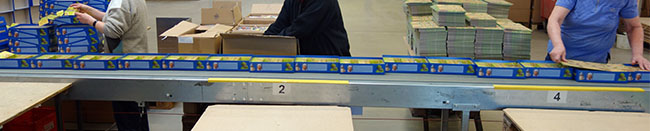
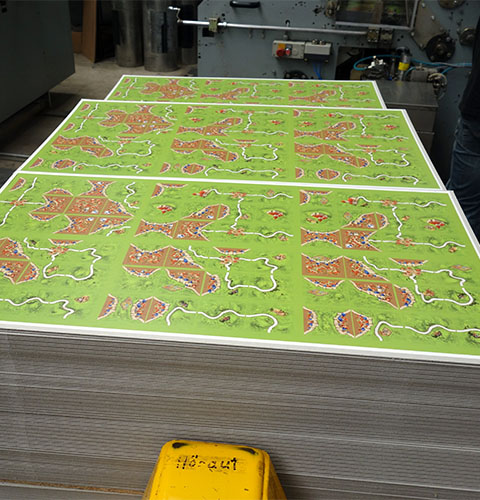
Als wir Westpark Gamers die Produktion am 23. April 2015 besuchen durften, sahen wir zum Beispiel die Live-Produktion eines holländischen Siedlers von Catan, eines spanischen Carcassonne und des Spiels „Samti baSal“ des israelischen Verlages Shafir Games.

Bei der Brettspielproduktion spielen hochspezialisierte Maschinen und Handarbeit eine gleichermaßen wichtige Rolle. Viele der Spezialmaschinen kommen von einem italienischen Maschinenbauer, dessen Kompetenzvorsprung bei der Herstellung von Kartonnagemaschinen daraus resultiert, dass die italienische Schuhindustrie schon vor Jahrzehnten Maschinen erforderte, um elegante Schuhschachteln herzustellen. Selbst die Maschinen zum Puzzle-Bröseln (also zum Auseinandernehmen der Teile) lassen sich vorgefertigt kaufen (allerdings hat LUDO FACT die eigene Maschine mit einem hocheffizienten Geheimverfahren zur Entfernung des Puzzle-Staubs verbessert, über das wir hier nicht berichten können). Nur wenige Maschinen sind Spezialanfertigungen, so etwa die Anlage, die das Gewebeband auf Spielbrettern anbringt. Dank dieses Bands kann man später den Karton vollständig durchschneiden, mit der Folge, dass das Brett 100%ig flach liegt.Verpacken

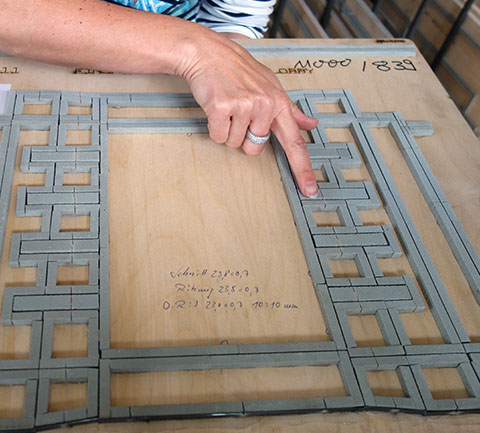
Handarbeit ist allerdings noch wichtiger. Bereits zu Beginn des Besuchs sagte man uns, dass wir auch in der Produktion überall fotografieren dürfen, denn der wahre Vorsprung von LUDO FACT vor Konkurrenten liegt in der Kompetenz der Mitarbeiter. Ein paar Beispiele: Die Stanzen für die Pöppel müssen für jedes Spiel einzeln von Hand aufgebaut werden. Bei der Puzzle-Produktion muss die Vorlage für die Stanzmaschine in den stundenlanger Arbeit vorbereitet werden, damit einerseits der Karton ganz durchgeschnitten wird, andererseits die Messer nicht durch zu weites Schneiden beschädigt werden. Die MaschStanzunginenführer müssen bei allen Arbeitsschritten genau aufpassen, dass das Endprodukt wie gewünscht aussieht und sich nicht etwa das noch aufgequollene Papier verschiebt oder ähnliches. Das Bestücken der fertigen Spiele („Konfektionieren“) muss zwangsläufig in Handarbeit erfolgen, da es sehr, sehr viele unterschiedliche Schachtelgrößen mit ebenso unterschiedlichen Inhalten gibt. Manche Arbeiten sind sogar ausgelagert an Heimarbeiterinnen, etwa das Vorfalten der Schachteleinlage oder das Zusammenbauen von komplexeren Elementen (etwa Würfeltürmen).

Alles, was Karton oder Schachtel ist, ist Kernkompetenz von LUDO FACT und wird selbst hergestellt. Vor nicht allzu langer Zeit hat LUDO FACT eine Druckerei zugekauft und stellt seitdem Spielkarten und viele Druckelemente selbst her (allerdings wird in diesem Bereich auch weiterhin viel zugeliefert). Andere Dinge, wie HoCarcassonnelzfiguren, Metallschachtel usw. usf. kauft man zu, von Unternehmen in Deutschland, dem europäischen Ausland und natürlich China. Für spezielle Anforderungen muss LUDO FACT erst Lieferanten auftreiben. Ein schönes Beispiel sind die „sandsteinartigen“ Pöppel von Babel, für die man erst herausfinden musste, ob es das überhaupt gibt, wer das macht, und ob das zu einem vertretbaren Preis machen lässt.

Wir haben viel Neues gelernt, zum Beispiel, dass Spiele in Abständen in geringen Mengen produziert werden: Also jetzt ein paar Tausend, dann wieder ein paar Tausend, dann noch ein paar Tausend. Der Mehraufwand ist den Verlagen offenbar lieber als die ansonsten notwendige Lagerhaltung. À propos Lagerhaltung: Direkt anschließend an LUDO FACT ist LUDO PACKT, die Logistiktochter, mit monströsem Lager und eigener Auslieferung. Dadurch können die Händler sehr schnell beliefert werden.

Auf Nachfrage erfuhren wir auch das Geheimnis, wie man ein echtes LUDO-FACT-Spiel erkennt. Denn da man sich als Dienstleister der Verlage versteht, hält sich der Produzent weitgehend im Hintergrund. Bei neueren Spielen ist das aufgrund einer gesetzlichen Vorgabe recht einfach: Beim Barcode außen auf dem Spiel gibt es quer eine Zeile, die bei LUDO-FACT-Produkten mit LF beginnt. Bei älteren Spielen muss man sich die Innenseite [!] des Schachtelbodens genau anschauen. Im „Umschlag“ (also dem Teil des bedruckten Papiers, das in den Karton hinein umgeschlagen ist) steht bei LUDO-FACT-Spielen eine Kennzeichnung, typischerweise zwei Buchstaben mit einer Zahl dahinter.

LUDO FACT ist ein schönes Beispiel für einen deutschen Mittelständler: Der breiten Öffentlichkeit unbekannt, auch wenn jeder Produkte kennt, die dort hergestellt wurden, und viele sie im Schrank haben (etwa „Siedler von Catan“). Kompromisslose Qualität, und Export in aller Herren Länder.

Nachruf auf Hans


Hans Rudolf Frey (*25.6.1963 †14.5.2014)

Unser langjähriger Mitspieler und lieber Freund Hans verstarb am 14. Mai 2014, wenige Wochen vor seinem 51. Geburtstag. Wenn das ein viel zu früher Tod ist, so gewinnt dieser seine besondere Tragik dadurch, dass Hans rund die Hälfte seines Lebens von einer schweren Autoimmunerkrankung gequält wurde. Sie machte ihm viele Dinge unmöglich, die für die meisten von uns selbstverständlich sind.

Bis Mitte 20 hatte Hans ein normales Leben, studierte Physik, bereiste Südamerika, arbeitete bei einem Hersteller von Lernsoftware. Die dann einsetzende Colitis Ulcerosa bedeutete häufige Klinikaufenthalte und schwere Operationen, ferner Phasen großer körperlicher Schwäche.

Wir kannten Hans seit den späten 90er Jahren, als er sozusagen Gründungsmitglied der „klassischen“ Westparkgamers wurde. Hans war einer von den wirklich intelligenten Menschen, die ich kennen gelernt habe; als Spieler jemand, dessen Manöver man niemals aus dem Blick verlieren durfte. Seine Klugheit war gepaart mit großer Besonnenheit, die stets höchst willkommen war, wenn gelegentlich am Westpark aufgrund unterschiedlicher Regelinterpretationen die Stimmung hochkochte.


Neujahrsspielen (1. Januar 2004)

Seine gut zehn Jahre am Westpark waren immer wieder unterbrochen von Krankheitsphasen. Ich bewundere Hans weiterhin für seine mentale Stärke, denn geklagt hat er nie. Wenn Walters Einladungsmail kam, passierte es eben, dass Hans zurück schrieb, er müsse bald wieder in die Klink und falle deswegen die nächsten Wochen und Monate aus. Dass sich sein Zustand zuvor verschlechtert hatte, ließ er sich niemals anmerken.

Nicht nur die Leidenschaft fürs Spielen verband mich mit Hans. Ich erinnere mich mit großer Wehmut an viele gelehrte Diskussionen, in denen er, der Physiker, naturwissenschaftliche Phänomene für mich herunterbrach, wir Kopenhagener Deutung versus Viele-Welten erörterten, über die Entstehung komplexer organischer Moleküle, also den Anbeginn des Lebens, philosophierten, die verschiedenen Arten und Ausbreitungsmechanismen von Krebs besprachen. Ich wüsste nicht, wen ich heute anrufen sollte, um solche Gespräche zu führen.


Hans‘ Sommerfest (18. Juli 2004)

Hans war ein Kämpfer. Vor jeder schweren Operation war er sicher, dass es ihm danach besser gehen würde, eine jede ging er nicht verzagt an, sondern mit großem Optimismus und ungeheurem Lebenswillen. Lange Jahre war er so krank, dass er gar nicht arbeiten konnte, aber in der zweiten Hälfte der 2000er, als es ihm besser ging, bildete er sich mit mehr als 40 Jahren zum Medizinphysiker weiter und wirkte dann im Krankenhaus bei der Bestrahlung von Tumoren mit. Dadurch hatte Hans weniger Zeit zum Spielen, denn einerseits hatte er oft Schicht, andererseits, wie er nicht selten schrieb, kostete ihm die Arbeit so viel Kraft, dass er für die Freizeit weniger Energie hatte. Doch auch hier: Feststellung, nicht Klage.


Beim Ys-Spielen (2. Dezember 2009)

Das letzte Mal, dass Hans regelmäßig am Westpark war, war im Juli 2010. Dreimal nahm er danach noch an Spielabenden Teil, zweimal Ende September und schließlich ein letztes Mal Mitte Oktober 2010. Dann schrieb er, dass es ihm schlechter gehe und er vorerst nicht mehr kommen könne. Im Dezember zog er nach Weilheim um: Dort hatte er im Krankenhaus eine feste Anstellung gefunden, und konnte sich damit auch endlich eine schöne Wohnung leisten.


Hans‘ vorletzter Besuch am Westpark (29. September 2010)

Seine Euphorie wurde noch größer, als sich für ihn eine Spenderleber fand, denn die schwere Medikamentation hatte im Lauf der Jahre seine Leber ruiniert. Er war sicher, dass nach dieser Transplantation seine letzten Beschränkungen entfallen würden und er endlich ein halbwegs normales Leben würde führen können.

Die Transplantation geschah im März 2011, erfolgreich, doch bald traten schwere Probleme auf. Nicht mit dem neuen Organ, sondern mit Hans‘ Gehirn. Eine andere, sehr seltene Autoimmunkrankheit begann, Teile seines Gehirns zu zerstören. Hans wurde zum Schwerstpflegefall. Nach einer Abfolge von Aufenthalten in verschiedenen Krankenhäusern und Heimen war Burghausen die letzte Station, wo er drei Jahre später verstarb.


Hans (18. Februar 2004)

Lieber Hans, wann immer sich Walter ohne Widerspruch die roten Steine sichern kann, wann immer ein anderer dir Konkurrenz macht und wegen übermäßiger Bedenkzeit ermahnt wird, wann immer die Chips aus Walters nie versiegendem Vorrat nachgefüllt werden müssen – ich werde an dich denken.

Was soll man nur schreiben angesichts der Endgültigkeit des Todes? Vielleicht so etwas: Das an sich schöne Spiel leidet an einem übermäßigen Glückselement, das bereits in früheren Spielphasen einzelne Spieler massiv in Nachteil bringen kann. Sauberes Planen bleibt gleichwohl weiter unerlässlich und wird auch belohnt. Die Asymmetrien hinsichtlich der Ausgangspositionen und die unberechenbaren Zufälle geben zwar dem Spiel seinen einzigartigen Reiz, können es einem aber auch mitunter recht vergällen. Um den Schluss einer Spielrezension zu zitieren, die Hans einst schrieb: „Unbefriedigend? Ich sage dazu: C’est la vie!“

Peter Riedlberger


Hans Beiträge auf unserer Website


Hans Lieblingsspiele

  • Caylus
  • Imuri
  • 6 nimmt!
  • Acquire
  • Bausack
  • Friedrich
  • Goa
  • Legend of Zandor
  • Puerto Rico
  • Small World
  • Vom Kap bis Kairo


Hans Spiele für die einsame Insel

  • Go (trad.), SpielTIEFE, könnte man sie in einem Leben ergründen?
  • Acquire (AH), 128 ! mögliche Spielverläufe, jeder hoch spannend
  • Empires in Arms (AH), Großmachtpolitik in Europa von 1805-15; Diplomatie-Spiel in realistischem Szenario – DAS beste
  • Risk 2210 A.D. (Hasbro), die Currywurst unter den Brettspielen
  • 6 nimmt (Amigo), für Logiker und Gedankenleser

Pursuit of Glory

Pursuit of Glory

by Moritz Eggert

Hello my friends – I hope you had a happy holiday and a good New Year! 2008 seems to have been a good year for wargames. If one looks at the current top five at boardgamegeek the first FOUR games have all been published in 2008 and the fifth game in 2007. These games are „Combat Commander: Pacific“, „Conflict of Heroes“, „Devil’s Cauldron“, „Unhappy King Charles“ and „Napoleon’s Triumph“. „Conflict of Heroes“ has gotten the most positive buzz lately – I could see with my own eyes that it was one of the most played games at Boardgamegeek con. Unfortunately I have yet to play this game, so I reserve final judgment over it, but the voices that express a great liking to this system are all very believable ones.

But this time I want to talk about another game that was my personal favourite wargame of 2008, and that is „Pursuit of Glory“, „Paths of Glory Part II“ if you will. I have to fully admit that I am a sucker for the Near East as a theatre of war – I find the mixture of cultures and religions highly fascinating, and the history of the region is full of heroic and sometimes less-heroic strife that makes for a fascinating backdrop.

Everybody who has ever played me as the Germans in any World War II game knows that I always will try to force the scenic route through Turkey. My favourite strategy in Barbarossa to Berlin is for example to conquer Alexandria and Cairo from the East; after coming through all of Turkey and then Palestine, and then put pressure on the Russians from the South. Of course this is a strategy that is often bound to fail, but if it works it’s great fun!

But I also have to admit that playing the Central Powers in a World War I game like PoG is a less guilty pleasure than playing the Nazi forces in WW II, it just feels better if you know what I mean. There was more honour in World War I, even though it was a senseless and extremely cruel war.

Every „Paths of Glory“ player knows that it is dangerous to underestimate the Near East, but there never seem to be enough resources to really be active in a big way. On the PoG map the Near East is a tiny sub-map with only a handful of spaces. This now changes as now this theatre gets star coverage in „Pursuit of Glory“ and is blown up to epic proportions. This also enabled the designers, Brad Stock and Brian Stock, to really go into great detail regarding the incredibly varied forces that were fighting in this region. These might range from Russian tank companies to hardy Turkish infanterists, from wild and untamed tribes attacking on horseback with makeshift weapons to religiously motivated rebellions. And there is always the Berlin-Baghdad railway to save the day!

„Pursuit of Glory“ comes in pretty much the same format as the original Paths of Glory, and each PoG player will recognize many features from the old game. It is a card-driven game that uses the basic 20th century warfare system created by Ted Raicer that is also used in Barbarossa to Berlin and Shifting Sands, albeit with some differences. Unlike for example Napoleonic Wars, in which it is impossible to act without leaders, here we deal with large combat units and small combat units, each of which represents an organized force like a division or a corps or even a wild tribe. This means that organizing a unified front is all important – holes in your front can always be exploited and attrition can wipe out whole stacks of units if the enemy drives through your lines and cuts your supply. This makes for nail biting decisions and great suspense, as any PoG player can attest to.

The game also uses three decks that consecutively come into play – one for „Mobilization“, one for „Limited War“ and one for „Total War“. Each card doubles as an event or ops, and most of the time you can only use one of each. The events lock into each other in complicated ways – some will usually have to be played if you want to be successful or are a prerequisite for other events, others are more optional. Timing is of the essence!

The map depicts part of the Balkans including Romania and Bulgaria as well as Serbia, Greece, all of Turkey, and great parts of Persia and North Africa as well as the Caucasian region. The map is huge and incredibly detailed. One thing that immediately is noticeable is that there are a LOT of victory point spaces, I would estimate at least double as much as in PoG. This means that basically each part of the map will really be used all the time, every front is equally important. There are also arrows leading to regions like India, which aren’t fully depicted. Any historian knows that the Near East front was extremely fluid, and sometimes it was even unclear why people fought against each other. The Germans for example often tried to incite religious anger against the colonial powers and had Muslim allies, like the Turkish but also tribes from Afghanistan and North Africa. The British on the other hand gained the tribal allies that were oppressed by the Turkish expansionist interests, most famously of course Lawrence of Arabia with his Arab Northern Army. So it was Muslims against Christians, Christians against Christians, and Muslims against Muslims, not to forget the Russian-Orthodox forces turned atheist through the Russian revolution- surely a crazy time. Throw in some colonial forces from India, French foreign armies and many fascinating historic events and cook to perfection – voila, „Pursuit of Glory“ indeed!

Now I have one big caveat – this is not an easy game to learn. I would actually not recommend playing this game before having played „PoG“ a couple of times. It comes with a rulebook that makes „Here I Stand“ and „Empire of the Sun“ look like quick reading material, it’s a long tome and also comes with the usual historical commentary and detailed examples of play that we are used to with GMT. But the good news is that all these rules are extremely well organized and everything is easy to find. I would say that these are some of the best rules that GMT have ever produced, and I personally found no area of play opaque or difficult to get, even though one is bound to overlook some chrome during first playthroughs. Most importantly the game includes 2 primers, one for people who have NOT played „PoG“ yet (and I don’t envy them starting with this game -the original PoG, which is not an easy game as well, will seem like Snakes and Ladders to them afterwards), and a primer for people who HAVE played PoG already. The latter primer is only 2 pages long and lists all the rules sections which include differences from what you are used to from PoG.

What I did is read only these sections (which didn’t take that long) and then immediately started the game in a solitaire runthrough to get used to the details. Everything is well explained and it was easy to find the passages which included new concepts from then onwards, I never found that I had to read everything; I just looked up the new details.

One player plays the Central Powers, which is mostly Turks but also some German, Austrian and Bulgarian troops, as well as the aforementioned many tribes.

The Allies on the other hand control everybody else, British, French, Romanians and many more, even one single Italian counter makes it into play after a certain event is played.

Now to the new concepts that make play very different from PoG.

First of all there are the irregular troops and the Jihad Level. Some of these irregular troops are the aforementioned tribes, but there are also very unique troops like a camel corps that have special rules. Tribes are weak units and basically live of the land, which means they don’t need normal supply sources like the normal troops. This also means that they can rummage around behind enemy lines, disturbing their supply, taking VP spaces and much more. The Central Powers use the tribes a bit more because they try to control the „Jihad Level“, which is influenced by card play and also the capture of religiously important spaces by the Allies. The higher the Jihad level the more tribes can be placed, and believe me, they can really be a nuisance. PoG had 3 corps that represented tribes, this game has literally dozens of them, and they constantly pop up behind your lines.

Another new aspect is headquarters. The Near East was a theatre in which personal abilities and bravado of the commanders mattered more than in the more static European fronts, this is why one has headquarter counters here, each with it’s own special abilities. Think of them as leader counters, they also don’t add to the stacking limit as well.

Another new concept is Railroads, which are used in supplying but also transporting troops around the map. And there are also Assets, an interesting concept that enables players to actually build a Large combat unit by combining 2 or 3 small combat units, a tactic that is especially important for the Turkish/Central player who starts out with weak defence that has to be brought up a step quickly. There are also regions that depict the greater areas that can’t be depicted fully on the map, like India or Afghanistan, and there is also, like in PoG, an insert map, this time of Gallipoli, a Turkish area that saw some of the hardest and violent fighting in WW I.

So how does it play? First of all both players will be basically overwhelmed by the choices they have. Even the first action of the game is not as clear cut as in PoG, with Guns of August being mostly the standard play. The Central Powers basically are on the defence from the start on, and they have not one but 5 fronts. The most active front at the start of the game is the Northern Caucasian Front where Russian armies attack, but these will hopefully fade away through the Russian revolution after a while, which is triggered through several card play steps, like in PoG. There is also the Eastern front, as Persia – although neutral at first- can quickly be brought onto the Allied side. Then there is the Southeast and the Persian Gulf where the Allies can bring in some easy invasions. Then there is the Southwest, with British forces lingering before an expanse of desert. And not to forget the Northwest, with looming involvement of the resurrected Serbia and also Greece and Romania. Basically it’s trouble everywhere, and the Allied player can even open up new problem zones by bringing in seaborne invasions.

Interestingly enough the Central Forces bear quite a punch, perhaps more so than in the original PoG, through the involvement of the tribes. Even though the Allies theoretically feel powerful they are much less so in reality because it is very difficult to really put pressure on one point. Because the front is so fluid even a carefully planned invasion can suddenly turn into only a minor nuisance, and it is really difficult for the Allies to create one big push like they usually do in old-style PoG. But the Central Player has one big problem, and that is dwindling resources. Even though Turkish armies start out quite powerful they become less and less so because of their Replacement point limitation, at some point they just wither away. And even though the Allied player doesn’t have a hammer that breaks through lines, he can create many, many pressure points, like small pricking needles, at some point these will have their effect, that’s for sure, it’s only a matter of time.

So far I found Pursuit of Glory to be a balanced and exciting game. The action is consistent – there will never be a long lull with both players playing replacement actions, everything is always on the move. In my opinion it is the best game on this theatre of WW I so far – it packs in loads of historical detail in a manageable way. Even though this is certainly on the higher end of card-driven games complexity I can only highly recommend it to anybody who likes this genre and this period, the game’s approach is extremely solid and everything seems to have been well researched and implemented. So put on your turban or your helmet and lead your armies to glory or the vain pursuit of the same and play this game – you won’t rue the day you bought it!

Happy gaming in 2009, Moritz over and out.

1830 für Gourmets


von Walter Sorger

Eigenschaften bester Spiele

Die Geschmäcker hier hienieden sind verschieden. Was Spiele betrifft gehen die Differenzen sogar mitten durch unsere, von Interesse und Spiel-Auffassung doch ziemlich homogene WPG-Gruppe. Es gibt eine eingeschworene 18xx-Fraktion, die alles stehen und liegen läßt, wenn ein Spiel dieser Serie angesagt ist. Und es gibt ein paar individuelle Geister, die immer wieder fassungslos vor den hohen Noten stehen, die wir für diese Art von Spielen vergeben.

Warum ist „1830“ für mich das Non-Plus-Ultra? Zur Antwort will ich nur ein paar wenige Eigenschaften herausstreichen. Die Kriterien sind abstrakt. Jeder Autor, Kritiker oder Leser, der eine Zielgruppe wie die WPG im Auge hat, kann seine eigenen Ideale mit diesen Qualitätsmerkmalen vergleichen.

Vielfalt im Handlungsspielraum:

Handlungsfreiheit ist mein oberstes Qualitätskriterium. Ein Spiel, mit dem man gerade mal eine Karten aus der Hand spielen oder gerade mal 1-2 Pöppel vorwärts ziehen kann, wird für mich nie über unteren Durchschnitt hinauskommen. In „1830“ kann man Kaufen und verkaufen, kreativ Bauen (welche Auswahl!). Engpässe an Ressourcen vermeiden oder bewußt herbeiführen, Kooperation oder Gegnerschaft eingehen, Nibelungentreue oder Verrat praktizieren; alles das sind ganz selbstverständliche und erfolgreiche Grundelemente des Spielablaufs, zusammengeschweißt zu einer natürlichen Einheit an Thema und Interpretation.

Komplexität:

Für mich bedeutet WENIGER Komplexität ein mehr Qualität. Ich mag nicht hunderttausend verschiedene Einzeleigenschaften auswendig lernen zu müssen, um ein Spiel zu beherrschen. In „1830“ gibt es Aktien, die man kaufen und verkaufen kann, es gibt Schienenteile, die man legen oder auswechseln kann und es gibt Züge, die man fahren lassen kann. Das ist alles. Gott-sei-Dank!

Überschaubarkeit und Planbarkeit:

Ich möchte einen Spielablauf in seiner Gesamtheit erkennen und aktiv gestalten können. Bei „1830“ ist allen Beteiligten von vorneherein ganz klar, was geschehen wird: Die Eisenbahn-Gesellschaften werden sich entwickeln, einige Linien und Zentren werden dominieren, ich muß danach streben, an den Brennpunkten beteiligt zu sein und ein paar wichtige Fäden in die Hand zu bekommen. Die Rolle, die jeder dabei spielt, ob er im Spielfluß Gas gibt oder bremst, liegt ganz in seiner Hand. Und natürlich in der Hand seiner Konkurrenten. Aber nirgendwo sonst!

Stimmigkeit:

Wir wissen wohl alle, was darunter gemeint ist. Wenn ein Spiel von mir Berechenbarkeit erwartet, dann darf es mich nicht dem Chaos ausliefern. Wenn Kampf angesagt ist, dann zählen Wölfe und nicht die Schafe. Wenn der Zufall eine bedeutende Rolle spielt, dann muß es flott gehen und es bedarf eines natürlichen Korrektivs gegen Glücks- oder Pechsträhnen. „1830“ ist diesbezüglich ohne Fehl und Tadel. Zufälle gibt es überhaupt nicht und Ungereimtheiten genauso wenig. Alles baut auf dem Plan auf, den ein jeder für sich verfolgt. Enttäuschungen, ein Strich durch die Rechnung sind immer selbst verursacht, entweder durch Denkfehler und durch das Übersehen von scharf-kalkulierten Aktionen der Gegner. Und das ist auch gut so!

Offene Entscheidung bis zum Schluß:

Ärgerlich ist ein Spiel, das vorzeitig – warum auch immer – entschieden ist, und bei dem es im letzten Drittel nicht mehr um den Sieger, sondern nur noch um die Höhe des Sieges geht. Bei „1830“ ändern die Besitzstände ständig ihre Wertigkeit. Was gerade noch hoch lukrativ war, kann im nächsten Augenblick schon auf den Konkurs zusteuern. Manchmal überraschend, post mortem wären die dunklen Vorzeichen aber immer erkennbar gewesen.

Pro Runde steigen progressiv die Umsätze. Wer am Anfang in Rückstand gerät, hat allein schon deswegen durch gutes Mittelspiel noch Chancen auf den Sieg. Der Führende ist ständig gefordert, die gegebene Spielsituation mit Umsicht zu meistern, wenn er die Spitzenposition behaupten will.

Andererseits wird ein guter Spielstand auch nicht durch irgendwelche Ereigniskarten, Schicksalsschläge oder sonstige unberechenbare Widrigkeiten ins Gegenteil verkehrt. Wer im gesamten Verlauf des Spieles am besten spielt, darf seine Führung auch sicher bis ins Ziel tragen. Das Gleichgewicht zwischen der Erhaltung des Besitzstandes und der Gefährdung desselben durch gutes Gegenspiel: in welchem anderen Spiel ist dieses wichtige Gleichgewicht besser realisiert?

Schadenfreude:

Konstruktive Schadenfreude ist ein sehr positives Spielelement. Nicht daß jemand einen schlechten Würfelwurf hinlegt, nicht daß jemand eine Risiko-Entscheidung verliert, sondern daß ein Spitzenspieler einen entscheidenden Winkelzug seiner Gegner übersehen kann und als Folge davon gravierende Einbrüche in Kauf nehmen muß, das hält die Spannung aufrecht (und fördert Spaß und Lust aller Beteiligten). Daß bei „1830“ solche Verluste an der Tageordnung sind, macht einen der vielen konstruktiven Charakterzüge des Spieles aus.

Zweitbeste Spiele

Ich möchte „1830“ jetzt ein paar anderen Brettspielen zum Vergleich gegenüberstellen. Alles sind weit überdurchschnittlich gute Spiele, denen es als Ehre gereicht, hier erwähnt zu werden. Kein Autor sollte sich auf den Schlips getreten fühlen, wenn er nur den zweitbesten Platz zugewiesen bekommt. Es sind meine persönlichen Präferenzen. Die Unterschiede will ich anhand von guten und sehr guten Küchen in Deutschland veranschaulichen.

1830

Entspricht einem Abendessen beim Winkler in Aschau: Abendfüllendes Programm, bei dem alles stimmt, vom Ambiente über die Einleitung bis zum Kick auf dem Höhepunkt. Und bis zur Abrechung am Schluß.

1835, 1844, 1856, 1860, 1895, 18xx

Sei es nun die Schwarzwaldstube Traube-Tonbach oder das alte Aubergine in München. Ich will niemanden von den Meisterköchen in die Pfanne hauen. Die Spiele der 18xx-Serie sind alle ein Hochgenuß, meisterhafte Erzeugnisse einer hohen Schule. Mal reichhaltiger in der Zusammenstellung, mal auf eine kleine, feine Genießerschar eingestellt. Einfach aus liebgewonnener Tradition steht 1830 für mich an der Spitze.

Bluff

Canapee aus dem Hause Dallmayr. Vielfalt auf kleinstem Raum, ausgezeichneter Geschmack. Man kann sich ein Leben lang davon ernähren. Sogar ausschließlich. Aber selbst mit einem guten Burgunder wird daraus kein richtiges Gelage.

Carcassone (Basis-Version)

Mittagsmenü in einem südfranzösischen Landgasthaus: in der Regel ist ein Gourmet-Erlebnis angesagt. Doch das tatsächliche Ergebnis hängt sehr stark von der Laune der Madam de Cuisine ab; sprich: Fortuna entscheidet für mich, ob es wirklich gelungen ist.

Puerto Rico, Die Siedler von Catan

Eine Lasagne aus der Hobbyküche meines Sohnes (Student): Mit sehr viel Erfahrung und Liebe zubereitet und immer wieder mal mit neuen Gewürzen passend abgeschmeckt. Vorzüglich in seiner Klasse. Noch fehlt ein Funken Genialität für den Stern zur Note 1.

Euphrat & Tigris

Wiener Schnitzel: hochwertiges Kalbfleisch mit feinster Pannade und einer frischen Zitronenscheibe. Für manche Mitbürger (z.B. für meine Ungarin) ein Nationalgericht. Für mich in der Summe etwas zu trocken.

Junta

Japanischer Kugelfisch (so stell ich ihn mir wenigstens vor), ein Kitzel für den Gaumen. Allzuleicht kann daraus ein tödlicher Genuß werden.

6 nimmt

Unser Grieche um die Ecke, immer einladende Atmosphäre, immer appetitliches, schmackhaftes Angebot. Aber irgendwie sträubt sich die Feder, für Lamm-Koteletts mit Tzatziki und Bauernsalat den Ausdruck „Hohe Küche“ zu gebrauchen.

Hase und Igel

Siemens Werkskantine: Bekanntermaßen eine Einrichtung gehobener Qualität: solide handwerkliche Arbeit, sauber und ordentlich serviert. Naturgemäß liegt ein gewichtiger Schwerpunkt auf Durchsatz und Geschwindigkeit.

Titan – The Arena, Colossal Arena

Mariniertes Schweinefilet auf Rhabarber nach Art von Jamie Oliver. Bunt und bemerkenswert. Wenige Zutaten gekonnt zusammengestellt und mühelos auf den Tisch gebracht. Für meine Vorlieben leider eine ganze Generation zu jung.

Castle of Magic

Schuhbeck’s am Platzl: vom zerhackten Würstchen in Sahnesud als Amuse Geule bis zur Bayrisch Creme eine bemerkenswerte Kombination von gewollt bodenständiger Tradition mit gekonnt internationaler Moderne. Ich habe meine Geschmacksnerven noch nicht genügend umerzogen, um die angebotene Richtung in meinem Weltbild einordnen zu können.

Sankt Petersburg

Abschlußgericht vom Kochkurs für Fortgeschrittene in der Volkshochschule. Das Ergebnis kann sich sehen lassen. Wir haben alle daran mitgewirkt und die Geheimnisse von Rezept und Zutaten entschlüsselt. Das geht unweigerlich auf Kosten von Überraschung und Spontaneität.

Fazit

Es muß nicht immer Kaviar sein. Aber wenn ich mir ein abendfüllendes Menu wünsche, auf dessen Gestaltung ich Einfluß nehmen kann, das meine Geschmacks- und Magen-Nerven kitzelt ohne mich zu überfüttern, dann gehe ich – zu „1830“.


Games for Three Couples

by Peter Riedlberger

If you have got lewd thoughts reading this headline, this article is not for you. Rather I am sharing some thoughts about having a successful board gaming time with your significant other and two other couples.

It is difficult enough to find a playable game for six players. First of all, there are few German games which are designed for more than five players. More often than not they don’t play well because people have to wait way too long before it is their turn again. Waiting time in games equals boredom, at least for me and most people I play with. Therefore, do not recommend some huge war game to me as the ideal solution for six players. Apart from the downtime, there is the game theme issue as well. Not everyone feels comfortable with war games, and females possibly less then males. In short, I wouldn’t recommend History of the World for your cosy gaming night.

Successful six player games need to address several issues. They need to keep downtime short. This can be accomplished by leaving only a limited number of choices to the player whose turn it is. Another efficient gaming mechanism is auctions – they keep all players busy. Another important factor is rule complexity. Probably not every one of your three couples is an experienced player. Therefore, explaining complicated rules might be too much, boring the advanced players and overwhelming the inexperienced ones. Therefore stick to easy rule sets (again, this disqualifies sophisticated war games). I feel that playing several games is better than spending the whole evening on the same game. If someone doesn’t like a game or isn’t successful at all, s/he might enjoy the next offering. Therefore, quick games are better than long games.

For the reasons outlined above, there is not a single full-blown boardgame I would recommend. Only perhaps „Traumfabrik“ might be such a candidate; it is easy to explain and understand, it plays in less than one hour, and due to its auction mechanism, everyone is involved all the time. However, „Traumfabrik“ is for five players maximum which is a pity indeed. I really would love to have an updated six player version.

These are the games I can really recommend for your hot pot three couples night:

BLUFF – As always, indispensable. Incredibly easy to explain, and no matter how often you play it, it’s constantly fun. Since playing bluff successfully means you need to know to how bluff, not only mathematics nerds can be winners. Bluff is actually the more fun the more players you have. A game takes about 15 minutes.

ZOFF IM ZOO – Since the rules are explained in two stages, it is fairly easy to understand even for non-players. The two player teams add additional fun for couples. Not only females like the cuddly Doris Frank animal artwork. A game should be finished in 30-45 minutes.

HAVOC – Yes, I am about to contradict myself. Havoc has a war game theme but in fact, it’s pretty abstract. Havoc takes a long time to play (90+ mins) but it is so much fun that this is still acceptable. One big advantage is the rules which can be readily understood since you can use the basic poker knowledge almost everyone has. Additionally, I like the fact that everyone’s sense of achievement gets boosted: If you don’t enter some fights, you’ll surely win the next. No-one is completely lost.

I wish I could recommend more games, but I cannot at this time. On the other hand, these three should be enough for an enjoyable time, and they have proven to be on more than one occasion.

Hispania Playing Aid

Playing Aid Hispania – Combat Table

To hit, you must roll a 7 or higher on a 10-sided die.

The following modifiers are applied to your die roll. All modifiers are cumulative. Regardless of modifiers, a 1 is always a miss, a 10 is always a hit.

Attacker modifiers Elite vs Infantry: +1 Cavalry in plain vs (any): +3 (any) in mountain : -1

Defender modifiers (any) vs Cavalry in plain -2 (any) behind river, in first combat round : +2

General modifiers Knight vs (any): +2 (any) vs Knight: -1 (any) vs Elite: -1 (any) vs Castle: -1 with leader: +2 with religious zeal: +1

Hans Frey

A Very Good Year

Development Notes for 1830

By Bruce Shelley

Our design staff heard the first news of 1830’s existence during „Origins“ in 1982. Tom Tresham, the brother of 1830 designer Francis Tresham, had come to the convention representing an English game distributor and we questioned him at length for game news from England, especially regarding his brother. By this date we had already purchased CIVILIZATION from Francis and had been playing his 1829 games about British railroads for many years. The idea of an 1829-type game about American railroads appealed to us immediately, and we told Tom to pass on the word that we were very interested in seeing 1830.

The 1830 proponents on our staff at this time were Mick Uhl, Alan Moon, Richard Hamblen, Rex Martin and myself. My own interest traced back to the first Michigan „Origins“, when I stumbled across a mixed group of gamers from MIT and Penn playing the first 1829 game. I was immediately fascinated by the topic and mechanics, and quickly knew „I’ve got to get this game.“ I soon did and 1829 became regular fare at the meetings of the UVA game club to which I belonged. My future colleagues at Avalon Hill had come across 1829 on their own a couple of years before this, and although they liked it very much, they did not believe it was a sellable product in the United States.

Not being the patient sort, I wrote to Francis after the ’82 Origins on behalf of Avalon Hill reiterating our interest in the 1830 project and offering to help in any way I could. Francis responded enthusiastically, beginning a long and enjoyable transatlantic correspondence. He had been hoping to sell the 1830 game to us all along, and was pleased to find strong support already in place.

In the fall of 1982, then, we were excited by the prospect of soon having an 1830 prototype in hand, and seeing it in print quickly thereafter. However, this was not to be. 1830 was not published until the early spring of 1986, almost four years after we had first heard of its existence. Over this time period the project had many ups and dawns, including the nadir in the fall of 1984 when 1830 was all but dead.

The first major delay was quite simple to understand. In the fall of 1982 the game was not finished. Although Francis had a game that was being playtested, he was not yet sufficiently satisfied to submit it. In Baltimore, we were quite anxious to get a prototype to examine, but Francis felt this would not be helpful and continued his development in England. The help we could give in this stage was mostly research on aspects of North American railroads and general encouragement. I recall sending information on possible private companies, suitable colors for the railroad pieces, and even designing a sample president’s certificate. Word finally arrived that Tom and Francis were coming to Origins ’83 in Detroit and were bringing an 1830 prototype to leave with us.

I don’t believe I have looked forward with more excitement to any event in my gaming experience than I did to meeting Francis and seeing his 1830 prototype. By now I felt we had become good friends through our correspondence and I had the highest regard for his earlier games. Our meeting was a great thrill for me, and I think also for the entire Avalon Hill entourage, as both Tresham brothers proved to be quite charming and good company.

My first exposure to the 1830 prototype was no less a success. The map and pieces looked much as they do today. We immediately arranged a playtest for the afternoon, and thereafter played it several more times before the convention ended. For our early playings we concentrated on learning the rules and components, and we all enjoyed it very much. I enthusiastically recommended it to Tom Shaw and was backed up by others who had had a chance to play. The convention ended too quickly for me, and the Treshams could not stop in Baltimore on their way home as they (and we) had hoped. I returned home with the prototype and quickly arranged to show it to the local enthusiasts who hadn’t gone to Detroit.

My memory of what this first prototype was like is a little hazy as it did not remain in its original form for long. Also, that first copy was returned to England during the game’s dark days. The largest differences between this early game and what was published are as follows:

1) On the stock market there were no orange and brown zones, and the highest prices reached $1000 instead of $350 (in the same number of spaces).

2) You could not buy stock in your choice of railroads after the private companies were sold. Instead, the companies were sold in order-PRR, NYC, CP, B&O, C&O, ERIE, NYNH&H, B&M. Shares in the NYC could not be bought until all PRR shares had been bought. Shares in the CP could not be bought until all NYC shares had been bought, and so on.

3) Initial share prices were fixed-PRR ($100), NYC ($90), CP ($82), B&O ($76), C&O ($71), and all others $67. Tokens were placed on the Stock Market in a specific box marked for each railroad.

4) Private Companies could be sold to railroads for up to five times their printed value. Printed values were higher; I recall the Camden & Amboy was $210 and the B&O was $265. (Thus, the C&A could be sold to a railroad for up to $1050.)

5) The PRR and NYC had no 20% certificate, just ten 10% shares, one of which was the president’s certificate. The NYNH&H had a 30% president’s certificate, a 20% certificate, and five 10% certificates. The B&M had a 40% president’s certificate, two 20% certificates, and two 10% certificates.

6) The map was very close to the published map, some important differences being no bypass track around the PRR home base in hex H-12 and the printed track on the New York hexagon connecting to hexes F-18 and G-17 instead of F-20 and H-18 as they do now.

Back in Baltimore we began playtesting in earnest. It took a few playings to get the rules down and get together a cadre of experienced players. As our playing continued through the summer and fall, our dissatisfaction with pans of the game increased. The wide open play of 1830 was a radical departure from the stately elegance we were familiar with from 1829. Bankruptcies were a common occurrence. To a large extent, a player’s fate in the game was out of his own hands.

Our first major concern dealt with the selling of the private companies for up to five times face value. The holders of the big private companies would sell for all they could get and then buy up stock. Players not in a position to do this seemed to be at a clear disadvantage, as the others would fill their stock portfolios much earlier. I have notes on one playtest where two „3“ trains had been bought. During the stock round following the purchase of those „3“ trains, every remaining company in the game (#4-#8) were floated. This resulted in almost every company share selling for less than $40, and a wild scramble for trains thereafter.

This sudden acceleration of the game seemed to lead to other distortions. So many railroads would be floated so quickly that we would find ourselves purchasing „5“ trains before they were really useful. In another playtest we had a situation where the trains came out so suddenly that the „4“ trains operated for only one operating phase. In other cases, the player purchasing the last „4“ train never got to operate it all, as his purchase was immediately followed by purchases of all the „5“s, one „6“, and a Diesel.

The extremely high stock values also seemed unsatisfactory, as they made share dividends substantially less important. The smart play seemed to be a consistent payment of dividends, regardless of the amount, to drive up the stock price. Obtaining a larger train was not worth any reduction in stock price because the last couple of jumps in the price ($100 per turn as I recall) could not be made up by any increase in train size. Thus, there was too little emphasis on board play towards winning. The value of track routes and rolling stock had a much reduced relation to winning compared to stock values. Diesels were only bought as an offensive ploy, to remove all „4“ trains from play and possibly force other players to buy diesels out of their pocket. We rarely saw more than three diesels purchased, and usually only one was purchased intentionally.

Our final major criticism concerned map play, including the relation of the order of the railroads and the interaction of the tiles and map. In our opinion after several playtests, incentives built into the game resulted in rail nets and operations that often bore little resemblance to historical fact. For example, the Canadian Pacific as the third railroad to operate, invariably laid track straight for Albany and placed a token there at its first opportunity. This guaranteed access to New York. With these connections the CP had little incentive ever to build track in Canada, and the later New England railroads were limited in their development. Also, the Baltimore & Ohio had access to such lucrative routes in its immediate vicinity that there was little incentive to build west. Historically, of course, the B&O was founded to connect Baltimore with the Ohio River Valley and siphon off some of the trade traveling to New York via the Erie Canal. The B&O never built past Washington, but in the game the first tile usually played by the B&O connected it to Richmond through Washington. Of all the rivers included on the map, the Ohio River was absent. We thought this was an error as the PRR, B&O, and C&O were all trying to reach this river and the important trade this would open up. Another example is the C&O railroad which begins play in Cleveland. The C&O began life as the Virginia Central, a major Confederate artery during the Civil War, and was renamed the C&O in 1868. Its headquarters was in Richmond until relocated in Cleveland by J.P. Morgan. Like the B&O, the C&O was trying to connect the eastern seaboard with the growing west. But in our game, the C&O was already west, and spent most of its time building east.

By November of 1983 we had detailed our dissatisfactions to Francis, and I believe they came as a shock to him. Our correspondence increased but we found it took at least a month for a letter to be received, considered, and answered. We looked for extraneous factors that might have influenced our different perceptions of the game. For example, in my experience with the Treshams, they played a very gentlemanly game, concentrating on having fun but not apparently driven to win. I found myself and fellow American players to be very aggressive and analytical, constantly stretching the rules looking for an advantage. Francis also always played in games of three or four players, while we usually had five or six. There was some concern that a larger number of players destabilized the game. In a smaller game every player should have a early chance to operate a railroad. In a larger game, however, some players would have to wait. Refuting my assertion that American players were aggressively trying to win, we found players without a railroad to operate would do whatever they had to do to get a presidency, regardless of the effect on their chances to win. This phenomena worked to destabilize the game, driving down stock prices and accelerating the retirement of trains.

Francis and I also found we had a different idea of how the game should play. I was looking for more of the measured pace of 1829 where the game progressed through a slow evolution of stages. Francis wanted to intentionally do something different from 1829 (he did not consider his second version of 1829 as successful as the first), and he wanted to capture some of the wide open free-for-all entrepreneurship that embodied the building of American railroads. We were both interested in having the game playable in under four hours and keeping the number of components to a minimum.

Still anxious to get the game in print, and believing we were still on the verge of making a great game, I decided to make changes to the game where I thought necessary. I thought this would help, especially considering the difficulty in communicating with England. I was hoping to actually demonstrate solutions to what we perceived to be wrong, where my arguments were not succeeding. Mick Uhl and I concentrated mainly on the map and tiles. We thought that a few changes on the map could improve the historicity of the game by providing incentives for a more historical development. Looking now at a surviving copy of the map we made at this time I see several changes of this type that were not incorporated in the final game. For example, I added the Ohio River which wandered through eight hexes of the map’s southeast corner, plus several important river cities-Cincinnati, Wheeling, and others not named. The PRR base hex had no track bypass and the hex immediately to the east of the PRR base is a mountain hex. This forced most railroads wishing to go west to cross a mountain. The new cities on the Ohio, plus making Chicago a 20/100 and the Gulf a 40/80, were to hopefully provide incentive for westward expansion. Both Albany and Philadelphia were also made river hexes.

We also felt this was a good time to get some other opinions. I made up two playtest kits using Francis’s rules and our map. I believe I also modified the stock market prices and possibly the order of the railroads. The games were sent to two friends, Gerald Lientz of Charlottesville, Virginia, and Steve Simmons of Woburn, Massachusettes. Gerald was a long-time member of the UVA game club and an excellent 1829 player. Steve was one of the people who had been playing 1829 when I first saw it in Michigan, and later had the pleasure of beating me twice in 1829 tournaments. I knew both Gerald and Steve had access to groups of experienced gamers, and were reliable. I was beginning to be concerned that the experiences and styles of play of the groups playing with Francis and myself were being unduly influenced by his and my personal participation. An outside playtest is normally conducted to look for bugs in a game after it is considered finished. In this case I was hopefully looking for support for our changes, and general opinions of the game. I believe I included descriptions of what had been changed as a point of reference. I was prepared for opinions in favor of Francis’s ideas as well, and awaited the first reports.

The results of these playtests were mixed, and therefore did little to advance the game. Both groups enjoyed the game and played it often, but both found several parts of it unsatisfactory. I believe both were thinking like me, dominated by their experience with 1829. I was soon receiving lists of suggested changes from both, and both began playtesting using their own modifications. So, while the playtesters were generally enthusiastic, they weren’t happy with either Francis’s version or our modifications, and were busy designing a third and fourth version.

When news of these playtests and our unhappiness reached Francis he was understandably alarmed. Instead of writing, our next communication was by phone. I can’t recall exactly how our conversation went, but the essential points were that we were unhappy with the game and could not recommend it in its current form. This was a real blow for Francis I’m sure, as he had believed the game was ready for production. But everyone who had played it in the States disagreed. At this point (late fall of 1984) 1830 was just about dead. Management was not happy with me because I had spent so much time on the game with nothing to show for it. I was not happy because this was the most interesting game project I had ever been involved with, and I had been looking forward to seeing it in print. Francis’s disappointment needs no description.

In November I mailed to Francis a final list of our objections. The major problems in our opinion were the selling of private companies, the retirement of trains, and the economic and geographic incentives for unhistorical development of the railroads. As discussed earlier, the ability to sell a large private company for five times its listed price worked to destabilize the game. In its early stages, players not holding one of the big three (Mohawk & Hudson, B&O, and Camden & Amboy) would try and block the others from getting control of a corporation. This was generally impossible, and certainly not fun. Instead of offensively building an empire, we were concentrating on keeping someone else from gaining a big advantage.

The problems with the retirement of trains centered on the „4“ trains. For their cost they appeared to be a bad bargain, often remaining in play for only a short time. Rapid retirement of the „4“ trains occurred most often when five or six people were playing, because then the presidencies were more spread out. Most players could get only one. Train problems became more acute because players didn’t have the luxury of manipulating the trains of two or more corporations for their mutual benefit.

I have already discussed what we didn’t like about the map. While the playtesting was going on we experimented with a few additional ideas. One I liked was adding an additional row of hexes at the map’s bottom. In this row we added the city of Richmond, placing there the base of the C&O. Several hexes west of Richmond in the new row we placed a city which was actually to represent the Virginia coalfields. With this configuration all railroads in the game started east of the Appalachian Mountains except the Erie, and the only gap in the mountain range was through central New York where the Erie Canal and New York Central were historically built.

We also experimented with new geography in the upstate New York area around the Erie base hex. We had found a lot of congestion there in play. Several surviving prototype maps show a number of configurations for what became hexes D-14 and E-11. None of these experiments were found to be an improvement over Francis’s design so ours were abandoned.

Francis had asked me whether the game was salvageable and at the end of my November letter I replied yes, but added that changes would have to be made to make the game fun and interesting to enough people in Baltimore to convince myself and management. I felt that 1830 should be moved closer to 1829 in style of play, and gave examples of three radical suggestions that could be tried: remove the ability to sell private companies; add more trains, money, tile variations, railroads (to give the players more options and decisions in play); or remove the train purchasing requirement for a railroad with no train. I wanted to give the players more options to ponder, and eliminate some of the jarring game conditions that were difficult to foresee and plan for. I wanted to emphasize rewards for consistent good decision making.

Back with the November letter went the original 1830 prototype left with us at the Detroit Origins. I was certainly disappointed to see it go. Francis responded in late December and again in January saying that he would try a few more playtests. If nothing worked out he was going to consider a complete new design, perhaps on the entire United States or just the western railroads. He also mentioned he had seven additional railroad games in some stage of development! (To my knowledge and regret, none of these has yet been published in England.)

Several months now passed with no additional news. Sometime in the spring we received word from Francis that he believed he had revitalized 1830 and that he would be bringing a new prototype with him to Origins ’85. He did not provide any details of what had been done, so we could only wait and see. When Francis and the new prototype arrived, we were pleased to find that the new game appeared to be substantially improved. The first days of the convention were spent in playtests and discussions. By Sunday we were sufficiently convinced of the success of the prototype that we took some time off to visit the B&O Railroad Museum. Again the game was left with us, and we were to continue playtesting. Assuming no more serious faults were found, we were hoping to publish 1830 at the next opportunity in our production schedule.

1830 was saved by several simple changes, most worked out by Francis and one, I believe, from myself. Francis’s critical idea was to eliminate the strict order of appearance for each railroad, and to instead allow stock to be bought in any corporation. The consecutive order of appearance rule derived from his earlier games. By discarding this rule, 1830 was dramatically opened up as a game. Instead of focusing on minor decisions such as which tile to lay where, the player now focused on the major decisions of what railroads to begin. Once the private companies were sold, stock in all of the railroad corporations was available. To me, this offered the player the options I was looking for, and the variety of combinations possible seemed to assure each game would be different.

A second change from Francis was a limit on the sale of private companies. Now they could be sold for a maximum of twice face value, and this seemed a good compromise. A sale for the maximum possible gain remained a dirty trick to the general loss of other stockholders, but it didn’t necessarily wreck the buying railroad or vault the seller into a dominant position. Francis later felt even the double face value limit was too high, but we were happy with it and got our way. This new limit allowed some representation of the „sharp practice“ that characterized early railroad building, but did not massively disrupt play as the old „five times“ limit did.

Other changes from Francis dealt with the private companies. In the original versions only the big three companies had special features (basically the same they have now). Francis added the current features of the Champlain & St Lawrence and the Delaware & Hudson. These changes were an immediate success. We found these two private companies became attractive as they could be important assets to railroads operating in their area. The C&StL is valuable mainly to the Canadian Pacific, but the D&H can be used to materially benefit almost every railroad in the game. We found it especially helpful to the C&O, Erie, B&M, and New Haven. For some it offered a route out of the northeast toward the west, and for others it offered access into New York. The D&H became a very desirable property, and the objective of spirited bidding.

Francis also redesigned the stock market scale into its current format. We were pleased with this because we felt it brought the relative importance of stock value and cash (dividends) back into balance. It was no longer clearly more beneficial to drive up stock prices, or to ignore stock values and go for big trains and dividends. Each railroad had to be considered according to its situation. Diesels were only desirable for those corporations with good prospects for income.

My own contribution at this stage concerned the par price of railroad stock. (If this was not actually my idea, I apologize to the real originator.) In Francis‘ revised game, any stock could be bought, but the par price was already fixed ($100 per share for the Pennsylvania RR, $90 for the New York Central, etc.). I thought, why not let the purchaser of the president’s certificate set his own price? This idea gave the players another tough decision, as the par price determined not only the per share price, but also the amount of capital the railroad would begin operating with. A player could tailor the par price to fit his objectives and his pocket book. The lower the price the easier it would be to find buyers for the stock and the quicker the railroad could begin operating. However, the lower the price the less money the new railroad would have in its beginning treasury. Higher priced stock generally made less relative share value increases over the course of the game. As I recall, this idea of variable par prices was accepted by all parties almost immediately and proved successful.

These changes were worked out during Origins and during continuing correspondence through the Fall. In this manner we arrived at the game as it now exists. Our other objections now either disappeared with the new rules or faded in importance in light of the game’s success. We found it fun to play again, and the problems posed for successful play were challenging. Two old objections not specifically addressed were the retirement of the „4“ trains and some of the game’s geography and history. The „4“ train problem still remains to some extent, but as the game appears to be much more stable than in its previous versions, we accepted this. In my experience, players anticipate problems with the last „4“ train and plan accordingly. Our geographic and historic objections lost their importance once the game was found to work to our satisfaction. As long as the previous versions were not successful, we pressed for having these historical and geographical changes incorporated as well. Now there was no need for change, and we compromised our objections.

From this point the story of making 1830 is an easy ride. I was given the „go ahead“ by management in late 1985. It was my job to edit the rules based on Francis‘ manuscript and incorporate all the last minute modifications. With the help of our artist, Charlie Kibler, Francis‘ original art and graphic work was converted to finished art. I selected the locomotive pictures that appear on the private company cards and train cards, and tried to find locomotives that were historically appropriate. The layout of the game board was just one of many contributions from Mick Uhl. The box cover was based on my design and painted by Jim Talbot. 1830 finally came rolling off the presses in the spring of 1986.

My personal taste in games is for those that 1) reward skill and good decision-making, 2) offer many challenges and interesting decisions, and 3) have simple mechanics allowing players to concentrate on strategy, not the rules. I believe 1830 incorporates all three of my principles. The decision making in 1830 centers on strategic problems, such as which railroad to start or invest in, and at what price. The tile play is somewhat restricted compared to Francis‘ earlier games, both to keep the game short and to keep the number of components down. But this is more than made up for by the strategic decisions that are required. The lurking specter of bankruptcy (absent in some earlier games) and the potential for dirty tricks add a nice element of uncertainty and danger. Various new rules for stock price movements give the stock market a large role. Stocks are continuously bought and sold, changing each player’s fortunes.

Despite the difficulties we encountered in bringing 1830 about, I am very proud of having contributed in some way to its creation. I think it is an excellent game, and it remains one of my favorites. Judging from the comments of those of you who have written us concerning 1830, you agree with me. With your continued support, I hope we can bring you more interesting games of this sort in the future.

THE PRIVATE COMPANIES AND RAILROADS OF 1830

What follows is a brief discussion of each private company and railroad in 1830. These are my opinions and I would not be surprised to find that other players disagree with me. Perhaps the discussion of each will be most valuable to new players with no previous basis for opinion. I have rated the railroads for suitability in two categories: one being one of the initial railroads started; and two, operating a Diesel Train profitably. An „A“ is the highest rating, „C“ the lowest. I also note which other railroads make good complements when run by the same player.

Private Companies:

Schuylkill Valley Navigation & Railroad: The SVN&RR is nothing special but is better than having no private company. I pass on this at my first opportunity and bid on something more desirable. If I’m offered it again, I usually buy it. This company pays the highest relative return and can probably be sold for $40 later in the game to one of your railroads.

Champlain & St. Lawrence: The C&SL matches up very nicely with the Canadian Pacific, but has little value to any other railroad. If you plan to run the CP buy the C&SL. Or, if you end up with the C&SL, consider trying to float the CP (get 60% of the stock bought by yourself and/or other players so it will begin operating) in the first stock round. Again, I usually pass on this company at my first opportunity in order to bid on something better. I never pass it on my second opportunity. It pays the same relative return as the SVN&RR, with the added value to a CP president, and can be sold for up to $80 with little pain to the buying railroad.

Delaware & Hudson: The D&H is perhaps the most interesting private company due to its special feature. By buying it, any railroad can set up a separate railhead in the D&H hex and should obtain access into or out of New York. This feature should be especially valuable to presidents of the C&O, Erie, B&M and New Haven. Your railroad probably won’t be able to afford paying $140 for it, but $70 to $100 is possible. There are usually two or more bids for this company, and anything less than $100 is probably a fair price.

Mohawk & Hudson: The M&H is the least valuable of the big three, and possibly less valuable than the D&H. I will probably buy it if it is available but I don’t recall bidding on it. The owner of the M&H has a tough decision because the development of the New York Central can’t go too far without access to hex D-18. So if the owner plans on running the NYC well, he will probably have to forego the M&H revenue. I normally trade the M&H certificate for an NYC share just before I need to lay a tile in D-18, but selling the M&H has is attractions as well. Another option is to develop the NYC without incorporating hex D-18 and try and keep the revenue coming in as long as possible. Later in the game look to trade the M&H for an NYC share in the Bank Pool or any remaining in the initial offering.

Camden & Amboy: In my opinion, the C&A is the most valuable private company. Besides the fact that it pays a good revenue and can be sold for up to $320, the icing on the cake is the free share of Pennsylvania RR stock. Some day I mean to record the return value of this free share by adding up the dividends it earns plus its final value. This company is normally the object of spirited bidding so if you ever have the opportunity to buy it at face value, don’t hesitate. The C&A usually goes for $175 or more in my experience, and I don’t think $200 is too high, though I’ve never seen it sell for that much. Selling the C&A to a railroad you control for $320 and then selling out so that someone else can try and pick up the pieces is the second most nasty ploy possible in 1830. If you hold more than one share in a railroad controlled by the owner of the C&A be careful of where the priority deal card ends at the end of a stock round, or better yet, never own more than one share in this player’s railroads.

Baltimore & Ohio: I normally don’t bid on the B&O, but will buy it at face value given the chance. Standard play in my experience has been to set the par price of B&O stock at $100 to discourage early investment, and then sit back collecting $30 per operating phase. The B&O Railroad is then started at your leisure, having recouped much of your investment. Unfortunately, other players often will force your hand by buying at least four shares of the stock in the first stock round. This will force you to close the private company, cutting off the revenue. The B&O has a lot of potential, so an early start is not a disaster. Since my heart is for an early start and good development of the B&O (my favorite real world railroad), but my mind says collect the revenue now and run the B&O later, I usually am content to let someone else make the decision.

Railroad Corporations:

PENNSYLVANIA RR (starting railroad-B, diesel-A, complements-C&O, B&O): I don’t like to get the PRR running right away because its opportunities for earning revenue are less than other railroads. It is handicapped by its base with a revenue of „10“, and the restricted development possible when only yellow tiles are available. However, in the middle and end games, the PRR is ideally situated to build a long and lucrative diesel route from New York to Chicago. A nice „6“ Train route is also possible-Chicago, H-4, H-10, H-16, H-18, New York. You will probably need to place tokens in H-10 and H-16, and possibly H-18 if you can’t negotiate to keep this tile open. Control of either the C&O or the B&O as well as the PRR can be a very strong position.

NEW YORK CENTRAL (starting railroad-B, diesel-A, complements-CP, Erie, NYNH&H): I don’t buy the presidency of NYC unless I own the M&H private company; and I don’t like to start the NYC right away because in my experience it earns too little revenue. However, to realize the NYC’s full potential of running to Chicago an early start is very helpful. It is possible for the NYC to earn a good income early by ignoring New York and instead build to Boston along the coast of Long Island Sound. Another advantage of this route is it delays the need for access to hex D-18. The disadvantage of this development is it may preclude the western expansion necessary to support a diesel. The NYC has good prospects for later development and can reach Chicago by several routes. However, to reach Chicago the NYC will have to build a lot of track. Getting control of the Erie or CP can greatly help the NYC expand. The NYC will probably need to place tokens in New York and D-14, and possibly D-10 if headed west that way.

CANADIAN PACIFIC (starting railroad-A, diesel-B, complements-NYC, Erie): I have had a lot of success starting the CP right away, especially when I hold the C&SL private company. It is then possible to quickly get two „2“ trains and a „3“ train running very lucratively. I usually plan for a „5“ or „6“ train and content myself with running the railroad for dividends thereafter and driving the stock value to the top of the chart. The high value of the CP’s base is big asset in this regard. If the NYC is late in getting started, the CP has the potential to build south to E-19. Place a token here as soon as possible and thereby gain access to New York. Not only does this help the CP, but it will hurt another railroad which would otherwise have expected to occupy that strategic position (probably the NYNH&H or B&M). A more ambitious plan for the CP is to build for Chicago north of the lakes in anticipation of running a diesel. For this to succeed you will probably need the help of second railroad. I have rarely seen CP development make a diesel worthwhile.

BALTIMORE & OHIO (starting railroad-A, diesel-A, complements-C&O, PRR): The B&O is a very solid railroad capable of earning a lot of money. It is the only railroad that may trace a route through Baltimore, an ability that gives it unique flexibility when operating a Diesel train in the Middle Atlantic area. I believe the highest revenue I have ever seen scored was for a B&O Diesel. The high value of its base (compared to the PRR for example) also gives it an advantage when just beginning. If I own the B&O private company I prefer to delay the start of the railroad and collect some private company revenue. Much of the track the B&O will be using later on will be built by the C&O and/or PRR. If I don’t have the B&O private company, I’m usually willing to buy a share or two of B&O stock to get it going early and force the closing of the private company. The B&O can set up good routes for any train, but the president should be planning to run a Diesel. Successfully running the B&O requires some negotiation skill, as at least two other railroads (the C&O and PRR) will be wanting to use much of the same route. The B&O will probably want to run through H-10, H-16 and H-18, and can’t place tokens in all of them.

CHESAPEAKE & OHIO (starting railroad-A, diesel-B, complements-B&O, PRR): Possibly the best railroad in the game, the C&O is almost always one of the first railroads started. It can quickly earn high dividends and with decent management can keep earning them all game. Its consistently high revenues mean its stock value should be high as it won’t have to forego dividends as often as other railroads might. Compared to most other railroads, it should have relatively less trouble financing trains. Although I only rate it „B“ for diesel suitability, it would rate „A“ if the C&O president also controls the B&O or PRR. I rate it a „B“ because it doesn’t have easy access to New York from either the north or the south, and doesn’t have the flexibility around Baltimore that the B&O does. Consequently I don’t think it can expect to earn the revenue that the PRR and B&O may. I look to run the C&O from Chicago to New York (south), but New York (north) is a possibility through control of the D&H private company. First track is usually built towards the Gulf or Chicago, and both offer interesting possibilities. Careful negotiations will be needed to keep open C&O routes, as it will be competing with the B&O and PRR for routes and can only place two tokens outside of Cleveland.

ERIE (starting railroad-C, diesel-C, complements-NYC, CP): The Erie is seriously handicapped because it may not place any tiles until the first „3“ has been bought. Because of this and the attraction of other railroads, the Erie is tough to get going. Often the president will find it necessary to buy 60% of the stock himself. I have seen the Erie end up with the most valuable share price and be the largest holding of a winning portfolio, but I don’t expect that to happen often. It is possible to make the Erie work well, but it is not easy. Once started the Erie has one strong point, its base is a 40-point city. If it can be floated early, the Erie has the potential to make money and grow. It can especially benefit from owning the D&H private company and placing a token in E-16 to gain access to New York. I usually see the Erie working its way into the double city at D-10 and from there connecting to CP track to western Canada or Montreal.

NEW YORK, NEW HAVEN & HARTFORD (starting railroad-A, diesel-C, complements-NYC, B&M): The NYNH&H can make money quickly by building track to Boston along the coast of Long Island Sound and placing a token in the city in hex F-22 as soon as possible. It may then operate two „2“ trains and a „3“ train for a good revenue. As part of this plan, I bring out the NYNH&H at a fairly low price, $67 or $71. This is enough capital to buy my trains, tokens, and cross the river in hex F-22, and the shares should sell well. If all ten shares are bought, you should have a nice gain in their value within a few turns. The high revenue means not only high dividends, but it is possible to quickly rebuild the treasury to finance future train needs. I look to run this railroad ultimately with a „5“ Train and, if it starts early, it should have one of the highest stock values. A more ambitious plan for the NYNH&H is difficult to implement because of two major handicaps, its lack of tokens (only one may be placed outside New York) and the competition from other railroads in the congested northeast.

BOSTON & MAINE (starting railroad-A, diesel -C, complements-NYC, NYNH&H): Most of the above comments for the NYNH&H apply as well to the B&M with a few provisos. First, I consider the B&M the lesser railroad of the two because of its base in Boston, versus the other base in New York. New York has better long term prospects for development of a rail net than is offered by Boston, which is blocked on two sides by mountains. Second, the B&M is only an „A“ as a starting railroad if the NYNH&H isn’t started. I don’t think that both can simultaneously pursue the same plan with success, and I would bet on the B&M being the loser. As in the real world, people’s perceptions greatly influence the decision of what stocks to buy. The B&M is perceived as a weak sister to the NYNH&H, making it difficult to convince other players to buy and hold the stock. The B&M serves best as second or third presidency for a player already controlling one of the northeastern railroads. I don’t recall it ever being the most valuable holding in a winning portfolio.

PLAYER’S NOTES

Elsewhere in this issue is „All Aboard“ by Ed Fahrmeier, a member of the nearby game group WARTHOG (Washington Area Retinue of Tacitly Highly Organized Gamers). Along with many other achievements, Ed has been awarded the title „Dr. ChooChoo“ in recognition of his skill in playing railroad games. I understand he rarely fails to win a game of 1830, an enviable record within his group of very competent game players.

I mention Ed and his record as evidence that 1830 rewards skillful play. He apparently has the ability to consistently make correct decisions about his stock purchases and railroad operations. Despite the fact that 1830 has no dice, random events, or similar mechanics (the only random element is the seating order for the players), while playing there is a tendency when things go wrong to claim bad luck. The reckless player can find himself suddenly president of a railroad with an empty treasury and nearly obsolete equipment, or have to dig deep into his own pockets to finance train purchases. Ed’s consistent success is evidence that it is possible to manage and build a valuable portfolio of railroads and stocks while avoiding the disasters that can trap the unwary. In the following player’s notes I have listed a number of principles to follow and tactics to employ while playing 1830. They will be most helpful to new and inexperienced players, but even old hands may find a helpful idea.

HAVE A PLAN: Many of the more important decisions you will have to make when playing 1830 are made as the game is just beginning. Specifically, you will need to decide what private companies you would like to own and how much you are willing to pay. After that, and assuming you have enough cash remaining, you will need to decide which railroad to invest in during the first stock round. Since you can’t know for certain which private companies you will end up with, planners must prepare for several contingencies. Decide whether you will start the Canadian Pacific right away if you get the C&SL. Decide whether or not to start the NYC if you get the M&H. Decide where you will set the par price of the B&O if you get the B&O private company. Look upon the private companies as the starting hand you are dealt with. Before you begin play have a plan as to which railroad you would like to start, or how to otherwise invest your money, based on what „cards“ you are dealt.

BUY A PRIVATE COMPANY: Always try and buy at least one private company. I rate the Private Companies in order of desirability as follows: 1)Camden & Amboy; 2) Delaware & Hudson; 3) Baltimore & Ohio; 4) Mohawk & Hudson; 5) Champlain & St Lawrence; and 6) Schuylkill Valley. The D&H is not as desirable if you don’t plan to use it to help a railroad. The B&O is not as desirable if the B&O railroad is floated immediately. I generally only bid on the C&A or D&H. For their cost, any private company is a good investment and a player without one begins at a disadvantage.

WHICH RAILROAD TO START: I rate the railroads in order of preference as follows:

1) C&O; 2) B&O; 3) CP; 4) PRR; 5) NYC; 6) NYNH&H; 7) Erie; and 8) B&M. This list would change according to what railroads you already control, what railroads your opponents control, what private companies you own, and at what stage the game is in. If the game is just beginning, you don’t want to try and start the Erie. If you own the C&SL, that is an incentive to start the CP. In the first stock round it will probably be easier to entice investors to buy NYNH&H stock rather than PRR or NYC stock, even though the second two railroads have better long-term prospects.

PAR PRICES: When you are about to purchase the president’s certificate of a new railroad, the par price should be determined by three factors: how much cash you have and thus how many shares you can afford to buy; how much capital you think the railroad needs; and how many shares you will need other players to buy. You want to buy as many shares as you can to make it easier to keep your presidency and to make it worthwhile to run your company well. Capital requirements are difficult to assess, but as a general rule, I believe the later a railroad starts, the more capital it will need. The earlier a railroad starts, the easier it is to manage with less capital. The lower the par price, the more attractive the stock will be to other players. I generally start companies at $71-$82 in the early and middle game, and at $100 in the end game.

RUN A RAILROAD: In order to have a chance at winning, you must be the president of at least one railroad. I have never seen a player win who wasn’t. Besides the fun of operating a railroad and the control over the destiny of the railroad’s stock, the president’s certificate represents two shares of stock. Assume two players each hold 16 certificates, but one has three presidencies and the other holds only one. In this case one player would actually have 19 shares of stock paying dividends and increasing in value while the other had only 17 shares. Other things being equal, the player with two additional shares would be expected to beat the second player. Getting control of a railroad has the obvious additional benefit of denying the presidency to another player, especially one who stands to gain by controlling more than one railroad in a region. For example, control over any two of the B&O, C&O or PRR, is a strong position as the two can work together to build and keep open lucrative train routes. When considering the purchase of a presidency look to obtain such combinations or to deny them to others.

KEEP FULLY INVESTED: It is important to quickly get your money working. Cash in your hand does not earn interest, and can only increase your wealth by being invested in shares that grow in value and pay dividends. At the end of a typical game the cash and stock values of player holdings will be worth around $25000 to $30000. This means each $ I of the $2400 distributed to the players at the start will grow to $10 to $12. If you have enough cash on hand to buy a share of stock in an operating company, it is generally wise to buy. You can often measure how you are doing in the game by comparing the number of shares (not certificates) of operating railroads you hold to the number held by others. If you hold several shares less than another player you are probably not winning.

DIVERSIFY YOUR PORTFOLIO: Your portfolio is your holdings of stock certificates. It is a mistake to only hold stocks in railroads you run. While it may be dangerous to hold more than one share in a competitor’s railroad, there is little risk in holding only one. An ideal portfolio would consist of 4-6 shares in each railroad you control and one share in each other railroad. In some cases holding more than one share will be desirable and in others you won’t want any stock at all. Being able to distinguish these cases comes with experience. The strength of diversification is the spreading of risk and the fact that usually one stock or another will be paying dividends and giving you some income. If you are holding only your own shares, there may be times when you won’t pay dividends and thus won’t have any income. Too, holding shares in other railroads gives you stock market flexibility. Often you won’t want to sell your own shares if they are overpriced since in the long run holding the presidency is so important. But you can buy and sell stock in other railroads as you see fit. Remember that selling shares reduces their market value, and moving in and out of several different railroads in one stock round drives down the value of all you sell.

AVOID UNWANTED PRESIDENCIES: You don’t want to be given the presidency of a railroad with no train, or one in otherwise poor condition, because you may find yourself called upon to spend your own money to buy that railroad a train. This can cause your bankruptcy, or at least knock you down in the final standings. You can be given such a presidency when you are holding two or more shares in the railroad and the previous president sells enough shares to leave you as the current largest shareholder. There are two ways to prevent this. The easiest is to never hold more than one share ( 10 % ) of a railroad of which you are not the president. If no other player holds two or more shares, the presidency cannot be transferred.

The second way to avoid an unwanted presidency is less certain. For this method you must watch the position of the priority deal card and never allow the current president to be in a position to trade before you. As long as you will have an opportunity to buy or sell before the current president, you can sell down to only one share or less. If it looks like the priority deal card will end in a bad position, sell out your stock rather than take the risk. If the current president of the railroad you are concerned about buys immediately after you in order, then you will be safe so long as you are not the last player to buy or sell.

WATCH THE PRIORITY DEAL CARD: Ideally you want to always be the holder of the priority deal card. In this position you can never be stuck with the presidency of a crippled railroad and you have the first opportunity to buy or sell stock. You don’t want to be the last person to buy or sell in a stock round if you can avoid it. It is sometimes preferable to pass on buying one more share and instead sit on your cash temporarily to keep the priority deal card in a more favorable position for the next stock round. Holding the priority deal card can be a strong temptation to pull a dirty trick and a dump a presidency. (I rarely yield to this temptation as I think every railroad in the game can be profitably managed. I have also seen players turn supposedly crippled railroads into valuable assets. If you are tempted to dump a railroad on someone else, be as certain as you can that this is a good move. Presidencies are very valuable assets and you shouldn’t give one away without good reason.)

PLOY #1-SELLING TRAINS: When one player gets control of at least two presidencies, the ability to buy trains from each other often makes each railroad stronger. Such railroads are more flexible and efficient in keeping adequate trains on hand. Other players must be aware in this situation that the capability also exists to loot one railroad to the benefit of another. This is simply done by railroad A buying, say, a „4“ train from the bank, and then having railroad B buy the same „4“ train from A for $1. This is usually only worth considering if you plan to get out of control of a railroad and if the priority deal card is positioned such that by your stock sales you will be guaranteed to force the presidency on to another player. To my mind the nastiest ploy possible in 1830 is to buy away a railroad’s only train and then force the presidency on another player when his only option is to buy a Diesel out of his own cash.

Selling trains can be useful when you are operating a „feeder line“ (see #14 below) and using it to buy trains which are then bought by another of your railroads. I have also seen trains sold between railroads when a player judges that railroad A’s train would be more useful with railroad B, either because railroad B has a better route, or because he has more stock in railroad B.

PLOY #2-SELLING PRIVATE COMPANIES: Selling a private company to a railroad can be beneficial to the player, the railroad, or both, depending on the price, the time of the sale and any special attribute that may accrue to the railroad. If the sale occurs soon after the purchase of the first „3“ train, and if the price is reasonable (around face value), and if the railroad derives some real benefit from the acquisition (access to a certain hex, for instance), then the sale can’t be considered a ploy, but rather good business. An early sale at a reasonable price means the railroad will be able to recover much of the cost before the private company is closed down. However, a late sale or a sale at a high price is a definite ploy, as the player has substantially enriched himself at the expense of other stockholders. As you play 1830 you must keep aware of the potential for yourself and other players to sell a private company. The larger the company the greater the temptation for „sharp practice. “ Never put yourself in a position to suddenly be running a railroad that has just bought the Camden & Amboy for $320. I rarely find a good reason to pull off this kind of ploy, as I have found that selling a company at a fair price early derives a sufficient benefit to the player and gives the railroad time to recover most of its expense. But I like having the possibility present because it adds a nice bit of uncertainty to the game.

PLOY #3-SELLING STOCK: You can improve your position in a game by judiciously selling shares in another player’s railroad and driving down its value. Consider the situation where the player you consider your closest competitor holds six shares of stock in a railroad in which you also hold two shares. The share price is $275 and is marked in the top row of the Stock Market. You anticipate the game will continue only three more operating rounds so you sell your two shares for $275 each, driving the price down to $200 per share. Assuming both shares are bought by other players and the railroad pays dividends in each of the remaining three operating phases, the maximum share value the stock can reach by the game’s end is $300. Without your sales (and no other sales) the share value would have reached $350. By selling you have cost your competitor $300 (or $420 if both shares are not bought by other players). You will have lost $25 per share in stock value increase ($275 to $300) plus the dividends you didn’t collect. Assuming that shares in other railroads were available to buy you will recoup some, if not all, of your losses, and should have improved your chances of winning relative to the player whose stock you sold. In order to make this ploy work you must hold at least two shares of the stock you wish to drive down, and there must be other shares available to buy.

DON’T UNDERESTIMATE STOCK VALUE: A common error among new players is to overestimate the importance of earning large dividends and having Diesel trains running on as many railroads as possible. I have heard of games where all stock values are very low when the game ends, as every railroad continually passed its dividend to build up its treasury to pay for larger trains. As long as everyone in the game is thinking similarly there is nothing wrong with this strategy, but I have found that several railroads are not suited for operating a Diesel and can do very nicely with a „5“ or „6“ train. Once a suitable train has been purchased, let these railroads pay dividends continually instead of trying to raise additional capital for other railroads you control. A railroad whose share price is over $300 and pays a $25 dividend per operating round will do more to win the game for you than a railroad with a $100 value that finally manages to pay a dividend of $50 per share, but only for the last three operating rounds. There is only $12000 cash in the bank, and when all five Diesels are operating (plus all the „5“ and „6“ trains) that $12000 will be drained out of the bank in no more than six operating rounds, possibly in only three. If one or more railroads have taken a more conservative approach and have been operating with a smaller train and driving up their share prices while the others have been forcing their share prices down to finance bigger trains, the players holding a majority of the high value shares will be better off. The routes required to make a Diesel tremendously profitable are also susceptible to being blocked by tokens from competitors, undoing any advantage that may have been gained. From my experience you will need a balance of shares paying a high dividend (usually those from railroads operating a Diesel) and shares with a high value. Having a portfolio heavy in shares of one type or the other will not beat a more balanced holding.

THE FEEDER LINE: This is a name I use for a railroad whose stock price is in the Yellow zone or worse on the Stock Market. While normally not desirable, some benefits can be derived from this situation. By paying out dividends only occasionally, the share price can be kept in the colored zone, and the money paid into the treasury can be used to not only keep the railroad going, but also to place tiles in mountain or river hexes, or to buy additional trains to be bought thereafter by other railroads you control. While in the colored zones, the shares in this railroad do not count towards the limit of certificates you are allowed to hold. For example, in a four-player game where you could normally hold only 16 certificates, you could hold not only the 16 allowed, but an additional six in the feeder line (or more if the price is in the orange or brown zone). By carefully manipulating the price, the share values can be kept in a colored zone until near the end of the game. When the final operating phases are taking place, pay dividends to earn your maximum return because the position of the share price no longer matters.

I call this ploy the „feeder line“ because it feeds cash or other assets into your other railroads. I would not deliberately set out to make a railroad a feeder line, but I understand that in some groups it is done regularly. The creation of a feeder line more often is the result of a ploy dumping a crippled railroad into another player’s hands. Seeing no immediate way of restoring the railroad to its former value and soundness, the new president converts it to a feeder line. The value of a feeder line is diminished if you can’t otherwise fill out your portfolio, or if for various reasons you can’t use it to significantly benefit other railroads.

SWALLOWING THE PILL: Since I first started playing 1830, to be stuck buying a train or a substantial part of one out of your own pocket has been considered a serious, if not a terminal, setback to your chances of winning. I have since heard of several instances where players have done so deliberately and have gone on to win. Their strategy is to continually drive up their share prices and maximize the dividends they pay out. The money they lose out of pocket to pay for a train is apparently more than made up for in higher share values, and they ultimately get the larger train as well. I have never taken part in a game where this has been done successfully, but no less an authority than Francis Tresham assures me that it is quite possible and he credits one of his best playtesters with its conception. It may be that the „swallowing the pill‘; strategy, like the „big train“ or „feeder line‘ strategies, only works so long as the other players let you get away with it or give you the opportunity. I still believe in the „balanced portfolio“ strategy, but will be looking at this new idea in the future. There is always something new to learn in a game as elegant as this.

KNOW YOUR COMPETITORS: This principle is not a revelation to game players, but 1830 can reward players who can accurately predict how others in the game are going to proceed. I have found that one type of player, whom I call the „empire builder,“ can be counted on to make one railroad he controls the jewel of his portfolio and will strive continuously to make this railroad successful. If you can identify this railroad or predict which it will be, you can safely buy as many shares of it as you wish and ride his coattails. This player would rather accept defeat than willingly admit he did a bad job and dump it. Another player I see a lot of is the „trickster.“ This player gets his kicks from the various plays he can pull off, and probably figures (correctly) that he has no chance in an orderly game where the premium will be on patience and planning. He attempts to create as much chaos and uncertainty as possible. Nothing makes this player happier than buying the first „4“ train (usually when he has no use for it) just to force the retirement of all „2“ trains. Never buy more than one share of a railroad the trickster controls, but be aware that his ploys can still affect you indirectly. Every game should have at least one trickster to add a little uncertainty.

(this article was first published 1987 in Avalon Hill’s periodical GENERAL, volume 23, issue#6 and is reproduced here with the permission of the author)


All Aboard

A Ride On The 1830 Express

By Edward Fahrmeier

Here’s the pitch – 1830 is a great railroad game. It isn’t really similar to any other game (except 1829, its English cousin); it is well-designed and it has many interesting features. It is one of the best games around for four to six players in which opportunities to win are present throughout much of the game, even for players who make mistakes in the early stages of the game. Experience and skill allow good players to recognize and seize opportunities that aren’t always available in the beginning. 1830 is also one of the best multi-player games in that „ganging up“ on the leader to prevent a win is relatively difficult to engineer. And solid alliances with other players aren’t usually necessary to enjoy the game.

There are alliances between players or between corporations, and there are some economic struggles; but because of the interlocking character of ownership of the corporations, it is seldom possible to make moves that benefit only one player at the expense of all the rest. More typically, the long term benefits and costs to each player of each move are difficult to predict in such a complicated economic environment. The first-time player, however, is at a disadvantage among experienced players simply because the „old hands“ have an improved sense of recognizing the opportunities. Chance is involved only in the determination of the arrangement of players for the share dealing phases of the game. (An experienced player might have some advantage in being placed to deal immediately after a novice, who is more likely to buy and sell the wrong stocks; likewise, a novice player is disadvantaged by dealing immediately after an experienced player since fewer „good deals“ will be available.)

This game has a nice „feel“ to it. Careful planning and analysis pay off, yet there is enough variety spawned by the various players‘ actions to present continuous interesting challenge. Each player is likely to have very different ideas about which actions are in his own best interest. The fewer the players, the more sedate the game. With only four players, each player has much , ore control over his own fate than in a five-player game. A six-player game is particularly tricky in that each has so little money and control, yet is immediately faced with difficult decisions. Games with fewer players are recommended for introducing novices to this classic railroad game.

As to the finer points of play, I have some specific suggestions in the following areas: the private companies, the special characteristics of each corporation, general strategies for running corporations, understanding some of the critical limits built into the game, and various thoughts on schemes, swindles and scams. With this as an introduction, even the novice player can become a „rail baron“ after a few games. And enjoy himself immensely in the process.

The Private Companies

In general, the private companies are good investments; but they must be unloaded before they lose their worth or become liabilities because of certificate-holding limits. The face value of these companies are approximately correct in games with four or fewer players, but in five- or six-player games there are other factors to consider. Simply stated, purchasers of the three most expensive private companies are more at the mercy of other players with excess cash (due to their not buying these expensive items). A player buying the Camden & Amboy for, say, $200 has only $200 left to buy shares in the first round, and some other player is likely to gain the presidency of the Pennsylvania. Setting a par value of $67 per share is obviously going to hurt the C&A holder as compared to setting par at $90. Similarly, while a high par value of the Baltimore & Ohio shares will protect one’s initial investment, other players can turn to cheaper stocks leaving the B&O president with just a private company.

Looking at each private company, we’ll start with the Schuykill Valley (SVRR). Buy at $25 or less, particularly if the purchase results in an opportunity to get another private company you want immediately and at a relatively low price. The revenue for the SVR isn’t bad, but better companies are available via the bid system. The other inexpensive private railroad, the Champlain & St. Lawrence (C&St.L) has adequate revenue also, but there are better investments unless you want to control the Canadian Pacific.

The Delaware & Hudson (D&H) can be critical because of its control of the station marker in the D&H hex. The Chesapeake & Ohio needs this station to get into New York City early in the game and the New York, New Haven & Hartford (NYNH&H) needs this station to head west. The Pennsylvania, Canadian Pacific or B&O could also make use of this hex to place a station marker; corporations with the most station markers have the most to gain by placing a $100 station in such a good location for only the price of the D&H and the $120 for placing a tile in the mountains. This is definitely a fun company to have, and its worth is more than its face value.

The Mohawk & Hudson is a good investment at face value, but the hex it commands isn’t very valuable to any corporation except the New York Central. Since it has to be exchanged for the NYC share rather than sold to a corporation, its resale is limited to individual players. I don’t think it is worth a premium price.

The Camden & Amboy (C&A) is a great investment at face value since even a par value of $67 for the Pennsylvania results in $25 a turn on a $93 investment. As a result, the C&A is often sold for a premium in a bidding war. However, as I have noted, a high purchase price for the C&A can result in embarrassment for the C&A owner. The resale value for the C&A is generally quite good and the corporation that gains control of the C&A-usually the PA or the B&O-can place the tile to its advantage in reaching New York City. Like the D&H, the C&A gives its owner some valuable options.

As a private company, I think the Baltimore & Ohio (B&O) has relatively little to recommend it. The $30 it earns each turn won’t make up for the retardation of early growth and the possibility that the Pennsylvania will make the corporate life of the B&O cramped. Eventually, other players will make the B&O float as a corporation and the private company will end. Of course, buying the B&O private company is the only way to get the president’s certificate, but the par has to be high enough to protect one’s initial investment. A player has to want the B&O corporation to buy this company, but I don’t think a good player should pay much over face value for the company.

The private companies usually get distributed evenly among the players, but it is possible for a player to either be heavily invested in private companies or to be cut out completely. Heavy investment in private companies usually gives control of the early starting corporation railroads to others. Good cash flow leads to some fine chances to start a corporation in Turns 4 or 5 because one is likely to have more ready cash than the other players, but liquidation of the few corporate shares one has will probably be necessary to make any big move. Unloading the C&A at this time to a corporation is also a great way to get cash. In contrast, players buying no private corporations have the best chance to control the corporation of their choice. Since cash flow will generally be low at first, these players will have to either sit tight on long term investments or plan massive share liquidations to raise cash for further major moves. Since such major moves should only be made if the first corporation is in horrible financial trouble, timing must be perfect for such a move to succeed. Let’s look at the corporations now for a better understanding of what can go wrong.

The Corporations

The Pennsylvania (PA) is disadvantaged by low revenues in the early stages of the game, but it typically is the dominant railroad in the game. It almost always gets started in the first turn. The PA has sufficient station markers, and two of them should be played in Pittsburgh and Philadelphia quickly. The PA should get into New York City and Chicago, and it should be able to use big engine power at the end of the game. Both a „5“ and a „6“ are ideal, but a diesel usually can be profitable. The PA can usually make an „alliance“ with either the C&O or the B&O for purposes of route enhancement. Its own interests should be carefully protected by its president, however.

The New York Central (NYC) is very disadvantaged at the beginning of the game. It has the worst available routes on the board until the „3“ engines are in play, and thus it is poor choice for a first railroad. This corporation has to make its way into territories of other railroads to do well. The best possibilities are around Buffalo and Toronto or Chicago since simple blocks will keep the NYC out of Philadelphia and its environs. Local cooperation is usually necessary to exploit any area of the board. There are possibilities, but this railroad is difficult to play well.

The Canadian Pacific (CP) is a nice little isolated railroad-deadly dull to own and run. It is well suited for the lean-engined, steady-dividend, highstock-value strategy to be discussed later. The corporation can also be run in the manner of an expansion-minded NYC, particularly if it buys the D&H. This play fills the New York area with hostile railroads and makes life difficult for all.

The Baltimore & Ohio (B&O) can have a very cramped game unless it breaks into the PA territory early. An early grab of Philadelphia is a joy and should be attempted if the B&O has a chance. The B&O has to defend itself against a PA-C&O alliance by getting a station marker on the „H“ tier or above. Shares are usually good investments if the corporation is going to be started immediately, but I find the price for becoming president a bit steep.

The Chesapeake & Ohio (C&O) is the great tracklaying railroad. It has good revenues early in the game, but like the PA, it always seems to need more engines, more money, or both. Running the C&O is a roller coaster ride. Investors will typically dump the stock after five or six turns to buy other stocks in anticipation of the C&O stock value decline due to frequent withholding of dividends in Turns 6 through 11. Of course, this corporation can be run leanly, but the C&O is a diesel-type of railroad and, as a result, timing of the purchase of new equipment is very critical. The best time to save is when revenues are high.

The Erie: does your spine tingle when you hear the word? It should – beware the Erie. It’s a lot safer to be president of the Erie than to invest in it, particularly if the president of it also controls another company. If the Erie starts late in the game with a par of $100, you can be sure that a diesel is going to be bought and that diesel will be sold to another company with smarter investors. The Erie is a nice second or third railroad to control; its success depends on the friendly assistance of other corporations.

The New York, New Haven & Hartford (NYNH&H) is another nice local railroad. With a little luck it can place its station marker in a nearby spot like the D&H or the NYC hex and set up a tidy „5“ engine run into New York City (south) or Boston. There are even good breakout possibilities to the west, but saving for a diesel with this railroad doesn’t usually make much sense. The tile placements to the northeast and west of New York City are critical for the future of this railroad. Try to keep the NYC president from making trouble, and you’ll likely do well enough with it.

The Boston & Maine (B&M) is another nice railroad, but its breakout potential is even less than that of the NYNH&H. In addition, mountain crossings are usually necessary. It is a fine second railroad to run, particularly when the NYC or NYNH&H is the other corporation controlled.

If I can’t get my favorites, I’ll take the best of what is left available; being president of several railroads is what the game is about. At the beginning of the game there is usually only enough capital to start three or four railroads. If the president’s share in one of the more lucrative corporations isn’t available, it makes sense to buy single shares rather than buy the president’s share of another corporation if there isn’t enough capital to get yours started anyway. Investor confidence is an important element in 1830, as the experienced players are likely to get better financial backing.

Corporate Strategy

The design of 1830 is such that carefully and competitively run corporations have the: highest stock values at the end of the game. For such corporations, dividends might be lower on a particular turn than far more grandiose corporations, but the dividends are steadier than those for corporations that save to invest in big engines and long lines. Let’s look at the economies.

Suppose corporations „A“, „B“ and „C“ have identical stock value of $126 on the highest row of the Stock Market Chart. Each has enough money to buy a „5“ train. Corporation A buys the „5“ and operates it for dividend distribution of $25 per share until the end of the game in, say, ten turns. Each share would then be worth $350, plus the $250 per share paid out for dividends. Corporation B saves two turns and, by then (as if by magic), a diesel is available and he has a „4“ train to trade; he buys the first diesel. His revenue is, say, $50 a turn for eight turns, but his shares are worth only $250 each on the market. There are some important „ifs“ in this calculation, but the return per share in this scheme is $650 – a small gain over Corporation A (which had $600 per share value at the end). Corporation C meanwhile buys a „5“ engine, and saves for four turns to buy a diesel as well. Once the „5“ and the diesel are at work, the dividends are $75 per share, but only for six turns. The total dividends are $450; including the share value of $180 makes for a total per share return of $630. If the game goes on longer than ten turns from the hypothetical point suggested, the corporations equipped with diesels are favored, but a shorter game tends to favor the conservative corporation (A).

1830 is so finely tuned as to make the decision of whether to save for diesels a very important one. Factors in this decision are whether the game will last long enough to make the diesel worthwhile, and whether the high revenue routes will still be available for it. The revenue estimates in the above calculations are by no means certain, and poor timing of saving and of purchasing new engines can lead to great disaster. Railroads that often can use a diesel profitably are the NYC, C&O, PA and B&O. The others are usually limited by territory, track or station markers.

No one strategy is perfect, but the conservative approach has a good chance to win if the quality of the player’s stock portfolio is high. On the other hand, a more opportunistic player who gains control of two or three corporations (possibly even a corporation with very low share values so he can exceed the certificate limits) often can win with proper management of his trains and lines.

One of the most difficult aspects of the game for novices lies in anticipating the changing conditions of the game. These changes simulate gradual modernization and increased complexity. The game is divided into phases in accord with the complexity of the tiles and the quality of the engines for sale. For me, there are three distinct stages of the game, which I’ll refer to simply as the opening, the middle and the finishing stages.

The opening stage includes the initial stock purchasing and initial tile laying operations of the game. Engines are plentiful and cheap (the „2“, „3“ and „4“ types); dividends are small but regular; and private capital is reinvested to buy more stock. The game looks simple at this point and of rather low complexity. Heavy investment in trains usually results in higher dividends, but a railroad often becomes cash poor if this is done.

The real challenge of 1830 lies in the middle stage of the game. It is marked by increasing scarcity of engines and high prices for the „5“ and „6“ trains now available. Often there is much action in the stock market as players jockey to improve their overall positions. Players often will sell shares of stock of corporations with high value and relatively little cash return in order to start new corporations, while holding on to corporations with good runs. The number of turns a corporation must save in order to purchase a new engine is critical for its eventual value, and presidents who start to accumulate too late sometimes have to dip into their own private capital. Games are won or lost at this stage; the absence of an engine almost always spells disaster for a corporation and the player who controls it. The purchase of the two „6“ trains and the first diesel are likely to be made by the corporations run by players with a little good luck (sequence of turns is important) and a lot of accurate planning. These purchases inevitably squeeze all the remaining corporations.

The finishing stage of the game begins after the first diesel is sold. Successful companies are now fully equipped and merely laying a few more tiles, while the „also-rans“ are still scurrying to amass capital to buy diesels. Since there are only three „5“ trains and two „6“ trains, the purchase of a diesel or two is inevitable, and only the first player to do so will get a cheap one. Seldom do diesel purchases made after the first turn in which they become available pay off, but players often have no other choice.

Another critical area, although less serious than that of engine purchase, is that of tile placement. Some blocking maneuvers with the non-station green and brown tiles are available to clever players who want to limit access to particular areas. Close study of the tiles available before it is the corporation’s turn to move is sometimes warranted. More obvious is the proper play of station tiles. Promoting tiles in the 57 to 14, or the 15 to 63, sequence in ones‘ own routes results in a small but important edge in revenues and access. Placing the right tile of the 64 to 68 set on the Camden hex can be very significant for the PA and B&O, for example. The Erie and Toronto hexes can be exploited well or poorly (tile 67 is particularly appropriate for Toronto). Last but not least, the 1, 2, 55, 56 and 59 tiles are of tremendous importance in the development of the New York City area. A thoughtful player will spend some time analyzing the possible placements with an eye toward eventual route building.

Another critical area of play is that of station marker placement. Most corporations have enough markers (with the exception of the B&M and the NYNH&H). I have seldom seen the PA, NYC, CP or Erie use all their station markers, while the B&O and C&O often need all of theirs. I must admit I prefer „open“ games with restrained usage of station markers; this leads to big, productive diesel runs for my trains. But some games will inevitably see „station wars“ commence as players place stations to block the access of other corporations to their lines.

A final critical topic is that of certificate limits. The certificate limits are, of course, lower as the number of players increases towards the maximum. A six-player game is usually very challenging as one must work with fewer resources. One „legal“ (i.e., not breaking the game rules) way to gain an advantage is to hold as many president’s certificates as possible, thereby increasing the actual number of .shares held. A person with two or three president’s certificates becomes a favorite to win on shares alone, so other players must strive to prevent any player from running three railroads simultaneously. The other „legal“ way to increase the number of shares held is to buy shares currently in the yellow and brown areas of the Stock Market Chart. How to succeed at this brings us to our next topic.

The Schemes, Scams and Swindles of Scoundrels

(This information is intended for honest players who need to know how to protect themselves from those who shouldn’t be allowed to play with gentlemen and ladies. Honest.)

Players running only a single railroad can usually be trusted not to ruin their own chances by mismanaging operations on purpose (although sometimes a little advice is necessary to prevent shooting off toes; that’s the role of other interested stockholders in a corporation). But players running two or more corporations can never be trusted. The most obvious ploy is to run one railroad to help another at its own expense. Sometimes irate minority shareholders can do something about it. However, the more subtle operator may need to be turned out also. If a player holds six shares in one corporation and three in another, watch for signs that the second corporation is withholding dividends to buy an engine while the first always pays dividends. A switch is in the offing. The second corporation will buy a new engine, but it will be quickly bought by the first corporation at a reduced price. The second will then simply keep on saving or will be dumped onto the market. The best defense against this is to wrest control of the second corporation away from its evil president before the switch is made. This usually requires the good guys to hatch a takeover bid; convince the other shareholders that you are indeed the deserving new president.

A second version of this scam is to gain control of one company deep into the brown or yellow areas of the Stock Market Chart. These stock shares aren’t worth much, but often there are possibilities for these low valued corporations in buying engines for rich sisters or themselves. Values are kept low so that shares don’t have to be sold to meet limits but there is no harm in timing dividend payments so that the stocks don’t emerge from the yellow area until just after the last stock buying round. A partial defense against this scheme is not to buy minority shares of corporations without engines or shares of corporations which are obviously going to be abused. A second defense is to gang up on these corporations to minimize revenues by blocking routes.

A third version of such a scheme is a true swindle. This is to start a railroad like the Erie relatively late in the game; set share value at $100; and then convince everybody to buy a share or two, but not enough to take away the presidency. Three shares (the president’s certificate plus another share) are usually enough to pull this one off. If the Erie does float, the $1000 (with an added $100 of personal money) buys a new diesel for a small investment of private capital. The diesel is transferred at once; no track is ever laid. And no other engine is ever bought. With a little luck, the villain will even get to unload his three shares for $76 each. The best defense here is not to invest; the second is to build a line into Buffalo so that the Erie has a run and must buy an engine. A lot of cooperation may be needed to accomplish this task for an unwilling president.

The scheme of selling shares to lower stock values usually has the effect of reducing the options of the remaining players holding that stock to sell and then buy something else. However, this usually doesn’t affect the long term value of the stock a great deal, and can actually assist the long term investor to pick up these shares cheap. If the seller has a better deal available elsewhere, the selling must be done; but such trading should be evaluated in terms of long term gain for oneself rather than temporary pain to others.

Final Thoughts for Successful Play

Winning 1830 depends a lot on careful planning and taking advantage of opportunities when they occur. Resorting to the worst swindles may result in a victory in a particular game, but since each of us usually plays with the same few players repeatedly, reputations develop. There is a considerable advantage to any player who can get others to invest in the corporations he controls, particularly in the initial share dealing round. Later diversions of corporate funds should be on the conservative side so as to be dismissed as merely good business sense. Always remember that the free enterprise system that made America great is being simulated in your dining room.

(this article first appeared in issue #6 volume #26 of Avalon Hill’s „GENERAL“)

GAMES INTERNATIONAL – The Journal of Fun and Games

ON A COLD AND GREY NOVEMBER DAY

When I visited London in November 1988 one of my usual evening strolls led me to „Just Games“ a small games shop just off Regent Street. I had visited them before and knew that I would find a wide range of imported boardgames, in particular those from the United States.

This time my attention was drawn to something completely different: a magazine called „Games International„, which not only appeared to be produced very professionally but also carried an interesting combination of articles about foreign and German games. At the time I was not aware that German games were known in Britain at all.

Hence, I bought a copy and spent the rest of the evening in my hotel room, reading what appeared to be the first issue of a very different games magazine. I was so intrigued by the mag that I filled in the subscription form that very night and sent it off the next day.

At that time, I already subscribed to one of the most popular German game journals „Pöppelrevue“, which covered the German boardgame market pretty well. But much to my surprise GI provided me with a new view about the games I thought I knew pretty well. On the one hand there was none of the rather dry style of writing I was used to from Pöppelrevue. Many articles had this humorous kind of „straight from the heart“ style elegantly spiced with the odd pun, which made reading them not only interesting but fun. On the other hand, the mag contained details about strategies and variants, which were completely new to me.

THE BRIGHT SIDE OF THE MOON

The type of games covered and their rating made me feel sort of „at home“. The first issue had favourable reviews about „Kremlin„, „6-Tage Rennen“ and „McMulti“ – games we liked and played a lot at the time. In addition, GI #1 included a strategy article about „Schoko&Co.„, something of a size and depth I never seen before in a German games magazine. Taking a note of the author provided some clue, as Alan R. Moon was known to me as a writer for Avalon Hill’s house magazine „General„. Besides the fact that the „General“ was quite expensive in Germany it also was pretty hard to find. So seeing that GI managed to get one of their authors on the payroll convinced me that GI was the right mag for me.

Talking about Alan R. Moon: he was introduced as GI’s „American Desk“ and Brian Walker, GI’s editor, wrote a rather strange (in my eyes) staff profile about him. It commenced with providing a photo of an empty suit of armour as „Alan R. Moon“ – something which later proved to be some kind of a GI policy: „Never provide a photo of any of the staff“. To my knowledge, this policy has been broken only once when issue #4 carried a photo showing Brian „Schoko & Co.“ Walker together with Steve Jackson and Ian Livingstone. Unless, of course, this was some kind of an inside joke.

Other now well-known names of the gaming hobby contributed regularly to GI: Derek Carver („Blood Royal„, „Showbiz„), Stuart Dagger („Counter“), Phil Orbanes („Infinity„), David Parlett („Hare and Tortoise„), David Pritchard („Games and Puzzles“) and Mike Siggins („Counter“) to name just a few.

The structure of GI’s content was based on game categories: general games, abstract games, war games and role-playing games besides „standard“ columns like an editorial („Up Front“), travel reports and reader letters („Rebound“). I cannot remember a mag where I enjoyed the editorial as much as Brian Walker’s „Up Front“. Besides being informative the tongue-in-cheek humour sometimes was hilarious. The way Brian dealt with the uproar about Metal Magic’s ad (with the „orcs with the dorks“ photo) in his „Members not allowed“ column was simply fantastic.

GAMES PEOPLE PLAY

German games were covered regularly, not only by reviews but also providing in depth strategy articles. „Die Macher„, „Schoko &Co.“ and other games were covered together with excellent strategy advice or variants. GI later decided to import German games to make them available in the UK via national mail order. Good for the German games industry but also a clear indication of the condition the British game market was in at the time.

The competition amongst the game mags in the UK must have been fierce as shown by the problems „Games Monthly“ went through in 1989 and the quarrel between GI and „Games Review Monthly“ in late 1989. Luckily, GI had decided early to not only address the UK market but to make the mag available in the US and Germany as well. Nevertheless, in 1989 GI had to realize that boardgaming was getting competition from a different direction altogether: computer games. So during what must have been a sort of self finding break the September issue of GI was skipped and appeared as Sep/Oct issue (#9) in October 1989 – containing the first articles on computer games. Consequently, the cover photo showed „Millennium 2.2“ to clearly demonstrate the change.

CYBER HOUSE RULES

At the time I was just getting into computer games myself so this change was rather welcomed. In the summer 1990 I decided to buy my first PC – at a ridiculously high price compared to today’s standards – mainly because of Brian Walkers and Bruce Shelley’s coverage of the computer game „Railroad Tycoon“ in GI issue #16 in July 1990 – take that as an example of the press influencing decisions.

While GI was still covering both boardgames and computer games a principle change in marketing strategy became visible when the August and September 1990 issues of GI were skipped and the mag’s October issue appeared under the new name „Strategy Plus“ issue #1 with a clear focus on computer games. It took however another 9 months until Brian Walker decided to convert „Strategy Plus“ into a computer games only magazine – issue #10 of SP was the last one with a boardgame section.

More changes followed course: from issue #18 SP was no longer printed in the UK but in the States, probably due to Brian Walker’s moving house to the United States. But things didn’t work out the way Brian had intended and hoped (see the interview below) and in the end the August 1993 issue (#33) of SP was the last with him as the editor. Following this SP dwindled into irrelevance – at least from my perspective.

NET ACT

So why do I write this article? GI was an excellent boardgaming mag which I liked very much and the demise of which I deplored a lot. So this is supposed to be a homage about the magazine. But there is more than just that. In the meantime the same has happened to another excellent boardgaming publication I had subscribed: „Pöppelrevue“. This indicates to me that the market for such publications is rather small probably because only die-hard boardgamers will spend money for game reviews, news and strategy articles. While the Internet was not around in the late 80’s it may well present an additional threat to printed boardgame magazines today. Reviews, session reports, strategies, variants and other articles are readily available on the Net – for free. And sites like ours may well expedite the end of printed game magazines. And what shall I read in bed when that happens?


TALKS WITH MR. WALKS

The following interview with Brian Walker, the former editor of Games International and Strategy Plus, was conducted via email in late December 2003.

WPG: Games International was launched in 1988. What was your main purpose to publish a magazine targeted at the serious gamer?

BW: My aim was to attract anyone with an interest in boardgames, serious or not.

WPG: You visited the „North Shore Gaming Club“ in the U.S twice in 1988. Did these visits play a role in your decision to create GI?

BW: No, these visits were just for fun.

WPG: One of the unique selling points of GI was the focus on German style games. Wasn’t this a kind of risky marketing approach?

BW: I never really had a ‚marketing approach‘. German games seemed to me to be the best around at that time so I gave them some coverage. It was very exciting on a personal level to discover these games, so I figured that if they excited me then they would the reader.

WPG: You made it possible to mail-order German games through the GI’s office. Do you regard yourself successful in bringing German games to Britain?

BW: This was a reader service; I don’t think ’success‘ is the right term. I’m happy that German games are now relatively widespread but it would be ludicrous for one person to take credit for this.

WPG: The second issue of GI appeared with over a month late. Were the GI launch date and the intended monthly issues kind of a false start, especially when considering that the next issues were published without a date on the cover?

BW: The conditions under which the first few issues were produced were really chaotic – I went through three production editors in the first three months. Paul Mason then joined up in that capacity and steadied the ship. I don’t think the ‚false start‘ had any effect long term.

WPG: In issue #4 you mentioned that GI will be using Games Monthly’s distribution channels and that GM subscribers would receive 2 GI issues for free. What is the story behind that?

BW: Steve Nicholls of Games Monthly, didn’t want to continue publishing his mag, but also didn’t want to leave his subscribers high and dry. We met up and arranged what was a mutually beneficial deal. In the case of GI that meant using GM’s newsstand distributor that enabled us to have a bigger print run. In the event, we didn’t sell that many more copies.

WPG: Right from the start you covered American games through Alan R. Moon as your „American Desk“. Had it been your initial intention to market GI in Britain and the States?

BW: Alan Moon makes an excellent desk, but my intention was to market the mag to any country that would stock it. The US game shops did not take very many and US newsstands were out of the question. Most Americans at that time didn’t even realise that Germany had a games industry, so the content and the general tenor of the mag would have made no sense to them, as indeed it made no sense to many British readers.

WPG: GI not only was available in British game shops, also major stores in the United States carried it. Did you sell more copies in the States than in Britain?

BW: No, because it was available on some newsstands here as well as in game shops.

WPG: How successful was GI commercially?

BW: Not at all.

WPG: Can you share the size of the print run and number of subscribers GI had in 1989?

BW: I think we printed around 8000 and sold around 2000. We had in the region of 400 subscribers.

WPG: The September/October 1989 issue of GI had a new section „Computer Games“. Was GI running out of review material for boardgames?

BW: We never ran out of material for boardgames but we were always running out of cash.

WPG: After 16 issues of GI the name was changed to „Strategy Plus“, giving even more room to computer games. Why did you change the name of the magazine?

BW: It was part of a transition to computer games, as the realisation that a boardgames mag in the UK could never make money. On a personal level I also wanted to be part of a successful industry – this is not the description I would use for boardgames industry in the UK.

WPG: Issue 10 of Strategy Plus was the last to cover boardgames. Judging by the excellent articles about boardgames GI & SP had you must have had a lot of complaints from boardgamers. Right?

BW: Remarkably few. There were a few moans from predictable quarters but readers seemed very understanding about the difficulties the magazine faced. There were very few requests for the subscription refunds that I offered.

WPG: SP’s issue 33 (Aug. ’93) was the last one with you as the editor. What was the reason for you to leave SP?

BW: This was a terrible period for me. I was living in Vermont and loathing every minute of it. I discovered that my US partner was ripping off the mag by transferring profits to his other company. So there I was, finally producing a successful magazine in every sense and all he could do was steal. I even had to take him to court just to get the shares that I’d been promised. I managed to win an out-of-court settlement, part of the agreement of which was that I would never talk about any of this.

WPG: Let’s take a look at the media for boardgaming related review and information. Compared to 15 years ago we now see a lot of Internet sites, which publish game reviews on a regular basis. As all of these contents are provided for free, doesn’t this render printed game magazines obsolete?

BW: All magazines face a similar problem, if it can be called thus. A site like boardgamegeek is fantastic and provides a resource for the hobby that no print mag can compete with. However, a good editor will ensure that a magazine competes in areas that websites cannot reach. Had the internet been as prominent in GI’s days as it is now, I believed it would have helped the mag. I would have seen it as a friend, and not as competition. The real problem is that the market for a boardgames magazine is very limited, internet or not.

WPG: It appears that only recently you returned to boardgaming. Can you tell us something about your games related work in the last ten years?

BW: I’m afraid I joined the dark side and worked for a couple of computer game companies. I produced Championship Manager 2 and Stars! I co-designed and produced International Cricket Captain. These are all games that I’m proud to be associated with.

WPG: What do you think of the boardgames scene now.

BW: I think it’s wonderful, much better then when I was involved in it (surely a coincidence!). There are a lot of very good games and not just from Germany. I like what Bruno Faidutti is doing in France, and Martin Wallace in the UK. Best of all, it’s great to see Alan Moon getting the success he richly deserves. Any industry out of which the ‚desk‘ can make a living has got to have something going for it.

WPG: Any boardgaming plans for the future?

BW: I’m working on a book on boardgames and am currently talking to publishers, but I’m not overly optimistic about getting a deal. I’m also trying to persuade some of the more serious newspapers here (in the UK) to give me a weekly column.

WPG: Any additional remarks you would like to add?

BW: As a postscript, I’d like to thanks any contributors to GI who may be reading this for their contributions in making the mag what it was, for better or worse. I just wish it was still around.

WPG: Brian, we’d like to thank you very much for the interview and wish you all the best for the future. We do hope to see more on boardgames from you soon. (Brian can be reached at Mr.walks@btopenworld.com)


GAMES INTERNATIONAL – Resurrected

Okay, the news is out (see Spielbox Online)! Brian Walker is reviving the journal of fun and games „Games International“ (see our article) by releasing issue number 17 at the Spiel 2004 fair in Essen. So we took the chance to talk to Brian about his new venture.

(WPG) Brian, your decision to revive „Games International“ by releasing issue #17 nearly 15 years after the appearance of issue #16 surely comes as a surprise to many. Can you tell us what triggered your decision?

(BW) What triggered my decision was unemployment.

(WPG) In last year’s interview you told us about the problems GI went through 15 years ago. The games industry hasn’t really changed much since and neither has the situation of games journals. Putting together a business model for a mag like GI still seems to be a challenging task. What are you doing differently this time?

(BW) What has changed in the last 15 years is technology. I’ve utilised this in what I think is an innovative way, and I’m not just talking about PDF files. The changes in this field have also altered the business model, particularly printing and distribution. These are usually the two elements that kill off small circulation magazines. Also, because of the (relative) boom in boardgames in the US, a new area has opened for us. I’m already discussing licensing the mag to a US publisher.

(WPG) You are going to publish GI in English. Although English is commonly spoken almost anywhere in the world you are probably addressing mainly British and American readers. However, gaming in Britain is still a lot different to gaming in Germany for example. How are you going to attract British readers and what is your actual target group?

(BW) Without wanting to sound chauvinistic, English is the international language so our ‚target group‘, were we to have such a thing, would be ‚gamers everywhere who speak English‘. When you start getting into market demographics beyond that, then you start to lose the plot.

(WPG) GI used to have a group of excellent writers mainly from the gaming scene in London together with game designers providing in-depth articles and strategy seminars. Have you been able to recruit some of the „old crew“ or who else besides yourself is going to provide content for the magazine?

(BW) Amazingly, most of ‚old crew‘ are still alive. Guys like John Harrington and Philip Murphy, I had to drag them kicking and screaming out of retirement homes, but they’ll be okay as long as they get to bed early.

I’ve taken on some new American writers but I’m having to teach them to spell correctly. I asked Mik Svellov to be our European news editor because he was the only person I asked that had ever heard of me.

(WPG) 15 years ago you covered German games to a large extent. Will German games again be a main subject of the „new“ GI?

(BW) Just like before, we’ll cover games from anywhere. In issue 17 there will be an emphasis on US and British games (we do have some), but that’s because there’s a slew of new releases from those countries. In the issue following, I guess there will be a lot new German games because of Essen. If the awful green things from outer space dropped off a few boxes, then we’d cover them too.

(WPG) The news blurb on Spielbox Online mentions a printed and an online version of the mag at different subscription rates. Can you tell us something about the reasoning behind releasing the mag on paper and online?

(BW) That’s easy. The on-line version costs us nothing to produce, so even if we don’t sell a single issue via PDF, it’s no big deal. The difference between the two versions will only be in resolution, with the PDF being optimised to enable fast downloads. You’ll be able to print it out, which will save readers in Australia waiting two years to get the newsstand version.

(WPG) You are shooting for a Spiel 2004 release of issue #17 of GI. Is the release actually planned to happen during the fair? Can you tell us when and where exactly?

(BW) The grand launch at Essen will consist of me turning up on the first day with a big box of magazines, begging for a drink.

(WPG)It says that you are going to put the complete contents of issues #1 to #16 online for free downloads. Where and when will we be able to find this?

(BW) The free downloads will be available from www.gamesinternational.biz . The site should be up next week (10/9), and the back issues available when I find time to scan them.

(WPG) Thanks a lot for your answers and background information on the new Games International. Many gamers are looking forward for the re-release of this fine games magazine. We are wishing you the best of luck and success.

(BW) It’s been a pleasure, and I look forward to meeting readers old and new at Essen.

This interview was carried out end of August 2004.

On the Faults of Risk-like Games and How to Overcome Them

Let me commence this discourse with a confession: Whenever someone proposes to play a Risk-like game, I try to alter the proposal or I try to avoid that particular gaming session. I don’t like Risk-like games, and in my eyes they are closer to a waste of time than to an enjoyable game.

Before I shall try to expound my harsh words, I want to deliver a precise definition of what I call Risk-like game. A Risk-like game has its players control territorial entities on the board; players conquer regions from other players; the more regions a player controls, the better; to obtain additional strength, players need to conquer additional territory; to win the game, players need to meet certain goals which are either linked directly to territorial possessions or are made easier obtainable by territorial possessions (e. g., „occupy 18 regions with 2 armies each“ or „exterminate the black armies“).

All basic risk-like games, no matter whether they are called Risk, Quest for the Dragon Lords, Mare Nostrum, Attack!, you-name-it, share some common vices:

  1. The more a player conquers, the more powerful he grows. Thus he gets a double reward: More power within the game mechanics as well as more victory points (or other progress) towards the final victory. Conversely, if lose ground early, better forget that gaming evening.
  2. Risk-like games necessitate a ganging-up-on-the-leader approach of gaming. In fact, if the leader reaches a critical mass, he wins. Therefore, the others simply have to attack together if they want to keep their own winning chances. Now, our gang of bloodhounds will quickly catch and overthrow the leader, but then, alas, there’s a new leader. This cycle recommences twice, three times, four times, and then the game is over. Someone was lucky enough to be leader at the right time. This is rarely predictable. Besides, not always do players react that rational (see 3, 4 and 5).
  3. Gaming behavior is often too predictable. There are players on whose backstab you can count. I think I have never played Risk-like games without seeing one particular player betraying his supposed allies. There are other players of low aggression for whom the golden rule of gaming – winning isn’t everything – it’s the only thing – doesn’t apply. They never backstab even if they should while their allies are on their way to building up the critical mass. Woe on you if you aren’t that ally.
  4. Grudges often have decisive effects. So the game might be decided because player A refuses to ally with player B against player C because player B took away a region from player A earlier. So player C wins. But is A to blame? In fact, otherwise B might have won. If I were player A, I would surely prefer to see player C win. If another person were player A, s/he might ally with B in order to keep C down; even this would mean certain victory for B. These players argue „that’s the strategy of Risk-like games, and that’s it“. I can only recommend one thing: If you are in a player B situation, be sure not to have wronged a player of my kind as player A.
  5. Another issue might be peculiar to our WPG group since I haven’t encountered it elsewhere, at least not that vehemently. Risk-like games tend to envenom the atmosphere. Every player has his own specific policy to make the others do what is needed for him. I love to set player C on player D by expounding amiably all the treasures to be gathered by such a simple coup. Player D might object, as will surely another player who opposes setting up as a matter of principle. This makes Risk-like games unplayable in my opinion because then there is hardly anything left you can influence except very basic gaming mechanisms. Besides, what shall I do if player E is bound to win because player F doesn’t sense the danger if I am not allowed to warn (or influence, as you wish) player F? Another player’s way of playing Risk-like games is whining, whining, whining. Well, as far as I am personally concerned, I enjoy that. I share Jengis Khan’s sentiment that there’s nothing like the whining of your crushed enemies. But I dislike indeed if other, rather faint-hearted players avoid attacking that player for reasons of playing atmosphere.

To sum up: Risk-like games are problematic for intrinsic reasons. If you do know your fellow gamers and their probable reactions quite well, it’s worse. Sessions get outright boring. Risk-like games differ in the kind of resources players are supposed to conquer, in the way combats are resolved and in the goal to reach. But this is not enough to be enjoyable, at least not in my opinion. And perhaps the worst thing: Risk-like games tend to fill up a whole gaming session.

I don’t know of too many successful attempts to overcome the deficiencies of Risk-like games. Those I do know however belong to my all-time favorites.

There are first of the all the Britannia-like games. Britannia-like games have players to control peoples of different strength, different objectives, and different interests. The one player gains most of his victory points early in the game, the other one late. Every player shares common interests and common conflicts with any other player. If a player is especially successful with a certain people, this is of course helpful for winning the game. But there isn’t yet a definite decision. His powerful people will whither and fall, and we’ll see how he’ll do with the next one. Britannia-like games need extremely thorough playtesting because players should obviously have fair chances of winning. After 50+ games of Britannia, I can say that except for purple, chances are equal (at least there’s not much deviation for purple – this player can be very sure not to be last and will probably be second). Maharaja is a mere catastrophe. If I ever had bought this one, I would sue the company. I’ve played Hispania twice, and it looks quite well-balanced. I haven’t played Rus yet.

Britannia-like games reshuffle the deck (or recast the dice, whichever metaphor you prefer) every once in a while with the arrival of new peoples. This eliminates issues 1 and 3. You cannot win the game with one successful people, and alliances don’t last long enough for the sure backstab. Issue 2, ganging up on the leader, isn’t an issue either because normally you don’t quite know who’s leading (well, in Britannia, I would know because I know how many victory points at any given time is more than a fair share, but this knowledge cost me dozens of gaming sessions). Even issue 4 is somewhat alleviated. Players don’t stay neighbors all game long. There are several turns in which wounds have time to heal, and when a major aggression (aka Major Invasion) takes place, old enemies might find themselves fighting back against the new common threat.

There’s another, entirely different way of making a game of territorial conquest enjoyable. This is Empires of the Ancient World, a masterpiece of game design by Martin Wallace.

Empires of the Ancient World at first looks much more similar to a basic Risk-like game. No different peoples, no objective cards, same victory point conditions for everyone. Players like me find themselves quickly conquering and conquering. Alas, you will quickly notice that the more you conquer, the more onerous it gets. Well, you get victory points for the countries you conquer. You even get a very small reward in playing force. But ultimately, you have just much longer frontiers to guard with upset barbarian tribes (err fellow players) beyond. The more you entangle yourself in reinforcing the army, the more you will fall behind economically. In fact, you not only score by conquest but also by placing trade cubes. The trading cubes are not entirely separate from the conquest mechanism, but quite so. Brave conquerors will soon realize that other players simply score more with some trade and some conquest than by simply rushing with their armies to the end of the world. But as soon as you start to improve your trading position, your military conquests are bound to crumble.

I have once played Empires of the Ancient World with four other players. In the middle of the game, I had reduced two of them to one region each. Both of them found their way into the game again. I think I finished third, and one of my victims ranked second.

Empires of the Ancient World elegantly solves issue 1. This solves at the same time more or less issue 2, because leading is difficult per se, no need for ganging up accordingly. Issue 3 isn’t that much present either because peaceful characters can have their way and trade, thus avoiding conflict without toppling the game balance. In other words: If you have a non-aggressive player in Risk, this is bliss for his neighbors. S/he’s no threat; s/he is as good as non-present. In Empires of the Ancient World, our shy friend will trade, and successful trade is one way to win the game. So our non-aggressive friend is indeed a danger, perhaps not military but certainly economically and therefore in terms of victory points. So you have to cope with him, in one way or another. You can’t simply concentrate on the others.

Now, what about issue 4? There was this player who was reduced to one region at the middle of the game and ranked second at the end. This is unthinkable in a basic Risk-like game, and that’s why unceasingly pursuing the player who robbed you of all chances of victory is comprehensible, yes indeed sensible (for reasons of deterrence). In Empires of the Ancient World however it is worthwhile to forget about past grudges since you keep your chance of winning; better concentrate on ranking first in the end. This solves issue 4 if the players are cool-blooded and not that much emotional.

Neither Britannia-like games nor Empires of the Ancient World solve issue 5. I therefore discourage playing them or any other Risk-related game with players whose playing behavior you cannot accept or who object to your playing behavior.