Westpark Gamers

Neueste Einträge

Spielbericht vom 04.05.2004

Autor: Walter

am Tisch: Aaron, Peter, Moritz, Walter

auf dem Tisch: Einfach Genial, Goa, Spooks

Einfach genial
Autor Reiner Knizia
Verlag Kosmos
erschienen 2004
Spielerzahl 1 – 4
Spielzeit 60 Minuten

Einfach Genial

Wenn Peter ein „Einfach Genial“es Spiel, noch dazu von Knizia, mitzubringen verspricht, dann fangen die WPG-Augen schon an zu glänzen. Bisher waren alle seine Empfehlungen genial. Doch als das Spiel „Einfach Genial“ dann fertig auf dem Tisch lag und die Regeln erklärt waren, da waren die Erwartungen schon leicht gedämpft.

Dabei besitzt „Einfach Genial“ eine sehr schöne Spielausstattung: stabile Plastik-Plättchen mit klarer, froher Farbmarkierung, einen sauber geschneiderten Stoffbeutel, aus dem die Plättchen blind nachgezogen werden, Ablagebänkchen wie bei Scrabble, um die gezogenen Plättchen übersichtlich und zugleich uneinsichtbar vor sich aufbauen zu können, Wertungstafeln und Wertungssteine, um den jeweiligen Punktstand pro Spieler anzuzeigen und natürlich einen festes, großes Spielbrett.

Das Spielbrett ist in Hexagons aufgeteilt und die Plättchen, die jeder Spieler gezogen hat, sind Doppel-Hexagons, die in beliebiger Anordnung auf die Felder des Spielbrettes angelegt werden dürfen (sollen). Das „beliebig“ entspricht der Spielregel, doch natürlich ist hier eine Wohlüberlegtheit gefordert. Ja im durchdachten Anlegen der Plättchen liegt der ganze Spielwitz drin. Jedes Hexagon der Plättchen ist mit einer Farbe markiert und beim Legen eines Plättchens erntet man genau so viele Siegpunkte, wie jedes gelegte Hexagon Nachbarn der gleichen Farbe besitzt. Die Siegpunkte sind aber farborientiert, d.h. jeder Spieler hat eine eigene Siegpunkteskala für jede der vorhandenen Farben, und bei der Punktewertung steigt nur die Farbe nach oben, die gerade angelegt wurde.

Einfach GenialAls typischer „Kniziasmus“ kommt noch die Besonderheit, daß in der Endabrechnung pro Spieler nur die Farbe mit den WENIGSTEN Siegpunkten in die Wertung kommt. Für die Spieler heißt es demnach, alle Farben möglichst gleichmäßig zu entwickeln. Gegenläufig zu dieser Gleichmäßigkeit ist aber eine Spielregel, die besagt, daß ein Spieler, der mit einer Farbe eine bestimmte Mindestmarke erreicht, jedesmal ein zusätzliches Plättchen legen kann, wenn diese Farbe gelegt wird. Es geht also auch darum, einzelne Farben sehr schnell zu entwickeln und sie dann als „Feeding-Color“ für eine ganze Reihe von Mehrfach-Wertungen heranzuziehen. Verstanden? Kauft euch das Spiel, dann könnt ihr in der Spielregel alles genau nachlesen.

„Einfach Genial“ ist ein echtes Knobelspiel. Um die lukrativste Ablegeposition zu bestimmen, kann man minutenlang zählen und kalkulieren. Wenn da aber vier heißhungrige WPGs zusammensitzen und sich gegenseitig das Fell über die Ohren ziehen wollen, dann ist es etwas zu langatmig. Vielleicht eignet es vorzüglich für weniger und für ruhigere Spieler, z.B. für zwei ausgemusterte Go-Spieler, die sich bei einem hübschen Glas Rotwein noch am Denksport mit den Farben erfreuen können. Wir waren dazu nicht aufgelegt.

WPG-Wertung: 4,75

Spielbericht vom 28.04.2004

Autor: Walter

am Tisch: Aaron, Hans, Walter

auf dem Tisch: Goa

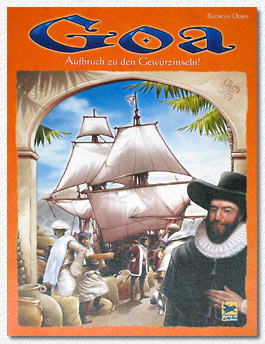
Goa cover
Autor Rüdiger Dorn
Verlag Hans im Glück
erschienen 2004
Spielerzahl 2 – 4
Spielzeit 60 Minuten

Goa

Drei aufrechte Kämpfer machten sich an die Aufgabe, die WPG-Strategietips zu Goa vom 14.4. zu bestätigen oder zu widerlegen. Alle waren überzeugt, daß die Geldpolitik wohl nicht die lukrativsten Aussichten versprach. Aaron versuchte sich in einer kombinierten Schiffe-Kolonisten-Strategie, wobei er den Kolonisten eine deutliche Präferenz einräumte. Ich engagierte mich sofort und ausschließlich in der propagierten Schiffsentwicklung; d.h. ich brachte die Schiffe so schnell es ging auf Entwicklungsstufe 4 und 5, unter absoluter Zurückstellung der anderen Produktionsmittel. Hans dagegen wollte der Schiffspolitik eine Alternative entgegensetzen und ging monopolartig auf die Expeditionskarten los. Ausgerechnet unser streng logisch ausgerichteter Hans öffnete dem Zufallsprinzip von Goa alle Türen und Tore!

Jeder konnte erfolgreich auf seiner Entwicklungslinie operieren. Ich hatte nie Schiffsmangel und konnte mir diesbezüglich leisten, was ich wollte. Wenn man 5 Schiffe pro Aktion produzieren kann, dann ist das ein Höchstmaß an Effizienz. Und Effizienz ist das Schlüsselwort in Goa. Hier gilt der GOA-EFFIZIENZ-SATZ: „Wenn ich genauso viele Aktionen wie meine Mitspieler durchführen kann, dann bin ich nur dann besser, wenn ich pro Aktion mehr Wirkung erzielen kann.“ In punkto Schiffen war ich unerreicht.

Leider hatte ich übersehen, auch meine Gewürzproduktion entsprechend zu optimieren. Ich besaß nur eine einzige Nelkenplantage, brauchte aber zum Vorrücken von fast allen Produktionsmitteln immer wieder Nelken. So wurde das Entwicklungstempo, das ich durch zügigen Schiffbau erzielen konnte, immer wieder durch meine schleppende Nelkenproduktion ausgebremst. Am Ende wurde ich Letzter. Das drückt aber keineswegs das Scheitern der Schiffspolitik aus!

Hans war mit seinen Expeditionen sehr erfolgreich. Während wir erfreut unsere 2-3 Zusatz-Aktionskarten pro Runde beliebäugelten, hatte er beide Hände voller Expeditionskarten, die ihm jede Menge Handlungsfreiheit ermöglichten.

Hier kommt jetzt die Ergänzung oder sogar Korrektur zum obigen Effizienz-Satz, nämlich der GOA-AKTIONS-SATZ: „Wenn alle Aktionen ungefähr die gleiche Effizienz besitzen, dann erzielt ein Spieler einen Vorteil gegenüber seinen Mitspielern, wenn er MEHR Aktionen durchführen kann.“ Klingt trivial, wird aber nicht unbedingt immer beherzigt.

Wie komme ich nun zu mehr Aktionen?

  1. durch die Ersteigerung des Startspielers;
  2. durch die Ersteigerung bestimmter Plättchen;
  3. indem ich als Erster in einer Kategorie auf Level 4 oder 5 komme;
  4. durch bestimmte Expeditionskarten;
  5. und was der Möglichkeiten mehr sind.

Wie gesagt, Hans war mit den Expeditionen sehr erfolgreich. Er konnte auf MEINEN hochentwickelten Schiffswerften SEINEN Schiffsbedarf eindecken. Er konnte seine Produktionsmittel weiterentwickeln, ohne ein einziges Schiff oder ohne ein einziges Gewürz dafür einsetzen zu müssen. Fast wäre er Erster geworden. Zum Glück, muß ich sagen, denn ich fände es schon schade, wenn das Zufallselement in Goa einen so mächtigen Einfluß ausüben könnte.

Aaron kam mit seinen Plantagen nur langsam voran. Er konnte sich aber eine exzellente Karte ersteigern, die ihm erlaubte, pro Runde ein beliebiges Gewürz auf seinen Plantagen zu ernten. Weiterhin betrieb er eine geschickte Versteigerungsstrategie. So kam es zweimal vor, daß er als einziger den Geldmarkt kontrollierte und die Preise diktieren, bzw. für Minimal-Summen mehrere Plättchen ersteigern konnte.

Bei drei Spielern liegt es immer im Bereich von natürlichen statistischen Schwankungen, daß so eine Geldsituation eintritt. Alle Spieler müssen genau wissen, worauf sie sich einlassen, wenn sie einem Spieler diese absolute Gelddominanz überlassen. Aaron profitierte am meisten davon und das reichte schließlich auch zu seinem Sieg.

Wir lagen aber alle dicht beieinander, ein Phänomen, das wir schon öfters bei Goa beobachten konnten. Das Spielprinzip begünstigt diejenigen, die ihre Ressourcen geschickt einteilen. Und dann ist es weitgehend egal, welche Entwicklungspolitik man verfolgt. Die Hauptsache ist, daß man überhaupt eine Linie verfolgt. Hans will es beim nächsten Mal doch noch einmal mit dem Geld versuchen.

GAMES INTERNATIONAL – The Journal of Fun and Games

ON A COLD AND GREY NOVEMBER DAY

When I visited London in November 1988 one of my usual evening strolls led me to „Just Games“ a small games shop just off Regent Street. I had visited them before and knew that I would find a wide range of imported boardgames, in particular those from the United States.

This time my attention was drawn to something completely different: a magazine called „Games International„, which not only appeared to be produced very professionally but also carried an interesting combination of articles about foreign and German games. At the time I was not aware that German games were known in Britain at all.

Hence, I bought a copy and spent the rest of the evening in my hotel room, reading what appeared to be the first issue of a very different games magazine. I was so intrigued by the mag that I filled in the subscription form that very night and sent it off the next day.

At that time, I already subscribed to one of the most popular German game journals „Pöppelrevue“, which covered the German boardgame market pretty well. But much to my surprise GI provided me with a new view about the games I thought I knew pretty well. On the one hand there was none of the rather dry style of writing I was used to from Pöppelrevue. Many articles had this humorous kind of „straight from the heart“ style elegantly spiced with the odd pun, which made reading them not only interesting but fun. On the other hand, the mag contained details about strategies and variants, which were completely new to me.

THE BRIGHT SIDE OF THE MOON

The type of games covered and their rating made me feel sort of „at home“. The first issue had favourable reviews about „Kremlin„, „6-Tage Rennen“ and „McMulti“ – games we liked and played a lot at the time. In addition, GI #1 included a strategy article about „Schoko&Co.„, something of a size and depth I never seen before in a German games magazine. Taking a note of the author provided some clue, as Alan R. Moon was known to me as a writer for Avalon Hill’s house magazine „General„. Besides the fact that the „General“ was quite expensive in Germany it also was pretty hard to find. So seeing that GI managed to get one of their authors on the payroll convinced me that GI was the right mag for me.

Talking about Alan R. Moon: he was introduced as GI’s „American Desk“ and Brian Walker, GI’s editor, wrote a rather strange (in my eyes) staff profile about him. It commenced with providing a photo of an empty suit of armour as „Alan R. Moon“ – something which later proved to be some kind of a GI policy: „Never provide a photo of any of the staff“. To my knowledge, this policy has been broken only once when issue #4 carried a photo showing Brian „Schoko & Co.“ Walker together with Steve Jackson and Ian Livingstone. Unless, of course, this was some kind of an inside joke.

Other now well-known names of the gaming hobby contributed regularly to GI: Derek Carver („Blood Royal„, „Showbiz„), Stuart Dagger („Counter“), Phil Orbanes („Infinity„), David Parlett („Hare and Tortoise„), David Pritchard („Games and Puzzles“) and Mike Siggins („Counter“) to name just a few.

The structure of GI’s content was based on game categories: general games, abstract games, war games and role-playing games besides „standard“ columns like an editorial („Up Front“), travel reports and reader letters („Rebound“). I cannot remember a mag where I enjoyed the editorial as much as Brian Walker’s „Up Front“. Besides being informative the tongue-in-cheek humour sometimes was hilarious. The way Brian dealt with the uproar about Metal Magic’s ad (with the „orcs with the dorks“ photo) in his „Members not allowed“ column was simply fantastic.

GAMES PEOPLE PLAY

German games were covered regularly, not only by reviews but also providing in depth strategy articles. „Die Macher„, „Schoko &Co.“ and other games were covered together with excellent strategy advice or variants. GI later decided to import German games to make them available in the UK via national mail order. Good for the German games industry but also a clear indication of the condition the British game market was in at the time.

The competition amongst the game mags in the UK must have been fierce as shown by the problems „Games Monthly“ went through in 1989 and the quarrel between GI and „Games Review Monthly“ in late 1989. Luckily, GI had decided early to not only address the UK market but to make the mag available in the US and Germany as well. Nevertheless, in 1989 GI had to realize that boardgaming was getting competition from a different direction altogether: computer games. So during what must have been a sort of self finding break the September issue of GI was skipped and appeared as Sep/Oct issue (#9) in October 1989 – containing the first articles on computer games. Consequently, the cover photo showed „Millennium 2.2“ to clearly demonstrate the change.

CYBER HOUSE RULES

At the time I was just getting into computer games myself so this change was rather welcomed. In the summer 1990 I decided to buy my first PC – at a ridiculously high price compared to today’s standards – mainly because of Brian Walkers and Bruce Shelley’s coverage of the computer game „Railroad Tycoon“ in GI issue #16 in July 1990 – take that as an example of the press influencing decisions.

While GI was still covering both boardgames and computer games a principle change in marketing strategy became visible when the August and September 1990 issues of GI were skipped and the mag’s October issue appeared under the new name „Strategy Plus“ issue #1 with a clear focus on computer games. It took however another 9 months until Brian Walker decided to convert „Strategy Plus“ into a computer games only magazine – issue #10 of SP was the last one with a boardgame section.

More changes followed course: from issue #18 SP was no longer printed in the UK but in the States, probably due to Brian Walker’s moving house to the United States. But things didn’t work out the way Brian had intended and hoped (see the interview below) and in the end the August 1993 issue (#33) of SP was the last with him as the editor. Following this SP dwindled into irrelevance – at least from my perspective.

NET ACT

So why do I write this article? GI was an excellent boardgaming mag which I liked very much and the demise of which I deplored a lot. So this is supposed to be a homage about the magazine. But there is more than just that. In the meantime the same has happened to another excellent boardgaming publication I had subscribed: „Pöppelrevue“. This indicates to me that the market for such publications is rather small probably because only die-hard boardgamers will spend money for game reviews, news and strategy articles. While the Internet was not around in the late 80’s it may well present an additional threat to printed boardgame magazines today. Reviews, session reports, strategies, variants and other articles are readily available on the Net – for free. And sites like ours may well expedite the end of printed game magazines. And what shall I read in bed when that happens?


TALKS WITH MR. WALKS

The following interview with Brian Walker, the former editor of Games International and Strategy Plus, was conducted via email in late December 2003.

WPG: Games International was launched in 1988. What was your main purpose to publish a magazine targeted at the serious gamer?

BW: My aim was to attract anyone with an interest in boardgames, serious or not.

WPG: You visited the „North Shore Gaming Club“ in the U.S twice in 1988. Did these visits play a role in your decision to create GI?

BW: No, these visits were just for fun.

WPG: One of the unique selling points of GI was the focus on German style games. Wasn’t this a kind of risky marketing approach?

BW: I never really had a ‚marketing approach‘. German games seemed to me to be the best around at that time so I gave them some coverage. It was very exciting on a personal level to discover these games, so I figured that if they excited me then they would the reader.

WPG: You made it possible to mail-order German games through the GI’s office. Do you regard yourself successful in bringing German games to Britain?

BW: This was a reader service; I don’t think ’success‘ is the right term. I’m happy that German games are now relatively widespread but it would be ludicrous for one person to take credit for this.

WPG: The second issue of GI appeared with over a month late. Were the GI launch date and the intended monthly issues kind of a false start, especially when considering that the next issues were published without a date on the cover?

BW: The conditions under which the first few issues were produced were really chaotic – I went through three production editors in the first three months. Paul Mason then joined up in that capacity and steadied the ship. I don’t think the ‚false start‘ had any effect long term.

WPG: In issue #4 you mentioned that GI will be using Games Monthly’s distribution channels and that GM subscribers would receive 2 GI issues for free. What is the story behind that?

BW: Steve Nicholls of Games Monthly, didn’t want to continue publishing his mag, but also didn’t want to leave his subscribers high and dry. We met up and arranged what was a mutually beneficial deal. In the case of GI that meant using GM’s newsstand distributor that enabled us to have a bigger print run. In the event, we didn’t sell that many more copies.

WPG: Right from the start you covered American games through Alan R. Moon as your „American Desk“. Had it been your initial intention to market GI in Britain and the States?

BW: Alan Moon makes an excellent desk, but my intention was to market the mag to any country that would stock it. The US game shops did not take very many and US newsstands were out of the question. Most Americans at that time didn’t even realise that Germany had a games industry, so the content and the general tenor of the mag would have made no sense to them, as indeed it made no sense to many British readers.

WPG: GI not only was available in British game shops, also major stores in the United States carried it. Did you sell more copies in the States than in Britain?

BW: No, because it was available on some newsstands here as well as in game shops.

WPG: How successful was GI commercially?

BW: Not at all.

WPG: Can you share the size of the print run and number of subscribers GI had in 1989?

BW: I think we printed around 8000 and sold around 2000. We had in the region of 400 subscribers.

WPG: The September/October 1989 issue of GI had a new section „Computer Games“. Was GI running out of review material for boardgames?

BW: We never ran out of material for boardgames but we were always running out of cash.

WPG: After 16 issues of GI the name was changed to „Strategy Plus“, giving even more room to computer games. Why did you change the name of the magazine?

BW: It was part of a transition to computer games, as the realisation that a boardgames mag in the UK could never make money. On a personal level I also wanted to be part of a successful industry – this is not the description I would use for boardgames industry in the UK.

WPG: Issue 10 of Strategy Plus was the last to cover boardgames. Judging by the excellent articles about boardgames GI & SP had you must have had a lot of complaints from boardgamers. Right?

BW: Remarkably few. There were a few moans from predictable quarters but readers seemed very understanding about the difficulties the magazine faced. There were very few requests for the subscription refunds that I offered.

WPG: SP’s issue 33 (Aug. ’93) was the last one with you as the editor. What was the reason for you to leave SP?

BW: This was a terrible period for me. I was living in Vermont and loathing every minute of it. I discovered that my US partner was ripping off the mag by transferring profits to his other company. So there I was, finally producing a successful magazine in every sense and all he could do was steal. I even had to take him to court just to get the shares that I’d been promised. I managed to win an out-of-court settlement, part of the agreement of which was that I would never talk about any of this.

WPG: Let’s take a look at the media for boardgaming related review and information. Compared to 15 years ago we now see a lot of Internet sites, which publish game reviews on a regular basis. As all of these contents are provided for free, doesn’t this render printed game magazines obsolete?

BW: All magazines face a similar problem, if it can be called thus. A site like boardgamegeek is fantastic and provides a resource for the hobby that no print mag can compete with. However, a good editor will ensure that a magazine competes in areas that websites cannot reach. Had the internet been as prominent in GI’s days as it is now, I believed it would have helped the mag. I would have seen it as a friend, and not as competition. The real problem is that the market for a boardgames magazine is very limited, internet or not.

WPG: It appears that only recently you returned to boardgaming. Can you tell us something about your games related work in the last ten years?

BW: I’m afraid I joined the dark side and worked for a couple of computer game companies. I produced Championship Manager 2 and Stars! I co-designed and produced International Cricket Captain. These are all games that I’m proud to be associated with.

WPG: What do you think of the boardgames scene now.

BW: I think it’s wonderful, much better then when I was involved in it (surely a coincidence!). There are a lot of very good games and not just from Germany. I like what Bruno Faidutti is doing in France, and Martin Wallace in the UK. Best of all, it’s great to see Alan Moon getting the success he richly deserves. Any industry out of which the ‚desk‘ can make a living has got to have something going for it.

WPG: Any boardgaming plans for the future?

BW: I’m working on a book on boardgames and am currently talking to publishers, but I’m not overly optimistic about getting a deal. I’m also trying to persuade some of the more serious newspapers here (in the UK) to give me a weekly column.

WPG: Any additional remarks you would like to add?

BW: As a postscript, I’d like to thanks any contributors to GI who may be reading this for their contributions in making the mag what it was, for better or worse. I just wish it was still around.

WPG: Brian, we’d like to thank you very much for the interview and wish you all the best for the future. We do hope to see more on boardgames from you soon. (Brian can be reached at Mr.walks@btopenworld.com)


GAMES INTERNATIONAL – Resurrected

Okay, the news is out (see Spielbox Online)! Brian Walker is reviving the journal of fun and games „Games International“ (see our article) by releasing issue number 17 at the Spiel 2004 fair in Essen. So we took the chance to talk to Brian about his new venture.

(WPG) Brian, your decision to revive „Games International“ by releasing issue #17 nearly 15 years after the appearance of issue #16 surely comes as a surprise to many. Can you tell us what triggered your decision?

(BW) What triggered my decision was unemployment.

(WPG) In last year’s interview you told us about the problems GI went through 15 years ago. The games industry hasn’t really changed much since and neither has the situation of games journals. Putting together a business model for a mag like GI still seems to be a challenging task. What are you doing differently this time?

(BW) What has changed in the last 15 years is technology. I’ve utilised this in what I think is an innovative way, and I’m not just talking about PDF files. The changes in this field have also altered the business model, particularly printing and distribution. These are usually the two elements that kill off small circulation magazines. Also, because of the (relative) boom in boardgames in the US, a new area has opened for us. I’m already discussing licensing the mag to a US publisher.

(WPG) You are going to publish GI in English. Although English is commonly spoken almost anywhere in the world you are probably addressing mainly British and American readers. However, gaming in Britain is still a lot different to gaming in Germany for example. How are you going to attract British readers and what is your actual target group?

(BW) Without wanting to sound chauvinistic, English is the international language so our ‚target group‘, were we to have such a thing, would be ‚gamers everywhere who speak English‘. When you start getting into market demographics beyond that, then you start to lose the plot.

(WPG) GI used to have a group of excellent writers mainly from the gaming scene in London together with game designers providing in-depth articles and strategy seminars. Have you been able to recruit some of the „old crew“ or who else besides yourself is going to provide content for the magazine?

(BW) Amazingly, most of ‚old crew‘ are still alive. Guys like John Harrington and Philip Murphy, I had to drag them kicking and screaming out of retirement homes, but they’ll be okay as long as they get to bed early.

I’ve taken on some new American writers but I’m having to teach them to spell correctly. I asked Mik Svellov to be our European news editor because he was the only person I asked that had ever heard of me.

(WPG) 15 years ago you covered German games to a large extent. Will German games again be a main subject of the „new“ GI?

(BW) Just like before, we’ll cover games from anywhere. In issue 17 there will be an emphasis on US and British games (we do have some), but that’s because there’s a slew of new releases from those countries. In the issue following, I guess there will be a lot new German games because of Essen. If the awful green things from outer space dropped off a few boxes, then we’d cover them too.

(WPG) The news blurb on Spielbox Online mentions a printed and an online version of the mag at different subscription rates. Can you tell us something about the reasoning behind releasing the mag on paper and online?

(BW) That’s easy. The on-line version costs us nothing to produce, so even if we don’t sell a single issue via PDF, it’s no big deal. The difference between the two versions will only be in resolution, with the PDF being optimised to enable fast downloads. You’ll be able to print it out, which will save readers in Australia waiting two years to get the newsstand version.

(WPG) You are shooting for a Spiel 2004 release of issue #17 of GI. Is the release actually planned to happen during the fair? Can you tell us when and where exactly?

(BW) The grand launch at Essen will consist of me turning up on the first day with a big box of magazines, begging for a drink.

(WPG)It says that you are going to put the complete contents of issues #1 to #16 online for free downloads. Where and when will we be able to find this?

(BW) The free downloads will be available from www.gamesinternational.biz . The site should be up next week (10/9), and the back issues available when I find time to scan them.

(WPG) Thanks a lot for your answers and background information on the new Games International. Many gamers are looking forward for the re-release of this fine games magazine. We are wishing you the best of luck and success.

(BW) It’s been a pleasure, and I look forward to meeting readers old and new at Essen.

This interview was carried out end of August 2004.

Spielbericht vom 21.04.2004

Autor: Walter

am Tisch: Aaron, Günther, Peter, Walter

auf dem Tisch: Zug um Zug

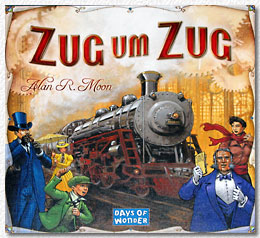
Zug um Zug
Autor Alan R. Moon
Verlag Days of Wonder
erschienen 2004
Spielerzahl 2 – 4
Spielzeit 45 Minuten

Zug um Zug

Auf einem Spielbrett mit einer geographischen der Karte der USA, auf der Städte und projektierte Eisenbahnverbindungen eingetragen sind, geht es darum, ein möglichst großes Streckennetz auszubauen und dabei vorgegebene Städteverbindungen herzustellen. Soweit ist das nichts Neues und das gute alte „Dampfroß“ wie auch viele andere Luftfahrt-, Schiffahrt- oder Landverkehrsspiele könnten hier Pate gestanden haben. Sogar einige gleichartige Spiele desselben Autors: Alan R. Moore.

Die projektierten Strecken besitzen jeweils eine bestimmte Farbe. Ein Spieler darf die Strecke nur bauen, wenn er so viele Streckenkarten dieser Farbe besitzt, wie die Strecke lang ist. Karten sind überhaupt der Motor des ganzen Spieles. Die Streckenkarten liegen auf einem verdeckten Stapel, und vier davon offen daneben auf dem Tisch. Pro Runde kann ein Spieler zwei Karten ziehen. Entweder blind von verdeckten Stapel, so daß keiner weiß, was der andere kann oder vorhat. Oder offen, so daß jeder Mitspieler die Streckenambitionen des Konkurrenten erkennen kann.

Zug um Zug

Auf einem weiteren verdeckten Stapel liegen Verbindungskarten, auf denen jeweils zwei Städte verzeichnet sind, die der Spieler verbinden soll. Pro Runde kann ein Spieler drei Verbindungskarten ziehen und maximal eine davon wieder ablegen. Bis zum Spielende sollte der Spieler für jede Verbindungskarte auf der Hand eine Verbindung aus eigenen Bahngleisen von einer Stadt bis zur anderen gebaut haben. Dann erhält er die Siegpunkte, die auf der Verbindungskarte eingetragen sind. Schafft der Spieler die Verbindung nicht, dann bekommt er den entsprechenden Punktewert von seinen Siegpunkten abgezogen.

Wie viele Verbindungen ein Spieler sich aufbürdet, liegt ganz allein in seinem eigenen Ermessen. Es ist durchaus eine mögliche Gewinnstrategie, nur die zu Spielbeginn zwangsweise zugeteilten zwei Verbindungen auszubauen und ansonsten die übrigen Siegpunkte allein durch freien Streckenbau zu erzielen. Für jede vollendete Strecke gibt es Siegpunkte. Je länger die Strecke, desto höher die Punktzahl. Fast mit einer quadratischen Steigerung.

Eigentlich könnte man erst mal ausschließlich Verbindungskarten aufnehmen und sammeln, und erst in der letzten Phase des Spieles damit die besten, längsten Strecken zusammenstellen. Eigentlich. Man muß nur aufpassen, daß die Konkurrenten nicht zuerst bauen. Denn jede Verbindung kann nur einmal gebaut werden, und wer das als erster tut, dem gehört sie. Eine gegnerische Verbindung bringt nicht nur dem Konkurrenten die Siegpunkte, sie erschwert u.U. auch das Vollenden der vorgegebenen Strecke. In diesem Spannungsfeld zwischen Sammeln und Bauen bewegt sich der Spielreiz von „Zug um Zug“.

Das ganze läuft ungeheuer flott ab. Jeder Spieler nimmt an Verbindungskarten in die Hand, was nur hineinpaßt. Während er sortiert und sondiert, ist schon der nächste Spieler an der Reihe. In höchstenfalls 30 Minuten hat wenigstens ein Spieler seinen kompletten Vorrat an Streckenteilen verbaut und das Spiel ist zu Ende. Als wir fertig waren und den Sieger ermittelt hatten, wollten alle spontan eine zweite Revanche-Runde spielen.

Sehr schönes Spielmaterial, gut überschaubarer Spielplan, hübsche Karten, allein schon aus ästhetischen Gründen ist „Zug um Zug“ ein einladendes Spiel.

WPG-Wertung: 7,0

Spielbericht vom 19.04.2004

Autor: Moritz

am Tisch: Andrea, Loredana, Peter, Moritz

auf dem Tisch: Maya, Spy, Spooks

Maya

Maya cover
Autor Bernd Eisenstein
Verlag Abacus Spiele
erschienen 2003
Spielerzahl 3 – 5
Spielzeit 90 Minuten

Nachdem dieses Spiel in letzter Zeit bei uns sehr positiv bewertet wurde, wollten Andrea und ich es gerne auch einmal ausprobieren. Peter erklärte die Regeln sehr detailliert und umfangreich (was seltsamerweise dennoch für einige Verwirrung sorgte) und los ging es beim Pyramidenbau.

Besonders spannend schien die Kartenablegephase zu sein, bei der man Mehrheiten bei bestimmten Aktionsplättchen zu ergattern sucht, die dann später in der Bauphase verwendet werden können. Dadurch, dass die hohen Karten auf der Rückseite bezeichnet sind, ergeben sich doch wesentlich mehr Möglichkeiten als z.B. bei „Corruption„, das hier ähnlich funktioniert.

Die Bauphase selber ist in gewisser Weise gruppendynamisch, denn hier ist der Doppelzug entweder sehr mächtig, wenn wenige ihn benutzen, oder sehr schwach, wenn fast alle ihn benutzen. Ich selber hatte immer eher wenig Klötzchen zum verbauen, profitierte aber letztlich von der Gier der anderen ein wenig mehr als Peter (51 Punkte für den Sieg, Peter hatte 50 Punkte). Auch der dritte und vierte Platz lagen mit 40 und 41 Punkten sehr dicht beieinander.

Fazit: Ein gut funktionierendes „Schweigespiel“ (bei dem mehr schweigend nachgedacht als kommuniziert wird), bei dem die Regeln gut ineinander greifen, aber nicht wirklich bahnbrechend.

SPY

Spy
Designer Reiner Knizia
Publisher Kosmos
released 2004
Players 2 – 4
Playing time 40 Minuten

This minor offering by Knizia had to be tried out as Peter and Guenther of our group momentarily try to do a full listing of the „master’s“ complete works.

This is one of Knizia’s simpler games: Every player starts with 9 agent markers and tries to place them at either continent cards or item cards. The player who first loses all his agents wins.

Each „region/item“ card starts out with one agent; this means that to place an agent there you have to top this with at least one card more showing this symbol, the difference will be the number of agents you can place. So if you play three „pen“ (item symbol) cards on the „pen“ symbol with one agent already there you can place two agents there 3-1=2). The next player playing the symbol would then have to play at least 4 symbol cards to lose at least one agent, making it more difficult for the players who wait too long and try to build up longer sets of cards to lose more agents.

All cards bear two symbols, so they can be theoretically used in two different kinds of sets. You can hold a maximum of three cards in your hand, if you have more you have to place them openly before you, which gives other players some kind of information about what you might collect.

And this is basically it: Playing the game you usually follow a very simple strategy:

  • collect sets until you have at least two more cards than necessary (losing 1 agent is only worth it in the end phase of the game)
  • if possible, place cards before you which DON’T belong to the sets you collect, to confuse the other players
  • wait before you play a set, but not too long. The longer you wait the greater the chance that another player will play a set on it.

Apart of that there is very little except luck of the draw or position in playing order. This might work better with 2 players (in fact it is especially recommended for 2 players), but with more players there is very little that can keep the attention of the jaded gamer, except as a very light filler.

Not specifically recommended…

Spooks

Spooks cover
Autor Jason Wittman
Verlag Steve Jackson Games
erschienen 2003
Spielerzahl 3 – 6
Spielzeit 90 minutes

Unser neues Kultspiel zeigt bei mehreren Runden eine seltsame Eigenschaft, die uns allen unerklärlich scheint: Obwohl die Startspielerreihenfolge sich ständig ändert, und damit auch die Kartenausteilung, des weiteren auch der Startspieler gänzlich zufällig ermittelt wird, ist es dennoch bei inzwischen mehreren Spielen hintereinander zu beobachten gewesen, dass ein/e Spieler/in jeweils einen „Run“ hat, d.h. über eine Serie von 7-8 Spielen jedes Mal die Runde als Sieger beendet, und letztlich auch das Spiel nach Punkten gewinnt.

Diesmal war Loredana die Glückliche – eine ganze Serie von Runden hinweg dominierte sie das Spiel mit quasi perfektem Ausspiel der Karten. Da das Zufallselement auszuschließen ist, könnte man vermuten, dass hier die Spielweisen der jeweils linken und rechten Sitznachbarn eine Rolle spielen, denn die bleiben ja fix.

Eine genauere wissenschaftliche Untersuchung von „winning strategies“ bei „Spooks“ steht aber weiterhin aus .

Arena Maximus

This new offering by Fantasy Flight caught my eye during our last visit in the US – I’m a big fan of Arena games in the spirit of AH’s old “Circus Maximus” – unfortunately there are not many playable ones around….

“Arena Maximus” packs quite a lot in a small box: Heart of the game is a variable arena circuit built from many single tiles (curved and straight) – good idea! Each player (up to 5) gets a different chariot with variable abilities, and there is also a nicely designed deck of cards which drives the game forward. The rules are present in several languages, what is definitely missing is a good cheat sheet which explains the various symbols, but this is what boardgamegeek is made for.

The chariots are rated in potential maneuverability (=the ability to add or deduct whip cards to/from the speed pool), aggressiveness (the number of possible ram, block or attack maneuvers) and sheer durability (each chariot can take a certain amount of hits until it breaks down, but it can start again with a final “second life”).

An interesting mechanism is centered around the card hand: the maximum is always 7, but the cards in your speed pool count towards this limit. In other words: the faster you go (the more whip cards you have played), the less you can react to threats by playing cards from your hand. And there are many threats: most track tiles have some kind of danger: you need to play certain cards or you have to have a certain speed to avoid hits. In addition the track tiles are unknown until you enter the last known tile (then you see the next three), which means that the leader of the race always runs the danger of crashing.

Arena Maximum

The race itself is very tight – as the last in the line and the last one to enter a tile starts the next round, the runner-ups constantly overtake the leader. When a player enters a tile with another chariot, a complex set of decision steps begins. First you have to decide if you want to ram the chariots before you (by playing sets of rein and whip cards which have to be countered). Then the chariots before you can block you (by playing rein cards, which then you have to counter). THEN you “encounter” the space (probably having to play additional cards), and THEN you can attack the other chariots with whip cards (which can then counterattack if they want and are able to). Failure to counter any card usually results in damage to your chariot.

It took us a while to learn how to go “through the motions”, and then we sometimes felt it was preventing game flow a little, although this could change with frequent playing. All in all the game did rather play like a “German” game – you watch the card hands of your opponents carefully before you maneuver in position, many decisions are not made because of the actual state of the race but rather because of your card hand. Although you never know your opponent’s exact cards, attacking someone who has just depleted all his cards to gain the lead can be perceived as a valid and unrisky tactic option. Optional “Magic” cards actually add to this impression, as they simply give you more options. A very interesting ruling occurs towards the end of the game (which plays as any chariot race should play – mean, with many nasty surprises): If a player cannot win anymore he is NOT allowed to act as a kingmaker (by playing aggressive cards against one or the other player). This simple rule is actually very elegant if you think about it. I wonder if it could be transferred to other games, for example the kingmaker-feast “Vinci”.

All in all this is a good game for the “silver” line from Fantasy Flight –The game has depth, is not overly complicated, perhaps luck-driven, but not dumb. Why a sixth player was not included may be anybody’s guess- I think for racing games the old adage “the more the merrier” is certainly true!

Goa

„Ganz nett“ war Peters erste Stellungnahme zu Goa. Ein von ihm absolut ungewohntes Understatement, er hatte dafür gerade die Traumnote 10 vergeben.

Goa ist ein Spiel mit zwei Gesichtern. Zum einen hat es stark den Charakter eines gut ausbalancierten Versteigerungsspiels mit allen Vor- und Nachteilen. Zum anderen ist es ein sehr vielseitiges und komplexes Aufbauspiel mit einem enormen komplexen Handlungsspielraum für die Spieler.

Versteigert werden Plantagen, Schiffe, Kolonisten und eine Reihe von anderen Elementen, die dem Ausbau eines Gewürzhandels förderlich sind. Schon allein in der Art und Weise, wie diese Dinge zur Versteigerung gelangen, steckt eine neue gute Spielidee: Ausgehend vom Startspieler, der die Startposition der Versteigerungsobjekte willkürlich bestimmt, sucht sich jeder Mitspieler genau eines der direkt benachbarten Plättchen heraus, das er unter seiner Regie auf den Markt bringen will. Entweder erwirbt er es für sich selbst, indem der den gebotenen Höchstpreis an die Bank zahlt, oder er überläßt es dem höchstbietenden Mitspieler und steckt dafür den gebotenen Preis in seine eigene Tasche.

Hier erhebt sich bereits die erste kniffelige Frage: Suche ich mir eine Plättchen aus, für das ich selber eine bestimmte Neigung empfinde, oder lieber eines, das eher für die Konkurrenten eine erhöhte Bedeutung besitzt? Im ersten Fall hoffe ich, es für billiges Geld selber erstehen zu können, im zweiten Fall möchte ich einen besonders hohen Versteigerungserlös erzielen.

Es gibt hierauf wohl keine schlüssige Antwort. Sofern bei allen Spielern genügend Geld auf dem Markt ist, wird es wohl besser sein, ein für alle interessante Stück auszusuchen um damit beim Verkauf ein erkleckliches Sümmchen einzustreichen. Ist man selber aber einer der reicheren Zeitgenossen und ziemlich vorne in der Reihenfolge der Versteigerer, dann lohnt es sich, ein Objekt der eigenen Neigung zu wählen und es in der anschließenden Versteigerung für sich selbst zu erwerben.

Kommen wir jetzt zum schöpferischen Teil des Spieles. Nach jeder Versteigerung stehen jedem Spieler drei oder mehr Aktionen pro Runde zur Verfügung, in denen er seine unternehmerischen Fähigkeiten als Gewürzbaron unter Beweis stellen kann. Hier entfaltet Goa seinen vollen Reichtum an neuen Ideen und spielerischen Schönheiten:

  • Vom Start weg kann jeder Spieler immer eine Fülle von konstruktiven Zügen zu seiner Entwicklung tun. Er ist niemals blockiert von seinen Mitspielern oder den Unbilden eines tragischen Spielerschicksals.
  • Wenn der optimale Zug auf Grund von Randbedingungen der Spielregel nicht ausgeführt werden kann, dann bieten sich immer genügend Ausweichzüge, die ebenfalls gute Entwicklungsaussichten erlauben.
  • Es gibt keine Fehlplanungen. Jeder Zug trägt den Spieler einen meßbaren Schritt in seiner Entwicklungsrichtung nach vorn. Und wenn das (geringe) Zufallsrisiko einem Spieler wirklich einmal einen Strich durch die Rechnung gemacht hat, dann erhält er als Ausgleich dafür immer eine akzeptable Entschädigung.
  • Es gibt nur positive Züge, keine Aktion ist gegen einen Mitspieler gerichtet, Ärgerelemente, Häme und Bosheit sind ausgeschlossen.

Goa

Kommen wir zu ein paar Details. Im Prinzip kann man die Aktionen jedes Spieler in zwei Klassen einteilen: Er kann alternativ seine Produktionsmittel entweder erweitern oder sie nutzen. Als Produktionsmittel stehen fünf Kategorien zur Verfügung:

  • Schiffswerften
  • Plantagen
  • Expeditionen
  • Steueraufkommen
  • Kolonisten

Jedes einzelne Produktionsmittel kann in Einerschritten von der Anfangsstufe 1 bis zur Maximalstufe 5 ausgebaut werden. Je höher die Ausbaustufe, desto höher der Ertag bei einer Ernte-Aktion. Für jede Erweiterung benötigt man eine Anzahl von Schiffen und bestimmte Gewürze, und zwar um so mehr, je höher die Entwicklungsstufe ist. Die Erhöhung von Stufe 1 zu Stufe 2 kostet eine Einheit, und je Stufe steigt dieser Preis um 1 nach oben. Von Stufe 4 zu Stufe 5 kostet sie bereits 4 Einheiten. In der Summe wären also 10 Schiffe und 10 genau vorgegebene Gewürze nötig, um ein Produktionsmittel von Stufe 1 auf die Maximalstufe 5 zu heben.

Die Leistungsfähigkeit der verschiedenen Produktionsmittel steigen von der Anfangsstufe bis zur Maximalstufe nach ganz unterschiedlichen Zahlenreihen. Der Schiffsbau steigt ziemlich langsam in Einerschritten von 1 auf 5, der Ernteertrag auf den Plantagen steigt dagegen in (fast durchwegs) Zweierschritten von 1 auf 8 deutlich schneller an.

Goa

In der Endabrechung bekommt man für jedes Produktionsmittel genau soviel Siegespunkte, wie man insgesamt dafür Schiffe eingesetzt hat. Ein Produktionsmittel der Stufe 5 bringt demnach 10 Siegpunkte. Wenn man alle fünf verschiedenen Produktionsmittel maximal ausgebaut hat, kann man damit insgesamt 50 Siegpunkte auf seinem Konto verbuchen. (Goa bietet noch weitere Möglichkeiten, an Siegpunkte heranzukommen; auf diese sekundären Erwerbsquellen will ich jetzt aber nicht näher eingehen.)

In der Regel sind am Ende eines Spieles nur wenige Produktionsmittel bis zur höchsten Stufe entfaltet. Als grober Daumenwert für ein gutes Ergebnis bei vier Mitspielern gilt: Zwei Produktionsmittel sind auf Stufe 5, ein Produktionsmittel auf Stufe 4 und zwei Produktionsmittel auf Stufe 3.

Die zweite kniffelige Frage ist nun, in welcher Reihenfolge soll ich meine Produktionsmittel entwickeln. Dies ist der entscheidende Knackpunkt, wie ich mehr Effizienz in meine Aktionen bringen kann und mir damit einen Vorteil vor meinen Konkurrenten verschaffen kann.

Die Antwort ist einerseits natürlich abhängig von der Art von Gewürzen, die ich auf meinen Plantagen erzeuge und die für den Entwicklungsfortschritt erforderlich sind. Andererseits muß es in einem solchen Spiel aber auch eine theoretisch beste Reihenfolge geben, und ich sollte versuchen, meine Entwicklung so nahe wie möglich gemäß dieser optimierten Linie anzunähern.

Hierzu eine kleine Überschlagsrechnung:

Für den oben definierten Endstand benötigt man insgesamt 32 (beliebige) Schiffe und 32 (definierte) Gewürze. 5 Schiffe sind mein Startkapital und etwa 3 Schiffe kann ich auf Versteigerungen erwerben. Bleiben also noch 24 Schiffe, die ich irgendwann, irgendwie auf meinen Werften zusammenbasteln muß. Wenn meine Werften pro Aktion nur jeweils 1 Schiff produzieren, dann brauche ich 24 Aktionen, um den besagten Endstand zu erreichen. Schaffe ich aber 2 Schiffe pro Aktion, dann kostet es mich nur noch 12 Aktionen, und bei einer durchschnittlichen Produktionsrate von 3 Schiffen sind es sogar nur 8 Aktionen. Bei keinem anderen Produktionsmittel ist der Bedarf so groß, die anfängliche Produktionsrate so klein und die erzielbare Steigerungsrate innerhalb der Effizienz so augenfällig.

Betrachten wir dagegen mal die anderen Produktionsmittel:

  1. Steuereinnahmen (Geldmittel)
    werden im Prinzip überhaupt nicht gebraucht. Sie sind ein notwendiger und selbstverständlicher Bestandteil der Versteigerungen. In Normalfall besitzt ein Spieler aber auch ohne Zusatzeinnahmen über Steuern genügend pekuniären Spielraum, um in seinem Entwicklungsfortschritt nicht gehemmt zu sein.

    Wer hier eine Finanz-Dominanz anstrebt, der bewirkt nur eine Inflation der Geldmittel, so daß als Folge davon seine relativen Einnahmen entsprechend immer geringer werden. Nach jeder Versteigerungsrunde ist das Geld ohnehin wieder gut verteilt in jedermanns Händen.

  2. Expeditionsfähigkeiten
    nützen zwar in bezug auf einem sekundären Spieleffekt, der bei Monopoly unter dem Begriff „Ereigniskarten“ bekannt ist: Zufallsgesteuert gerät der Spieler an verschiedene Arten von Bonusse (oder Boni). Diese haben aber nur einen äußerst geringen Einfluß auf den Fortschritt innerhalb der Produktionsmittel. Ich behaupte, eine Gewürzpolitik, die sich überwiegend an Expeditionen orientiert, ist jeder soliden Grund- und Bodenpolitik unterlegen. Vielleicht irre ich mir hier, ich werde aber nur widerrufen, wenn ich durch klare Aussagen aus der heiligen Schrift diesbezüglich widerlegt werde.
  3. Kolonisten
    werden benötigt, um gezielt neue Plantagen zu bewirtschaften. Die freien Plantagen kann man ohnehin ganz ohne Kolonisten ersteigern und bewirtschaften. Weiterhin können einige der zugeordneten Plantagen allein mit der ausgeteilten Grundausstattung bei Spielbeginn in Besitz genommen und abgeerntet werden. Es bleibt also nicht viel an möglichen Vorteilen, die zusätzliche Kolonisten dem Besitzer einbringen können. Ich würde diese Kategorie nur ausbauen, wenn ich wirklich keine bessere Aktion ausführen kann.
  4. Plantagen
    werden natürlich gebraucht. Insgesamt stehen ja immer noch die oben erwähnten 32 Gewürze im Raum, die ich für das Erreichen meines Entwicklungs-Endstandes benötige. Problemlos kann ich zirka 12 davon per Versteigerung erwerben. Wenn meine Plantagen einen Entwicklungsstand der Stufe 3 besitzen, dann produzieren sie bereits 4 Gewürze pro Aktion. Für die ausstehenden 20 Gewürze brauche ich also bloß noch 5 Aktionen der Ausbaustufe 3, um alles unter Dach und Fach zu bringen. Das ist bedeutend weniger als der Bedarf an Aktionen für den Bau der benötigten Schiffe.

Fazit: Leute, baut Schiffe! Goas Zukunft liegt auf dem Meer!

Natürlich kann man die favorisierte Linie nicht ungehindert einschlagen. Das ist ja schon (ein bißchen) davon abhängig, ob die notwendigen Plantagen überhaupt auf den Markt gekommen sind, und ob ich sie mir ersteigern konnte. Und wenn alle Spieler diese Goa-Gewinnstrategie anwenden, dann werden sie sich zwangsweise um die Ressourcen prügeln, die auf dieser Gewinnlinie die Engpässe darstellen. Prügeln? Der Verlag spricht sogar von einem „gnadenlosen Wettstreit“, aber das ist maßlos übertrieben. Der eigentliche Motor für den Sieg in Goa liegt in diesem Fall in der Versteigerungstechnik. Hier wird dann Fingerspitzengefühl, Erfahrung und auch ein Quentchen Glück den Ausschlag geben.

Ansonsten baut jeder stillvergnügt und unbehelligt von den Konkurrenten an seiner eigenen heilen Welt. Jeder ist mit seiner Produktion genauso zufrieden wie ein Vater mit seinem Kind. Und nur wenn man über den Tellerrand schaut – das passiert gewöhnlich aber erst in der Schlußabrechnung – kann man erkennen, ob die Brut des Nachbarn nicht doch besser gelungen ist als die eigene. Das ganze entspricht eher einer „friedlichen Koexistenz“ aus den Zeiten, als die Sowjetunion schon längst die Hoffnung aufgegeben hatte, den Kapitalismus links überholen zu können.

WPG-Gesamtnote: 8,4

Geschenkt …ist noch zu teuer (No Merci)

reviewed by Aaron Haag

Looking for a filler game? A game that is perfect to start or finish a game session? Then your probably looking for something with short rules that can be explained quickly and played quickly just as well. In addition, it should have a kind of fun factor rather than requiring deep tactical analysis. There are already a good number of games falling into this category, like „Take 6“, „Liar’s Dice“ or „Hol’s der Geier“ to mention just a few.

In Essen 2004 Amigo presented their new card game „Geschenkt …ist noch zu teuer“ (literally: „For free …is still overpriced“), which is supposed to extend this line of games. The game principle is very simple:

From a deck of 32 cards, numbered 3 to 35, nine hidden cards are removed at random. The remainder of the deck is then used for play. The start player turns over the top card and may either take it for free or pay one coin for NOT taking it. If the card is not taken, the next player in sequence makes a similar decision: take the card plus the coin(s) for free or pay a coin to pass. The catch is that any cards taken count NEGATIVE points according to their face value and coins count positive at the end of the game, hence the game’s German name.

cover

So far this sounds simple but rather boring at the same time. However, one small additional rule changes the game play and adds considerable fun and challenge to the game: if a player has collected cards in sequence only the LOWEST card of that sequence is counted. Now it becomes clear why nine random cards are removed from the deck before the game starts: this creates random „holes“ in possible card sequences and players always run a risk of not being able to create a straight sequence of cards.

I played the game with three different groups and the verdict ranged from „boring“ to „fun“. Of course, there is no real depth or challenge in this game, but that’s not something one would want in a filler game, anyway. This may explain the „boring“ statement from one group. However, like in „Take 6“ or „Hol’s der Geier“ one’s fate is heavily dependent on card luck and player interactions. Especially the latter plays a big role in „Geschenkt“ when played with the right group of people, because a lot of gloating is involved when that important missing card of a sequence is taken by an other player (or isn’t in the deck at all). This is what players will aim for, taking a considerable risk for themselves at the same time (hence the English title of the game).

Like the three other filler games mentioned above, „Geschenkt“ should be played with four or five players and it needs to be played several times before the real fun factor is discovered.

The Haunting House

„Twilight Creations“ stays close to its horror roots and presents this easy but also somehow disappointing game of explorers trapped in a maze-like haunted mansion made up of square corridor tiles which look very dull. As many reviewers have already noted, this game’s theme has been thinly applied – what we have is in fact a variant of „Das verrueckte Labyrinth„, with more randomness and probably less fun.

Each player starts at the same „entrance“ to the haunted mansion (which – apart from some ghostly drawings on some of the tiles – is totally devoid of any monsters or horrific encounters), and tries to reach the exit (on the other side). The problem is: half of the game you are played instead of being the player, and all tiles can be moved, INCLUDING the exit.

The Haunting House

Each player has his own hand of cards: at the beginning of a round 4 are randomly selected and carried out, step-by-step, like in Robo Rallye. You can decide where you move if you move, but most of the time there is only one way. There are also cards which let you trade places with other players (very often this is forced on you, as there is only one adjacent player you can trade places with) or cards that let you „miss a step“ (probably because you encountered something horrible). Other cards let you miss out a turn, or let you exchange/turn tiles without a player on them.

Then follows a deliberate round, where you play 4 cards to your liking, in a „programmed“ way – sans the „white cards“ which move the exit or let you pass. Here the starting player (who changes every round) has a clear advantage, as he can be pretty sure that his orders can be carried out.

First who reaches the exit wins.

We played the game three times in a row – and invariably the game went exactly the The Haunting Housesame way: In the first round everybody maneuvered roughly into the center of the house which is isn’t very big really), in the next round the starting player would invariably win IF the round before no „move the exit“ card had been accidentally drawn. If it was drawn, the next starting player got his chance, as it was usually possible to prevent the former starting player from using the exit if „move exit“ was drawn in the random round. Only in the last of the 3 games there was a chance that one other player instead of the starting player could have won, and only if this player got lucky with his card play (in fact there was simply a 50/50 chance).The first 2 games lasted exactly 2 rounds, the third game 3 rounds, and the starting player always won. Not very interesting if you think about it. There might be a little more variation if you play this often, but frankly: don’t expect too much.
This is very light fare, like „Zombies!!!„, if there is one redeeming trait about this game it is the fact that it is easy to play with non-gamers, and doesn’t last very long. But that’s about it. For more brainwork you might still fare better with the now old, certainly not perfect but still much more interesting „Das verrueckte Labyrinth“.

DESERT STEAM

A preview of „1895 – Namibia“

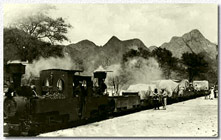
Railway in Namibia1895 is located in Namibia or „Deutsch-Suedwest Afrika“ as it was called at the time. Namibia is situated south of the equator at the west coast of Africa and being a country dominated by the Namib Desert there are not that many cities and possible routes for railroad lines. An interesting „feature“ of Namibia is the „Caprivi Zipfel“, a strip of land in the north east of Namibia presenting an additional challenge to railway operators. We will see later how the game deals with this.
Railway building in Namibia began with some smaller mining rail lines in 1895 and developed full speed in 1897 when the German Colonial Authority launched a project to build the „Staatsbahn“ (state railway) from Swakopmund to Windhoek.

Here I stand

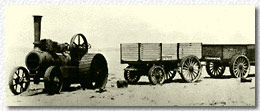
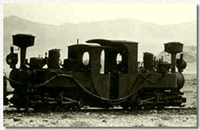
Even earlier, in 1894, the German artist Troost intended to revolutionize the transportation in the desert by replacing the tedious ox-wagons by a steam traction engine hauling several wagons which operated out of Swakopmund. Martin Luther Steam Traction EngineThe engine was imported from its manufacturer Dehne near Halberstadt, Germany and was landed at Walvis Bay. Three months later it was delivered to Troost at Swakopmund. It had practically been pushed the entire distance because of its tendency to dig itself into the deep sand every time an effort was made to move it under its own power. Service was started and the traction engine did surprisingly well once it had passed the coastal sand belt, but eventually the desert was stronger, and it blew a tube which could not be replaced. Later the people of Namibia called it „The Martin Luther“, after his famous quote „Here I stand and I cannot do otherwise.“ Martin Luther certificateToday, the first steam traction engine to operate in Namibia has been restored and declared a national monument.
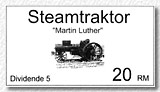
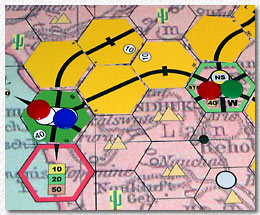
It does not come as a surprise that an 18xx game situated in Namibia includes the Martin Luther as the very first „private company“ available for purchase. What is a surprise though is the fact that the Martin Luther is the only private company available in the game. Its sole purpose is to act as a tie-breaker in case no player is willing to buy stock or obligations as the owner of the Martin Luther cashes in 5 Marks dividends at the beginning of each operation round (throughout this article it is assumed that readers are familiar with the 18xx game concepts; readers not familiar with the basics of the 18xx series should have a look at our 18xx section).

Much obliged

Once the Martin Luther has found its owner obligations became available for purchase via auctioning. Obligations are a new element to 18xx and constitute a players obligation to connect two cities with railway tracks. The player who successfully bid on an obligation, receives one free 10% share certificate of the corresponding corporation. At the time of auctioning these share certificates have no value and cannot be sold. They only become dividend paying shares once the track between the two cities has been build. State Railway has fulfilled its obligationThis happens irrespective of the fact which corporation laid the final connection between the two cities. Another benefit the owner of an obligation gets is the option to buy the president’s certificate of the corresponding corporation once it is available for purchase. This option may even be executed if the certificate becomes available during the turn of another player. In this case, if the player owning the obligation wants to buy the president’s certificate s/he may do so immediately and out of sequence provided s/he holds sufficient money in hand – no shares may be sold to raise money at this point.
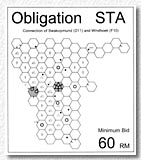
While obligations present the advantage of receiving a free share and the purchase option for the presidency these advantages are linked to challenging conditions: only building a predefined railway connection valuates the free share and executing the purchase option requires sufficient money in hand at the right point in time.

STA Obligation certificateThere is a rough correlation between initial price of an obligation and the length of the route to be built but it turns out to be a rather tough decision of how much, if anything, one bids for an obligation. In our game we had the situation that I was „forced“ by Walter to execute the purchase option at an extremely bad moment. I was short on cash at the time and had to set the initial price for the corporation in question to the lowest possible value. This combined with the following purchase „war“ to keep the presidency forced me to sell some of my much more valuable stock.
Günther, on the other hand, purchased an obligation but chose to not buy the corresponding presidency. Unfortunately, the corporation’s target route for activating the obligation’s free share was the longest route on the map: right into the Caprivi Strip to the eastern-most end of Namibia. The consequence of this was that Walter as the president of the corporation had no intention to build the awkward track while Günther was left for a long time with an inactive share counting towards his certificate limit.

Obligations need not be bought to continue the game. If all players pass on a single obligation the obligation is removed from the game and the next obligation comes up for auction. If the last obligation is gone corporation shares become available.

Sold out

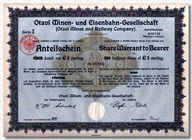
The five corporations also come up for sale in a predefined order. The buyer of the president’s (20%) share sets the price for a 10% share. Otavi share (real)There is only one share price and no distinction between initial offering price and bank pool price, a rule we liked already much in 1951 and which we adopted for 1830 (see our Walter variant). Once 60% of the shares of a corporation are sold, including the still inactive share coming with a sold obligation, the corporation floats. All remaining shares are then transferred to the treasury of the corporation together with 5 times the initial share price (6 times the share price if the obligation has not been sold). Any subsequent shares bought from the corporation’s treasury cost the current price indicated on the stock market chart and the money is paid to the corporation.
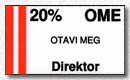
Otavi president's share certificateThere is one aspect during the stock market round which was new to us and we found an excellent idea: a player is allowed to own up to 100% of the shares of a corporation. However, for any share bought in excess of 60% a player must pay a 20% commission to the bank and the certificate limit for each player is set 13 so that never all shares can be sold out. This puts players in the position to completely control a corporation and not being dependent on robber baron style players and their stock market manipulations. In our game this was used by Walter to his advantage when he decided to disinvest in all of my shares and instead investing in 100% of the shares of one of his two corporations. Unfortunately for him, in mid-game he overlooked the threat of his route being devastated by a cleverly placed token of another corporation with the consequence that dividend payments were severely impacted for a while. Overall, we found the concept of being able to buy ALL shares of a corporation for a 20% premium to be a perfect enhancement of the game system.
Boarding the H-train

train stack of 1895This leads us to the operation rounds. By deliberately providing only a limited supply of brown tiles and the fact that as soon as they become available corporations may build two yellow tiles per operation round instead of one the duration of the endgame is significantly shortened. A fact we liked a lot as it prevents those tedious waiting times when one player is trying to still find a worthwhile extention of his routes. Also the well-balanced overall supply of money in the bank supports this concept.
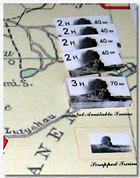
Trains come in the H-variant, traveling their designated number of mid-hex distances rather than a given number of stations. There are 8 different trains available, starting with the tiny 2H up to the giant 16H, which can cover nearly any north-south route of the map. Supply of trains is very limited, though. All but the 2H (4) and 3H (3) trains types have only 2 trains, except for the 16H, which has an endless supply. Scrapping of obsolete trains occurs whenever a train with twice the size is first bought, i.e. 8H trains scrap 4H trains and results in 10H, 12H and 16H trains being saved from scrapping. Even with our empire building style of game play this led to a very dynamic mid-game in terms of train acquisition; sometimes making it difficult to get at least one run out of a newly purchased train. The amount of dynamics in train acquisition and operation is something we have not seen before in an 18xx game and which definitely is another highlight of 1895.

Working in a coalmine

diamond mine and mine income table

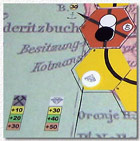
Another new feature is the two mines on the map, one coal mine and one diamond mine. If connected to a route a corporation collects additional income when using that route. Different to the normal income of a corporation the mine income may not be used for dividends but is paid into the corporation’s treasury straight away. We found this to be a very welcomed extra income for a corporation virtually at no extra cost other than using a route along a mine field.

And in the end

In the end Günther won the game by a small margin. This is remarkable in so far as Günther was the player with only one presidency and who had the additional handicap of a reduced certificate limit due to the blocked share, which came with the obligation. Walter and I both owned two presidencies, Walter owning 100% and 50% of his corporations and I owning 80% and 60% of my corporations. In retrospect the forced floating of my second corporation at a very low share price only to keep the benefits of the obligation was definitely a mistake and probably cost me the game.

Conclusion

1895 is a 3-player game, designed to last 2 hours or less if played without a moderator program (the configuration file for Lemmi’s 18xx moderator program is already available on Adam’s homepage). As with most 18xx games the designer took care to reflect the historical development of the railway system in the respective country with some accuracy. Four of the five railroad corporations in the game are real railroad companies of that period. Most likely, trackbuilding also follows historical routes due to the obligation’s target cities and the cleverly placed fields with extra costs (terrain) or benefits (mines).

Namibia trains 1900The idea to design a short 3-player variant of an 18xx game has been implemented very well indeed. 1895 is highly dynamic both in the bank round, due to the low certificate limit as well as in the operation rounds, due to the limited supply of trains of a single type. The concept of obligations works very well and provides an extra dimension to the game which we found challenging both in determining the right price for them as well as using their benefits to a player’s best advantage. Comined with the excellent production quality of the game (map, tiles, certificates and trains are laminated) makes 1895 a highly recommended game. Walter gave it a ranking of 10 (out of 10), which puts 1895 in line with his much liked 1830. For me 1895 is a excellent addition to the 18xx series, especially due to the fact that it is a short, 3-player game and still has a lot of dynamics and challenges. But the „suspense factor“ of 1830 is still my favorite; hence my ranking is 9 out of 10.

Our thanks go to Adam Romoth (designer) and Helmut Ohley (co-designer and producer) for making it possible to play „1895 – Namibia“ a few months before the scheduled re-release date in October, in time for „Spiel 2004“ in Essen. The improvements made to the inital design released in 2002 are considerable and resulted in an overall enhancement of the game.

Details about the games availability can be found here soon.