Archiv der Kategorie: Spieleabende

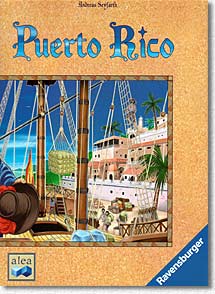
Puerto Rico

Puerto Rico

Puerto Rico

Publisher: Alea/Ravensburger

Author: Andreas Seyfarth

Tester: Aaron Haag, Hans R. Frey

Game Tested: German release, 2002

Scenario: Puerto Rico – the small island of the West Indies is the setting for
this fight for wealth and honor of 3 to 5 players. By building plantations and production
plants as well as important support facilities, and by exporting goods, players try to
accumulate victory points. Players start with just one little corn field and no
buildings, and face the task of setting up a prosperous production chain of goods ready
for export or local sale in order to generate the money necessary for further
expansion.

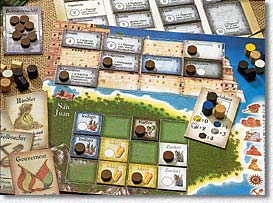
The Game: Each player is given his own placemat depicting the town of San Juan
with 12 available spaces for buildings and a settlement area with room for up to 12
plantations. A separate board represents the “Bank” for doubloons, the currency
of the game, and holds the available buildings. Buildings come in two flavors: there are
plants to produce goods from crop (like e.g. the sugar mill) and there are buildings that
provide the player with special abilities (like e.g. a market place which allows the
player to sell goods already present in the trading house).

The motor of the game are the “character cards” or “roles” which
provide the players with a means to control the sequence of phases in which the game is
played. Beginning with the start player (represented by “Governor” card) each
player selects a character. Different to other games with a number of roles all
players perform the action associated with the selected character. The benefit for the
selecting player (besides first choice when performing the action) is the right to make
use of a special “privilege” each character provides. Basically, this mechanism
makes the players determine the sequence of actions performed in a round and is of great
tactical importance. Also, there are 3 more character cards in play than there are
players, making it possible to avoid certain actions in a particular round at all. Once
all players have selected their character and hence all have played the actions of all
characters selected the round ends and the Govenor is handed to the next player not
before a doubloon each is placed on the 3 character cards that have not been selected in
this round (making them more attractive in the next round).

The actions and privileges of the character cards are:

  • Settler

    Each player selects a plantation to be placed on his island. Privilege: the player
    may choose to place a quarry instead.
  • Mayor

    Players receive colonists from the colonist ship. All colonists on the island may be
    redistributed. Privilege: the mayor receives one extra colonist from stock.
  • Builder

    Players may build one of the available buildings by paying the appropiate cost in
    doubloons. Privilege: the builder pays one doubloon less.
  • Craftsman

    Players receive goods according to their production chains. Privilege: the
    craftsman receives an extra token of one of the goods produced.
  • Trader

    Players may sell one goods token to the trading house. Privilege: the trader
    receives one extra doubloon for his token.
  • Captain

    Players must place goods on available ships and receive a victory point chip for
    each goods token placed. Privilege: the captain receives one extra victory
    point.
  • Prospector

    No action. Privilege: the prospector takes one doubloon from the bank.

At the start of the game the settler and the builder are the most useful characters
because they are required to build plantations and buildings – both being vital for
successful production chains. Plantations come in 5 different types: indigo, sugar, corn,
tobacco and coffee, in order of abundance. Puerto RicoWith the exception of corn
all other crops require a processing plant in order to generates goods for sale or
shipment. Some plants come in two different sizes with the smaller size being available
at a lower price. A production chain requires that each plantation used for production as
well as the production plant itself is occupied by colonists.

While plantations come for free in the Settler phase building need to be paid for and
money (doubloons) is very scarce in this game. Players start the game with between 2 to 4
doubloons depending on the number of players and buildings cost between 1 and 10
doubloons to construct. One way out of this shortage of money is to place quarries
instead of plantations, as each quarry occupied by a colonist lowers the building price
by one doubloon in the Builder phase.

There are, of course, ways to generate money. The first way is to sell goods to the
trading house. Each commodity may only be present once in the house and the storage
capacity is small as well (4 tokens). If a good can be sold in the Trader phase the money
a player receives depends on the commodity sold, ranging from zero(!) doubloons for corn
to four doubloons for coffee. The second way to receive money is by selecting character
cards with doubloons on them. Often at the beginning of a round some cards have two
doubloons on them making them rather attractive to take. Sometimes even a prospector has
this two doubloons bonus because that role has not been chosen since two rounds making it
an attractive 3 doubloons deal this round. Anyway, generating money is certainly not an
easy task.

Another very scarce resource of the game are the colonists. No plantation, quarry or
building operates or provides special benefits if not occupied by one or more colonists.
As explained before, this is most important in producrion chains. Colonists arrive on the
colonist ship in a varying number depending on the number of players and the number of
open positions in buildings. In the Mayor’s phase all colonists are distributed
amongst the players in sequence and the players may place these colonists on any position
they have vacant at the time (plus they may redistribute all colonists on their island).
Most of the time a player will receive only 1 colonist per round so getting one’s
plantations and buildings fully operational takes time.

The decisive element, however, are victory points. On the one hand they are generated
in the captain’s phase by placing goods on available ships. As there are only three
ships available, each ship has a limited capacity, and each ship may only carry one
commodity at a time, often some goods cannot be placed at all. This can pose a serious
problem as goods must be placed on a ship if possible but goods not placed due to the
unavailability of a ship must either be placed in an operational storage building or are
lost – a situation to avoid at all cost.

At the end of the game victory points are also credited for each building a player
has, irrespective of whether it is occupied by a colonist or not. The four
“large” buildings (if occupied !) generate extra victory points (the fortress
for example provides 1 extra victory point for every 3 colonists on the players
board).The game end is variable: it occurs at the end of the round where either an
insufficient amount of colonists is available to fully stock the colonist ship or at
least one player has buildings on each of his 12 town fields or when all victory point
chips have been distributed.

Playing Time: The game can be explained in 15 minutes and played in about 2
hours.

Similar Games: Princes of Florence

Westpark Gamer’s Opinion: Like many good games Puerto Rico has a strong
timing and resource management (i.e. tactical) component combined with several strategic
options. It has actually been quite a while that we have seen a new game which leaves
such a wide scope for different strategies and at the same time provides the permanent
challenges of tactical decisions. Many times during a game one is faced with a situation
that the obvious best move for oneself has just been destroyed by another player by
picking the character card one wanted to select, too. Therefore, most of the time you are
forced to devise a “plan B” and sometime even “plan C” which you can
use as alternatives. This sounds complicated and hard to grasp but we found that this
comes quite naturally when getting familiar with the game while it does no harm if the
players are not yet familiar with all strategic options.

Overall, the number of strategic variants seem to be quite high. Until now we have not
yet found a sure winning strategy though and in fact we believe that there is none which
will work all the time – again a sign of a good game. A Player needs to constantly be
watching the moves of the others in order to adjust his or her strategy accordingly and
at the same time prevent the other players to build up “winning combinations”.
For example, allowing a player to build lots of corn fields, a hospice and a shipyard
most likely means victory for that player. Similar situations arise if a player is
allowed to build more than one large building generating extra VPs at the end of the
game. This aspect of the game is what makes it rather complex because depriving other
players of certain building does not necessarily match with your own strategy. Sometimes
this means that one has to play the Captain just to create e.g. a “coffee” ship
with one coffee in order to prevent another player to get VPs for all his corns. Or you
may already have sufficient doubloons but are faced with a situation where you need to
take a prospector with 2 extra doubloons just to prevent someone else to get enough money
for that winning shipyard. Throughout the game players are in the type of dilemma
situation where they would like to do several things at once but are only allowed to take
one action – another indication of a good game.

Player interactions are quite low though and are mainly limited to cautious hints to
other players or “I wanted to take that role, too” type sighs. This can lead to
a rather “quite” gaming session but due to the fact that everybody feels
involved all of the time we never found this to be a problem.

Some words about strategies: in our games the number of VPs required for winning the
game varied between 28 and 43 – a rather wide spread although the distance between first
and last position in most cases was rather small (less than 10 points). This can be
attributed to the different strategies we followed as our experience grew. From what we
have learnt so far it seems to be wise to keep a good balance between VPs generated by
production and those generated by the buildings (a 50:50 share seems okay). And unless
you are playing with newcomers to the game it is a good idea to try and produce at least
3 different types of goods. Clever building selection also plays a major role. Keep an
eye on the “hospice” and if possible try to grab one of the two available. We
found this building to be one of the most powerful of the game and one has to prevent
other players from building “power combinations” with it (like
“hospice”/”builder’s hut” or
“hospice”/”shipyard”).

Hans’ strategy hints: A word of caution in advance: I have never won in
this game yet, though I haven’t lost very badly, either. What I like best in this
game, is that the actions of all players interact and create a different feel each time.
What works one day, need not work another. This said, let me propose a few ideas:

Life is short: The last round inevitably comes too early for you. Running down
the game clock can be your best strategy, or it can ruin your best plan. Normally,
colonists run out fastest, but watch out for the other two types of game ending.
Don’t do anything in the endgame which bears fruit too late!

Build big: Normally, you will (at game end) need one of the X-large buildings
for extra victory points. Get two, and you’re top dog. It is essential to know where
the money is to come from in that final builder phase. And remember, you need to shuffle
a colonist on it later!

Take the money and run: Sometimes, the best way to make money is by selecting a
not-so-hot character with many doubloons on it – but don’t do that too often (see
hint #1).

Play along: In most rounds, you’re not te governor, and if you are: good
luck, as you’ll be the last to pick a character next time. It is very important to
have an idea which characters will be picked before you’re up next. Let’s assume
You want to trade goods for money: First, you need a plantation and a production
plant, then you need to shuffle colonists on them, then produce goods
tokens, at last – you are forced by a captain’s phase to convert the tokens
into victory points (if you’re lucky and there’s a ship for them) instead of
trading them in a trader’s phase. In Zen words: the shapeless form is the strongest.
In my words: play so that the others are forced to help you while serving their own
interest.

Experience tells: So far, our group of players finds the hospice, the hazienda,
and the constructor’s hut to be the most rewarding support buildings. Try to get one
or two of these right away. Get all three, and you’re unstoppable. Get none, and Your
only hope is in a short game. As well, to have one of the storage buildings is regarded
as indispensable by most of us (not me, though). Quarries are the best plantations, but
it needs time until they make their weight felt.

Closer views:

The heavy strategy: You want to get four quarries asap, in order to construct a
high-price, high-victory-point city. You must have a constructor’s hut, so you know
what to do in the first builder phase. You will be short of plantations, colonists and
money for a long time, so be careful if there’s a lot of production chains in the
other player’s cities. These attract many colonists in the mayor phase, and the game
may end so soon that You can’t harvest the returns of your investment. Best friends:
hazienda, hospice.

The yellow strategy: You want to make use of the fact that corn fields need no
factory in order to produce goods. In fact, you don’t need a single building, at all!
Just make sure you get all corn that pops up in the settler phase and pick the captain
yourself as often as you possibly can. You won’t have money – but you don’t need
it, anyway! You will never have too few colonists. Ships at the quay, that’s what you
need, and an early end to the game. Best friends: storehouse, wharf.

The scented strategy: Be the first to produce tobacco, later coffee. Trade like
lightning and spend your income on buildings. Your problem is that you may be unable to
trade sometimes, which can be a major setback. The good thing is that the money gives you
flexibility. You will have to develop an idea how to make the best of the end game. Best
friends: office, market.

The sweet strategy: You want to strike a balance between export and trade, between
cash and victory points flow. Sugar is a very attractive commodity to produce in this
case – the plantation is the second most abundant type, the trading price is reasonable,
and the factories are not expensive to build. The problem is that you may end up a little
short of money for that decisive building and with too little export for that extra
victory point chip. Best friends: your keen sense for opportunities that open up. A short
game probably doesn’t hurt.

The drugstore strategy: You want to produce as many different commodities as
possible. It’s easier to implement than it sounds, and it avoids the pitfall of the
trading business, i.e. not having the right commodity to sell. Beware of a short game, as
it takes time to build the production chains. Obviously, the drugstore can develop out of
the other strategies in the middle game. Best friends: harbour, factory.

Add your comments here

Westpark Gamers’ Rating: 8.17

Links to further information: BoardgameGeek’s page on Puerto Rico
Alea’s page
about the game
Rio
Grande’s
page about the game

Spielbericht vom 4.3.2002

Spielbericht vom 4.3.2002

Autor: Moritz

am Tisch: Günther (der “Chef”), Aaron, Peter, Hans, Moritz

auf dem Tisch: Puerto Rico, Warhamster Rally

  1. Puerto Rico

    Die Spielmesse ist ja schon wieder ein Weilchen her, aber dieses von Freaks hoch gelobte
    Spiel kam erst jetzt bei uns auf den Tisch, auf besonderen Wunsch von Aaron und Günther
    (nach seinem legendären Erfolg bei der Vorausscheidung der Brettspielmeisterschaft
    – 4 Siege! – nur noch “Der Chef” genannt).

    Aaron las uns die detaillierte Regel vor – und tatsächlich war dann auch so
    ziemlich alles klar. Hans kommentierte richtig “Das hat sich wohl ein Mathematiker
    ausgedacht!”. Die Mechanismen scheinen alle bekannt: Ein bißchen Fürsten von Florenz, ein bißchen Ohne Furcht und
    Adel
    , sogar ein bißchen La città ,
    alles trocken, klar, und “straight”. Aber läßt sich das auch spielen? Die
    Antwort ist ein verhaltenes Ja – das Spiel funktioniert…irgendwie. Wie bei den
    “Siedlern” oder auch bei “Fürsten von Florenz” handelt es sich hier
    um eine Art Gruppen-Solitärspiel, anders als bei “Fürsten” findet hier die
    Interaktion nicht in der Bietrunde, sondern in der geschickten Ausnutzung der
    Zugreihenfolge statt.

    Mehrere Taktiken bieten sich an, alle scheinen potentiell zu funktionieren. Kaufe ich
    lieber Plantagen oder Häuser? Wo stelle ich meine meistens viel zu raren Arbeiter drauf
    (nur besetzte Gebäude/Plantagen sind nämlich aktiv). Soll ich lieber auf den Verkauf
    meiner Ware (Geld ist immer knapp), oder auf deren Umwandlung in Siegpunkte spekulieren?
    Aus diesen vielen kleinen Fragen entwickelt sich ein unerwartet untrockenes Aufbau-Spiel
    mit einiger Spannung. Nach der Partie meinten alle, “das müsste man nochmal
    spielen” um zu sehen wie es funktioniert, der Sieg (in diesem Fall meiner) kam
    nämlich eigentlich irgendwie unerwartet und hatte auch ein bißchen was mit Glück, sprich
    Zugreihenfolge zu tun. Aber: Spaß hat’s gemacht, und das Spielmaterial ist ohnehin,
    genau wie die Spielregel, über jeden Zweifel erhaben. Also eindeutig mal einen Versuch
    wert, Freunde!

    Bewertung: 7.8 (Neueinsteiger der Woche!)

  2. Warhamster
    Rally


    Nach dem obligatorischen Empire-Spiel gelingt es mir immer mal wieder, eine kleine
    Rarität auf den Tisch zu bringen, in diesem Fall “Warhamster Rally” von Jolly Roger Games. Um so mehr erstaunte mich Günther, der lakonisch meinte
    “das habe ich schon mal gespielt” – wow, das sind echte Freaks!

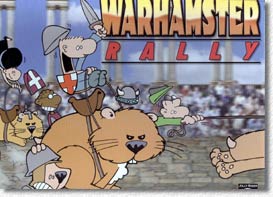
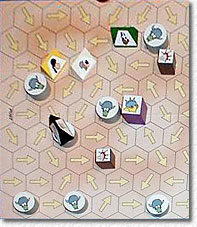
    Warhamster RallyWarhamster Rally boardDieses Rennspiel, eine Art Robo
    Rally “light” (die Hindernisse sind durch ein Pfeillabyrinth ersetzt, und man
    muß auch nur eine Bewegungskarte “planen”) benutzt die allseits beliebten
    Charaktere aus John Kovalic’s Comic “Dork Tower” – es geht
    irgendwie darum, mit irgendwelchen Riesenhamstern irgendein skurriles Rennen zu gewinnen,
    also eigentlich ein abstraktes Spiel ohne irgendwelchen tieferen Themenbezug (die
    “special abilities” der Charaktere erscheinen dementsprechend auch vollkommen
    willkürlich ausgewählt – mit dem Comic hat das nix zu tun). Das Spiel hinterlässt,
    genauso wie Chez Dork keinen sehr tiefen Eindruck – ganz nett, aber nicht
    umwerfend. Zu viel Chaos durch die Aktionen der anderen vermiesen einem jeden Plan,
    andererseits ist es nicht komplex und spielt sich schnell. Allerdings hätte das Spiel
    mehr Sympathien, wenn es bei Cheapass erschienen wäre – da wäre Preis und Spielidee in irgendeiner
    Relation gestanden, aber als teures Brettspiel mit Comic-Lizenz ist es eindeutig
    “hypertroph” und letztlich unbeindruckend.

    Ach ja, Aarons Hamster gewann – väterliche Sachkenntnis?

    Bewertung: 4,8

Spielbericht vom 27.2.2002

Spielbericht vom 27.2.2002

Autor: Aaron

Ort: bei Walter

am Tisch: Walter, Peter, Günther, Aaron

auf dem Tisch: Evo, Euphrat&Tigris, Bluff

  1. Evo

    Lange nicht mehr gespielt – insbesondere in der Viererbesetzung. Wie nicht anders zu
    erwarten startete Peter gleich zu Anfang einen Angriff und Günther verlor seinen ersten
    Dino im Kampfeinsatz. Überraschenderweise baute Pter seine Angriffsstärke nicht weiter
    aus, sondern verlegte sich auf schnelle Fluchtbewegungen mittels der Schwanzverlängerung.
    Bald hatte sich Günther wieder erholt und durch zwei Hörner gegen jeden weiteren
    Angriffsversuch ausreichend geschützt. Zwischen Walter und mir gab es ausser ein paar
    kleineren Geplänkeln keine größeren Reibereien, so dass wir beide relativ ungestört
    unsere Position ausbauen konnten. Schnell zeigte sich aber, dass es letztendlich auf eine
    ausgewogene Genmischung ankommt – so nützten mir meine 3 Felle, 4 Beine und 3 Eier wenig,
    als es zur weiteren Ausbreitung nur noch Wüsten- und Ebenenfelder gab, die Dinos aber
    kaltes Bergklima bevorzugten. Drei Runden vor Schluss hatte Günther durch seine
    exzellente Genauswahl und gute Positionierung auf dem Brett seine Führung uneinholbar
    ausgebaut und dann auch verdient gewonnen. Peter belegte wohl auch durch seine
    misslungenen Offensiven im Endspiel den letzten Platz.

    Bewertung: 8

  2. Euphrat & Tigris

    Eines unserer liebsten Viererspiele, das wir grundsätzlich mit offenen Wertungssteinchen
    spielen, um auch den Gedächtnis-schwächeren Spielern eine Chance zu geben. Relativ
    schnell entwickelten sich zwei große Reiche in den fast alle Fürsten vertreten waren.
    Peter hatte bald eine solide Führung ausgebaut, die noch durch die Beteiligung an zwei
    Tempeln jede Runde verstärkt wurde. Durch geschicktes Legen des Katastrophenplättchens
    und gezielter Doppelangriffe konnte sein Siegeszug zwar kurzzeitig unterbrochen werden
    aber es reichte nicht, ihm den ersten Platz streitig zu machen. In einer Verzweiflungstat
    startete Günther in der Endphase des Spiels zwei Großangriffe gegen mich, die er Dank
    unglücklicher Plättchenverteilung beide verlor und mir dadurch den sichernen zweiten
    Platz bescherte. Konsequenterweise beschloss dann Peter, das Spiel durch den Tausch von
    12 Plättchen rasch zu beenden.

    Bewertung: 9

  3. Bluff

    Diesmal hatte Günther eine “goldene Serie” – er gewann drei Spiele in Folge.

    Bewertung: 7.73

Spielbericht vom 13.2.2002

Spielbericht vom 13.2.2002

Autor: Moritz

Ort: bei Walter

am Tisch: Walter, Peter, Hans, Aaron, Moritz

auf dem Tisch: Titicaca, Ohne Furcht und Adel, Bluff

  1. Titicaca

    Eigentlich halten wir uns ja für ziemliche Spieleprofis, die auch vor langen und
    komplexen Regelwerken nicht zurück schrecken, aber diesmal war wirklich der
    Verständniswurm drin – und das bei einem Spiel, das nur 4 Seiten Regeln hat!
    Allerdings 4 Seiten, die vollkommen abstrakte und willkürlich scheinende Mechanismen
    beschreiben, und das auch noch mit mehreren Unterschieden in den verschiedenen
    Übersetzungen. Zum Teil war nur nach langem, umstrittenem Studium der graphischen
    Beispiele (die zum Teil auch noch fehlerhaft bezeichnet sind) ein Verständnis bestimmter
    Regeln möglich.

    Bei “Titicaca” handelt es sich aber im Grunde um einen eigentlich sogar recht
    simplen Vertreter der Gattung “modulares Board – Einsetzen von Figuren zum
    Erlangen von Mehrheiten – Wertungsrunden”, wenn man denn von so einer Gattung
    sprechen kann, zu der sicherlich Spiele wie “El Caballero” und natürlich auch
    “Carcassonne” gehören. Im Gegensatz zu den anderen genannten Spielen gibt es
    bei “Titicaca” kein Glückselement beim Ziehen von Regionen – Spielbrett
    und auch die Reihenfolge der zu wertenden Felder sind von vornherein klar. Dennoch hat
    natürlich jedes Spiel, bei dem – wie hier auch – geheim geboten wird, ein
    “psychologisches” Glückselement, das man nicht unterschätzen sollte.

    Am Schluss dieses trotz seiner Einfachheit doch unnötig verwirrendem Spiels, gewann
    Walter mit überragender Mehrheit, obwohl weder wir noch er eigentlich wirklich wussten
    warum.

    Seltsamerweise also ein fader Nachgeschmack, mit einem unbestimmten Wunsch, es nochmal
    zu spielen, um es besser zu durchschauen.

    Bewertung: 5.2

  2. Ohne Furcht und Adel

    Sicherlich eines der meistgespielten Spiele der letzten Jahre, wahrscheinlich, weil es
    doch recht fix zu erklären ist, und sich für grössere Runden gut eignet. Wir spielten
    diesmal mit den “richtigen” Regeln, d.h. der König wechselt auch, wenn er
    gemeuchelt wird, eine der aussortierten Karten ist offen, und die Gebäudebonusse können
    am Anfang ODER am Ende eine Runde abkassiert werden (was man nur versteht, wenn man das
    Spielbeispiel in den Regeln wirklich seeeeehr genau liest).

    Hans legte in Empirebuilder-Manier eine hochwertige Karte nach der anderen aus, und
    lieferte sich dabei ein heisses Rennen mit Walter. Durch geschickte Nutzung des Söldners
    konnte Hans den leichten Vorsprung Walters genügend schwächen, um selber schließlich als
    Einziger mit 8 Karten das Spiel zu beenden.

    Beim Spielen kam die Theorie auf, daß niemand, der einmal gemeuchelt wurde, das Spiel
    noch gewinnen kann. Zumindest habe ich noch nie ein Spiel erlebt, in dem dies möglich
    war. Ein unbefriedigendes Element dieses Spiels? Gerade in den ersten Runden kann es
    reines Pech sein, gemeuchelt zu werden….

    Bewertung: 7.47 (leicht abgewertet)

  3. Bluff

    Hier besonders zu erwähnen die Durchbrechung von Aarons “Schwarzer Serie” : 13
    Spiele – und nie gewonnen!

    Endlich gelang es Aaron, sich für diese Demütigung gebührend zu rächen. Das nächste
    Spiel entschied dann Walter mit unverschämten Würfelglück.

    Bewertung: 7.73

    Die besten Bluffspieler (ELO):

    Thomas d.J./Peter W.: 6

    Günther 4.07

    Moritz 3.83

Spielbericht vom 7.2.2002

Spielbericht vom 7.2.2002

Autor: Aaron

Ort: bei Peter

am Tisch: Peter, Aaron

auf dem Tisch: De Bellis Antiquitatis, Robin Hood

  1. De Bellis Antiquitatis

    Mein erstes Tabletop Spiel und das gleich mit den wunderbar bemalten Zinnfiguren von
    Peter. Ungewohnt war, dass es so gar keinen Spielplan gab, sondern “nur” auf
    den Tisch gelegte Flächen für schweres Gelände (Wald) und Straßen. Peter hatte speziell
    für diesen Abend noch dünne Moosgummi-Platten besorgt, aus denen ich dann unregelmäßig
    geformte Geländestücke schneiden durfte. Als Krönung gab es kleine Kunststoffbäume aus
    dem Modelleisenbahnbedarf. Nachdem das Gelände und die Heere auf dem Tisch platziert
    waren, ging es ans Regelstudium – die “einfachen” mit nur 16 Seiten, davon 3
    Seiten mit wirklich wichtigen Dingen. Es war schon etwas ungewohnt ein Spiel zu spielen,
    bei dem es um eine möglichst exakte Nachbildung früherer Schlachten geht. So wurde ich
    dann auch gleich nach Aufstellung meiner Truppen von Peter mit einem Bild aus einem
    seiner vielen antiken Bücher überrascht: “Schau Dir das mal und vergleiche es mit
    Deiner Aufstellung”. Okay, offenbar wurde damals mit möglichst breiter Front
    gekämpft – also: Neuformation.

    Das Spiel selbst erforderte dann dauerndes Messen mit einem Zollmaß, um die Zugweiten
    der Einheiten korrekt zu bestimmen. Da es dabei manchmal auf Bruchteile von Millimetern
    abkommt, bietet das ernsteren Spielern sicherlich jede Menge Gelegenheit zum Streit. Wir
    haben das ganze jedenfalls nicht so eng gesehen und entsprechend flüssig lief das Spiel.
    Peters Kenntnissen als Althistoriker hatte ich bestenfalls ein wenig Logik und (mein
    bekannt geringes) Würfelglück entgegen zu setzen. So war dann auch nach rund einer Stunde
    die Schlacht zugunsten von Peter entschieden.

    Irgendwie scheinen mir Tabletops eher für Menschen interessant zu sein, die sich daran
    erfreuen können, Situationen möglichst naturgetreu nach zu stellen – vielleicht so etwas
    wie die aggressive Form von Modelleisenbahn-Liebhabern. Mir als recht nüchternem Menschen
    war das “Drumherum” eher lästig – Bäume, die umfallen, Einheiten, die aus
    Versehen um Millimeter verschoben werden – da geht einfach zuviel Spielzeit für nicht
    spielrelevante Dinge drauf…

    Eine (kostenpflichtige) Online-Version von DBA gibt es bei DBAOL.

  2. Robin Hood

    Ebenfalls als reines Zweier-Spiel ist Robin Hood von Calder Craft konzipiert. Der
    Modellbau-Hersteller aus England hat Ende der 70er Jahre ein Spiel rund um die als
    Zinnfiguren realisierten Männer von Robin Hood, Maid Marion und die Schergen des Sheriffs
    von Nottingham entworfen. Gespielt wird auf einem vierteiligen Plan mit quadratischen
    Feldern, die Wege, Wälder, Cottages sowie das Schloss und die Stadt Nottingham
    symbolisieren. Aufgabe der Leute des Sheriffs ist es, Maid Marion vom Schloss zur Stadt
    zu bringen, ohne dass sie in die Hände von Robin Hoods Leuten fällt. Sobald sich Gegener
    in Reichweite befinden kommt es zum Kapf, der wie üblich durch Würfeln mit diversen
    Modifiern entschieden wird. Eine nette Idee ist, dass zu Beginn des Spiels die Männer von
    Robin Hood in den Wäldern versteckt sind und erst in Erscheinung treten, wenn dies der
    Robin Hood Spieler möchte. Dadurch bietet sich Gelegenheit, Hinterhalte aufzubauen.

    Peter hatte auch hier einerseits das bessere Würfelglück als auch den Vorteil, dass ich
    die Männer von Robin Hood zu früh und zu agressiv ins Spiel gebracht habe. So konnte es
    meine Figuren mit einem Trupp seiner Leute in Kämpfe verwickeln und parallel dazu Maid
    Marion mit leichter Bewachung ungestört auf einem Seitenweg zur Stadt bringen.

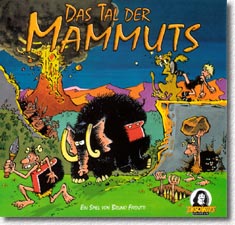
Das Tal der Mammuts Valley of the Mammoths

Das Tal der Mammuts

Das Tal der Mammuts

Valley of the Mammoths

Publisher: Eurogames/Jeux Descartes

Author: Bruno Faidutti

Tester: Aaron Haag

Game Tested: 1st release 2001

Scenario: Will your tribe be the first to vanquish its enemies? Can it
prosper, multiply and seize vast territory? Are you ready to battle rival tribes and
confront ferocious beasts? To hunt, fish, forage and farm in order to provide the
necessary food for the survival of your tribe? Then welcome to the Valley of the
Mammoth… and good luck!
This quote from the English rules nicely describes
what this game is all about: controlling a tribe of humans in prehistoric times with the
aim to not only avoid starvation (difficult!) but also extend your control of the map
board by setting up camps.

The Game: Ten years after the first release of this game (“La Vallée des
Mammouths”, 1991, Ludodélire) the German version became available at Spiel 2001 in
Essen. An English release (“Valley of the Mammoths”, 2001, Eurogames Descartes USA) is
also planned and should be available by the time you read this. Compared with the French
version there have been some slight modifications to make the games more balanced and in
some respects easier to play (e.g. animals all have the same strength now).

The games is set up on a board with 37 hex spaces depicting three types of regions
(plains, forests, mountains). As a nice touch the board comes in two pieces and is
printed on both sides using different regional setups – so there are a total of 4
different maps to play on. Each of the two to six players controls a tribe of 10 warriors
and 6 females of which at the start of the game 5 warriors and 2 females are placed in a
camp on the board . The players then receive 5 fate cards each. Fate cards provide a
tribe with one-time abilities or options and may be used when the appropriate turn is
played. The player’s task is to set up a total of four camps on the board and keep
them for one complete round. The first player achieving this goal wins the game.

The game is played in turns consisting of up to 10 phases each. The actions in a phase
vary depending on the current season of the year: each game year is divided in a three
turn summer season followed by a three turn winter season.

The phases of a turn are:

  1. Events

    Depending on the season a summer or winter event is drawn from the appropriate event card
    pile. Most of the events have a negative effect on all tribes on the board, some
    affecting only a particular region or have a lasting effect for a whole season. For play
    balance events are not drawn in the first two turns of the game.

  2. Arrival of new animals

    New animals arrive on the map by randomly drawing them from a sack. Their numbers vary
    depending on the season (and the number of players) with less animals arriving during the
    winter turns. Each animal drawn has a defined starting location at the border of the map.

  3. Movement of animals

    The roll of a die determines the direction in which all animals move across the board.
    Depending on the type of the animal (wolf, tiger, bear, bison, rhino or mammoth) they
    move a different number of hex spaces and are able to traverse different regions.
    Whenever an animal moves into a hex occupied by humans its movement stops.

  4. Movement of tribes/setting up camps

    Starting with the strongest tribe on the board (number of camp then number of tribe
    members are considered) players may move there tribe tokens one or two hex spaces on the
    map. If any enemy tokens (animals or enemy tribes) are in the same hex a token may only
    be moved if the enemy is outnumbered because a player must leave at least as many tokens
    in such a hex as there are enemies present. Instead of moving a player may set up a new
    camp if there are at least one warrior and one female and no enemy tokens in a hex space.

  5. Combat

    Combat takes place in hexes occupied by different tribes or by tribes and animals.
    Combats are resolved by die rolling with a modifier for each warrior, animal or camp.
    Combats between tribes are resolved first and finish when there are only warriors of one
    tribe left in the hex concerned. Females finding themselves in a hex with enemy warriors
    and no warriors of their own tribe are replaced with a female token of the
    “capturing” tribe. Camps may be captured in a similar way. After all tribe
    combats have been resolved combat with animals takes place. Killed animals provide food
    points which can be used in the next phase.

  6. Survival

    In this phase the tribe first collects food points when occupying hex spaces in forests
    (gathering) or near water (fishing) or for harvesting any previously cultivated plain
    hexes with camps. Then they consume food points. Each tribe member requires one food
    point to survive the turn. If insufficient food points are available the player must
    remove any surplus tribe members from the map.

  7. Births

    At the end of each season (not at the end of each turn) up to two females per camp give
    birth to new tribe members. The gender of the new member is determined by a die roll with
    a small chance (roll of a 6) that twins are being born. New-borns are immediately
    considered adults.

  8. Cultivating land

    In the last turn of winter tribes may cultivate any plain hexes with camps at the cost of
    one food point.

  9. New fate cards

    Players with less than 5 fate cards may drawn one new card from the fate card pile. Fate
    cards usually provide an advantage to a tribe by either strengthening the own tribe or
    harming enemy tribes.

  10. End of turn

    The season marker is now moved one space clockwise. If a player controls four camps that
    player must notify the other players about this condition. If the same player still
    controls four camps at the end of the next turn that player wins the game.

Playing Time: The game can be explained in 15 minutes and played in about 60
minutes to 3 hours depending on the number of players and the type of players (fighters
vs. builders).

Similar Games: La Vallée des Mammouths, Vinci,
Ursuppe

Westpark Gamer’s Opinion: In many respects this a typical Faidutti game
with a strong strategical component plus some equally strong chaotic elements added (the
fate and event cards). Players who like this kind of mixture will definitely like this
game. The potential for clever strategies is quite high and as long as one does not mind
too much to be hit by some ill fate or event at the worst possible time this game
provides a lot of fun.

Because some of the fate cards can have quite a big effect on the game (e.g.
“Kindbettfieber” i.e. childbed fever or “Steinschlag” i.e. falling
rocks) Tal der Mammutsit may be a good idea to quickly go through them

before the very first game.Freund This is also recommended for those
(non-Europeans?) who may have problems with the cards’ wonderful cartoonish
graphics (e.g. “Freund”, i.e. “friend”) or theme (e.g.
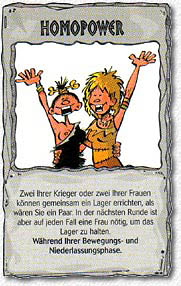
“Homopower”). Actually, the German “Homopower” card (which
allows a player to establish a camp without the necessity to have members of
different gender present) translates to “Domestic Partners” in the English
version. So its more in line with Lemmon/Matthau’s “The Odd Couple”
and rest assured: in the game females are still required to keep the camp for longer
than just one turn or to propagate ;). And there is a sufficient number of cards in
the deck so you can take out which ever you find inappropriate for whatever
reason.

We found it quite hard to keep one’s tribe strong enough as the food supply is
very sparse. Some bad events during the winter season actually can reduce a tribe to a
mere couple. Combat between tribes therefore is not a common event and usually only
happens once one tribe has become so strong that some of its members will not survive
anyway. In this case its better to loose warriors in combat rather than due to
starvation.

There is certainly room for a number of different strategies: from “empire
building” and avoiding combat with other tribes as much as possible but instead
concentrating on setting up camps and collecting food to agressively “attacking
everything that moves” with the aim to take over as many enemy females and camps as
possible. I still have to see the empire building strategy to really work (I lost twice
trying to do this being unable to defend the 4 camps I set up). Also keep in mind that
the game tends to take considerably longer if all players are of the empire building
kind. I personnally believe that the game is much more fun when played agressively.

There is an optional rule about the usage of fire which I strongly recommend you use.
It makes the game only a little more complex but adds an advantage to combat with animals
which in my opinion is necessary to generate sufficient food. On the other hand this is
counterbalanced by the fact that now 1.5 food points are consumed per tribe member per
turn. Another variant also dealing with food availability is called Health
Food
and is described on Bruno Faidutti’s web pages.

There seems to be a second edition of the rules that state that the game is to be
played with three to six players instead of the two to six mentioned in my 1st release
rules book. The game can be played with 2 players without any problems, however, due to
the fact that there is a lot more room for expansion, fights will occur less often than
with more players, which may suit those “empire builders”.

One word about the German Eurogames edition: although the quality of the game
components is quite high I must say that this game again is a typical Eurogames title. I
wished that they would get the rules right with the first release of a game. The German
rule book has some serious translation errors regarding the camp set-up, fire-taking and
food gathering. The correct rules are that camps may be set up and fire may be taken as
long as there are no enemies in the same hex and fishing provides only one
food point if a hex is located at a river and a lake. Luckily, Bruno Faidutti provides an
errata
page
on his web site.

There is also a tiny flaw with a small number of games of the Eurogames edition: the
crop markers are printed incorrectly showing only one ear of grain on both sides. This
can easily be corrected by marking one side with a bold 2 (or by writing to Eurogames who
will send you a correct set of tokens). One small additional hint here while you are
marking the crop tokens: we also marked the animal tokens with their movement points,
movement ability through terrain and their food points. This speeds up the game a little
as you do not have to look up these values in the rules every time you need them.
Alternatively, you may want to print out Pierre-Nicolas Lapointe’s very nicely done
help card.

Aaron’s Rating: 7 (out of 10)

Westpark Gamers’ Rating: 7.67

Links to further information: Westpark Gamers’ Strategy Tips
Bruno
Faidutti’s page
with english rules, a FAQ and rules errata
Luding link for Das Tal der Mammuts

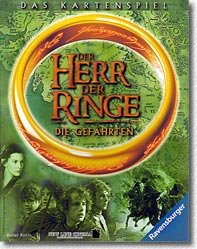
Der Herr der Ringe – Die Gefährten The Card Game

Der Herr der Ringe – Die Gefährten

The Card Game

Der Herr der Ringe - Die Gefährten

Publisher: Ravensburger

Author: Reiner Knizia

Tester: Aaron Haag

Game Tested: 2001 release

Scenario: Frodo and his friends Sam, Merry and Pippin flee through the towns of
Middlearth to prevent Sauron from taken the ring back from him. Two to four players play
character cards for each town in order to receive victory points.

The Game: Although designed by the same author this game is not an extension or
sequel to the “Lord Of The Rings” game series published by Kosmos/Hasbro. In
fact, there is very little reference in the game mechanics to the Lord of the Rings theme
and one may assume that Ravensburger decided to use the current LotR hype for marketing
reasons only as the game itself is an abstract card-laying game. The cards use
photographs of characters of the LotR movie and this may explain the relatively high
price.

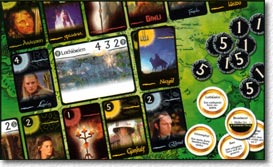
Up to four players use identical sets of 22 cards to gain control over 10 towns of
Middlearth. To do this players in sequence place cards next to the two cards representing
a town from their hand. Das KartenspielOf the 22 cards each player receives 6
randomly drawn cards. Once all ten spaces surrounding a town are occupied players earn
points depending on their relative strength in that town. Each character card has a value
between 0 and 5. Players may play any number of cards valued 1 or one higher
valued card. The one card with value 0 and the Nazgûl may be played in addition. All
character card values of a player on the cards bordering the currently scoring town are
added up and the top scoring players receive the victory points printed on the town card.
Additionally, some towns provide a “ring” to the strongest player. Such a ring
may be used in subsequent turns to protect a character just played. In addition most
rings provide special powers that influence the character cards played in a town or the
town itself.

The player who placed the card which initiated the scoring of a town is the first
player to place a new town on the table. The two cards of the new town must be placed
next to each other and next to already placed character cards. This means that characters
can score twice in a game. It is therefore a considerable advantage to place the last
card for a town because only then one is able to place the new town cards in a favorable
position.

Some towns (black) are more dangerous than others (white) because in black towns
stronger character cards may be placed on top of already played cards. And there is the
Nazgûl card of which each player has exactly one. The Nazgûl is used to remove an already
played card from the table. Frodo (value 3) is however always protected by the ring
against being covered up or being removed.

The game ends when either the last (tenth) town has been completed or all but one
player have run out of cards.

Playing Time: The game can be explained in about 5 minutes. Playing time is 20
to 45 minutes.

Similar Games: Samurai, Corruption

Westpark Gamer’s Opinion: Besides the fact that the game’s atmosphere
bears no resemblance to LotR whatsoever, which may disappoint players looking exactly for
this, “Die Gefährten” is not a bad game at all. Due to the nature of card games
there is an element of luck but the game mechanics provide sufficient room for tactics
and timing. I personally believe that the game is rather more complex than one may think
after one has played it just once or twice – a typical Knizia so to say.

The victory points per town vary from the lesser valued towns (5 points total plus 1
rings) in the beginning to the higher valued towns (13 points) towards the end of the
game. Some careful resource management with respect to character cards is asked for here.
It is also quite important to keep an eye on the card layout on the table. First, this
provides valuable information about the cards other players are still able to play;
secondly, one must avoid that one player gains many “high-valued” sides for
placing new towns and thirdly, the edge of the table is often approaching faster then one
may think. It is a good idea to agree beforehand how this last situation is dealt with –
either towns may only be placed where it is possible to play all character cards (not
quite to the rules though) or the cards are shifted on the table (not as easy as it
sounds). On smaller tables I suggest you move to the floor anyway.

“Finishing” a town by placing a card on the last free space is of a
considerable advantage in this game. On the one hand it enables a player to tip the
scales in this town by playing a high valued card and gaining higher victory points and
on the other hand it enables a player to decide upon the location of the next town. This
“double scoring effect” is what makes the game rather complex and which forces
the players to carefully think and plan ahead. As a consequence there may be very little
player interaction and a lot of thinking and calculating in a group of
“serious” gamers.

Aaron’s Rating: 6 (out of 10)

Westpark Gamers’ Rating: 4

Links to further information: Funagain’s page about Der Herr der Ringe – Die Gefährten
Luding link for Der Herr der Ringe – Die Gefährten

DIE ERBEN VON HOAX

Erben v. Hoax

DIE ERBEN VON HOAX

Publisher: Spielzeit Verlag, Am alten Pastorat 42, 51465 Berg.-Gladbach (under
license of EON)

Author: V. Hesselmann, rework of the original rules by EON (J. Kittredge, P.
Olotka, W. Eberle, E. Horn)

Game tested: German Edition, 1999

Tester: Moritz Eggert

Scenario: Who will inherit the “Legacy of Hoax” (translation of the
German title)? Will it be the fat baron with his ability do declare practically
everything as illegal? The wily judge who turns these accusations into lawsuits mostly
profitable for himself? The preposterous Monk who can pardon the poor punished git…for
a price? The sneaky thief who can steal even the hidden treasures? The shrewd trader who
exchanges goods with you – even against your will? The mysterious magician who can steal
riches with his magic – and basically annoys the hell out of everybody by being immune to
most actions? Or the peaceful farmer, who is the only character in the game who seems to
be happy just harvesting his grain while leaving everybody else in peace?

To find out you will have to assume all this roles – whenever and however you want.
But be aware that you only have one true identity…which makes you an imposter most of
the time, because if anybody finds out who you truly are…you’re out of the
game!

The game: Even today the name EON is almost legendary. This group of dedicated
and imaginative gamers invented more all-time classic games than you can shake a stick
at. One most only mention games like “Cosmic Encounter” (their most famous
game, re-published only recently by Avalon Hill/Hasbro, also in German),
“Dune”, “Runes”, “Borderlands”, “Quirks” to bring
a gleam into the eyes of collectors and gaming buffs. There was always a common trait of
all their games: they were wilder, whackier and more interactive than most other games.
You will never sit quietly waiting for your turn in an EON game – all-round chaos and
player communication are always part of any EON-design. But EON seemed to be a phenomenon
of the 70’s/80’s, slightly out of joint with the current fads of gaming. I was
very intrigued when I found out, that the original EON team was still alive and kicking,
working on an Internet-version of Cosmic Encounter (see link below). And even more when I
was introduced to a German reissue of their classic game “Hoax”. And “Die
Erben von Hoax” is more than a new edition – it is an improvement on an already
genial game done in collaboration with the original authors, adding a point-scoring
system, many clarifications and even a new character, the trader.

Describing the game does not do it justice, but I will try nevertheless…Each player
(up to 8, minimum 4 to be fun) is dealt a secret identity from the ones described above.
To win you must survive (which means nobody discovers your true identity) and also guess
successfully what the other players are (kicking them out of the game and earning
points). When it’s your turn, you can act as any of the characters (apart of one you
choose before the round starts and which is “blackened out” on your game card),
mostly to get some kind of resource (there are three in the game: grain, gold and wine).
You try to get “trio’s” of resources (one of each kind) which you can
exchange into a “question” about another player, which he has to answer
truthfully by secretly passing you a card with an identity he is NOT playing (therefore
increasing your knowledge about the identity he IS possibly playing). All other players
can always react to any statement of identity: for example if a player takes 2 grain as
the farmer, a baron might declare this illegal, another player might punish it as the
judge, and yet another player might pardon you as the monk, but taking one of your grain
as a price. In fact this combination of events will happen all the time, and you will
find it EXTREMELY difficult to gain a trio. Once you have one, you might be safe, as a
trio can not be torn apart…except by the thief. Bummer!

But of course nobody forces you to believe any identity declared by a player. You can
always “hoax” him, which means raising your finger and stating “I
don’t believe you are the…”. If 50% or more of the other players join in, the
so accused has to say the truth: Either he “blackens out” the false identity
for the rest of the round, unable to use it anymore, or he indeed IS the identity he
stated – meaning he is out of the round, but with 3 safe victory points more than you.
There is also the real “accusation” “I believe you ARE the…” which
is dealt with secretly by passing accusation cards, and which is extremely dangerous as
either the accusing player (if he was wrong) or the accused player (if the suspicion was
correct) gets kicked out. The surviving player of this duel gets 1 VP, which isn’t
half-bad as well. If you make it to be one of the 2 last players in a round you get at
least 1 VP extra, if you are THE last, you get 3 VP.

Several rounds (usually 3) are played to determine the winner – you win the moment you
have 10 VP’s.

Playing time: The first rounds will be very confusing for new time players –
This is not a complicated game, but you have to know all 7 roles well to act
convincingly. A game, once in flow, will last about an hour, not more, take 10-15 minutes
for explaining the rules thoroughly. The rules (in German) are very complete and might
seem overly detailed at first glance, but in fact are very intelligently done and
unambiguous.

Similar games: “Sein oder Nichtsein” (first German edition, closer to
the original hoax – as a curious side note: This game used caricatures of the then German
game-of-the-year jurors as pictures for the various identities), “Hoax” (the
original game published by EON)

Westpark Gamer’s Opinion: This is a highly enjoyable game with lots of
laughs. It is mostly a game of psychology – each player slowly develops his own strategy
of deception and bluff. One of the most obvious ones will be to use your true identity to
do something extremely annoying to as many players as possible (like the baron raising a
tax), therefore provoking the “finger” “I don’t believe you
are…”. If you indeed are, you will have 3 points, and be normally well off. But to
be successful you’ll also have to understand the strategies of the other players,
though, and that will be much more difficult. This makes just watching the game and the
other players as important and fun as being active in it. The best strategy will have
everybody insecure about your identity all the time, therefore preventing the
“finger” and the unwanted blackening out of identities (which reduces your
action possibilities). The Victory-point element is a brilliant improvement on the
original game, as it now also induces tactical thinking – sometimes it’s better to
doubt a player even if you’re not sure, if it makes you one of the last 2 players
with the potential to garner even more points. This prevents the stand-still-situations
sometimes apparent in the old game, when everybody was scared to doubt as it was an
automatic win for the wrongly doubted player. Now “tactical out-doubting” is
crucial to the game.

“Die Erben…” might wear off slightly if you constantly play it with the
same people, but even one single new player changes the whole complicated equilibrium of
doubt and certainty. In short: a wonderful classic which everybody should know and play
again and again. And a truly innovative game design unlike no other game.

Moritz’ Rating: 10 (ok, you guessed it)

Westpark Gamers’ Rating: 8 (19.9.2001)

Links to further information:

Spielbericht vom 23.1.2002

Spielbericht vom 23.1.2002

Autor: Moritz

Ort: bei Walter

anwesend: Günther, Aaron, Moritz, Andrea, Peter, Walter, Hans

auf dem Tisch: Die Erben von Hoax, Der Grosse Dalmuti, Ein solches Ding!,
Bluff!

  1. Die Erben von Hoax

    Immer wieder gern gespielt: Die geniale Neuausgabe (mit vielen Verbesserungen) des alten
    EON-Klassikers “Hoax”. Das Motto ist “the more the merrier”, und so war
    dieses Spiel eine gute Wahl bei dem vollen 7er-Tisch dieser Woche. Dadurch das gerne und
    viel gezweifelt wurde, verliessen viele Spieler mit 3 Thronpunkten die Runden, dadurch
    entstand in der 3. Runde eine interessante Patt-Situation – da Hans und ich
    (Moritz) als einzige am Tisch jeweils 7 Punkte hatten, war es für uns die beste Taktik,
    jeden anderen Spieler anzuzweifeln, da die anderen Spieler maximal 9 Punkte erreichen,
    und damit nicht mehr gewinnen konnten. Dagegen mußte man uns alles durchgehen lassen,
    denn sonst wären wir eventuell sofort Sieger mit 10 Punkten (7+3=10). Leider durchbrach
    Peter in gewohnt chaotischer Manier diese Situation, indem er Hans anzweifelte, und
    natürlich Unrecht bekam – sudden death victory für Hans!

    Bewertung: 7.45

  2. Der Grosse Dalmuti

    Auch als “das schlechtere Karrierepoker” bekannt, oder als das Spiel, bei dem
    vollkommen unklar ist, wer es eigentlich erfunden hat, denn mindestens 3 Spiele
    (“Karrierepoker”, “Dalmuti” und das meiner Meinung
    nach deutlich beste “Zoff im Zoo”) benutzen quasi die gleichen
    Spielmechanismen. Bei Dalmuti stellt sich ein gewisser Ernst ein, da es ein strenges
    Punktsystem gibt, welches Fehler nicht verzeiht, und das Aufholen sehr schwer macht.
    Trotz unglaublich mieser Blätter (zumindest gegen Ende des Spiels) gelang es mir
    (Moritz) über 6 Spiele die meisten Punkte zu machen.

    Bewertung: 6.25

  3. Ein solches Ding

    Die neue Ausgabe dieses Evergreens ist merkwürdigerweise auf 2 Schachteln verteilt, mit
    der Anmerkung “mit der 2. Ausgabe sei das Spiel für 8 Spieler erweiterbar”
    – natürlich ausgemachter Blödsinn, vor allem, da die 2. Box die alten Karten
    enthält, und die 1. die neuen, nun ja…

    Die einfache Spielidee besticht, doch wird das Spiel mit “kämpferischen”
    Spielern wie uns eine einzige Diskussionrunde, vor allem, da die Kartentexte doch recht
    ungenau gehalten sind, und es viele Interpretationsprobleme gibt …”fasziniert
    Männer” z.B.: heißt das, daß es NUR Männer fasziniert, oder VOR ALLEM Männer, oder
    genausogut auch Frauen, aber eben auch Männer? Trotz interessanter Dingfindungen seiner
    Gegner (Maibaum, Verona Feldbusch, der mit einer Goldkette die Gliedmaßen
    zusammengebunden wurden, etc.) konnte Hans den Sieg souverän für sich ausmachen.

    Bewertung: 5.43

  4. Bluff

    Kaum ein Spiel eignet sich so sehr für einen “schnellen” Absacker wie Bluff….
    Diese Partei sah schon gleich am Anfang schwere Verluste durch “Anzweifeln” und
    ging schon recht bald in ein langwieriges Endgame zwischen Aaron und Günther über. Würde
    Aaron seine Statistik verbessern können? Nein – Günther gewann knapp aber
    bestimmt…

    Bewertung: 7.73

Spielbericht vom 17.1.2002

Spielbericht vom 17.1.2002

Autor: Moritz

Ort: bei Moritz

anwesend: Peter, Hans, Andrea, Moritz

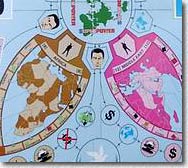
  1. SuperpowerSuperpower

    In meiner endlosen Suche nach alten “Klassikern” stieß ich auf dieses wenig
    bekannte Spiel von Games Workshop, das in der kurzen Phase erschien, in der GW viele
    interessante Brettspiele herausbrachte, darunter auch das legendäre “Talisman”
    und “Fury of Dracula”. Leider ist “Superpower” eine totale Gurke, und
    nach der Bewertung sogar der “Tiefeinsteiger der Woche” auf unserer Liste! Die
    Regeln klingen gar nicht mal uninteressant: In einer Art globalem Monopoly versucht man
    Länder des Erdballs erst unter ökonomischen, dann unter militärischen Einfluss zu
    bringen. Mit Staatstreichen können die Machtverhältnisse jederzeit wechseln, aber ein
    Land kann auch “befestigt” werden, das kostet allerdings “World
    Opinion”-Scheine, die Währung des Spiels. Durch ein ausgesprochen merkwürdiges
    System können manche Länder, wie z.B. Brasilien (!), überhaupt nur bei einem Wurf von 12
    auf 2 Würfeln unter Einfluss gebracht werden, das Spiel endet aber erst, wenn alle Länder
    “vergeben” sind! Da es zusätzlich noch möglich ist, andere Spieler wieder aus
    Ländern herauszukicken (mit dem Feld “Diplomacy”), findet das Spiel effektiv
    nie ein Ende. Da wäre viel “tweaken” der Regeln notwendig gewesen, um aus
    diesem Flop ein gutes Spiel zu machen, leider geschah dies nicht….schade!

    Bewertung: 2

  2. Anno Domini: Lifestyle Edition

    Dieses Spiel wird immer wieder gerne von unserem Historiker Peter verlangt, der
    allerdings meistens nie bis zu Ende spielt, sondern sich dann auf den Weg zur U-Bahn
    macht. Diesmal blieb er allerdings bis zuletzt, machte aber nur den 3. Platz – gewinnen
    konnte überlegen Andrea (weibliche Intuition?). Die “Life-Style”-Edition dieses
    an sich sehr guten Spiels wurde nicht so begeistert aufgenommen – einige Fragen
    schienen doch sehr “fragwürdig”, und manche Schweizer Formulierung (ist
    “pflästern” etwas anderes als “pflastern”?) sorgte für Verwirrung.
    Dennoch eine tolle Spielidee, die immer wieder Spaß macht.

    Bewertung: 6.25