Archiv der Kategorie: Spieleabende

Havoc – The Hundred Years War

Havoc
– The Hundred Years War

reviewed by Moritz Eggert

Out of the blue (or out of a sunny river, one might say) comes a very enjoyable card
game that probably also rides on the wave of the recent poker revival, but is so much
more….

As any poker player will attest, poker is very often battle-like in structure. Like
Zhukov or Patton or Wallenstein you let the enemy in doubt about your actual strength,
and when it’s time to strike you reveal your full power. Some give up before it comes
to this moment, and some bluff their way to victory and some win with a simple pair,
comparable to the victory of the 300 Spartans.

The Hundred Years War is the perfect setting for a battle-like poker game, as it was a
time of constant upheaval, short periods of peace followed by another outbreak of
violence. A series of battles is played to complete a full game of “Havoc”;
each battle gives different amounts of victory points to the victor and the players on
2nd or 3rd or even 4th place, while giving additional benefits to the player who actually
started the war (usually drawing more cards than anybody else). The player cards are
numbered 1-18 (when playing with less players the number of cards will be reduced) and
come in different colours and with beautiful illustrations taken from original art from
the time period of the game.

After the “peacekeeper” (or starting player) is determined by an ingenious
device, a rotating finger that soon will be geek item no.1, players take turns either
taking cards from the pile (a selection of open and face-down cards) or declaring
“havoc” and starting a poker battle round. The problem is that the longer peace
endures the more the peacekeeper will profit from it, as he will keep his cards after two
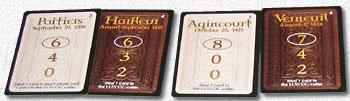
cardsfull turns, whereas the other players have to discard one of their cards in
hand. The battle card will then be discarded (if there’s peace there is no battle,
obviously). But this happens rarely, more likely the cry of “havoc” is heard at
some point and the game of poker begins. Each player now has to place two of his cards on
the table or pass, if s/he passes, s/he can take two cards but is out of the round. If
you stay in the game you have to play another card in front of you (up to a maximum of 6)
or fold. All cards played are lost… usually, but there are also “dogs of
war” cards, which prove to be very useful. They can either retrieve cards played in
a battle (up to a maximum of 2) or be part of a winning hand (number 0). They also help
when drawing cards – two dogs can be exchanged for any card in the discard pile, and one
dog can be exchanged for any open card.
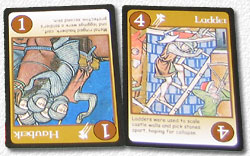
cards

The rank of a played hand follows standard poker rules with 6 cards, first come pairs,
then simple flushes, then triples etc., up to a 6 card straight flush, the best combo.
Although 6 cards are the limit that one can play in a battle, additional dogs of war can
be played to increase the number of cards up to 8, theoretically.

After the battle the victors get the spoils of war and a new round begins, with the
winner of the battle becoming the new peacekeeper. The final battle is a special affair,
as it begins directly after the last battle, with only limited ways to improve your hand.
Not surprisingly the final battle gives the most VP’s as well…

Characteristics
Playing time: very much depending on the number of players – anything from 45-70 minutes when
playing the “full” game
Explaining the rules: 10 minutes, basic poker knowledge required, otherwise a bit longer
Brain: is used
Luck: plays a role, but not overly, as there are always plenty of cards to choose from
Strategy/Tactics: required

In this excellent card game players are not playing a simple poker game, they play
three poker games at once. For a start it is not always a good idea to participate in
every battle or to give your best when doing so. You always have to consider how your
hand will look AFTER you play the battle, not only winning the battle itself. This means
that your hand (which is unlimited in number of cards) is in constant flux: it is a
result of former battles fought, of what is involved in a present battle and what you
will have to save for future battles. This makes for interesting decisions, even
sometimes resulting in very weakly fought battles as every player holds back his best
cards. But if you fight too weakly somebody will win the day with a meagre pair, so you
constantly have to look out for the hand management of other players. If you have played
3 cards from a 5 card set should you actually play the other two cards as well to win
safely (if you can) or should you instead play two dogs to retrieve at least two of them
at the end of the battle and prepare a 4 card set for next round, but then perhaps giving
another player the ultimate victory? The victory points “schedule” of battles
will also influence your decision – if only the first place gets points you probably have
to either fold immediately or give all, but if there are several tiers of victory you
might have to try to always be involved with at least a pair for some easy VPs. As often
card draws will be from the row of open cards you will also be able to outguess other
players’ plans, also something missing from “normal” poker.

Whatever your tastes in card games are, you will find “Havoc” to be a
challenging and clever game on its own that you will want to play again and again. There
is even an in-game expansion that adds more options and abilities to cards, if you ever
should get bored or want to try out something new.

In my opinion “Havoc” was one of the best new card games of Essen 2005, and
can wholeheartedly be recommended to anyone, even if they HATE poker (like me).
Hazienda

Hazienda

Preview of the new Kramer game by Moritz Eggert

Living in Munich means living in the most expensive city in Germany – the (usually)
nice weather, the closeness of the Alps and the many beergardens and other available
hedonistic pleasures make for extremely high rents and costs of living. I know many a
gamer here who can’t afford an apartment big enough to store his/her games!

But there are also benefits of living here, and one of them is living around the
corner of the headquarters of Hans-im-Glueck, undoubtedly one of Germany’s best
publishers for quality boardgames. As I’m a regular visitor of their monthly
boardgame evenings I sometimes have the honour of being able to test the new designs in
the pipeline. One of Hans-im-Glueck’s new games for this year’s Essen fair is
“Hazienda”, a new boardgame by master designer Wolfgang Kramer. But convincing
Bernd Brunnhofer, head of Hans-im-Glueck, to give a special preview of this game was not
as easy as I first thought:

We don’t usually like to do previews.‘ says Brunnhofer.
Even if they are positive they tend to create a too high expectation that nobody
can compete with, as was the case with “Euphrates & Tigris”. Now E&T is
considered a classic, but when it first came out there was a certain backlash to the
immense hype that didn’t make us happy
‘.

But after promising to make this a descriptive preview instead of an evaluating review
(the latter would be morally dubious anyway, as I was slightly involved in the
playtesting of this game), Bernd was only too happy to indulge me in the secrets of this
new and certainly interesting Kramer game.

“Hazienda” takes place in Argentina, sometime between the 30’s and
50’s. The players (2-5) represent land owners who want to get rich quick by
establishing trade routes and accumulating acres of land. Earning and spending cash is an
important motor of the game, but of course it is victory points that count at the end of
the game, after all this is a game with the eponymous ‘Kramer Leiste’ (Kramer
track) to keep track of VP!

brunnhofer playtester group

Each player starts with 20 bucks and a selection of animal and land cards. The board
consists of a ‘land track’ with 5 different types of land surrounding the open
‘Pampa’ spaces so typical for Argentina. Appearing throughout the Pampa spaces
are markets which players try to connect to their land spaces via ‘animal
routes’. Animals come in 4 different kinds, and have to be played as a match, so a
pig trade route can only be lengthened by playing more pig cards on it. There are also
water spaces (lakes) that accumulate victory points when the player owns adjacent animal
or land tiles. There are two VP calculations in the game, one after half of the animal
cards have been used up, one after all of them are in play, the latter situation ends the
game.

If all this sounds rather abstract it comes as no surprise. First of all this is a
Kramer game (what do you expect?), and even Brunnhofer makes it clear that ‘this is
certainly not an unconventional game’. But Kramer’s designs are widely known for
their durability and elegance, and so ‘Hazienda’ is certainly worth a closer
look. In fact the options for the players are impressive – there are 3 actions per player
turn, and they can be multiples of the same action and be done in any order.

First of all it is possible to buy cards. There are always open animal or land cards,
and these can be purchased for 3 bucks each. You can also try your luck and buy unknown
cards from the deck for 2 bucks. Playing a card also counts as an action. Land cards are
placed to own the corresponding land spaces (shown by placing a tile of your colour on
the board) and animal cards are played to create animal lines to reach the markets (also
played as tiles in your colour). The players usually try to create lines of at least 3
land spaces on the land track – the longer a continuous stretch of land is, the more VP
it will bring during the calculations (2 per space). Placing a hacienda on a land line is
expensive (12 bucks), but it brings an additional VP per space, so you better save up
actions for doing it before the game ends! It should be no surprise as the game is named
after them….

Haciendas can also be placed on animal lines, but this is done rarely.

Another possibility is ‘hugging’ lakes with your animal or land lines. You can
also cleverly create your own lakes (quasi godlike and slightly dubious from a realism
point of view, but essential to the game. One could think of them as artificial water
spaces created by dams). This also costs 12 bucks, and you should select a lake form that
hugs as many of your spaces as possible as other players will also benefit from a lake
placed next to their spaces, even if they didn’t do it themselves.

board

Connecting the markets is important in 2 ways: first of all each time an animal
connects to a market (even if done several times in a circle by playing more and more of
the same type of animal) you get the length of your land stretch plus the animal track in
money. Get rich quick schemes are usually quickly thwarted by your opponents who can
tactically place their tiles in your way to prevent a ‘circle run’ around a
market. The second and more important function of markets is that they are a VP cash cow:
the more different markets you connect yourself to the more VP you get, in an exponential
curve similar to the game Hare and Tortoise. Another way to make cash is to harvest a
stretch of land (this can only be done once per line) for 3 bucks per land space. Owning
money is not bad either, as 10 bucks convert to 1 VP – in both VP calculations!

These are, in a nutshell, the rules of the game, and they can be understood quickly by
any kind of gamers. As is usual for this type of games you want to do many things at once
but can only do so little in each turn. The road to victory is therefore to be as
efficient as possible with your actions, by maximising input and output. Balancing the
various VP requirements was therefore the most important task in the design work of this
game, says Brunnhofer, who is an expert at removing unnecessary details to make the
design as fluid as possible. Early versions of the game included, for example, many more
options for earning VP’s. One of them was the possibility to earn bonus VP’s for
the longest land line. ‘We dropped this to eliminate the boredom of watching players
constantly counting the length of their land lines, which bogged the game down
immensely’ says Brunnhofer. Another way of calculating VP’s by multiplying them
instead of adding them was also removed, because it ended in wildly differing sums which
made close and more exciting finishes impossible.

But there are also things which were added. ‘The original design of Kramer had
numbered spaces instead of different land types, because he wanted to avoid similarity to
other games of this type. Playing land cards was done very differently, with the use of
jokers and the possibility to look for certain numbers in the other player’s hands.
In the end we introduced the lands again because they added more flair’. Good idea,
because otherwise “Hazienda” might have been confused as an Acquire variant,
which it certainly isn’t! Another later change (this time by Kramer himself) was to
interrupt the otherwise continuous land track with Pampa spaces, which forces the players
to buy Pampa cards and also makes Pampa cards more valuable when they appear.

The prototype I played was the finished version ruleswise, but the game itself had not
yet gone to the printer. This is usually done very shortly before the Essen fair, to give
the possibility to change small details. Hans-im-Glueck is known to work hard on their
rules to avoid any opaqueness or confusion, and even as we played our 3-player game Bernd
Brunnhofer and Georg Wild made little notes for additional fine tuning.

As the game is very dependent on an interesting map this comes in two versions, one
‘symmetrical’ and one ‘asymmetrical’, with the first one being
recommended for beginners. As an additional service our own Guenther Rosenbaum from
www.westpark-gamers.de has finished a special program that enables players to create any
map they want from the original symbols and then print it out. Look for it now on our website or on the official Hans-im-Glueck website.

“Hazienda” plays in 1-2 hours, and can be equally played aggressively
(hindering other players from building good ’empires’), strategically (go for the
markets to get a surprise VP rush) or tactically (just consider what is best for you each
turn). Each of these options will tax your head without bursting it, as the game play is
rather swift (which was not the case with the earlier versions, where too many options
slowed the game down). It plays equally well with 3 or 2 players, with only slight
modifications in the distribution of cards. I predict that “Hazienda” will be a
welcome new addition to the already impressive line of Kramer games.

But don’t believe my hype – join Hans-im-Glueck in Essen to see the finished game
or play the game when it’s available. Although none of us would probably mind another
Euphrates & Tigris – hype or no hype.

Session Report 12 October 2005

Session Report 12 October 2005

by Moritz Eggert

at the table: Aaron, Loredana, Peter, Andrea, Moritz

on the table: Tabaijana, Chez Geek!, Diamant, Mamma Mia (Grande)

After a long gaming hiatus from Andrea and me this was the first time we could get
together again with the other Westpark gamers, so it was intuitively decided to make this
a very relaxed round with shorter and easier games.

Tabaijana

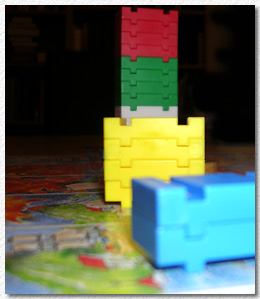
board

We started with a gem(?) by reliable Wolfgang Kramer, Tabaijana, a game where some
poor indigenous people have to flee a volcano island, but if they don’t take enough
pizza cartons with them (at least the game board suggests these are pizza cartons), they
will starve at sea, In addition the pizza boxes (or crates) have to be stacked in the
right order. Trouble is: they start as one big, chaotic stack. During the game each
player is responsible for one colour. After a die roll he can move any stack he is
involved in (or the ship, on which the crates have to end at some point). Splitting up
the stacks is necessary to get the crates into some kind of order, a player can do this
as long as he takes one of his own crates into the new stack, or leaves one of his own on
top of the old stack. All crates plus the ship move on a single track path towards the
inevitable end of the game.

This is a collaborative game, from a time where working with statistical probabilities
and working together were still relatively new concepts. Fact is that it becomes obvious
after a few turns that each player can only do ONE best thing with his die roll,
everything else is just plain stupid. As this is a cooperative game, all players will of
course always discover the best move. Now it depends on the roll of the dice if you make
it or not, as simple as that.

This is very light entertainment from an author who later went on to create some of
the best modern German games. Some games from this period of gaming have survived the
test of time (like “Scotland Yard” or “Hare and Tortoise”), but this
game is plain boring from a modern point of view. That the game material is minimalistic
and unpractical to say the least doesn’t help either. Don’t open this pizza box
of ye olden times – the pizza inside has long past its best before date!

Chez
Geek!

Peter is going to torture me forever for this present of mine….”Chez
Geek!” is another one of the totally useless card games Steve Jackson has produced
lately (with the exception of the excellent “Spooks”). The theme and the cards
are funny because of the humour of the creator of “Dork Tower”, John Kovalic,
but the game play is dominated by the usually deadly combo of “solitaire game”
with “take that!” cards. Each player represents a “slacker” who wants
to acquire as many “slack” points as possible.

Basically game play consists of you playing cards to acquire “slack”
(depending entirely on what cards you happen to draw) and other players playing
“take that” cards to prevent you from playing these cards. This continues until
some player has enough luck and the other players have run out of “take that”
cards. The only “strategy” consists of “going shopping” several times
to drain your opponents of “take that” cards against you instead of shopping
all items at once so they can all be prevented at once.

Boy, were we glad we didn’t play this totally useless game with Walter! One could
cut out the pictures and create a nice comic with them, but playing the game is the only
thing that will REALLY make you wish you were a slacker instead, as you might find
hanging out in front of the TV more exciting than playing this game. Seriously!

Diamant

Now we were ready for a good game. Faidutti’s and Moon’s “Diamant”
fit the bill of a game that can be explained in 3 minutes and played in 20. This has been
reviewed elsewhere on this site, but let it be said that this really is a good and fun
light filler game, the only problem being that there are a lot of light and fun filler
games out there at the moment. But we had a good laugh, and the game has even some
tactical issues that the advanced player can ponder about, so there really is nothing to
complain about.

Mamma
Mia (Grande)

This fine card game has been revived by some expansion sets and advanced rules. In its
original form this was a kind of inverse Bohnanza. Players play ingredients and recipe
cards on a pile, hoping that the cards below their recipe (after all card plays the tile
is reversed) will be enough to fulfil the pizza recipe. Some recipes work, some
don’t, and one can never be sure as remembering the actual ingredients in the pile is
very difficult.

The expansion “Sole Mio” (also playable stand alone) adds some very odd
recipes with partly complicated rules, and the possibility to “help” other
players with finishing their recipe – for the price of finishing one of your own recipes
for free. The odd recipes make the game more chaotic and unforeseeable, the
“helping” options make the game more tactical. All in all this is a good and
fun mix of ingredients, and the game was very well received in our group. After Peter
explained it, we had the impression this was an complicated game, but once we got to
actually play it, it turned out to be easy fare. Not to be played with hard thinkers,
though, but on that evening we were all “in the mood”.

Session Report 12 October 2005

Session Report 12 October 2005

by Moritz Eggert

at the table: Aaron, Loredana, Peter, Andrea, Moritz

on the table: Tabaijana, Chez Geek!, Diamant, Mamma Mia (Grande)

After a long gaming hiatus from Andrea and me this was the first time we could get
together again with the other Westpark gamers, so it was intuitively decided to make this
a very relaxed round with shorter and easier games.

Tabaijana

board

We started with a gem(?) by reliable Wolfgang Kramer, Tabaijana, a game where some
poor indigenous people have to flee a volcano island, but if they don’t take enough
pizza cartons with them (at least the game board suggests these are pizza cartons), they
will starve at sea, In addition the pizza boxes (or crates) have to be stacked in the
right order. Trouble is: they start as one big, chaotic stack. During the game each
player is responsible for one colour. After a die roll he can move any stack he is
involved in (or the ship, on which the crates have to end at some point). Splitting up
the stacks is necessary to get the crates into some kind of order, a player can do this
as long as he takes one of his own crates into the new stack, or leaves one of his own on
top of the old stack. All crates plus the ship move on a single track path towards the
inevitable end of the game.

This is a collaborative game, from a time where working with statistical probabilities
and working together were still relatively new concepts. Fact is that it becomes obvious
after a few turns that each player can only do ONE best thing with his die roll,
everything else is just plain stupid. As this is a cooperative game, all players will of
course always discover the best move. Now it depends on the roll of the dice if you make
it or not, as simple as that.

This is very light entertainment from an author who later went on to create some of
the best modern German games. Some games from this period of gaming have survived the
test of time (like “Scotland Yard” or “Hare and Tortoise”), but this
game is plain boring from a modern point of view. That the game material is minimalistic
and unpractical to say the least doesn’t help either. Don’t open this pizza box
of ye olden times – the pizza inside has long past its best before date!

Chez
Geek!

Peter is going to torture me forever for this present of mine….”Chez
Geek!” is another one of the totally useless card games Steve Jackson has produced
lately (with the exception of the excellent “Spooks”). The theme and the cards
are funny because of the humour of the creator of “Dork Tower”, John Kovalic,
but the game play is dominated by the usually deadly combo of “solitaire game”
with “take that!” cards. Each player represents a “slacker” who wants
to acquire as many “slack” points as possible.

Basically game play consists of you playing cards to acquire “slack”
(depending entirely on what cards you happen to draw) and other players playing
“take that” cards to prevent you from playing these cards. This continues until
some player has enough luck and the other players have run out of “take that”
cards. The only “strategy” consists of “going shopping” several times
to drain your opponents of “take that” cards against you instead of shopping
all items at once so they can all be prevented at once.

Boy, were we glad we didn’t play this totally useless game with Walter! One could
cut out the pictures and create a nice comic with them, but playing the game is the only
thing that will REALLY make you wish you were a slacker instead, as you might find
hanging out in front of the TV more exciting than playing this game. Seriously!

Diamant

Now we were ready for a good game. Faidutti’s and Moon’s “Diamant”
fit the bill of a game that can be explained in 3 minutes and played in 20. This has been
reviewed elsewhere on this site, but let it be said that this really is a good and fun
light filler game, the only problem being that there are a lot of light and fun filler
games out there at the moment. But we had a good laugh, and the game has even some
tactical issues that the advanced player can ponder about, so there really is nothing to
complain about.

Mamma
Mia (Grande)

This fine card game has been revived by some expansion sets and advanced rules. In its
original form this was a kind of inverse Bohnanza. Players play ingredients and recipe
cards on a pile, hoping that the cards below their recipe (after all card plays the tile
is reversed) will be enough to fulfil the pizza recipe. Some recipes work, some
don’t, and one can never be sure as remembering the actual ingredients in the pile is
very difficult.

The expansion “Sole Mio” (also playable stand alone) adds some very odd
recipes with partly complicated rules, and the possibility to “help” other
players with finishing their recipe – for the price of finishing one of your own recipes
for free. The odd recipes make the game more chaotic and unforeseeable, the
“helping” options make the game more tactical. All in all this is a good and
fun mix of ingredients, and the game was very well received in our group. After Peter
explained it, we had the impression this was an complicated game, but once we got to
actually play it, it turned out to be easy fare. Not to be played with hard thinkers,
though, but on that evening we were all “in the mood”.

28.09.2005: Vier im Quintett

Loredana kam frisch vom Oktoberfest: im feschen Dirndl mit schwarzen Lackschuhen: von Kopf bis Fuß ein einladender Anblick, einschließlich aller Augenpaare. Sagt mal, ihr Leute da draußen, findet ihr die klobigen Bergschuhe am Ende von lieblichen Mädchenbeinen eigentlich hübsch?
Vor die Alternative gestellt, 4 Stunden “Die Macher” oder eine Hand voll gemeine deutsche Spiele zu spielen, entschieden wir uns einstimmig für das Gemeine.
1. “Colossal Arena”
Funktioniert wie “Titan – the Arena”: Ein Karten- Wettspiel, bei dem jeder seinen Wetteinsatz auf das Überleben verschiedener Rassen setzen soll und durch Auslegen der richtigen Karten dafür sorgen muß, daß diese Rasse im Kampf ums Dasein von Runde zu Runde überlebt.
Der Kampf ums Überleben ist äußerst spannend. Es gibt sehr viele taktische Finessen um offene und versteckte Seilschaften. Dazu kommt das geordnete Chaos der Charaktere und Sonderkarten, die eine konsequente Planung unmöglich machen.
Peter und Moritz halten das Spiel für ein Spitzenspiel und geben ihm 10 Punkte. Ich kritisiere das zu große Glückselement beim “Secret Bet” und die Tatsache, daß man in der letzten Runde sein gesamtes Hab und Gut verlieren kann, ohne ein einziges Mal am Zug gewesen zu sein.
WPG-Wertung: Roland drückte mit seinen 7 Punkte den WPG-Durchschnitt auf 7,5 Punkte.
Als Rezension ist Moritz Beitrag zu “Titan” vom 4. 9. 2002 immer noch gültig.
2. “Intrige”
Ein Spiel aus dem vorigen Jahrtausend, das wir noch mit Susanne gespielt haben. Damals hatte sie alle ihre weiblichen Finessen damit vergeudet, Aaron durch unlautere Gebote im äußeren und inneren Konflikt-Bereich für sich geneigt zu machen. Susanne, wo steckst du denn jetzt eigentlich?
Intrige ist ein äußerst bösartiges Spiel. Die Spieler stecken sich gegenseitig unverbindlich Geld zu, um bei der Postenverteilung damit einen guten Schnitt zu machen. Ob der jeweilige Hauswirt die Bestechungssumme aber auch angemessen honoriert, steht allein in seinem Gutdünken. Es gibt keine Vertragstreue, keine Garantien für den Einsatz, keine Gerechtigkeit und kein Gewissen. Ohne Humor und harte Nehmerqualitäten gehen hier die besten Freundschaften aus dem Leime.
Wer mit einer “armenischen Krämerseele” ausgestattet ist, kann dem Spiel viel abgewinnen: Feilschen, Schmeicheln und Drohen, Berechenbar-Sein, wo es in die eigene Tasche geht, Undurchsichtig-Sein, wenn man den großen Verrat plant, Vertrauen erwecken, obwohl es doch nur skrupellos um den eigenen Gewinn geht. Es gibt ganz eigene verbale Chiffren:
“Aaron ist sauer!” – “Ich kann ganz schnell verzeihen!” (= Nur nicht zeigen, daß der Deal schon gelaufen ist.)
“Ich bin immer gesprächsbereit” (= Ich will kaltblütig mein Bündnis brechen.)
“Haben wir noch einen Deal?” (= Ich will warmblütig mein Bündnis brechen.)
“Konkrete Summen nennen!” (= Hier spricht der Judas Ishariot)
“Ich bin nicht käuflich!” (= “Hola, Kumpan, laß mich jetzt bloß nicht fallen!”)
“Wenn ich Loredana jetzt bescheiße …” – “Dann kriegst du soooo einen Ärger!” (= Voreheliche Positionsbestimmung.)
In diesem Wust von Deutungen und Andeutungen ließen wir unsere Spiellaune treiben. Vor lauter Intrigen vergaßen wir sogar sporadisch das Fremdgehen. So entstand dann eine irreguläre Spielsituation, die nicht mehr zu reparieren war: 2 Runden vor Schluß mußten wir abbrechen. Aber das war auch gut so: Wir mußten den Giftbecher von “Intrige” nicht bis zur bitteren Neige austrinken, sondern konnten in lockerer Stimmung zum nächsten Spiel übergehen. Fast ein Salomonischer Schluß!
WPG-Wertung: Aaron: 7, Loredana: 5, Peter: 6, Roland: 7, Walter 6.
Gegenüber “Intrige” bin ich bis zum Halse voll mit positiven und negativen Emotionen. Das sollte demnächst für eine Rezension reichen.
3. “6 nimmt”
Unser altes Absacker-Spiel in der Rolle des Vor-Absackers. Peter konnte in seinem Mathematik-Studium ganz aktuell den Begriff “limes superior” durch den 6-nimmt-Begriff “höchste niedrigere” höchst populär-wissenschaftlich umschreiben.
WPG-Wertung: Roland drückte mit seinen 6 Punkten den WPG-Durchschnitt auf 7,9 Punkte.
4. “Bluff”
Im Endspiel legte Aaron mit 2 Würfeln gegen Loredana mit nur einem Würfel 2 Fünfen vor. Loredana hob auf 3 Fünfen! Alle vorhandenen Würfel mußten 5er sein! Aaron blieb nichts übrig, als auf 2 Sterne zu erhöhen. Damit war Loredana ausgeknockt.
Im nächsten Endspiel gewann Aaron gegen mich aus einem 3:1-Rückstand heraus. Hi Günther, hier hat schon wieder die “Immer-4-Strategie” zugeschlagen!
WPG-Wertung: Roland drückte mit seinen 8 Punkten den WPG-Durchschnitt auf 8,44 Punkte.

Intrige

Intrige

rezensiert von Walter Sorger

“Intrige” ist nach dem deutschen Wörterbuch eine “heimliche,
hinterlistige Machenschaft, durch die man sein Ziel zu erreichen sucht”. Nach diesem
Wortsinn hat das Spiel “Intrige” geradezu sein Thema verfehlt. Hier ist nichts
heimlich, sondern alles öffentlich; hier gibt es keine Hinterlisten sondern nur
vordergründige Versprechungen und Drohungen; es gibt auch keine
“Machenschaften” im Sinne von handeln und tun, hier geht es eher um aussitzen
und abkassieren.

“Postenschacher” ist eine treffendere Charakterisierung des Spiels. Zu
“Schacher” schreibt das DWDS: “Handel, bei dem sehr gefeilscht wird,
unsauberer Handel, mit dem man großen Gewinn erzielen will.” Genau das ist
“Intrige”.

Jeder Spieler hat jeweils 5 verschiedene Ämter an seine Mitspieler zu vergeben. Die
Ämter sind mit unterschiedlichen Einnahmen dotiert, sie bringen 10-, 20-, 30-, 50- oder
gar 100-Tausend Dukaten pro Runde ein. Man bewirbt sich um einen Posten, indem man einen
Pöppel in den Vorgarten des Mitspielers legt und ihm dazu eine beliebige Summe
Bestechungsgeld rüberschiebt. Ob der Mitspieler die Höhe des Bestechungsbetrages
honoriert und den fremden Pöppel zum Spitzenverdiener macht, oder ob er das Geld
einstreicht und den Pöppel lediglich in die Hofkolonne steckt, das liegt im freien
Ermessen des Mitspielers.

Hat ein Pöppel einen mehr oder weniger lukrativen Posten bekommen, ist der ihm noch
längst nicht sicher. Ein anderer Mitspieler kann einen eigenen, gleichartigen Pöppel in
den Vorgarten legen und damit den Posten streitig machen: einer der beiden Pöppel muss
weichen und scheidet aus. Die Lösung des Konfliktes wird ebenfalls über Bestechungsgelder
eingeleitet: die beteiligten Spieler überreichen dem Hofeigentümer wieder eine beliebige
Geldsumme und hoffen, damit ihn damit für sich gewogen zu stimmen. Doch wie schon bei der
Erstbesetzung der Posten braucht sich diese nicht um die Höhe der Bestechung zu scheren,
sondern er kann willkürlich einen Spieler auf den Posten setzen bzw. dort belassen und
den anderen in den Orkus schicken.

Natürlich sollte man dem Mitspieler die Postenvergabe nicht zu einfach machen.
Stillschweigend das Geld zu übergeben, auf angemessene Gegenleistung zu warten und
hinterher zu jammern, wenn man schlecht weggekommen ist, mag zwar bieder-brave Gemütsart
sein, für “Intrige” taugt das überhaupt nicht. Die Spielregel selbst beschreibt
das begleitende Szenario – leider erst auf der letzten Seite – unter Tips:
“Bittet, droht, nervt, hetzt, fleht, verlangt, erwartet, argumentiert,
opportuniert, wo Ihr nur könnt – Hauptsache, es wirkt in Euerem Sinne.”
Mit
diesem Satz ist der konzipierte Spielablauf von “Intrige” umfassend
beschrieben. Für wen diese Tätigkeiten mentaler Alltag ist, der wird sich hier zu Hause
fühlen. Wer von dieser Krämer-Mentalität abgestoßen wird, – und ich muß gestehen, daß ich
zu dieser Spielerkategorie gehöre – der kann dem Spiel nicht viel abgewinnen.

Für uns WPG-ler möchte ich hierbei nur mal kurz an den Entwurf eines WPG-Kodex
erinnern: “Außer Alle erlauben es ausdrücklich vor einem Spiel, sollten keine
Kommentare zur Platzierung der Mitspieler und der eigenen Platzierung während des Spiels
fallen. Die Kommunikation beim Spiel sollte sich allein auf Regelfragen und neutrale
Spielkommentare beschränken.
” Selbstverständlich gehört “Intrige” zu
den Spielen, bei denen hiervon eine Ausnahme gemacht werden muß.

Wenn das Spiel erst mal eingeschwungen ist, wenn die Spieler sich gegenseitig die
guten und schlechten Posten zugeschustert haben und darüber Allianzen eingegangen sind, –
jeder steht ja vor dem gleichen Problem, seine Pöppel gut unterzubringen – , dann sind
die Abläufe berechenbarer geworden. Dann weiß man, bei welchen Mitspielern man noch
landen kann und wo man nur Perlen vor die Säue wirft.

In dieser Phase ist der ganze Spielablauf aber auch schon ziemlich festgefahren. Die
gegenseitigen Abhängigkeitsverhältnisse lassen kaum einen Ausbruchsversuch zu. Ein
beneideter Krösus muß zwar immer damit rechnen, schlagartig von allen guten Geistern
verlassen zu werden, doch setzt dies eine überzeugende Absprache unter den Gegnern
voraus, und die kann nur ein fähiger Demagogen in Gang setzen. Schließlich darf er ja
nicht zeigen, daß es ihm im Grunde nur um die eigenen Interessen geht.

Ein bemerkenswerter Aspekt von “Intrige” ist die psychologische Analyse der
Mitspieler. Natürlich erst hinterher, wenn das Spiel gelaufen ist und man sich die
Ergebnisse noch mal durch den Kopf gehen läßt.

1) In unserer Runde fing ich als Senior an und engagierte mich bei meinen linken
Nachbarn Loredana und Peter. (Es war ein kleiner strategischer Fehler, denn auch wenn das
Herz links schlägt, sollte man sich rechts orientieren, weil da die Zeitspanne zwischen
Investition und Rendite am kürzesten ist!)

Als Loredana mein Bestechungsgeld kassieren durfte, schob ich ihr 40.000 Dukaten hin.
Immerhin das vierfache der kleinstmöglichen Summe. Was sagt das über mich?

  • Ich bin vorsichtig, kein Hasardeur und will den Stier nicht gleich bei den Hörnern
    packen.

  • Ich lasse gezielt Versuchsballons los, um den Untergrund auszuloten und bin dabei auf
    alle möglichen Ergebnisse gefaßt.

  • Leider bin ich auch kein diplomatisches Talent, denn ich gab die Summe hin, ohne mit
    deutlichen Worten meine Erwartungen zu unterstreichen.

2) Loredana stellte meinen Pöppel auf den schlechtesten Platz. Was sagt das über
sie?

  • Loredana ist eine sparsame Hauswirtschaftlerin: wenn’s um das Materielle geht,
    wird kein Pfennig unnötig zum Fenster heraus geworfen.

  • Sie kannte das Spiel noch nicht, sonst hätte sie den niedrigsten Platz als Droh-Platz
    für die nächsten Bestechungsrunden offen gelassen.

  • Sie kennt mich noch nicht, denn nach so einer ungerechten Behandlung kann sie an
    diesem Abend keinen Blumentopf mehr bei mir gewinnen.

  • Loredana ist wagemutig und hat keine Ängste, sich Feinde zu machen.

3) Als Peter am Zug war, bot er mir sofort einen guten Deal an: Er würde mich für die
geringste Geldsumme auf seinen höchst-dotierten Posten stellen, wenn ich umgekehrt seinen
Pöppel genauso auch bei mir positionieren würde. Ein sehr gutes bilaterales Angebot, das
ich sofort annahm. Was sagt das über Peter:

  • Peter weiß, wovon dieses Spiel (und alle ähnlichen Diplomacy-Spiele) lebt: nicht vom
    vorsichtigen Herumlavieren, sondern von klaren Zielvorstellungen und entschiedenem
    Handeln.

  • Er ist ein psychologisches Genie und kennt seine Pappenheimer: er wußte, daß ich
    durch Loredanas Enttäuschung angeschlagen war und dann um so fester zu meinen
    anderweitigen Verpflichtungen stehe.

  • Peter ist ein guter Rechner: Selbst wenn ich ihm seinen Deal vermasseln würde, hätte
    er nur den geringst möglichen Betrag verloren.

  • Er ist ein gewiefter Diplomat: Bei obigen Deal war es ja noch einfach, aber auch
    sonst waren alle seine Angebote von solch überzeugenden Plädoyers begleitet, daß sich
    keiner seiner Argumentation entziehen konnte.

4) Aaron schaffte umgehend einen entsprechenden Deal mit Loredana herbei. Später
verbandelte er sich auf dem zweitbesten Posten auch noch mit Peter und mit mir. Nur von
Roland sackte er gruß- und gnadenlos die Bestechungsgelder ein. Was sagt das über
ihn:

  • Aaron ist ein großer, ausgleichender Absahner.
  • Er setzt gerne aus dem Windschatten heraus zum großen Wurf an.
  • Selbst wenn er einen über das Ohr gehauen hat, wirkt seine seriöse Art immer noch
    vertrauensbildend.

5) Roland war das fünfte Rad am Wagen: Die Partnerschaften waren gelaufen. Er
investierte unverdrossen hohe und höchste Summen in alle Richtungen, fand aber kein
liebendes Haus, das sich ihm öffnete. Auch eine leibhaftige Aphrodite hätte jetzt nur
schwer Überläufer animieren können. Was sagt das über Roland:

  • Roland ist ein geduldiger, verzeihender Optimist: trotz aller Abfuhren und
    Genickschläge versuchte er immer wieder mit neuem Mute bei Aaron zu landen.

  • Er ist genügsam und ein finanzielles Genie: auch ohne Einnahmen konnte er bis zu
    letzten Runde seine Bestechungsgelder zahlen.

  • Er kennt unsere Runde noch nicht so gut: sonst hätte er sein ganzes Geld bei mir
    untergebracht.

Hallo Peter, ich würde ja allzu gerne noch mal sehen, wie du in dieser undankbaren
fünften Position das Ruder zu deinen Gunsten herumgerissen hättest. Ich weiß selber
nicht, wie es gehen sollte, aber dir traue ich zu, daß zu es gekonnt hättest. In meiner
heutigen Stimmung das einzige Motiv, noch mal “Intrige” auf den Tisch zu
bringen.

21.09.2005: Friedrich im Trio

1. “Friedrich”
Die Peters waren erkältet, die Andreas verreist und Günther war auch unterwegs, so konnte Roland das Trio vervollständigen, das noch mal tief in die Geheimnisse der preußischen Selbstbehauptung eintauchen wollte. Mit einem österreichischen Zweigelt Cuvée Classic und einem 3-puttonyos Tokaji Aszu aus dem Jahre 1983 versetzten wir uns in Stimmung und Blutalkohol in das zugehörige Jahrhundert.
Eigentlich gebe ich mich ja immer als Pazifisten aus; in unserem aktuellen Trio, und nach den Erfahrungen der Vorgänger-Sessions wollte ich aber endlich auch mal den 8-Sterne-General Friedrich kommandieren. Roland bekam die kompakten Österreicher und Aaron die geographisch verstreut operierenden Schweden, Russen und Franzosen.
Wir waren in Spielerlaune, es wurde nicht allzu kleinlich gerechnet und auch mal eine Zug-Korrektur zugelassen, wenn sie bei längeren Nachdenken ohnehin erfolgt wäre (z.B. die Troß-Versorgung). Trotzdem dauerte es nach der 1 Stunde Spielerklärung noch ganze 4 Stunden, das Spiel über die Bühne zu bringen. Doch die Zeit verging wie im Flug.
Aaron wagte sich – halb freiwillig, halb auf der Flucht – mit seinen Franzosen bis an die Nordseeküsten in Schleswig. Er konnte beide Hannover-Generäle und noch dazu zwei Preußen-Armeen auf sich ziehen und damit eine Menge Kräfte binden. Doch einem Sieg brachte ihn diese Situation nicht näher, ganz im Gegenteil, als sein Troß vernichtet wurde, mußte er sich mehrere Runden lang in Richtung seiner Stammlande zurückziehen und verlor wichtige strategische Ausgangspositionen.
Die Österreicher gingen sehr zögerlich ins Spiel. Sie sammelten lieber Taktikkarten, als daß sie das verlorene Schlesien wieder unter ihre Kontrolle bringen wollten. Preußen konzentrierte sich ebenfalls sehr defensiv auf sein Kernland, so daß seine Kartenhand schon gigantische Ausmaße annahm und es sich irgendwie unbezwingbar vorkam.
Nach ein paar frivol vom Zaun gebrochenen Schlachten gegen die Franzosen im Kreuz-Sektor, war Preußen auf einmal ohne eine einzige Kreuzkarte, und alles Gegner wußten daß. Es kostete dann gleich 10 Armeen und 2 Generäle und nur unter hohen Terrain-Verlusten konnte es eine neue Auffanglinie aufbauen. Wir waren halt alle noch Anfänger.
Alle Parteien waren mal knapp am Sieg. In unserer Runde hätte es Österreich schaffen müssen, wenn es nicht auf Landgewinn in Sachsen und Schlesien ausgegangen wären, sondern sich konsequent auf die Eroberung der Siegpunktstädte konzentriert hätte. Die Franzosen waren dem Sieg auch mal greibar nahe, doch mußten sie nach einer verlorenen Schlacht weit ins zurückziehen und waren damit weg vom Fenster. Wir waren froh darüber, weil sich damit die im Internet behauptete Favoriten-Stellung der Franzosen nicht bewahrheitet hatte.
Nachdem er sich als Heißsporn eine blutigen Nase geholt hatte, verlegte sich Friedrich auf gezieltes Verteidigen mit minimalsten Gebietsverlusten und ab und zu mal einem Einfall in Böhmen und Schlesien. Auch wenn es manchmal eng wurde, auch wenn das Ende erst in der drittletzten Runde per Ereigniskarte herbeigeführt wurde, reichte diese Durchhalte-Taktik zum Sieg.
“Friedrich” hat eine Unmenge an taktischen Finessen, die man unbedingt beachten muß, um wirklich gut zu spielen. Mit unserer jetzigen Erfahrung sind wir noch meilenweit davon entfernt. Nur ein paar selbstverständliche Details:
– Rüste jeden abgebrannten General mit mindestens 2 Armeen auf. Dann kannst du bei einer 1-Punkt-Niederlage wenigstens die Stellung halten.
– Bringe jeden ausgeschiedenen General möglichst umgehend wieder ins Spiel. Selbst wenn er ganz schwach ist kann er den Vormarsch der Gegner verzögern und ein paar Siegpunkt-Städte vor dem gegnerischen Zugriff verteidigen.
– Preußen sollte grundsätzlich defensiv spielen und höchstenfalls mal punktuell angreifen, um gegnerische Armeen zu vernichten, nicht aber um Terrain zu gewinnen. Auf die Dauer werden die Gegner stärker mit Taktik-Karten ausgestattet und nur durch Armee-Vernichtungen mit einer 6:1-Quote gegenüber der Wiedergewinnung und durch gezielte minimale Rückzüge kann man sich optimal dagegen wehren.
– Die Gegner müssen sich unbedingt in der Schlachtordnung gegen Friedrich absprechen. Durch gezieltes Angreifen auf Preußens Mangel-Sektoren können sie hier taktische Erfolge erzielen.
Friedrich ist ein Super Spiel. Ich möchte meine ursprünglich vergebenen 8 Punkte auf 10 Punkte aufstocken. Was soll ein Spiel denn sonst noch aufweisen, um die Höchstnote zu erhalten? Aaron legte auch einen Punkt, auf jetzt 9 Punkte drauf. Er möchte zu unserem Über-Alles-Spiel “1830” noch eine kleine Reserve freihalten. Roland vergab noch keine Note.

31.08.2005: Viel Spiel

1. “Haselwurz und Bärenklau”
Peter hat dieses Jahr schon öfters Spiele mit schlechter Bewertung abgetan, die vom Rest der WPG dann deutlich positiver aufgenommen wurden. Bei “Haselwurz …” wollte er eigentlich nur demonstrieren, was ihm hier nicht gefällt, aber ohne ein paar Proberunden wollten wir ihm seine Ausführungen nicht abnehmen.
Die Spieler reisen wie der kleine Nils Holgersson auf dem Rücken von Tierchen in der Landschaft umher und versuchen, passende Geländeformationen zu finden, die ihnen Siegpunkte einbringen.
Der Spielaufbau, die Reisetechnik und die dahintersteckende Naturbetrachtung sind sehr gefällig. Viele schöne Ideen sind hier eingeflossen.
Man muß aber auch mit ein paar Schwächen zurechtkommen. Die Möglichkeit, in einem einzigen Zug gleich mehrere Siegpunktkarten abzugrasen, verführt Knobelfreunde zu langen Denkzeiten; lockere Gemütern sind dann leicht etwas verstimmt. Zum Charakter des Spieler hätte es sicherlich besser gepaßt, wenn nur jeweils eine Karte erwerbbar wäre.
Auch der Zwang, sich erst bewegen zu müssen, bevor man Siegpunktkarten kassieren darf, findet keinen rechten Beifall. Warum sollte man nicht im Stehen seine Umgebung inspizieren können? Das wäre ein Freiheitsgrad mehr im Handlungsspielraum, ohne daß dabei am Spiel auch nur das Geringste verlorenginge!
WPG-Wertung: Aaron: 6, Günther 5, Peter 3, Walter 5.
Aaron hat seine (englische) Rezension schon fertig; in der nächsten “Games International” wird sie veröffentlicht. Vielleicht fällt mir dazu auch noch was in Deutsch ein.
2. “Ogallala”
Das Spiel ist ein Oltimer aus dem Paläowestparkium; Aarons Ausgabe wurde 1989 von ASS herausgebracht und lag bei uns schon auf dem Tisch, als Martin noch Hecht im Karpfenteich war.
Jeder Spieler hat vor sich ein eigenes riesiges Spielbrett, auf dem er zufällig gezogene Karten offen ablegt. Er baut daraus Kanus; je länger sie sind, desto mehr Punkte bringen sie ein. Insofern ist das ganze ein solitäres Kartenablegespiel.
Allerdings gibt es auch Karten, die eine chaotische Interaktion mit sich bringen: man darf fremde Kanuteile zerstören oder bei sich selber einbauen, und u.U. muß man sogar mal unfreiwillig ein eigenes Kanu auf Grund setzen. Berechenbar ist nichts, Kartenglück und Risikobereitschaft alles, und nostalgische Freude an der eigenen Spiel-Vergangenheit noch mehr. Der Youngster Peter hatte natürlich noch keine Erinnerung.
WPG-Wertung: Aaron: 5, Günther 6, Peter 2 (Youngster), Walter 5.
Ich werde eine Rezension schreiben.
3. “Modern Art”
Noch ein Spiel aus den Vor-WPG-Zeiten, aber ein sicherer Garant für eine knappe Stunde Spielspaß.
Eigentlich nur ein Versteigerungsspiel, aber eines von allerfeinster Art. Man muß sich selber schwer ins Zeug legen, um unbedingt die wertvollsten Kunstwerke auf seine Seite zu bringen. Man darf sie aber auch, natürlich nicht geschenkt, bewußt einem Mitspieler überlassen, damit er Gefallen am Künstler findet und seine Werke fördert. Dann steigt natürlich auch der Marktwert der Karten, die man selber noch von diesem Künstler in der Hand hält.
Wir haben noch lange darüber diskutiert, wie man mit bestimmten Kartenhänden umgeht. Welche Karten soll man zuerst versteigern? Diejenigen, an denen man selber Interesse hat oder diejenigen, mit denen man die Konkurrenz auf ein falsche Fährte locken will? Bis zu welchem Preis soll man mitgehen? Manchmal ist das eine klare Dreisatz-Rechnung, manchmal steckt dahinter eine klare Verschleierungstaktik. Wir kamen zu keiner abschließenden, einvernehmlichen Lösung. Das ist immer ein Zeichen von gutem Spieldesign.
Peter, als eingefleischter Knizianer konnte nur konstatieren: “Hier stimmt alles! Ein Kunstwerk!”
WPG-Wertung: Aaron: 8, Günther 7, Peter 9, Walter 9.
Das Spiel ist eine Rezension wert, spätestens wenn es mal unser “Gem des Monats” geworden ist. Aber bei Luding sind dazu schon genügend Links aufgeführt; die sollten reichen.
4. “Samarkand”
Wir hatten schon eine Menge Spielspaß erlebt und doch erst 2 ½ Stunden gespielt. Ist es tatsächlich möglich, höchst kurzweiliges Spielvergnügen zu haben, ohne 7 Menschenzeitalter am Spieltisch verbringen zu müssen?
Im Vertrauen auf Uns-Willi von Grünspan zogen wir uns noch ein Wirtschaftsspiel herein. Die Spieler bewegen sich von Wüste zu Wüste, zu Oasen und Städten, verteilen Gastgeschenke, kaufen Waren, tauschen Waren und verkaufen sie wieder. Wer am schnellsten den notwendigen Umsatz gemacht hat, beendet das Spiel.
Das Kartensammelspiel ist ein ziemlich friedliches Herumreisen auf den Spielfeldern, die die Welt bedeuten. Jeder kann auch denken, wenn er nicht dran ist. Es spielt sich ziemlich flott, und doch hinterläßt es irgendwie auch einen leicht schleppenden Eindruck. Wer dieses Paradoxon auflösen kann, möge sich bitte melden.
Peter verkündete schon vorzeitig seinen Sieg, brachte es dann aber nur auf 495 Piaster. Diesmal schenkte ihm niemand die fehlenden fünf Rupien, er mußte noch einmal sein Geschäft erledigen. Gekonnt griff er zum Würfel, lies sich die benötigte Fünf servieren und war am Ziel.
WPG-Wertung: Aaron: 5, Günther 6, Peter 6, Walter 6.
Hallo Wilhelm, auf dem Deckel und auf dem Spielbrett haben wir am Ende noch lange nach dem “Grünspan” gesucht. Und ihn nicht gefunden. Gibt es einen? Und wo ist er?

Haselwurz und Bärenklau

Haselwurz und Bärenklau

rezensiert von Walter Sorger

Das Spiel ist nicht “mein” Spiel. Das muß vorausgeschickt werden. Für eine
harte Männerrunde mit Dame fehlt die Interaktion. Unter anderem. Aber für meine vier
kleinen, friedlich geborenen und pfiffig-friedlich aufwachsenden Neffen würde ich es
immer wieder gerne hervorholen.

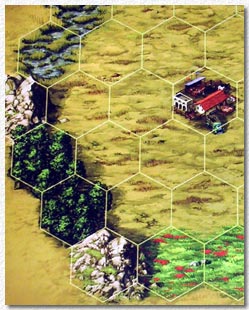
Im Verlauf des Spieles bauen die Spieler aus Feld-Wald-Wiesen-Hexagons eine
Landschaftsfläche auf. Hierin bewegen sie sich pro Zug anhand verschiedener
Transportmittel unterschiedlicher Bewegungsmöglichkeiten:

  • die Libelle zieht nur entlang von Wasserläufen
  • der Dachs bevorzugt Wälder, Hecken und Felder mit Gehölzen
  • die Heuschrecke springt über Wiesen und Äcker mit Blumenfeld
  • der Vogel kann über beliebige Flächen ziehen, allerdings nur maximal bis zu drei
    Felder weit, und er darf seinen Zug nicht auf Dörfern oder Seen beenden.

board

Ziele der Bewegung sind Hexagons, an deren Ecken beim Aufbau der Landschaft eine
bestimmte Kombination von Landschaftstypen zusammengekommen ist. Die gesuchte Kombination
wird auf ausliegenden “Entdeckungskarten” vorgegeben. Wer ein Hexagon mit einer
gesuchten Landschaftskombination erreicht hat, darf die betreffende Entdeckungskarte an
sich nehmen. Sie zählt als eine Anzahl von Siegpunkten. Wer bei Spielende die meisten
Siegpunkte hat, ist Sieger.

Das Spiel ist freundlich gestaltet, die Landschaftsteile haben eine gefällige
Farbgebung, ebenso die Holzteile zum Markieren von Hecken, Gehölze und Blumenfeldern und
zum Abdecken der abgegrasten Landschaftskombinationen.

Das Spielprinzip ist eine gelungene Kombination von langfristigen Zügen zum Planen von
Routen und Transportwegen und von kurzfristigen Zügen zum Einfahren der Ernte. Auch das
zugrundegelegte Design mit Natur- und Umweltmotiven ist überzeugend umgesetzt.

Soll man jetzt noch darüber meckern, daß das Aussuchen eines neuen Hexagons und seine
optimale Stelle im Spielfeld, das Ermitteln des lukrativsten Zielfeldes in der Landschaft
und die Auswahl des besten Transportmittels dorthin eine gewisse Denkzeit erfordern, in
der alle Mitspieler sich in Geduld üben müssen? Diese Kritik ist der Zielgruppe des
Spieles nicht angemessen. Und für die anderen gilt: Wer schon vor Jahrzehnten seine
Nerven beim “Scrabble” mit der Oma geschult hat, wird bei einem “Haselwurz
und Bärenklau” mit seinen Enkelkindern keine Geduldsprobleme haben.

Bei uns hat Peter eine kontroverse Diskussion zu unserem WPG-Wertungsverständnis
eingebracht: Dürfen wir bei der Notenvergabe nur die eigenen Spielvorlieben oder auch den
Geschmack Außenstehender (“Kinder, Glücksspieler, Trottel”) berücksichtigen?
Ich finde, es gibt sachliche Kriterien, nach denen wir einem Spiel Qualität zuerkennen
müssen, auch wenn es nicht gerade auf unserer eigenen Linie liegt. Hallo Peter, warte
nur, bis Du selber Kinder hast! Dann wird sich deine knallharte
Alles-oder-Nichts-Einstellung über Nacht in eine butterweiche Sowohl-als-Auch-Haltung
verwandeln.

Haselwurz & Bärenklau

Haselwurz & Bärenklau

reviewed by Aaron Haag

Murmel Spielwerkstatt is one of the two game companies that spring to mind when
associating Switzerland with gaming. Other than Fata Morgana, Murmel is devoted to
releasing games with educational, ecologically rather than economically oriented games.
This description does not necessarily fit their best-known game Rumis, which was one of
the nominees for “Spiel des Jahres 2003”, but their recent releases
“Enix” (Essen 2004) and “Haselwurz und Bärenklau” (Essen 2005) have a
clear educational message.

“Haselwurz und Bärenklau” has been developed in cooperation with the Swiss
Federal Institute of Technology in Zurich to celebrate the 150th anniversary of their
Institute of Geo-Botany. Hence, it does not come as a surprise that the name of the game
refers to European ginger (Haselwurz) and hogweed (Bärenklau). The goal was to develop a
game, which demonstrates the importance of a large variety of landscapes required for a
high diversity in plant and animal life and the creation and maintenance of biodiversity
are the main theme of the game.

Looking at the game from an educational point of view I can state that it has been
done very well. The game contains 48 cards showing the required habitat of species, their
rarity, and a photograph of the species together with their common names in German,
English and French. Furthermore, the game includes a 44 page booklet describing all the
habitats and species of the game in quite some detail together with a few articles about
the importance of biodiversity.

By now, many gamers may think “Oh, no, another one of these“. So
let’s have a closer look at the game inside this educational tour de force.

When opening the box and looking at the game components your first thought will be:
another Siedler von Catan clone. There is a variable board layout made of hex tiles
showing different terrains and lots of differently shaped wooden pieces. However, the
game mechanics and game play bear no resemblance to Siedler whatsoever as a look at the
very well written rules quickly reveals.

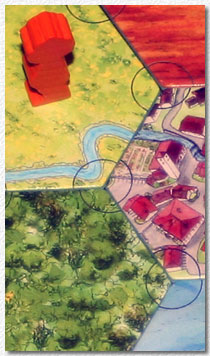
board

The game starts with a board setup of seven hex tiles in a standard layout. The tiles
represent seven different types of terrain across which the player’s pawn, a gnome –
or pixie as the rules calls it – travels to discover rare plants and animals. Discoveries
yield victory points depending on the rarity of a species. Four open discovery cards
display the species that are currently available for discovery, and most importantly
showing their respective terrain requirements.

In his turn a player first extends the board by adding one of his three terrain tiles
in hand. The only restriction for this extension is that rivers must join and may never
end in other terrain. Then a player may place one or more differently coloured wooden
pieces as hedgerows, copse and flowers on the board in order to make areas more
favourable for rare species. Next, he moves his pawn to a new location, using one of four
means of transport: a dragonfly, a grasshopper, a badger and a yellowhammer bird, each of
which can travel only through the type of terrain they prefer. The tricky bit here is
that a particular type of transport may only be used again once all other types have been
used.

After having travelled the player checks, if his pawn resides on a tile that, together
with its two neighbouring tiles, reflects exactly the combination of three terrains
required by one of the species on the four discovery cards. If so, the player has
successfully made the discovery and receives the card as a proof. To show that the area
is no longer available for discoveries an indicator – a red wooden disk – is placed on
the intersection of the three terrains. As the last action in his turn, the player
replenishes the discovery cards on display and the terrain tiles in his hand. The game
ends as soon as either the card or the tile stack is depleted. Each player now adds up
the rarity score of all his discovery cards; the highest scorer wins the game.

The rules are short enough to be explained in a few minutes but mastering the game is
a different matter. Players are faced with some difficult decisions to make: which tile
to place, which terrain enhancements to use, which transport to use and which route to
travel to make discoveries. Placing tiles and enhancements as well as travelling are
predetermined by the four open discovery cards and are hard to plan in advance. Even in a
two player game one cannot assume that the discoveries available at the end of a turn
will still be available at the start of your next turn. Therefore, performing the above
actions is a matter of optimizing your options at that very instance with almost no need
to consider your next move. Deciding about which transport to use is a different matter
however. Here, your goal is to reach discoveries in your current turn while at the same
time leaving you with as much freedom of movement as possible for your next turn. This is
the most difficult decision to make – and the most vital just as well because all
transports but the bird requires a particular terrain to start in. One small oversight
here and you are left with no movement options in your next turn but still being required
to “use” one of your transports. Finding a sequence of transportation means
that will enable you to travel each and every turn given the current terrain is very hard
if not impossible. Luckily, your opponents are faced with the same problem.

My first reservations about the educational aspect of the game have completely
disappeared after a few plays. The game is educational from the point of the material
provided and playing it delivers some insights into the habitats of many rare animals and
plants. At the same time, the game provides some nice tactical challenges that also attract
the seasoned gamer, which overall makes it a very nice concept. Maybe on your next
excursion to the countryside you will recognize some of the habitats that are in the game
and maybe even discover rare species in real life.

(An earlier version of this article has been published in “Games International“, issue
#23)