Archiv der Kategorie: Spieleabende

Goldbräu

Goldbräu

reviewed by Aaron Haag

If you have ever been to Munich or any other part of southern Bavaria during summer,
you have probably been to a beer garden. These are, sometimes rather large, outside areas
with tables and benches where people can drink and eat. Beer gardens in the past where
often owned by breweries in order to make use of the area atop their cellars which for
the purpose of keeping the cellars cool during the summer had been planted with densely
leafed chestnut trees. Until today, many beer gardens are owned by breweries with tight
bands between leaseholders and the breweries (sometimes with dramatic consequences as in
the case of the “Hundertjähriges Haus” in Munich).

Franz-Benno Delonge adopted the beer garden and brewery relation for his latest game
“Goldbräu”. Players aim to control beer gardens and breweries in order to earn
the most money through selling beer to guests in the beer gardens.

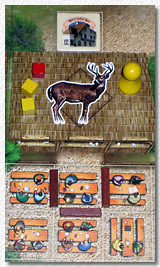
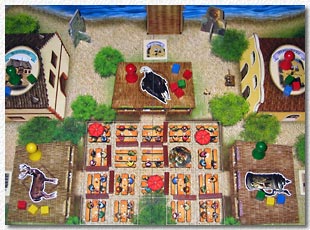
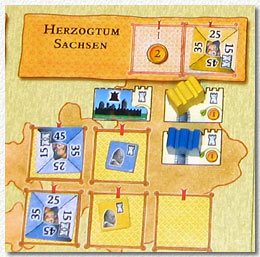
The board shows a total of four breweries and six beer gardens. The beer gardens are
tiny when the game starts but can be extended by its manager later in the game, similar
to the mechanism used in “Löwenherz”. The size of the beer garden is the prime
factor for calculating its income.

During the game setup, each player is dealt six shares, four of which are revealed
immediately and influence tokens placed on the respective brewery and beer garden while
two remain secret in the players’ hand. The concept of hidden influence reminds one
of “Kremlin”. In addition, each player in sequence places two manager pieces on
any not yet occupied brewery or beer garden.

Control of managers is vital in the game as only they give control about the actions
performed by beer gardens and breweries. They can only be placed on the board if no other
player holds a majority of shared in that brewery or beer garden. While it is important
to have sufficient own managers on the board it is equally necessary to have sufficient
influence (shares) in order to prevent other players to take over a manager’s
position. Players secretly and simultaneously select their action for a turn having a
choice of

Goldbräu board

  • expanding a beer garden controlled by one of their managers,
  • nominate one of thier managers as the new manager for a beer garden,
  • sign a beer delivery contract between a brewery and a beer garden, both of which must
    be controlled by their managers,

  • buy shares.

However, “Goldbräu” is a game of shortages. In any one turn players can only
perform one of these actions. Therefore, correct timing and balance is an issue in this
game; it is too easy to lose control of a beer garden only because one spent too many
actions on expansion rather than taking care of maintaining influence (i.e. by buying
shares). There’s one more element of timing in the game, which is interesting and
new: a player has a benefit, if he is the only one selecting a particular action. Now he
is allowed to perform the action twice or pays a lower price for shares. This concept
favours anti-cyclical gameplay on the one hand, but to be honest, it introduces also a
large element of luck as it is hardly possible to sufficiently plan ahead to make use of
it.

Goldbräu board This is further amplified by the fact that
brewery/beer garden shares are not freely available for purchase. Two shares per turn are
revealed and only one of these or a hidden share drawn from the share pile can be bought
by the players. Since there are only six shares of a kind, it is common that players have
to wait several turn for the right share to become available. Again, it is a matter of
timing here combined with making the best out of the current position. As a consequence
the ownerships on the board can be rather static.

Aword about the “pretty waitress” and the “drunkard”: they are
giving a bonus/malus to the beer garden in question and their main effect is adding chaos
to the game. While their position is known at the beginning of the game, the ability to
change their position is completely determined by luck (i.e. decided by cards in the
share pile), rendering any advanced planning obsolete.

The subtitle of the game reads “The most clever landlord wins”. Well, does
he? Walter mentioned after our first game, that if the shares were freely available and
not drawn from a pile “Goldbräu” would come close to “1830”. This
statement indicates a potential problem with “Goldbräu”: it is very dependent
on the luck of the cards drawn and may not appeal to die-hard gamers and it is too
complex to be a good all-purpose family game. All in all, it is a fast-paced business
game and given the right group of people it will provide 60 minutes of fun.

Westpark Gamers ranking: 6.5

15.12.2004: Popeln, Goldbräu, Metallurgie, Destino

Heute wieder ein Quantum von der in Essen 2004 aufgehalsten Arbeit konsequent abgeleistet.

1) Popeln
Ziemlich belanglos.

Aaron 3, Günther 2, Moritz 3, Walter 2.
Der einzige Spaß kann entstehen, wenn man die Assoziation zum “poppen” herstellt.
Schreibt man letzteres mit einem oder mit zwei “p”?
Sag' jetzt bloß nicht: “Mit drei “p”, einem vor dem “o” und zweien nach dem “o”!”
Ich schreibe eine Kurzkritik.

2) Goldbräu
Ein hübsches flottes Wirtschaftsspiel um Ausbau und Erträge in Biergärten. Wenn die Aktien für Brauereien und Biergärten alle offen gehandelt würden, wäre es fast so etwas wie “1830”. Ja, WENN! Aber auch dann nur “FAST”:

Aaron 6, Günther 7, Moritz 6, Walter 7
Aaron schreibt eine Rezension.

3) Metallugie
Endlich konnte Aaron das zweite Spiel der “Gartenzwerge” auf den Tisch bringen.
Moritz wurde unangefochtener Sieger. Mit einer Strategie, die er uns erst ganz am Ende verraten wollte. Nach seiner Offenbarung konnten wir alle drei nur erwiedern: “Si tacuisses .” (oder so ähnlich).

Aaron: 4, Günther 4, Moritz 7 (klar, er zog ja von Anfang an uns allen davon), Walter 5.
Moritz schreibt die Rezension (oder was immer das Spiel wert ist).

4) Destino
Ein Uraltspiel aus Günther's Speicher. Ein Vorläufer von “Hol's der Geier”, aber mit großem Spielbrett und echten Pöppeln, um die Punkte zu zählen.
Mit einer fast 100% Zufallsstrategie (in 3 Spielen habe ich wirklich nur 2 von etwa 50 Karten NICHT voll-randomisiert gezogen!) wurde ich 3 mal Sieger.

Aaron: 6, Günther 8 (er war ja der stolze Besitzer), Moritz 5, Walter 5.
Ich schreibe eine Kurzkritik.

Quest For The Dragonlords: The Advanced Game Expansion

Quest
For The Dragonlords: The Advanced Game Expansion

reviewed by Moritz Eggert

Two years ago the independent game designer Robert Johannessen from Canada
single-handedly revived the grand epic risk-style wargame-cum-adventure fantasy game
genre (lying dormant since “Battlemist” from Fantasy Flight) with his major
effort “Quest For The Dragon Lords”, a beautifully produced game with lots of
figurines and cards in a sturdy box packed to the rim with goodies. The game found many
friends (including me) and so it was no surprise that last year saw the “Crystals of
Power” expansion, which made 5 and 6 player games possible.

With the “Advanced Game Expansion” Dragonlords gets it’s first
“real” expansion, which adds additional rules to make the game more varied. It
can be used with or without the “Crystals of Power” expansion.

“Dragonlords” is one of the few games that combine “Talisman”
style fantasy adventure with epic battles. It has relatively simple rules and a
reasonably short playing time (for such games), making it possible to play a full game in
an evening. This does not really change with the expansion, but players should be well
familiar with the original game to fully enjoy the new rules.

What does the expansion change?

First of all the battle rules have been changed for the third time (after streamlining
them a little in the “Crystals of Power”) and an all new battleboard is
introduced, which is reminiscent of “Axis&Allies”-type games. The main
reason for the battleboard is to make large battles easier to play and keep track of (it
is actually not necessary to use the board in the many smaller battles the game usually
sees), but it also shines by introducing some new tactical options which spice things up
considerably. These include rules for flanking and a revised magic system.

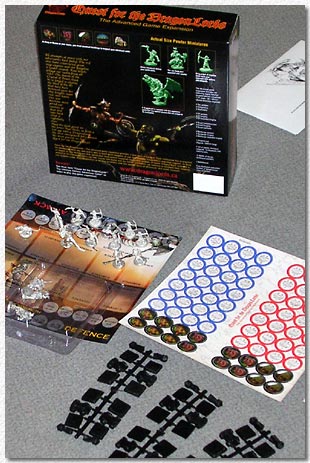
QFTDL Expansion Set

The second major change is the introduction of buildings and a tech tree. As an
alternative to buying the “ordinary” units players can now invest in the
development of more powerful offensive or defensive units and abilities through the
placement of buildings, which gives the game a totally new dynamic. The tech tree is kept
relatively simple to keep it playable, but the options it gives the players will result
in more varying strategies than before. There are also some buildings that only work with
certain races – the formerly weak dwarves especially profit from this as they now can
build mighty cannons with the alchemists lab for example. Wizards can now research and
buy spells at a temple, not necessarily having to travel to the Wastelands as before. The
game comes with beautiful pewter figures to represent the new units, there are also
slightly boring looking counters that one can use in addition. The new units all bring
different advantages, but as so often in games of this type it is the well-mixed army,
which will be most successful.

One can also fortify additional spaces now, which makes the introduction of Siege
rules necessary. The Siege rules actually drive the game forward, as laying siege to a
space can majorly affect the production abilities of your opponent and can even lead to a
quick victory if handled the right way.

All these rules combined make for a deeper but also, as could be expected, slightly
“slower” experience of Dragonlords. QFTDL is still not a deeply strategic game-
part of the fun comes from the all-out chaos reigning on the board, but the expansion set
is a major attempt to give players with good “empire building” skills a certain
edge and a more rewarding gaming experience.

It is especially nice to see that Johannessen and his crew are clearly dedicated to
keep the game alive and interesting. If you talk to him, he is certainly full of
enthusiasm and interesting ideas that he wants to try out to satisfy the fans of the
game. And it is already clear that the development of “Dragonlords” has not
stopped with this effort. This dedication to increasing perfection is certainly a nice
change in a scene, which is increasingly dominated by people trying to make a quick buck
with half-baked designs that soon end up as unfinished torsos. Therefore I can fully
recommend the game to fantasy enthusiasts – don’t expect the game to be perfect, it
still need some tweaks here and there (and Johannessen is working on it), but the sheer
enthusiasm for the project makes it stand out from a lot of mediocrity in the genre.
Compared to the products of the big player game companies QFTDL is still like a slightly
wild grunge band, but it has something that others don’t have – the heart is
definitely in it!

7 Ages

7
Ages

reviewed by Moritz Eggert

I have to admit something from the start: I love this game. It is great. Please buy it
and make Harry Rowland a rich man (or at least help him produce more games). If games
like “History of the World” or “Civilization” have ever piqued your
interest, this game is an absolute must-have. Believe me. You can trust me. Order it….
NOW!

Now come back to the screen or wherever you are reading this and let me explain
why:

“7 Ages” has a bold approach – 6000 years of human history in a nutshell, or
rather, if you dare, in a weekend (although you can shorten the game in many ways, see
below). If you ever wanted to see the Babylonians make it into the 20th century and
develop nukes (possible in the game), if you ever wanted to see many of the historical
great empires rise and fall in a grand all-or-nothing game (possible), if you ever wanted
to build world wonders like the Colossus or the Hanging Gardens (possible), if you ever
wanted to see Native Americans force back a European invasion (possible), this is the
game for you.

The game is about gathering Glory points. Each of the empires you play (and you will
play many different ones, rest assured) has different “goals”. Some want to
dominate a certain continent, some want to be the most technologically advanced, some
want to have the most cities, etc. Achieving the goals gives an empire around 4 glory
points average per turn; if you fall below that number, you might think about dumping an
empire and start a new one.

Players can perform various actions, which are as follows:

  1. Start Empire (if you have a “slot” free – depending on the total number of
    players one can play from 1-7 empires simultaneously)

  2. Production (count the territories and cities you have, earn money, spend money for
    upkeep of your units, buy new units depending on which age you are in)

  3. Trade and Progress (perform a trade action with either the board or another player –
    if you are successful you advance 1-3 spaces on the age track)

  4. Manoeuvre (move your units and fight if necessary)
  5. Destiny (draw new cards)
  6. Civilize (create artefacts, adopt religions or governments for various advantages,
    play mean cards against other players, get leaders, develop your cities)

  7. Discard Empire (obvious)
  8. Wild Card (joker action= any of the above, but with negative effects if you double
    any action that has been played before)

The number of actions seems daunting at first, but with a very simple rule, downtime
is effectively negated: each empire can only perform ONE of these actions! (Harry Rowland
writes in the rules that it took him several years to finally discover this solution to
the problem of endless turns). At the beginning of a turn all players place action chits
(they have one of each the above) on their empires, the phases are then played one at a
time and only the empires who have the action will be active in each phase.
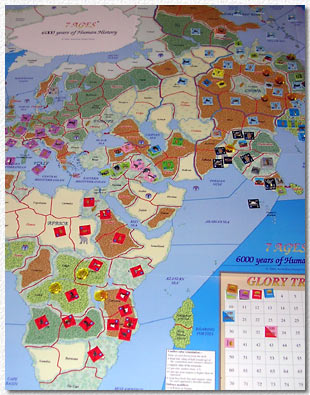
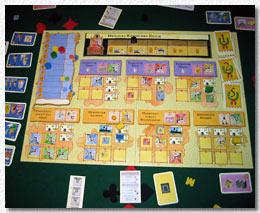
7 Ages boardThis of course creates interesting dilemmas – on the one
hand, you have to guess the actions of your fellow players and play accordingly, on the
other hand, you have to develop your fruitful empires before they disappear from the
centre stage of history. A common combo is to play production in one turn, then to play
manoeuvre in the next. Two production rounds in a row rarely make sense as you have to
always conquer new territory to earn more money than the upkeep for existing troops that
amass in crowded spaces costs you. But spreading yourself thin makes you extremely
vulnerable to attacks, as your defence will be pitiable.

“Civilize” is perhaps the most powerful action…if you have the right
artefact cards to play, and perhaps an evil event card or two to spare. However, to use
it effectively you MUST have played “Destiny” with some other empire, because
cards aren’t automatically drawn, they have to be acquired. “Trade and
Progress” seems boring at first, but many empires need to be advanced to gain glory
points, and also many nifty units only become available in higher ages.

This brings us to the “age track”, which is the heart of the game. Each
empire will have a position on this 7×7 square track, which 1) shows in which age it is
(one of the 7 lines) and 2) which units it can build (certain spaces show units which can
be bought if you are on or beyond this spaces).

There are also “dark ages” spaces which can only be left via a “trade
and progress” action. The game ends, when the final space of the track is reached
(or “Internet” is invented – a very funny idea). This happens more or less
automatically after a while (barring dark ages) as each empire normally gets a “free
progress” at the end of a turn.

The “age track” can also be used to limit game length; one could decide to
just play one age for example.

The empire that is farthest ahead on the track denotes the current “age” of
the game. There are over a hundred cards representing the cultures (they can also be used
as event or artifact cards), but you can only start an empire if it’s age is
“current”. You can even restart an empire (if still possible) that already
appeared.
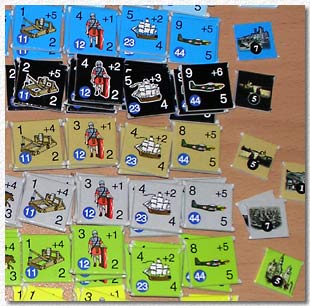
7 Ages countersThe amount of units available in the game is impressive
– any possible military unit you can think of is represented, there are even Elephant and
Star Wars counters that would make Ronny Reagan proud (or ashamed, as he should be). In
addition each playable colour (15 empire “colours” are available) has a
completely different counter mix, even different strengths for various units. Therefore,
you better think twice when selecting a colour for an empire that tries to conquer the
seas (for which you need ships) – some colours have more but weaker ships, some less but
more powerful ships.

The combat system (diceless) looks daunting at first, but turns out to be very
ingenious and logical. Each player divides their troops in a front and back row, adding
support, frontline value, defensive bonuses, bonuses for being in a higher age etc., all
this added to a random card that you can look at BEFORE deploying your troops. If you
burn up your troops quickly at the front you will have to reuse them and gain disorder
markers (which makes you weaker), on the other hand some units are stronger in frontline
value than in support and vice versa. The ancient battles at the beginning of the game
are usually tense affairs, as the card drawn (valued 0-7) really can make a difference.
As technology advances units become more and more powerful and fortifications and cards
(luck) play a much lesser role (which reflects the real evolution of military
technology). There are some cards that mess around with this, but usually you win a
battle that you really commit yourself to with the necessary force, which is nice.
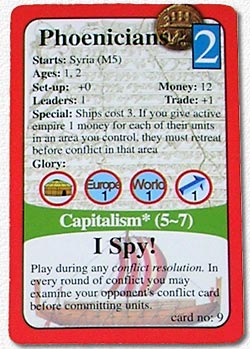
7 Ages cardThe best thing though is that war is not the best way to win
– in fact, there are very few cultures, which profit from all-out conquest like the
Mongols or the Huns (following their real-life counterparts). The vast majority of
cultures profits from other things. In our current game, I play the Phoenicians under the
rule of an able artist. Since starting their empire, the Phoenicians have never left
their homeland, instead concentrating on building artefacts. So far, they have a record
number of eight artefacts in their homespace, gaining double as many points through the
artist present. I actually got many more points through peaceful play than if I had tried
to attack my neighbours!

All out war never pays off in the game – the more you fight the more you lose
opportunities to get glory points. In fact artists (to my great joy the game actually has
counters for personalities like Mozart and Shakespeare) can be deemed the most powerful
point-garnering leaders in the whole game, much more effective than tacticians and
strategists. The most often used tactic is to select an empire that is far away from any
“action” or “conflict” and let it thrive as long as you can, of
course, but sometimes it also makes sense to start empires close to or even IN other
players’ lands to limit their progress.

Conflict is therefore sometimes a necessity (and fun to play), but it is nice to see
that the game is not solely dependent on it (like “History of the World”).
Glory points are forever – once you gain them you don’t lose them, so in effect it is
not important if you are the big boss on the board – gaining glory points in any way
possible is the main incentive.

I already noted that event cards can be very powerful – in fact, this is the only
gripe one could have with the game. Some events are so powerful that they literally can
erase a complete huge empire with the play of one card. In the long run things equal out,
though, as at the moment players oppose a certain empire it is best to give it up anyway,
and by having it destroyed one even saves an otherwise necessary time-consuming action
(“discard empire”). The events have clearly been introduced to create flavour
(of course, there are earthquakes and even the dreaded civil wars which play similar like
in “Civilization”) and to satisfy players who want to have a
“historic” or epic game with no regard to game balance. The rules suggest a
“Mike Siggins” variant in which events can only be played on empires “in
range” (range is determined by the age an empire is in). I would certainly recommend
that variant, but it is also easily possible to leave away the events altogether,
especially if you want to play a shorter game. As I already said, events will equal out
in the long run, but if you only play a couple of rounds, they can be very unfair.

“7 Ages” is not, as many would expect, a complicated game. In fact the rules
are only slightly more complicated than “History of the World”. One can tell
that a lot of streamlining work has gone into the rules – although some concepts need
getting a little used to; the rules only need to be consulted for looking up the various
artefact and leader abilities (a handout would have been handy, but isn’t existent).
They also contain a long fun article covering the whole world history and extensive and
interesting designer notes. There is even a quite beautiful and poignant poem by Harry
Rowland’s father in it, to top things off.

The amount of counters needed for the game is immense. ADG provides six heavily
cluttered countersheets (the graphic design is excellent, by the way), but even then many
counters can only be found on the back of counters that are needed somewhere else, which
makes it hellish to find some particular counter. Some event cards ask for counters that
are not existent (or at least we couldn’t find them). The amount of named leaders and
artefacts is staggering, and if you don’t put them in some kind of order before the
game you might spend a couple of minutes to find Genghis Khan for example.

I recommend using different, out-of-the-game markers for fortresses (we use small
wooden blocks) and unrest (we use the “gem stones” used for Magic the
Gathering-type card games). The huge board (two A1 paper sheets) is cluttered with
counters as it is, so some different looking, easy-to-spot counters are a nice change.
Are all these (minor) gripes damaging the game as it is? Definitely no, you will find
your own solutions, and play it nonetheless.

Don’t be deluded, though: “7 Ages” is not a game for the casual gamer or
for the family gathering. It demands some attention, and especially time. You would need
a weekend to play a full game from age 1 (which is actually not necessary, as any age can
be used to start a game) with 4-5 players. In contrast to some other monster games in
your cabinet this game won’t gather dust. It is a game that you will want to store
somehow and continue playing again and again. Because there is little downtime every
player is constantly involved in the game, and the fascination of seeing empires rise and
fall in a truly epic but totally playable game is payoff enough for me. It is even easily
possible to join a game already in progress, or to leave a game and come back later. The
Internet will be another medium in which this game will thrive – there is already an
experimental cyberboard version around, and the game lends itself easily to an online or
computer version – Harry should recommend it to the excellent Matrix Games who are
already working on computer versions of “Empires in Arms” and “World in
Flames”.

If you have any love for grand historical games (AND call yourself a non-casual gamer)
this game will become a classic for you, to be visited again and again, for countless
hours of pleasure. Don’t wait, do Harry a favour and order a game, I promise you
won’t be disappointed.
06.12.2004: Ys, Medici, Oltre Mare, Fugger, Zoff im Zoo, Kohle, Kies & Knete, Titan-The Arena

Außerdem wurden gestern beim äußerst netten Abend bei “Hans im Glück” von Günther und mir gespielt:

1) YS
Bewertung: Moritz 7, Günther 7, Michael 8, Henning 8
(Günther abgeschlagen hinten (!), Moritz sehr knapper Sieg vor Henning – Super Spiel!

2) Medici (Knizia)
Bewertung: Moritz 7, Günther 8, Dieter 8, Michael 8
(Günther wieder untypisch weit hinten, Sieger Michael knapp vor Moritz)

3) Oltremare
Bewertung: Moritz 7 (etwas abgewertet), Günther —, Michael 7, Dieter 4
(Wieder Michael Sieger, gefolgt von Günther, Moritz vollkommen abgeschlagen auf dem letzten Platz mit einer “Piratenstrategie”: möglichst viele Minuspunkte mit Piraten gesammelt! Das Spiel war zwar nach wie vor gut, seltsamerweise war das Handeln aber im Gegensatz zu uns total öd – es wurden keine Karten verschenkt, und irgendwie kam das Spiel nie richtig in die Gänge, hängt anscheinend doch sehr von den Leuten ab…)

Loredana/Peter haben meines Wissens folgende Spiele gespielt:
“Zoff im Zoo”
“Flaschenteufel”?????
“Kohle, Kies und Knete” (erstaunlicherweise gab es weder eine Schlägerei noch wurde es jemals an dem Tisch laut, so weit ich beurteilen konnte. Das ist fast unheimlich! Am Ende gewann wohl souverän Loredana)
“Titan – The Arena”
Vielleicht kann er ja noch ergänzen
“Hans im Glück” – recommended!
Ergänzung von Peter:

Also, wir spielten
– Fugger (ganz gut)
– Zoff im Zoo (göttlich)
– Kohle, Kies und Knete (wir haben überhaupt nicht gestritten, aber das Spiel ist nicht gut)
– Titan – The Arena
und an mehr kann ich mich nicht mehr erinnern

Black Molly

Black
Molly

reviewed by Aaron Haag

Did you ever enjoy the tranquillity of a tropical fish tank? Well, here’s the game
for you or is it? This game is about murderous Black Mollies and deadly devices and there
all but peace and quiescence in this fish tank.

The game comes in the clear and sturdy plastic box already known from Richard de
Rijk’s “Atta Ants”, published last year. And similar to Atta Ants the game
uses cards to generate a random board layout. This time 6 by 4 cards depict 24 areas of a
tropical fish tank. Some cards (7) show devices like a heater, a catcher, or a pump while
other cards (2) depict anemones. Four cards are the start areas for the four fishes of
each player while two other cards indicate where the Black Mollies start.

The rules are very simple and quickly explained. Beginning with the start player all
may players move their fishes horizontally or vertically by one area card. Fishes may not
end their move on anemone cards or on a device card with an active device. Next, the
device statuses are toggled by rolling a four-sided die. The number rolled changes the
status of the respective device. Now it is checked if the pump is active. If so, the
current moves all fishes in its path one additional area card in the direction of the
current. Then it’s the Black Mollies turn. They love to feed on young fish and the
start player must move them one area card towards the card with the least number of
fish.

Finally, the devastation results of the devices and the hungry Black Mollies are
determined: all fishes on cards with active devices or Black Mollies are taken out of the
game. If there are only fishes of one player left, that player wins the game, otherwise
the start player changes and the next round begins.

If you know Atta Ants and always liked to have an increased level of suspense by
adding more spiders, Black Molly can satisfy your needs. With more than half of the area
cards being more or less off limits for your fish there’s hardly a turn where not
some or even all of your fish are at risk. Black Molly boardMany times you cannot avoid to move fishes onto a
(turned off) device card in order to escape from the approaching Black Mollies, only to
find exactly this device being turned on by an unlucky die roll later in the round.
Similar to Atta Ants it is important to take into account the player sequence and the
position of the start player who is in control of the Black Molly if they have a choice
of the route the travel.

The rules state that the game lasts between 5 and 30 minutes, which is confirmed by
the games we played. Expect rather short playing times with only two players and longer
ones with four. The downtime of players already out of the game is not too high as often
the game ends with a sudden death of a larger group of fish.

Sooner or later some group of fish will be trapped between the Black Mollies and the
devices and eventually perish. Players may find it necessary to distract the Black
Mollies with a single fish but this is a rather risky venture. Many times, it is
successful but also means the certain death of the lonely distracter fish.

Black Molly is a non-complex short game with not a lot of tactics to apply and with
just about the right amount of luck by die rolling. I can recommend it as a game for
families and not so die-hard gamers, if the subject of fishes being eaten, fried by a
heater or hacked to death by a pump is not felt to be too inappropriate.

Westpark Gamers ranking: 4.75

Im Schatten des Kaisers

Spielbericht vom 01.12.2004

Autor: Walter

am Tisch: Aaron, Günther, Hans, Walter

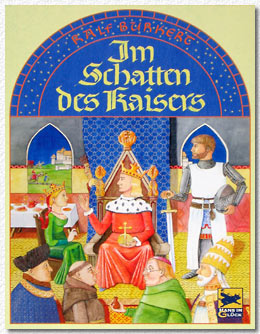
auf dem Tisch: “Im Schatten des Kaisers”

Im Schatten des Kaisers
Autor Ralf Burkert
Verlag Hans im
Glück
erschienen 2004
Spielerzahl 2-4
Spielzeit 90 Minuten

Im
Schatten des Kaisers

Nur mit einem einzigen lapidaren Satz geht die Spielanleitung auf die dargestellte
Szenerie ein: “Deutschland im Mittelalter: Die Spieler vertreten adelige Familien,
die Anspruch auf die Kaiserkrone erheben.” Kurz und bündig. Ein gutes Spieldesign
hat es nicht nötig, durch eine aufgeblasene Titelgeschichte über die eigenen Schwächen
hinweg zu täuschen. “Im Schatten des Kaisers” ist ein solches gutes Spiel. Die
Dramaturgie ist spannend, die Spielmechanismen sind vielseitig und fein aufeinander
abgestimmt, und der Bezug zum historischen Hintergrund ist absolut überzeugend.

In der Schule hat mich das Mittelalter mit seinen vielen Kaisern und Königen ziemlich
kalt gelassen. Im reiferen Leben, wenn die Fragen nach dem “Ob” und
“Wie” immer häufiger ersetzt werden durch die Frage nach dem “Warum”,
gewann diese äußerst schillernde Phase mitteleuropäischer Geschichte für mich erst ihre
gebührende Faszination.

Kaum hatte Karl, der Große, fünftausend Sachsen hinschlachten lassen und sich damit
die römische Heiligsprechung verdient, da wurde auch schon ein Urenkel seines größten
Gegners auf den fränkischen Königsthron gewählt. Kaum hatte der verlotterte Sproß einer
normannisch-schwäbischen Familie den Kaiserthron bestiegen, den Papst in eine mächtige
deutsch-sizilianische Zange genommen, und für die christlichen Jerusalem-Pilger mit dem
Beherrscher aller Gläubigen in Bagdad einen friedliche Zugang zu den heiligen Stätten
ausgehandelt, da wurde auch schon sein letzter Enkel von den päpstlichen Häschern
ergriffen und hingemordet.

Zwanzig Jahre lang verdarb das Reich in einer kaiserlosen, schrecklichen Zeit, bis
sich die Landesfürsten zusammentaten, um das herrschende Faustrecht zu beenden und ein
neues Wahlrecht für ihren König zu beschließen. Vier weltliche Landesfürsten und drei
kirchliche Fürstbischöfe gründeten einen Kurverein und reservierten für sich das
Privileg, den deutschen König zu wählen. Warum es gerade die Kürfürstentümer Böhmen,
Sachsen, Brandenburg und die Pfalz waren, und warum gerade die Erzbistümer von Mainz,
Köln und Trier dieses Privileg bekamen, hat mir noch niemand überzeugend darlegen können.
(“Sie waren halt die Mächtigsten!”) Auf Grund welcher Legitimation der Gekürte
dann auch noch ordentlicher “Kaiser” wurde, ist ebenfalls ein Geheimnis der
Geschichte.

Zumindest ging es von nun an ohne Mord und Totschlag zu, wenigstens in den oberen
Etagen. Man ließ sich höchstenfalls zum Gegenkaiser ausrufen, bekriegte sich ein bißchen,
wurde gefangen genommen und mußte – bei Sekt und Kaviar – auf die Auslösung warten. Man
paktierte mit dem Papst, verkrachte sich mit ihm, wurde gebannt und exkommuniziert,
schrieb im Gegenzug dem Herrscher in Rom (oder Avignon) die Rechtgläubigkeit ab, und
leistete sich riesige Militärausgaben, um seinen Ansprüchen auch einen glaubwürdigen
Nachdruck zu verleihen.

Wußtet Ihr, daß damals in diesen verworrenen Zeiten ein gewisser Papst Johannes XXII
agierte, und daß es dann volle siebenhundert Jahre dauerte, bis ein humorvoller mutiger
Roncalli sich als nächster getraute, den Papstnamen Johannes wieder zu verwenden?

Kehren wir zurück in den Schatten des Kaisers! Man braucht den geschichtlichen
Hintergrund nicht zu kennen, um das Spiel spielen, genießen und gewinnen zu können. Es
erhöht aber das Entzücken bei der Begegnung mit vielen hübschen Eigenschaften dieses
Spiels.

Im Schatten des Kaisers boardDas Spiel läuft in fünf
Runden ab, in den die Spieler reihum verschiedene Aktionen ausführen können, solange ihre
Geld-Mittel dafür ausreichen. Wie schon im lapidaren Einleitungssatz gesagt, sind die
Spieler Adelsfamilien, die ihre Söhne (Pöppel, Plättchen) auf Kurfürsten- und
Kaiserthröne heben und dafür Siegpunkte kassieren. Wer am Ende die meisten Siegpunkte
gesammelt hat, ist Sieger.

Jeder Spieler hat insgesamt sieben Sprößlinge (Plättchen), die er an einem beliebigen
Ort in einem beliebigen Kurfürstentum zu Welt bringen kann. Nicht alle auf einmal,
sondern immer nur einzeln, soweit seine Mittel reichen. Die Sprösslinge altern von Runde
zu Runde und sterben in der Regel nach vier aktiven Runden den Alterstod. (Das erinnert
an Kremlin.)

Mit Medizin läßt sich der Tod kurzfristig aufhalten. Ein böser Gegenspieler kann aber
auch einen Kurpfuscher in ein fremdes Herrscherhaus schicken und dem Senior dort das
Lebenslicht ausblasen lassen.

Den Posten als Kurfürst erhält eine Familie für die einfache Mehrheit an
Machtelementen im entsprechenden Gebiet. Zu den mehrheitsbildenden Faktoren gehören
Ritter, Adels-Siedlungen und natürlich Mitglieder der engeren Adelsfamilie. Letztere
können sich verheiraten, dann zählen sie doppelt. (Die Spielprinzipien um die Mehrheiten
erinnern vage an “Die Macher“.)

Die Kaiserfamilie bekommt in jedem Kurfürstentum zusätzliche Punkte für die darin
enthaltenen Reichsstädte. Die Reichsstädte werden vom jeweiligen Kaiser gegründet, sind
aber kein fester Besitz in den Händen einer Familie, sondern wechseln jeweils mit der
Figur, die den Kaiser stellt.

Kaiser wird man, indem man sich demonstrativ zum Gegenkaiser ausrufen läßt und eine
Mehrheit an Stimmen der Kurfürsten dafür gewinnt. Auch der Papst kann hier eine Stimme
geltend machen. Einzelne kirchliche Kurfürsten können ihren Einfluß verdoppeln oder auch
gänzlich einbüßen, wenn ein Spieler die entsprechende Aktion ausgewählt hat.

Aber nicht der Kaiser gewinnt am Ende das Spiel, nicht die Masse an Besitztümern oder
die Mehrheit an Einfluß, es gewinnt allein die Summe aller Dynamik, die ein Spieler im
Laufe des gesamten Spieles an den Tag gelegt hat. Machtvolles Verteidigen von
Kurfürstentümer, anstrengende Kuren, um das Altern der betagten Familienmitglieder zu
verhindern, all diese statisch ausgerichteten Aktionen bringen keinen Gewinn. Leben und
Leben lassen ist hier die Devise. Die beschränkten Mittel leicht und locker an den
schwächsten Machtpositionen ansetzen und die Herrschaftsverhältnisse ständig im Fluß
halten, das bringt Punkte und hält das Spiel in Schwung.

Fünf Jahre lang hat der Autor Ralf Burkert über seiner Idee gebrütet, zwei Jahre lang
hat er in Zusammenarbeit mit dem Verlag an der Spielgestaltung gefeilt. Das Spiel sollte
Im Schatten des Kaisers boardals Merkmale aufweisen:

  • keine Zufallselemente
  • Vielfalt im Handlungsspielraum
  • Dynamik in der spielerischen Entfaltung
  • Bremsen gegen die Herausbildung jeglicher Hegemonie

Was dabei herausgekommen ist, dem möchte ich heute den Titel “Weltmeister der
Balance” verleihen. Dazu ein paar Beispiele:

  1. Alle Aktionen sind durch wohldosierte Anzahl von Karten limitiert. Nur drei neue
    Adelige dürfen pro Runde ins Spiel gebracht werden; bei vier Mitspielern geht einer leer
    aus. Nur einmal pro Runde kann eine ausländische Königstochter zu Verehelichung
    eingeflogen werden. Da heißt es schon präsent sein und seine Zugreihenfolge gut wählen,
    damit man bei seinen Expansionsplänen nicht in die Röhre schauen muß.

  2. Alle Aktionen kosten Geld, und zwar unterschiedlich je nach Qualität der Aktion.
    Einen neuen ledigen Baron in Spielfeld zu bringen, kostet drei Taler, einen Verheirateten
    zu bringen kostet gleich fünf Taler. Da sind die Geldmittel sehr schnell ausgeschöpft und
    man kann sein Restgeld nur noch mit billigen Umzügen und Ritterspielen unter die Leute
    bringen.

  3. Allein schon das definierte Maximum an Geldmitteln, das ein jeder Spieler einhalten
    muß, ist eine wohldurchdachte Schranke. Wer mehr als zwölf Taler besitzt, muß jede
    Einnahmen, die darüber hinausgeht, ersatzlos verfallen lassen. Keiner kann sein Kapital
    ansparen, auf jegliche Aktionen verzichten und die anderen Streithähne allein in die
    Arena schicken. Um dann später von hinten her das ausgeblutete Feld aufzurollen. Nein,
    jeder Spieler muß in jeder Runde Einsatz zeigen.

  4. Der Kaiser, normalerweise ein Titel, der nach Sieger klingt und mit dem sich jeder
    gerne schmücken möchte, bringt hier zwar ein paar Sonder-Privilegien mit sich, diese
    halten sich aber durchaus die Waage mit den damit verbundenen Nachteilen: Die Familie muß
    dafür eine Adelsfigur aus einem Kurfürstentum entfernen und verliert dadurch Präsenz auf
    dem Spielbrett. Auch unter unseren Analytikern ist noch nicht entschieden, ob Kaiser zu
    werden ein gewinnbringendes Ziel ist.

  5. Wer einen Kurfürstenposten aufgeben muß, erleidet eigentlich keinen materiellen
    Verlust. Er darf sein abgesetztes Familienmitglied unverzüglich in einem beliebigen
    Kurfürstentum unterbringen, und kann damit sofort einen Angriff auf die dortigen
    Machtverhältnisse starten.

  6. Wer in einem Kurfürstentum die Mehrheit erreicht hat, muß eine Figur aus den Feldern
    des Kurfürstentums entfernen und auf den Thron setzen. Dadurch ist seine Machtposition
    deutlich geschwächt und der nächste Machtwechsel vorprogrammiert.

  7. Wer eine Kurfürstenwahl knapp verloren hat, kann dort ziemlich sicher in der nächsten
    Runde zum Erfolg kommen. Vor allem weil es sich nicht lohnt, das Kurfürstentum zu
    verteidigen; dafür gibt es ja keine Siegespunkte. Der freundlichste Mitspieler ist der,
    mit dem man sich alternierend in der Mehrheit an einem Kurfürstentum abwechselt. Dann
    kassieren beide abwechselnd die Siegpunkte.

  8. Die Kurfürstentümer besitzen unterschiedliche Privilegien, die sich entweder in
    erhöhten Einnahmen, in mehr Einfluß bei der Kaiserwahl, in direkten Siegpunkten oder in
    anderen kleinen Vorteilen auswirken. Moritz schreibt sinngemäß in seiner Kritik zu
    Cthulhu-500: “In einen guten Spiel besitzen ALLE asymmetrischen Modifikationen den
    gleichen Nutzeffekt, aber alle auf unterschiedlicher Weise”. Hier “Im Schatten
    des Kaisers” ist diese Regel auf beispielhafte Weise eingehalten.

  9. Jeder Spieler besitzt nur drei Siedlungssteine, mit denen er Machteinfluß und
    Siegpunkte gewinnen hat. Für alle ist Platz vorhanden, und am Ende sind wohl alle
    Siedlungen gebaut. Wer früh baut, bekommt zwar früh einen erhöhten Machteinfluß, er lockt
    damit aber auch leicht die Geldgier der Mitspieler auf sich. Der Kurfürst erhält nämlich
    auch für die Siedlungen fremder Familien in seinem Gebiet bestimmte Geldzahlungen
    zugewiesen. Wenn ein Spieler ein Kurfürstentum mit eigenen Siedlungen gegen solche
    Mitesser aber unbedingt verteidigen will, dann verliert er Dynamik in seinen weiteren
    Aktionen und muß auf mögliche Siegpunkte beim Machtübernahmen verzichten.

  10. Jeder Spieler besitzt insgesamt nur sieben Familienmitglieder. Hat er alle
    eingesetzt, dann ist sein Vorrat erschöpft und er kann keine neuen mehr zur Welt bringen.
    Eine Dominanz durch eine einzige Adelsfamilie ist dadurch ausgeschlossen.

  11. Die Ritter können in den Kurfürstentümern auf Adelsfelder oder auf Ritterburgen
    gesetzt werden. Auf den Adelsfeldern sind sie variabel; sie können in andere Fürstentümer
    umziehen und dort in die Mehrheitsverhältnisse eingreifen. Wenn aber ein echter
    Adelssproß kommt und ihr Feld beansprucht, werden sie ganz vom Brett genommen. Wurden sie
    auf Ritterburgen eingesetzt, besitzen sie ewiges Hausrecht und können nicht mehr
    verdrängt werden. Dafür habe sie ihre flexible Einsatzfähigkeit eingebüßt.

  12. Das ganze Spiel ist u.a. ein ständiger Kampf gegen Altern und Tod. Je mehr Adelige
    ein Spieler im Feld hat, desto stärker nagt der Zahn der Zeit an seiner Familie. Je mehr
    aktuellen Einfluß – teuer erkauft – ein Spieler auf dem Brett hat, desto sicherer wird er
    ihn wieder los.

Dieser Katalog ist nur eine kleine Kostprobe von Balancen, die “Im Schatten des
Kaisers” wie selbstverständlich eingebaut sind, den Spielablauf komplexer machen und
es erschweren, eine klare Gewinnlinie zu finden und zu verfolgen. Jedes einzelne Detail
steht mit allen seinen konkurrierenden Elementen im wohldurchdachten Gleichgewicht.
“Im Schatten des Kaisers” ist kein billiges Kriegsspiel, bei dem gegen Ende ein
einziger Spieler zum monopol-artigen Sieger emporschießt. Man muß mehr Dinge beherzigt
haben, als ein paar Gigatonnen Sprengstoff auf seine Gegner abgeworfen zu haben, um sich
hinterher zum totalen Sieger proklamieren zu können. Kann sein, daß dies für viele
Gelegenheitsspieler zu anspruchvoll ist. Für einen professionellen Liebhaber des alten
Europa ist es aber ein ungetrübter, herausfordernder Genuss.

WPG-Gesamtwertung: 6,75

Gods

Gods

rezensiert von Walter Sorger

“Nach der großen Flut” dürfen die Spieler mal wieder anfangen, die Welt neu
entstehen zu lassen. Was ist dafür besser geeignet als Hexateile, die zu einem einzigen
großen Kontinent zusammengelegt werden müssen?

Es gibt neutrale Hexateile mit “Völkern”, die alle Spieler einsetzen dürfen,
und es gibt private Hexateile mit unterschiedlichen “Tempeln” (oder Göttern),
die den einzelnen Spieler zugeordnet sind. Legt ein Spieler einen Tempel an ein Volk, so
hat er es sofort zu seiner Religion bekehrt und es gehört ihm. Der nächste Spieler kann
es ihm in seinem Zug natürlich umgehend wieder abspenstig machen.

Legt ein Spieler ein Volk an einen Tempel (oder an ein bereits bekehrtes Volk) an und
es grenzt an kein Hexateil mit einer fremden Religion, so nimmt das Volk sofort die
herrschende Religion an.

Offensichtlich ist es ziemlich leicht, Proselyten zu machen: Weder die Nähe noch die
massive Präsens von Religionszentren hindert ein Volk daran, vom rechten Glauben
abzufallen. Der gute Hirte könnte seine Schäfchen nur in dann in seiner Herde Seite
halten, wenn er sie rund herum mit Tempeln abgeschottet hat. Doch für eine solche
Brutalo-Technik reicht das vorhandene Material keineswegs aus.

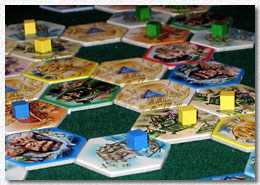
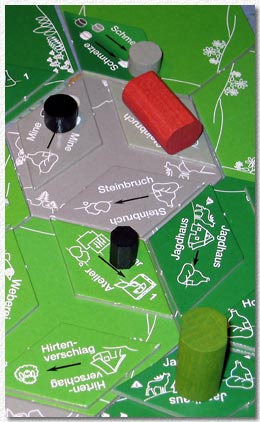
board

So ist es unvermeidlich, daß die Gläubigen regelmäßig die Seiten wechseln. Welchem
Mitspieler man mit seinem Zug die Herde streitig macht, liegt neben strategischen
Erwägungen (welchen?) sehr schnell an der taktischen Überlegung: welchem Mitspieler MUSS
man ein paar Schäfchen wegnehmen, damit er die Siegbedingungen nicht erfüllen kann und
somit das Spiel beendet.

Siegbedingung ist, von drei verschiedenen Völkern je drei Hexagons unter seinen
religiösen Einfluß gebracht zu haben. Mit größer werdendem Kontinent und mit wachsenden
Völkerzahlen ist das früher oder später unvermeidlich. Im Grunde geht es ganz flott, und
das ist ein wesentlicher Pluspunkt in diesem konstruktiven Legespiel.

Natürlich gibt es bei “Gods” auch Sonder-Hexateile, mit denen etwas Farbe in
das gradlinige Ausbreiten und Inbesitz-Nehmen von Völkern und Tempeln hineingebracht
wird. “Ödländer” gehören grundsätzlich keiner Religion an und erleichtern das
Abschotten von (Religions-)Besitztum. Mit “Wirbelstürmen” kann man die Ödländer
wieder mal versetzen. Das Sonder-Hexateil “Zusatzaktion” ist eine Art
Zug-Sparschwein: der Spieler kann damit auf einen aktuellen Zug verzichten und ihn zu
einem beliebigen späteren Zeitpunkt nachholen.

board

Das Spiel verläuft trotz des Kampfes aller gegen alle in geordneten Bahnen. In einer
Zweier-Runde mag es sogar ein absolut strategisches Denkerspiel sein. Aber auch in einer
Vierer-Runde kommt man sich an keiner Stelle gespielt vor.

Wie man das Spiel gewinnt? Ich weiß es nicht. Wie man seine Tempel optimal legt, wie
man seine Glaubensgenossen am wirksamsten vor den begehrlichen Zugriffen fremder Götter
schützt, wie man das gewinnende Endspiel einleitet: das alles sind für mich noch
topologische Geheimnisse. Ganz sicher gehört das Sparschwein zur Siegstrategie (wenn es
uns vom Schicksal angeboten wird): der zusätzlichen Zug im geeigneten Zeitpunkt
erleichtert es ungemein, die notwendigen Mehrheiten zusammen zu kratzen. Da Züge aber
Geld kosten, sollte man für vor einem erfolgreichem Endspiel auch für eine gefüllte
Aktionskasse gesorgt haben.

“Gods” besteht aus einer gelungenen Mischung von Geduld haben und
Vorpreschen, von abwartendem Planen und von improvisiertem Zugreifen. Man muß es häufiger
spielen, um mit ausreichender Spielerfahrung die vielen hübschen
Entwicklungsmöglichkeiten zu sehen, zu erarbeiten und genießen zu können. Aber Genießen
kann man es von Anfang an.

In 80 Tagen um die Welt

In 80
Tagen um die Welt

reviewed by Peter Riedlberger

This game seems to be a merchandising product in the wake of the new “Around the
world in 80 days” movie. Well, I don’t care. It’s the gameplay I’m
interested in, and that’s fine.

The Kosmos of this game is difficult to explain (unless you use an advanced concept of
space-time): In fact, players move in two dimensions. On the board, they move from city
to city (London – Paris – Brindisi – … – New York – London). The brim of the board
features a Kramer bar but probably the only one I know where you wouldn’t prefer to
advance since it’s the number of days spent. You start with zero and you’ll end
up with around 80 days.

In order to travel from one city to another, you play cards. For London – Paris, you
need a ship and a train, for example. Every card has a value in days. Accordingly, for
London – Paris, you play a ship and a train, add the values of those two cards and
advance that amount on the day bar. You don’t want to play cards with huge values.
Therefore, it can be a good idea to miss a turn, just to get new cards and hope for a
better fare.

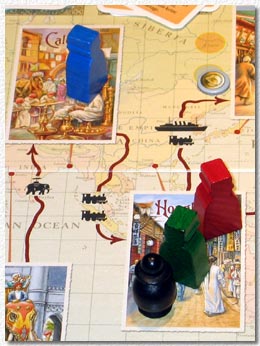
In 80 Tagen um die Welt board

It might happen that player A advances “quickly” in space, meaning he always
hops from city to city and arrives in London… within 90 days… Player B might arrive
two turns later, but he used lower cards and wins in the end. Imagine: Both started the
same day in London, the first one experienced 90 days while the other only lived through,
say, 72. Did you ever hear of Einstein’s twin paradox?

Back to the game. My description so far may have sounded complicated, but “80
Tage” is a really, really straightforward game. It’s luck-driven, but it can be
explained and played with four players in less than one hour (which we did). Players
might complain that they don’t have too many choices during their turns, but in fact,
they do have some: At the beginning of a turn, you pick up one of the open transportation
cards. Every card is linked to some other advantage (free event card, start player next
round, …) so you must ponder the cards and their values against those other advantages.
Then, when you have two completely identical cards (e.g., two trains with value 6) and
you have to use exactly this kind of transportation (e.g., two trains), you advance only
half of the amount of days (i.e., 6 instead of 12). This means that card care is somewhat
less primitive than it might seem at first glance. Then, the very first and the very last
player to arrive at a city get another advantage (free event card, plus 1 day for all
others…). So you can follow the tactic of always being last (but beware, as soon as the
first player arrives in London, you lose 1 day per turn).

I haven’t mentioned all rules, but most. Winning the game is largely due to
getting the right cards, but it is still fun. “In 80 Tagen um die Welt” is the
kind of game you could play with non-players or children instead of stomaching Monopoly
or Risk. It is luck-driven, it is true, but there you’ll still find enough classic
German game mechanisms.

Westpark Gamers rating: 7.0

Neuland

Neuland

reviewed by Peter Riedlberger

When it’s your turn in Neuland, you have a maximum of 10 actions. You can spend
those actions on the production either of raw products (e.g. wood) or of new production
sites (e.g. lumberjack cabin). The gist of the game is “production sequences”.
I will explain this unwieldy coinage of mine with the example of a turn and you’ll
see what I mean. I produce one piece of food (1st action). I use this piece of food to
produce a piece of rock (2nd action). I use the piece of rock to build a paper mill (3rd
action). Again, I produce first a piece of food (4th action) which I employ this time for
the production of wood (5th action). This wood becomes paper (6th action). Once more, I
produce food (7th action), then stone (8th action). This time, I use the stone to build
some victory point site (9th action). In the next turn (let’s imagine no other player
acted) I produce food (1st action), then stone (2nd action), then I activate the victory
point site with the paper from last turn and the stone (3rd action) and I get some
victory points.

Neuland board

This kind of production sequences can be much fun, e.g. in the computer game
Civilization (cultural advances). It is a gaming mechanism that works very well with
solitaire games since it can be mind thrilling to find the best sequence of production.
However, in Neuland, it doesn’t work out at all. We were four experienced players. No
one would finish his/her turn before having found the best sequences. This means: much
calculating (for the active player), much boredom (for all others). Individual turns
tended to last 10+ minutes. Since production sites are “public” (any player can
use them, no matter who originally built them) you have to carefully ponder whether you
should really establish e.g. a paper mill. Worse: Whenever you build a victory point
site, you make another victory point site available (which was not available before the
other one was built). You are allowed to check the stack. However, this means even more
calculating: If I build this site, I might give the next player the opportunity to build
a site that awards more victory points. Just another factor for your mental
arithmetic!

There are positive things about Neuland. The playing material consists of very nice
wood pieces (but you pay dearly with 44 Euros for that!) and I liked the next-player
mechanism very much: The fewer actions you use, the sooner it’s your turn again.
However, this is not enough to save Neuland. Gameplay is simply boring. It’s not much
fun to watch others calculating most of the time and to do some math yourself once in a
while. Neuland is too complicated for the occasional player and too calculable for the
seasoned veteran.

Westpark Gamers rating: 3.8