Archiv der Kategorie: Spieleabende

Alexander the Great

Alexander the Great

reviewed by Moritz Eggert

Alexander the Great has a varied history as a game theme. First there was
“Battles of Alexander the Great” which had reportedly one of the most garish
game boards of all time (described as looking like a pile of puke by one reviewer), then
there was a series of board/computer games (“The Great Battles of Alexander”)
that successfully captured the feel and strategy of ancient warfare, then Colin Farrell
came along in a stinker of a film that again prompted Phalanx to produce this fine
boardgame (that is obviously not based on the film licence). The fear of encountering
anything resembling the film might be one of the reasons why geeks may overlook this
game, which would be a shame, because the design is – while not being a groundbreaking
endeavour – certainly solid enough to reward a closer look.

The map reminds one of an area wargame, which is very far from what the game actually
is. Only a small part of the map is used at a time, and a lot of map space is
“dead” space – it’s never used at all because as players we follow
Alexander’s route of conquest and there were some lands he never actually went to,
even though many think that the guy was simply everywhere (while being haunted by the
image by Angelina Jolie as his mum).

The players represent unknown lesser generals (or underlings) of Alexander, who lead
his armies to some temple and city building on the side, while competing to be the
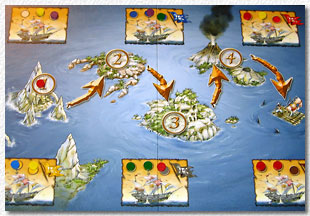
biggest honcho doing this. The game is played in a succession of “areas”, a
couple of board spaces connected by various movement arrows. Each of these areas is
played a maximum of three rounds, but impatient generals can shorten this by prematurely
moving their armies to the respective last space of each area.
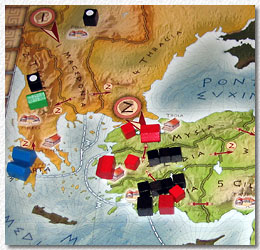
board

At the beginning of each area players secretly place their 15 “resource”
cubes on the 4 spaces of their “planning” board, hidden from the prying eyes of
the other generals. One can place cubes on the “turn order” space, the
“army” space, the “temple” space or the “city” space. After
all players have done their planning, the most decisive phase in the game, they reveal
their choices. Whoever invested most in “turn order” can now move his turn
order pawn to any space (usually coming last is most desirable), the others following in
order of the amount bid. Then the armies placed on the “army” space are brought
in the play (this is the only time that armies enter the game in an area). Each army has
three movement points and can move independently, but the crossing of movement arrows
often demands the expenditure of extra resource cubes that have to be taken from the
cubes placed on “temples” or “cities”. After you have moved your
armies you can “threaten” to build temples or cities in each space (if the
space itself allows it) – if you have at least one army cube there – by placing a tilted
temple or city meeple.
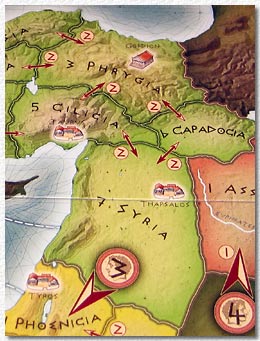
board

After all players have gone through these phases each space is checked in numerical
order. If one player has the majority in army cubes there, s/he gets two points for a
start. Then the generals decide among themselves who will build the city. The player who
invested most cubes in the “city” space will build the city (on rock and roll,
presumably), paying as much as the player with the second most cubes plus one or at least
two cubes if no player competes. A city immediately brings 5 VP as well. The other
players grudgingly destroy their half built city, probably pouting a lot. Temples work
similarly, but they only give 3 VP, while building them costs one less then cities. With
this building and competing a round is finished and players can now use the still unspent
cubes to distribute them again on their temple and city spaces respectively. No new
armies appear in the next rounds though, one has to live with what one brought into the
area at the beginning, which of course favours the player who went for majority VP’s
and brought a lot of his fighting buddies into the area. Also players who spent a lot for
their temples and cities now look on sheepishly as their opponents still have many cubes
to act while they are empty handed.

When the last area is played through, players count majorities in each formerly played
area (who has the most cities or the most temples in each area gets 5 VP) and their total
of built temples and cities (most temples=15 VP, most cities=10 VP). As one can guess the
final scoring can change positions wildly – it is not uncommon to see one player moving
from last place to first place here. Also it is a little strange that majorities of
temples and cities per area are not counted immediately but only at the end of the game,
as these majorities never change until the end of the game, once the hordes of Alexander
have left the lands not a stone is moved there anymore.

Characteristics
Playing the game: up to two hours, depending on the number of players
Explaining the rules: 15 minutes
Brain: a lot, more for geeks than the casual gamer
Historicity: little
Space required: bring a large table
Eye vision: not for the short sighted or badly lit rooms
Colin Farrell does not: bear his naked bum

One of the nice aspects of the game is the “starting afresh” mechanic. When
an area is played through and you messed up totally you can start on absolutely equal
terms in the next area. All used cubes are regenerated, and all players start again with
15 cubes, regardless of how successful they were before.

It is even tactically valid to deliberately fall behind, as player last on the scoring
track are always preferred when deciding turn order, even if they don’t bid
anything.

With freaks the game can become quite tense. As all cube selections are open and there
is absolutely no element of luck involved there can be quite a lot of “calculating
your move”, turn angst or analysis paralysis. Very often things can also get quite
complicated when several prospective temples and cities are in the making and you have to
calculate the losses of your opponents through until you arrive at a “perfect”
move. Therefore this is a “silent” game with relatively little in-game
communication – each one ponders their move and that’s it. But then skill is usually
rewarded, and each area differs slightly from the previous ones in tactics, so players
who play the game without thinking a little longer will usually lose.

The game board graphics are nice (although one has to look at some spaces with a
looking glass when looking for temple or city symbols, and some spaces can also become
very crowded – perhaps several smaller boards would have been better?), the rules are
well laid out and simple, although some concepts could have been explained a bit more in
detail. But all in all this is a solid effort which rewards repeated play and might well
turn out to be one of the many unjustly overlooked games of 2005.
Westpark Hispania Review

Hispania

Hispania is Andreas Steding‘s Britannia-clone. Hispania was issued by Azure
Wish
in 1994. I’m not sure whether Azure Wish is still in business. The
website is is defunct. Hispania is long out of print, but I was able to secure my copy
at Spirit Games. Alas, it
had the rules in an improvable English translation which wasn’t always
unambiguous. So we took careful preparations: Each of us, Loredana, Hans, Markus and I
myself had their own copy of the rules booklet, we all read them beforehand and
discussed issues by e-mail before we finally met to play the extended version.

And extended it was. When Hans and Markus arrived, the board was already completely
set up and we started at once at 10 am. We finally finished with Loredana winning at 10
pm. There were no longer interruptions, no rule discussions, only one short pizza break.
We all felt rather exhausted but happy. I do no longer have the scorings for the game
(perhaps Moritz or Aaron kept note) but they were all between 7 to 10 points.

Interestingly enough, Markus and I, inveterate Britannia players as we are, scored
lower than Hans and Loredana. This is basically my main point in this review. Hispania is
good, yes very good indeed, but Britannia (excuse the pun) rules.

I won’t try to explain the basic mechanics of Britannia-style games. I did this
elsewhere (link), and by the way, every one of
us skips paragraphs which try to explain abstract gaming concepts, don’t we?

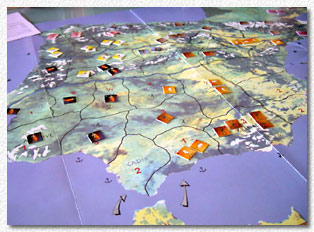
Old Hispania, prior to the Roman Invasion

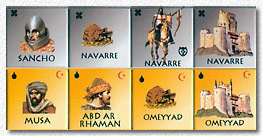
The counters of Hispania are really beautiful, being reproductions of Osprey
Man-at-Arms books. Alas, players in Hispania don’t use color like in Britannia but
symbols instead. Colors are in fact much superior. You can distinguish a red marker from
a blue marker with one glimpse. Distinguishing a tiny symbol in the upper left is much
Hispania counterharder. Then, there are those useful words blue,
red, green, purple to denote the four players in Britannia. In Hispania, there’s
the teardrop player, the player with the four rhombs that form a rhomb, the player
with that gizmo that somewhat resembles that cross on Portuguese Euro coins and
finally the player with the 3D globe. Why couldn’t they chose colors, or at
least cross, triangle, square, teardrop? Even worse: the counters of Omeyyad, most
powerful people of the teardrop player, have erroneously the Portuguese-cross-like
thingy printed on it. This adds more misunderstanding to an already confusing
system. But since we all stayed alert, this whole symbol chaos never turned into a
real problem.

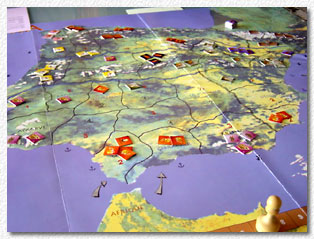
Spain after the Vandals rushed through - note the many vacant areasThe rest
of the gaming material is rather cheap, but it perfectly does the job. One of the
innovations of Hispania is the use of 10 sided dice. They are needed because there
are much more battle modifiers than in Britannia so 1-6 would be too short a scale.
I did not like this additional complexity because it lengthens the game (“Did
you account for knight modifier?” “Err, knight as attacker or
defender?”). I prefer the Britannia approach which totally focuses on the
objectives of each player without too much distraction by too many extra rules.

Hispania has in fact more special rules to consider. It is at the same time fun and
burden to explore them. Like with any Britannia-style game, you always keep thinking
“Next time, I’ll do it totally different”.

I really cannot give a fair estimate whether or not Hispania is fair for all players.
As with every Britannia-style game, players think that the color (err, symbol) that won
in their particular game has certain advantages (in ours, it was Loredana’s
teardrops). Thanks to a long Britannia experience I wouldn’t subscribe to that. Only
lots of replays can show the truth. I am only certain that there is neither a clear favor
nor a handicap for any one color (err, symbol).

There is one thing I really did not like about Hispania. This is that one can
exterminate peoples that are bound to transform into other, mightier peoples, thereby
hamstringing a poor player considerably. Markus and I did this to Hans, and consequently
he finished last.

Markus, a seasoned Britannia veteran. Obviously, he plans his own game, to be set in Scandinavia!

Final verdict: Well, I repeat myself: Hispania is a very good game. If you don’t
know Britannia yet, you better start with that classic because it is easier to play and
slightly better. If you are already a seasoned Britannia veteran, you absolutely should
try to get hold of one of the few Hispania copies still available. You’ll enjoy the
game. And if you don’t insist on playing the extended version like us, you should get
away with perhaps 7 hours gameplay.

Additional clarifications:

  • The rules do not state the dice modifiers clearly. They offer merely dice tables.
    Using them seems rather cumbersome, and so Hans wrote a playing aid with the battle modifiers extracted from
    the tables.

  • By doing this, Hans noticed two errors in the official tables. We asked Andreas
    Steding, and he confirmed Hans’ finding. They are:

    – defending Knight vs. Cavalry in mountain: should be +2; in the tables it’s zero

    – defending Elite vs. Knight in mountain: should be -1; in the tables it’s
    -2.

We had several other questions to Andreas Steding. Some of them might be clear for
someone with the German or French rules, but for other victims of the English translation
let me repeat them all:

  • If you have a +4 counter, you can save — even if you cannot build castles yet, or
    anymore. So, p. 7, “A nation with Knight or Castle units can save up to 8 points of
    income” should be corrected to “A nation with a +4 counter can save…”

  • When the Vandals rush through Spain, enemy “armies” get a free attack. We
    wondered whether “army” includes Roman forts — and yes, it does. Forts can
    cast their die.

  • There is a +1 stacking bonus during invasions (so +2 counters over limit in one
    area). It applies as well to the first as to the second movement of an invasion, not only
    to the first movement.

  • Byzantium has naval supremacy in turn 9 (rule book). The Byzantium card says 9 and
    10, but the 10 is a typo.

  • The Omayyad card says for turn 12 “For each own castle the income value of the
    area as points”. This is hardly understandably. Andreas gave us the German text so
    it’s clear now. Omayyads count victory points at the end of turn (not their turn). In
    every area with castle they get the income value of that area as victory points. They do
    not count victory points for areas with castles of subjected people.

  • When Toledo is sacked, castle areas without infantry surrender. We wondered whether
    this applies only to the very moment of the fall of Toledo or is applies to all later
    combats. Correct is the latter, i.e. the condition is not only checked in the very moment
    of the fall of Toledo, but from then on always when Omayyads are attacking Visigothic
    castles. Andreas also told us that at least one Omayyad unit has to survive to enter the
    castle. So if Visigothic infantry and Omayyad attackers die at the same time, the castle
    doesn’t surrender.

  • Al Cid disappears in turn 19, in the turn of Valence

Hispaniola

Hispaniola

rezensiert von Walter Sorger

Ein stinknormales Stichkartenspiel mit einem absolut unnormalen Wertungssystem. 75
Karten in 5 Farben (rot, grün, gelb, blau, violett) werden gemischt und an die Spieler
ausgeteilt. (bei weniger als 5 Mitspielern sind es entsprechend weniger Karten.) Die
Spieler bestimmen die Trumpffarbe und los geht’s. Jeder Spieler spielt eine Karte
aus, wer nicht bedienen kann, darf trumpfen. Wer die höchste Karte zugegeben hat, bekommt
den Stich. Soweit alles Standard.

Wieviel Stiche man machen kann, hängt natürlich zu 100 % von den zugeteilten Karten,
also rein vom Kartenglück ab. Dazu kommen noch mal 30 % Glück, ob eine Farbe einmal oder
zweimal von allen bedient werden kann. Wiederum reine Zufallsergebnisse. In welcher
Reihenfolge ich meine Karten spiele, und ob ich meine Chancen für die erzielbaren Stiche
optimal auswerte, das kann ich tatsächlich mit etwas Kartenintelligenz beeinflussen.
Vielleicht zu 10 %, höchstenfalls.

Habe ich jetzt insgesamt mehr als 100 % Einflußfaktoren zusammengebracht? Nun ja, dann
habe ich mich irgendwo verrechnet.

Aber wir werden die Stiche gewertet? Gewinnt der, der die meisten Stiche erzielt hat?
Oder derjenige, der die Anzahl seiner Stiche am genauesten vorhergesagt hat? Denkste!
Hier wird es kompliziert. Wer bei Spielende den LETZTEN Stich in einer Farbe gemacht hat,
bekommt dafür satte 5 Punkte. Wer den vorletzten oder drittletzten Stich in einer Farbe
gemacht hat, bekommt dafür nur einen einzigen Punkt. Alle anderen Stiche zählen gar
nicht! Die ersten Pflaumen sind madig!

Aber das ist noch nicht alles. Wer in einer Farbe einen frühen Stich gemacht hat, und
wegen drei nachfolgenden Stichen in der gleichen Farbe aus der Wertung fällt, bekommt
dafür Minuspunkte. Je früher ein Spieler herausgefallen ist, desto mehr Minuspunkte
werden es. Erst wenn man bis zu Minus 4 Punkten stillgehalten hat, kommt die Erlösung und
der Stich geht mit 0 Punkten ins Nirwana ein.

Hispaniola boardUnd jetzt kommt ein Schmankerl (=
Delikatesse). Alle Stiche, die ein Spieler gemacht hat, muß er auf einen einzigen Stapel
zusammengeben. Diesen Stapel darf bis an sein Lebensende behalten, er darf ihn aber auch
jedesmal (oder wann immer er will), nachdem er einen Stich gemacht hat, komplett an
seinen rechten oder linken Nachbarn abgeben. Warum? Wegen der Wertung! Wer bei Spielende
den dicksten Stapel hat, bekommt 4 MINUS Punkte, wer den zweitdicksten hat, bekommt 2
Minuspunkte. Was hat man sich denn dabei gedacht? Kingmakerei und Chaos in einer einzigen
Regel! Ein an sich logisches Stichspiel sollte halt noch ein bißchen unberechenbarer
werden. Oder witziger? Wer weiß!

Um die Stichreihenfolge für die einzelnen Farben besser verwalten zu können, und um
aus dem stinknormalen Stichkartenspiel ein regelrechtes Brettspiel zu machen, wurde ein
riesengroßes Spielbrett erfunden, das man auf dem Tisch aufbreiten kann und in dem die
einzelnen Stichpositionen vermerkt werden können. Mit richtigen Holzpöpeln. Die heißen
Piraten. Und wer jeweils den letzten Stich in einer Farbe gemacht hat, heißt Kapitän.
Schaut ihn Euch an, wie furchtbar er auf dem Schachteldeckel daherkommt. Als hätte er in
seinem Leben noch nie etwas zu Lachen gehabt. Genauso wenig wie wir in unseren
Hispaniola-Runden!

29.12.2004: Mad, Das Kartenspiel, Sicilianos, Hispaniola, Stimmt so!, Hexenhammer, Bluff

Heute wurde wieder ein volles Programm abgewickelt.

1) Mad
Eine Offenbarung aus Peters Jugendzeit im Stile von “Uno”, “Schnuff” oder “Mau-Mau”.

Aaron: 4 (erbarmungslos), Basti: 6 (noch mitten in der Offenbarung), Peter: 7 (nostalgischer Besitzer), Loredana: 5 (keine Nibelungentreue), Walter: 5 (vor 30 Jahren wären es mehr gewesen)
Wenn Peter seinen Jugendtraum noch mal auferstehen lassen will, schreibt er ein paar Zeilen. (Hat er aber nicht versprochen.)

2) Sicilianos
Kartenkampfspiel nach Art der Mafia. Vereinigt eine Menge guter Ideen mit zuviel Würfel- und Karten-Nachzieh-Glück.

Aaron: 5, Basti: 7 (ihm hat der Kartenkampf gefallen), Loredana: 5, Peter: 4, Walter: 5
Ich werde eine Rezension schreiben.

3) Hispaniola
Ein Stichspiel mit sehr wenig Witz.

Aaron: 2, Basti: 3 (hat ein gutes Herz), Peter: 2, Loredana: 2, Walter 3 (Stiche reizen jeden Kartenprofi)
Ich werde eine Rezension schreiben.

4) Stimmt So!
Ein “Tante-Emma-Wirtschaftspiel” aus dem Jahre 1998. (Man wählt aus einer Reihe ausliegender Geldscheine die optimalsten aus und kauft damit die sympathischsten Aktien und verdient damit als Mehrheitsaktionär in 3 zufälligen Wertungsrunden möglichst die meisten Siegpunkte.)

Aaron: 2, Basti: 1 (gnadenlos! Gratuliere: die erste 1!), Loredana: 2, Peter: 4 (Besitzer), Walter 4 (Wirtschaftler)
Vielleicht erbarmt sich Peter zu einer Rezension. Muß ja nicht heute sein.

5) Hexenhammer
Chaotisches Kartenspiel, bei dem jeder gegen jeden Karten zum Angriff und zur Verteidigung ausspielt, um irgendwelche anderen Karten zu verteidigen oder zu erobern.
Kein überzeugendes Spiel. Wir kamen mit den Regeln nicht klar, aber ohne innere Konflikte. In Eintracht und Harmonie haben wir abgebrochen. Von den Rollen (Hexen, Zauberer, Inquisitoren etc.) und von der chaotischen
Interaktion her, wurde vermutet, daß es sich wohl um ein “Moritz-Spiel” handeln müßte.
Hallo Moritz: Wenn Du die Rezension schreibst, kannst Du das Spiel gleich bei mir abholen. Ansonsten mußt Du noch warten, bis mir etwas dazu einfällt.

Aaron: 1, Basti: 2 (junge Leute brauchen immer noch etwas Luft), Loredana: 1, Peter: 1, Walter 2 (man könnte aus der Idee ja vielleicht noch was machen, obwohl für mich ein lockeres Spiel um Hexenprozesse noch peinlicher ist als simple War-Games).
Hallo Moritz: Dein Lieblingsspiel ist von seinem Platz verdrängt worden!

6) BluffÜberdurchschnittlich viele große Einzelverluste, überdurchschnittlich viele Multi-Verluste.

23.12.2004: Große Geschäfte, Boomtown, Bluff

Der letzte Spieltag vor Weihnachten ist in einer 5er Runde mit den Riedlbergers über die Bühne gegangen.

1) Große Geschäfte,
abstraktes, fitzeliges Lege-Spiel, bei dem erzielte Ablegekombinationen als Siegpunkte honoriert werden. Zu Lachen gab es nichts, dafür ist beim Rückdrehen einer ganzen Runde wegen falscher Regelauslegung fast so etwas wie aggressive Stimmung aufgekommen.

Peter: 7 (Sieger), Loredana: 6, Aaron: 5, Günther: 5, Walter 6
Aaron will die Rezension schreiben.

2) Boomtown (Faidutti)
Versteigerungs-, Chaos- und Würfelspiel.
Ein wenig Innovation (und ausgleichende Gerechtigkeit) beim Verteilen des Ersteigerungserlöses gegenläufig zur ersteigerten Zugreihenfolge, ansonsten: Ärgerkarten, Kingmakertum und Würfelzufall zum Bestimmen der Erträge (wie bei Siedler).

Peter: 6 (kein Sieger), Loredana: 7, Aaron: 6, Günther 6, Walter 4 (kein Verlierer).
Peter will die Rezension schreiben.

3) Bluff
Nichts Neues. Nichts Besseres zum Absacken.

Boomtown

Boomtown

reviewed by Peter Riedlberger

Boomtown is a game by Bruno Cathala and Bruno Faidutti. You perceive Faidutti’s
handwriting quite clearly: Boomtown is quick chaotic fun game.

At the start of each turn, as many cards are put openly on the table as there are
players. Then, the right to chose first is auctioned off.

Since this auction is the heart of the game, let me illustrate it with a concrete
example. There are five players A, B, C, D, E. A wins the auction and plays 11 coins. You
don’t pay to the bank, you pay to your right neighbour, in this case E who receives
the 11 coins. But he’s allowed to keep only half rounded up. So he keeps 6 and passes
5 coins to D. D keeps 3 and passes 2 to C. C keeps 1 and hands one to B.

So, the nearer you are to the high bigger in counter-clockwise direction, the
better.

However, only the right to chose first is auctioned off. Second is the player to the
left of the high bidder and so on.

So, the nearer you are to the high bigger in clockwise direction, the better.

Simple: Try to have the high bidder as neighbour. It’s helpful.

Boomtown cards

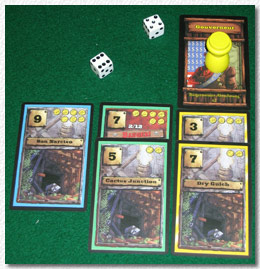
Most of the cards show “mines” with a gold value and a dice score. If this
score is diced at the end of the turn (there’s exactly one roll for all) you receive
the gold value. If you have two mines of the same colour (every mine has a colour, there
are 5 colours in all), you’re mayor. Advantage: Whenever someone else buys a mine of
this colour, he has to pay you the number of cards you own of this colour in gold coins.
If someone ever gets more cards in a colour you lose the mayor status and he’s your
successor.

The mayor mechanism allows for new tactics. Imagine you have 5 green cards and there
are two green cards for auction. Nobody wants them because whoever chooses them has to pay
you 5 coins. So, people will place high bids just to avoid drawing last while there is no
need for you to get engaged since you’ll get your gold anyway.

It wouldn’t be a Faidutti game without chaotic event cards. There are cards for
destroying a single mine, for stealing a single mine, for receiving 10 coins from the
bank, for stealing (announce a player, announce a number of X coins you want to steal,
dice X or more, and you got it).

This game would be bad if it were longer since there is too much chance, too much
kingmaking, too fews ways to interfere. Since it can be played very quickly it works out
if no-one takes it too seriously.

Grosse Geschäfte / Mall World

Grosse
Geschäfte / Mall World

reviewed by Aaron Haag

Remember your last visit to your favourite shopping mall? Plenty of shops, outlets,
and restaurants cleverly located under one roof and aligned in perfect order to persuade
the unsuspecting target groups to spend their money. This is what “Grosse
Geschäfte” claims to be about.

Permission has been granted to build a new shopping mall and you and the other players
are managers deciding about the location of shops in the mall and later in the game to
whom they lease a particular shop. Of course, it’s all about money in “Grosse
Geschäfte” and successful deals will provide a healthy income, appropriately
transferred to your Swiss bank account. Every now and then, a bit of slush money changes
hands in order to ease the signing of contracts or permissions.

Sounds like an interesting business game, doesn’t it? Reading the rulebook
certainly makes you believe this as the concepts described and the elements used are just
what I have described above. But once you’ve come to the end of the rules you’re
most likely pretty puzzled and start reading over again. It is not because the rules are
written poorly; in fact, they are quite good with examples provided whenever necessary,
but you probably didn’t get the idea about the shop contracts, permissions and target
groups. Why is that? Because the game is a very abstract tile placing game with a theme
grafted on top, which neither conveys a certain atmosphere nor does it help understanding
the game principles. I hope the designer, Andrea Meyer, will forgive me that I
describe the game principles here in more abstract terms rather than using the shopping
mall scenario.

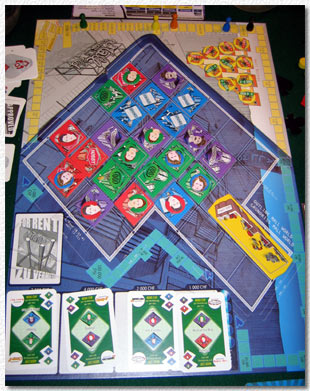
The board setup is semi-variable by placing one or two (depending on the number of
players) blocking tiles together with one tile of each of the four colours randomly on
the board. Tiles come in two versions, rhombus shaped normal tiles and round upgrade
tiles. Further game components are: contracts showing combinations of two tiles,
placement permissions for tiles, bribes for contracts, and slush money for bidding on
placement permissions.

It is the players’ goal to fulfil contracts, which are combinations of tiles on
the board. Fulfilled contracts earn money at the end of a round. Three rounds are played
in total and the player with the largest amount of money wins the game.

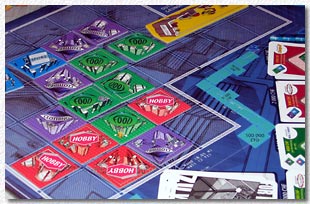
Grosse Geschäfte board

Each round consists of several phases:

  • A player may buy one of the openly available contracts and put it in his hand.
  • Next, the player may either
    • confirm a contract by placing it in front of him and either receiving or paying a
      bribe for doing so (early contract confirmations are sweetened by receiving a
      bribe),
    • or by putting a maximum of three placement permissions up for auction. All
      permissions are auctioned off using slush money rather than money from the Swiss account.
      Tile placement is performed immediately when a permission card is acquired.

  • Now, the player may draw up to two new permission cards provided he has not reached
    his hand limit of eight cards.

  • And finally, any money in the slush fund is distributed evenly between all players
    (rounded down).

A round ends once six or ten (round 3) contracts have been confirmed.

“Grosse Geschäfte” is a game full of player dilemmas. Since contracts are
bought openly, the other players will try to prevent one from completing the contract, at
least they will prevent a multiple completion at several different locations. Next, the
contract cards in the deck are arranged in such a way that early contracts are not using
upgrade tiles while later contracts use them. This forces players to confirm contracts
without upgrades early in the game to rake in money for them because upgrade tiles
invalidate those combinations (by the way, this mechanism is required to force players to
confirm contracts during the first round). Correct timing here is vital for winning the
game.

Grosse Geschäfte board

In any case players are always faced with the dilemma to either confirm a contract or
auction placement permissions, when in fact they would like to do both (which is only
permitted during the final third round).

Chance does not play a big role in the game. The only hidden information is the
“special contract” dealt to each player when the game commences and it is hard
to prevent the other players from correctly deducing your special contract combination (a
combo of two normal tiles plus 2 upgrades) once you are in round two.

“Grosse Geschäfte” plays fast with three or four players and tries to
involve all players most of the time, so downtime is rather low. In the five player
version downtime is of course higher and player control is reduced a little because
rather a lot is happening on the board before your next turn, but you still feel in
control. A minor quibble is the increasing downtime in round three because players can
now calculate the pros and cons of their moves almost exactly. We even experienced a
kingmaker effect during the last turn, as it is possible for a third player to exchange
the position of the two leading players without any harm to his own position.

If you are interested in games that transmit their theme nicely and provide more than
an abstract flair, “Grosse Geschäfte” will not appeal to you. However, if you
like abstract tile laying games (“Einfach genial” comes to mind here) and want
to see some new game mechanics that foster player interaction and provide player dilemmas
this is the game for you.

WPG Rating: 6.0

Hexenhammer

Hexenhammer

rezensiert von Walter Sorger

Ein Kartenspiel für 3 bis 5 Spieler. Es geht darum, die Besitzkarten der Mitspieler
durch Ausspielen von Aktionskarten zu erobern und die entsprechenden Aktionen der Gegner
auf die eigenen Besitzkarten abzuwehren.

Vom Thema her ist das Spiel in den Zeiten der Hexenverfolgungen angesiedelt. Die
Besitzkarten sind einzelne “Dorfbewohner”; sie werden erobert, indem sie
mittels “Hexenverleumdungen” auf den Scheiterhaufen gebracht und verbrannt
werden. Jeder Spieler erhält bei Spielbeginn drei Stück davon. Während er bestrebt ist,
die Bewohner seiner Mitspieler auf dem Scheiterhaufen enden zu lassen, muß er
gleichzeitig versuchen, seine eigenen Bewohner vor diesem Schicksal zu bewahren.
Gesteuert wird das ganze durch zufällig ausgeteilte Aktionskarten, mit denen man einer
beliebigen Person einheizen, d.h. die Temperatur ihres Scheiterhaufens erhöhen oder
erniedrigen kann. Jede Person, die ein bestimmtes Feuer-Niveau erreicht hat, scheidet
aus.

Das Spiel läuft in mehreren Phase ab. In der “Anklagephase” spielt jeder
Spieler reihum jeweils eine Aktionskarte aus (mit Nachziehen) und verleumdet damit
gezielt einzelne Personen der Mitspieler als Hexe. Wenn der Besitzer keine passende
Gegenkarte spielen kann, rückt der Scheiterhaufenpegel der betroffenen Person
entsprechend dem Gewicht der Verleumdung nach oben. Man kann auch Aktionskarten zur
Entlastung der eigenen Personen spielen und den Scheiterhaufenpegel damit nach unten
schieben.

Zusätzlich kann jeder Spieler – außerhalb der Reihenfolge, aber passend zu Situation –
weitere Karten spielen, mit denen einzelne Anklagen verschärft oder gemildert werden. Daß
die Karten dabei “Verleumdung”, “Beweis”, “Ableugnung” oder
“Geständnis” heißen, mag vom thematischen Stimmungsbild her von Bedeutung sein,
im Spieleffekt läuft alles auf das gleiche hinaus: eine Verschiebung auf dem
Scheiterhaufen. Eine multiple stochastische Interaktion ist unvermeidbar, eher sogar
erwünscht.

Die Anklagephase wird beendet, wenn ein Spieler die Inquisition anruft. Wenn kein
Spieler die passende Aktionskarte “Keine Inquisition” dagegensetzt, wird der
Anrufer jetzt zum Inquisitor und die “Einkerkerungsphase” beginnt. Alle Spieler
sind diesmal gleichzeitig am Zug, der wiederum aus dem Ausspielen von Aktionskarten
besteht (diesmal ohne Nachziehen). Die einzelnen Dorfbewohner werden damit genauso wie in
der vorhergegangenen Phase in heißere oder kühlere Regionen ihres Scheiterhaufens
verschoben. Andere Aktionskarten erlauben, eine Anklage auf andere Bewohner umzulenken
oder zusätzliche Unschuldige in den Inquisitionssumpf zu ziehen. Besonders beliebt sind
natürlich Karten wie “Der Ankläger und nicht der Angeklagte erhält die ausgespielten
Anklagepunkte”. Vor allem wenn Du selbst diese Karten in der Hand hältst!

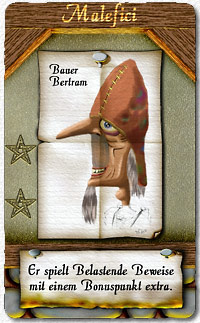
Hexenhammer cardSobald kein Spieler mehr Karten spielen
will, beginnt die dritte Spielphase: der “Glaubensprozeß”. Reihum spielt jeder
eine Karte (diesmal nur ein einzige, ohne Nachziehen) mit der bereits bekannten
Wirkungsweise auf den Scheiterhaufenpegel. Oder er spielt außerhalb der Reihe sogenannte
Probe-Karten: wenn eine angeklagte Hexe die Probe nicht besteht, d.h. wenn der Besitzer
der betroffenen Person keine Gegen-Probekarte in der Hand hält, dann wird die angeklagte
Hexe sofort verbrannt. Ansonsten geht es dem Bewohner auf dem heißesten Scheiterhaufen an
den Kragen. Er wird verbrannt, der Inquisitor erhält die Prämie.

Sogleich kommen wir in die vierte Phase. Nein, diesmal werden keine Karten
ausgespielt, sondern im Gegenteil: Jeder Spieler zieht wieder auf sechs Aktionskarten in
seiner Hand nach. Und schon ist die vierte Phase beendet und die nächste Runde beginnt
wieder von vorne mit einer Anklage.

Das muntere Hexenverbrennen wird solange wiederholt, bis genügend Bewohner auf dem
Scheiterhaufen verendet sind. Dann ist das Spiel aus und der Sieger wird ermittelt. Wer
als Inquisitor die meisten Hexenbrennpunkte, und innerhalb der eigenen Reihen die meisten
Schutzpunkte sammeln konnte, hat das Spiel gewonnen. Dazu braucht man bloß vom Kartengott
zum richtigen Zeitpunkt die richtigen Aktionskarten zugeschustert zu bekommen.

Kann sein, daß ich in dieser Kurzbeschreibung ein paar Details zu den Spielregeln
übersehen habe. Vier eng bedruckte Seiten Script-Schrift mit sehr klaren aber massiv
beeindruckenden Regeln lassen sich nur schwer komprimiert wiedergeben. Mir geht es auch
weniger darum, die Spielregeln wiederzukäuen, sondern eher darum, Spielidee,
Spielprinzipien und charakteristische Abläufe herüberzubringen.

Das Spielmaterial kommt wie bei Rommé in einer Schachtel mit zwei Kartenstapeln daher.
Die Karten sind von Art und Design her sehr vielseitig. “Witzig und originell”
kennzeichnet sie Troudi. Ein paar Namen habe ich oben schon erwähnt. Daß damit im
wesentlichen aber immer nur die gleiche Wirkung ausgelöst wird, nämlich den
Scheiterhaufenpegel rauf und runter zu regulieren, stört nur kleine Geister. Leider bin
ich einer: ich kann diesem überwiegend zufallsgesteuerten Spielmechanismen nicht
besonders viel abgewinnen.

Die Kartengestaltung ist didaktisch gelungen. Farbe und Piktogramm lassen sofort
erkennbar, welche der 78 Aktionskarten in welchen Phasen gespielt werden können. Reihum
oder durcheinander, eine oder viele, nachziehen oder nicht, das steht dann sehr genau in
der Spielanleitung. Wer Ankläger, Angeklagter oder Inquisitor ist und wie sich die Rollen
ändern, kann man auch nachlesen und mit ein bißchen Grips sogar verstehen. Schließlich
wird das Spiel erst für Spieler ab 16 Jahre empfohlen. Und das sicherlich nicht deshalb,
weil einige der bedauernswerten Damen nur mit der eigenen Haut bekleidet in die
peinlichen Verhandlungen geschickt werden.

“In diesem Spiel kannst Du selbst in die Garderoben der ehrenwerten Herren
Inquisitoren schlüpfen.” heißt es in der Spielanleitung. Das ist zwar schwarzer
Humor, aber genau von der Sorte, mit der ich Probleme habe. Mir wäre lieber gewesen, der
Anleitungssatz hätte geheißen: “In diesem Spiel kannst Du die Gefühle unschuldiger
Hexen am eigenen Leibe nachvollziehen. Du kannst Zorn über Denunzianten, Haß über
dogmatischen Aberglauben, Empörung über richterliche Parteilichkeit, Verachtung vor
widersinnigen Wahrheitsproben und Todesangst auf dem Scheiterhaufen miterleben.”
Nach einer solchen Formulierung hätte ich wenigstens ein paar moralische Sympathiepunkte
vergeben können.

Aber nein, Inquisitoren sollen wir sein und mit Vorsatz und Lust und die größte
Schande der christlichen Religionsgeschichte weitertragen und weiterführen. Als
Über-16-jährige oder als Kinder? Kann sein, daß der richtige Spielerkreis seinen Spaß
daran findet. Meine überdurchschnittliche WPG-Note drückt nur die Anerkennung aus, daß
man sich mit einem – zweifellos anspruchsvollen – Thema intensiv auseinandergesetzt hat,
und daß die dargestellten Kartenmotive mit Bild und Text anschauliches Material zum
Hexenwahn unserer christlichen Neuzeit vermitteln.

Destino

Destino

rezensiert von Walter Sorger

Der ältere Bruder von “Hol’s der Geier”: Alle Spieler bekommen den
gleichen Kartensatz mit aufgedruckten Zahlen zwischen 0 und 6. Alle ziehen verdeckt
jeweils eine Karte aus ihrem Stapel und legen sie dann gleichzeitig auf. Jetzt wird das
Ergebnis ausgewertet. Gleiche Karten neutralisieren sich und verfallen. Die Spieler,
deren Karten nicht verfallen sind, müssen auf einem Schicksalsweg (daher wohl der Name
“Destino”) so viele Felder vorwärtsgehen, wie die Zahl auf ihrer Karte angibt.
Wer auf diesem Weg 25 Felder vorwärtsgezogen ist, fällt in ein Schwarzes Loch und
scheidet aus.

Der Spieler, dessen nicht-verfallene Karte die höchsten Zahl aufweist, bekommt
zusätzlich einen Siegpunkt. Wer als erster fünf Siegpunkte auf dem Konto hat, ist Sieger.
(Sofern er nicht in das Schwarze Loch gefallen ist.)

Bereits 1986 hat Spear dieses Spiel von Garrett Donner herausgebracht. Wie damals
üblich, mit einem richtigen, großen Brett und ausgewachsenen Holzpöppeln, die auf dem
Spielbrett tapfer ihrem Schicksal entgegengehen. Das zwei Jahre später erstmals
erschienene “Hol’s der Geier” von Alex Randolph ist dagegen ein reines
Kartenspiel und unterscheidet sich von “Destino” in folgenden Elementen.

Merkmal

Destino

Hol’s der Geier

Auswirkung

Kartenwerte

Liegen zwischen 0 und 6.

Jeder Wert kommt mehrfach vor.

Liegen zwischen 1 und 15.

Jeder Wert kommt genau einmal vor.

Die Wahrscheinlichkeit für das Aufdecken gleicher Zahlen ist bei Destino deutlich
höher.

Siegpunkte

Es gibt immer nur 1 Siegpunkt pro Karte.

Siegpunkte liegen zwischen minus 5 und plus 10.

Dadurch, daß bei Destino immer die gleiche Anzahl von Siegpunkten vergeben wird, gibt
es keine Spekulation auf gute oder schlechte Karten. Man kann weder eine eigene Taktik
entwickeln noch die der Mitspieler versuchen zu erraten.

Schwarzes Loch

Besitzt dieses zusätzliche Spielende-Kriterium.

Besitzt dieses Merkmal nicht.

Diese zusätzliche Möglichkeit zum Ausscheiden ist ein reizvolles positives
Spielelement bei Destino.

Bei beide Spielen handelt es sich um lockere Kartenspiele zum Aufwärmen, Absacken oder
für Zwischendurch. Während “Hol’s der Geier” aber eine ganze Reihe von
taktischen und psychologischen Finessen kennt und hier auch ein gutes Gedächtnis einige
Vorteile mit sich bringt, regiert “Destino” ohne Einschränkungen der blinde
Zufall. Es gibt keinerlei Hinweise, ob die Kontrahenten gerade Ambitionen für hohe oder
für niedrige Karten zeigen könnten. Dubletten lassen sich nicht vermeiden. Taktik gibt es
nicht, höchstenfalls einen Spaßfaktor. Der kann in der richtigen Gesellschaft, vor allem
auch in jüngeren Kreisen, vielleicht sogar erheblich sein.

Wir waren von diesem Zufallsprinzip allerdings nicht ganz so erbaut. Um mir nicht
unnötig den Kopf über die richtige Kartenauswahl zerbrechen zu müssen, und vor allem um
mich nicht hinterher über meine falsche Psychologie ärgern zu müssen, habe ich einfach
meine Karten gemischt und jeweils blind eine Karte aus dem eigenen Kartensatz gezogen.
Augen zu und durch. Überliste den Zufall mit dem Zufall! Stellt Euch vor, ich habe alle
drei Durchgänge gewonnen! Ist das bei “Destino” vielleicht die
Gewinnstrategie?

Günther war enttäuscht, daß man sein Spiel damit kaputt machen kann. Womit er auch
Recht hat. Aber leider ist das in “Destino” eine unvermeidliche, ja
offensichtlich sogar eine erfolgreiche Option.