Archiv der Kategorie: Spieleabende

Metallurgie

Metallurgie

rezensiert von Moritz Eggert

“Im Schein der Kerzen beginnen die Alchimisten ihre Zeremonie….” so
beginnt die Regeleinleitung des neuen Kartenspiels von Maik Hennebach, erschienen im
Argentum Verlag. Und undurchschaubar wie eine alchimistische Zeremonie ist auch erst
einmal das Auslegen der Karten. “Hä?” mag man erst denken, wenn man sich in das
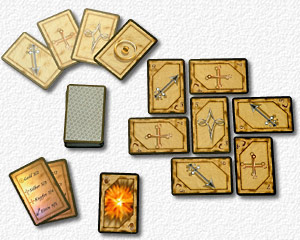
auf den ersten Blick komplexe Auslegesystem der alchemistischen Grundsymbole Eisen,
Kupfer, Silber und Gold, repräsentiert durch längliche Karten, hineindenkt. Die Regel
sagt hier einfach nur “werden nach einem komplexen Muster ausgelegt” nebst
einem Bild, man imitiert also, und so langsam lichten sich die Schleier des Zweifels und
es wird klar, dass das System durchaus funktioniert und Sinn macht.

Das Spiel erinnert ein wenig an eine Art 3D-Tetris -die Karten werden nach einem
bestimmten System entweder nebeneinander oder aufeinander gelegt, ist die richtige Menge
an angrenzenden Karten der selben Sorte beisammen, werden diese als Punkte einkassiert
und ein neues (durch die Auslegeregel aber vorhersehbares) Muster kommt zum Vorschein.
Wer also geschickt plant (so weit dies bei maximal 3 Handkarten auf der Hand möglich
ist), kann gleich mehrere Felder abräumen, wobei man natürlich auch von den Vorgaben der
Mitspieler abhängig ist. Gerade letzteres wurde in unserer Runde ein wenig bemängelt –
eine mögliche Lösung wäre eine Heraufsetzung des Handkartenlimits, oder aber das Spiel
nur zu zweit zu spielen, denn dann ist jeder mehr seines eigenen Glückes Schmied.

Nichtsdestotrotz ist Maik Hennebach mit “Metallurgie” vielleicht das
schlüssigste und beste der neuen Spiele aus dem Argentum Verlag gelungen. Metallurgie cards“Metallurgie” spielt sich flüssig und
unverkrampft, und die Regeln beschränken sich auf ein Minimum. Wer also leicht abstrakte
Kartenspiele mag, wird an diesem Spiel mit schöner Kartengraphik und Sinn für Ästhetik
seine Freude haben. Bis zu 4 Spieler können mitmachen, empfehlenswert ist es besonders
als 2er-Spiel.

Regelerklärung: 5-10 Minuten, je nach “räumlichem Vorstellungsvermögen”.

Popeln

Popeln

rezensiert von Walter Sorger

Ja tatsächlich, der Titel bezieht sich auf eine Tätigkeit im Zusammenhang mit der
menschlichen Nase und schon in Essen auf der “Spiel 2004” drückten Besucher ein
gewisses unappetitliches Befremden aus, wenn sie an Spieltischen vorbeigingen, an denen
dieses Spiel auflag. Auch ich finde den Titel nicht besonders geschmackvoll. Was haltet
Ihr davon, wenn ich jetzt durchwegs das Verb “poppen” dafür verwende? In meiner
Generation hat dieses Wort einen sehr liebenswürdigen, unverfänglichen Klang. Warum also
nicht!

In der Mitte des Spieltisches liegen fünf Nasenkarten. (Behalten wir hier mal den
Namen unseres Geruchsorgans!). Die Karten liegen so weit auseinander, daß an alle vier
Seiten gut angelegt werden kann. An die Ostseite jeder Nasenkarte wird ein
“Popper” vom Popperstapel hingelegt. Das ist eine Wertungskarte mit
Siegpunkten, die es zu erringen gilt.

Jeder Mitspieler besitzt fünf Fingerkarten aus den Typen Nord, Süd und West, die er an
die freien Seiten der Nasenkarte anlegen darf. Nur wenn dort Platz ist, Nebenbuhler
verdrängen gilt nicht. Einen Finger muß jeder Spieler mindestens legen, alle fünf Finger
seiner Hand darf er legen. Danach besitzt jede Nase einen genau definierten
Eroberungswert, der sich aus den angelegten Finger- und Popperkarten berechnet.

Anschließend wird gewürfelt. Wer mit seinem Wurf unter dem Eroberungswert bleibt, darf
den Popper an sich nehmen und zusätzlich einen anliegenden Finger entfernen. Ein neuer
Popper vom Stapel wird an die freie Stelle gelegt, jeder füllt seine Handkarten wieder
auf fünf auf, und schon geht das lustige Poppen weiter.

Es gibt noch ein paar Sonderkarten, mit denen ein Spieler den Eroberungswert der Nase
zu seinen Gunsten beeinflussen kann. Der generelle Spielablauf bleibt davon aber
unberührt:

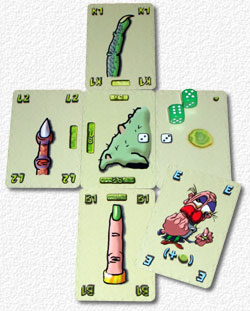
Popeln cards

  1. Laß Dir vom Kartenglück die richtigen Fingerkarten austeilen!
  2. Lege Deine Karten wohlüberlegt an die ein, zwei möglichen freien Plätze an!
  3. Würfele gut!

Das ist doch schon was, oder? Für zwei-ein-halb Punkte aus dem Westpark hat es
gereicht.

Lieber Spiele-Produzent:

  1. Hättet Ihr in die Kartenfarben nicht auch ein bißchen Rot hineinbringen können? Es
    gibt doch manchmal auch Nasenbluten? Damit wäre wenigstens der optische Eindruck – für
    einen Traditionalisten wie mich – schon gleich etwas gefälliger geworden.

  2. Die Südfinger und die Nordfinger lassen sich von Form- und Farbe her nicht gut
    auseinanderhalten. Da hätte der Grafiker etwas mehr Designer-Schmalz hineinpacken dürfen.

  3. Die Größe der Finger ist nicht leicht erkennbar. Ich mußte schon genauer hinschauen,
    um einen Zweier von einem Dreier zu unterscheiden. Ist diese Schwierigkeit eine der
    gewollten Herausforderungen des Spiels?

Kleine formale Verbesserungen, und schon wären drei WPG-Punkte möglich gewesen!

Popeln

Popeln

reviewed by Walter Sorger

Actually, the title (nose picking) refers to an activity in connection with the
human nose and already in Essen at “Spiel 2004” visitors expressed a certain
surprise of bad taste when passing the game tables where this game was played. I, too, do
not find the title of particularly good taste. If you don’t mind I will use the verb
“screw” instead from now on, because in my generation this word has a very
kind, harmless sound. Why not! In the centre of the game table lie five cards with noses
(we’ll stick to the name of our smell organ, here!). The cards lie apart far enough
that an other card can be placed on either of the four of the nose. To the eastern side
of each nose card a “booger” from a draw pile is placed. It shows victory
points, which players try to achieve.

Each player possesses five finger cards from the types north, south and west, which he
may place on the respective sides of the nose card. But only if there is a vacant space,
competitors may not be removed (unless they are of lesser value). Each player must place
at least one finger and can place a maximum of all five fingers during his turn. Once a
nose has been completed it has an exactly defined “conquest value”, calculated
by using the finger and booger cards next to it.

Subsequently, the dice are rolled. If you roll less than the conquest value, you may
take the booger and additionally remove one finger card. A new booger is placed on the
free space, the hand cards are filled up to five, and the screwing continues.

There are a few special cards, which allow a player to affect the conquest value of
the nose to his favour. The general sequence of play remains however unaffected:

Popeln cards

  1. Be lucky and draw good cards!
  2. Place your cards in a well-conceived way on the one or two possible free spaces!
  3. Dice well!

That’s already a lot, or isn’t it? It sure is enough to receive two and a half
points from the Westpark.

Dear game producer:

  1. Couldn’t you have added a little red colour to the cards? There’s sometimes
    nose bleeding, you know? At least the optical impression – for a traditionalist like
    myself – would have been somewhat more pleasing.

  2. The south fingers and the north fingers cannot easily be kept apart neither by form
    nor by colour. Here the artist might have put some more thought into it.

  3. The size of the fingers is not easily recognizable. I had to look at them quite
    closely in order to differentiate a two from a three. Is this an intended challenge of
    the game?

Small formal improvements and three WPG points would have been possible!

Destino

Destino

rezensiert von Walter Sorger

Der ältere Bruder von “Hol’s der Geier”: Alle Spieler bekommen den
gleichen Kartensatz mit aufgedruckten Zahlen zwischen 0 und 6. Alle ziehen verdeckt
jeweils eine Karte aus ihrem Stapel und legen sie dann gleichzeitig auf. Jetzt wird das
Ergebnis ausgewertet. Gleiche Karten neutralisieren sich und verfallen. Die Spieler,
deren Karten nicht verfallen sind, müssen auf einem Schicksalsweg (daher wohl der Name
“Destino”) so viele Felder vorwärtsgehen, wie die Zahl auf ihrer Karte angibt.
Wer auf diesem Weg 25 Felder vorwärtsgezogen ist, fällt in ein Schwarzes Loch und
scheidet aus.

Der Spieler, dessen nicht-verfallene Karte die höchsten Zahl aufweist, bekommt
zusätzlich einen Siegpunkt. Wer als erster fünf Siegpunkte auf dem Konto hat, ist Sieger.
(Sofern er nicht in das Schwarze Loch gefallen ist.)

Bereits 1986 hat Spear dieses Spiel von Garrett Donner herausgebracht. Wie damals
üblich, mit einem richtigen, großen Brett und ausgewachsenen Holzpöppeln, die auf dem
Spielbrett tapfer ihrem Schicksal entgegengehen. Das zwei Jahre später erstmals
erschienene “Hol’s der Geier” von Alex Randolph ist dagegen ein reines
Kartenspiel und unterscheidet sich von “Destino” in folgenden Elementen.

Merkmal

Destino

Hol’s der Geier

Auswirkung

Kartenwerte

Liegen zwischen 0 und 6.

Jeder Wert kommt mehrfach vor.

Liegen zwischen 1 und 15.

Jeder Wert kommt genau einmal vor.

Die Wahrscheinlichkeit für das Aufdecken gleicher Zahlen ist bei Destino deutlich
höher.

Siegpunkte

Es gibt immer nur 1 Siegpunkt pro Karte.

Siegpunkte liegen zwischen minus 5 und plus 10.

Dadurch, daß bei Destino immer die gleiche Anzahl von Siegpunkten vergeben wird, gibt
es keine Spekulation auf gute oder schlechte Karten. Man kann weder eine eigene Taktik
entwickeln noch die der Mitspieler versuchen zu erraten.

Schwarzes Loch

Besitzt dieses zusätzliche Spielende-Kriterium.

Besitzt dieses Merkmal nicht.

Diese zusätzliche Möglichkeit zum Ausscheiden ist ein reizvolles positives
Spielelement bei Destino.

Bei beide Spielen handelt es sich um lockere Kartenspiele zum Aufwärmen, Absacken oder
für Zwischendurch. Während “Hol’s der Geier” aber eine ganze Reihe von
taktischen und psychologischen Finessen kennt und hier auch ein gutes Gedächtnis einige
Vorteile mit sich bringt, regiert “Destino” ohne Einschränkungen der blinde
Zufall. Es gibt keinerlei Hinweise, ob die Kontrahenten gerade Ambitionen für hohe oder
für niedrige Karten zeigen könnten. Dubletten lassen sich nicht vermeiden. Taktik gibt es
nicht, höchstenfalls einen Spaßfaktor. Der kann in der richtigen Gesellschaft, vor allem
auch in jüngeren Kreisen, vielleicht sogar erheblich sein.

Wir waren von diesem Zufallsprinzip allerdings nicht ganz so erbaut. Um mir nicht
unnötig den Kopf über die richtige Kartenauswahl zerbrechen zu müssen, und vor allem um
mich nicht hinterher über meine falsche Psychologie ärgern zu müssen, habe ich einfach
meine Karten gemischt und jeweils blind eine Karte aus dem eigenen Kartensatz gezogen.
Augen zu und durch. Überliste den Zufall mit dem Zufall! Stellt Euch vor, ich habe alle
drei Durchgänge gewonnen! Ist das bei “Destino” vielleicht die
Gewinnstrategie?

Günther war enttäuscht, daß man sein Spiel damit kaputt machen kann. Womit er auch
Recht hat. Aber leider ist das in “Destino” eine unvermeidliche, ja
offensichtlich sogar eine erfolgreiche Option.

Goldbräu

Goldbräu

reviewed by Aaron Haag

If you have ever been to Munich or any other part of southern Bavaria during summer,
you have probably been to a beer garden. These are, sometimes rather large, outside areas
with tables and benches where people can drink and eat. Beer gardens in the past where
often owned by breweries in order to make use of the area atop their cellars which for
the purpose of keeping the cellars cool during the summer had been planted with densely
leafed chestnut trees. Until today, many beer gardens are owned by breweries with tight
bands between leaseholders and the breweries (sometimes with dramatic consequences as in
the case of the “Hundertjähriges Haus” in Munich).

Franz-Benno Delonge adopted the beer garden and brewery relation for his latest game
“Goldbräu”. Players aim to control beer gardens and breweries in order to earn
the most money through selling beer to guests in the beer gardens.

The board shows a total of four breweries and six beer gardens. The beer gardens are
tiny when the game starts but can be extended by its manager later in the game, similar
to the mechanism used in “Löwenherz”. The size of the beer garden is the prime
factor for calculating its income.

During the game setup, each player is dealt six shares, four of which are revealed
immediately and influence tokens placed on the respective brewery and beer garden while
two remain secret in the players’ hand. The concept of hidden influence reminds one
of “Kremlin”. In addition, each player in sequence places two manager pieces on
any not yet occupied brewery or beer garden.

Control of managers is vital in the game as only they give control about the actions
performed by beer gardens and breweries. They can only be placed on the board if no other
player holds a majority of shared in that brewery or beer garden. While it is important
to have sufficient own managers on the board it is equally necessary to have sufficient
influence (shares) in order to prevent other players to take over a manager’s
position. Players secretly and simultaneously select their action for a turn having a
choice of

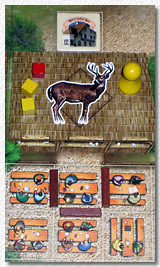
Goldbräu board

  • expanding a beer garden controlled by one of their managers,
  • nominate one of thier managers as the new manager for a beer garden,
  • sign a beer delivery contract between a brewery and a beer garden, both of which must
    be controlled by their managers,

  • buy shares.

However, “Goldbräu” is a game of shortages. In any one turn players can only
perform one of these actions. Therefore, correct timing and balance is an issue in this
game; it is too easy to lose control of a beer garden only because one spent too many
actions on expansion rather than taking care of maintaining influence (i.e. by buying
shares). There’s one more element of timing in the game, which is interesting and
new: a player has a benefit, if he is the only one selecting a particular action. Now he
is allowed to perform the action twice or pays a lower price for shares. This concept
favours anti-cyclical gameplay on the one hand, but to be honest, it introduces also a
large element of luck as it is hardly possible to sufficiently plan ahead to make use of
it.

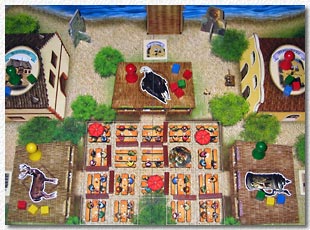
Goldbräu board This is further amplified by the fact that
brewery/beer garden shares are not freely available for purchase. Two shares per turn are
revealed and only one of these or a hidden share drawn from the share pile can be bought
by the players. Since there are only six shares of a kind, it is common that players have
to wait several turn for the right share to become available. Again, it is a matter of
timing here combined with making the best out of the current position. As a consequence
the ownerships on the board can be rather static.

Aword about the “pretty waitress” and the “drunkard”: they are
giving a bonus/malus to the beer garden in question and their main effect is adding chaos
to the game. While their position is known at the beginning of the game, the ability to
change their position is completely determined by luck (i.e. decided by cards in the
share pile), rendering any advanced planning obsolete.

The subtitle of the game reads “The most clever landlord wins”. Well, does
he? Walter mentioned after our first game, that if the shares were freely available and
not drawn from a pile “Goldbräu” would come close to “1830”. This
statement indicates a potential problem with “Goldbräu”: it is very dependent
on the luck of the cards drawn and may not appeal to die-hard gamers and it is too
complex to be a good all-purpose family game. All in all, it is a fast-paced business
game and given the right group of people it will provide 60 minutes of fun.

Westpark Gamers ranking: 6.5

15.12.2004: Popeln, Goldbräu, Metallurgie, Destino

Heute wieder ein Quantum von der in Essen 2004 aufgehalsten Arbeit konsequent abgeleistet.

1) Popeln
Ziemlich belanglos.

Aaron 3, Günther 2, Moritz 3, Walter 2.
Der einzige Spaß kann entstehen, wenn man die Assoziation zum “poppen” herstellt.
Schreibt man letzteres mit einem oder mit zwei “p”?
Sag' jetzt bloß nicht: “Mit drei “p”, einem vor dem “o” und zweien nach dem “o”!”
Ich schreibe eine Kurzkritik.

2) Goldbräu
Ein hübsches flottes Wirtschaftsspiel um Ausbau und Erträge in Biergärten. Wenn die Aktien für Brauereien und Biergärten alle offen gehandelt würden, wäre es fast so etwas wie “1830”. Ja, WENN! Aber auch dann nur “FAST”:

Aaron 6, Günther 7, Moritz 6, Walter 7
Aaron schreibt eine Rezension.

3) Metallugie
Endlich konnte Aaron das zweite Spiel der “Gartenzwerge” auf den Tisch bringen.
Moritz wurde unangefochtener Sieger. Mit einer Strategie, die er uns erst ganz am Ende verraten wollte. Nach seiner Offenbarung konnten wir alle drei nur erwiedern: “Si tacuisses .” (oder so ähnlich).

Aaron: 4, Günther 4, Moritz 7 (klar, er zog ja von Anfang an uns allen davon), Walter 5.
Moritz schreibt die Rezension (oder was immer das Spiel wert ist).

4) Destino
Ein Uraltspiel aus Günther's Speicher. Ein Vorläufer von “Hol's der Geier”, aber mit großem Spielbrett und echten Pöppeln, um die Punkte zu zählen.
Mit einer fast 100% Zufallsstrategie (in 3 Spielen habe ich wirklich nur 2 von etwa 50 Karten NICHT voll-randomisiert gezogen!) wurde ich 3 mal Sieger.

Aaron: 6, Günther 8 (er war ja der stolze Besitzer), Moritz 5, Walter 5.
Ich schreibe eine Kurzkritik.

Quest For The Dragonlords: The Advanced Game Expansion

Quest
For The Dragonlords: The Advanced Game Expansion

reviewed by Moritz Eggert

Two years ago the independent game designer Robert Johannessen from Canada
single-handedly revived the grand epic risk-style wargame-cum-adventure fantasy game
genre (lying dormant since “Battlemist” from Fantasy Flight) with his major
effort “Quest For The Dragon Lords”, a beautifully produced game with lots of
figurines and cards in a sturdy box packed to the rim with goodies. The game found many
friends (including me) and so it was no surprise that last year saw the “Crystals of
Power” expansion, which made 5 and 6 player games possible.

With the “Advanced Game Expansion” Dragonlords gets it’s first
“real” expansion, which adds additional rules to make the game more varied. It
can be used with or without the “Crystals of Power” expansion.

“Dragonlords” is one of the few games that combine “Talisman”
style fantasy adventure with epic battles. It has relatively simple rules and a
reasonably short playing time (for such games), making it possible to play a full game in
an evening. This does not really change with the expansion, but players should be well
familiar with the original game to fully enjoy the new rules.

What does the expansion change?

First of all the battle rules have been changed for the third time (after streamlining
them a little in the “Crystals of Power”) and an all new battleboard is
introduced, which is reminiscent of “Axis&Allies”-type games. The main
reason for the battleboard is to make large battles easier to play and keep track of (it
is actually not necessary to use the board in the many smaller battles the game usually
sees), but it also shines by introducing some new tactical options which spice things up
considerably. These include rules for flanking and a revised magic system.

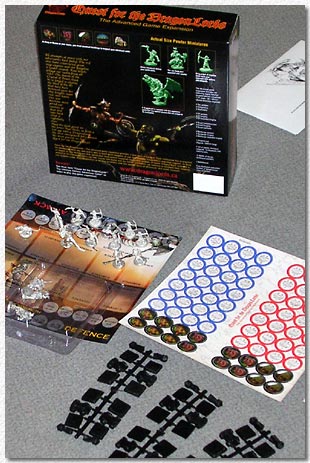
QFTDL Expansion Set

The second major change is the introduction of buildings and a tech tree. As an
alternative to buying the “ordinary” units players can now invest in the
development of more powerful offensive or defensive units and abilities through the
placement of buildings, which gives the game a totally new dynamic. The tech tree is kept
relatively simple to keep it playable, but the options it gives the players will result
in more varying strategies than before. There are also some buildings that only work with
certain races – the formerly weak dwarves especially profit from this as they now can
build mighty cannons with the alchemists lab for example. Wizards can now research and
buy spells at a temple, not necessarily having to travel to the Wastelands as before. The
game comes with beautiful pewter figures to represent the new units, there are also
slightly boring looking counters that one can use in addition. The new units all bring
different advantages, but as so often in games of this type it is the well-mixed army,
which will be most successful.

One can also fortify additional spaces now, which makes the introduction of Siege
rules necessary. The Siege rules actually drive the game forward, as laying siege to a
space can majorly affect the production abilities of your opponent and can even lead to a
quick victory if handled the right way.

All these rules combined make for a deeper but also, as could be expected, slightly
“slower” experience of Dragonlords. QFTDL is still not a deeply strategic game-
part of the fun comes from the all-out chaos reigning on the board, but the expansion set
is a major attempt to give players with good “empire building” skills a certain
edge and a more rewarding gaming experience.

It is especially nice to see that Johannessen and his crew are clearly dedicated to
keep the game alive and interesting. If you talk to him, he is certainly full of
enthusiasm and interesting ideas that he wants to try out to satisfy the fans of the
game. And it is already clear that the development of “Dragonlords” has not
stopped with this effort. This dedication to increasing perfection is certainly a nice
change in a scene, which is increasingly dominated by people trying to make a quick buck
with half-baked designs that soon end up as unfinished torsos. Therefore I can fully
recommend the game to fantasy enthusiasts – don’t expect the game to be perfect, it
still need some tweaks here and there (and Johannessen is working on it), but the sheer
enthusiasm for the project makes it stand out from a lot of mediocrity in the genre.
Compared to the products of the big player game companies QFTDL is still like a slightly
wild grunge band, but it has something that others don’t have – the heart is
definitely in it!

7 Ages

7
Ages

reviewed by Moritz Eggert

I have to admit something from the start: I love this game. It is great. Please buy it
and make Harry Rowland a rich man (or at least help him produce more games). If games
like “History of the World” or “Civilization” have ever piqued your
interest, this game is an absolute must-have. Believe me. You can trust me. Order it….
NOW!

Now come back to the screen or wherever you are reading this and let me explain
why:

“7 Ages” has a bold approach – 6000 years of human history in a nutshell, or
rather, if you dare, in a weekend (although you can shorten the game in many ways, see
below). If you ever wanted to see the Babylonians make it into the 20th century and
develop nukes (possible in the game), if you ever wanted to see many of the historical
great empires rise and fall in a grand all-or-nothing game (possible), if you ever wanted
to build world wonders like the Colossus or the Hanging Gardens (possible), if you ever
wanted to see Native Americans force back a European invasion (possible), this is the
game for you.

The game is about gathering Glory points. Each of the empires you play (and you will
play many different ones, rest assured) has different “goals”. Some want to
dominate a certain continent, some want to be the most technologically advanced, some
want to have the most cities, etc. Achieving the goals gives an empire around 4 glory
points average per turn; if you fall below that number, you might think about dumping an
empire and start a new one.

Players can perform various actions, which are as follows:

  1. Start Empire (if you have a “slot” free – depending on the total number of
    players one can play from 1-7 empires simultaneously)

  2. Production (count the territories and cities you have, earn money, spend money for
    upkeep of your units, buy new units depending on which age you are in)

  3. Trade and Progress (perform a trade action with either the board or another player –
    if you are successful you advance 1-3 spaces on the age track)

  4. Manoeuvre (move your units and fight if necessary)
  5. Destiny (draw new cards)
  6. Civilize (create artefacts, adopt religions or governments for various advantages,
    play mean cards against other players, get leaders, develop your cities)

  7. Discard Empire (obvious)
  8. Wild Card (joker action= any of the above, but with negative effects if you double
    any action that has been played before)

The number of actions seems daunting at first, but with a very simple rule, downtime
is effectively negated: each empire can only perform ONE of these actions! (Harry Rowland
writes in the rules that it took him several years to finally discover this solution to
the problem of endless turns). At the beginning of a turn all players place action chits
(they have one of each the above) on their empires, the phases are then played one at a
time and only the empires who have the action will be active in each phase.
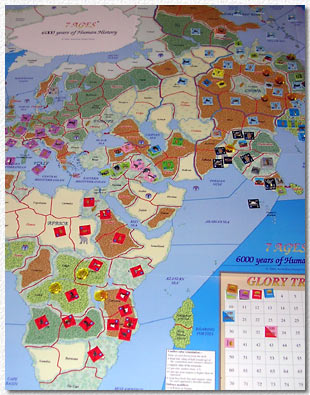
7 Ages boardThis of course creates interesting dilemmas – on the one
hand, you have to guess the actions of your fellow players and play accordingly, on the
other hand, you have to develop your fruitful empires before they disappear from the
centre stage of history. A common combo is to play production in one turn, then to play
manoeuvre in the next. Two production rounds in a row rarely make sense as you have to
always conquer new territory to earn more money than the upkeep for existing troops that
amass in crowded spaces costs you. But spreading yourself thin makes you extremely
vulnerable to attacks, as your defence will be pitiable.

“Civilize” is perhaps the most powerful action…if you have the right
artefact cards to play, and perhaps an evil event card or two to spare. However, to use
it effectively you MUST have played “Destiny” with some other empire, because
cards aren’t automatically drawn, they have to be acquired. “Trade and
Progress” seems boring at first, but many empires need to be advanced to gain glory
points, and also many nifty units only become available in higher ages.

This brings us to the “age track”, which is the heart of the game. Each
empire will have a position on this 7×7 square track, which 1) shows in which age it is
(one of the 7 lines) and 2) which units it can build (certain spaces show units which can
be bought if you are on or beyond this spaces).

There are also “dark ages” spaces which can only be left via a “trade
and progress” action. The game ends, when the final space of the track is reached
(or “Internet” is invented – a very funny idea). This happens more or less
automatically after a while (barring dark ages) as each empire normally gets a “free
progress” at the end of a turn.

The “age track” can also be used to limit game length; one could decide to
just play one age for example.

The empire that is farthest ahead on the track denotes the current “age” of
the game. There are over a hundred cards representing the cultures (they can also be used
as event or artifact cards), but you can only start an empire if it’s age is
“current”. You can even restart an empire (if still possible) that already
appeared.
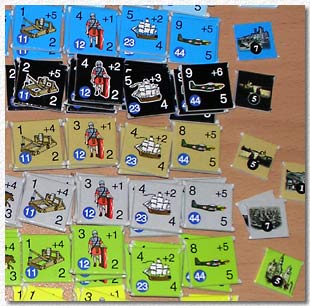
7 Ages countersThe amount of units available in the game is impressive
– any possible military unit you can think of is represented, there are even Elephant and
Star Wars counters that would make Ronny Reagan proud (or ashamed, as he should be). In
addition each playable colour (15 empire “colours” are available) has a
completely different counter mix, even different strengths for various units. Therefore,
you better think twice when selecting a colour for an empire that tries to conquer the
seas (for which you need ships) – some colours have more but weaker ships, some less but
more powerful ships.

The combat system (diceless) looks daunting at first, but turns out to be very
ingenious and logical. Each player divides their troops in a front and back row, adding
support, frontline value, defensive bonuses, bonuses for being in a higher age etc., all
this added to a random card that you can look at BEFORE deploying your troops. If you
burn up your troops quickly at the front you will have to reuse them and gain disorder
markers (which makes you weaker), on the other hand some units are stronger in frontline
value than in support and vice versa. The ancient battles at the beginning of the game
are usually tense affairs, as the card drawn (valued 0-7) really can make a difference.
As technology advances units become more and more powerful and fortifications and cards
(luck) play a much lesser role (which reflects the real evolution of military
technology). There are some cards that mess around with this, but usually you win a
battle that you really commit yourself to with the necessary force, which is nice.
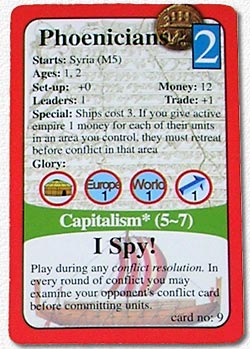
7 Ages cardThe best thing though is that war is not the best way to win
– in fact, there are very few cultures, which profit from all-out conquest like the
Mongols or the Huns (following their real-life counterparts). The vast majority of
cultures profits from other things. In our current game, I play the Phoenicians under the
rule of an able artist. Since starting their empire, the Phoenicians have never left
their homeland, instead concentrating on building artefacts. So far, they have a record
number of eight artefacts in their homespace, gaining double as many points through the
artist present. I actually got many more points through peaceful play than if I had tried
to attack my neighbours!

All out war never pays off in the game – the more you fight the more you lose
opportunities to get glory points. In fact artists (to my great joy the game actually has
counters for personalities like Mozart and Shakespeare) can be deemed the most powerful
point-garnering leaders in the whole game, much more effective than tacticians and
strategists. The most often used tactic is to select an empire that is far away from any
“action” or “conflict” and let it thrive as long as you can, of
course, but sometimes it also makes sense to start empires close to or even IN other
players’ lands to limit their progress.

Conflict is therefore sometimes a necessity (and fun to play), but it is nice to see
that the game is not solely dependent on it (like “History of the World”).
Glory points are forever – once you gain them you don’t lose them, so in effect it is
not important if you are the big boss on the board – gaining glory points in any way
possible is the main incentive.

I already noted that event cards can be very powerful – in fact, this is the only
gripe one could have with the game. Some events are so powerful that they literally can
erase a complete huge empire with the play of one card. In the long run things equal out,
though, as at the moment players oppose a certain empire it is best to give it up anyway,
and by having it destroyed one even saves an otherwise necessary time-consuming action
(“discard empire”). The events have clearly been introduced to create flavour
(of course, there are earthquakes and even the dreaded civil wars which play similar like
in “Civilization”) and to satisfy players who want to have a
“historic” or epic game with no regard to game balance. The rules suggest a
“Mike Siggins” variant in which events can only be played on empires “in
range” (range is determined by the age an empire is in). I would certainly recommend
that variant, but it is also easily possible to leave away the events altogether,
especially if you want to play a shorter game. As I already said, events will equal out
in the long run, but if you only play a couple of rounds, they can be very unfair.

“7 Ages” is not, as many would expect, a complicated game. In fact the rules
are only slightly more complicated than “History of the World”. One can tell
that a lot of streamlining work has gone into the rules – although some concepts need
getting a little used to; the rules only need to be consulted for looking up the various
artefact and leader abilities (a handout would have been handy, but isn’t existent).
They also contain a long fun article covering the whole world history and extensive and
interesting designer notes. There is even a quite beautiful and poignant poem by Harry
Rowland’s father in it, to top things off.

The amount of counters needed for the game is immense. ADG provides six heavily
cluttered countersheets (the graphic design is excellent, by the way), but even then many
counters can only be found on the back of counters that are needed somewhere else, which
makes it hellish to find some particular counter. Some event cards ask for counters that
are not existent (or at least we couldn’t find them). The amount of named leaders and
artefacts is staggering, and if you don’t put them in some kind of order before the
game you might spend a couple of minutes to find Genghis Khan for example.

I recommend using different, out-of-the-game markers for fortresses (we use small
wooden blocks) and unrest (we use the “gem stones” used for Magic the
Gathering-type card games). The huge board (two A1 paper sheets) is cluttered with
counters as it is, so some different looking, easy-to-spot counters are a nice change.
Are all these (minor) gripes damaging the game as it is? Definitely no, you will find
your own solutions, and play it nonetheless.

Don’t be deluded, though: “7 Ages” is not a game for the casual gamer or
for the family gathering. It demands some attention, and especially time. You would need
a weekend to play a full game from age 1 (which is actually not necessary, as any age can
be used to start a game) with 4-5 players. In contrast to some other monster games in
your cabinet this game won’t gather dust. It is a game that you will want to store
somehow and continue playing again and again. Because there is little downtime every
player is constantly involved in the game, and the fascination of seeing empires rise and
fall in a truly epic but totally playable game is payoff enough for me. It is even easily
possible to join a game already in progress, or to leave a game and come back later. The
Internet will be another medium in which this game will thrive – there is already an
experimental cyberboard version around, and the game lends itself easily to an online or
computer version – Harry should recommend it to the excellent Matrix Games who are
already working on computer versions of “Empires in Arms” and “World in
Flames”.

If you have any love for grand historical games (AND call yourself a non-casual gamer)
this game will become a classic for you, to be visited again and again, for countless
hours of pleasure. Don’t wait, do Harry a favour and order a game, I promise you
won’t be disappointed.
06.12.2004: Ys, Medici, Oltre Mare, Fugger, Zoff im Zoo, Kohle, Kies & Knete, Titan-The Arena

Außerdem wurden gestern beim äußerst netten Abend bei “Hans im Glück” von Günther und mir gespielt:

1) YS
Bewertung: Moritz 7, Günther 7, Michael 8, Henning 8
(Günther abgeschlagen hinten (!), Moritz sehr knapper Sieg vor Henning – Super Spiel!

2) Medici (Knizia)
Bewertung: Moritz 7, Günther 8, Dieter 8, Michael 8
(Günther wieder untypisch weit hinten, Sieger Michael knapp vor Moritz)

3) Oltremare
Bewertung: Moritz 7 (etwas abgewertet), Günther —, Michael 7, Dieter 4
(Wieder Michael Sieger, gefolgt von Günther, Moritz vollkommen abgeschlagen auf dem letzten Platz mit einer “Piratenstrategie”: möglichst viele Minuspunkte mit Piraten gesammelt! Das Spiel war zwar nach wie vor gut, seltsamerweise war das Handeln aber im Gegensatz zu uns total öd – es wurden keine Karten verschenkt, und irgendwie kam das Spiel nie richtig in die Gänge, hängt anscheinend doch sehr von den Leuten ab…)

Loredana/Peter haben meines Wissens folgende Spiele gespielt:
“Zoff im Zoo”
“Flaschenteufel”?????
“Kohle, Kies und Knete” (erstaunlicherweise gab es weder eine Schlägerei noch wurde es jemals an dem Tisch laut, so weit ich beurteilen konnte. Das ist fast unheimlich! Am Ende gewann wohl souverän Loredana)
“Titan – The Arena”
Vielleicht kann er ja noch ergänzen
“Hans im Glück” – recommended!
Ergänzung von Peter:

Also, wir spielten
– Fugger (ganz gut)
– Zoff im Zoo (göttlich)
– Kohle, Kies und Knete (wir haben überhaupt nicht gestritten, aber das Spiel ist nicht gut)
– Titan – The Arena
und an mehr kann ich mich nicht mehr erinnern

Black Molly

Black
Molly

reviewed by Aaron Haag

Did you ever enjoy the tranquillity of a tropical fish tank? Well, here’s the game
for you or is it? This game is about murderous Black Mollies and deadly devices and there
all but peace and quiescence in this fish tank.

The game comes in the clear and sturdy plastic box already known from Richard de
Rijk’s “Atta Ants”, published last year. And similar to Atta Ants the game
uses cards to generate a random board layout. This time 6 by 4 cards depict 24 areas of a
tropical fish tank. Some cards (7) show devices like a heater, a catcher, or a pump while
other cards (2) depict anemones. Four cards are the start areas for the four fishes of
each player while two other cards indicate where the Black Mollies start.

The rules are very simple and quickly explained. Beginning with the start player all
may players move their fishes horizontally or vertically by one area card. Fishes may not
end their move on anemone cards or on a device card with an active device. Next, the
device statuses are toggled by rolling a four-sided die. The number rolled changes the
status of the respective device. Now it is checked if the pump is active. If so, the
current moves all fishes in its path one additional area card in the direction of the
current. Then it’s the Black Mollies turn. They love to feed on young fish and the
start player must move them one area card towards the card with the least number of
fish.

Finally, the devastation results of the devices and the hungry Black Mollies are
determined: all fishes on cards with active devices or Black Mollies are taken out of the
game. If there are only fishes of one player left, that player wins the game, otherwise
the start player changes and the next round begins.

If you know Atta Ants and always liked to have an increased level of suspense by
adding more spiders, Black Molly can satisfy your needs. With more than half of the area
cards being more or less off limits for your fish there’s hardly a turn where not
some or even all of your fish are at risk. Black Molly boardMany times you cannot avoid to move fishes onto a
(turned off) device card in order to escape from the approaching Black Mollies, only to
find exactly this device being turned on by an unlucky die roll later in the round.
Similar to Atta Ants it is important to take into account the player sequence and the
position of the start player who is in control of the Black Molly if they have a choice
of the route the travel.

The rules state that the game lasts between 5 and 30 minutes, which is confirmed by
the games we played. Expect rather short playing times with only two players and longer
ones with four. The downtime of players already out of the game is not too high as often
the game ends with a sudden death of a larger group of fish.

Sooner or later some group of fish will be trapped between the Black Mollies and the
devices and eventually perish. Players may find it necessary to distract the Black
Mollies with a single fish but this is a rather risky venture. Many times, it is
successful but also means the certain death of the lonely distracter fish.

Black Molly is a non-complex short game with not a lot of tactics to apply and with
just about the right amount of luck by die rolling. I can recommend it as a game for
families and not so die-hard gamers, if the subject of fishes being eaten, fried by a
heater or hacked to death by a pump is not felt to be too inappropriate.

Westpark Gamers ranking: 4.75