Westpark Gamers

Influential game companies of the past Part 8: Games Workshop

Transcript of the podcast published on November 1st, 2010.

This time I want to talk about another company that existed some time ago but which has left its mark on the gaming scene, and this company is called “Games Workshop”.
“What?” you may ask, “Games Workshop? But they are alive and kicking and very much in the business? What is this, some evil mockery”?
But I am not talking about THAT Games Workshop, that multimillion dollar company that sells crack in the form of miniatures to masses of teenage boys and men, about Warhammer or Warhammer 40000, game systems that have mainly been designed to make people follow the cult of GW, as they are mostly called nowadays.
No, I am talking about the ORIGINAL Games Workshop, a company founded by genre luminaries Steve Jackson, Ian Livingstone (they were later famous for their Fighting Fantasy solitaire game books) and John Peake, originally as a manufacturer of wooden boardgames in 1975, but then quickly becoming the main importer of that game called D&D and spearhead of the British gaming scene.
In order to promote their postal games, the London shop that was called “Games Workshop” printed a magazine called Owl and Weasel, which later became “White Dwarf”, perhaps the most important European roleplaying magazine ever, a fantastic magazine that used to be full of scenarios for all kinds of roleplaying games, along with fantastic art and comics, and which now also has become a Warhammer only magazine about how to paint miniatures. But in the days back then every roleplaying fan used to anxiously await the new issues of “White Dwarf”, because it was simply the best magazine out there, even more beloved than the “Dragon”, TSR’s own house magazine. There was actually a time when Gary Gygax proposed a merger between TSR and Games Workshop to prevent this competition, but even then Games Workshop proved to have a lot of business sense and declined. By now they had expanded all over Britain, with shops opening practically everywhere.
But I am not talking about Games Workshop the role playing and miniature gaming entity, but about the relatively short period of time in which they produced great board games.
The most famous of these is most certainly “Talisman”, a game hated by Tom Vasel but beloved by many, as it was the first successful attempt to transfer a role playing experience into a boardgame, along with the possibility to add endless expansions with new adventure cards and boards.
But there were also other influential games, next to the reprints of games like “Cosmic Encounter” that Games Workshop also had in their line.
For example “Blood Royale”, a now highly sought after game by Derek Carver about medieval power politics that enabled players to actually marry off their princesses and princes while fighting wars with neighbouring fiefdoms. Or “Fury of Dracula”, the game of vampire hunting and a variant of Ravensburger’s Spiel des Jahres’ “Scotland Yard” (a fact that is often forgotten) which for a long time was one of the most expensive out-of-print games one could buy because of it’s legendary fame and a relatively low print run.
“Warrior Knights”, another medieval wargame. Or how about “Dungeonquest”, the first international edition of the Swedish cult game “Drakborgen” which became very successful in the Games Workshop version and thus created more expansions than the original Swedish version.
Or “Battlecars”, a generally underrated game that transported players into the world of Mad Max style automotive combat, a game that was famous for its big car displays that were literally slowly shot to pieces by using damage counters showing the piercing of the various armours of a car. This was also followed up by an expansion, “Battlebikes”, a very rare item to find nowadays.
Or “Dr. Who – The Boardgame”, the first “serious” boardgame in the Doctor Who universe, in itself related to Talisman from some of its mechanics. Or the ingenious “Rogue Trooper”, a game based on a series in Britain’s number one selling anthology comic, “2000 AD”.
Or “Warlock”, a card game of duelling wizards which most certainly was an inspiration for the biggest success story in gaming ever, “Magic The Gathering”. Or “Curse of the Mummy’s Tomb”, a game mostly known for its actual cardboard depiction of a pyramid that players could explore Indiana Jones style. Or “Apocalypse”, a Diplomacy variant set in an apocalyptic future.
As you can tell many of these games are still known well today, which has to do with the fact that one excellent company called Fantasy Flight games is publishing them in new and very often improved editions today. This in itself was no simple task. The Games Workshop juggernaut more and more concentrated on their miniatures brand that made the most business, and the GW of today has little to do with the friendly hobby orientated beginnings, and it also has different owners now. GW is feared for being very protective of the game rights they own, even if they don’t plan to ever publish these games again. This went so far as forcing Boardgamegeek contributors to remove all fan-created files for their games to protect their copyright, a stupid move if there ever was one. But somehow Fantasy Flight managed to convince some folks at GW to let them republish their most beloved titles, and as far as I can tell they have a very good success with it. This is also good for the games themselves which usually had quite flimsy production values when they originally came out. So we have to thank Fantasy Flight that one of the most important fantasy game companies of the past is still with us, at least in spirit. And perhaps the current Games Workshop will at some point change back into the friendly Games Workshop of the days of yonder. Let’s hope that!
Influential Game Companies of the Past Part 7: Yacquinto

Transcript of the podcast published on October 15th, 2010.

As one of the more unusual and quirky game companies, Yaquinto was always its own beast.  It existed only for short 4 years and was founded at a time when wargaming was already on its way out in mass popularity, 1979. But in these 4 short years they managed to become quite a voice in the gaming scene, publishing games of an unusual variety.

The name Yaquinto sounds like a Japanese battle cruiser, but it is derived from the Robert Yaquinto Printing Company of Dallas, Texas, which decided to use its printing resources to power up a game company. For this they hired two well-known wargame designers, Steve Peek and Craig Taylor, who were responsible to create an interesting line-up that would eventually include wargames but also family games, role playing games and SF and Fantasy Games as well as light historical games.

Yaquinto is remembered for their invention of the Album Game format. These came in 2 versions, used at different times in the life of the company:

  • The slim album games used a record sleeve for a vinyl record double LP as the game box. The record sleeve folded out to create the game board, counters and rules were stored in the 2 pockets. This made for extremely slim storage, but usually the many game counters inside the sleeves formed little bulges that eventually began to destroy and bend the cardboard covers. Ironically many of these games actually had a sign “This is not a record” on them, so that people would not accidentally think they would buy a music record!
  • There were also thicker versions of these album game boxes that had something like a paper counter tray insert in between the two sides. This prevented the problem of the bulging counters, but the insert was so flimsy that it was easily crushed if you stored the games on top of each other. If you stored the games in the upright position though the contents of the insert tended to fall out and get lost easily.

Even though the album games looked cool on first glance, the were something of a  drag to use, but they were still MUCH better than the normal oblong boxes used for their larger games – .these were so flimsy that actually already looking at them made them bend. It is extremely hard to find good condition Yaquinto games nowadays and still harder to find some of their best and sought-after games.

It is absolutely impossible to list every Yaquinto game here, so I will name only a few that I know well:

“Swashbuckler” is a still legendary game that simulates Errol Flynn style tavern or pirate combat, using written hidden commands. This is one of the funniest games I’ve ever played; you can confuse opponents by hurling insults at them or waving your hat in their face. It is absolutely stunning to play this game with 6 or more players; the influence on Robo Rally is clearly visible. There was also a science fiction version called “Adventurer” which is less known.

“Mythology” is the best game ever created on Greek mythology. Players have heroes roam the land to fulfil tasks – the players secretly influence these heroes representing the Greek gods by assigning influence points. The game has many rules problems, but these can be solved to create a highly unusual game.

“Hero” was a very successful attempt to create a 3 player dungeon skirmish game. Player A sends his hero into a dungeon controlled by player B, player B sends his hero into a dungeon controlled by player C and player C sends his hero into player A’s dungeon. Lots of hilarity ensues with hidden movement of monsters and even traps. Players design characters like in a role playing game, one important trait was looks, as if you were too ugly the princess you tried to rescue in the game would ignore you.

“Attack of the Mutants” is a very much “Plan 9 from Outer Space” like game, where you defend an underground basis against the attacks of Zombie-Mutants.

“Beastmaster” was Yaquinto’s partly failed attempt to create some kind of “Super-Titan”-variant, but still remains one of the more interesting fantasy battle games out there.

“Apache” was a Western game where players could have Cowboys and Indians fight it out. The game was notorious for its random events table which also featured a landing of aliens in the prairie.

“Dallas” was a roleplaying-lite boardgame featuring the famous J.R. and his consorts.

“Market Madness” was a crazy luck-driven stock market game. Just like real life, then!

“Ironclads” was the still legendary game about battleships in the American Civil War, popular until today.

“Starfall” was an ambitious Science Fiction exploration game for 1-4 players, where the universe was randomly created by a set of sophisticated rules.

“Time War” was the spiritual predecessor of “Time Agent”, a fantastic Time Travel game with many unusual ideas.

“The Roaring 20’s” had players create speakeasies and flee from the police.

“Ultimatum” tackled the most difficult of subjects: Nuclear War.

As you can see the line-up of Yaquinto was weird and very varied, but that is exactly why their games still are remembered until today. Graphic design was not always their biggest strength, but their hard-duty, extra thick cardboard counters were always a joy to handle, even if they were very hard to unpunch.

The games mentioned above are all recommended by me, some of them highly, like “Swashbuckler” or “Mythology”. One can do worse with collector games than with Yaquinto, a company that folded after the computer game market began to take over in 1983. We should remember them fondly – they don’t make them like this anymore!

Influential Game Companies of the Past Part 6: TimJim/Prism Games

Transcript of the podcast published on September 30th, 2010.

TimJim/Prism Games – both names work – was always a small company and never a big player on the market, but in their short life – they closed down business 1998 – they managed to put out a small but extremely influential portfolio of pretty outstanding games. In fact they could be called one of the few game companies which never published a game that sucked.

TimJim Games came out of Prism Games, a small company started by James Hlavaty and Tom Lehmann. The first game published by this company was “Outpost”, a game that nowadays has a nearly legendary fame for being one of the first boardgames to translate computer game concepts of science fiction empire building games into a tight and simple design that is still appreciated today and which has even been updated as a fantasy game as “Das Zepter von Zavandor”. Next came “Mystic War”, a fantasy card game that probably would have been a big success had it had glossy cards and beautiful graphics. This was also the year that Tom Lehmann began his design career. Tom should be known to current gamers as the inventor of the widely appreciated “Race for the Galaxy” game, but he has designed games for much longer, having been active as a designer since 1992. Tom has played games all his life, role playing games and 18xx games being his specialty, and is also an avid dancer and choreographer of group dances in his spare time. Logically the company should have now been called TomJim Games, but I am glad they decided against it.

Next came “Fast Food Franchise” by Tom Lehmann, which has the honour of being the only Monopoly variant that I would ever sit down to play, by giving the player’s many more choices during their turn while keeping the fun of estate or rather burger franchise dealing alive.

“Suzerain” was Tom’s attempt at a card game, a game simulating medieval wars of succession to great effect.

The same year saw the release of their magnum opus in my opinion – the super excellent and totally underrated “Time Agent”, the best time travel wargame ever invented in my opinion, a fascinating and intelligent design in which several races try to manipulate time to their advantage. A Wargame with some connections to 1830, as the time web is simulated by hexagonal tiles interacting in complex ways. Actually playing a game of “Time Agent” is like looking at a picture by Dutch artist M.C. Escher, which makes sense, as time travel should make your head spin.

“Age of Exploration” came 2 years later, another solo Lehmann design – this being an interesting and super realistic simulation of the exploration of the two American continents, so realistic that one usually ended up being killed by natives or lost at sea. It’s similar to “Source of the Nile” in style, being more of an educational than a gamers’ game, but still very good.

1995 saw another mutual effort by Tom and Jim, “2038”, perhaps the most involved 18xx variant of them all where players try to mine asteroid fields instead of building a network of rails only. The game is considered one of the best 18xx variants out there and is a sought-after collector’s item.

After a two year delay the last game of TimJim Games was published: “Throneworld”; an ambitious Science Fiction Game design, which can be considered an update of classic games like “Stellar Conquest”. Again an outstanding and good design.

Prism games used the Avalon Hill established bookcase format for their games, which made them handy to store and relatively durable. The graphic design was usually perfunctory but professional, their rules tightly printed and sometimes difficult to work out, while never being illogical or confusing. Just think of your first game of “Race for the Galaxy” when you tried to work out the iconography and you will know what I mean.

Why did they go out of business? I couldn’t find any information of that, but from their line-up one can tell that they tried to cater for the specialist gamers’ market at a time where Boardgamegeek wasn’t yet the force it is now, and before models like GMT’s P500 made small-audience games with good production values feasible. Some of their games could have actually crossed to a bigger market had they had a bit of more glossy production values.

But still, for me the great value of TimJim Games is the high quality of each of their games – one can always tell that a lot of work went into each of their designs, and they strove hard to present them in the most professional way they could achieve at the time. Every game collector worth his salt is bound to have a few of their games in his possession, and they will be treasured for a long time to come.

Moritz over and out.

Influential Game Companies of the Past, Part 5: Hexagames

Transcript of the podcast published on July 16th, 2010.

This time I am going to talk about a German game company that few of you will know, but which was extremely influential in the rise of the Euro Game phenomenon in Germany. The company was called… Hexagames.
For 10 years, 1982 to 1992 – which seems to be the lifespan of many game companies – Hexagames was an independent voice of quality in the German gaming scene.
It was founded by L. Hensley to promote his stock market game “Long Short”. I say L. Hensley because nowhere on the web could I find his first name, not even on Boardgamegeek.
There is actually an interesting story behind this game: L. Hensley was not a gamer but a business man who did something that today would probably be called “Day Trading”, meaning that he bought the rights to buy and sell shares only to wait until the shares had fallen before actually buying them, then selling them for the old price making a profit.
This activity – which regularly brings on financial breakdowns until today – was regarded as highly dubious in Frankfurt at the time, so L. Hensley actually went to prison in Frankfurt. There he had 7 months and 1 day of leisure time which he used to create this stock market trading game. Hagedorn met him and became his business partner after his release from prison. The resulting publicity about the “stock market game that was invented in prison” fired up the company that was Hexagames. It was Hagedorn’s idea to create a special hexagonal game board that could be looked at from each side and give the same information to everybody, because he was annoyed with the usual boards where some players always have to read everything upside down. As he used the hexagonal board design for several games in a row it gave the early games of the company a distinctive look and the name Hexagames was born and quickly became a trademark.
At it’s time “Long Short” was regarded as something of a hit, and if one believes the comments at the Geek it still can be regarded as a business game of high quality, simulating the turns and tides of the stock market quite well. Together with Juergen Hagedorn Hensley wanted Hexagames to publish further new games, but quickly they found themselves as the inheritors of the Buetehorn games line instead, a company that went bankrupt roughly the year Hexagames started business. Buetehorn had several beautifully produced games in its line, most notably the strategy game “Conquest” which still exists in one form or another until today. Buetehorn games had a specific box design – a sturdy cardboard box that opened and closed with a button that was also used by many of Hexagames’ games.
Hexagames was quickly recognized for their design quality. First was “Uisge” by Roland Siegers, which garnered the special “beautiful game” or “Schoenes Spiel” prize at the Spiel des Jahres 1984. Already their next big game, the fabulous “Abilene”, also by Roland Siegers, made it on the selection list of the same prize a year later.
I still have a special place in my heart for “Abilene” – it was an unusual design for the time: a fun Western game that was specifically designed to be only played by 3 players, something that is still a rarity and difficult to pull off. Sadly it fell under the curse of the Western game genre – always a difficult sell in Germany – and is now mostly forgotten. But I can only recommend it to anybody interested in unusual games.
Also in later years Hexagames always was a contender for the Spiel des Jahres, but it unfortunately never won the coveted prize. But the company attracted top game designers like Sid Sackson (who did “Die 1. Million” for them) and especially the young Reiner Knizia, who did one of his first and some may argue still best card game design for them, “Res Publica”, a very good civilization light card game that is in print until today.
Like many game companies Hexagames also specialized in bringing interesting games over the pond. They were the first German company to produce a German version of “Cosmic Encounter” for example, still a rarity among collectors. “Cosmic Encounter” had attracted them because of their similar use of a hexagonal game board, so it was a perfect fit to them. Alan Moon did “Black Spy”, a game that was also published by Avalon Hill.
Other games in their very varied line were for example:
“Choice” – an interesting dice game by Sid Sackson which can be seen as an influential multiplayer solitaire dice game, later known as “Einstein”:
“Gimel” – a 2 player abstract game influenced by Egyptian designs.
“Indiana Jones And The Temple Of Doom” – an unsuccessful movie tie-in attempt.
“Karriere-Poker” – a wonderful card game that later became “The Great Dalmuti” and which can be seen as the direct predecessor of the wonderful “Zoff im Zoo”, sharing some of its mechanics.
One of the most legendary games ever produced by Hexagames must certainly be “McMulti” by James St. Laurent, though, a game that still is held in high regard in German gaming circles. This is an economic game that has some design similarities to the much later “Settlers of Catan” and which has been published in the US under the name “Crude: The Oil Game”.
Another notable Hexagames game is “Showbiz” by Derek Carver, a game that bears a not too slight resemblance to “Modern Art” in a way and which has players manage stars with varying success levels.
Many of Hexagames’ games may seem as if they haven’t aged that well, but in their time they were highly influential. One impressive aspect of Hexagames output was a great variety of games with a preference for simple and non-convoluted designs paired with good production values.
The end of Hexagames was a prolonged one. First Hagedorn left the company and was replaced by Joe Nikisch who later founded “Abacus-Games”, a company that is still going strong today. Hexagames was dissolved in 1992, but was taken over by the Berlin company “Sala Games” which published the best of Hexagames under their brand name. But also Salagames went down, only 2 years later, in 1994.
Today Hexagames’ games are sought-after collector’s item – their legacy is not forgotten and they have shaped many designers that still are successful today.
Moritz Eggert

Influential Game Companies of the Past, Part 4: International Team

Transcript of the podcast published on July 16th, 2010.

After looking at some of the most important game companies of the US let’s move over the big pond to small and crowded Europe, and to a country that was nearly lost to gamers at that particular time in the past: Italy. That is until International Team came along.
In the year 1979 Renzo Angelosanto and Marco Donadoni decided to bring the joys of wargaming to the land of wine, good food and opera. They founded the company “International Team” which for nearly 10 years was an important presence in the European market.
At that time Wargaming was an extremely obscure hobby in Italy, even more obscure than in other European countries because of a huge language problem – as every American Tourist can attest Italy is not exactly a country with many English speakers, so it was no surprise that only a select few in Italy could actually understand English-language games.
Instead of translating titles from the US International Team decided to create their own line of mostly conflict orientated games, and from this decision resulted a line of the most beautiful, interesting and also frustratingly irritating games ever made in the history of mankind.
International Team’s games were always extremely pretty – they were published in huge and flat oblong boxes, difficult to store and easy to open while emptying all their contents on the floor. But pretty. Also the graphic design was always ahead of it’s time, featuring stylish illustrations which especially came to life in the many Science Fiction and Fantasy games that they published, like the game “Zargo’s Lords” which must count as the most successful game of their line. Boards were gigantic and always mounted – so from a sheer production viewpoint their games were superior to all other games published at the time.
But there was one big problem: The Rules.
Early on International Team decided to address an international market, hence their name, so rules sets usually came in Italian, English, French and German. So far so good, but sadly there never was any person in the whole company who actually ever checked the translations. This resulted in the most bizarre rulebooks ever published – the Italian rules were usually decent albeit imperfect, but all other languages sounded worse than even the worst on the spot babelfish translation you can get from the internet.
International Team’s most ambitious effort, the actually fabulous Science-Fiction-Roleplaying/Boardgame Hybrid “Legio VII”, was so lost in translation, that whole parts of the game became absolutely unplayable to anybody not speaking Italian. I would like to convey you the bizarreness of some German sentences in this rulebook, but I fear you would lose too much sanity if I tried.
But that was not the only problem – many games that International Team published were only vaguely tested, so sometimes they would simply break down once you tried to play them. Important rules concepts were not thought through, the rules would contradict themselves even in Italian, etc. This has been an ongoing problem with wargaming rules and certainly something that plagues games by SPI and Avalon Hill, but International Team brought the negligence in rules design to a never before achieved height.
The frustrating thing was that International Team’s games were actually no duds at all – they very often were full of beautiful ideas and interesting concepts, but trying to decipher what the game designers actually meant sometimes was a huge task.
Still, International Team enjoyed some success to the extent that their games are still sought after by collectors and they were very influential on the budding European games market and prepared the soil for later great designers to come from the country of Italy, like Nexus. But it was a venture that couldn’t last forever because of these problems, so in 1988 they declared bankruptcy and both founders moved on to other projects, still being influential in gaming circles. The most important lesson was perhaps learned by companies like Fantasy Flight – if you make your games beautiful people will most certainly look, but try to make them worthwhile as well.

Influential Game Companies of the Past, Part 3: SPI

Transcript of the podcast published on June 2nd, 2010.

SPI, or Simulations Publications Incorporated, was to Avalon Hill what Marvel was and is to DC Comics: the former new kid on the block, which then went on to become a bit louder, a bit more in your face, a bit more bang for your bucks than its competitor.
For ca. 15 years the rivalry between SPI and Avalon Hill was something that incredibly enriched the wargame hobby, because both companies had their unique strengths and weaknesses, and competition meant that both their games became better and better.
SPI started small – founder Jim Dunnigan took over small wargame magazine Strategy and Tactics (S&T) and quickly realized that wargaming was a new and exciting hobby that was quickly growing.
He began to pursue the policy of publishing one complete wargame in each magazine of S&T. These were simple affairs consisting of a game map, a counter sheet and rules while the rest of the magazine was devoted to military and strategic articles. Another magazine, „Moves“, quickly followed, in which there was more talk about the design of games.
The first SPI game of note was most certainly the now famous „Napoleon at Waterloo“, a simple introductory wargame that could be taught to anyone in minutes, but which proved to be almost chess-like in its myriads of applicable strategies. In an early and wildly successful marketing coup this little game was actually distributed for free to attract new gamers to the hobby. It proved incredibly popular, and the game is played even today, belonging to the most-played wargames ever. Hey, even Tom Vasel would play it, as a typical game only lasts an hour!
The early SPI output of games basically went through three phases. In long questionnaires usually published in „Moves“ or „S&T“ gamers where asked in detail what kind of design they would like to see and what themes would interest them. According to this data games were created, usually with one general rules set that could be adapted to several scenarios of a given period. Single games were then often published either in S&T or in flimsy plastic trays that had a shelf life of a few months before falling apart. Wargamers will immediately recognize the early SPI games, with the plastic trays usually brown with age, but they will also have fond memories of the games themselves. Later they went on to produce cardboard boxes, but even these were incredibly flimsy.
It was also popular to combine games into quadrilogies, different games using the same rules-set. Most famous is probably the quad-game „Napoleon’s Last Battles“ by Kevin Zucker, which broke up the famous Waterloo battle into 4 single battles that could be combined into one large monster game if wished for. All of SPI’s Napoleonic period games had common features for example, so that it was easy for anybody that had played one of them to play other games of the series practically out of the box.
Monster games in particular quickly became a staple of SPI – most infamous is probably „Campaigns for North Africa“, a game so overblown, detailed and complicated that it even contained a rule for the influence of spaghetti cooking on the water supply of Italian troops in North Africa in WWII. The game had been developed for years but never been playtested in full because it took so darn long to actually play it; it therefore must count as the only game in existence that has never actually been fully played from beginning to end.
But other monster games like „War in the East“ proved more playable and SPI quickly gained a reputation for producing hugely thematic and long games with actually not too unwieldy rules. For a while they ruled supreme and were hugely influential, especially because of their trademark graphic design that was pioneered by the wonderful Redmond A. Simonson and which still fascinates because of its relative simplicity and clarity compared to the often garish and overproduced art of today.
Like Avalon Hill SPI quickly branched out into other markets – they quickly adapted the fantasy fad and produced innovative games with Tolkien themes, but also excellent Science Fiction Games like the highly interesting „Freedom in the Galaxy“. This was also the time when they began producing the fantastic game magazine „Ares“ which had only fantasy and SF themed games and must still count as the most interesting magazine-with-game-included publication ever done, containing also short stories by highly renowned SF and fantasy authors.
SPI’s own fantasy roleplaying game „DragonQuest“ was actually more successful than Avalon Hill’s roleplaying attempts for a while, but SPI also landed a huge flop with the „Dallas“ the TV series roleplaying game, for which they had paid a lot in royalties.
For 13 years SPI was the industry’s work-horse, producing an incredible number of games in a short space of time. But exactly this overstretching also produced its downfall – earlier than Avalon Hill SPI went bankrupt and was taken over by TSR, the roleplaying company that became a giant through Dungeons and Dragons. But TSR was already also not in their prime anymore, and the SPI games by TSR where shoddier and less playtested than their predecessors. In addition the new management alienated many of the former game designers working for SPI, who then went on to work for their biggest former rival, Avalon Hill, by creating their new game line „Victory Games“, which had its moment of glory for a while. The experiment TSR/SPI didn’t last for long, and also TSR was later gobbled up by Wizards of the Coast. The SPI era – short but influential – had come to a sudden end.
But not quite – small company Decision Games managed to acquire the rights to many of SPI’s titles, including S&T, and by reducing print runs, using P-500 like schemes and careful pricing managed to keep the glory of this magazine up to today, as well as producing new versions of many of SPI’s games. In many ways they have tried to keep the old SPI spirit successfully alive, so if you are interested in this fascinating wargame period the Decision Games website is a good place to start. You might also want to check out their new solitaire wargames like D-Day Omaha Beach and RAF, by the way.

Combat Commander

Transcript of the podcast published on May 24th, 2010.

GMT’s hugely successful tactical WWII combat game „Combat Commander“ is an interesting case. It proves that game design and rules design play an important part in the success of a game, perhaps even more so than a theme. And let’s be honest: WWII tactical combat has been done already. A lot.

But for me Combat Commander really is the best of the bunch. It has already spawned 2 big box expansions, Combat Commander Mediterranean and Combat Commander Pacific, as well as various scenario packs. In scope and possibility for endless expansions it probably comes close to ASL, but CC makes an interesting decision to not go „all the way“ like ASL did when it was developed past the original Squad Leader, the original game that many wargamers still miss for its relative simplicity compared to the Juggernaut that is ASL.

Let’s go through all the factors that make Chad Jensen’s wonderful game such a hit, and we will find that it is a hit simply because it succeeds on many levels not only one.

Factor 1: The Rulebook

Let’s start with the most obvious point: CC’s rulebook is simply a thing of beauty. It is perfectly organized, clear and to the point, well written and interspersed with interesting quotes to break the monotony of paragraphed wargame rules. And yes, it isn’t even difficult to understand, and a joy to read. Even though it has been slightly improved in later editions of the game the very first edition already was so good that there was little to complain about. For me it belongs to the best rulebooks GMT has ever published, up there with the equally excellent „Here I Stand“ and „Pursuit of Glory“ rulebooks. In a market where most rulebooks are obtuse, confusing or riddled with mistakes and inconsistencies it is really a joy to hold such a polished product in your hands.

Factor 2: Elegance of Design

Hardcore Anti-Euro Wargamers have to face a difficult realization with CC:
Without Eurogames there would be no CC, as Chad Jensen has taken many elements in which Euro Game designs shine to heart and applied them to the wargame world. First of all this means: no exceptions and no tables. CC completely lives from the info presented on either the counters or the status sheet where players track various things important for the game. The whole game hinges on opposed rolls: Single counters attack alone or in fire groups, perhaps the most important tactical element in CC. Defending counters also roll, trying to oppose the attack roll. There are no „to-hit“-charts or complicated accumulated modifiers.

When you attack you create a Fire Attack Strength based on your combat values printed on the counters and a 2 dice die roll which is not actually rolled but looked up on a card. This attack roll is only modified through one single factor, and that is hindrance through intervening terrain or terrain features, like smoke. The defender opposes this roll with a roll based on the defending units Morale value to which „cover“ through certain terrain like walls or boscage is added.

Even though the difference between hindrance and cover is unusual at first, it really is everything that you need to understand about combat. Everything else is on the counters.

Combat itself is elegant and easy, and as basically everything comes down to a defense roll based on your unit’s morale it is easy to resolve various situations in the game, because they always follow the same, easy-to-understand logic.

Factor 3: The Cards

Not only Euro Games have been an influence on CC, also card-driven games have played a part in the shape of its design. In CC everything is resolved through multifunctional cards, an idea that goes back to old designs like „Empires of the Middle Ages“ or „Gunslinger“. Each card can be many things:
an order, a special action, an event, a designated hex and a die roll as well as a time trigger. This makes planning your turns very interesting: you could use a certain card for a special action, but perhaps you need the order later on? Especially the „Fire“ cards which let you – well, you guessed it – fire against other units, are much rarer than you wish for, and you also want to have „Fire“ cards in your hand to create reaction fire when your opponent moves. „Ambush“ cards are extremely powerful in skirmish combat, but also fill up your hand when holding them. CC involves everything that a good card-driven game has: bluffing elements, hand management and also an element that is often underrated in card-driven-games: conscious reduction of choices to avoid analysis paralysis and endless pondering. Even
better: each faction has its own set of cards, so it becomes a really unique experience to play the Russians instead of the Germans for example, as many things that tactically work for one faction don’t work for the other. This is especially remarkable, as most other games only can manage this kind of distinction through complicated info on counters or exception rules.

Factor 4: Story Elements

CC comes close to a role playing game in the management of your forces.
Individual leaders and heroes really have their moments, which is a cue most certainly taken from ASL which attempts similar things. But the heart of the game is the various events, some of them common like Snipers, some of them really rare. One can literally play dozens of games of CC before a certain event happens, and one never knows what will happen next, as there is no set turn-order – each player decides himself when and how to play his cards and can stop playing anytime, replenishing his hand. Sometimes several turns go by with each player simply preparing his hand for the next decisive attack, and just like on a real battlefield sometimes also a lot happens in a short time. For me this is the main improvement on ASL, which always follows the same strict and highly complicated turn order – in CC one never really can be sure of anything. The victory point system allows for wild swings – I have seen games with fantastic comebacks of the losing side for example.
Still it is also not completely random – CC is less about doggedly following a pre-determined know-all strategy (which would also be ridiculous in a Squad Level situation – every real-life soldier knows that), but more about constantly adapting your play to the situation at hand and working with what you got. One can never be sure of anything. And that creates tension!

Factor 5: Scale

The element that CC is mostly criticized for: In contrast to ASL CC makes a conscious decision to concentrate on the grunt, the common soldier, instead of machinery. The scale of CC is roughly half that of ASL, which means that group counters are always half-squads, and that individuals play a bigger role. Hexes are large to allow uncluttered management of weapon and other special counters, but this also means that there are no tanks, as a tank could simply move from one end of the game map to the other in one single movement action at this scale. Everything else is there – detailed weaponry with huge differences of various nations, artillery, smoke grenades, assault fire, but players who absolutely have to have tanks will be at a loss. But this is one of the reasons why CC is so elegant – tanks would simply be to much. Still, there might be an attempt to translate CC’s concepts to a larger scale at some point, and the result might very well be a new „Panzer Leader“ game.

Factor 6: Length

Combat Commander is not an endless game – a scenario will probably take you about 2-3 hours, and even though the scenarios can often be wildly different or even linked campaigns, they never outstay their welcome. Game length itself is handled by the „Time Trigger“ mechanic – games can be shorter or longer than one expects, but also this creates a welcome change to other games, where both players boringly know that a particular scenario ends on turn 7 and always exactly know, when and where reinforcements appear. CC lacks any scriptedness, and that is a huge advantage, also for replayability.

Factor 7: Scenarios

Like with ASL, there is already a huge range of CC scenarios on the market, each of them using different maps. But even better according to many are the completely random scenarios, where both players create forces and victory conditions on the fly, often these scenarios are the most fun, as nobody knows what they can expect!

Hidden victory point info is a decisive element to the game – both players will always know more about the victory point value of certain areas than their opponent, which creates interesting situations on the map. Any new player to the CC universe will know for sure that the game never ends – even if you have mastered the impossible task of playing all known CC scenarios playing them for a second time would be such a different experience that it would be worthwhile doing so. And the random scenarios literally last forever.

As you can tell I am a big fan of this game, and can only heartily recommend to you playing it. For me it is the number one tactical WWII game, and I have never looked back to other games with that theme that I have played. CC surpasses other games simply because it works on several levels – the casual player will enjoy it as well as the history buff, and even Euro Gamers could find it an experience that they will like, in contrast to many other wargames. This concludes my first little feature for this show – I hope you enjoyed it!

See you next time, when the Noise before defeat is making itself heard.

„Influential Game Companies of the Past“ Part 2: Avalon Hill

Transcript of the podcast published 13 May 2010:

How can we not talk about one of the greatest game companies ever when following up last week’s segment about 3M: and that company was called Avalon Hill!

Now many of you will say: “but why, Avalon Hill still exists, aren’t they the publishers of Axis and Allies?” And I will say: “You Heathens! How dare you compare the monstrous Hasbro corporate monster who bought the sad remains of a once proud company in 1998, when I had just bought a subscription to the “General”, and which are now defiling the holy name of Avalon Hill by branding a game with it which wasn’t even an original Avalon Hill game, how can you compare all this… with the best game company ever?”.

Ok, many of you, used to the sleek and slim designs of today, might wonder why Avalon Hill, with it’s trademark unwieldy rulebooks in boring black and white print which often read like lawyer’s notes and were ordered in their trademark paragraphs, and with their sometimes incredibly complex games like Advanced Squad Leader or Magic Realm should be so great when compared to eye candy like Fantasy Flight’s games.

And I tell you why: because Avalon Hill was the most pioneering, daring and varied game company ever, with a backlog of games that still are considered all-time classics after being around for decades.

Taking the cue from 3M-games Avalon Hill was the first gamer’s game-company, a company that from the beginning on tried to address a market of specialist gamers, even though they sometimes dabbled in simpler family games and even notoriously published “Dr. Ruth’s Game Of Good Sex” and a “Witchcraft Kit” for young girls.

A short history is in order: In 1954 the company was started a small enterprise by the now fondly remembered Charles S. Roberts, the grandfather of wargaming as we know it. Roberts can be credited as the inventor of the modern wargame, and had some moderate success with games like Tactics I and Tactics II, which were still quite abstract wargames, but already a first step into the direction of the historical simulations we play today. He followed this up with a line of more historically oriented games like “Stalingrad” or “U-Boat”, which seemed to find a target audience with teenage boys who grew up with the war stories of their fathers. One of the major inventions of the then new Avalon Hill game company was the use of the hex-grid as a means to simplify movement and to be able to transport some concepts of miniature wargaming – a trend that developed at the same time – to a game board.

But also from early on Avalon Hill sought non-wargaming themes, Roberts’s own favourite design was a game called “Management” which was far from being a wargame.

In 1962 the company became a subsidiary of Monarch Printing Company, and from then on began to act similarly like 3M games in the context of a larger, non-game company. With the new owner came heightened popularity and improved distribution, and for a long time, at least the 70’s and 80’s, Avalon Hill was the absolute market leader in the realm of everything related to gaming. They continued to use the ingenious bookcase format for most of their games, and their graphic design set new standards.

Wargaming was probably the main fundament for the company, and the list of classic games in this field is immense. During their great years they boasted a staff of excellent game designers like Richard Hamblen or Don Greenwood, and had a fantastic development team that really enjoyed what they were doing. Many inhouse-game designs of AH became classics, but they also had – at least most of the time – a good knack for buying game designs from independent game companies or designers, like the classic “Dune” (by EON) or the legendary “Titan” (privately published by two friends as a game to sell at conventions), or “Civilization” by Francis Tresham and Hartland Trefoil, which today can be considered three of the greatest games of all time.

AH games were never facile, and often astonishingly deep and rich in detail, sometimes to the effect that the games became nearly unplayable except for people with lots of patience and a high IQ, but that was rarer the case than with some designs from their big competitor, SPI.

In general most Avalon Hill games fulfilled a high standard of rules organisation and quality, rarely did they do cheap one-shot games. Avalon Hill also went with the times – for a certain time they were actually a sales leader in computer games, publishing a huge number of either conversions of their own games (sometimes bizarrely bad like the computer version of “Diplomacy”, another Avalon Hill hit), but from a certain point on they just couldn’t compete with the new kids on the block, console and graphics-intensive games with huge development budgets.

They also tried out RolePlaying, by buying the rights to “Runequest” and also later creating a “James Bond Role Playing Game” with their sibling-company “Victory Games” (where also the legendary “Ambush” was published), which was created when they bought a part of the SPI-design team when SPI was bought by TSR (which was later gobbled up by Wizards of the Coast, then Hasbro – strange how the gaming scene somehow reminds us of a game of PacMan, isn’t it?).

The “General”, AH’s inhouse magazine, can be considered as one of the most influential game magazines ever, even though many complain about that it was quite boring to read, consisting mainly of deep analytical discussions and replays of complex strategy games and dry historical articles.

Sadly the good times couldn’t last forever. When Monarch got into legal trouble in the late 90’s the effect on AH was disastrous. The company had already struggled in the years before that – after the big wargaming and sportsgaming (another staple of AH) boom of the 70’s and 80’s had died out, it found it was increasingly difficult to compete with Real Time Strategy computer games and other computer games, which had become the new dominant hobby. One can also argue that the Eurogame boom of the 90’s did also play a great role in the downfall of AH, because they could not switch quickly enough the new elegant and more simple designs that suddenly came from Europe. Still, the AH design team tried to change things, and the last games of AH actually contain many gems, like the still excellent card game “Titan: The Arena”, which was simply a Don Greenwood conversion of an older Eurogame by Reiner Knizia. We can only speculate what might have become of AH if they had had more luck with money and management in the last years, I personally like to think they would still rule and bring countless hours of enjoyment to gamers all around the world, but alas, it wasn’t meant to be.

Dominion: Simulation einiger „Killerstrategien“ – Teil 4

Dominion: Simulation einiger „Killerstrategien“

Teil 4 – Seaside

von Günther Rosenbaum

Seit dem Hype über „Siedler von Catan“ war es klar: Jedes größere Spiel braucht irgendwann einmal eine Seefahrererweiterung! Auch bei Dominion gibt es daher seit Essen 2009 die „Seaside Erweiterung“; diesmal handelt es sich tatsächlich um eine Erweiterung, denn man benötigt die Punkte- und Geldkarten aus einem der ersten beiden Spiele, um die Erweiterung nutzen zu können.

In diesem 4-ten Teil möchte ich daher einige wenige Karten von Seaside etwas genauer betrachten. Es wird in Seaside ein neuer Aktionskartentyp eingeführt: „Dauer-Karten“, welche ihre Wirksamkeit über mehr als nur einen Zug erstrecken.

Der Taktiker

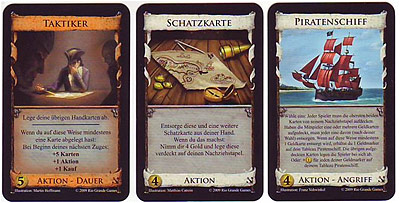
Zuallererst betrachten wird den Taktiker (Dauer-Karte). Beim Ausspielen des Taktikers(Aktionsphase) muss man alle übrigen Karten abschmeißen; zur Belohnung erhält man zu Beginn des nächsten Zuges : + 5 Karten, + 1 Aktion, + 1 Kauf.

Man kann also gewissermaßen anschließend einen Doppelzug durchführen, bei welchen man 10 Karten auf der Hand hält.

Geld-Taktiker(1)-Strategie
    • Liegt ein Taktiker im Dauerkartenbereich der Spielauslage, so nutze den Taktiker(+ 5 Karten, + 1 Aktion, + 1 Kauf) und kaufe zweimal nach der Priorität Provinz/Gold/Silber.
    • Kaufe eine Provinz, falls du 8 Geld hast.
    • Kaufe einen Taktiker, falls du noch keinen hast und du 5 Geld besitzt.
    • Ansonsten kaufe Gold oder Silber (wie üblich zu Spielende nur noch Siegpunktkarten kaufen).

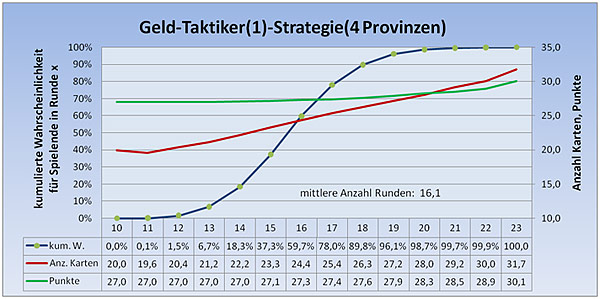
Simulationen mit mehreren Taktikern zeigen, dass der Kauf von nur genau einem Taktiker wohl die besten Ergebnisse erzielt.

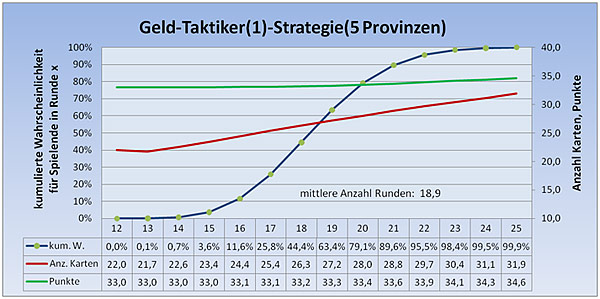
Analysieren wir also die Geld-Taktiker(1)-Strategie für 5 und 4 Provinzen im Solospiel nun detailierter:

Diese Strategie ist also etwas besser als die reine Geldstrategie, da man den „Verschnitt“ beim Kaufen von Karten mit dem Taktiker etwas ausgleichen kann. Verbessern kann man diese Strategie noch, indem man gegen Ende des Spieles auch mit dem Taktiker nur noch Siegpunkte kauft.

Da man mit dem Taktiker ja 10 Karten auf der Hand hält, so liegt es vielleicht nahe, ihn mit 2 Schatzkarten zu kombinieren: Hat man 2 Schatzkarten auf der Hand, so muss man sie entsorgen und darf sich dann 4 Goldkarten oben auf den Nachziehstapel legen!

Geld-Taktiker(1)-Schatzkarte(2)-Strategie
    • Liegt ein Taktiker im Dauerkartenbereich der Spielauslage, so nutze den Taktiker(+ 5 Karten, + 1 Aktion, + 1 Kauf), nutze die Schatzkarte(falls 2 auf der Hand) und kaufe zweimal nach der Priorität Provinz/Gold/Silber.
    • Nutze die Schatzkarte, falls du 2 auf der Hand hast.
    • Kaufe eine Provinz, falls du 8 Geld hast.
    • Kaufe bis zu einem Limit von 1 Taktiker und 2 Schatzkarten, falls du genügend Geld hast.
    • Ansonsten kaufe Gold oder Silber (wie üblich zu Spielende nur noch Siegpunktkarten kaufen).

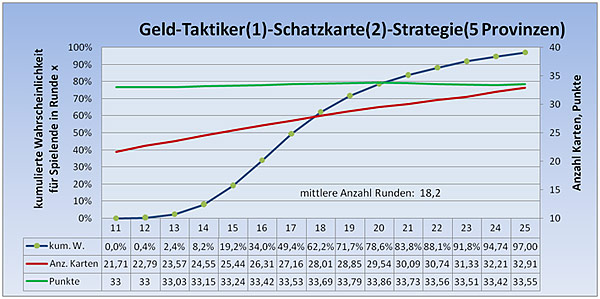
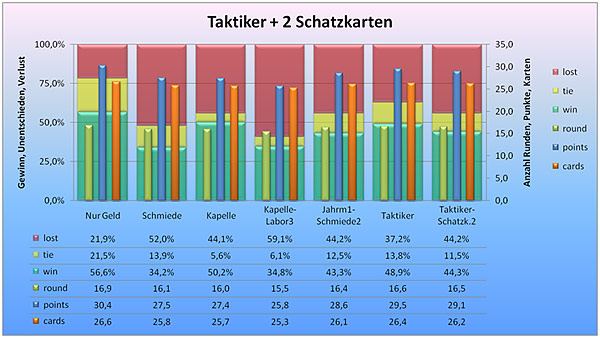
Die Feinanalysen ergeben dann:

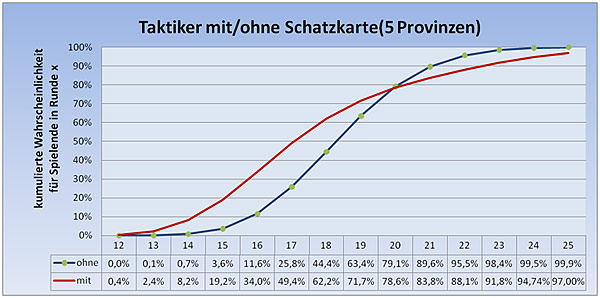
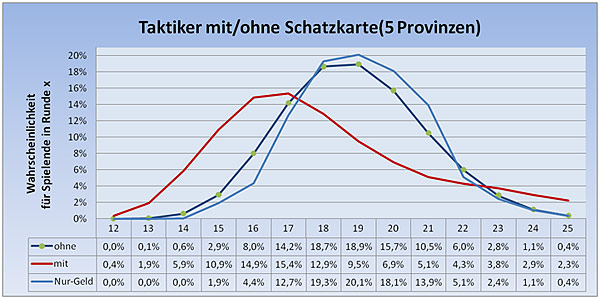
Durch die Schatzkarten wird die Taktikerstrategie noch einmal verbessert. Allerdings wird die Varianz der Rundenanzahl jetzt recht hoch, d.h. die Kurve der kummulierten Wahrscheinlichkeiten ist um den Mittelwert herum recht flach!

Manchmal hat man also schon recht früh im Spiel beide Schatzkarten gleichzeitig auf der Hand – dann ist die Strategie recht stark. Allerdings kann man dies hier nicht selbst beeinflussen – man ist auf den Zufall angewiesen!

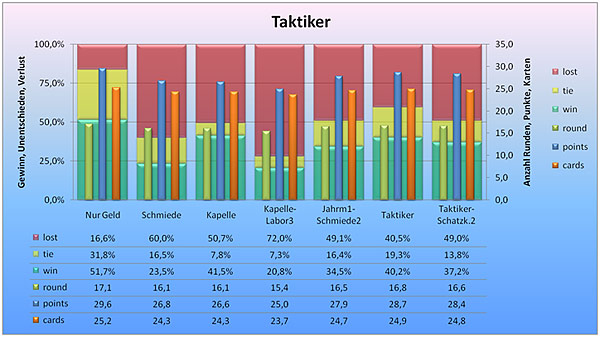
Lassen wir nun unsere beiden neuen Strategien im 2-Personenspiel gegen unsere bekannten Strategien aus den früheren Artikeln antreten:

So wirklich überzeugend sind beide Strategien nicht; insbesondere die hohe zufällige Komponente bei den Schatzkarten mag den echten Strategen wenig überzeugen!

Im Dominion-Blog wird darauf hingewiesen, dass möglicherweise die Schatzkarten in Kombination mit dem Lagerhaus (+1 Aktion, + 3 Karten, 3 Karten abwerfen) recht stark seien. Ich habe das noch nicht getestet, aber es hört sich ganz gut an. Zu bedenken ist allerdings, dass jede Nutzung des Lagerhauses die Anzahl der Karten auf der Hand um 1 reduziert.

Das Piratenschiff

In Seaside sind insgesamt 5 Angriffskarten enthalten. Eine davon ist das Piratenschiff, welches Geldkarten der Mitspieler entsorgt und gleichzeitig virtuelles Geld im eigenen Piratenschiff sammelt.

Piratenschiff(X)mit Geldgrenze(Y)-Strategie
    • Hast du ein Piratenschiff auf der Hand und weniger als Y Geld auf der Hand (inklusive virtuellem Piratengeld), dann greife die Mitspieler an; ansonsten nutze das virtuelle Piratengeld.
    • Hast du weniger als X Piratenschiffe in deinem Deck, so kaufe nach der Priorität Provinz/Piratenschiff/Silber.
    • Ansonsten kaufe nach der Priorität Provinz/Gold/Silber (wie üblich zu Spielende nur noch Siegpunktkarten kaufen).

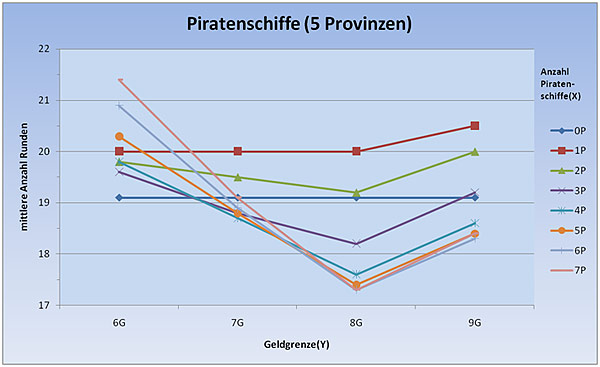
Ich variiere nun die Parameter X und Y in einem Solitärspiel, bei dem ich davon ausgehe, dass die Piratenangriffe immer erfolgreich sind; außerdem ignoriere ich hierbei natürlich, dass die Mitspieler durch den Angriff negativ beeinflusst werden.

Man erkennt hier sofort, dass als Geldgrenze(Y) 8 gewählt werden sollte und man 4 bis 5 Piratenschiffe benötigt, um ein im Mittel möglichst kurzes Spiel zu erreichen!

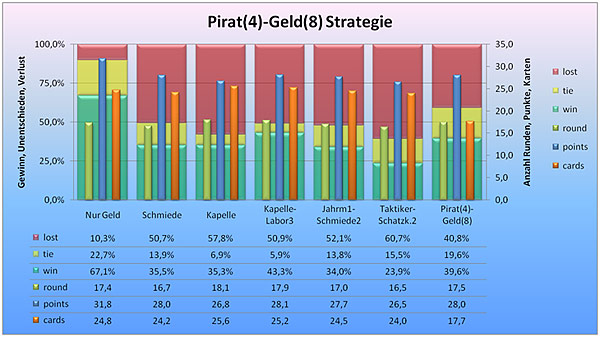
Ich werde nun das Piratenschiff im 2-Personenspiel auch noch gegen einige andere Strategien antreten lassen. Das Ergebnis ist allerdings mit etwas Vorsicht zu genießen, da die anderen Strategien nicht auf den Angriff reagieren können, denn sie wurden ja ohne Berücksichtigung aller Arten von Interaktion definiert! Man beachte aber, dass Piratenangriffe in frühen Phasen häufig auch hilfreich sind, denn sie entsorgen ja zu Spielbeginn Kupfer, welches manchmal sowieso lästig ist!

Das Ergebnis sieht etwas enttäuschend aus!

Nur gegenüber der reinen Geldstrategie ist der Pirat klar überlegen. Zusätzlich scheint sogar die Taktiker(1)-Schatzkarte(2) Strategie vom Piraten am wenigsten gestört zu werden, denn sie ist hier unter den betrachteten Strategien der stärkste Gegner für den Piraten! Allerdings ist der Pirat in etwa gleichstark wie die bisher im 2-Personenspiel starke Kapelle-Labor3 Strategie.

Dass die Angriffsfunktion des Piraten notwendig ist und die reine „Münzsammlung im Piratenschiff“ ohne Entsorgen von gegnerischen Karten zu schwach ist, sieht man in der folgenden Simulation:

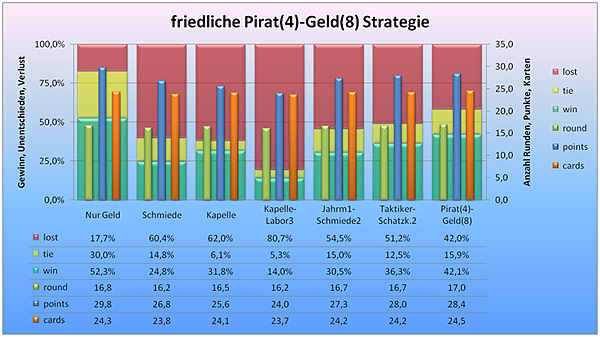
Wir modifizieren den Piraten in der Form, dass er keine gegnerische Karte entsorgt, sondern immer beide Karten abwirft (friedlicher Pirat)!

Wie man sieht, ist der friedliche Pirat im 2-Personenspiel im allgemeinen schwächer als der normale Pirat. Zwei Dinge sind allerdings zu beobachten:

Erstens ist Kapelle-Labor3 jetzt wieder sehr stark – sie wurde durch das Entsorgen von Geldkarten wohl sehr stark gestört. Zweitens sieht man den erstaunlichen Effekt, dass TaktikerSchatzkarte2 beim friedlichen Piraten schwächer wird – diese Strategie hatte durch den agressiven Piraten tatsächlich profitiert!

Möglicherweise kann man daraus schließen, dass sich der Taktiker auch ganz gut mit einer Kapelle kombinieren läßt!? Probiert es mal aus!

An diesem Beispiel sieht man also sehr schön, wie sich die Strategien der Mitspieler durch Interaktionskarten sowohl positiv als auch negativ beeinflussen können!

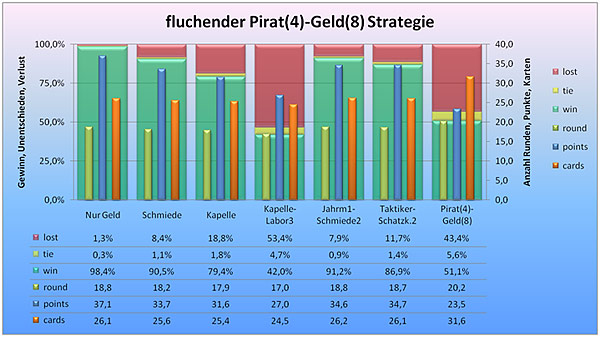
Verlassen wir den friedlichen Piraten nun wieder und betrachten stattdessen einen „fluchenden Piraten“: Der fluchende Pirat entsorgt , wie der friedliche Pirat, im Erfolgsfalle keine gegnerische Karte, sondern schiebt dem Gegner eine Fluchkarte unter (die Kapellen entsorgen natürlich auch Flüche).

Ups!! Der fluchende Pirat ist extrem stark – nur Kapelle-Labor3 kann ihm noch standhalten!

Wir sehen:

Das Piratenschiff aus Seaside ist gut ausgewogen; ohne Angriffsfunktion wäre es wohl etwas zu schwach und bei einer stärkeren Angriffsfunktion, wie dem Fluch, wäre es eigentlich zu stark!

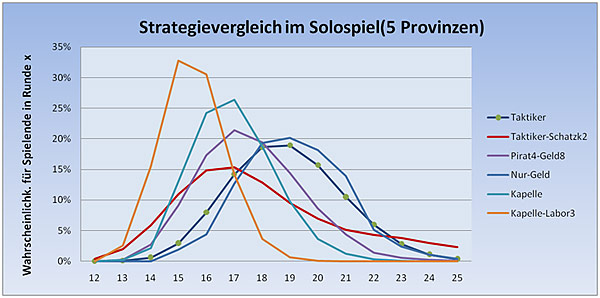
Als Abschluss hier noch eine vergleichende Grafik der Strategien im Solospiel; zu beachten ist, dass die Angriffsfunktion des Piratenschiffs hier nicht berücksichtigt werden kann!

Diese Grafik sollte jedem wieder vor Augen führen, dass alle Aussagen über Strategien hier nur dann gelten, wenn man eine größere Anzahl von Spielen auswertet!

Die Aussage, eine Strategie ist besser als die andere, bedeutet immer nur: Im Laufe von vielen Spielen wird man häufiger mit der einen Strategie gewinnen als mit der anderen. Im Einzelfall kann die langfristig schlechtere Strategie durchaus auch große Siege gegen die bessere Strategie erringen! Die Taktiker-Schatzkarte2 kann manchmal in 14 Runden schon 5 Provinzen besitzen – manchmal hat sie diese nach 24 Runden aber immer noch nicht gesammelt (und irgendjemand anderes hat das Spiel bis dahin schon längst beendet…).

Hiermit endet der vierte Teil meiner Analysen. Ich hoffe, dass sich keine (großen) Fehler eingeschlichen haben und ihr meine Ergebnisse im realen Spiel auch bestätigen könnt.

Die vorgeschlagenen Strategien sind alle recht einfach gehalten; ich habe natürlich verschiedene Modifikationen ausprobiert, allerdings ist nie ausgeschlossen, dass man z.B. das Piratenschiff und auch die anderen Strategien durch geschicktere Anwendung noch verbessern kann. Versucht es mal!

Euch allen wünsche ich weiterhin viel Spaß mit Dominion und allen zukünftigen Erweiterungen!

Günther Rosenbaum, 31.10.09

gehe zu Teil 1

gehe zu Teil 2

gehe zu Teil 3

Dominion: Simulation einiger „Killerstrategien“ – Teil 3

Dominion: Simulation einiger „Killerstrategien“

Teil 3 – Intrige

von Günther Rosenbaum

In Teil 1 und Teil 2 dieser Analyse haben wir verschiedene Strategien betrachtet und simuliert, wie viele Runden man braucht um eine vorgegebene Anzahl Provinzen zu erwerben.

Auch für das Basisspiel von Dominion gäbe es noch eine Vielzahl von Karten und Strategien, die man analysieren könnte. In diesem Teil 3 möchte ich allerdings einige Karten aus der ersten Erweiterung „Intrige“ näher betrachten.

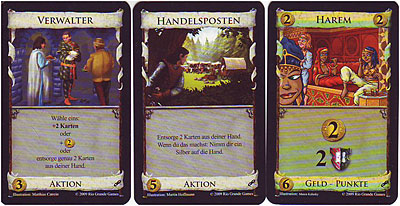
Der Verwalter

Zuallererst betrachten wird den Verwalter:

Er ist recht flexibel: Man kann 2 Karten entsorgten oder +2 Geld nehmen oder 2 Karten nachziehen. Je nach Spielsituation kann man also flexibel reagieren!

Geld-Verwalter(X)-Strategie
    • Kaufe zu Beginn des Spieles X Verwalter.
    • Wenn du einen Verwalter auf der Hand hast, dann nutze ihn wie folgt:
      • hast du mindestens 8 Geld, dann ziehe 2 Karten
      • hast du mindestens 6 Geld, dann nutze +2 Geld
      • ist zu erwarten, dass du nach dem Ziehen von 2 Karten insgesamt mindestens 7 Geld hättest, so ziehe 2 Karten
      • hast du mindestens 4 Geld, dann nutze +2 Geld
      • hast du mindestens 5 Geld im Gesamtbesitz und Flüche, Anwesen oder Kupfer auf der Hand, dann entsorge genau 2 Karten
      • ziehe 2 Karten
    • Mit den nun vorhandenen Handkarten (und eventuell virtuellem Geld) gehe gemäß der Nur-Geld-Strategie vor.

Der Passus „ist zu erwarten, dass du nach dem Ziehen von 2 Karten insgesamt mindestens 7 Geld hättest“ ist wie folgt zu verstehen:

Man kann sich die Anzahl Karten und das enthaltene Geld innerhalb seines Nachziehstapels in etwa merken. Beim Nachziehen einer Karte erhält man also im Mittel „enthaltenes Geld / Anzahl Karten“ Geld. Zweimal dieser Wert plus der Geldwert auf der Hand muss also mindestens 7 ergeben, damit die obige Bedingung zutrifft.

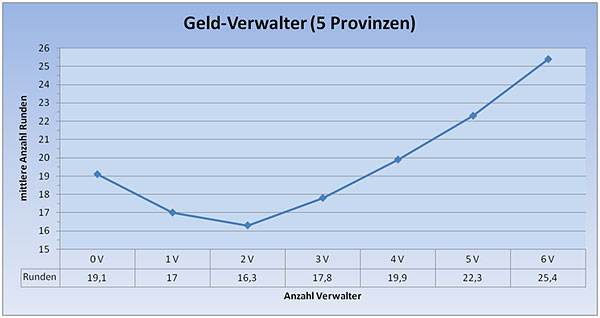
Ich möchte nun im Solospiel den Parameter X = Anzahl Verwalter variieren und bestimmen, mit wie vielen Verwaltern ein möglichst kurzes Spiel entsteht (bis zum Erreichen von 5 Provinzen).

Das kürzeste Spiel mit 16,3 Runden entsteht beim Kauf von 2 Verwaltern!

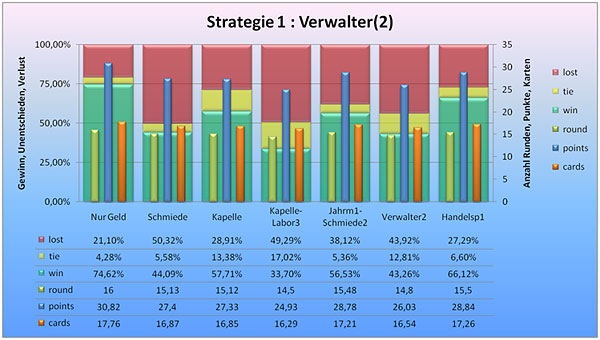
Wir erinnern uns, dass die Nur-Geld-Strategie bei 5 Provinzen ca. 19 Runden benötigt – damit können wir vermuten, dass die Geld-Verwalter(2)-Strategie wohl besser ist.

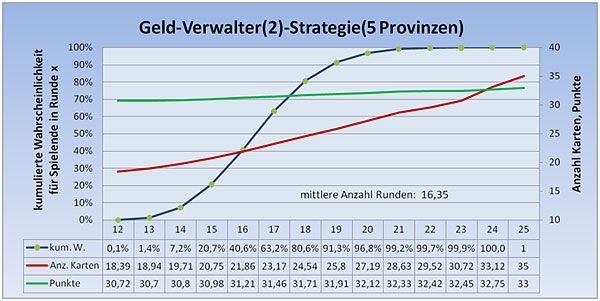
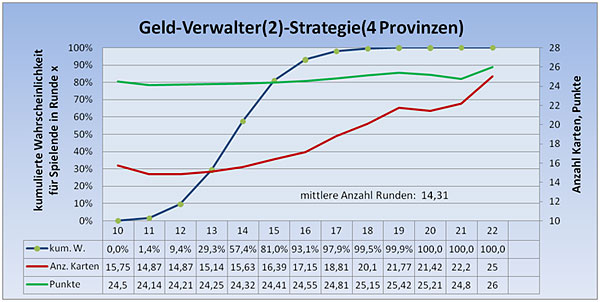
Analysieren wir die Geld-Verwalter(2)-Strategie für 5 und 4 Provinzen nun detailierter:

Der Handelsposten

Bevor ich nun diese Strategie im 2-Personenspiel betrachte, schauen wir uns noch den Handelsposten an:

„Entsorge 2 Karten aus deiner Hand. Wenn du das machst: Nimm dir ein Silber auf die Hand. Kosten: 5“

Das hört sich auch interessant an; man kann wie bei der Kapelle Karten entsorgen, bekommt aber gleichzeitig als Belohnung noch ein Silber auf die Hand! Allerdings sind die Kosten von 5 recht hoch (damit kann man häufig in den ersten beiden Runden bei einer 3-4 Geldverteilung den Handelsposten nicht kaufen).

Geld-Handelsposten(X)-Strategie
    • Kaufe zu Beginn des Spieles X Handelsposten.
    • Wenn du einen Handelsposten auf der Hand hast, dann nutze ihn wie folgt:
      • Sei A = die Anzahl von Flüchen, Anwesen und Kupfer auf der Hand; wird im folgenden von „Entsorgen“ gesprochen, so werden zuerst Flüche, dann Anwesen und dann Kupfer entsorgt.
      • Falls A mindestens 2 ist, so entsorge 2 Karten und nimm ein Silber auf die Hand
      • Falls A=1 und du ein Silber auf der Hand hast und du kein Kupfer auf der Hand hast oder nicht genau 8 Geld hast dann entsorge ein Silber und eine weitere Karte und nimm ein Silber auf die Hand.
      • Falls A = 0, dann nutze den Handelsposten nicht
    • Mit den nun vorhandenen Handkarten gehe gemäß der Nur-Geld-Strategie vor.

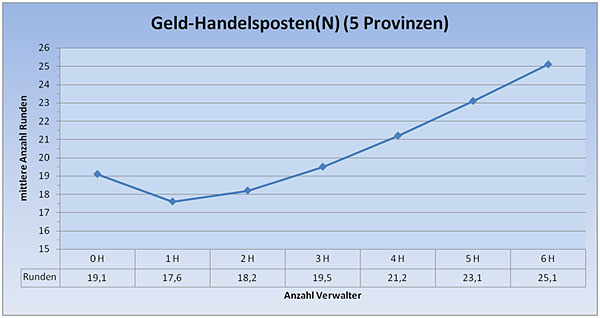
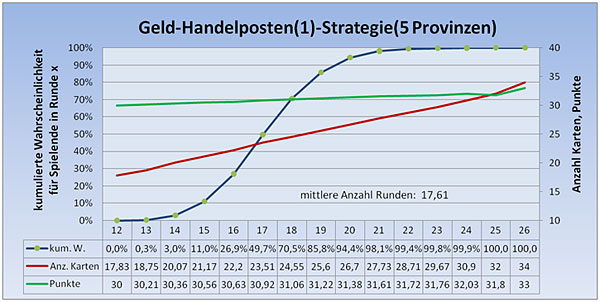
Wie beim Verwalter bestimme ich nun die optimale Anzahl von Handelsposten und analysiere die Strategie in der Solovariante!

Das kürzeste Spiel mit 17,6 Runden entsteht beim Kauf von genau einem Handelsposten!

Die Feinanalysen ergeben dann:

Der Handelsposten ist recht teuer: Würde er nur 4 Kosten, so würde man 16,2 Runden erreichen und damit sogar etwas weniger als der Verwalter!

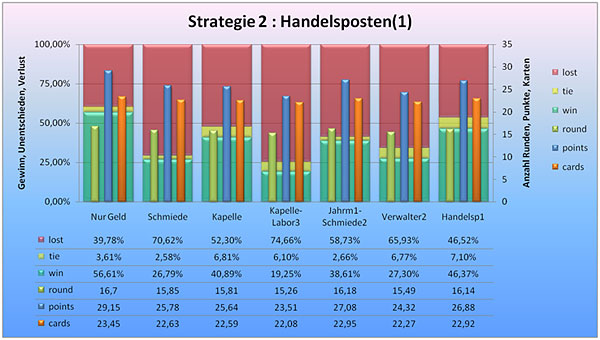
Es ist nun an der Zeit, unsere beiden neuen Strategien im 2-Personenspiel gegen unsere bekannten Strategien aus den früheren Artikeln antreten zu lassen:

Man sieht: Der Handelsposten(1) ist recht schwach – vermutlich aufgrund der hohen Kosten. Möglicherweise kann man den Handelsposten aber dann spielen, wenn man in den Eröffnungsrunden die 5-2 Geldverteilung hat!

Der Verwalter(2) ist recht stark – nur Kapelle-Labor3 und Schmiede sind etwas besser!

Der Harem

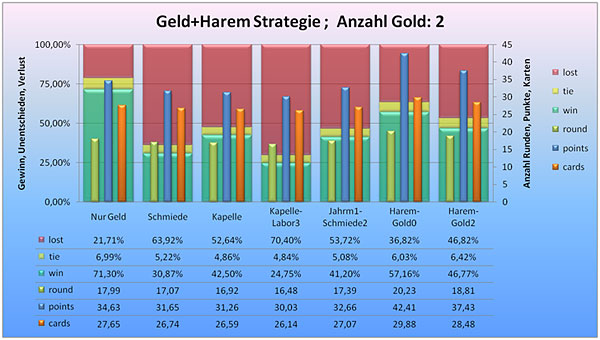
Der Harem zählt sowohl als Geldkarte als auch als Punktekarte. Damit kann man mit dem Harem Punkte erwerben, welche die Kartenhand nicht blockieren, da sie ja im Spiel als „2 Geld“ genutzt werden können. Der Harem kostet genauso viel wie ein Gold – daher stellt sich schnell die Frage, ob man nicht z.B. in der Geldstrategie immer den Kauf eines Goldes durch einen Harem ersetzen sollte?

Tatsächlich ist eine solche Strategie besser als die reine Geldstrategie; besser ist es aber, wenn man das Ganze kombiniert: Erst nachdem man schon 2 Gold gekauft hat, ersetzt man alle folgenden Goldkäufe durch Haremskäufe! Man muss aber leider feststellen, dass diese Strategie nicht so richtig gut ist – sie ist zwar besser, als die reine Geldstrategie, aber weiterhin schlechter als die Schmiede oder die Kapelle!

Zu guter Letzt hier noch ein paar Informationen zu Angriffs- und Verteidigungskarten. Wir betrachten ein Dominion 2-Personenspiel:

1)

    • Spieler 1 spielt Geld-Burggraben1 Strategie
    • Spieler 2 spielt Geld-Hexe1 Strategie
    • Spieler 1 kauft also möglichst früh einen Burggraben zur Verteidigung, Spieler 2 eine Hexe zum Angriff; ansonsten verfolgen beide die Geldstrategie und nutzen ihre Aktionen!

Ergebnis: In ca. 73% der Spiele gewinnt die Hexe! (Der Burggraben kann zu selten verteidigen; die Flüche können ihre Wirkung entfalten, trotz der hohen Kosten(5) der Hexe)

2)

    • Spieler 1 spielt Geld-Kapelle Strategie (wie in Strategieanalyse )
    • Spieler 2 spielt Geld-Burggraben1 Strategie (wie oben)

Ergebnis: In ca. 52% der Spiele gewinnt die Kapelle (ca. 8% unentschieden)! (Gegen die Schmiede(+3 Karten) hat die Kapelle keine Chance; für den Burggraben(+2 Karten) reicht es gerade!)

3)

    • Spieler 1 spielt Geld-Kapelle Strategie (wie in Strategieanalyse + Entsorgen von Flüchen)
    • Spieler 2 spielt Geld-Hexe1 Strategie (wie oben)

Kann die Kapelle durch das Entsorgen von Flüchen die Hexe neutralisieren?

Ergebnis: In ca. 67% der Spiele gewinnt die Hexe (ca. 3% unentschieden)! (Gegen die „+2 Karten“ gewinnt die Kapelle noch mit 52%; kommt bei der Hexe noch die „Flucheigenschaft“ hinzu, verliert die Kapelle, obwohl sie Flüche entsorgen kann)

4)

Ich hatte im letzten Artikel gefragt, ob nicht doch der Kauf einer Schmiede besser ist, als die teure Hexe. Das muss ich jetzt verneinen – die Hexe gewinnt in 68% der Spiele gegen die Schmiede!

Hiermit ist der dritte Teil meiner Analysen beendet. Wie so häufig wirft jede Antwort über die Güte einer Strategie wieder mehrere neue Fragen auf. Ob in der Zukunft an dieser Stelle weitere Dominion Strategiefragen beantwortet werden, kann ich noch nicht sagen – schaun mer mal!

Euch allen wünsche ich weiterhin viel Spaß mit Dominion und allen zukünftigen Erweiterungen!

Weitergehenden Lesestoff gibt es auch im Dominionblog.

Günther Rosenbaum, 17.10.09

gehe zu Teil 1

gehe zu Teil 2

gehe zu Teil 4