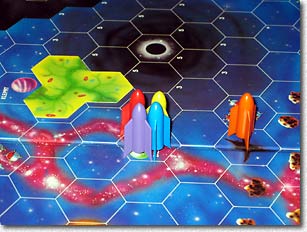
Taking Control Of Time Control
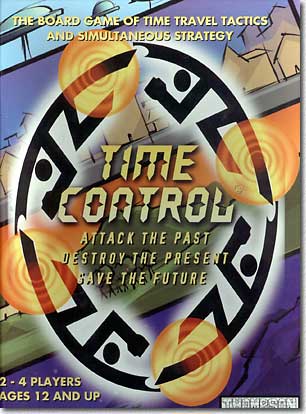
Taking Control Of Time Control

Time Control - box

A review and a possible „fix“

Time
Control
” has been one of the most dissed games in boardgamegeek history – this
has to do with the fact that the designer sent out many free games to possible reviewers,
a practice which is normally laudable but which backfired in this case. We as the
“Westpark Gamers” had also received a copy, but as it arrived relatively late
we already had word from the various boardgamegeek reviews (by usually reliable
reviewers) that this game was truly awful. Therefore we never really got around to play
it (or rather didn’t dare, to be honest).

This reviewer will not try to rectify the view that is dominant about “Time
Control” – the game suffers from many flaws and has certainly not been
playtested enough (or perhaps not at all). But while reading the rules (second, optimized
version, still with many unclarities) I found that some of the ideas in the game were
neat and interesting. I also felt sorry for the game designer, who had apparently gone to
great length to present and print his game professionally (you can certainly not say that
the game is ugly looking, although tastes differ). Also, I am a fan of the “time
machine” genre, of which there are only very few good games (and only one true
masterpiece, the totally underrated and out of print “Time Agent” by TimJim
games). So before we finally decided to test this game, I already changed some of the
rules that I was sure wouldn’t work (therefore sparing us the aggravation that the
other testers felt while trying “to make it work”). But more about that
later…

To give you some idea what the game is about, here is a short description:

Each player represents a time agency which tries to keep reality safe from “time
waves”, accumulated problems that wander “up” to the present from the
past, created by the other players agents. Each player therefore is master of his own
“alternate reality”.

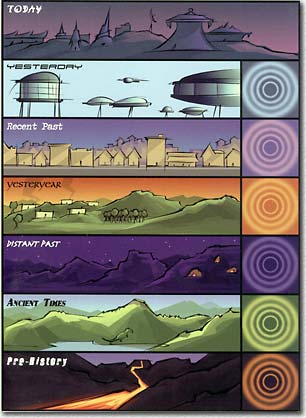
There are 7 time zones: today, yesterday, recent past, yesteryear, distant past,
ancient times and pre-history. Today is where your agents are safe, and from which you
send them to the past, to your own, and ultimately also to other players time zones.
There are 4 kinds of agents: normal ones, brawlers (good at beating the crap out of other
agents), scientists and historians (which are good in influencing and changing the time
waves).

First players deploy their agents on various time zones on their own board (movement
is linear, you can only move towards pre-history, from which you “snap back”
to the present). Now the most problematic phase of the game begins: the “free for
all”, which simply doesn’t work. In the original rules every player can do
whatever he wants whenever he wants, he just has to announce it, and see if somebody
opposes it. The latter happens when another player tries to take “time
control” , saying “before you do this I do that”, to which of course
another player can chime in say “and before you do that, I do
this”, etc. ad nauseam. At some point you try to get out of this mess by
resolving these “time duels”, which are akwardly done by the rules: you
either spend time chips (numbered 1-21) OR you play a “Fate” time chip which
enables you to blindly draw a card from -15 to +15 (or an automatic win card –
sic!). Confused already? Even more confusing is the fact that you can always re-duel (in
fact every player involved in the duel could do that), and that you lose only the
highest time chip spent, the others are kept.

Theoretically every player can be active until all his agents are “busy”,
moving/activating one at a time. Agents are moved to other boards to create
“create” tokens, which in turn create a time wave that after the first round
moves up to the present step-by-step to create more “create tokens” and
finally problem cards, which oust a player from the game if he accumulates enough of
them. Agents can also try to rectify these problems by flipping the create tokens to
their “solve” side (when in the same zone) – “solve” tokens who
reach the present can get rid of “problems”. Of course you can also attack
other agents, again using the clumsy duel rules.
Time Control

And have I already said that time waves also attack agents, again using the
duel rules??? Although the duel faintly reminds one of the classic “Cosmic
Encounter”, it is absolutely overdone to use it for nearly every mechanism in the
game – in “Cosmic” playing the duel cards is always decisive and much
more rarely done.

And the biggest problem is: The first turn never ends! Agents keep on being active
(you start with 12), as some actions, even sometimes fights, don’t
“busy” them, therefore ending their activities. This means that we look at at
least 48 if not more actions by four players, most of which will be duelled about. And
most of which will involve yet another duel! And reduelled. And reduelled again.
For all eternity (perhaps fitting the theme, perversely).

All play reports said the same: They were playing the first round for what seemed like
ages, and then stopped because they simply were bored witless.

All this doesn’t sound like a lot of fun. This is why I tried to change it!

When we finally played I already used the optional rules that I created, and lo and
behold, suddenly the game wasn’t half bad! Players even admitted having
“fun”! :-)

After experimenting a bit more this is my attempt at an easy rules fix that makes
“Time Control” a much better, perhaps even interesting game. I am actually
sure that the designer, who I applaud for being calm about all the bad reviews, would
have changed the rules to this had he tried out the game a bit more with neutral
playtesters. Everybody at our playing agreed that this game “deserved another
chance” – I leave it to you if you are willing to give it a try!

Main problems with the game:

  1. The “free for all” rule creates endless confusing duels which are
    repetitive and take forever.
  2. Victory conditions involve kicking out every other player of the game – not a
    good idea if turns take that long!
  3. Game is much too long for its relatively light content.

And here is my attempt at a fix:

SETUP

  1. Remove the 4 problem cards “Bureaucratic” (2x) and
    “Narcissism” (2x) they are not needed at all.
  2. Remove the “fate” tokens from the time control tokens. They are not
    needed. Remove the “Fate” card from the “Fate” deck. The
    “Fate” deck will not be used, only for checking the results of individual
    battles.
  3. Get a few 6-sided dice – they are needed.
  4. Get 4 markers to show “1st”, “2nd”, “3rd” and
    “4th” player, as the turn order will constantly change.

GAME PLAY

One major change: At the beginning of the game there is a time duel, using the time
control tokens. If there is a tie between two players, these two duel again, but they
cannot use the tokens they already played. The highest bidding player becomes
“player 1”, the second highest “player 2” etc.. Tokens that
are played are lost, even if several were played
.

Now the playing order for the game has been established, which is adhered to strictly,
until somebody opposes it (see below).

Playing “interrupts”: Every player does one action at a time, as per the
original rules. But before he actually puts the action into effect every player can
“interrupt” his action, and try to duel for “time control”. The
first player to announce this challenge plays a duel with the challenged player, using
the “time control” tokens. The higher value wins, ties are repeated like
above. If the challenging player wins, he now takes over the former position of the
challenged player. He now does one action of his choice, which cannot be
interrupted again by other players!
If the challenged player wins, he proceeds to do
his original action (which cannot again be interrupted by other players).

Example: Player 1 announces and does an action. Then player 2 announces another
action. Player 1 wants to interrupt and is the first to do so. Both players play a time
duel. Player 1 wins and now becomes in effect player 2, giving him two actions in a row,
while player 1 misses a turn. When it is player 3’s turn, either player 1 or player
2 (or player 4) could interrupt again, therefore changing the turn order again.

All Time Control tokens used for duels are lost and can only be regained through the
“Cash in” rules of the original rules, which remain as written!

The will never be any “reduels” – the first duel counts!

FIGHTS BETWEEN AGENTS

Agent’s duels are simplified as thus: Every player simply rolls a 6-sided die,
trying to beat the other player’s roll, ties are won by the attacker. The
losing player draws a fate card to see the combat result (as in the original rules),
which also refers to the attacker (again, as in the original rules).

All other agents by one of the fighting player’s which are in the exact same
time zone, add +1 per active agent, even if already busied. These “helping”
agents will NOT be busied after the combat!

This modifier is optional, the player can choose to involve only a few, even
none of his other agents (he has to specify which). But all agents who were involved in a
combat suffer the same negative result when losing (not when winning – so
already busied agents won’t suddenly become active again!).

“Sabotage” and “Aid”:

  • “Sabotage” is trashed, there is only “Aid”.
  • “Aid” is given when agents of other players announce to help with their
    agents, if they are present in the same time zone as the combat. This means they give
    their “+1” bonus/ses to one of the involved players. This is asked for in the
    momentary turn order (after the attacking player): Players can give aid if present, or
    refuse. If they give aid and the combat is successful for their side, they can
    resurrect one “time control” token (regardless of how many agents
    participated) that has already been used. There are no negative side effects when their
    side is losing.
  • The player who receives aid can refuse to receive it, but once he uses the modifier
    (deciding before rolling) he also has to accept the fact that aiding players regain time
    control tokens, if he wins.

TIME WAVE ATTACKS

These attacks are handled as combats above, but there is no “aid” this
time. Time waves roll 1 die, adding 1 for each token present above one, regardless of
it’s kind (for example: the time wave consists of 3 “create”’s
and 1 “solve” – it rolls 1 die, adding 3 to the result.

Defending agents roll a die at a time for each of their agents present, adding
2 if the agent is still active, and nothing if the agent is busied.

Results of successful time wave attacks are handled by drawing a fate card, as in the
original rules.

WINNING CONDITIONS

Players are never kicked out of the game. Instead they accumulate
“problem” points for problem cards drawn. These problem points are kept,
even if the problem card is later “solved”
(use poker chips or write them
down).

You get:

  • 1 problem point for each problem card drawn
  • 1 additional problem point if you draw a problem type that you already have as a card
    (meaning you still own the unsolved problem). This is cumulative: if for example you draw
    a technological problem and already have 2 technological problems, you would get
    three problem points in one go.

The first player to accumulate 10 problem points ends the game immediately. Now
the player with the fewest problem points wins the game. If there is a tie, add
all remaining time control tokens of the players involved, checking who has more. If
there is still a tie, count the agents of the players involved, checking who has the most
left. If there is still a tie, both (or more) players win!

All other rules are as in the original game.

Note: These rules are still a work in progress. I would be interested in how
you liked them, and if you have other suggestions. In our opinion they made for a
quicker, more interesting game, that brings out the qualities of the original design idea
much more than the original rules.

ATTACK THE PAST

DESTROY THE PRESENT

SAVE THE FUTURE!

©Westpark Gamers, 2003, Moritz Eggert
Spielbericht & Review 25.09.2003

Spielbericht & Review 25.09.2003

Author: Thomas, Aaron

at the table: Walter, Hans, Thomas, Aaron

on the table: Manhattan, McMulti

  1. ManhattanManhattan cover

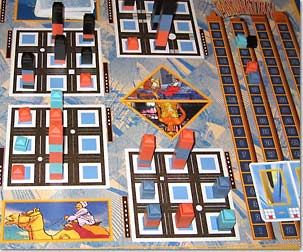
    In “Manhattan” geht es darum, Häuser bzw. Türme zu bauen: möglichst viele,
    die meisten in einzelnen Städten, und am besten den aller höchsten.

    Zu den Regeln/Spielablauf:

    Zu diesem Zweck ist der eher funktionale als hübsche Spielplan in 6, jeweils 3×3
    Quadrate große Städte, aufgeteilt. Die tragen Namen wie Kairo, Frankfurt oder eben auch
    Manhattan.

    Jeder Spieler erhält zu Beginn 24 unterschiedlich große Turmteile der eigenen Farbe.
    Es gibt 1, 2, 3, und 4 Stockwerk hohe Teile. Am meisten erhält man von den kleinen
    Teilen. Außerdem kriegt jeder Spieler 4 Karten, die ein Quadrat auf den 3×3 großen
    Städten bezeichnen. Also z.B. das mittlere Quadrat oder das oben links usw.

    Gespielt wird jetzt in 4 Runden. Jeder Spieler sucht sich aus seinen Turmteilen 6
    Stück aus, die er in dieser Runde verbauen will (in der letzten Runde gibt’s
    natürlich nicht mehr viel zu entscheiden ;-). Dann spielt, beginnend mit einem
    Startspieler, jeder Spieler eine seiner Karten aus und setzt dann eines seiner
    ausgesuchten Bauteile auf eine beliebige Stadt, aber auf das Quadrat das von seiner
    gespielten Karte ausgewählt wird. Dabei gibt es allerdings eine Einschränkung: man darf
    das Bauteil nur dann auf einen bereits bestehenden Turm setzen, wenn man dadurch
    mindestens genauso viele Stockwerke der eigenen Farbe in diesem Turm stellt, wie der
    Spieler mit den zweit meisten Stockwerken (in diesem Turm). Dann zieht man eine Karte
    nach und der nächste ist dran. Pro Runde macht das jeder Spieler sechsmal, dann wechselt
    der Startspieler und man sucht sich die nächsten 6 Bauteile heraus.

    Und wie gewinnt man? Am Ende jeder Runde wird gewertet:

    • für jeden Turm (d.h. die mit einem Bauteil der eigenen Farbe an der Spitze) gibt es
      einen Punkt,
    • für den Spieler mit den meisten Türmen in jeder Stadt gibt es zwei Punkte,
    • und für den insgesamt höchsten Turm gibt es drei Punkte.

    Die Punktestand wird dann, für alle Spieler sichtbar, an einer Punkteleiste auf dem
    Spielplan festgehalten. Wer dort nach der letzten Runde führt hat gewonnen.

    Manhattan board

    Zum Spielspaß:

    Wir heben festgestellt, dass einem das Spiel keine Gelegenheit gibt eine langfristige
    Strategie zu entwickeln. Das liegt vor allen daran, dass man bei jedem Zug durch seine 4
    Karten limitiert ist. Meistens (insbesondere in den beiden letzten Runden) hat man oft
    nur zwei Möglichkeiten ein Bauteil zu setzen, da man oft eine Karte doppelt hat und eine
    zweite Karte nur auf Quadrate verweist auf denen man nicht bauen kann, da dort bereits
    große Türme stehen auf die man nicht setzten darf (weil eine andere Farbe zu viele
    Stockwerke hat). Das bedeutet aber auch, dass die Züge recht flott gehen und man schwer
    gezielt gegen jemanden spielen kann. Dieses wiederum verhindert einen starken
    Kingmaker-Effekt.

    Die Spieler haben im Wesentlichen zwei Entscheidungen zu fällen:

    • ob sie lieber neue Türme bauen (d.h. auf leere Quadrate setzen) oder bestehende Türme
      zu übernehmen
    • und in welchen Städten sie sich engagieren und die 2 Punkte für die Städte zu
      bekommen.

    Bei jedem Zug schaut man sich also an, welche Möglichkeiten einem die Karten lassen und
    trifft dann obige Entscheidungen. Das ist nicht sehr strategisch, macht aber durchaus
    Spaß und geht recht schnell. Und so war es auch in unserer Runde.

    Thomas Reichgruber
  2. McMultiMcMulti cover

    It has been several years since we last played McMulti mainly because
    “business” style games are not really to the liking of all Westpark Gamers (if
    we do get the chance and have a willing crew we rather tend to play 18xx games).
    Nevertheless, McMulti was back on the table. The two newcomers to the game were quite
    intrigued by the “real life” appeal the game seems to convey: players are
    dealing with the commodity market, are drilling for crude oil and are busy in refining
    crude and selling petrol. All business transactions are influenced by the current
    economic climate, which may change every time doubles are rolled. This already points to
    a serious problem of the game: the element of luck has a much to large an influence.
    Almost everything in the game is controlled by the roll of two six-sided dice: finding an
    oil well, pumping crude, refining crude and selling petrol at gas stations.

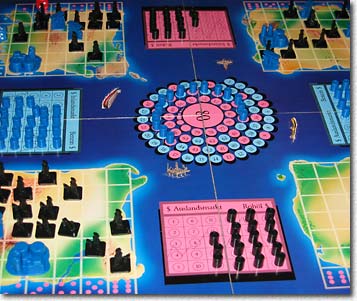
    McMulti boardIn our game we rolled almost no doubles for the first
    half of the game, causing to economic climate to stay moderate with medium equipment
    prices and an ever decreasing petrol price. In this situation turn order becomes a
    significant element once a double is rolled and prices suddenly change dramatically:
    those how can now sell petrol are very well off as well as those (more often than
    not the same players) who have sufficient money available to take advantage of the
    now dropped equipment prices. If you are really hit by bad luck the economic climate
    changes again before you even had a chance to take advantage of it.

    This not being enough the game also uses “event cards”, which can cause all
    sorts of positive or negative effects on players. Although a potential event is revealed
    before it actually comes in effect there is not too much sense in planning ahead here.
    Events, too are controlled by the dice and it is by no means certain that a revealed
    event will actually happen, it might just as well be replaced by another event card.

    Strategic planning in McMulti is limited to planning the correct moment to roll a
    double – hence there is no strategy. The “real life” feeling of the other
    elements quickly becomes rather stale as players quickly discover that the governing
    factor is: buy low and sell high.

    Taking that the game is not short – you can expect 2.5 to 3 hours of playing time –
    and that it can be frustrating to be hit by unlucky die rolls the game only scored
    average in our ranking.

    Aaron Haag

Session Report & Review 25.09.2003

Session Report & Review 25.09.2003

Author: Moritz

at the table: Loredana, Andrea, Peter, Moritz

on the table: T-Rex, Star Wars – Epic Duels, Bluff

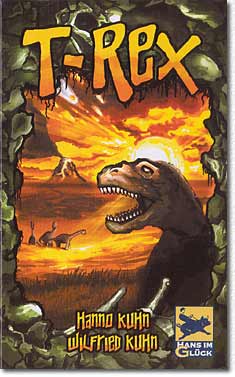
  1. T-RexT-Rex cover

    For some reason this game gets good replay in our group – it is a clever little card
    game with good mechanisms (that take at least 1 game getting used to – the game confused
    me as well when I first played it!). Each player tries to gather dinosaur eggs in
    different colors, even better: of the SAME color, as their net worth will be squared (so
    3 eggs of the same color give 9 points).

    Each turn two eggs are revealed randomly, the player who played the highest card in
    the final round of card play gets the first choice of “egg”, the second gets
    the remaining one. The LAST player will be able to alter trump OR losing suit for the
    next round. In a 4-player round, the 3rd player will get nothing, which is usually to be
    avoided, as the ability to change trump suits is actually pretty important in the end
    game.

    Each player has exactly the same number of cards, numbered 1-15, but in 5 colors (so 1
    color has the 1, 6 and 11, another color has the 2, 7 and 12 and so on). There are also
    two special cards (more about them later).

    You start with only a selection of cards, the others come into play through drawing
    additional cards from your private draw pile, to which about half of the cards you will
    play enable you. The brown “8” gives you 3 new cards for example. The other
    half of the cards are “comet” cards: these start the last round of card play,
    starting from the player who played them (this last round will determine the
    “winner” of the current turn), but only until somebody plays a HIGHER comet
    card, which starts a new round. So it is possible to prolong the last round a lot of
    times, which is usually what happens. Playing the same card as your predecessor actually
    beats his/her card. But as you never really know when exactly the round will end (players
    might also play one of the special cards, the “super comet”, which beats all
    other comets) it will also be in your interest to play a card that is the highest in the
    current round. And if you played the highest comet you also have to play an additional
    card for your final play – if it is also a comet, it could prolong the current
    round…again!

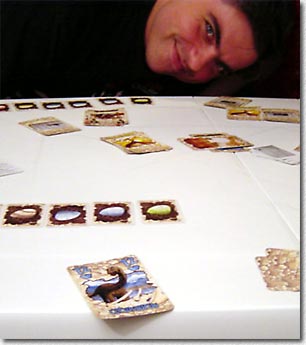
    T-Rex board

    Decisions, decisions….

    For this problem you can use the “chameleosaurus” card, which enables you to
    imitate the card you play it on, without copying its comet or card draw abilities. If
    yellow is the trump color you could first play the 11 comet card (which is the highest
    yellow card), and then, as the final card play, the chameleon, which is again the yellow
    11, but doesn’t start the new round.

    Another mechanism makes the game interesting: After one round is finished, each player
    either removes the visible card of his discard pile, or an unknown card from his draw
    pile. The discard pile is then turned over and placed under the draw pile. Therefore you
    have to memorize your cards, as they will reappear in exactly the same order. You’ll
    also have to memorize the cards the other players lose, as they will determine who is
    leading in one or the other color.

    The game ends when the number of available cards reaches a certain limit, the player
    with the highest net worth in eggs wins.

    The challenge in this game is to judge when you start the “final” comet
    round: sometimes, if your hand is better than the other player’s hands, you should
    push early to exploit this advantage, if you have few cards, you might play the
    “card draw” cards first. But you might miss the end of the round, which
    sometimes comes earlier than you think, when players refuse (or are unable) to play
    higher comet cards to continue the round. Very often an unexpected card play of your
    neighbor can ruin your best plans!

    “T-Rex” is a challenging and interesting card game – it takes time to get
    used to, but it is definitely worth the effort.

    Westpark rating: 7.33

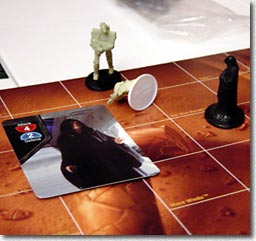
  2. Star Wars: Epic DuelsStar Wars Epic Duels cover

    Star Wars: Epic Duels

    Peter and Andrea played Emperor and Count Dooku (their favorite combo), Loredana and
    me poor Mace Windu and Yoda. As was to be expected the dark side had a big advantage by
    stripping Mace of his carefully collected cards. They concentrated their efforts on Mace
    early on, which enabled Yoda to hold back a little and collect useful cards. Although
    Mace was able to damage Count Dooku considerably he couldn’t prevent being killed –
    sadly the clone troopers didn’t fare better. Yoda was able to give Dooku the
    finishing blow, but Dooku’s robots had survived and annoyed the hell out of Yoda with
    sneaky shots from the distance. In the end Yoda was only able to scratch the emperor (who
    simply healed himself again and again), and succumbed to the concentrated use of the
    emperor’s “3 damage cards”.

    Westpark rating: 7

  3. Bluff

    Both games were nearly exactly alike and resulted in victories by Moritz – ’nuff said
    ;-)

Session Report & Review 19.09.2003

Session Report & Review 19.09.2003

Author: Moritz

at the table: Peter, Hans, Loredana, Moritz

on the table: Fürsten von Florenz, Titan – The Arena, Bluff

  1. Fürsten von Florenz (Princes of Florence) Princes of Florence cover

    Some thoughts about strategy

    It was interesting to play this game again, after Peter and me had thoroughly
    “overplayed” it while training for the German boardgame championships two years
    ago. Peter’s big shock came when his supposedly foolproof tactic of playing with the
    “Gaukler” strategy was successfully countered with an astonishingly flexible
    and unforeseeable strategy by the winning the player in the championship.

    “Fuersten” has been a bit out of the spotlight after a similar but perhaps
    slightly superior game, “Puerto Rico”, has appeared on the scene. In both games
    the fascination lies in the joy of developing a purposely “unbeatable” superior
    strategy, only to discover that there is no valid basic strategy, as any successful
    strategy has to be adaptable to the circumstances. In both games you have only relatively
    few actions available in the game, and the player who most successfully uses these few
    actions to his own benefit will be the winner, not the player who stays with his strategy
    no matter what happens.

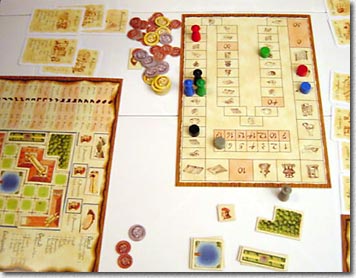
    Fürsten von Florenz board

    In “Fuersten” the “Gaukler” tactic is, theoretically, foolproof.
    You buy a lot of entertainers at the beginning of the game, as well as
    “Abwerbekarten” and additional “Personenkarten”, to shock every other
    player with a barrage of successfully accomplished works in the last 3 rounds (usually
    going for around 8 works in the whole game). But if the other players know this tactic,
    they will make you pay dearly for your entertainers, and beyond a certain sum (1.200 Fl.
    in our opinion), they simply don’t become viable anymore, as you’ll end up having
    serious money problems (in our game, by the way, this tactic DID work, and gave Peter the
    victory).

    We also speculated about a “Baumeister” strategy, which successfully carries
    through what many players try to do unsuccessfully in their first game, buying three
    “Baumeisters” and plastering your court with 7 or more buildings for additional
    victory points, also buying as many bonus cards and prestige cards as possible to achieve
    2-3 monster works for additional benefits. These two strategies have a good chance of
    winning when playing with players who have a disorganized approach to the game. The
    “Baumeister” strategy could even coexist with the “Gaukler” strategy
    – both players would follow completely different goals and not even once conflict in the
    bidding phase.

    But they stand no chance against the “organized disorganized” approach,
    which simply means doing what costs you least and benefits you the most (which is
    admittedly not always easy to fathom). Everything you do depends on the other
    player’s actions – and, in the end, this is the true social aspect of gaming which we
    all love, otherwise we would be content with average and automated computer AI’s
    (which, in the end, we aren’t).

  2. Titan – The ArenaTitan - The Arena Cover

    Bring through your bets! – How to win “Titan the Arena”

    Although “Titan – the Arena” – this wonderful American variation on a design
    by Reiner Knizia – is by no means a pure strategy game (the luck of the draw DOES play a
    huge role), there are some obvious strategies and tactics that will help your bets to
    survive.

    1. THE LEFT PLAYER IS YOUR FRIEND

      It is usually best to bet on the same monsters as the player on your left. Being the next
      player in line gives him the first opportunity to foil your well-made plans and destroy
      your favourite monster first. The more common interests you have the more chances your
      monsters have of surviving.

    2. THE RIGHT PLAYER IS YOUR ENEMY

      Why? See above. If you let the player to your right constantly benefit of mutual bets,
      s/he will mostly have the better of it. Therefore avoid mutual bets with your right
      player. There is another benefit as well: if you play “destructive” cards (see
      below) against the player to your right, there will be 1 (in a 3-player game), 2 (in a
      4-player game) or 3 (in a 5-player game) possible “allies” to possibly end the
      round before s/he gets a chance to act. The more other players there are the higher the
      chance they will accept your offer of an ending of a round that benefits them.

    3. PLAY DESTRUCTIVE CARDS BEFORE CONSTRUCTIVE CARDS

      Titan - The Arena board Constructive cards are high cards played
      on your own monsters. This is the only benefit these cards have. They will usually
      be an invitation for other players to downsize them with another card played on
      them. This will mean that you will have to act again by playing ANOTHER high card on
      your favourite monster. You will end up being dependent on the survival of your own
      monster, never having the chance of influencing the game in another way (the
      “offering” of a round end to other players is essential).

      If you play a negative “low” destructive card on other player’s monsters,
      you achieve two things with one play only: you weaken their monster, forcing them to play
      more cards to strengthen their monster, and strengthening your own monsters, which are
      hopefully stronger than the new weaker monsters. You ACT, they REACT. Try to be the
      ACTING player as often a possible, and you’ll keep in control of what’s
      happening, and when combat rounds will end.

      This rule will have to be adapted towards the end of the game, when combat rounds are
      short. It is then usually better to support your monster with a strong card, as each
      player tries to end the combat round as quickly as possible.

    4. WAIT BEFORE PLAYING YOUR SECRET BET

      Usually most players try to play their secret bet as quickly as possible, but it is much
      better to wait until you see an open bet by ANOTHER player on the monster you secretly
      support, even better if it’s the player to your left! The chances of your secret bet
      surviving will rise considerably. NEVER play a secret bet on a monster you also openly
      support from the start.

    5. TRY TO “CROSS BET” (not to be confused with “cross dressing”)

      Don’t bet on the same old monsters you already support in the second (and further)
      betting round. This will be an invitation for murder to the other players. It is clear
      that the more players have an interest in a monster surviving the more it’s chances
      of survival will be. Bet on a monster that another player strongly supports, and
      don’t forget to look for the monsters the player to your LEFT supports.

    6. DON’T “SPREAD BET”

      Punters know that “spread betting” is the first step to bankruptcy. You want
      to win, and you want to have the highest score possible. Concentrate on 3 monsters
      maximum (including your secret bet), as only 3 monsters will survive, period. And these 3
      shall be YOUR monsters. Weigh your bets so that they are evenly divided among these 3
      monsters. Bets on a 4th monster are only very rarely feasible, only in desperate
      situations were you want to avoid a total defeat should you go this road (or when of the
      monsters you originally bet on died).

    7. DON’T UNDERESTIMATE THE “REFEREE” CARDS

      Most players are annoyed by owning referee cards instead of “real” cards
      (especially the “Master referee”). But there are situations where no
      “real” card you play benefits you because you have a bad hand. Save your
      “master referee” card for exactly this situation and you will avoid playing
      cards that benefit others.

    8. THE NOBLE “ART OF OFFERING”

      Always play cards (if possible) that give the players playing directly after you the
      opportunity to fulfil their wish of ending the round with their monsters surviving. Of
      course the trick is to offer them something that will also let YOUR monsters survive.
      Knowledge of secret bets is essential for this – players might have played high cards on
      a monster they don’t openly support, usually a sure sign of secret support. There
      might even be “offer” situations where the player to your left will lose a
      monster that he will accept losing – to make other, more important bets to him/her
      survive (of course you want all YOUR bets to survive, hehe).

    Of course all this is theory, as you simply might not have the cards that will enable
    you to do all of the above in the right situations. But following these guidelines as
    closely as possible will ensure you a good place at the end of the game, even if it’s
    not number one.

    Have fun!

  3. Bluff

    Unusual game, no player ever lost more than one die (so we were always pretty close to
    the truth). In the end Peter won with two dice against Moritz 1 die.

Preview of Helmut Ohley’s 1844

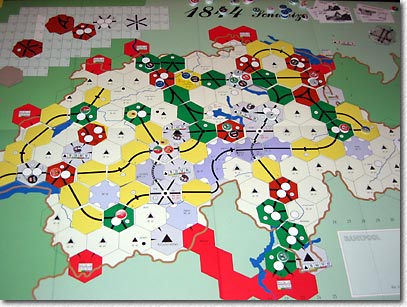
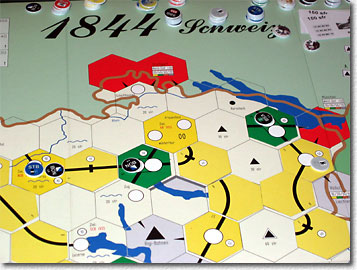
1844 board

Preview of Helmut Ohley’s 1844

In time for Essen 2003 the 18xx family of railroad games, based on Francis
Tresham’s 1829, has received a new member: “1844 -Schweiz” for 3 to 7
players. Those not familiar with the 18xx games should have a look at our 18xx section if they want to learn more about the series.

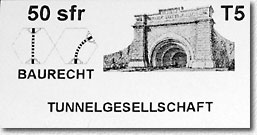
1844 Tunnel Operator

In 1844 the first railroad appeared in Switzerland and it ran from Strassbourg, France
to Basel. Helmut Ohley, the author of 1844 made the effort to implement the scenario
around the development of railroad companies during that time. Compared to other 18xx
games the author designed a number of new ideas derived from the real setting in
Switzerland. Due to the landscape Swiss railroad companies were forced to deal with many
mountains and to cross the Alps and hence one of the new elements is that players are
able build tunnels in the course of the game, which are operated by companies that
generate dividends by themselves.

1844 Mountain Railway

Another new concept is that of mountain railways, railroad companies that can be built
on specially designated mountains and which, in terms of dividends, count like major
cities for the other railroad companies. Mountain railways, too, generate their own
income.

1844 Mountain Railway

A concept taken over from 1826 is the H trains, which travel a number of hexes rather
than a defined amount of cities/villages. Players can decide on which type of engine to
buy for their corporations with H-type engines being slightly less expensive than the
normal trains. Most engines now rust in two steps: normal engines become H-type and lower
H-type engines disappear altogether. The largest engine available is the 8E, an electric
engine which may skip the small villages on its route.

There are 7 private companies and 15 railroad corporations, 5 mountain railways and 5
tunnel companies. This makes it possible that even in a seven player game each player
should be able to become director of at least one of the corporations. Like in 1835 four
of the corporations will however unite to form the SBB major once the first 5 train has
been bought. In addition, four regional corporations exist, which can only run H trains
within Switzerland.

Overall, the larger amount of railroad corporations provides much more room for
strategies and tactics but also make the game mechanics less transparent for new players.
In particular, the fusion of the earlier corporations to become the SBB is something
which I feel to be very demanding in terms of devising a proper strategy. Like in 1835 I
always felt a bit out of control of the fate of an early corporation and the resulting
success of the SBB. Anyway, the reduction of corporations in mid-game provides a tough
decision base for all players.

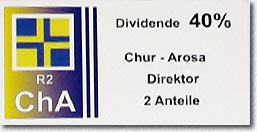
1844 Director Share

Another important fact is the distribution of shares across the corporation’s
certificates. Like in 1830, the major corporations have a 20% director’s share and 8
10% shares. The small regional corporations have a 50% director’s share and two 25%
shares and the early corporations have a 40% director’s share plus three 20% shares.
Buying the director share of a regional is rather attractive as the corporation floats
immediately and even an early corporation floats after only 2 certificates have been
bought. The SBB comes with 5% certificates which make the corporation a favourite for
stock manipulations in the end phase of the game.

The mechanism for handling the priority deal is a big improvement over 1830 since it
eliminates many manipulation possibilities. Priority deal now goes to the player with the
most money in hand, usually the least invested player.

1844 Oberalpbahn

In order to achieve a track system that resembles history in its basic principles,
each corporation has been asigned a target city. Once a route exists between the home
town and the target city, the remaining 50% of the corporation’s cash are paid to its
treasury. While this is a nice mechanism to take care of history it yields track systems
which are much more independent from each other than with for example in 1830. No fights
for the best routes around Boston and New York here but rather a well organised,
structured way of track building. In our game there was also no real fight with station
markers as hardly any corporation had enough money to lay them in the mid and end phase
of the game.

This shortage of corporation treasury is on the one hand caused by many mountains and
rivers which need to be crossed and on the other hand by the constant need to buy trains.
As opposed to other 18xx games one train is removed from the bank (“sold to a
foreign country”) after each set of operation rounds. This speeds up the game and
makes it impossible for players to run a single engine for very long.

Especially the 5 and 6 trains rust too quickly and become (permanent) H trains with a
rather limited range. This makes building large diesel type routes unnecessary and, due
to the mountains, even unattractive. This may be historically correct but does not appeal
to any empire building style of playing.

On the other hand, the game is much less cut throat as e.g. 1830. Villages have green
tiles thus making the blocking of routes virtually impossible. And share prices drop by
one field when shares are sold, independently of the number of shares sold, making stock
scams much more unlikely.

1844 final board

All in all, 1844 is a more than worthy member of the 18xx family. Helmut Ohley was
able to blend the characteristics of the Swiss railroad system into the 18xx concepts
very well and he managed to create a game with truly new and challenging mechanics.
Switzerland as a setting provides enough possibilities for this. Game play is very
balanced somewhere between empire building and cut throat stock market play. It appears
that there are a lot less “extreme” situations where a game can tilt in favour
or against a player, and ganging up on the leader seems to be more difficult, too.

A few words about the game material: looking at the professional quality of all
components it is hard to believe that 1844 is produced as a private effort. Compared to
Avalon Hill’s 1830 the components are of far better quality and even when looking at
the platinum edition of 1851 I still find that 1844 provides more value for money. And
last but not least: it comes with a full featured rule book, not just a “difference
list”, which makes it a true standalone game suitable just as like for novices and
experts of 18xx game series. Recommended!

Session Report & Review 11.09.2003

Session Report & Review 11.09.2003

Author: Aaron

at the table: Loredana, Hans, Peter, Aaron

on the table: Titan – The Arena, Maestro, Ra, Traumfabrik

This has been one of our few 4 player evenings and with the exception of Maestro we
made it a “Knizia only” game session. Interestingly, because unplanned, and
besides the fact that three games had Knizia as the author we found that this was an
evening where all games played had some commonality either in theme or game
mechanics.

  1. Titan – The Arena

    We have already publish a review of this unfortunately
    out-of-print game some time ago.

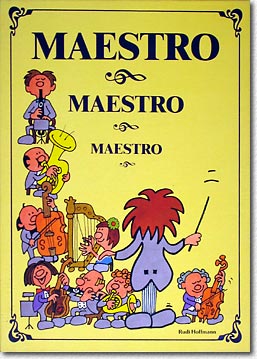
  2. MaestroMaestro - box

    Just a few short word about Maestro, a Rudi Hoffmann attempt that has been one of the
    nominees of “Spiel des Jahres” in the year 1989. Each player owns an agency of
    musicians. A maximum of 10 artist tiles can be placed in the agency (up to 3 per turn
    drawn randomly from a sack). Each musician plays a instrument and its the players’
    task to place their musicians on one of the 10 pieces (from Darius Milhaud’s duo
    Scaramouche to Rudolf Kummerer’s septet Alpenjägermarsch) that require these
    musicians.

    Once the hiring of musicians for a piece has been started by placing a Maestro on one of
    the available musician slots a player may place any number of musician on that piece per
    turn as long as he plays the required instrument and the tiles are placed in sequence
    next to the Maestro. Each such played artist yields 5 victory points. If a player is able
    to place all artists including the Maestro in one single turn, thereby completing the
    piece, each artist placed yields 10 VPs. A player completing a piece receives the
    “critic” which yields 10 VPs to that player each turn, forcing the other
    players to start and finish pieces themself quickly. The game ends when a total of 14
    “applause” tiles have been drawn from the musician tile sack.

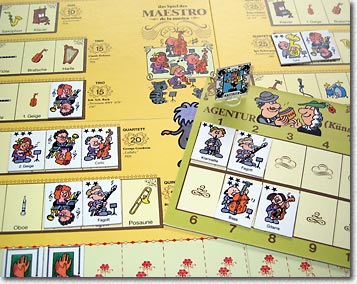
    Maestro - boardSounds simple enough and not very challenging in terms of tactics
    but there are a few things which make the game more demanding than one first thinks.
    First of all, the agencies are split into a public and a private section, allowing
    players to hire artists from the public parts of all other players’ agencies. This
    makes filling the slots a little tactical (and risky) as players want to place important
    (i.e. rare) musicians in the private slot of their agency. On the other hand these slots
    yield a lot more negative VPs when still filled with artists at the end of the game.

    The second thing to watch is the placement of the Maestro himself. Since the Maestro tile
    covers a musician slot in a piece players like to cover exactly those musicians that are
    placed in the private area of the other players’ agencies, rendering them more or
    less useless and a likely candidate for providing negative VPs at the end of the game.

    Maestro is a family game, not too demanding, with a good amount of luck and it can be
    played quickly. Interestingly, we only realized at the end of the evening that due to its
    mechanisms it fits very well into the game selection of our session.

  3. Ra

    This game, too has been reviewed by us before: review.

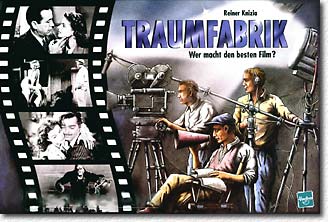
  4. TraumfabikTraumfabrik - box

    This Essen 2000 release of Reiner Knizia has been published by Hasbro, nowadays not
    necessarily a recommendation for serious gamers. But since it’s a Knizia game and
    Peter even stated it to be one of the best Knizia games he’s ever played it was on
    the table as the final game of the evening (after convincing Loredana to play it again
    when she mentioned that she’d played it too often in the last few weeks).

    Traumfabrik, or “Fabrik der Träume” as it was renamed some time ago, is a
    bidding game about movie making. Players try to get artists (director, camera, actors,
    special effects, guest stars) for the free slots of their movies and once a movie is
    completed it yields a number of victory points based on the value of the artist (Knizia
    appears as an actor with value -1, I guess he knows best why). Special prizes (victory
    points) are allocated to the best movie of each of the four categories, the first movie
    of a category and the worst movie of all (here’s where Knizia as an actor comes in
    handy).

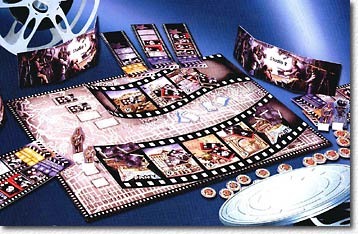
    Traumfabrik - boardThe game is played in four rounds and each
    round has 6 auctions and 2 parties. The two to three artists available at each of
    the six auctions of a round are randomly drawn and are revealed at the start of a
    round so each player is able to decide on a suitable bidding strategy for the
    complete round. The artists available at the two parties (one artist per player) are
    not revealed in advance and they are not auctioned off but are selected by the
    players in sequence based on the number of already hired actors of a player.

    At the start of the game each player receives money for bidding in an auction and after
    each auction the money bid is paid by the highest bidder and distributed equally amongst
    the other players (any modulo is saved for the next auction). As soon as a player has
    filled all available slots and the VPs have been assigned they draw the next movie from
    an open pile.

    The game ends after 4 rounds. Now the special prizes for best and worst movie are
    allocated and the total number of VPs calculated. Any bidding money still in the players
    possession counts as VPs.

    There is an element of luck in the game but it is acceptably low because all available
    artists of the 6 auctions per round are visible when a round commences. The distribution
    of movies at the start of the game is fair (each player has one movie of each category)
    and the initial values of the movies appear to be identical. The key element of
    Traumfabrik is clever bidding and if you like aution games Traumfabrik is definitely a
    game for you. Or in other words, if you like “Modern Art” by Reiner Knizia, you
    will also like Traumfabrik. Another nice touch is that, similar to Modern Art,
    Traumfabrik is able to provide a flair which matches the game’s theme very well. All
    movies in the game are classics and it’s fun to fill the artists positions with
    famous people from the movie industry – the end result most of the time being rather
    hilarious.

    I disagree with Peter about Traumfabrik being one of the best Knizia games. Traumfabrik
    is very good no doubt and I liked it a lot, but Modern Art in my opinion still is the
    better of these two Knizia bidding games.

Session Report & Review 13.08.2003

Session Report & Review 13.08.2003

Author: Moritz

at the table: Andrea, Aaron, Hans, Günther, Peter, Moritz

on the table: Tutanchamun, Restaurant, Medici, Bluff

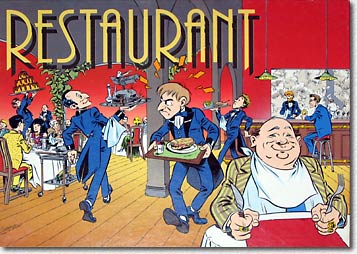
  1. RestaurantRestaurant box

    This older game from the otherwise pretty reliable and long defunct company Flying Turtle
    did not rock our world – instead it garnered laurels as being one of the worst rated
    games in our group ever! The theme and cards remind one immediately of a more long-lived
    game: “Café International“, but whereas in “Café International” the
    goal of the game is placing the guests for victory points, “Restaurant” deals
    with fulfilling orders to become the most successful waiter.

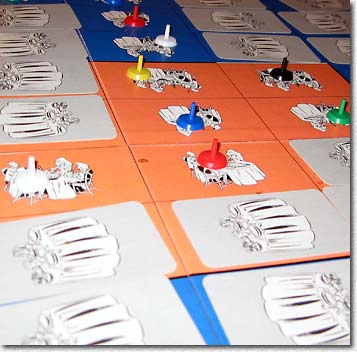
    The game consists of two phases: In the first phase players collect orders from the
    various tables by “exploring” the orthogonally adjacent table next to the last
    explored table and leaving a pawn of their own colour on the empty space. You’ll find
    various menus ranging from 100-600 points worth, “Jump cards” (enable you to
    choose any table as your next table), “Go twice” cards, which enable you to,
    well, go twice, and “Fast food” cards, which let you steal menus from other
    players (drawn blindly). There are also “reserved” cards, which let you place
    the orders you collected until then in a “safe” stack that cannot be robbed.

    The phase continues until either all tables have been explored, or the players have
    manoeuvred themselves in a dead end (which you can’t until at least 30 tables have
    been uncovered). Now points are counted and the lowest scoring player begins the second
    round. Now you have to place the cards on the tables, i.e. “serving”
    them. Only cards you place on your “own” spaces (with a pawn) will give you
    points, therefore it is important to have your pawns well spread in the first phase. The
    other cards can be used like before, with the difference of the “fast food”
    cards, which can now be used as worthless cards to be placed on other players tables (if
    you can’t reach your own ones). For some strange reason the “cover at least
    30” rule does not apply here, therefore the game can end very quickly by a player
    moving into a dead end (and the leading player will always do that). Now the cards are
    counted again, but this time the cards in your hand count negative (and the
    “reserved” cards double negative). The scores of the two phases are
    added and determine the winner.

    Restaurant board Many problems become apparent in the description
    already. The worst aspect of the game is the fact that the luck of the card draw is
    actually heightened by being able to use them twice (you keep all your cards and go
    through them again). The “Jump” and “Go Twice” cards are the
    worst offenders. “Jump”, for example, not only gives you the ability to
    spread your pawns to other areas of the board, no, you can use it again to
    safely place your cards on your tables in the next phase (which otherwise is very
    difficult to achieve). This makes the drawer double lucky (and the other players
    look on sheepishly). In our game I only drew menu cards and two reservation cards.
    Most of the cards were stolen by other players with their “fast food”
    cards, until I could use the reservation cards to protect the other cards. The
    second phase started with Peter and then Guenther played a jump card to place an
    order in a dead end, thereby ending the game without giving anybody the chance to do
    anything. As he had earned the most points in the round before, he therefore also
    became the winner. My reservation cards now pushed my negative points to the max,
    and I didn’t even get to have a turn!

    From the perspective of Guenther this was the best play, but of course a mechanism which
    allows this makes for a very unsatisfying game, in which you certainly feel
    “played” rather than being a player.

    For a German game this one has a very high luck factor, and there is practically no
    decision making, so it is easy to say that this is simply not a good game (and the
    artwork is bad and uninspired, too). The only thing going for it is its short length, but
    you can play more interesting games that have the same trait. Avoid, if you can…

    Moritz Eggert

    How to win “Restaurant” – a well-researched and extensive strategy guide by
    Moritz Eggert: Draw the right cards!

Spielbericht & Review 30.07.2003

Spielbericht & Review 30.07.2003

Author: Peter, Hans

at the table: Aaron, Hans, Günther, Peter, Walter

on the table: Andromeda, Tutanchamun, Bluff

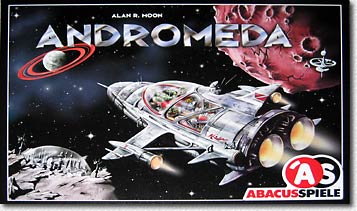
  1. AndromedaAndromeda box

    At the time of writing, Andromeda is on sale at Adam spielt. For a bargain price of a mere 5 Euros, you can get
    this beautiful game. Thus Aaron bought not only his game but another one to be offered as
    incentive for writing the Andromeda review. As it turned out, I was desparate (greedy?)
    enough to accept the offer.

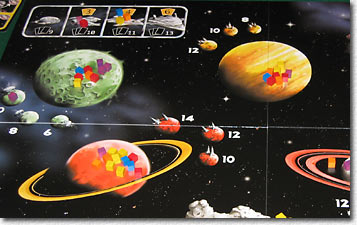
    The main gaming mechanism of Andromeda is using the Gate. Physically, The Gate is an
    ashtry-shaped plastic device. Players get little wooden cubes in their respective colors
    on the seven planets on the board. So each planet has an assortment of little cubes in
    different colours. When you use the Gate, you cover all cubes with the plastic tray, put
    a finger on the exit and make it rattle so to mix the cubes up well. Then you open the
    exit and slowly draw the Gate in one direction. The cubes will exit one by one. When a
    cube of another player’s colour is drawn, it is sent back to planet Earth (giving
    you, needless to say, better odds). When a cube of your colour is drawn, it occupies one
    of the scoring fields of the plant. Each planet has three of them. As soon as all of them
    are occupied, this planet loses all interest to the players.

    The rest of the playing mechanisms basically provide the framework for the getting the
    cubes on the planets in the first place and, of course, for bringing the Gate into
    action. Both of those actions are paid (as are “the technological advances”,
    which basically modify certain rules for the player who attained them) by sets of
    identical cards which match the different planets. A set of three lets you send one cube
    or draw once at the matching planet, a set of four or five lets you send two or draw
    twice, a set of six or seven lets you send three or draw three times. Whenever you play a
    set of four or better, you get a wildcard for free which gives you bonus points as well
    (and a wildcard for playing five has a higher point value than a wildcard for playing
    four, that’s why it makes sense to play sets of five if should have wondered).

    Andromeda board At the start of each turn, you complete your card hand to 9
    cards (or more, depending on technological advances). As you can guess by now, the
    winning strategy of this game is (apart from shaking the Gate in a way that your
    cubes exit) drawing identical cards of the planet you are interested in. Okay, there
    is a way for trading cards between the players. However, it is highly formalised.
    The starting player of each turn offers one planet card. All other players must
    offer him a different (i. e., different from his offer) planet card in return. Then
    he offers a second card, and the others must offer another card which neither
    matches his first or second card. This can be repeated once (or twice, with a
    certain technological advance). The starting player now has to change this offer
    with the one of another player, who in turn can accept the starting player’s
    offer or turn to another player’s offer instead and so on.

    Of course, this procedure favours the starting player very much. Even worse, the
    starting player gets three actions (exchanging cards or playing out sets of cards)
    whereas all other players only have two.

    I do like the basic ideas of game play. The Gate is some kind of two-dimension
    Würfelturm (you know Zeichen des Kreuzes or Wallenstein, don’t you?), and since drawn
    cubes of other players are removed, you always get something in return whenever you
    paying for drawing. The formalised trade is annoying at times, but on the other hand, you
    definitely can develop tactics (“if I offer my wildcard, the starting player might
    take my offer, and I can get those planet cards player C offers”).

    But don’t be fooled into believing this game could be controlled. It cannot. If the
    players present do intellectually understand even the most simple concepts of tactical
    gameplay, it is all about luck. What bothers me most is that the oldest player or the
    next one in turn order tends to win. That’s how the rules establish the first
    starting player – if you prefer, say that the very first draw (i. e., who’s the first
    starting player) might decide the game.

    Therefore some proposed rule amendments to make Andromeda more agreeable to seasoned
    players:

    • Don’t stop the game when all three scoring fields of three different planets are
      occupied. Instead, continue until every player has been starting player twice (or perhaps
      three times).
    • Don’t allow the starting player a third action. Let him have two as all others.
      He’s already strong enough.
    • The scoring fields of the planets are different. The most valueable one has 14, 12,
      10, those least have 8, 6, 4. Since you cannot plan which cards you draw, this difference
      introduces a fair amount of luck. Therefore, let them have all 10, 8, 6.

    Verdict: It’s fun to play. But it won’t be classic. Be sure to get your copy for
    5 Euros.

    Peter Riedlberger
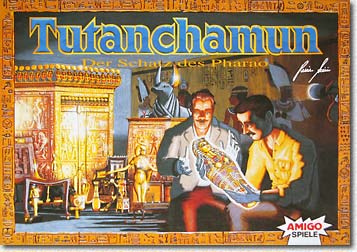
  2. TutanchamunTutanchamun box

    ” Rapidité, Rapidité … ” oder: “Wer zuerst kommt, mahlt zuerst”.
    Zwei bis sechs Archäologen (oder besser: Grabräuber) versuchen, wertvolle Schätze
    einzusammeln und für Siegpunkte zu verwerten, bis der erste die geforderte Punktzahl
    erreicht hat. Dann ist Schluss! Der Sieger steht fest, das Spiel ist vorbei. Es gibt
    keine festliegende Zahl von Spielrunden oder von Wertungen. Das variable Ende setzt jeden
    von Anfang an unter Druck, möglichst zeitsparende Pläne zu verfolgen. Jede Entscheidung
    zählt, insbesondere bei fünf oder sechs Mitspielern.

    Was passiert in “Tutanchamun”?

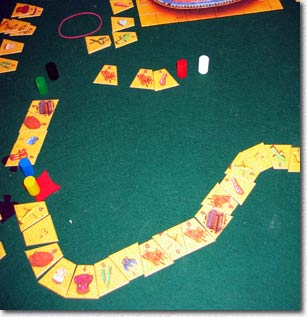
    Zur Spielvorbereitung werden die 69 Schatzkärtchen gemischt und zufällig verteilt in
    einer langen, sich windenden Reihe ausgelegt. Dies ist der Pfad, auf dem sich die
    Spielfiguren bewegen. Am Ende des Pfades befindet sich die große Pyramide, in der als
    besonderer Bonus die Goldmaske des Tutanchamun wartet.

    Wer an der Reihe ist, setzt seine Spielfigur entlang des Pfades weiter, stellt sie auf
    ein Schatzkärtchen und nimmt dieses an sich. Die Zugweite ist beliebig.

    Aber: es gibt kein Zurück. Ein Schatzkärtchen, das passiert worden ist, kann von dem
    Spieler nie mehr aufgesucht und eingesammelt werden. Wer das Ende des Pfades erreicht,
    sammelt nicht mehr, nimmt aber an den Wertungen teil, die die anderen Spieler auslösen.
    Es ist wie beim Golf; auch im Klubhaus kann man das Turnier gewinnen.

    Es gibt 15 Schatzarten: je 3 sind dabei achtfach, sechsfach, vierfach, doppelt und
    einfach vorhanden. Dazu kommen sechs Schätze ohne Sammelwert, die Aktionen erlauben. Wer
    die meisten Kärtchen einer Schatzart gesammelt hat, bekommt im Moment der Wertung
    entsprechend 8,6,4,2 oder 1 Punkt. Der Zweitplazierte (oder bei Gleichstand die beiden
    Ersten) bekommen die Hälfte. Gibt es beim zweiten Platz Gleichstand, oder teilen sich
    mehr als zwei Spieler die Mehrheit, entfallen die Punkte dafür. Beim Spiel zu fünft
    gewinnt, wer als Erster 16 Punkte erreicht. Bei weniger Mitspielern ist die Grenze höher,
    bei sechs Spielern braucht man nur 14 Punkte.

    Von den sechs Aktionskärtchen erlauben drei, einem Mitspieler ein Kärtchen zu stehlen
    (als Entschädigung gibt es für das Opfer einen Siegpunkt). Drei fungieren als Joker; bei
    einer Schatzwertung können sie als Tie-Breaker eingesetzt werden. Gibt es keinen
    Gleichstand, sind sie nicht zu verwenden. Die Goldmaske des Pharao schließlich kann bei
    einer Wertung als Joker eingesetzt werden, auch wenn es keinen Gleichstand gibt. Die
    beiden Joker-Effekte lassen sich kombinieren.

    Knackpunkt des Spiels ist: wie löst man Wertungen aus?

    Eine Wertung findet für einen bestimmten Schatz statt, wenn kein Exemplar dieser Art
    mehr aufgenommen werden kann, sei es, weil alle eingesammelt sind, oder, weil alle
    Spieler die noch ausliegenden Kärtchen dieser Art passiert haben. Klingt kompliziert, ist
    aber einfach. Die Kärtchen, an denen alle Spieler vorbeigezogen sind, kommen aus dem
    Spiel. Wenn das letzte Kärtchen einer Art aufgenommen oder weggelegt wird, geschieht die
    Wertung.

    Offensichtlich werden die Schätze, von denen Kärtchen nahe dem Ende des Pfades, an der
    Pyramide, liegen, wahrscheinlich später gewertet als die anderen – und sind damit weniger
    attraktiv! Eine andere offensichtliche Beobachtung ist, dass die drei nur einfach
    vorhandenen Schätze beim Betreten dem jeweiligen Spieler sofort einen Punkt einbringen.

    Tutanchamun board Was gilt es zu beherzigen?

    Wie im richtigen Leben gibt es viel mehr Optionen, als man wahrnehmen kann. Jeder Zug
    sollte maximal effizient sein, das Spiel ist kurz. Einen einfachen Anhaltspunkt gibt die
    folgende Überlegung: Typischerweise dauert ein Spiel mit fünf oder sechs Personen zehn
    Runden, möglicherweise weniger. Jedes aufgenommene Kärtchen sollte im Schnitt zwei Punkte
    bringen, und das, bevor die zehn Runden um sind!

    Die Erfahrung lehrt, dass es wichtig ist, sich nicht zu verzetteln. Wertungen zählen,
    nicht gesammelte Schätze. Um die Mehrheit bei einem der drei 8er-Schätze sicher zu haben,
    reichen möglicherweise fünf gesammelte Kärtchen nicht aus, wenn ein Mitspieler eine Karte
    stiehlt und/oder Joker besitzt. Kämpfe, die sich über mehrere Spielzüge hinziehen, lohnen
    sich nicht. Man sollte so schnell wie möglich zwei Kärtchen einer hochwertigen Schatzart
    aufnehmen, die die Mitspieler bisher nicht sammeln, das schreckt ab. Wenn dann im Laufe
    des Spiels Kärtchen weggelegt werden, reicht oft die dritte Karte schon zur Sicherung der
    Mehrheit.

    Gift sind natürlich die Schätze, die spät gewertet werden. Wenn man gezwungen ist, die
    letzten Kärtchen einer Art selbst aufzunehmen, nur, damit die Wertung kommt, hat man
    schon verloren. Andersherum betrachtet: von den Schätzen mit jeweils dem gleichen
    Punktwert ist der der attraktivste, der von der Pyramide am weitesten entfernt ist.

    Daraus ergibt sich, dass einige hochwertige Schätze umkämpft sein werden. Zweite Plätze
    sind hier nicht zu verachten, wenn man dafür nur ein, zwei Kärtchen aufnehmen muss.

    Wenn die ersten Kärtchen aus dem Spiel fallen, gilt es, ein Auge für schnelle Punkte
    offen zu halten. Wenn von einer 4er-Schatzart ein Kärtchen wegfällt, reicht eines der
    verbleibenden schon für den zweiten Platz. Fehlt bei einer 2er-Schatzart eines der
    beiden, bedeutet das andere sofortige zwei Punkte. Die anfangs unattraktiven Schätze
    können wieder interessant werden, wenn bis auf zwei Kärtchen alle übrigen weg oder
    vergeben sind. Dann kann es sein, dass weite Sprünge ans Ende des Pfades den Sieg
    bringen.

    Die Joker sollte man bevorzugt am Anfang des Spiels aufnehmen. Dann haben sie
    abschreckende Wirkung und geben dem Besitzer Flexibilität. Je länger das Spiel dauert,
    desto eher ist es Zeitverschwendung, Joker zu nehmen. Beim Stehlen ist es umgekehrt: das
    tut besonders weh, wenn die Verhältnisse sich bereits klären. Es ist jedoch Vorsicht
    geboten! Feinde kann man nicht gebrauchen. Es sollte also nur bestohlen werden, wer sich
    nicht wehren kann (auch wie im richtigen Leben :-) Und nicht vergessen: der Bestohlene
    kriegt einen Siegpunkt! Also nur die Armen bestehlen…

    Irgendwann steht fest, welche Züge (die Wertungen herbeiführen, wo man vorne liegt, die
    anderen verzögern) man noch machen muss, um die Gewinnschwelle zu erreichen. Wer dann den
    kürzesten Plan als erster verwirklicht, hat’s. Zu schade, dass man meistens eine
    Runde zu spät fertig wäre, zu schade, wenn die Mitspieler dazwischenfunken. Wundervoll
    dagegen, wenn ein Mitspieler in Zugzwang gerät und die Wertung auslöst, die man noch zum
    Sieg braucht.

    Mir gefällt das Spiel sehr, weil es die effizienteste Spielweise ganz direkt belohnt und
    weil es mit eleganten, kurzen Regeln und mit wenig, dazu schön gestaltetem Spielmaterial
    auskommt. Der Nachteil, den einige von uns sehen, ist, dass es (bei vielen Mitspielern)
    gegen Ende zu einer Vielzahl von Wertungen in kurzer Zeit kommt, auf die der einzelne
    nicht genug Einfluss hat. Unbefriedigend ? Ich sage dazu: C’est la vie!

    Wertung: 6.6 (fünf Mitspieler)

    Hans Frey

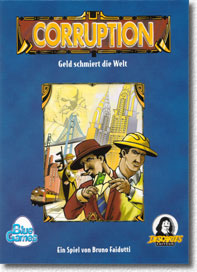
Corruption

Corruption

Corruption

Publisher: Eurogames/Jeux Descartes

Author: Bruno Faidutti

Tester: Aaron Haag

Game Tested: 1st release 2000

Scenario: Money makes the world go round – especially in a world of bribery and
corruption. Three to seven players try to win valuable contracts by cleverly bribing
government bodies.

The Game: Three government bodies – the city hall, the county administration
and the capitol offer building contracts of values between $100.000 and $1.200.000.
Players each receive a deck of identical cards consisting of 6 bribe cards valued $1.000
to $10.000 and four character cards – two journalists, a hit man and a judge.

The game plays over four rounds, each round beginning with randomly drawing two
contracts per government body. These contracts are now on offer to the players, which try
to place the highest total bribe for the contracts they like – most probable the highest
valued ones on the table. Players have a choice of either placing their bribe card
directly below a contract or putting it above the government body card, which represent
the Swiss bank account of the respective body. After having played six cards each a round
is complete and the contract is awarded to the player with the highest bribe on that
contract.

This sounds pretty straight forward and far too simple for a Bruno Faidutti game. And,
of course, there are a few little things that make the game much more interesting. First
of all, depending on the round played some cards are placed face down, thereby not
reveiling their bribe value. In the first round only the first card played by a player is
face up with each round adding one more open card.

Then there are the character cards which may be played instead of a bribe card but not
in the Swiss bank account. Once all players have placed their six cards hit men take
their turn in order of play by killing one other character played for the same contract.
Then any remaining judges act by voiding all bribes played on “their” contract
so that the contract is not awarded in this round. And finally the journalists step in
who negate one bribe card each, chosen by the player who played the journalist. Money
placed into the Swiss bank account of a government body is of course safe from
journalists but the big drawback is that this money is only counted half when finally
tallying the bribes.

A new round starts with two new contracts for each of the government bodies and all
bribe cards are returned to the players. Character cards however act only once and are
not returned. The player with the highest total contract value goes first in placing new
bribes.

Playing Time: The game can be explained in less than 10 minutes and played in
about 30 to 45 minutes.

Similar Games: Banana Republic, Dolce Vita,
Ex&Hopp, Raj

Westpark Gamer’s Opinion: The game very much reminds of “Banana
Republic” by Doris & Frank and Bruno gives due credit to this game in the rules
where he also describes that he has been inspired by stud poker. This is of course a game
of bluffing but here every player has the same 10 cards and there is no element of luck
by randomly dealing out cards. Hence the resemblance to stud poker is very low. The
psychology of the game is much more like Banana Republik or even Raj (Hol’s der
Geier) in that you exactly know which resources are available to each player and that you
are left with guessing and double guessing the other players’ tactics.

With a small number of players the game may become a little dry due to very little
direct player interaction and depending on the group a lot of quiet thinking. With more
players the stack of bribe cards per contract is so large that it becomes almost
impossible to guess on the tactics of other players and people tend to gang up on the
leader.

Overall this is a nice little game which can be played as a starter or finisher of an
evening of gaming. I personally prefer a quick game of Raj or Liar’s Dice,
though.

Aaron’s Rating: 5 (out of 10)

Westpark Gamers’ Rating: 5.0

Links to further information: Bruno Faidutti’s page with english rules and an FAQ
Luding link for Corruption
link to Atlas Games’ Corruption page

Spielbericht & Review 09.07.2003

Spielbericht & Review 09.07.2003

Autor: Walter, Moritz

am Tisch: Aaron, Hans, Günther, Moritz, Peter, Walter

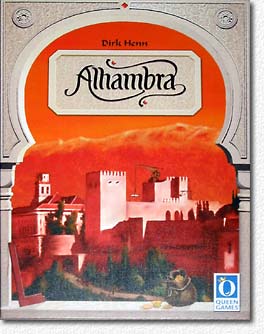
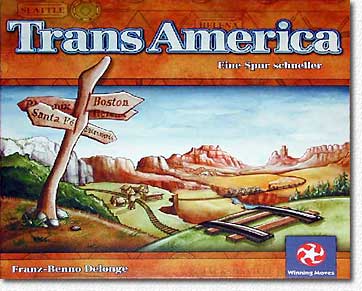
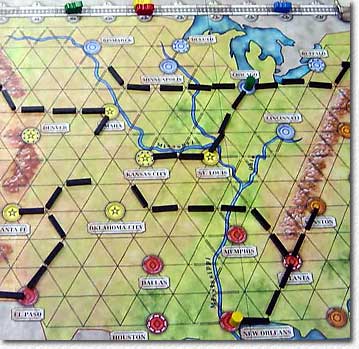
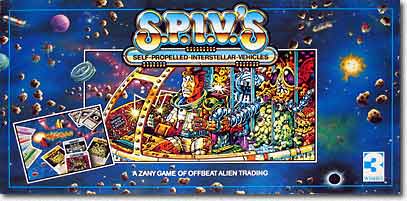
auf dem Tisch: Alhambra, Transamerica, S.P.I.V.’s, Bluff

  1. AlhambraAlhambra

    Als Spiel des Jahres 2003 sollte es Alhambra wohl verdient haben, ein zweites Mal auf
    unseren Tisch zu kommen. Sechs Mitspieler sollten sich noch mal ein eigenes Urteil
    darüber bilden können, warum dieses Spiel die höchste Auszeichnung gewonnen hat. Auch
    wenn unsere Orc-Fraktion gleich zu Beginn ihre Bedenken angemeldet hatte.

    Das Spiel läuft recht linear ab. Wer am Zug ist, kauft entweder eines (u.U. auch
    mehrere) der ausliegenden Gebäude und / oder nimmt sich einen (u.U auch mehrere) der
    ausliegenden Geldkarten. Wer am Ende die “besten” (was immer das ist) Gebäude
    erstanden hat, ist Sieger. Es wird nicht nur am Spielende gewertet, sondern auch –
    zufallsentschieden – nach ca. 1/3 bzw. nach 2/3 der Spielrunden und alle Ergebnisse
    werden zusammenaddiert.

    Welches sind nun die charakteristischen Elemente von Alhambra?

    1. Handlungsspielraum

      Jeder Spieler am Zug hat eigentlich nur einen geringen Handlungsspielraum:

      a) Eine oder mehrere der ausgelegten Geldkarten nehmen.

      Das sollte sich lohnen, falls ein Wert von 7 oder höher angeboten ist. Der
      Durchschnittwert ist immerhin nur 5. Mehrere Karten bis zu einem Gesamtwert von 5 zu
      nehmen ist schon eine zweischneidige Sache. Man kann sich damit natürlich Kleingeld
      besorgen, um beim nächsten Einkauf auf den genauen Kaufpreis zu kommen. Allerdings werden
      anschließen entsprechend viele, d.h. mehrere, neue Geldkarten aufgedeckt, und wenn dabei
      ein paar Spitzenwerte sind, landen die ausschließlich in den Händen der nachfolgenden
      Spieler.

      b) Eine Gebäudekarte für den genauen Kaufpreis kaufen.

      Dies sollte man fast immer tun, wenn man es kann, da man dadurch eine weitere Aktion
      dazugewinnt. Man sollte es aber bleiben lassen, wenn das angebotene Gebäude für die
      eigenen Bebauung wenig geeignet ist, wenn es zudem teuer ist, und wenn ersichtlich ist,
      daß andere Mitspieler darum kämpfen werden (die sich hoffentlich darum streiten und mich
      als lachenden Dritten zurücklassen).

      c) Eine Gebäudekarte für einen überhöhten Kaufpreis kaufen.

      Das ist nur sinnvoll, wenn die Karte wirklich (einschließlich Überzahlung) billig ist,
      von den Außenmauern gut in die eigenen Planungen paßt, eine bevorzugte Bebauungsart
      besitzt und / oder als Mehrheitsbeschaffer eine besondere Bedeutung besitzt.

    2. Gebäude-Bewertung

      Kommen wir gleich zu den Präferenzen, mit denen ich Gebäudekarten erwerbe:

      a) Außenmauern

      Gebäudekarten mit mindestens zwei Außenmauern, die sich gut in meinen Landschaftsgarten
      einfügen, kaufe ich fast immer. Ganz besonders gern am Anfang, da die ersten Außenmauern
      (also diejenigen, die man vor der ersten Wertung ersteht) DREIFACH zählen, nämlich für
      jede Wertung einmal. Auch sonst bringen Mauern eine konstante und ungefährdete Einnahme.
      Ich halte es durchaus für eines der strategischen Ziele von Alhambra, “die
      längste” zu haben.

      b) Erschwinglichkeit

      Billige Gebäudekarten (zum Preis von 4 Geldeinheiten) kaufe ich immer, wenn ich das
      passende Geld habe. Ich kaufe sie fast immer, wenn ich dabei nur wenig überzahle. Da der
      Durchschnitt der ausliegenden Geldkarten genau 5 ist, verliere ich immer
      Aktionsmöglichkeiten (d.h. ich muß mich häufiger als sonst nach neuem Geld umsehen), wenn
      ich teure Gebäude erwerbe.

      c) Gebäudetypen

      Gebäudetypen haben es in sich. Hier lohnt es sich, nur auf die höherwertigen Typen zu
      setzen. Vergleichen wir nur mal die Extreme, d.h. Türme und Pavillons. Bei der ersten
      Wertung bringt die Mehrheit für Türme 6 Punkte, diejenige für Pavillons nur 1 Punkt. Da
      darf man ruhig sechs mal soviel Energie in die Türme investieren. Schließlich bleibt die
      erworbene Mehrheit ja nach der Wertung erhalten. Bei der zweiten Wertung beträgt der
      Unterschied 13 zu 8 Punkte. Insgesamt werden für Türme 65 Punkte verteilt, für die
      Pavillons nur 35 Punkt, also etwa die Hälfte.

      Auch wenn ein Konkurrent mir die Mehrheit weggeschnappt hat, bekomme ich bei der zweiten
      Wertung als Besitzer der zweitmeisten Türme noch 6 Punkte, bei den Pavillons nur 1 Punkt.
      Besitzen zwei Spieler gleichgroße Besitzanteile, dann erhalten beide für die Türme in der
      ersten Wertung immerhin noch 3 Punkte, in der zweiten Wertung 9 Punkte, bei den Pavillons
      geht man in der ersten Wertung leer aus, in der zweiten erhält man 4 Punkte.

      Fazit: Ohne auf die Anzahl der Gebäudetypen jeder Farbe, ohne auf ihren
      durchschnittlichen Preis und ohne auf die Wettbewerbssituation bei den Mehrheiten genauer
      einzugehen, möchte ich einen Turm von den Siegpunkten her mehr als doppelt so hoch
      einschätzen wie einen Pavillon. Diese Differenz ist zweifellos nicht sehr ausgewogen. Ich
      hielte es für besser, von den wertvollen Gebäuden noch ein paar zusätzliche Karten mehr
      ins Spiel zu bringen.

    3. Glücksfaktoren

      Kommen wir noch zu den Glücksfaktoren, die zu einem guten deutschen Spiel halt auch
      gehören.

      a) Welche Gebäudekarten werden aufgedeckt?

      Diejenigen, die schon daliegen, sind offensichtlich zweiter Wahl, denn die Mitspieler
      haben sie links liegengelassen. Aber diejenige Karte, die für mich neu aufgedeckt wird,
      ist reiner Zufall. Wenn ich Glück habe, bekomme ich genau für meine Geldkarten ein
      passendes und wertvolles und preiswertes Angebot. Vielleicht auch nicht.

      Hier eine kleine Bemerkung zum Kaufen von mehreren Gebäudekarten mit einem Zug:
      Selbstverständlich bemüht sich jeder, den Kaufpreis exakt zusammen zu bekommen und sich
      damit zusätzliche Aktionen zu erwerben. Wer aber gleich mehrere Gebäude kauft, erhöht
      damit die Wahrscheinlichkeit, daß sich unter den anschließend neu aufgedeckten Gebäuden
      ein paar Perlen befinden, die großzügig den Nachfolgern überlassen werden.

      b) Welche Geldkarten werden aufgedeckt?

      Normalerweise sind die ausliegenden Angebote an Geldkarten und Gebäuden alle nicht
      besonders attraktiv; die wirklich guten Sachen haben sind die Mitspieler längst unter den
      Nagel gerissen. So trägt jeder die Hoffnung in sich, wenigstens in den neu aufgedeckten
      Geldkarten einen Goldschatz zu finden. Hier bleibt es dem Wirken des blinden Zufalls
      überlassen, Haupttreffer und Nieten auszuschütten.

      c) Zeitpunkt der Wertung

      Die Auslösung der Wertungen ist ungerecht: nicht alle Spieler habe die gleiche Anzahl
      von Zugmöglichkeiten gehabt. Bei der ersten Wertung haben die Spieler etwa vier bis fünf
      Gebäude ersteigert. Wer einen Zug mehr hatte, konnte demnach etwa 20 % mehr Immobilien
      erwerben. Bei der zweiten Wertung setzt sich ein zusätzlicher Zug immerhin noch in 10 %
      mehr Besitzstand um. Ich fände es besser, wenn bei der Wertung alle Spieler zum Zeitpunkt
      der Wertung gleichviel Zugmöglichkeiten gehabt haben.

      Das könnte man durch zwei Regeländerungen bewirken:

      1. Nach dem Aufdecken der Wertungskarte wird noch solange weitergespielt, bis die Reihe
        wieder an den Startspieler gelangt ist. Erst dann wird die Wertung durchgeführt.

      2. Die Wertungen werden ausgelöst, wenn jeweils der Startspieler an der Reihe ist.
        Entweder nach vordefinierten Rundenanzahlen oder vom Startspieler – mit steigender
        Wahrscheinlichkeit – ausgewürfelt, wird festgelegt, ob jetzt die Wertung
        stattfindet.

      Dadurch besäßen allerdings die letzten Spieler einen Spielvorteil, weil sie die
      gebotenen Mehrheiten besser überblicken können. Deshalb sollte hier nach jeder Wertung
      der Startspieler wechseln.

    4. Gesamtwertung

      Das Spiel ist für jedermann geeignet, der Zahlenkombinationen im Zahlenraum bis 13
      sicher beherrscht. Er sollte auch nicht farbenblind sein, damit er Geldsorten und
      Gebäudetypen besser unterscheiden kann. Obwohl hierbei auch die aufgedruckten Schriften
      und Formen helfen. Beim Erwerb von Gebäuden mit passenden Außenmauern gehört schon ein
      gewisses geometrisches Verständnis dazu. Wer aber rechtzeitig im Sandkasten damit
      angefangen hat, sollte auch dieses Problem bewältigen können.

      Die oben geschilderten Überlegungen und Präferenzen bei den Spielzügen klingen
      vielleicht etwas kompliziert, sind es aber keineswegs. Meist bietet sich jedem Spieler
      sowieso nur entweder ein einziger sofort einleuchtender guter Zug oder mehrere mäßige
      fast gleichwertige Alternativzüge an. Und wer nicht kalkulieren will, der kann das Spiel
      auch einfach vor sich hin spielen.

      Interaktion zwischen den Spielern gibt es nicht, es sei denn, das Nachschauen, welche
      Gebäudetypen bereits vergeben sind und das Merken, welche Geldkarten jeder Spieler
      aufgenommen hat, will man unter diese Kategorie einreihen.

      Schließlich ist noch ein bißchen Zufall eingebaut, damit das Spiel seine Variationsbreite
      bekommt. Jeder darf glauben, eine Strategie oder wenigstens eine Taktik verfolgen zu
      können. Genügend für ein “Spiel des Jahres”?

      Walter Sorger

    WPG-Wertung: 5,6

  2. Transamerica

    This is one of the good “filler”-games that the German games market (sometimes)
    excels in. “Transamerica” has extremely simple rules but also enough tactical
    decisions to keep your brain in action. It also plays extremely quickly, with any number
    of players, and games lasting rarely longer than 30 minutes. The downtown of a game turn
    comes close to nothing, which is a big plus of the game.

    Although there is obviously a train building theme the game is basically a pretty
    abstract connection game. On a map of North America there are 5 colour groups of (actual)
    cities. Each player draws 5 different cards, one for each colour group. The goal of the
    game is to be the first player to connect all the cities with train tracks (the colour
    coding ensures you have to cover a good part of the board). The hitch: They don’t
    have to be your own tracks! Any track built is simply a black token. Every player
    determines a starting point and can build tracks from there. If his tracks connect with
    other players tracks he “inherits” their network and can now also use these
    connections to expand. Of course the other players can do likewise if you connect to
    them. You have 2 building points each round – most tracks cost 1 BP, but some also cost 2
    (mountains and rivers).

    A round ends when one player finishes all his connections. S/he scores 0, the other
    players score negative points corresponding to the tracks they would have to build to
    finish their own connection. After usually 3 rounds one negative scorer will cross a
    threshold and the game ends, giving the win to the player with the least negative points.

    I have initially disliked the game as being a pretty weak connection game, but increased
    playing, especially with several players, show that there is some subtle strategy
    involved. TransamericaHere are some tips for winning:

    1. The first pawn

      Placing your starting pawn is decisive. Basically you don’t want to be too far apart
      of the others, but also not in the middle of it, where you lose any advantage connected
      to having “your own little part of the board”. A good idea is to plan
      developing a network on your own which, in mid-game, becomes attractive to the other
      players so that they connect to it by themselves.

      A good rule of thumb is to select the two cities from your cards that are the closest
      together, and place the pawn in between them…. if you don’t end up on one of
      the coasts, which, in my opinion, is usually bad.

    2. Placing tracks

      This is a racing game, and you want to finish first. Think of your tracks as
      “energy points” and give yourself the goal of using as little energy points as
      possible to finish your network. This means that you have to invite other players into
      helping you building your own network while they think they expand their own. The mistake
      that new players (including myself) often make is happily building their own network and
      just hoping their cards were right and they will be first. This will never work. Watch
      the other players develop their network – it is usually easy to foresee their track
      building. Take advantage of it! If one colour area is not connected yet you can bet it
      will be soon: every player needs all colours to win.

      Also watch closely for a sudden death win – you cannot prevent it, but you might profit
      from a track connecting to the winning network in the last minute.

    3. Subtle placing strategies (very helpful!)

      For the first few rounds you should be happy with your little network, connecting 2
      cities. But soon you will need access to other networks. Don’t do it for yourself,
      let the others do it! A simple trick is to build one, and only one, track in the
      direction of a possible connection node. Build another one to another node, but don’t
      connect them. The more players are playing the higher the chance that one of the
      other players will do the dirty work for you and connect. If you have
      “lured” at least 2 players in doing just that, you will have gained a numerical
      advantage: they have saved one step of building, but you will have saved at least
      two
      (or even more). If you manage this trick round for round you’ll get a very
      good headstart for finishing your network first.

    4. Watch the others work

      The area in the middle of the board gets developed the most usually. Watch where the
      other players build tracks that come close to cities you need, but don’t
      connect…yet! Instead plan a “meta”-network that is able to connect to all
      this development areas interesting for you in as few as possible steps. Connect at the
      last moment to hinder other players getting the advantage of YOUR network (better: let
      them connect to you), but of course also not too late (see above).

      The “meta” network is much more important than building track after track to
      reach that out-of-the way desert city for you. Only place tracks where you absolutely
      must – other tracks might be built by others for you if you just wait a little.

    Moritz Eggert
  3. S.P.I.V.’sS.P.I.V.'s

    Da wir stetig auf der Suche nach einem 6er Spiel sind, das nicht den Glücks- (oder
    vielmehr Unberechenbarkeits-)faktor in die Höhe treibt, wagen wir es auch manchmal,
    ältere Spiele hervorzuholen und „anzutesten“, so also diesmal dieses leichte
    Weltraumhandelsspielchen. Little did we know…

    S.P.I.V.’s steht für „Self-Propelled-Interstellar-Vehicles“, und ist
    nichts weiter als ein alberner Titel für ganz gewöhnliche Raumschiffe.

    Öffnet man den Plan, werden Erinnerungen an „Merchant of Venus“ und
    „Cosmic Encounter“ wach, und tatsächlich spielt sich dieses Spiel auch exakt
    wie eine Mischung dieser beiden Vorgänger, ohne jedoch nur annähernd deren Spieltiefe
    und-Spass zu erreichen!

    Die Spieler sind Händler in einem kleinen Raumsektor, der mit einer Handvoll Planeten
    und 3 Basen recht übersichtlich gestaltet ist. Dieser Sektor ist in drei Untersektoren
    eingeteilt: In einem befindet sich ein schwarzes Loch, das gnadenlos Raumschiffe anzieht,
    im nächsten spuckt eine Supernova Feuer ins All, im dritten schließlich wütet eine
    gefrässige Amöbe. Aber auch sonst tummeln sich allerlei Gefahren – so beschädigen
    Asteroidenfelder das Raumschiff und verwirren Raumnebel die Navigationsinstrumente. Es
    gibt letztlich fast kein Feld auf dem Spielplan, wo einem nicht geschadet wird, und auf
    denen, bei denen nichts dergleichen lauert, zieht man bei schlechtem Würfelwurf eventuell
    sogar noch eine Ereigniskarte!

    S.P.I.V.'sJeder Spieler besitzt ein Raumschiff mit 4
    „Cargo-Holds“, also Frachträumen. Ziel des Spiels ist es, allerlei skurrile
    Aliens auf den Planeten einzusammeln und auf den Raumstationen zu verkaufen. Es gibt 3
    verschiedene Sorten von Aliens, mechanische, organische und steinerne, die wiederum in
    vielfacher Form daherkommen.

    Wenn ein Spieler dran ist, würfelt er erst einmal, wohin die Supernova spuckt (da das
    Spielfeld sich Hexfeldern bedient, kommt der altbewährte Mechanismus Würfelwurf=Richtung
    zum Tragen). Dann würfelt er noch einmal, wohin sich die Amöbe bewegt. Falls sich
    Raumschiffe auf den Feldern befinden, werden sie entsprechend beschädigt, was sich
    seltsamerweise im Verlust von Treibstoff äußert (man besitzt anfangs 20
    „Energiepunkte“, und muß diese später an den Stationen auftanken). Nun
    entscheidet man, ob man sich normal bewegt (in ein angrenzendes Feld) oder
    „springt“ (bis zu 3 Feldern in eine beliebige gerade Richtung). Wählt man
    letzteres, muß man würfeln, ob das überhaupt klappt, ansonsten wird man in eine zufällige
    Richtung bewegt. Befindet man sich nun auf einem Planeten, kann man, man ahnt es schon,
    würfeln, ob man ein Alien „findet“. Dieses beamt sich dann in den Frachtraum,
    in den nächsten freien Cargo-Hold.

    Mit den Aliens kommt etwas Spielwitz ins Spiel, denn sie haben unterschiedliche
    Fähigkeiten, die chronologisch in der „Alienphase“ abgehandelt werden. Manche
    Aliens sind sich nicht grün und fressen einander auf, manche verhindern um sich herum den
    Hypersprung, manche ziehen andere Raumschiffe an, etc.. Tatsächlich war es in unserem
    Spiel schier unmöglich, überhaupt von der Stelle zu kommen, wenn man erst einmal ein
    Alien aufgenommen hatte – 5 von 6 Spielern klumpten, ständig voneinander angezogen
    durch Magnetaliens, ewig auf den selben zwei Feldern herum.

    Endet man auf einem Feld eines anderen Spielers, kann man, oh Wunder, würfeln, ob man
    dessen Aliens klauen kann. Und wenn man Lust hat, kann man auch, unter der völlig
    überraschenden Zuhilfenahme eines Würfels, seine eigenen ungeliebten Aliens wegbeamen.
    Auch beim Freikommen aus der Amöbe kommt ein vollkommen bizarrer und unerwarteter
    Spielmechanismus zum Tragen: Man… würfelt!

    Wenn man Pech hat, landet man auch im „Non-Space“….wo man ausnahmsweise
    mal nicht würfelt, sondern Karten zieht, ob man durch ein „Wurmloch“ wieder
    freikommt (was im Falle von Hans mehr als 10 Runden dauerte).

    Tatsächlich gibt es so viele negative Ereignisse, daß es fast unmöglich scheint, das
    Spielziel, 100.000 Credits durch Alienverkauf, zu erreichen!

    Man ahnt, dies ist ein Chaosspielchen, das zwar die Lachmuskeln anregt, aber leider
    wenig Spielspaß bietet. Zu unberechenbar ist letztlich alles was man treibt, und der
    alles dominierende Würfel ersetzt mühsam ausgetüftelte Balance. Ich persönlich spiele
    gerne mal ein solches Spielchen, wenn Atmosphäre aufkommt, oder auch eine gewisse
    Spielgeschwindigkeit. Bei unserer Runde fehlte jedoch beides – nachdem es auch nach
    2 Stunden noch keinem gelungen war, ein einziges seiner Aliens zu verkaufen geschweige
    denn überhaupt nur wieder in die Nähe einer Raumstation zu geraten, schienen uns die
    nächsten 10 Stunden mit anderen Spielen besser verbracht…

    Daher:

    Westpark-Gamers-Bewertung: 3

    Moritz Eggert
  4. Bluff

    Im Endspiel standen sich Hans und Moritz gegenüber, jeder mit genau einem Würfel. Moritz
    legte eine Zwei vor, Hans erhöhte auf zwei Zweien und das war es dann.

    Sofort erhobt sich die Kritik der Besserwisser, Moritz’ Zweier-Vorlage sei schlecht
    gewesen; offensichtlich (wirklich?) hatte er keinen guten Wurf und legte mit seiner Zwei
    neutral vor. Eine Eins wäre sicherlich nichts-sagender gewesen. Und welchen Druck hätte
    er auf Hans erst mit einer Drei, Vier oder Fünf ausgeübt?

    Moritz konterte, daß er seine Zwei ja nicht willentlich hingelegt habe, sondern sie mit
    einem zweiten Würfel als Zufallsvorgabe ausgewürfelt habe; eine Nebenaktion, die
    tatsächlich öffentlich stattgefunden hat, die wir alle aber gar nicht so bewußt
    registriert hatten. Moritz hatte mit seiner Zufallsentscheidung einen spieltheoretisch
    absolut richtigen Zug gemacht. (Hi Günther: Wo bleibt die endgültige mathematische
    Auflösung dieses doch fast-trivialen Problems?!)

    So haben die drei Zweien hintereinander Moritz’ Schicksal besiegelt. Besser als drei
    mal hintereinander Sex! Oder?

    Walter Sorger

    Keine neue WPG-Wertung

"Was lag auf den Tisch?"