Archiv der Kategorie: Spieleabende

Lucca Cittá

Lucca
Cittá

reviewed by Aaron Haag

The quiet Italian town of Lucca just north of Pisa sees an annual international
convention called “Lucca Games & Comics”. Comic artists, illustrators and
game designers present works here and every year the “Gioco Inedito Award” is
given to the best unpublished game of the year. This award includes the publication of
the game sponsored by the city of Lucca. Last year’s award had the theme “Cities
and Walls” and the winner, “Lucca Cittá” by Alessandro Zucchini, has now
been published by daVinci Editrice.

Because of the theme of the award it does not come as a surprise that “Lucca
Cittá” is mainly about cities and walls, or more precisely palazzos (palaces),
towers and city walls. However, as with many card games this theme is only vaguely
visible in this, in essence, abstract game.

Players build “palazzos” by collecting cards of the same colour by selecting
one of the rows of cards of an open display (there’s always one more row than the
number of players in the game). The player may then place them openly in front of him/her
and as soon the correct amount of cards have been collected (e.g. three in a five-player
game) the palazzo is completed and yields victory points. The victory points of a palazzo
are determined by the number of windows printed on the cards comprising the palazzo.

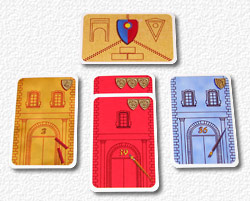
There are six differently coloured sets of 16 palazzo cards and a player may only
build one palazzo of each colour per game. Each card besides its colour contains three
types of information: a number (0 to 3) of windows, a number of shields (0 to 3, always
making the sum of windows and shield equal to 3) and a street number of the palazzo. The
street numbers are unique and range from 1 to 16 for the brown cards up to 81 to 96 for
the blue ones and are used as tiebreaker when determining the players’ sequence of a
round.

Palazzos yield victory points for a second time when a player decides to
“open” an already completed palazzo. Opening palazzos is voluntarily and
happens as the first action in a players turn. When a palazzo is opened the number of
victory points is determined by the number of palazzos/cards of the same colour of the
other players which are either being built or completed but not yet opened.

At the end of the game victory points are awarded for “walls” and
“towers” built by each player. Whenever a player takes a row of cards from the
open display s/he may decide to play them as part of a palazzo (if that colour has not
yet been completed) or play them face down as a wall or discard it. The catch is that
walls need support at the end of the game to yield VPs (other than the towers, which are
special cards in the deck). Wall support is provided by the shields of the palazzos still
under construction and only if there are twice as many shields on the cards of these
palazzos does every wall and tower provide an extra 2 VPs for each opened palazzo. And
finally, there is a bonus/malus given to the players with the highest/lowest street
number in their palazzo stack.
cards

The rules may sound more complicated than they really are. During their turn, players
have a choice of opening completed palazzos, then take a card set from the open display,
distribute them amongst their palazzos, wall stack and discard pile. The decisions to
make however add a considerable complexity to the game as timing is the essence here:

You want to have a good selection of cards in the open display, hence you want to be
first or second player in a round. However, your position is determined by the cards of
the previous round forcing you to think one round ahead when selecting your card set.
Another problem is the timing of palazzo completion. Here you want to complete palazzos
as quickly as possible as there are not too many rounds to do so (e.g. five in a five
player game). And the sooner you have completed palazzos the more options you have when
opening them. On the other hand, completed palazzos do not provide support for your
walls, so keeping the correct amount of palazzos unfinished is vital, too.

So again timing is important as opened palazzos will not provide VPs to other players
who complete their palazzo of the same colour. At the same time they will provide VPs to
you depending on the number of cards and completed palazzos of the same colour of the
other players, while possibly depriving you of VPs in the final calculation.

“Lucca Cittá” for me has the problem that on the one hand if you want to
consider all your options to make the best possible move at any given time there is a lot
of calculation and thinking ahead involved, causing the game to drag along. If you just
play “as you please” using your “gut feeling” the game speed will
increase considerably but so will the luck factor. Here, memories of the second game of
Mr. Zucchini “Palatinus” come to mind, which suffers from a similar
problem.

Talking about luck: I found the element of luck a bit too high for my liking,
particularly the dependency on playing order and the random card set display. And the
final VP calculation of supported walls and towers plays a too big a role in the final
result and the fact that if you have insufficient support for ALL your walls results in
your not getting ANY VPs (not even for the supported number of walls) adds to the
“being played” feeling. Played with the right group of people, either a group
of brooders or a group of gamblers, the game can be fun just as well.
21.10.2005: Essen 2005 Take Two – Spuiratzn

Arche-Opti-Mix

Sadly the new Frank Nestel game disappoints on many levels. The quite head-bending placement rules for the animal cards (which are similar confusing at first as “Zoff im Zoo”) hide the fact that this is a pure “you-are-played” game, especially when played with more than 3 players. Before you can actually start to develop any card management strategy the rain cards end the game and everything is simply down to the luck of your card draw. There are also very few possibilities where you can actually “act” in this game, and while the other players ponder their move you simply sit there and correct their mistakes. I still give this game 5 points for some very nice drawings by Doris Matthäus, but it will be a disappointing experience for most gamers and too confusing for normalos. “Zoff im Zoo” remains the superior game, as there you actually are the player, not the played-one.

Alexander the Great

This looks like a wargame, but it ain't. In fact in this game players ALL represent the armies of Alexander, simply trying to get the best of the spoils of conquest. The rules are relatively simple but the game can be very fiddly, as after the secret cube placement is revealed your move can be calculated, which can take quite a long while when playing with uber-geeks. Still, there are no obvious faults with this game, and the mechanics themselves are logical and interesting, without being amazingly new. The map, large as it is, still creates a lot of fiddling around with your pawns that constantly hide the temple and city symbols. Interestingly only a small part of the map is ever used at one time. Not a game for the grognard but for the Euro gamer who wants some VERY light historic flair, but basically this could have been a game about many things. Still, a better than average game, as one would expect from Phalanx.

Giza

This is a very light tile-laying game that can be explained in under 5 minutes and played in 30. Basically you always have a choice of destroying the buildings of other players or furthering your own, although sometimes the choice can be made for you by the luck of your draw. Very tactical with 2 players, a luck-fest with 6, but still an enjoyable little game. The art is very good looking and the egyptian theme is well realized. Might be a very good game to play with children as well, for geeks it will work as a light filler game.

Il Principe

Emanuela Ornella doesn't disappoint with his new game – I actually liked it a bit more than Oltre Mare even, but that could be a matter of taste. Game mechanics are very clever (with some getting used to necessary), and the end result might also have to do a lot with the draw of the cards, but still this is a very interactive game (and the interaction is on several levels: auctioning, counter placement, competition for role cards). All these elements combine to form a complex whole that can at no moment be exactly pinned down (for example who is REALLY leading in VP's). Might be a bit dry for non-geeks, but gamers will have a lot of food for thought here.

Moritz Eggert

20.10.2005: Ernte in Essen

Vollgepackt mit neuen Spielen kamen unsere Frontkämpfer von der diesjährigen “Spiel 2005” zurück. Das wird wieder ein hartes Stück Arbeit werden. Doch die ersten Kostproben waren durchaus vielversprechend.
1. “Sushi Express”
Eine Kombination aus Würfel und Risiko-Spiel: Die Spieler positionieren sich auf Zahlenfelder mit Werten zwischen 2 bis 12 und müssen dann mit 2 Würfeln die gesetzte Zahl mindestens erreichen.
Kleine Nebenrechnung (Heiliger Sankt Euler sei mir gnädig): Die Wahrscheinlichkeit, mit 2 Würfeln mindestens 9 Punkte zu erwürfeln ist knapp 48 %, bei einer 8 sind es schon 66 %!
Wer die höchste Zahl gesetzt hat, fängt an. Hat er gut genug gewürfelt, darf er mit seinem Pöppel so viele Felder vorwärtsziehen, wie er gesetzt hat. Kommt er dabei über ein bestimmtes Spielfeld, darf er sich eines der ausliegenden Bonuskärtchen nehmen. Die sind natürlich nicht alle gleichwertig, und schon allein um bei manchen Auslagen der erste zu sein, muß man manchmal ziemlich hoch setzen.
In jedem Fall eine kurzweilige Unterhaltung.
WPG-Wertung: Aaron 5, Günther 7, Moritz 6, Roland 6, Walter 6
Roland will eine Rezension schreiben.
2. “Havoc”
Ein Kartenspiel, bei dem die Spieler nach Pokerart um die Einsätze kämpfen. Flash geht vor Fullhouse, Drilling, Pärchen und was der Kombinationen mehr sind. Doch das Spielprinzip ist wesentlich vielseitiger als beim Poker: Die Kartenhand wird nicht jedesmal ausgetauscht, sondern jeder behält die nicht ausgespielten Karten, so daß die Kartenhand ständig wächst. Kartenpflege ist das Geheimnis.
Für Rechner und Denker unter den Glücksspielern eine mehr als überzeugende Erweiterung des Hasardeur- und Psychologie-Mechanismuns vom Wildwest-Poker.
WPG-Wertung: Aaron 7, Günther 8, Moritz 8, Roland 8, Walter 7
Moritz will eine Rezension schreiben.
3. “Big Kini”
Ein Entwicklungsspiel: Die Spieler fangen auf einsamen Inseln an, vermehren sich, verschaffen sich einflußreiche Posten innerhalb der Inselwelt, entdecken das Umland und punkten dabei.
Die Sammler unter uns sind gefragt, nicht die Jäger. Möglichkeiten zu Interaktion und Aggression sind gegeben, doch eher selten. Die wesentlichste Konkurrenz unter den Spielern liegt bei der Verteilung der jeweiligen Zug-Prioritäten. Das soll aber keine Kritik sein. Moritz hat heftigst widersprochen, sobald nur ein Satz gefallen ist, der in diese Richtung mißverstanden werden könnte.
WPG-Wertung: Aaron 6, Günther 8, Moritz 8, Roland 8, Walter 7
Moritz will eine Rezension schreiben.
4. “Cash’n Guns”
Statt mit unserem Standard-Absacker “Bluff” den Abend zu beschließen legte Günther noch schnell “Cash’n Guns” auf den Tisch: Jeder bekommt eine Pistole in die Hand und auf das Kommando 1-2-3 müssen alle gleichzeitig aufeinander zielen. Dabei ist nicht klar, ob nur Platzpatronen oder tödliche Kugeln abgefeuert werden können.
Auf das gleiche Kommando 1-2-3 haben alle Spieler jetzt noch die Chance, den Schwanz einzuziehen und davon zu schleichen oder sich dem Kugelhagel auszusetzen. Wer auf dem Platz überlebt, weil entweder gar nicht oder nur mit Platzpatronen auf ihn geschossen wurde, wird an der ausliegenden Beute beteiligt, die anderen gehen leer aus.
Klar ist, daß hier langgehegte Spieler-Rechungen ausgeglichen werden können. Auch Senioren-Allianzen können sich durchaus bewähren. Moritz hat alle seine Erschießungen tapfer ertragen.
Für eine echte Chancen-Gleichheit wird neben der Sympathie-Symmetrie zusätzlich ein kreisrunder Tisch benötigt, um den alle Spieler mit absolut äquidistanten Abständen verteilt sein müssen (2 r π / n). Da dies in der Praxis aber nirgends gewährleistet ist, liegen allein schon aus der natürlichen menschlichen Bewegungsfaulheit heraus einige Spieler häufiger in den Schlußlinien als andere.
Man darf es nicht zu erst nehmen. Als Party- und Dödelspiel mag es seine Fan-Gemeinde erobern. Originell ist es auf jeden Fall.
WPG-Wertung: Aaron 6 (konnte Moritz in Schach halten), Günther 6 (weiß nicht warum), Moritz 7 (Cowboynatur), Roland 7 (Chaot), Walter 3 (aus dem Party-Alter heraus)
Walter will (vielleicht) eine Rezension schreiben.

Big Kini

Big
Kini

reviewed by Moritz Eggert

Big Kini is the first published game by gaming veteran Guido Eckhof. Guido’s game
shop “Guido’s Spieleck” used to be me one of my favourite haunts during my
formative years as a gamer, so of course there is a hint of nostalgic sympathy from me in
this review. Nevertheless I wouldn’t call myself an independent reviewer if I
wasn’t able to judge a game on its own merits, so here we go…

Big Kini (the title hints at “bikini’s”, the “bikini islands”
but can also mean “The Big King”, if you understand “Kini” in its
Bavarian meaning – although Bavarians would stress that only Koenig Ludwig – the fairy
tale king – was actually called “kini”, but I digress…) plays on a yet
uncharted island territory. The players try to conquer posts, milk the islands of their
resources and to gain fame through discovery of new islands. The game ends when either
all islands are explored or 12 rounds have passed. Most VP’s win, as usual.

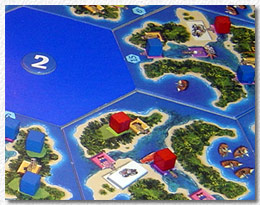
In typical Settler’s style a modular board is built, consisting of hexes with
three islands each.

These islands come in 4 different sorts:

  1. producing new pawns, or farmers,
  2. producing money,
  3. producing three different kinds of goods to be harvested or
  4. producing ships (or movement ability, the number of ships equalling movement
    points).

Each player selects one of these hexes as starting space and places two pawns (or
cubes in this case). All the hexes are different, and pay different starting money. On
each hex are empty spaces which denote “posts”.

There are three types of posts:

  1. “Island Steward” (controls one island only, the lowliest post, worth 1 VP
    at the end of the game if occupied by your cube,
  2. “Reef Minister” (controls two islands, worth 2 VP) and finally
  3. “Bay Baron” (controls all islands on a hex, worth a whopping 5 VP).

In (changing) order from wandering start player each player now has two actions, which
are marked on a separate action board. These actions are:

  • multiply (players in your group will most certainly find
    more…eh…”basic” words to describe what’s exactly happening here = place
    a new cube on a free farmer space,

  • move = move a cube to a free position or “post” – either on the same hex or
    to another hex, paying 1 money per hex moved. If you don’t control an island with
    movement ability on the starting hex you won’t be able to move to another hex from
    there,

  • produce money = get the money from a factory you own (varies),
  • harvest one of three goods,
  • election = if there are at least two cubes with posts on a hex they can vote to move
    one of those up to the position of Bay Baron (which can not be occupied without an
    election),

  • discovery = move a cube with the movement ability and pay 5 money extra to reveal an
    undiscovered hex (2 VP for each hex that is such discovered).

The “hitch” of the action board is as follows: if you are the FIRST player
to use an action, you will be able to do it DOUBLE. This is extremely powerful, as you
can create TWO new cubes, or have TWO factories produce money, etc.

board

The second player to place the same action can only do it “normally”,
whereas the third player already has to pay two money to actually do a singular action.
This means that your turn order will be extremely important for your tactical decisions
this round. Sometimes you have to consider doing something that you rather wouldn’t
have done, or you will do a double action simply to deprive another player of doing the
same!

Voting the Bay Baron is a special process: You need the simple majority to vote one of
your cubes into the post, but if you actually incite the action yourself you can win a
tie. Some Bay Barons can also be bribed into their posts by paying resources of a certain
type (which you have to spend). But triplets of three different resources also give 3
VP’s at the end of the game, so you will consider if you want to actually spend them
for political battles.

How does it play? Big Kini belongs into the category of multi-player-solitaire games,
as most of the time you will be content expanding your own empire. But the other players
will constantly foil your plans by placing actions before you on the action board, so
there is a constant influence in what players can do through the actions of the others.
The conquest of new tiles at your doorstep or sending your cubes on the hexes of other
players can seriously disrupt plans and further the development of others, so if you play
with a more aggressive group this can even be a kind of wargame, with ministers and
stewards battling it out for the coveted Bay Baron posts. Therefore one of the most
important tips you have to give new players is: multiply, multiply, multiply, as having
more cubes in play will give you more options.

But luckily Big Kini never falls into the trap of similar empire building games, by
making the proceedings too cumbersome and the game drag through constant
micro-management. In fact Big Kini plays astonishingly quick with a good boardgame feel
(expect it to last 60-90 minutes). As each player action is clearly defined, the game
moves on at a good pace, as there are no fiddly things to do and the number of cubes is
always in a range that can be easily handled. Of course there might always be the
pondering types among your group…

Characteristics
Playing time: 60-90 minutes
Explaining the rules: 10-15 minutes, no real difficulties here, as everything is very logical and easy to
grasp
Players: 1-4 basic game, expansion gives “action” cards, making the game more
competitive, and the possibility to expand the board for 5 or 6 players
Game material/graphics: cute, game material efficient without being lush
Rules: in English and German, no understanding of card or board text necessary, which makes
the game perfectly easy to play for non-Germans. All symbols are very clear and don’t
need constant referring to the rule book.

The lightly handled theme creates a fun atmosphere – the island setting is artificial
(originally this was supposed to be a SF game, but these never sell well in the German
market) but somehow fresh, and the humoristic drawings are actually quite cute and funny.
I personally really like this game – it plays quickly, and can be taught quickly as well.
It is certainly not above Settlers in its level of complexity, and so could be a good
game to introduce new gamers to the finer arts of boardgaming while giving seasoned
players a lot of food for thought without them feeling undernourished. If you don’t
trust my judgment alone: this was also the general feeling of gamers playing Big Kini at
the Essen fair, as it was – together with the already much-talked-about Caylus – the
“Best of Show” – game at the Fairplay booth. As there is momentarily a
profusion of light “filler” games or heavier “gamer’s games”
(like Caylus) it is good to have a game of the “medium” category, which is so
rarely present right now.

PlayMe (originally a mail-order store for games) can be congratulated on giving Guido
Eckhof a chance to develop this great new game and risking publishing it in an already
crowded market. It certainly has made a good splash at Essen, and I’m sure it will
continue so in the future.

Havoc – The Hundred Years War

Havoc
– The Hundred Years War

reviewed by Moritz Eggert

Out of the blue (or out of a sunny river, one might say) comes a very enjoyable card
game that probably also rides on the wave of the recent poker revival, but is so much
more….

As any poker player will attest, poker is very often battle-like in structure. Like
Zhukov or Patton or Wallenstein you let the enemy in doubt about your actual strength,
and when it’s time to strike you reveal your full power. Some give up before it comes
to this moment, and some bluff their way to victory and some win with a simple pair,
comparable to the victory of the 300 Spartans.

The Hundred Years War is the perfect setting for a battle-like poker game, as it was a
time of constant upheaval, short periods of peace followed by another outbreak of
violence. A series of battles is played to complete a full game of “Havoc”;
each battle gives different amounts of victory points to the victor and the players on
2nd or 3rd or even 4th place, while giving additional benefits to the player who actually
started the war (usually drawing more cards than anybody else). The player cards are
numbered 1-18 (when playing with less players the number of cards will be reduced) and
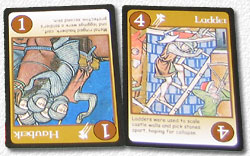
come in different colours and with beautiful illustrations taken from original art from
the time period of the game.

After the “peacekeeper” (or starting player) is determined by an ingenious
device, a rotating finger that soon will be geek item no.1, players take turns either
taking cards from the pile (a selection of open and face-down cards) or declaring
“havoc” and starting a poker battle round. The problem is that the longer peace
endures the more the peacekeeper will profit from it, as he will keep his cards after two
cardsfull turns, whereas the other players have to discard one of their cards in
hand. The battle card will then be discarded (if there’s peace there is no battle,
obviously). But this happens rarely, more likely the cry of “havoc” is heard at
some point and the game of poker begins. Each player now has to place two of his cards on
the table or pass, if s/he passes, s/he can take two cards but is out of the round. If
you stay in the game you have to play another card in front of you (up to a maximum of 6)
or fold. All cards played are lost… usually, but there are also “dogs of
war” cards, which prove to be very useful. They can either retrieve cards played in
a battle (up to a maximum of 2) or be part of a winning hand (number 0). They also help
when drawing cards – two dogs can be exchanged for any card in the discard pile, and one
dog can be exchanged for any open card.

cards

The rank of a played hand follows standard poker rules with 6 cards, first come pairs,
then simple flushes, then triples etc., up to a 6 card straight flush, the best combo.
Although 6 cards are the limit that one can play in a battle, additional dogs of war can
be played to increase the number of cards up to 8, theoretically.

After the battle the victors get the spoils of war and a new round begins, with the
winner of the battle becoming the new peacekeeper. The final battle is a special affair,
as it begins directly after the last battle, with only limited ways to improve your hand.
Not surprisingly the final battle gives the most VP’s as well…

Characteristics
Playing time: very much depending on the number of players – anything from 45-70 minutes when
playing the “full” game
Explaining the rules: 10 minutes, basic poker knowledge required, otherwise a bit longer
Brain: is used
Luck: plays a role, but not overly, as there are always plenty of cards to choose from
Strategy/Tactics: required

In this excellent card game players are not playing a simple poker game, they play
three poker games at once. For a start it is not always a good idea to participate in
every battle or to give your best when doing so. You always have to consider how your
hand will look AFTER you play the battle, not only winning the battle itself. This means
that your hand (which is unlimited in number of cards) is in constant flux: it is a
result of former battles fought, of what is involved in a present battle and what you
will have to save for future battles. This makes for interesting decisions, even
sometimes resulting in very weakly fought battles as every player holds back his best
cards. But if you fight too weakly somebody will win the day with a meagre pair, so you
constantly have to look out for the hand management of other players. If you have played
3 cards from a 5 card set should you actually play the other two cards as well to win
safely (if you can) or should you instead play two dogs to retrieve at least two of them
at the end of the battle and prepare a 4 card set for next round, but then perhaps giving
another player the ultimate victory? The victory points “schedule” of battles
will also influence your decision – if only the first place gets points you probably have
to either fold immediately or give all, but if there are several tiers of victory you
might have to try to always be involved with at least a pair for some easy VPs. As often
card draws will be from the row of open cards you will also be able to outguess other
players’ plans, also something missing from “normal” poker.

Whatever your tastes in card games are, you will find “Havoc” to be a
challenging and clever game on its own that you will want to play again and again. There
is even an in-game expansion that adds more options and abilities to cards, if you ever
should get bored or want to try out something new.

In my opinion “Havoc” was one of the best new card games of Essen 2005, and
can wholeheartedly be recommended to anyone, even if they HATE poker (like me).

Hazienda

Hazienda

Preview of the new Kramer game by Moritz Eggert

Living in Munich means living in the most expensive city in Germany – the (usually)
nice weather, the closeness of the Alps and the many beergardens and other available
hedonistic pleasures make for extremely high rents and costs of living. I know many a
gamer here who can’t afford an apartment big enough to store his/her games!

But there are also benefits of living here, and one of them is living around the
corner of the headquarters of Hans-im-Glueck, undoubtedly one of Germany’s best
publishers for quality boardgames. As I’m a regular visitor of their monthly
boardgame evenings I sometimes have the honour of being able to test the new designs in
the pipeline. One of Hans-im-Glueck’s new games for this year’s Essen fair is
“Hazienda”, a new boardgame by master designer Wolfgang Kramer. But convincing
Bernd Brunnhofer, head of Hans-im-Glueck, to give a special preview of this game was not
as easy as I first thought:

We don’t usually like to do previews.‘ says Brunnhofer.
Even if they are positive they tend to create a too high expectation that nobody
can compete with, as was the case with “Euphrates & Tigris”. Now E&T is
considered a classic, but when it first came out there was a certain backlash to the
immense hype that didn’t make us happy
‘.

But after promising to make this a descriptive preview instead of an evaluating review
(the latter would be morally dubious anyway, as I was slightly involved in the
playtesting of this game), Bernd was only too happy to indulge me in the secrets of this
new and certainly interesting Kramer game.

“Hazienda” takes place in Argentina, sometime between the 30’s and
50’s. The players (2-5) represent land owners who want to get rich quick by
establishing trade routes and accumulating acres of land. Earning and spending cash is an
important motor of the game, but of course it is victory points that count at the end of
the game, after all this is a game with the eponymous ‘Kramer Leiste’ (Kramer
track) to keep track of VP!

brunnhofer playtester group

Each player starts with 20 bucks and a selection of animal and land cards. The board
consists of a ‘land track’ with 5 different types of land surrounding the open
‘Pampa’ spaces so typical for Argentina. Appearing throughout the Pampa spaces
are markets which players try to connect to their land spaces via ‘animal
routes’. Animals come in 4 different kinds, and have to be played as a match, so a
pig trade route can only be lengthened by playing more pig cards on it. There are also
water spaces (lakes) that accumulate victory points when the player owns adjacent animal
or land tiles. There are two VP calculations in the game, one after half of the animal
cards have been used up, one after all of them are in play, the latter situation ends the
game.

If all this sounds rather abstract it comes as no surprise. First of all this is a
Kramer game (what do you expect?), and even Brunnhofer makes it clear that ‘this is
certainly not an unconventional game’. But Kramer’s designs are widely known for
their durability and elegance, and so ‘Hazienda’ is certainly worth a closer
look. In fact the options for the players are impressive – there are 3 actions per player
turn, and they can be multiples of the same action and be done in any order.

First of all it is possible to buy cards. There are always open animal or land cards,
and these can be purchased for 3 bucks each. You can also try your luck and buy unknown
cards from the deck for 2 bucks. Playing a card also counts as an action. Land cards are
placed to own the corresponding land spaces (shown by placing a tile of your colour on
the board) and animal cards are played to create animal lines to reach the markets (also
played as tiles in your colour). The players usually try to create lines of at least 3
land spaces on the land track – the longer a continuous stretch of land is, the more VP
it will bring during the calculations (2 per space). Placing a hacienda on a land line is
expensive (12 bucks), but it brings an additional VP per space, so you better save up
actions for doing it before the game ends! It should be no surprise as the game is named
after them….

Haciendas can also be placed on animal lines, but this is done rarely.

Another possibility is ‘hugging’ lakes with your animal or land lines. You can
also cleverly create your own lakes (quasi godlike and slightly dubious from a realism
point of view, but essential to the game. One could think of them as artificial water
spaces created by dams). This also costs 12 bucks, and you should select a lake form that
hugs as many of your spaces as possible as other players will also benefit from a lake
placed next to their spaces, even if they didn’t do it themselves.

board

Connecting the markets is important in 2 ways: first of all each time an animal
connects to a market (even if done several times in a circle by playing more and more of
the same type of animal) you get the length of your land stretch plus the animal track in
money. Get rich quick schemes are usually quickly thwarted by your opponents who can
tactically place their tiles in your way to prevent a ‘circle run’ around a
market. The second and more important function of markets is that they are a VP cash cow:
the more different markets you connect yourself to the more VP you get, in an exponential
curve similar to the game Hare and Tortoise. Another way to make cash is to harvest a
stretch of land (this can only be done once per line) for 3 bucks per land space. Owning
money is not bad either, as 10 bucks convert to 1 VP – in both VP calculations!

These are, in a nutshell, the rules of the game, and they can be understood quickly by
any kind of gamers. As is usual for this type of games you want to do many things at once
but can only do so little in each turn. The road to victory is therefore to be as
efficient as possible with your actions, by maximising input and output. Balancing the
various VP requirements was therefore the most important task in the design work of this
game, says Brunnhofer, who is an expert at removing unnecessary details to make the
design as fluid as possible. Early versions of the game included, for example, many more
options for earning VP’s. One of them was the possibility to earn bonus VP’s for
the longest land line. ‘We dropped this to eliminate the boredom of watching players
constantly counting the length of their land lines, which bogged the game down
immensely’ says Brunnhofer. Another way of calculating VP’s by multiplying them
instead of adding them was also removed, because it ended in wildly differing sums which
made close and more exciting finishes impossible.

But there are also things which were added. ‘The original design of Kramer had
numbered spaces instead of different land types, because he wanted to avoid similarity to
other games of this type. Playing land cards was done very differently, with the use of
jokers and the possibility to look for certain numbers in the other player’s hands.
In the end we introduced the lands again because they added more flair’. Good idea,
because otherwise “Hazienda” might have been confused as an Acquire variant,
which it certainly isn’t! Another later change (this time by Kramer himself) was to
interrupt the otherwise continuous land track with Pampa spaces, which forces the players
to buy Pampa cards and also makes Pampa cards more valuable when they appear.

The prototype I played was the finished version ruleswise, but the game itself had not
yet gone to the printer. This is usually done very shortly before the Essen fair, to give
the possibility to change small details. Hans-im-Glueck is known to work hard on their
rules to avoid any opaqueness or confusion, and even as we played our 3-player game Bernd
Brunnhofer and Georg Wild made little notes for additional fine tuning.

As the game is very dependent on an interesting map this comes in two versions, one
‘symmetrical’ and one ‘asymmetrical’, with the first one being
recommended for beginners. As an additional service our own Guenther Rosenbaum from
www.westpark-gamers.de has finished a special program that enables players to create any
map they want from the original symbols and then print it out. Look for it now on our website or on the official Hans-im-Glueck website.

“Hazienda” plays in 1-2 hours, and can be equally played aggressively
(hindering other players from building good ’empires’), strategically (go for the
markets to get a surprise VP rush) or tactically (just consider what is best for you each
turn). Each of these options will tax your head without bursting it, as the game play is
rather swift (which was not the case with the earlier versions, where too many options
slowed the game down). It plays equally well with 3 or 2 players, with only slight
modifications in the distribution of cards. I predict that “Hazienda” will be a
welcome new addition to the already impressive line of Kramer games.

But don’t believe my hype – join Hans-im-Glueck in Essen to see the finished game
or play the game when it’s available. Although none of us would probably mind another
Euphrates & Tigris – hype or no hype.

Session Report 12 October 2005

Session Report 12 October 2005

by Moritz Eggert

at the table: Aaron, Loredana, Peter, Andrea, Moritz

on the table: Tabaijana, Chez Geek!, Diamant, Mamma Mia (Grande)

After a long gaming hiatus from Andrea and me this was the first time we could get
together again with the other Westpark gamers, so it was intuitively decided to make this
a very relaxed round with shorter and easier games.

Tabaijana

board

We started with a gem(?) by reliable Wolfgang Kramer, Tabaijana, a game where some
poor indigenous people have to flee a volcano island, but if they don’t take enough
pizza cartons with them (at least the game board suggests these are pizza cartons), they
will starve at sea, In addition the pizza boxes (or crates) have to be stacked in the
right order. Trouble is: they start as one big, chaotic stack. During the game each
player is responsible for one colour. After a die roll he can move any stack he is
involved in (or the ship, on which the crates have to end at some point). Splitting up
the stacks is necessary to get the crates into some kind of order, a player can do this
as long as he takes one of his own crates into the new stack, or leaves one of his own on
top of the old stack. All crates plus the ship move on a single track path towards the
inevitable end of the game.

This is a collaborative game, from a time where working with statistical probabilities
and working together were still relatively new concepts. Fact is that it becomes obvious
after a few turns that each player can only do ONE best thing with his die roll,
everything else is just plain stupid. As this is a cooperative game, all players will of
course always discover the best move. Now it depends on the roll of the dice if you make
it or not, as simple as that.

This is very light entertainment from an author who later went on to create some of
the best modern German games. Some games from this period of gaming have survived the
test of time (like “Scotland Yard” or “Hare and Tortoise”), but this
game is plain boring from a modern point of view. That the game material is minimalistic
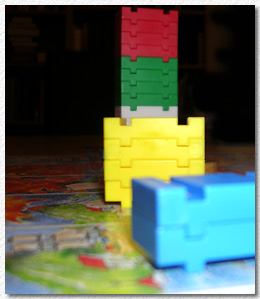
and unpractical to say the least doesn’t help either. Don’t open this pizza box
of ye olden times – the pizza inside has long past its best before date!

Chez
Geek!

Peter is going to torture me forever for this present of mine….”Chez
Geek!” is another one of the totally useless card games Steve Jackson has produced
lately (with the exception of the excellent “Spooks”). The theme and the cards
are funny because of the humour of the creator of “Dork Tower”, John Kovalic,
but the game play is dominated by the usually deadly combo of “solitaire game”
with “take that!” cards. Each player represents a “slacker” who wants
to acquire as many “slack” points as possible.

Basically game play consists of you playing cards to acquire “slack”
(depending entirely on what cards you happen to draw) and other players playing
“take that” cards to prevent you from playing these cards. This continues until
some player has enough luck and the other players have run out of “take that”
cards. The only “strategy” consists of “going shopping” several times
to drain your opponents of “take that” cards against you instead of shopping
all items at once so they can all be prevented at once.

Boy, were we glad we didn’t play this totally useless game with Walter! One could
cut out the pictures and create a nice comic with them, but playing the game is the only
thing that will REALLY make you wish you were a slacker instead, as you might find
hanging out in front of the TV more exciting than playing this game. Seriously!

Diamant

Now we were ready for a good game. Faidutti’s and Moon’s “Diamant”
fit the bill of a game that can be explained in 3 minutes and played in 20. This has been
reviewed elsewhere on this site, but let it be said that this really is a good and fun
light filler game, the only problem being that there are a lot of light and fun filler
games out there at the moment. But we had a good laugh, and the game has even some
tactical issues that the advanced player can ponder about, so there really is nothing to
complain about.

Mamma
Mia (Grande)

This fine card game has been revived by some expansion sets and advanced rules. In its
original form this was a kind of inverse Bohnanza. Players play ingredients and recipe
cards on a pile, hoping that the cards below their recipe (after all card plays the tile
is reversed) will be enough to fulfil the pizza recipe. Some recipes work, some
don’t, and one can never be sure as remembering the actual ingredients in the pile is
very difficult.

The expansion “Sole Mio” (also playable stand alone) adds some very odd
recipes with partly complicated rules, and the possibility to “help” other
players with finishing their recipe – for the price of finishing one of your own recipes
for free. The odd recipes make the game more chaotic and unforeseeable, the
“helping” options make the game more tactical. All in all this is a good and
fun mix of ingredients, and the game was very well received in our group. After Peter
explained it, we had the impression this was an complicated game, but once we got to
actually play it, it turned out to be easy fare. Not to be played with hard thinkers,
though, but on that evening we were all “in the mood”.

Session Report 12 October 2005

Session Report 12 October 2005

by Moritz Eggert

at the table: Aaron, Loredana, Peter, Andrea, Moritz

on the table: Tabaijana, Chez Geek!, Diamant, Mamma Mia (Grande)

After a long gaming hiatus from Andrea and me this was the first time we could get
together again with the other Westpark gamers, so it was intuitively decided to make this
a very relaxed round with shorter and easier games.

Tabaijana

board

We started with a gem(?) by reliable Wolfgang Kramer, Tabaijana, a game where some
poor indigenous people have to flee a volcano island, but if they don’t take enough
pizza cartons with them (at least the game board suggests these are pizza cartons), they
will starve at sea, In addition the pizza boxes (or crates) have to be stacked in the
right order. Trouble is: they start as one big, chaotic stack. During the game each
player is responsible for one colour. After a die roll he can move any stack he is
involved in (or the ship, on which the crates have to end at some point). Splitting up
the stacks is necessary to get the crates into some kind of order, a player can do this
as long as he takes one of his own crates into the new stack, or leaves one of his own on
top of the old stack. All crates plus the ship move on a single track path towards the
inevitable end of the game.

This is a collaborative game, from a time where working with statistical probabilities
and working together were still relatively new concepts. Fact is that it becomes obvious
after a few turns that each player can only do ONE best thing with his die roll,
everything else is just plain stupid. As this is a cooperative game, all players will of
course always discover the best move. Now it depends on the roll of the dice if you make
it or not, as simple as that.

This is very light entertainment from an author who later went on to create some of
the best modern German games. Some games from this period of gaming have survived the
test of time (like “Scotland Yard” or “Hare and Tortoise”), but this
game is plain boring from a modern point of view. That the game material is minimalistic
and unpractical to say the least doesn’t help either. Don’t open this pizza box
of ye olden times – the pizza inside has long past its best before date!

Chez
Geek!

Peter is going to torture me forever for this present of mine….”Chez
Geek!” is another one of the totally useless card games Steve Jackson has produced
lately (with the exception of the excellent “Spooks”). The theme and the cards
are funny because of the humour of the creator of “Dork Tower”, John Kovalic,
but the game play is dominated by the usually deadly combo of “solitaire game”
with “take that!” cards. Each player represents a “slacker” who wants
to acquire as many “slack” points as possible.

Basically game play consists of you playing cards to acquire “slack”
(depending entirely on what cards you happen to draw) and other players playing
“take that” cards to prevent you from playing these cards. This continues until
some player has enough luck and the other players have run out of “take that”
cards. The only “strategy” consists of “going shopping” several times
to drain your opponents of “take that” cards against you instead of shopping
all items at once so they can all be prevented at once.

Boy, were we glad we didn’t play this totally useless game with Walter! One could
cut out the pictures and create a nice comic with them, but playing the game is the only
thing that will REALLY make you wish you were a slacker instead, as you might find
hanging out in front of the TV more exciting than playing this game. Seriously!

Diamant

Now we were ready for a good game. Faidutti’s and Moon’s “Diamant”
fit the bill of a game that can be explained in 3 minutes and played in 20. This has been
reviewed elsewhere on this site, but let it be said that this really is a good and fun
light filler game, the only problem being that there are a lot of light and fun filler
games out there at the moment. But we had a good laugh, and the game has even some
tactical issues that the advanced player can ponder about, so there really is nothing to
complain about.

Mamma
Mia (Grande)

This fine card game has been revived by some expansion sets and advanced rules. In its
original form this was a kind of inverse Bohnanza. Players play ingredients and recipe
cards on a pile, hoping that the cards below their recipe (after all card plays the tile
is reversed) will be enough to fulfil the pizza recipe. Some recipes work, some
don’t, and one can never be sure as remembering the actual ingredients in the pile is
very difficult.

The expansion “Sole Mio” (also playable stand alone) adds some very odd
recipes with partly complicated rules, and the possibility to “help” other
players with finishing their recipe – for the price of finishing one of your own recipes
for free. The odd recipes make the game more chaotic and unforeseeable, the
“helping” options make the game more tactical. All in all this is a good and
fun mix of ingredients, and the game was very well received in our group. After Peter
explained it, we had the impression this was an complicated game, but once we got to
actually play it, it turned out to be easy fare. Not to be played with hard thinkers,
though, but on that evening we were all “in the mood”.

28.09.2005: Vier im Quintett

Loredana kam frisch vom Oktoberfest: im feschen Dirndl mit schwarzen Lackschuhen: von Kopf bis Fuß ein einladender Anblick, einschließlich aller Augenpaare. Sagt mal, ihr Leute da draußen, findet ihr die klobigen Bergschuhe am Ende von lieblichen Mädchenbeinen eigentlich hübsch?
Vor die Alternative gestellt, 4 Stunden “Die Macher” oder eine Hand voll gemeine deutsche Spiele zu spielen, entschieden wir uns einstimmig für das Gemeine.
1. “Colossal Arena”
Funktioniert wie “Titan – the Arena”: Ein Karten- Wettspiel, bei dem jeder seinen Wetteinsatz auf das Überleben verschiedener Rassen setzen soll und durch Auslegen der richtigen Karten dafür sorgen muß, daß diese Rasse im Kampf ums Dasein von Runde zu Runde überlebt.
Der Kampf ums Überleben ist äußerst spannend. Es gibt sehr viele taktische Finessen um offene und versteckte Seilschaften. Dazu kommt das geordnete Chaos der Charaktere und Sonderkarten, die eine konsequente Planung unmöglich machen.
Peter und Moritz halten das Spiel für ein Spitzenspiel und geben ihm 10 Punkte. Ich kritisiere das zu große Glückselement beim “Secret Bet” und die Tatsache, daß man in der letzten Runde sein gesamtes Hab und Gut verlieren kann, ohne ein einziges Mal am Zug gewesen zu sein.
WPG-Wertung: Roland drückte mit seinen 7 Punkte den WPG-Durchschnitt auf 7,5 Punkte.
Als Rezension ist Moritz Beitrag zu “Titan” vom 4. 9. 2002 immer noch gültig.
2. “Intrige”
Ein Spiel aus dem vorigen Jahrtausend, das wir noch mit Susanne gespielt haben. Damals hatte sie alle ihre weiblichen Finessen damit vergeudet, Aaron durch unlautere Gebote im äußeren und inneren Konflikt-Bereich für sich geneigt zu machen. Susanne, wo steckst du denn jetzt eigentlich?
Intrige ist ein äußerst bösartiges Spiel. Die Spieler stecken sich gegenseitig unverbindlich Geld zu, um bei der Postenverteilung damit einen guten Schnitt zu machen. Ob der jeweilige Hauswirt die Bestechungssumme aber auch angemessen honoriert, steht allein in seinem Gutdünken. Es gibt keine Vertragstreue, keine Garantien für den Einsatz, keine Gerechtigkeit und kein Gewissen. Ohne Humor und harte Nehmerqualitäten gehen hier die besten Freundschaften aus dem Leime.
Wer mit einer “armenischen Krämerseele” ausgestattet ist, kann dem Spiel viel abgewinnen: Feilschen, Schmeicheln und Drohen, Berechenbar-Sein, wo es in die eigene Tasche geht, Undurchsichtig-Sein, wenn man den großen Verrat plant, Vertrauen erwecken, obwohl es doch nur skrupellos um den eigenen Gewinn geht. Es gibt ganz eigene verbale Chiffren:
“Aaron ist sauer!” – “Ich kann ganz schnell verzeihen!” (= Nur nicht zeigen, daß der Deal schon gelaufen ist.)
“Ich bin immer gesprächsbereit” (= Ich will kaltblütig mein Bündnis brechen.)
“Haben wir noch einen Deal?” (= Ich will warmblütig mein Bündnis brechen.)
“Konkrete Summen nennen!” (= Hier spricht der Judas Ishariot)
“Ich bin nicht käuflich!” (= “Hola, Kumpan, laß mich jetzt bloß nicht fallen!”)
“Wenn ich Loredana jetzt bescheiße …” – “Dann kriegst du soooo einen Ärger!” (= Voreheliche Positionsbestimmung.)
In diesem Wust von Deutungen und Andeutungen ließen wir unsere Spiellaune treiben. Vor lauter Intrigen vergaßen wir sogar sporadisch das Fremdgehen. So entstand dann eine irreguläre Spielsituation, die nicht mehr zu reparieren war: 2 Runden vor Schluß mußten wir abbrechen. Aber das war auch gut so: Wir mußten den Giftbecher von “Intrige” nicht bis zur bitteren Neige austrinken, sondern konnten in lockerer Stimmung zum nächsten Spiel übergehen. Fast ein Salomonischer Schluß!
WPG-Wertung: Aaron: 7, Loredana: 5, Peter: 6, Roland: 7, Walter 6.
Gegenüber “Intrige” bin ich bis zum Halse voll mit positiven und negativen Emotionen. Das sollte demnächst für eine Rezension reichen.
3. “6 nimmt”
Unser altes Absacker-Spiel in der Rolle des Vor-Absackers. Peter konnte in seinem Mathematik-Studium ganz aktuell den Begriff “limes superior” durch den 6-nimmt-Begriff “höchste niedrigere” höchst populär-wissenschaftlich umschreiben.
WPG-Wertung: Roland drückte mit seinen 6 Punkten den WPG-Durchschnitt auf 7,9 Punkte.
4. “Bluff”
Im Endspiel legte Aaron mit 2 Würfeln gegen Loredana mit nur einem Würfel 2 Fünfen vor. Loredana hob auf 3 Fünfen! Alle vorhandenen Würfel mußten 5er sein! Aaron blieb nichts übrig, als auf 2 Sterne zu erhöhen. Damit war Loredana ausgeknockt.
Im nächsten Endspiel gewann Aaron gegen mich aus einem 3:1-Rückstand heraus. Hi Günther, hier hat schon wieder die “Immer-4-Strategie” zugeschlagen!
WPG-Wertung: Roland drückte mit seinen 8 Punkten den WPG-Durchschnitt auf 8,44 Punkte.

Intrige

Intrige

rezensiert von Walter Sorger

“Intrige” ist nach dem deutschen Wörterbuch eine “heimliche,
hinterlistige Machenschaft, durch die man sein Ziel zu erreichen sucht”. Nach diesem
Wortsinn hat das Spiel “Intrige” geradezu sein Thema verfehlt. Hier ist nichts
heimlich, sondern alles öffentlich; hier gibt es keine Hinterlisten sondern nur
vordergründige Versprechungen und Drohungen; es gibt auch keine
“Machenschaften” im Sinne von handeln und tun, hier geht es eher um aussitzen
und abkassieren.

“Postenschacher” ist eine treffendere Charakterisierung des Spiels. Zu
“Schacher” schreibt das DWDS: “Handel, bei dem sehr gefeilscht wird,
unsauberer Handel, mit dem man großen Gewinn erzielen will.” Genau das ist
“Intrige”.

Jeder Spieler hat jeweils 5 verschiedene Ämter an seine Mitspieler zu vergeben. Die
Ämter sind mit unterschiedlichen Einnahmen dotiert, sie bringen 10-, 20-, 30-, 50- oder
gar 100-Tausend Dukaten pro Runde ein. Man bewirbt sich um einen Posten, indem man einen
Pöppel in den Vorgarten des Mitspielers legt und ihm dazu eine beliebige Summe
Bestechungsgeld rüberschiebt. Ob der Mitspieler die Höhe des Bestechungsbetrages
honoriert und den fremden Pöppel zum Spitzenverdiener macht, oder ob er das Geld
einstreicht und den Pöppel lediglich in die Hofkolonne steckt, das liegt im freien
Ermessen des Mitspielers.

Hat ein Pöppel einen mehr oder weniger lukrativen Posten bekommen, ist der ihm noch
längst nicht sicher. Ein anderer Mitspieler kann einen eigenen, gleichartigen Pöppel in
den Vorgarten legen und damit den Posten streitig machen: einer der beiden Pöppel muss
weichen und scheidet aus. Die Lösung des Konfliktes wird ebenfalls über Bestechungsgelder
eingeleitet: die beteiligten Spieler überreichen dem Hofeigentümer wieder eine beliebige
Geldsumme und hoffen, damit ihn damit für sich gewogen zu stimmen. Doch wie schon bei der
Erstbesetzung der Posten braucht sich diese nicht um die Höhe der Bestechung zu scheren,
sondern er kann willkürlich einen Spieler auf den Posten setzen bzw. dort belassen und
den anderen in den Orkus schicken.

Natürlich sollte man dem Mitspieler die Postenvergabe nicht zu einfach machen.
Stillschweigend das Geld zu übergeben, auf angemessene Gegenleistung zu warten und
hinterher zu jammern, wenn man schlecht weggekommen ist, mag zwar bieder-brave Gemütsart
sein, für “Intrige” taugt das überhaupt nicht. Die Spielregel selbst beschreibt
das begleitende Szenario – leider erst auf der letzten Seite – unter Tips:
“Bittet, droht, nervt, hetzt, fleht, verlangt, erwartet, argumentiert,
opportuniert, wo Ihr nur könnt – Hauptsache, es wirkt in Euerem Sinne.”
Mit
diesem Satz ist der konzipierte Spielablauf von “Intrige” umfassend
beschrieben. Für wen diese Tätigkeiten mentaler Alltag ist, der wird sich hier zu Hause
fühlen. Wer von dieser Krämer-Mentalität abgestoßen wird, – und ich muß gestehen, daß ich
zu dieser Spielerkategorie gehöre – der kann dem Spiel nicht viel abgewinnen.

Für uns WPG-ler möchte ich hierbei nur mal kurz an den Entwurf eines WPG-Kodex
erinnern: “Außer Alle erlauben es ausdrücklich vor einem Spiel, sollten keine
Kommentare zur Platzierung der Mitspieler und der eigenen Platzierung während des Spiels
fallen. Die Kommunikation beim Spiel sollte sich allein auf Regelfragen und neutrale
Spielkommentare beschränken.
” Selbstverständlich gehört “Intrige” zu
den Spielen, bei denen hiervon eine Ausnahme gemacht werden muß.

Wenn das Spiel erst mal eingeschwungen ist, wenn die Spieler sich gegenseitig die
guten und schlechten Posten zugeschustert haben und darüber Allianzen eingegangen sind, –
jeder steht ja vor dem gleichen Problem, seine Pöppel gut unterzubringen – , dann sind
die Abläufe berechenbarer geworden. Dann weiß man, bei welchen Mitspielern man noch
landen kann und wo man nur Perlen vor die Säue wirft.

In dieser Phase ist der ganze Spielablauf aber auch schon ziemlich festgefahren. Die
gegenseitigen Abhängigkeitsverhältnisse lassen kaum einen Ausbruchsversuch zu. Ein
beneideter Krösus muß zwar immer damit rechnen, schlagartig von allen guten Geistern
verlassen zu werden, doch setzt dies eine überzeugende Absprache unter den Gegnern
voraus, und die kann nur ein fähiger Demagogen in Gang setzen. Schließlich darf er ja
nicht zeigen, daß es ihm im Grunde nur um die eigenen Interessen geht.

Ein bemerkenswerter Aspekt von “Intrige” ist die psychologische Analyse der
Mitspieler. Natürlich erst hinterher, wenn das Spiel gelaufen ist und man sich die
Ergebnisse noch mal durch den Kopf gehen läßt.

1) In unserer Runde fing ich als Senior an und engagierte mich bei meinen linken
Nachbarn Loredana und Peter. (Es war ein kleiner strategischer Fehler, denn auch wenn das
Herz links schlägt, sollte man sich rechts orientieren, weil da die Zeitspanne zwischen
Investition und Rendite am kürzesten ist!)

Als Loredana mein Bestechungsgeld kassieren durfte, schob ich ihr 40.000 Dukaten hin.
Immerhin das vierfache der kleinstmöglichen Summe. Was sagt das über mich?

  • Ich bin vorsichtig, kein Hasardeur und will den Stier nicht gleich bei den Hörnern
    packen.

  • Ich lasse gezielt Versuchsballons los, um den Untergrund auszuloten und bin dabei auf
    alle möglichen Ergebnisse gefaßt.

  • Leider bin ich auch kein diplomatisches Talent, denn ich gab die Summe hin, ohne mit
    deutlichen Worten meine Erwartungen zu unterstreichen.

2) Loredana stellte meinen Pöppel auf den schlechtesten Platz. Was sagt das über
sie?

  • Loredana ist eine sparsame Hauswirtschaftlerin: wenn’s um das Materielle geht,
    wird kein Pfennig unnötig zum Fenster heraus geworfen.

  • Sie kannte das Spiel noch nicht, sonst hätte sie den niedrigsten Platz als Droh-Platz
    für die nächsten Bestechungsrunden offen gelassen.

  • Sie kennt mich noch nicht, denn nach so einer ungerechten Behandlung kann sie an
    diesem Abend keinen Blumentopf mehr bei mir gewinnen.

  • Loredana ist wagemutig und hat keine Ängste, sich Feinde zu machen.

3) Als Peter am Zug war, bot er mir sofort einen guten Deal an: Er würde mich für die
geringste Geldsumme auf seinen höchst-dotierten Posten stellen, wenn ich umgekehrt seinen
Pöppel genauso auch bei mir positionieren würde. Ein sehr gutes bilaterales Angebot, das
ich sofort annahm. Was sagt das über Peter:

  • Peter weiß, wovon dieses Spiel (und alle ähnlichen Diplomacy-Spiele) lebt: nicht vom
    vorsichtigen Herumlavieren, sondern von klaren Zielvorstellungen und entschiedenem
    Handeln.

  • Er ist ein psychologisches Genie und kennt seine Pappenheimer: er wußte, daß ich
    durch Loredanas Enttäuschung angeschlagen war und dann um so fester zu meinen
    anderweitigen Verpflichtungen stehe.

  • Peter ist ein guter Rechner: Selbst wenn ich ihm seinen Deal vermasseln würde, hätte
    er nur den geringst möglichen Betrag verloren.

  • Er ist ein gewiefter Diplomat: Bei obigen Deal war es ja noch einfach, aber auch
    sonst waren alle seine Angebote von solch überzeugenden Plädoyers begleitet, daß sich
    keiner seiner Argumentation entziehen konnte.

4) Aaron schaffte umgehend einen entsprechenden Deal mit Loredana herbei. Später
verbandelte er sich auf dem zweitbesten Posten auch noch mit Peter und mit mir. Nur von
Roland sackte er gruß- und gnadenlos die Bestechungsgelder ein. Was sagt das über
ihn:

  • Aaron ist ein großer, ausgleichender Absahner.
  • Er setzt gerne aus dem Windschatten heraus zum großen Wurf an.
  • Selbst wenn er einen über das Ohr gehauen hat, wirkt seine seriöse Art immer noch
    vertrauensbildend.

5) Roland war das fünfte Rad am Wagen: Die Partnerschaften waren gelaufen. Er
investierte unverdrossen hohe und höchste Summen in alle Richtungen, fand aber kein
liebendes Haus, das sich ihm öffnete. Auch eine leibhaftige Aphrodite hätte jetzt nur
schwer Überläufer animieren können. Was sagt das über Roland:

  • Roland ist ein geduldiger, verzeihender Optimist: trotz aller Abfuhren und
    Genickschläge versuchte er immer wieder mit neuem Mute bei Aaron zu landen.

  • Er ist genügsam und ein finanzielles Genie: auch ohne Einnahmen konnte er bis zu
    letzten Runde seine Bestechungsgelder zahlen.

  • Er kennt unsere Runde noch nicht so gut: sonst hätte er sein ganzes Geld bei mir
    untergebracht.

Hallo Peter, ich würde ja allzu gerne noch mal sehen, wie du in dieser undankbaren
fünften Position das Ruder zu deinen Gunsten herumgerissen hättest. Ich weiß selber
nicht, wie es gehen sollte, aber dir traue ich zu, daß zu es gekonnt hättest. In meiner
heutigen Stimmung das einzige Motiv, noch mal “Intrige” auf den Tisch zu
bringen.