Archiv der Kategorie: Spieleabende

Maya

Maya

Games can’t get more German than this. If you’re fond of little wooden cubes
and cherish a certain predilection for obtaining majorities, this game is for you.
I’ll try to draw a rough outline of the game. I deliberately won’t attempt to
mention every single rule.

As you expect from an El Grande style game, there are two different phases: Gaining
cubes and placing cubes. The gaining cube phase has the players put face down cards at
different places. Those different places pay a different number for cubes for the first,
the runner-up and sometimes lower scorers. Additionally, they give special abilities to
the winner (like: “place one cube immediately for free” or “in the placing
phase, miss one turn if you want”). As a rule of thumb, the more powerful the
special abilities are, the less cubes you can earn at that place.

Each player has the same set of numbered cards which are, as already said, played
face-down. Contrary to games with similar mechanics (“Corruption”, “Caesar
und Cleopatra”) which tend to be more or less luck-driven, Maya introduces two
different backsides for those bid cards. This means you can see whether a player is
really interested, even if you cannot know whether he played 6, 7, or 8. Or, you see that
he only played 3, 4, or 5 and so he is probably satisfied with a third place.

Aaron complained after the game this approach still involves too much luck. Well, yes.
It’s frustrating to lose a place by one point (or even the tie-breaker rule). On the
other hand, games need some luck element. In any case, it’s a much quicker and much
less chaotic way to gain cubes than “Venezia’s” built-in pigeon wargame.
And I was impressed that in our 5 player game players always got 7-9 cubes (with 9 being
quite rare) – this implies thorough game testing.

The placing phase has some interesting new ideas, too. Most surprising perhaps is the
tie rule. Imagine two players with two cubes each and three players with one cube each.
In most games, the 2 players would share the victory points for the first and the second
place. In Maya, both get the full number of victory points for the first player, and,
even more astounding, those 3 players get all the number of victory points for the
runner-up. In most games there are scoring areas which you can completely ignore. But in
Maya, it is always possible to get points with just one cube. This makes the game more
thrilling.

All El Grande style games need a mechanism for removing cubes. In Maya, each player
who scored loses a cube (so in our example, each and every player loses one cube, leaving
a single cube of those two players who have two cubes each before).

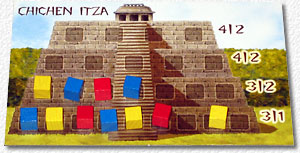
And there is another surprising element: The scoring areas are different levels in the
pyramids which afford more victory points the higher up you get. All first levels have to
be covered before you can place in any second level and so on. You are not allowed to put
a cube in a level if there aren’t any cubes of yours in every lower level of the same
pyramid. This means: often, you just put one cube in a pyramid to keep your options for
high levels. But woe on you if you happen to score with your single cube – remember it
gets removed, and if it was indeed your last in that particular level, all cubes from
higher levels are removed as well.

It can be very confusing to read descriptions of games you haven’t played, and
this was perhaps already confusing enough. However, my main point is that Maya offers a
dazzling variety of tactical choices, and I tried to convey that. Perhaps I am a little
bit over enthusiastic (compare how other WPGs scored the game) but for me it is the best
El Grande style game at this time.

Westpark Gamers ranking: 7.8 (G: 8, P: 9, A: 6, H:7, W:7)

©2003, Peter Riedlberger

Princes Of The Renaissance

Princes Of The Renaissance

Review by Moritz Eggert

One of the games that I awaited most in Essen was this new offering from Martin
Wallace, who is increasingly becoming one of the best and prolific game designers in the
gaming world. So it was easy to talk everybody into trying out this game immediately
after the fair.

“Princes of the Renaissance” (or PotR) is thematically very close to games
like “Princes of Florence” or “Age of Renaissance” – Players are
noble families in Renaissance Italy who vie for power and influence in the various large
cities of the time. The game covers three decades of intrigue and war, and each decade
equals one round with an undetermined number of player actions (a decade ends when all 4
event cards of the decade have been auctioned off). After the third decade, victory
points are counted (quite an involved process – but more about that later) and the winner
is decided.

First each player selects a noble house of the 6 available ones – each family has one
small special ability connected to one of the game mechanisms, two families can buy
artists (most of the events are artists who give you victory points or raise the status
of cities) one gold cheaper for example. As you buy perhaps 2 or 3 in a complete game
this is not really that big an advantage – you save only 2-3 gold!

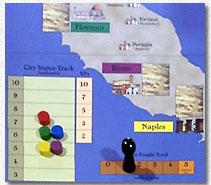
Then the game begins: On the relatively small board the 5 major Italian cities of the
time are depicted: Venice, Rome, Naples, Florence and Milan. Each city has a marker which
shows its status at the beginning of the game: Status can range from 3 (lowest) to 10
(highest). Princes of the Renaissance - correct setupATTENTION: The first edition
misses any mention of where these makers start – These are the correct starting
positions: Venice 7, Florence/Milan 6, Rome/Naples 5!

Each city has 6 tiles connected to it which can be bought after a player auctions them
off. These tiles work a little like shares in 1830 – The city status will change during
the game through wars and artists, and at the end of the game the value of the city’s
status will be transformed into a point value between 10 and 2 that will be the net value
of each of the owned tiles. A player can buy a maximum of 6 tiles of up to three
different cities, so great care has to be taken when buying tiles.

In addition all tiles have some special ability, which is historically flavoured.
Merchants earn money, the Borgia family excels in treachery and gets free treachery tiles
(see below), some historical personalities give bonuses with certain army tiles, and so
on. The different abilities are quite daunting at first play (one has a selection of 5×6
tiles plus the pope tile at the beginning of the game), and you should take your time to
look at and explain all the city tiles before starting the game, as they are the most
important element of the game.

Each player takes one action when it’s his/her turn. One can either buy one tile
of the various groups of army tiles (these give bonuses in defence or attack when war
looms) or one of the random treachery tiles, using the two currencies of the game,
influence (square tokens) and money (round tokens). Treachery tiles function like event
cards that give players advantages – one tile paralyzes one army tile in war through
bribe, another prevents the next player from bidding higher than you, and so on.

Or one can auction off a city or event tile – the first bid of a city tile has to be
double its influence, so successful cities become increasingly expensive! The third
option (apart of simply passing) is starting a war, which is always very exciting. The
warmonger determines an attacking city and a defending city. Then “condottiere”
rights are auctioned off, first for the attacking city, then for the defending city. Each
condottiere also earns the value of the city in money as a fee for fighting, but this can
only be collected at the end of the decade. Now each combatant rolls a die, adding the
various bonuses of his armies and special abilities. The higher result wins – now the
winning city gains one status (or two, if the result was double that of the defender),
and the losing loses one (or 2) status. In addition the winning condottiere gets one
“victory” marker, the more you have of them the more dramatic the victory point
gain.

There can be a maximum of 4-5 wars per decade (depending on the number of players),
but it is also possible to have a couple of “extra” wars by playing certain
treachery tiles.

Players can either “push” the decade end by auctioning off the 4 event
tiles, or delay it as long as possible. But before long money and influence run out, and
the actions become increasingly limited – so one moves on to the next decade. Now each
player gets his basic allowance in money and influence, which can be increased by income
from wars and income from special tiles owned (for example “Merchants”).

A special tile deserves to be mentioned: The Pope, which is a single tile that
“leaves” the player after one decade. The Pope gives the special ability of
being (once per decade) able to assist another player in a war without being part of it.
The Pope becomes especially interesting in the last decade, when he gives 3 extra Victory
points.

After the third decade the game ends. Now each city tile gives VP’s as explained
above, but also other tiles like artists might give extra points. The player with the
most and second most money gets 6 or 3 VP’s, the player with the most influence 4.
The Victory counters from wars also increase the tally considerably, if you have lots of
them.

So how does it play? As with many of Martin Wallace’s games, there are many ways
to win. One can play the game as a kind of historical stock market game, watching the
city tiles that other players buy and trying to be on the sunny side of business. Or you
act aggressively, building a large army that attacks the cities of your enemies to
destroy their value. Or you act treacherous, deviously stealing influence and money from
other players via the use of special abilities and treachery tiles.

The rules are elegant and simple (they come on 4 pages, one of which is a long example
of play), and the first game should take around 3 hours with 4 players. But be warned –
it is very difficult to decide what to do sometimes, as the choices are overwhelming
(especially in the first rounds of play). Even our experienced group seemed a little
befuddled at first. But quickly the game runs at a good pace, as the actions of each
player usually don’t take long, and there is loads of interaction through the bidding
and the treachery. Through the complicated victory point calculation the winner can be
something of a surprise, which is not necessarily bad.

Comparable games that come to mind are “Republic of Rome” (through the role
of wars) and even “Puerto Rico”, as there seem to be many strategies that can
be realized by the careful selection of city tiles and their special abilities. The only
complaint was that some of the treachery tiles were considered a bit annoying – The
“Pope” cost reduction tile was useless after the pope was acquired, and the
“steal 3 gold” or “steal 2 influence” were regarded as bringing too
much needless “little” aggression into the game – Walter was especially annoyed
by them! Also the game’s graphic design, although generally good, was considered
confusing – the German and English tiles use different colour codes for the gold symbols
for some reason, and the army tiles confusingly use squares differently than in the rest
of the game, which doesn’t make them easy to decipher. And of course there is the
omission of the city start status on the board itself. But “Warfrog” is a small
company that tries very hard (and successfully) to produce professionally looking games
in sturdy boxes, so these are minor complaints, especially when you compare them to the
sometimes incredibly awful typo orgies of Euro Games for example.

Our first game was not yet an extensive insight into the game, certainly one would
play the next game very differently, and the one after it probably as well. This is, all
things considered, certainly the sign of a good and lasting game design. In our opinion:
Highly recommended!

Westpark Gamers rating: 7.5 (on a scale of 1 to 10)

©2003, Moritz Eggert

Session Report 25.10.2003 – Spiel 2003

Session Report 25.10.2003 – Spiel 2003

Booth: The Realm Of Fantasy

On the table: Atta Ants

The Saturday in Essen’s Spiel fair tends to be the busiest day of all and there
was no difference this year. In the past I had avoided staying in hall 6 for too long –
the fantasy gamer’s hall – as it is usually packed with people (and because I am not
too interested in fantasy games anyway). This year was different, though, due to the fact
that my son was looking for extensions to his Magic – The Gathering card collection. As
in previous years he was quite impressed by the folks in the hall as many, many dress up
in fantasy game style; some looking really frightening while others, especially the girls
(am I really developing into a dirty old man?), were looking rather cute.

While Sebastian was flipping through the folders of the card dealers I spent my time
roaming the hall. And there I found this small booth of “The Realm of Fantasy“, a Dutch fantasy game
mail order company. Richard de Rijk, the founder of TROF presented his
two games: “Anera’s Arena” published already two years ago and his brand-new
game “Atta
Ants
“. This little game about leaf cutting ants immediately caught my attention
so I sat down and had an introduction into the game.

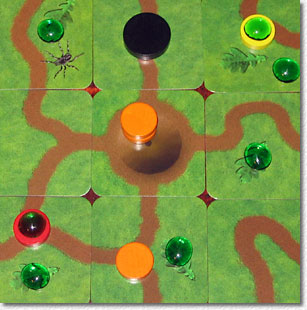
Atta Ants is a 2 to 4 player game with a variable board layout. During the setup phase
8 tiles (good quality cardstock) are placed around a central “ant nest” tile.
The tiles represent terrain around the ant nest. Most of the tiles have brown
“tracks” printed on them, which represent the preferred route of roaming ants.
Some of the tiles carry atta ant food, represented by an oak leaf while others have a
little spider printed on them – spiders are the enemy of the atta ants as they feed on
them.

Each player has 6 ants represented by colored wooden disks. Once the initial board has
been setup by laying down the first nine tiles, each player places 2 of his ants in the
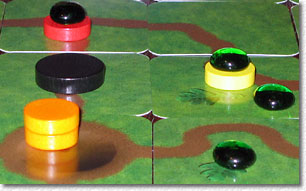
central nest. In addition all tiles with a spider illustration receive a larger black
disk representing a spider (there is a maximum of four spiders). Any tiles with leafs
receive 2 glass tokens representing food.

Atta Ants - board

The players’ task is it to collect the food tokens with their ants and to bring
the food back to the nest. For each food token returned to the nest the player may place
one new ant into the nest. The first player who has placed all 6 ants on the board wins
the game. Alternatively, the game ends once all 24 terrain cards have been placed. In
this case the player with the most ants on the board wins. This would be all too easy
were there not movement restrictions and the deadly enemies of the ants.

Each round begins with the start player adding one new tile to the board. New tiles
must extend any existing ant paths and must match with already existing tracks. Once the
tile is placed the start player moves his ants: Ants may travel a distance of up to 2
tiles on the ant paths or 1 tile through the “rough”. At any time during its
movement an ant may pick up one food token, either from the ground or from another ant.
The round then continues with the next player moving his ants. Once all players have
moved their ants the start player completes the round by moving the spiders. Spiders move
only one tile and into the direction of the tile holding the most number of ants
(excluding the nest). If there are more tiles like this, spiders will move towards the
closest one; if there is more then one possible route the start players decides which
route the spider will take. If a spider ends its movement on a tile with ants it will eat
all of them and the ant tokens are removed from the board and given back to their
respective players. The startplayer position then moves on in a clockwise fashion.

Atta Ants by TROF

On the booth we had a three player game and on the same day I played three more two
player games in the evening with Sebastian. What is surprising to me is how different the
game works in a two vs. a multi-player setting. While with two players the game can
become quite a brain teaser when considering the right routes to take for your ants and
the spiders. The game has a completely different “flavor” with three (and
possibly four) players. With more then two players it is of course much more difficult to
precisely plan ahead and to build “traps” for the opponent’s ants. It is
much more important to stay clear of the spiders and to correctly time the picking up of
food so Richard de Rijkthat
other ants cannot steal it from your.

The friendly girl at the booth pointed out that a good move is to set up a
“delivery chain” which makes it possible to move food into the nest in just one
turn (I leave you to sort this one out by yourselves) and it seemed to me that this may
be vital for winning the game. Another important thing to consider is to actively
“steer” the spiders: As spiders always move into the direction of the tile(s)
with the most ants on them it can be very wise to move one of your ants onto a tile which
holds already some opponent’s ants. Particularly in a two player game this is one of
the tactical moves you can make when you are NOT the start player. In a multiplayer game
it can be wise to team up with one opponent for “spider steering”.

All in all, “Atta Ants” is a very nice game. It has high quality components,
can be explained and played in under 45 minutes and last but not least works very nicely
as a two player game as well as a multi-player game. I’m curious to see how it will
work with the rest of the Westpark Gamers.

Westpark Gamers score: 7.0

©2003, Aaron Haag

Session Report 22.10.2003

Session Report 22.10.2003

at the table: Walter, Hans, Aaron, Moritz

on the table: Marchants d’Empire (Merchants Of
Empire)

Der Spielanleitung gemäß befinden wir uns, Jahrtausende zurück, im Landes des
allmächtigen Gottes Phaos. Nach der braunen Wüstenfarbe des Spielfeldes, der Ausstattung
mit Handelsstraßen und Edelsteinen usw. könnte es aber genausogut im mittelalterlichen
vorderen Orient spielen. Der Name “Euphrat und Tigris” war halt schon vergeben
und “Bagdad” hat im Augenblick keinen so guten Klang wie zu den Zeiten von 1001
Nacht.

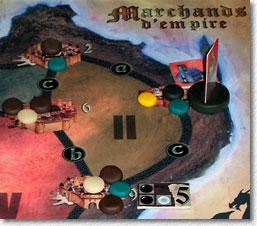
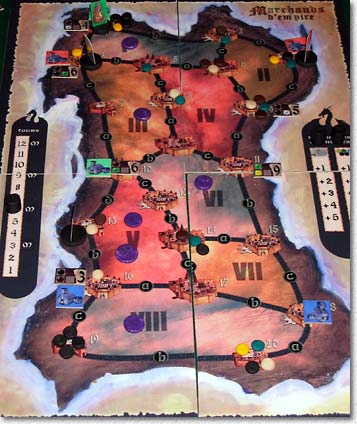
Auf den Spielplan sind größere und kleinere Städte um eine Hauptstadt herum plaziert
und mit Straßen verbunden. Zufallsverteilt werden auf einige Städte verschiedenfarbige
Glaskugeln (sinnbildlich für Kohle, Bronze, Silber, Edelsteine und Gold) und
Vertragskarten gelegt. Die Spieler haben je einen Pöppel (genannt Karawane), mit dem sie
sich über die Handelstraßen von Stadt zu Stadt bewegen, Glaskugeln aufnehmen und damit
die Verträge einlösen.

Die Bewegungen der Spieler werden nach dem Robbo-Ralley-Prinzip abgewickelt: Jeder
Spieler besitzt 6 Aktionskarten, die entweder die Richtung vorgeben, in der sich ein
Spieler bewegen will (muß), oder die eine Handlung anzeigen, die der Spieler in der Stadt
ausführen will. Die Aktionskarten muß jeder Spieler für sich ordnen und verdeckt vor sich
hinlegen. In einer Spielrunde werden die Karten dann einzeln in der eingestellten
Reihenfolge aufgedeckt und der Spieler führt die entsprechende Aktion aus. Entweder
bewegt er sich oder er nimmt eine Glaskugel auf oder er erfüllt einen Vertrag.

Als Erfüllung des Vertrages kann der Spieler:

  1. die Vertragskarte behalten und den aufgedruckten Wert (2-9 Punkte) Kapital
    gutschreiben lassen.
  2. die Vertragskarte abgeben und dafür einen Tempel errichten, mit dem er sich
    himmlische Schätze erwirbt.
  3. die Vertragskarte abgeben und dafür Repräsentanten in den umliegenden Gebieten
    aufstellen, mit denen er seinen politischen Einfluß erweitert.

Wenn jeder Spieler seine 6 Aktionskarten aufgedeckt und ausgeführt hat, ist eine Runde
vorbei. Für jeden erfüllten Vertrag und für jede Stadt, deren Glaskugeln vollständig
entfernt wurde, wird gewürfelt, wo ein neuer Vertrag bzw. wo ein neuer Satz von
Glaskugeln aufs Spielbrett gebracht wird. Wer Glück hat, bekommt die Güter dieser Welt
gleich vor die Nase gesetzt; wer Pech hat, muß erst meilenweit dafür gehen.

Nach 12 Runden ist das Spiel zu Ende und es wird der Sieger ermittelt. Hierzu wurde
ein bemerkenswertes mehrstufiges Filterverfahren entwickelt, bei dem jeweils immer ein
Spieler durchfällt. Der am Schluß übrig bleibende Spieler ist der Sieger. Die ganze
Siegesstrategie besteht also darin, bei allen Ausscheidungskriterien nicht der letzte zu
sein.

Als erstes scheidet der Spieler mit den wenigsten Tempeln aus. Dabei zählen nicht alle
Tempel gleich, sondern Tempel in größeren Städten liefern mehr Punkte. Bei insgesamt
Punktegleichheit scheidet der Spieler mit dem kleinsten Tempel aus. Herrscht auch hier
Gleichheit, scheidet der Spieler mit den wenigsten Tempeln aus.

Als zweites verabschiedet sich der Spieler mit dem geringsten politischen Einfluß.
Hier gibt es genaue Rechenverfahren, wie die Mehrheit der Repräsentanten in den
jeweiligen Gebieten in Polit-Punkte umgerechnet wird. Und es gibt ebenfalls Unterregeln,
die bei Unentschieden angewendet werden müssen, um doch noch einen Verlierer zu
bestimmen.

Als dritter und letzter scheidet der Spieler mit dem geringsten Kapital aus. Das
Kapital setzt sich aus den gesammelten Vertragspunkten sowie aus einer ganzen Reihe von
anderen Punkten zusammen, die man nach jeder Runde als Monopolist von Glaskugeln erwerben
konnte. Für Unentschieden gibt es hier bis zu 9 Unterkriterien (z.B. die Mehrheit im
Besitz von Glaskugeln einer Farbe), die mit Sicherheit zu einer Endausscheidung führen.
Wer hier dann die Nase vorn hat, ist Sieger.

Wir habe bei unserem ersten Spiel gleich zwei entscheidende Spielregeln übersehen und
damit unabsichtlich dem Spiel einen Großteil seines gewollten Konkurrenzkampfes
genommen.

  1. Es sollen nur dann nur neue Sätze von Glaskugeln aufs Spielbrett gebracht werden,
    wenn ein Satz vollständig abgeräumt wurde. Wir dagegen haben für jede einzelne abgeräumte
    Glaskugel gleich einen neuen Satz plaziert. (Bis der Vorrat leer war!) Das hatte zur
    Konsequenz, daß die Glaskugeln nie eine verknappte Ressource darstellten, um die wir
    kämpfen mußten. Sie fielen uns eher wie die gebratenen Tauben im Schlaraffenland einfach
    so in die Hände.
  2. Wenn neue Glaskugeln auf Spielbrett gebracht werden, so soll auf jedem Fall die
    Hauptstadt eine Portion davon abbekommen (falls sie keine mehr hat). Damit soll der Kampf
    um das privilegierten Zentrum gefördert werden. Wir verteilten ausnahmslos alle
    Kugel-Sätze zufällig über das ganze Brett. So erzielten wir natürlich eine viel größere
    Streuung, und jeder konnte sich ziemlich unbehindert von den Mitspielern ein Gebiet
    heraussuchen und es abgrasen.
  3. Tatsächlich waren es sogar drei Fehlinterpretationen, da wir das
    Eliminierungsverfahren ebenfalls nicht ganz korrekt angewendet haben – ansonsten hätte
    ich nämlich den zweiten statt des dritten Platzes belegt [ah].

Nur bei Befolgung der Original-Regeln entsteht im Zentrum ein Kampf um Prioritäten und
Mehrheiten, der ein wesentliches Element dieses Spieles ausmacht. Bei uns waren alle
Güter in Hülle und Fülle vorhanden und unsere Überlegungen beim Spielablauf bezogen sich
ausschließlich auf die komplexen Siegbedingungen. Dafür, daß es keine Anzeigetafel gibt,
auf der die Zwischenstände aufgezeichnet sind, tappt jeder Spieler bei seinen Planungen
doch ziemlich im Dunkeln. So schätzten wir am Ende den Zufallseinfluß dieses Spieles auf
bis zu 70 % ein, ein Wert, der für die trivialen Zugmöglichkeiten entschieden zu hoch
ist. Wir müssen das Spiel unbedingt noch mal mit genauer Regelbeachtung wiederholen.

Inzwischen haben wir Marchands d’Empire noch einmal mit der korrekten
Regelauslegung gespielt. Unsere Erfahrung damit beschreibt Walter hier.

Westpark-Gamers Wertung: 6,25

©2003, Walter Sorger

Session Report 22.10.2003

Session Report 22.10.2003

at the table: Walter, Hans, Aaron, Moritz

on the table: Shipwrecked

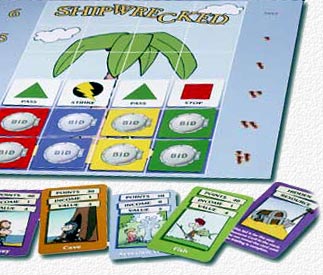
Ein Versteigerungsspiel um Karten, die einerseits Punkte für den Sieg und andererseits
Einkommen für die nächsten Versteigerungen liefern. Eine Versteigerung läuft in 1 bis 6
Runden ab, in denen jeder Spieler jeweils eine Gebot-Karte ausspielt. Es wird nicht offen
geboten, sondern die Karten werden verdeckt ausgelegt, wobei sich die verschiedenen
Karten nach Art von “Stein-Schere-Papier” gegenseitig ausstechen.

Shipwrecked Material

Wer eine Stop-Karte legt, kann die Versteigerung beenden. Er hat die Versteigerung
aber nur gewonnen, wenn in dieser Runde keiner eine Strike-Karte gelegt hat, und wenn
kein weiterer Spieler eine Stop-Karte gelegt und dabei in den vorhergegangenen Runden
mehr Pass-Karten gelegt hat.

Wer eine Strike-Karte legt, hat die Versteigerung gewonnen, wenn ein anderer Spieler
eine Stop-Karte legt UND mit dem Wort “Stop” die Versteigerung beendet. Und
wenn natürlich kein weiterer Spieler eine Strike-Karte gelegt hat. Wer eine Pass-Karte
legt, sammelt nur Tie-Breaker-Pluspunkte, für eine spätere Runde, in der er die
Stop-Karte legen und sich gegenüber seinen Stop-Konkurrenten durchsetzen will.

Es geht also im wesentlichen um ein psychologisches Glücksspiel, bei der man die
Taktik seiner Mitspieler im Einsetzen von Strike-Stop-Pass-Karten richtig einschätzen muß
und seine eigenen Karten passend dagegen setzen muß.

Wir haben kurz mal überlegt, ob das Spiel unserem Standard-Absacker “Bluff”
das Wasser reichen kann. Kann es nicht. Hier wird nicht gerechnet, es wird nicht gelogen,
es wird nicht geschoben, gedrückt und geblufft. Man kann lediglich versuchen zu erraten,
mit welcher Kartenreihenfolge die Mitspieler ihre Versteigerungsambitionen verfolgen
werden. Und man muß versuchen, asynchron darauf zu reagieren. Das ist alles. Aber das
Spiel ist locker und leicht und wurde als Absacker grundsätzlich positiv aufgenommen.

Westpark-Gamers Wertung: 6,0

©2003, Walter Sorger

Session Report 10.10.2003

Session Report 10.10.2003

at the table: Walter, Thomas, Andrea, Moritz

on the table:
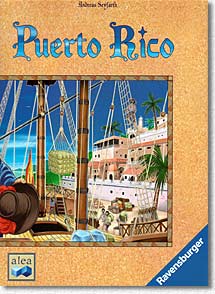
Puerto
Rico
Puerto Rico cover

Andrea was really eager to play “Puerto Rico” again, which was absent from
our gaming table for quite a while. 4 players being the ideal number we readily agreed.
Of course we were also longing for being able to cruelly flog slaves into submission,
being the evil Germans that we are. And of course this is only a joke ;-).

The game began with Walter taking the settler to get a quarry. As there were 3 coffees
laid out, and I was a maize player, the coffee/maize tactic basically jumped at me, as
coffee would be rare in the future. Andrea imitated me.

The game went ideally for me in the first 6 rounds or so. First I was able to make
quite a good profit with the neglected gold digger and the small market, so I could
quickly buy the coffee mill. For a couple of rounds I was the only person to sell coffee,
so I upgraded to the big market. Thomas went for the diversity tactic and the
manufacture, Walter went for the quarry/building tactic, Andrea pretty much imitated what
I did.

Because I was clearly leading the game, the last rounds were not so profitable for me
(the others got more careful with their choices), and I made some wrong decisions about
acquiring large buildings (because of my guaranteed money flow I actually bought 3 of
them in the end), so Andrea caught up pretty well. But in the end she didn’t manage
to beat my quite high score of 63 and made second place.

Thomas and Walter (3rd and 4th place) were nearly tied, but didn’t fare so well.
Again the game went never exactly as planned for anybody, and always remained
interesting.

And, we treated our slaves like kings, and gave them their freedom at the end of the
day!

©Moritz Eggert

Session Report & Review – 22.10.2003

Maestro – Eine musikalische Kritik

Nachdem wir vor kurzem eine ausführliche Kritik
dieses Rudi Hoffmann – Klassikers veröffentlicht haben, möchte ich mich hiermit, auf
Walters Anregung hin, allein auf eine “musikalische” Kritik beschränken. D.h.
also: “Maestro” mit den Augen eines Musikers betrachtet!

Milhaud

Diese Betrachtungen betreffen natürlich weniger das Spiel selber, als vielmehr das
Spielbrett und die dort auffindbaren, äußerst seltsamen Abbildungen, die für den Laien
zwar wie Musikinstrumente aussehen, in Wirklichkeit aber aus einer äußerst seltsamen
Parallelwelt stammen, in der Musik höchstwahrscheinlich nicht von Menschen, sondern von
seltsam missgebildeten Aliens gespielt wird. Und in der “Laura Branigan” noch
immer ein Begriff ist, den jeder kennt.

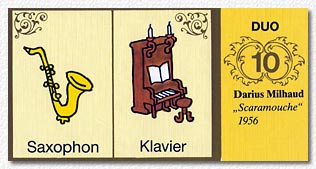
Fangen wir links oben an: Milhaud’s “Scaramouche” für Saxophon und
Klavier. Sehen wir einmal davon ab, dass “Scaramouche” in Wirklichkeit für 2
Klaviere ist, so können wir doch die beiden abgebildeten Instrumente erkennen. Das
Saxophon ist ein Saxophon, trotz merkwürdigem Untersatz unter dem Schalltrichter
(vielleicht war hier ein Alphorn Modell?), und das Klavier sieht nun wirklich
hundertprozentig aus wie das Klavier in Walters Wohnung. Nur auf einem Podium würde es
überraschen, denn da stehen ausschließlich Flügel, also die größere Version des
“aufrechten”, hier abgebildeten Klaviers.

Debussy

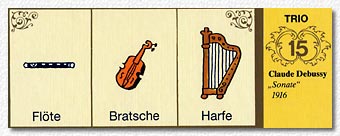
Kommen wir zu Debussys “Trio” – tatsächlich für die abgebildete Formation
geschrieben, allerdings hat eine echte Bratsche 4 statt 3 Saiten (alle Saiteninstrumente
haben auf dem Spielbrett 3 statt 4 Saiten – aber das ist wahrscheinlich aus ähnlichen
Gründen der Fall wie bei Walt Disney, da haben die Bewohner von Entenhausen auch immer
nur 4 Finger anstatt 5). Skurrilerweise haben die abgebildeten Saiteninstrumente auch
alle nur ZWEI Stimmschrauben – Jede Stimmschraube stimmt also 1.5 Saiten, was schon eine
Leistung ist!

BachUnd eine Flöte hat ein ganz wichtiges Utensil, das man
“Mundstück” nennt. Ohne das kann man die Flöte nämlich gar nicht blasen!
Auch Harfen pflegen für gewöhnlich Pedale zu haben, und zwar deren 7. Sonst kann man
nämlich darauf nie Debussy, sondern nur irische Volksmusik spielen, und die wird ja
dann doch irgendwann fad…

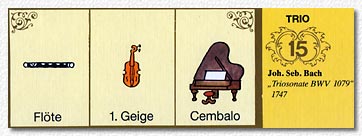
Was kommt jetzt? Triosonate von Bach. Immerhin richtig, dass hier Cembalo anstatt
Klavier gespielt wird, allerdings sieht das Cembalo aus wie der Flügel, der bei
Scaramouche nicht mitspielen durfte.

Gershwin

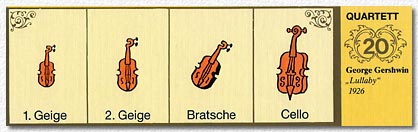
4 Dreisaiter bilden dann das Quartett “Lullaby” von George Gershwin, das
besonders apart auffällt, denn es gibt gar kein Streichquartett von Gershwin. Dieser
Missstand ist insofern verwunderlich, da es ca. 5 Millionen andere Streichquartette gibt,
die man hier hätte nennen können, von Haydn bis Mozart, und von Beethoven bis Schubert.
Um nur einige von hunderttausend Namen zu nennen…

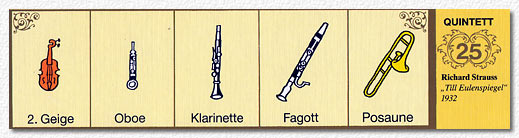
Mein Lieblingsstück ist das jetzt folgende: “Till Eulenspiegel” von Richard
Strauss, in einer neuen Fassung, die die Musikwissenschaft schockieren würde:
Holzblastrio unter Zusatz von allein ZWEITER Geige (nur so nebenbei: wenn nur eine Geige
spielt, kann es nie aber auch wirklich nie die zweite sein) und dem vollkommen zu dieser
Besetzung unpassenden Instrument…Posaune????

StraussVielleicht geht das, denn die abgebildete Posaune kann von
einem Menschen nicht gespielt werden, nur von einem kopflosen Schlossgespenst, das
keine Probleme damit hat, dass dort, wo der Kopf hinmüsste, ein Rohr ist. Da
Gespenster aber nicht blasen können, ist das eben nicht schlimm, nur ein Ton kommt
halt nicht raus. Noch “geiler” ist natürlich das Fagott, das in dieser
Form nur in Australien gespielt werden kann, denn es steht schlicht und einfach auf
dem Kopf! Dort wo man hier rein blasen müsste, ist in Wirklichkeit der Fuß des
Fagotts.

Auf der nächsten Spielplanhälfte begeben wir uns nun in vollkommen seltsame
musikalische Gefilde. Und das nicht wegen des Forellenquintetts von Schubert, denn da
stimmt die Besetzung ausnahmsweise. Auch nicht wegen Tscherepnins
“Sommermusik”, einem quasi nie gespielten Werk eines eher zweitklassigen
russischen Komponisten, das Hoffmann hier verewigt hat. Vielleicht wird es so selten
gespielt, weil die Trompeten hier die Ventile unten anstatt oben haben müssen???

Branagan

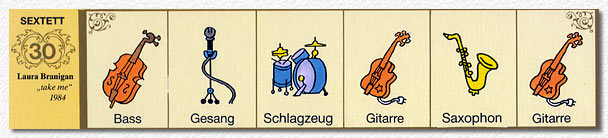
Nein, es ist das “Opus Summum” des Spielplans, das beliebte Stück “take
me” der berühmten Sängerin Laura Branigan (!!!!). Wie bitte? Noch nie gehört? Nun,
es ist, sagen wir mal: eher unbekannt. Vielmehr…äh… gar nicht bekannt. Vielmehr…gar
nicht existent???? Wer auch immer Laura Branigan sein mag, ihr wurde hier etwas gutes
getan, noch in 1000 Jahren werden Spieler sich um dieses Brett versammeln, und sagen
“Hey, Laura Branigan, das war doch mal so ne geile Sängerin, legen wir doch mal ihre
Scheibe auf”, und aufgelegt wird sie, die Scheibe, und Spieler werden ihre
Applauskarten im Rhythmus des Welthits “take me” spielen, und dabei sinnend vor
sich hinschunkeln. Vermutlich wird es bis daher aber gar keine Menschen mehr geben. Nicht
wegen Atomkrieg oder so, nein, es reicht die abgebildete E-Gitarre zu spielen, da ist man
auch ohne tolle Branigan-Mucke wie “unter Strom”….

Saga

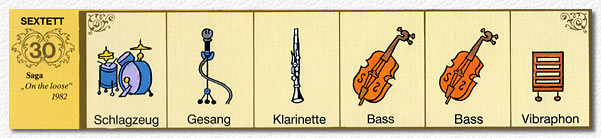
Das nächste Stück ist wiederum eine Erinnerung an ganz schlimme 80er Jahres-Zeiten,
nämlich an den entsetzlichen Protzrock der grauenhaften Band “Saga”. Dass diese
allerdings in der vollkommen bizarren Besetzung Gesang, zwei (!!!) Bässe, Klarinette und
Vibraphon auftraten, war mir nicht mehr ganz so klar, aber so wie deren Musik klang, kann
das schon stimmen. Nachdenklich macht uns der Künstler mit der Abbildung eines, wie soll
ich sagen, unbekannten Objektes, das uns in quasi “Magrittescher Weise” auf das
Unrecht in der Welt aufmerksam macht, indem es sich der althergebrachten Gestaltung eines
Abbildes als etwas ideell dem Abgebildeten ähnlichen radikal verweigert. Ich kann nur
sagen, daß das abgebildete Objekt alles mögliche ist, aber “ceci n’est pas une
vibraphone”, das ist sicher.

Denn Abschluss bildet irgend so ein doofer Marsch (Militarismuskritik?), aber der
Schlagzeuger wird nicht so einen Lärm machen mit seiner Schiessbude, bei der die Bassdrum
auf der einen, und die Hi-Hat auf der anderen Seite ist. Oder waren hier ursprünglich
zwei Musiker vorgesehen?

Wie auch immer, angesichts der Phantasie von Rudi Hoffmann und seinem Illustrator kann
ich nichts weiter tun, als den Hut zu ziehen, oder vielmehr die letzte Applauskarte aus
dem Sack!

©2003, Moritz Eggert

Taking Control Of Time Control
Taking Control Of Time Control

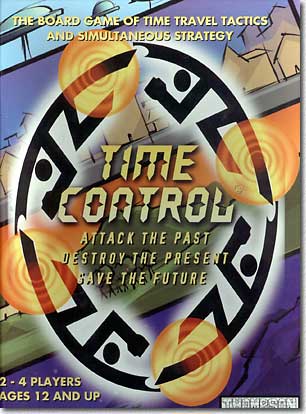
Time Control - box

A review and a possible „fix“

Time
Control
” has been one of the most dissed games in boardgamegeek history – this
has to do with the fact that the designer sent out many free games to possible reviewers,
a practice which is normally laudable but which backfired in this case. We as the
“Westpark Gamers” had also received a copy, but as it arrived relatively late
we already had word from the various boardgamegeek reviews (by usually reliable
reviewers) that this game was truly awful. Therefore we never really got around to play
it (or rather didn’t dare, to be honest).

This reviewer will not try to rectify the view that is dominant about “Time
Control” – the game suffers from many flaws and has certainly not been
playtested enough (or perhaps not at all). But while reading the rules (second, optimized
version, still with many unclarities) I found that some of the ideas in the game were
neat and interesting. I also felt sorry for the game designer, who had apparently gone to
great length to present and print his game professionally (you can certainly not say that
the game is ugly looking, although tastes differ). Also, I am a fan of the “time
machine” genre, of which there are only very few good games (and only one true
masterpiece, the totally underrated and out of print “Time Agent” by TimJim
games). So before we finally decided to test this game, I already changed some of the
rules that I was sure wouldn’t work (therefore sparing us the aggravation that the
other testers felt while trying “to make it work”). But more about that
later…

To give you some idea what the game is about, here is a short description:

Each player represents a time agency which tries to keep reality safe from “time
waves”, accumulated problems that wander “up” to the present from the
past, created by the other players agents. Each player therefore is master of his own
“alternate reality”.

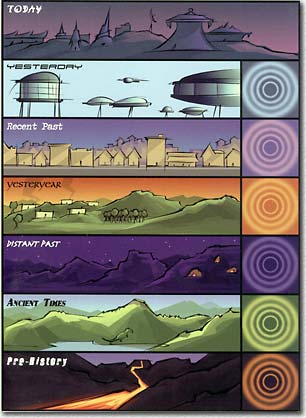
There are 7 time zones: today, yesterday, recent past, yesteryear, distant past,
ancient times and pre-history. Today is where your agents are safe, and from which you
send them to the past, to your own, and ultimately also to other players time zones.
There are 4 kinds of agents: normal ones, brawlers (good at beating the crap out of other
agents), scientists and historians (which are good in influencing and changing the time
waves).

First players deploy their agents on various time zones on their own board (movement
is linear, you can only move towards pre-history, from which you “snap back”
to the present). Now the most problematic phase of the game begins: the “free for
all”, which simply doesn’t work. In the original rules every player can do
whatever he wants whenever he wants, he just has to announce it, and see if somebody
opposes it. The latter happens when another player tries to take “time
control” , saying “before you do this I do that”, to which of course
another player can chime in say “and before you do that, I do
this”, etc. ad nauseam. At some point you try to get out of this mess by
resolving these “time duels”, which are akwardly done by the rules: you
either spend time chips (numbered 1-21) OR you play a “Fate” time chip which
enables you to blindly draw a card from -15 to +15 (or an automatic win card –
sic!). Confused already? Even more confusing is the fact that you can always re-duel (in
fact every player involved in the duel could do that), and that you lose only the
highest time chip spent, the others are kept.

Theoretically every player can be active until all his agents are “busy”,
moving/activating one at a time. Agents are moved to other boards to create
“create” tokens, which in turn create a time wave that after the first round
moves up to the present step-by-step to create more “create tokens” and
finally problem cards, which oust a player from the game if he accumulates enough of
them. Agents can also try to rectify these problems by flipping the create tokens to
their “solve” side (when in the same zone) – “solve” tokens who
reach the present can get rid of “problems”. Of course you can also attack
other agents, again using the clumsy duel rules.
Time Control

And have I already said that time waves also attack agents, again using the
duel rules??? Although the duel faintly reminds one of the classic “Cosmic
Encounter”, it is absolutely overdone to use it for nearly every mechanism in the
game – in “Cosmic” playing the duel cards is always decisive and much
more rarely done.

And the biggest problem is: The first turn never ends! Agents keep on being active
(you start with 12), as some actions, even sometimes fights, don’t
“busy” them, therefore ending their activities. This means that we look at at
least 48 if not more actions by four players, most of which will be duelled about. And
most of which will involve yet another duel! And reduelled. And reduelled again.
For all eternity (perhaps fitting the theme, perversely).

All play reports said the same: They were playing the first round for what seemed like
ages, and then stopped because they simply were bored witless.

All this doesn’t sound like a lot of fun. This is why I tried to change it!

When we finally played I already used the optional rules that I created, and lo and
behold, suddenly the game wasn’t half bad! Players even admitted having
“fun”! :-)

After experimenting a bit more this is my attempt at an easy rules fix that makes
“Time Control” a much better, perhaps even interesting game. I am actually
sure that the designer, who I applaud for being calm about all the bad reviews, would
have changed the rules to this had he tried out the game a bit more with neutral
playtesters. Everybody at our playing agreed that this game “deserved another
chance” – I leave it to you if you are willing to give it a try!

Main problems with the game:

  1. The “free for all” rule creates endless confusing duels which are
    repetitive and take forever.
  2. Victory conditions involve kicking out every other player of the game – not a
    good idea if turns take that long!
  3. Game is much too long for its relatively light content.

And here is my attempt at a fix:

SETUP

  1. Remove the 4 problem cards “Bureaucratic” (2x) and
    “Narcissism” (2x) they are not needed at all.
  2. Remove the “fate” tokens from the time control tokens. They are not
    needed. Remove the “Fate” card from the “Fate” deck. The
    “Fate” deck will not be used, only for checking the results of individual
    battles.
  3. Get a few 6-sided dice – they are needed.
  4. Get 4 markers to show “1st”, “2nd”, “3rd” and
    “4th” player, as the turn order will constantly change.

GAME PLAY

One major change: At the beginning of the game there is a time duel, using the time
control tokens. If there is a tie between two players, these two duel again, but they
cannot use the tokens they already played. The highest bidding player becomes
“player 1”, the second highest “player 2” etc.. Tokens that
are played are lost, even if several were played
.

Now the playing order for the game has been established, which is adhered to strictly,
until somebody opposes it (see below).

Playing “interrupts”: Every player does one action at a time, as per the
original rules. But before he actually puts the action into effect every player can
“interrupt” his action, and try to duel for “time control”. The
first player to announce this challenge plays a duel with the challenged player, using
the “time control” tokens. The higher value wins, ties are repeated like
above. If the challenging player wins, he now takes over the former position of the
challenged player. He now does one action of his choice, which cannot be
interrupted again by other players!
If the challenged player wins, he proceeds to do
his original action (which cannot again be interrupted by other players).

Example: Player 1 announces and does an action. Then player 2 announces another
action. Player 1 wants to interrupt and is the first to do so. Both players play a time
duel. Player 1 wins and now becomes in effect player 2, giving him two actions in a row,
while player 1 misses a turn. When it is player 3’s turn, either player 1 or player
2 (or player 4) could interrupt again, therefore changing the turn order again.

All Time Control tokens used for duels are lost and can only be regained through the
“Cash in” rules of the original rules, which remain as written!

The will never be any “reduels” – the first duel counts!

FIGHTS BETWEEN AGENTS

Agent’s duels are simplified as thus: Every player simply rolls a 6-sided die,
trying to beat the other player’s roll, ties are won by the attacker. The
losing player draws a fate card to see the combat result (as in the original rules),
which also refers to the attacker (again, as in the original rules).

All other agents by one of the fighting player’s which are in the exact same
time zone, add +1 per active agent, even if already busied. These “helping”
agents will NOT be busied after the combat!

This modifier is optional, the player can choose to involve only a few, even
none of his other agents (he has to specify which). But all agents who were involved in a
combat suffer the same negative result when losing (not when winning – so
already busied agents won’t suddenly become active again!).

“Sabotage” and “Aid”:

  • “Sabotage” is trashed, there is only “Aid”.
  • “Aid” is given when agents of other players announce to help with their
    agents, if they are present in the same time zone as the combat. This means they give
    their “+1” bonus/ses to one of the involved players. This is asked for in the
    momentary turn order (after the attacking player): Players can give aid if present, or
    refuse. If they give aid and the combat is successful for their side, they can
    resurrect one “time control” token (regardless of how many agents
    participated) that has already been used. There are no negative side effects when their
    side is losing.
  • The player who receives aid can refuse to receive it, but once he uses the modifier
    (deciding before rolling) he also has to accept the fact that aiding players regain time
    control tokens, if he wins.

TIME WAVE ATTACKS

These attacks are handled as combats above, but there is no “aid” this
time. Time waves roll 1 die, adding 1 for each token present above one, regardless of
it’s kind (for example: the time wave consists of 3 “create”’s
and 1 “solve” – it rolls 1 die, adding 3 to the result.

Defending agents roll a die at a time for each of their agents present, adding
2 if the agent is still active, and nothing if the agent is busied.

Results of successful time wave attacks are handled by drawing a fate card, as in the
original rules.

WINNING CONDITIONS

Players are never kicked out of the game. Instead they accumulate
“problem” points for problem cards drawn. These problem points are kept,
even if the problem card is later “solved”
(use poker chips or write them
down).

You get:

  • 1 problem point for each problem card drawn
  • 1 additional problem point if you draw a problem type that you already have as a card
    (meaning you still own the unsolved problem). This is cumulative: if for example you draw
    a technological problem and already have 2 technological problems, you would get
    three problem points in one go.

The first player to accumulate 10 problem points ends the game immediately. Now
the player with the fewest problem points wins the game. If there is a tie, add
all remaining time control tokens of the players involved, checking who has more. If
there is still a tie, count the agents of the players involved, checking who has the most
left. If there is still a tie, both (or more) players win!

All other rules are as in the original game.

Note: These rules are still a work in progress. I would be interested in how
you liked them, and if you have other suggestions. In our opinion they made for a
quicker, more interesting game, that brings out the qualities of the original design idea
much more than the original rules.

ATTACK THE PAST

DESTROY THE PRESENT

SAVE THE FUTURE!

©Westpark Gamers, 2003, Moritz Eggert
Session Report & Review 25.09.2003

Session Report & Review 25.09.2003

Author: Moritz

at the table: Loredana, Andrea, Peter, Moritz

on the table: T-Rex, Star Wars – Epic Duels, Bluff

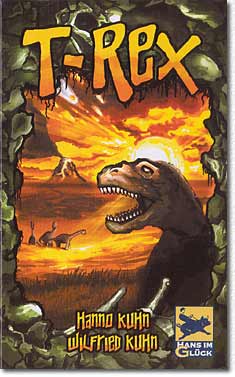
  1. T-RexT-Rex cover

    For some reason this game gets good replay in our group – it is a clever little card
    game with good mechanisms (that take at least 1 game getting used to – the game confused
    me as well when I first played it!). Each player tries to gather dinosaur eggs in
    different colors, even better: of the SAME color, as their net worth will be squared (so
    3 eggs of the same color give 9 points).

    Each turn two eggs are revealed randomly, the player who played the highest card in
    the final round of card play gets the first choice of “egg”, the second gets
    the remaining one. The LAST player will be able to alter trump OR losing suit for the
    next round. In a 4-player round, the 3rd player will get nothing, which is usually to be
    avoided, as the ability to change trump suits is actually pretty important in the end
    game.

    Each player has exactly the same number of cards, numbered 1-15, but in 5 colors (so 1
    color has the 1, 6 and 11, another color has the 2, 7 and 12 and so on). There are also
    two special cards (more about them later).

    You start with only a selection of cards, the others come into play through drawing
    additional cards from your private draw pile, to which about half of the cards you will
    play enable you. The brown “8” gives you 3 new cards for example. The other
    half of the cards are “comet” cards: these start the last round of card play,
    starting from the player who played them (this last round will determine the
    “winner” of the current turn), but only until somebody plays a HIGHER comet
    card, which starts a new round. So it is possible to prolong the last round a lot of
    times, which is usually what happens. Playing the same card as your predecessor actually
    beats his/her card. But as you never really know when exactly the round will end (players
    might also play one of the special cards, the “super comet”, which beats all
    other comets) it will also be in your interest to play a card that is the highest in the
    current round. And if you played the highest comet you also have to play an additional
    card for your final play – if it is also a comet, it could prolong the current
    round…again!

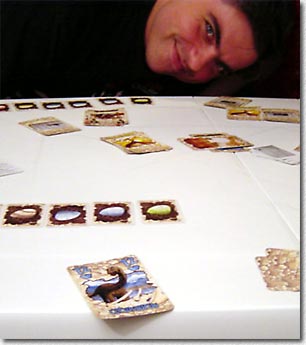
    T-Rex board

    Decisions, decisions….

    For this problem you can use the “chameleosaurus” card, which enables you to
    imitate the card you play it on, without copying its comet or card draw abilities. If
    yellow is the trump color you could first play the 11 comet card (which is the highest
    yellow card), and then, as the final card play, the chameleon, which is again the yellow
    11, but doesn’t start the new round.

    Another mechanism makes the game interesting: After one round is finished, each player
    either removes the visible card of his discard pile, or an unknown card from his draw
    pile. The discard pile is then turned over and placed under the draw pile. Therefore you
    have to memorize your cards, as they will reappear in exactly the same order. You’ll
    also have to memorize the cards the other players lose, as they will determine who is
    leading in one or the other color.

    The game ends when the number of available cards reaches a certain limit, the player
    with the highest net worth in eggs wins.

    The challenge in this game is to judge when you start the “final” comet
    round: sometimes, if your hand is better than the other player’s hands, you should
    push early to exploit this advantage, if you have few cards, you might play the
    “card draw” cards first. But you might miss the end of the round, which
    sometimes comes earlier than you think, when players refuse (or are unable) to play
    higher comet cards to continue the round. Very often an unexpected card play of your
    neighbor can ruin your best plans!

    “T-Rex” is a challenging and interesting card game – it takes time to get
    used to, but it is definitely worth the effort.

    Westpark rating: 7.33

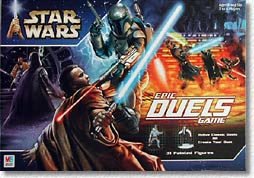
  2. Star Wars: Epic DuelsStar Wars Epic Duels cover

    Star Wars: Epic Duels

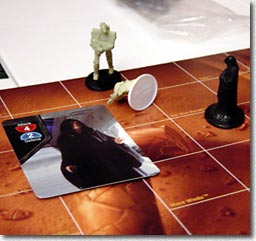
    Peter and Andrea played Emperor and Count Dooku (their favorite combo), Loredana and
    me poor Mace Windu and Yoda. As was to be expected the dark side had a big advantage by
    stripping Mace of his carefully collected cards. They concentrated their efforts on Mace
    early on, which enabled Yoda to hold back a little and collect useful cards. Although
    Mace was able to damage Count Dooku considerably he couldn’t prevent being killed –
    sadly the clone troopers didn’t fare better. Yoda was able to give Dooku the
    finishing blow, but Dooku’s robots had survived and annoyed the hell out of Yoda with
    sneaky shots from the distance. In the end Yoda was only able to scratch the emperor (who
    simply healed himself again and again), and succumbed to the concentrated use of the
    emperor’s “3 damage cards”.

    Westpark rating: 7

  3. Bluff

    Both games were nearly exactly alike and resulted in victories by Moritz – ’nuff said
    ;-)

Spielbericht & Review 25.09.2003

Spielbericht & Review 25.09.2003

Author: Thomas, Aaron

at the table: Walter, Hans, Thomas, Aaron

on the table: Manhattan, McMulti

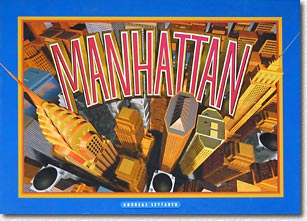
  1. ManhattanManhattan cover

    In “Manhattan” geht es darum, Häuser bzw. Türme zu bauen: möglichst viele,
    die meisten in einzelnen Städten, und am besten den aller höchsten.

    Zu den Regeln/Spielablauf:

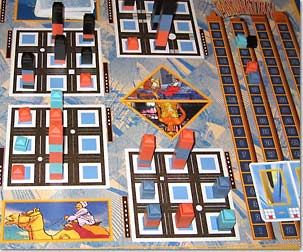
    Zu diesem Zweck ist der eher funktionale als hübsche Spielplan in 6, jeweils 3×3
    Quadrate große Städte, aufgeteilt. Die tragen Namen wie Kairo, Frankfurt oder eben auch
    Manhattan.

    Jeder Spieler erhält zu Beginn 24 unterschiedlich große Turmteile der eigenen Farbe.
    Es gibt 1, 2, 3, und 4 Stockwerk hohe Teile. Am meisten erhält man von den kleinen
    Teilen. Außerdem kriegt jeder Spieler 4 Karten, die ein Quadrat auf den 3×3 großen
    Städten bezeichnen. Also z.B. das mittlere Quadrat oder das oben links usw.

    Gespielt wird jetzt in 4 Runden. Jeder Spieler sucht sich aus seinen Turmteilen 6
    Stück aus, die er in dieser Runde verbauen will (in der letzten Runde gibt’s
    natürlich nicht mehr viel zu entscheiden ;-). Dann spielt, beginnend mit einem
    Startspieler, jeder Spieler eine seiner Karten aus und setzt dann eines seiner
    ausgesuchten Bauteile auf eine beliebige Stadt, aber auf das Quadrat das von seiner
    gespielten Karte ausgewählt wird. Dabei gibt es allerdings eine Einschränkung: man darf
    das Bauteil nur dann auf einen bereits bestehenden Turm setzen, wenn man dadurch
    mindestens genauso viele Stockwerke der eigenen Farbe in diesem Turm stellt, wie der
    Spieler mit den zweit meisten Stockwerken (in diesem Turm). Dann zieht man eine Karte
    nach und der nächste ist dran. Pro Runde macht das jeder Spieler sechsmal, dann wechselt
    der Startspieler und man sucht sich die nächsten 6 Bauteile heraus.

    Und wie gewinnt man? Am Ende jeder Runde wird gewertet:

    • für jeden Turm (d.h. die mit einem Bauteil der eigenen Farbe an der Spitze) gibt es
      einen Punkt,
    • für den Spieler mit den meisten Türmen in jeder Stadt gibt es zwei Punkte,
    • und für den insgesamt höchsten Turm gibt es drei Punkte.

    Die Punktestand wird dann, für alle Spieler sichtbar, an einer Punkteleiste auf dem
    Spielplan festgehalten. Wer dort nach der letzten Runde führt hat gewonnen.

    Manhattan board

    Zum Spielspaß:

    Wir heben festgestellt, dass einem das Spiel keine Gelegenheit gibt eine langfristige
    Strategie zu entwickeln. Das liegt vor allen daran, dass man bei jedem Zug durch seine 4
    Karten limitiert ist. Meistens (insbesondere in den beiden letzten Runden) hat man oft
    nur zwei Möglichkeiten ein Bauteil zu setzen, da man oft eine Karte doppelt hat und eine
    zweite Karte nur auf Quadrate verweist auf denen man nicht bauen kann, da dort bereits
    große Türme stehen auf die man nicht setzten darf (weil eine andere Farbe zu viele
    Stockwerke hat). Das bedeutet aber auch, dass die Züge recht flott gehen und man schwer
    gezielt gegen jemanden spielen kann. Dieses wiederum verhindert einen starken
    Kingmaker-Effekt.

    Die Spieler haben im Wesentlichen zwei Entscheidungen zu fällen:

    • ob sie lieber neue Türme bauen (d.h. auf leere Quadrate setzen) oder bestehende Türme
      zu übernehmen
    • und in welchen Städten sie sich engagieren und die 2 Punkte für die Städte zu
      bekommen.

    Bei jedem Zug schaut man sich also an, welche Möglichkeiten einem die Karten lassen und
    trifft dann obige Entscheidungen. Das ist nicht sehr strategisch, macht aber durchaus
    Spaß und geht recht schnell. Und so war es auch in unserer Runde.

    Thomas Reichgruber
  2. McMultiMcMulti cover

    It has been several years since we last played McMulti mainly because
    “business” style games are not really to the liking of all Westpark Gamers (if
    we do get the chance and have a willing crew we rather tend to play 18xx games).
    Nevertheless, McMulti was back on the table. The two newcomers to the game were quite
    intrigued by the “real life” appeal the game seems to convey: players are
    dealing with the commodity market, are drilling for crude oil and are busy in refining
    crude and selling petrol. All business transactions are influenced by the current
    economic climate, which may change every time doubles are rolled. This already points to
    a serious problem of the game: the element of luck has a much to large an influence.
    Almost everything in the game is controlled by the roll of two six-sided dice: finding an
    oil well, pumping crude, refining crude and selling petrol at gas stations.

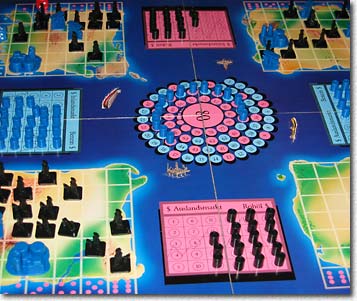
    McMulti boardIn our game we rolled almost no doubles for the first
    half of the game, causing to economic climate to stay moderate with medium equipment
    prices and an ever decreasing petrol price. In this situation turn order becomes a
    significant element once a double is rolled and prices suddenly change dramatically:
    those how can now sell petrol are very well off as well as those (more often than
    not the same players) who have sufficient money available to take advantage of the
    now dropped equipment prices. If you are really hit by bad luck the economic climate
    changes again before you even had a chance to take advantage of it.

    This not being enough the game also uses “event cards”, which can cause all
    sorts of positive or negative effects on players. Although a potential event is revealed
    before it actually comes in effect there is not too much sense in planning ahead here.
    Events, too are controlled by the dice and it is by no means certain that a revealed
    event will actually happen, it might just as well be replaced by another event card.

    Strategic planning in McMulti is limited to planning the correct moment to roll a
    double – hence there is no strategy. The “real life” feeling of the other
    elements quickly becomes rather stale as players quickly discover that the governing
    factor is: buy low and sell high.

    Taking that the game is not short – you can expect 2.5 to 3 hours of playing time –
    and that it can be frustrating to be hit by unlucky die rolls the game only scored
    average in our ranking.

    Aaron Haag