Archiv der Kategorie: Spieleabende

Emmerlaüs

Emmerlaüs

Emmerlaüs

Hersteller: Creations Chaos (erhältlich)

Autor: J.-F. Hamel

Getestet: Basisspiel (erschienen 2000)

Tester: Moritz Eggert

Szenario: In einer nicht näher definierten Fantasy-Welt stoßen mächtige Magier
und ihre Zaubersprüche aufeinander. Wer als letzter übrigbleibt, gewinnt!

Das Spiel: Jeder Spieler repräsentiert einen Magier, und versucht die anderen
Spieler aus der Arena (oder wo auch immer dieses Gemetzel stattfindet) zu werfen. Ein
Spiel zu zweit ist möglich, der Autor empfiehlt jedoch 3-10 (!) Spieler. Jeder Spieler
hat immer 5 Karten auf der Hand (mehr, falls die verschiedenen Expansion-Sets verwendet
werden), die mit zum Teil etwas konfusen Computergrafiken recht aufwendig gestaltet sind
(bei schlechtem Licht oder schlechten Augen nicht gut zu lesen, allein in unserem Spiel
schaffte es Walter mehrmals, die falschen Karten zu spielen, oder wichtige Karten zu
übersehen – was allerdings seinen Erfolg nicht beeinträchtigte!). Alles Fantasy-übliche
ist vertreten: magische Ringe, Zaubertränke, Feuerbälle, etc.. Es gibt 10 Kategorien von
Karten – auf jeder Karte ist angegeben, welche Gegensprüche oder Rettungswürfe verwendet
werden können. Apropos Würfe: Es wird unglaublich viel gewürfelt – Jeder Zauberspruch hat
seinen eigenen Schaden, der anhand verschiedener “polyhedral dice” ausgewürfelt
wird, meist mit dem “Power-Level” des Magiers multipliziert. Also ist es
vorrangig wichtig, diesen anhand bestimmter Karten so schnell wie möglich zu erhöhen. Der
Schaden wird immer von den Lebenspunkten abgezogen (deren Anzahl ständig, zum Teil
dramatisch wechselt). Wer 0 Lebenspunkte hat, ist draußen, und spielt nicht mehr mit
…und kann gelegentlich stundenlang warten, bis die anderen sich auch endlich
massakriert haben.

Spieldauer: Regelerklärung ca. 10 Minuten (das Spiel wird nur durch die Wirkung
der Karten kompliziert, der Spielablauf ist ansonsten extrem simpel), Spieldauer: Nun ja,
wir brachen nach 2 Stunden ab. Es hätte noch eine weitere Stunde dauern können, denn es
waren noch 3 Magier übrig, die sich verbissen bekämpften…

Ähnliche Spiele: MagBlast, Plague & Pestilence, Honour of the Samurai,
Lunch Money

Kommentar der Westpark Gamers: Dies ist eins der Spiele, in denen viel gelacht
wird, viel Schadenfreude aufkommt…und die letztendlich doch nicht wirklich gefallen
oder gar zum Wiederspielen anregen. Das Glückselement ist sicherlich hoch, wäre aber bei
einem Spiel dieser Art nicht so schlimm, wenn nicht auch die Entscheidungsmöglichkeiten
so gering wären. Im Grunde ist die Auswahl der zu spielenden Karten gering, und das Spiel
wird schnell repetitiv, denn obwohl die Karten unterschiedliche Namen haben, ist die
Wirkung doch ähnlich (“wie viele Würfel soll ich jetzt nehmen?”). Das größte
Problem ist jedoch der willkürliche Charakter des Spielverlaufs – Wer durch irgendwelche
Aktionen auffällt (meist ist man gezwungen, irgendjemanden anzugreifen, weil man halt
keine anderen Karten hatte), wird sofort von allen anderen angegriffen. Wenn man dann
erst einmal kurz vor dem “Ende” ist, gibt einem schnell jemand den Rest.
Angriffe entstehen meist spontan, ohne tiefere Strategie. Für ein kurzes Spiel wäre dies
noch ok, “Emmerlaüs” ist jedoch einfach viel zu lang….Lustig war’s aber
dennoch!

Moritz’ Bewertung: 5 von 10 (wegen der “Lustigkeit”)

Westpark Gesamtbewertung: 4.0

Weiterführende Informationen: Homepage von Créations Chaos, verfügbar in Englisch und Französisch

Session Report 22.01.2003

Session Report 22.01.2003

Author: Moritz

at the table: Walter, Aaron, Günther, Andrea, Moritz

on the table: Emerald, Puerto Rico, Bluff

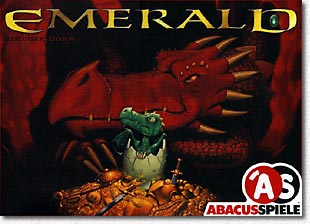
  1. EmeraldEmerald - box

    This game has been around for some time, but gets additional exposure in German gaming
    circles right now as it is part of the 4 games to be mastered for the German championship
    in boardgaming 2003 (the other games are “Sticheln“,
    Medina” and – what else could it be – “Puerto Rico“).

    Inclusion of this game has been a matter of discussion, as it is a very light family
    game with only very shallow tactical elements, also dependent on luck a lot (usually the
    games in the selection are less luck oriented). The game board consists of a single track
    starting in a city and leading to a dungeon of sorts, occupied by the unavoidable dragon.
    Players get a number of knight pawns dependent on the number of players (with 5 players 4
    for example), and try to collect gem (worth 1 VP each, 4 extra points if you are the
    first to collect all 4 colours, 4 VPs for each majority in a colour at the end of the
    game) and gold cards (1 to 5 VPs) on the way to the inner sanctum. Movement is very
    simple and known from other games as a routine: The number of spaces you can move is
    determined by the number of pawns in your space, including your own. This means that you
    try to reach populated spaces to advance quickly, making your way alone will take a long
    time.

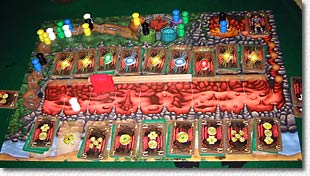
    Emerald - board At some point you reach the dungeon – landing on a dungeon space
    gives you the choice to take one of either the open gold or gem cards (or none, if the
    stacks are empty). But beware of the dragon – its movement is actually one of the
    ingenious mechanics of the game. There is a “dragon stick” which marks the 4
    spaces the dragon is searching at the moment. Every time a player lands a pawn in one of
    these spaces, the dragon moves by means of a die roll (1,2 or 3 spaces), and is
    “reflected” by the border of the stick if it would go beyond it. At the same
    time the stick is moved one space to the right until it reaches the end of the track,
    where the dragon will guard the entrance to the treasure hoard. After the dragon moves,
    it will “eat” one of the knights that are standing on the space it lands on (if
    there are several the moving player decides which), but if the knight sacrifices a
    treasure card (gems don’t interest the dragon for some reason) he will survive. As
    the game is basically about gaining VPs through cards it sometimes absolutely okay if you
    let your knight die – giving up your 5 VP card might be worse. Therefore it is also good
    to have low VP cards handy- each player will encounter the dragon at some point or
    another!

    The first 4 pawns that reach the treasure hoard get 5 bonus points each, the fourth one
    to reach it ends the game. Another possibility for sudden death is that one player loses
    all knights but one – if you have many VP cards you can enforce the end in this way a
    little: “let them be eaten!”.

    We played the game 2 times to get some feeling for the strategy, or what little there
    is. As you have only 4 pawns in a 5 player game, you make 2 choices out of 4, sometimes
    less if choices might be obviously awful and to be avoided, and also because taking cards
    always ends your turn – you can never take two cards in a row! Movement is mandatory, you
    cannot go less spaces than you have to. Usually you will try to concentrate on 3 knights
    and get them to the good cards as quickly as possible. The other knights will wither away
    at the starting space.

    It doesn’t make much sense to avoid the dragon – although there are moves which put
    you at higher risk than other moves at some point you will have to face the danger
    of being eaten, and whether that happens or not is pure luck, not skill. Of course you
    will be safer when travelling in numbers and having a low score on hand, as the dragon
    moving player will then gobble up the weightier player (in points, not pounds). To a
    certain extent you can foresee the moves of the other players and make your decisions
    based on that, but basically you are played by the turn order and the moves of the other
    players. We found that the starting player always won, and always was the first to cash
    in the extra VP cards of the treasury.

    Although this is a fun game for the whole family and even for “non-gamers” I
    don’t think it will hold the attention of any true freak for a long time. The big
    plus is that games are very short, around 45 minutes, and can be played out of the box,
    with little preparation.

    View/add comment

    Slightly recommended – forget the fantasy theme, though, the game could also be a about
    making your way through Camden Town, the dragon then being a bobby searching you for
    illicit drugs or something.

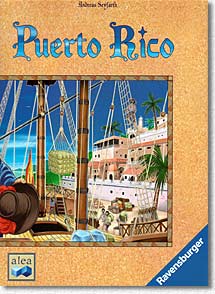
  2. Puerto RicoPuerto Rico - box

    Some strategy tips

    P.R. is one the best documented new games on the web right now – we have already
    reviewed it, so I will try to give some strategic advice based on my now considerable
    experience with the game. Hopefully I can add a grain of wisdom to the immense material
    out there!

    I have become a bit disillusioned with the game recently. Although I still think it is
    great, I have my doubts about how much of a “strategy” can be applied
    successfully (like in “Princes of Florence” or even
    Settlers” where you basically follow a semi-solitaire strategy). But on
    the other hand this is one of the charms of the game, and adds to its replay value,
    whereas games of “Princes of Florence” have recently turned into clashes of
    pre-set strategies. I haven’t yet decided which I like better.

    What every player of P.R. must learn is that there is no valid
    “building” strategy, for example. No combination of buildings that you
    plan ahead is of any use, even if they are ingeniously devised. I have seen each strategy
    win and fail in equal measures, but what you want is a strategy that gives you a good
    chance to win, not one that you simply think is clever. In fact, I would argue that there
    should be no strategy in P.R. at all, rather “advanced tactics” depending on
    turn order, strategies deployed by other players and sometimes even luck (selection of
    plantations is a huge luck factor).

    P.R. is totally dependent on the choices that other players make. It is therefore in
    nature a very chaotic and unpredictable game. The other players make the game and they
    ruin your plans… usually. The beauty is that they can also help you, if you foresee
    what they will do.

    Here are some tactical rules that will definitely help you win:

    1) Don’t come into the game with ANY strategy.

    It won’t work, believe me. Watch what the other players do, and act accordingly.
    Puerto RicoBe constantly on the watch for their strategy – basically you want to
    be in the middle of it: If the player to your right goes for quick victory points you
    should do the same. For example, leaving one player alone with a certain strategy is
    usually a bad idea, especially if it’s the “end the game quickly with as many
    VPs as possible” strategy. If you follow a similar tactic and succeed this
    particular player might think twice about ending the game quickly as you might have an
    equal or even bigger number of VPs. On the other hand, if the player is already
    “imitated”, don’t do it – three players following the same route will
    usually cancel each other out. Any combination of buildings can be the winner in a
    certain game, it just depends on the players and their actions.

    2) The LEFT PLAYER RULE

    Rick Heli brings it down to a simple point in his excellent short description of the
    game at “spotlightongames.com
    “…When deciding what crops to grow, the workings of the ship and the trader make
    it wise to avoid what your right hand neighbour grows and to strongly consider growing
    what your left hand neighbour does….”

    I would call this most important advice. Why? Growing the same crops as your left
    neighbour is one of the few ways in which you can actually play aggressively against a
    player, and your left neighbour is your best victim. This is because of the turn order,
    which is always 1,2,3,4, then 2,3,4,1, then 3,4,1,2 then 4,1,2,3 for example. If you are
    player number two you will be ahead of player number 3 (your left neighbour) 3
    times out of 4 when roles are selected, which means you have a pretty good chance of
    shipping/selling goods before her or him.

    This of course also explains why you should avoid the plantations of the right
    player – who is of course possibly after you as you are after your left neighbour.

    Try to copy your left neighbour as closely as possible, but only in plantations
    and factories. Apart from that your tactics should be the absolute opposite of the left
    player. Why? See the “RIGHT PLAYER RULE” below!

    3) The RIGHT PLAYER RULE

    The right player will go before you ¾ of the time (in a 4 player game). Which gives you
    the possibility to see what s/he does, and then somehow imitate it (not the
    plantations, see above). With somehow I mean “not exactly”. Of course you
    should rule out imitating dumb moves, for a start (I have seen weak players win games of
    P.R. against the top-pro’s because they had an equally weak right neighbour).
    But the buildings the right player builds should be closely watched. If your
    right neighbour buys a building that is triggered by the “settler”
    phase, you should consider building it as well (if possible), or another building that is
    triggered by the same phase. Chances are s/he bought it for a reason, and will possibly
    play this role on her/his turn – and you will profit from it as well! I have closely
    followed this rule in my last experimental games, even sometimes buying buildings I
    thought I had little use for, or which seemed weird in my specific setup (getting the
    right feel for this is the closest this game comes to “skill”). I never
    regretted it – sure enough I always profited from my right player taking certain roles
    which I also benefited from, and then I was free to take roles that only benefited me
    afterwards! The game usually rewards the second player, especially when shipping
    for VPs!

    Watch closely, and most importantly: be flexible!

    4) The SAVINGS RULE

    This is a more obscure tactic that doesn’t seem obvious at first. The rule is:
    “When you buy buildings in the builder phase, already consider what you are able
    (not what you “want”) to buy in the next phase – it might come sooner
    than you think!”. This means sometimes buying “cheap” buildings when you
    could actually buy more expensive ones. I see it happening very often that good players
    trigger phases that as few as possible other players can benefit from (a basic rule of
    thumb that is mostly followed). Usually it happens that one player triggers the builder
    phase, all players dump their money into expensive buildings, and then the player who has
    the most money will immediately become builder again next turn (this might even happen
    directly afterwards, when the turn ended with the builder phase) to buy another
    building with his savings, whereas the other players just dumbly stare. Don’t let
    that happen – try to always buy a building in the builder phase. Even the meagre
    “1” building might be worth many more points with certain large buildings. If
    only buildings are available that you don’t think fit into your strategy,
    change your strategy. When you are always able to buy buildings and never miss out
    a phase, you will have an edge on other players, believe me!

    Always save some money, if possible! Always consider taking the gold digger, even if
    it’s only worth one buck.

    5) The FIRST TURN

    What should you do when you’re first? It’s not easy to “imitate” when
    there is nothing there to imitate. I personally think there is only one answer: take the
    settler and take a free quarry. Quarries always come in handy in any game
    (although one might argue how many you need – I think you’ll be fine with no more
    than two, personally), nobody else will be able to get one, and you will have an edge
    when “imitating” a quarry strategy of your right player later on. If
    there are too many maize plantations lying around you might consider taking the gold
    digger instead, though, but that case will be rare. Also, if you’re lucky, somebody
    might play the “mayor” and give you the possibility to populate the quarry
    before the first builder phase, therefore giving you the same edge that the builder role
    would have brought you at the start.

    View/add comment

    These tactics can form the basis for a more serious delving into the game. Guenther, our
    most successful P.R. player certainly knows them well – he always uses them and wins 80
    percent of the time!

    Good gaming.

  3. Bluff

    Strange that the two gaming groups “Westbank” and “Westpark”-gamers
    have one affliction in common: the call of the dice (or, shall we say, the SCOURGE of the
    dice?). Since we experimented with different seating orders (usually we always sit at the
    same places of the table) results have varied wildly, this time Andrea won twice in a
    row, whereas Walter, who very often wins, came always in last.

    PETER, IF YOU READ THIS…..COME BACK!

Session Report 15.01.2003

Session Report 15.01.2003

Author: Aaron

at the table: Walter, Peter, Moritz, Andrea, Aaron

on the table: T-Rex, Linie 1, Bluff

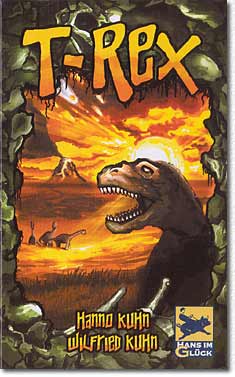
  1. T-RexT-Rex - box

    After some debate about the first game of the evening Peter finally succeeded in
    convincing us to agree to T-Rex. Peter had played the game several time before and
    enjoyed it a lot whereas especially Moritz didn’t like it too much on his first try.

    T-Rex is a card game where all players use an identical set of 17 cards and try to win
    dinosaur eggs. These eggs come in 4 different colors and each egg is worth the total
    number of eggs a player owns of that color at the end of the game, resulting in a
    possible exponential growth of victory points.

    The player cards come in five colors with 3 cards of each color numbered from 1 to 15
    plus 2 special cards. Before the first (of a total of 12) round of the game commences
    each player shuffles his/her deck and draws 7 hand cards to start with. Additionally, 2
    dino eggs are revealed from the dino egg draw pile and two color cards are placed on the
    table to indicate the highest and lowest ranking card color for this round.

    Players in sequence play one of their hand cards placing it in front of them – there is
    no need to follow suit. Each card carries a symbol (cards or a comet) which either
    enables the player to draw additional cards from the draw pile or it signals the
    beginning of the “end sequence” of that round. When the first comet card has
    been played the round immediately ends once that player has played another turn and no
    other player has played a higher ranking comet card. Card ranking goes by the card’s
    color followed by the number on the card.

    Whoever has the highest ranking card in front of him/her selects one of the two dino
    eggs; the second egg goes to the player with the second highest card. As a small, but
    important, bonus the player having the lowest ranking card may replace one of the two
    color cards that indicate the color rank for the next round. Then each player permanently
    discards either the top card from his/her draw pile or the card last played in this
    round. Then the remainder of the cards played this round are placed under the draw pile.

    T-RexThe first two or three rounds of T-Rex are usually heavily luck based as it
    is completely unknown which cards are held by the other players. After a while most
    players have gone through their draw pile at least once and usually have collected a set
    of cards that suits their tactics. Especially players with a good memory now have an
    advantage if they remember which cards are permanently out of the game and which cards or
    at the bottom of the draw piles.

    Once a comet card is played in a round this type of information can be vital for winning
    a dino egg because at that point it is important to be able to judge which player is able
    to play higher ranking comet cards thereby extending the round. Exact timing is what make
    winners here as it is important to play the highest ranking card in the last turn of a
    round and in fact it can be very annoying if a round is extended by another comet card
    and one has to play another card, which more often than not is a lower ranking card,
    destroying any hope for winning an egg.

    For my liking T-Rex rewards good memory too much (old age, I guess). This combined with
    the usual uncertainties of what tactic another player will apply provides me with too
    many unpredictability. Interestingly, Moritz, who said he didn’t like the game
    because of the strong memory effect won the game by far and Walter, our Bridge playing
    card game wizard came in last.

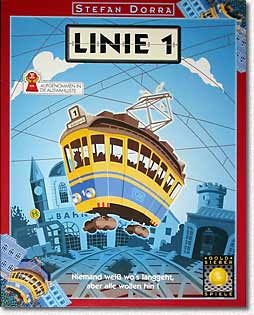
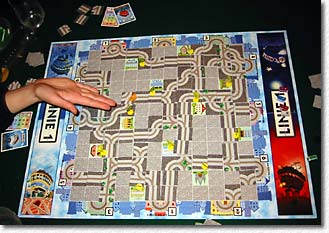
  2. Linie 1Linie 1 - box

    Linie 1 – or Streetcars as the English version published by Mayfair is called – was our
    second game of the evening. We played this already once a couple of years ago with not
    too enthusiastic memories and we wanted to give it another try.

    The task of the (up to five) players is to connect the terminal stops of their streetcar
    line which are located at opposite borders of the game board by building tracks between
    them, a principle which was employed already by Twixt may years ago. To make things not
    too easy players get their streetcar line dealt secretly out of the six available lines
    and additionally they have to include two (or three in games with less than 4 players) of
    the many intermediate stops that are placed throughout the board. Also these stops are
    dealt secretly.

    The game is played in two phases. During the track building phase a player places two
    new track tiles anywhere on the board or upgrades already existing tiles. Tiles may only
    be placed if they legally connect to tiles already placed and can only be upgraded if
    existing track is maintained. As soon as a track tile is placed next to a stop location a
    stop sign is placed on that tile. No additional stops are possible at this location.

    Players therefore are faced with the difficult task of making sure that the stops they
    must pass are located in such a way that they caneasily be integrated into their own
    network and on the other hand they must try and avoid revealing their intentions and line
    identity too early. Line 1 allows all sorts of nasty track laying making it possible to
    create long detours for other players once one knows their intentions. Even endless loops
    are possible (see the left terminal of line 4 on the photo) making it impossible to use a
    piece of track in both directions.

    Linie 1The second phase of the game begins once a player has completed the
    required route. The player announces this to the other players and indicates the route on
    the board. The rules state that this must be done so that all players are able to verify
    that a valid route exists. And in fact, it happened twice during our game that a player
    announced a valid route which in fact did not exist! Once the route has been verified the
    player starts travelling with a streetcar starting at one terminal, along the two (three)
    intermediate stops to the terminal at the opposite side of the board. The
    “motor” of the streetcar is a die with numbers 1 to 4 and two “H”
    signs. The player rolls the die once per turn and moves the streetcar the number of track
    tiles indicated on the die or to the next stop if an “H” has been rolled. Here
    it becomes obvious why a short route is so important.

    While some players have already started their streetcar other players may still be
    building their route. The point in time when to start the streetcar needs to be carefully
    judged because sometimes it can pay to optimize a route further rather than starting the
    car on a hopelessly long route.

    Moritz came in first closely followed by Walter, who in fact had the shortest route of
    all players. My chances of winning came to an abrupt end when Andrea
    (“unintentionally”, as she said, believe it or not) blocked my intended
    starting location by a loop construction.

    Line 1 in my opinion is a strange mixture of a game: on the one hand there is the rather
    complex track building race amongst the players followed by a dice rolling war in the
    second phase. My feeling is that the players who like the track building will not be too
    happy with the second phase and vice versa.

  3. Bluff

    This evening we had sufficient time left to try some experiments with our usual final
    game of the evening: Bluff. After Moritz had won the first game of Bluff (making this a
    very good evening for him) we decided to change player position at the table to find out
    if that has any influence on the game results. Doing so we managed to achieve a clear win
    for each player – a result we never had before. Which leaves us with the question: does
    the seating order really have in influence on the Bluff results? If so, what exactly is
    the cause of this influence?

Session Report 08.01.2003

Session Report 08.01.2003

Author: Moritz

at the table: Hans, Walter, Aaron, Peter, Moritz

on the table: La Città, Bluff

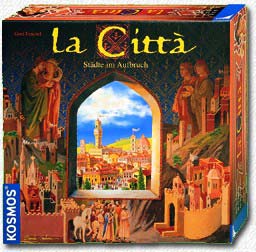
  1. La CittàLa Città - box

    For some reason we hadn’t had a games evening for quite a while – this is
    why the general mood was especially friendly. In fact, we never had a games evening with
    so little bickering and quarreling in a long time. Might it have been the bottles of wine
    that Walter and Aaron freely distributed (it was a belated celebration of Aaron’s
    xxth birthday – I’m not allowed to say, which…[Did I say
    that? Looking at Marcus Barnick’s “Who’s Who” website my age appears to be public knowledge!
    Aaron]
    )?

    We decided to play “La Città” – Walter had been given this game as a
    present, and had apparently completely forgotten that we had already played this game
    ages ago, when it was newly published. Back then the game hadn’t impressed us
    greatly, but this time we really had to admit that this is a great game (which shows,
    that the good game reviewer “always has to play twice”).

    Kosmos published this game as a planned successor to “Siedler
    – it is a lush edition, with absolutely fabulous game material, even for German
    standards. It probably wasn’t the big commercial success they hoped for, but this
    is a “gamer’s game”, like “Puerto
    Rico
    ”, a treat for addicts like us.

    The huge map depicts an empty Tuscany landscape, that players hope to fill with
    prosperous cities. Certain landmarks are placed on the map before play (the setup
    described in the rules gives each player about the same starting position, and is highly
    recommended for the first games). There are “farming” (adjacent cities and
    farms get food markers, they range from “1” food to “3” food
    – a city/farm can touch a maximum of two of these tiles and earn the sum of the
    tiles they touch), “water” (give the possibility to build the all-important
    “fountain” tiles that hugely increase population capacity) and
    “mountain” tiles (each mine touching them gives money, it is very important
    that you build them early, like in “Puerto Rico”).

    Players start with two cities each, hoping to expand them and to achieve a huge
    population.

    For this it is important to know the “will of the people” – people are
    interested in 3 traits: “culture”, “education” and
    “hygiene”, each symbolized through a colour. Each round 4 “will of the
    people” cards are drawn: one open, the other three are secret. At the end of the
    round the dominating colour will be found out by looking at the hidden cards (in case of
    a draw, both traits are “prominent” and the players can choose which one to
    activate with each of their cities). Now all cities within a certain distance (2 hexes)
    of each other will compete for the extremely fickle and easily bored population. If the
    neighbouring has city more cultural buildings than you, and culture is “in”
    at the moment, it will draw away one population figure (which look suspiciously like
    hobbits, by the way). You usually want as many people in your city as people –
    first they bring points at the end of the game, second city expansion tiles need people
    to work- if they have no people on them, they are “torn down” – the
    city shrinks!

    But there is also a drawback: people need to be fed, and if you have more people than
    food markers (described above) the game system will punish you heavily with having you
    miss out a turn next round, and also reducing your victory score in the final round
    severely. Peter, who has played this game more often than us, had warned as about this
    fact, and we all played very carefully in this respect, but still people starved, as the
    board and the expanding neighbours limit your access to food tiles severely.

    A round consists of 5 actions – you have 3 cards that you can always play, they
    allow you to build basic buildings, get gold or start new cities. If you want to build
    the larger coloured buildings (that give you more of an edge in the populace competition)
    you need money and the abundant “open” row of action cards, that is
    constantly renewed from the deck. This means you can have a maximum of 3
    “self-decided actions” , the other actions come from the deck – with a
    selection. Some of these cards have other functions – they give you free extra food
    for the round, or strengthen your “traits” for the competition. The most
    important card is certainly the one that allows you to predict to or more of the hidden
    cards “will of the people” – played early this will give you an edge in
    planning your turn!

    Cities are limited to 5 citizens and therefore tiles. A “market place” gives
    you one “gift” citizen and the possibility to reach the populace of 8, a
    “fountain” removes even this limit (this is why the water spaces are
    extremely important – the winner needs two large cities, possibly more, no doubt
    about that). Each round ends with the mutual removal of citizens from the cities, then
    you check if you can actually nourish them.

    The game rewards good planning – If you pump up the traits of the cities (the
    symbols for these traits look suspiciously like “McDonalds”-M’s, by the
    way :-), you might get a larger population than you hoped for – starving is bad
    news, as you lose an action next turn.

    You also want diverse cities – cities with all traits present get bonus points. It
    is also a good idea to build last ditch cities in the final round (although there is very
    little room on the board for additional cities) – each citizen gives you one
    victory point – and new cities come with 3 “free” citizens!

    Turns are quick as the decisions are limited but important, very similar to Puerto Rico.
    Watching the board and planning your expansion is strategically very demanding –
    when will you cross the safe border of 2 hexes to other cities by building new buildings?
    Can you be sure to beat them in traits this round? If not you might lose more than you
    get.

    Cities can actually be completely destroyed by draining them of all cities, so beware!

    If you have farming land close by you should build as many farms as possible, they come
    in very handy for the end game, when you suddenly build new cities to garner VP’s.
    The same is to be said for mines – the good buildings can be very expensive, and
    money is very rare. A tactic that usually works is to have a “money city” and
    a “farming” city, both with different goals.

    All in all this is a very nice game – not too complicated, but with lots of
    nail-biting decisions to make. Although it is – like “Princes of Florence” and “Puerto
    Rico
    ” essentially a solitaire game played by a group, the competition between
    the cities is THE all-important element of the game. The board is small, and the
    competition is not sleeping. The game time is longer than the usual German game, I would
    say around 3 hours for newbies.

    Thumbs up to “La città”!

  2. Bluff

    After a “perfect” victory in “La Città” my strange lucky streak
    didn’t stop – the two “Bluff” games we played were won with
    almost no problem, the dice rolled where they should, and twice I beat Walter with
    extremely lucky rolls that he just couldn’t believe.

    That this was a lucky streak was proven 2 days later at the “Spuiratzn”
    – I lost every game, and always came last!

Session Report 18.12.2002

Session Report 18.12.2002

Author: Aaron/Walter

at the table: Peter, Günther Walter, Aaron

on the table: Fische Fluppen Frikadellen, Mogul, Imperium

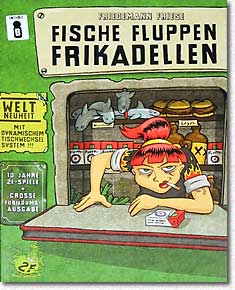
  1. Fische Fluppen FrikadellenFische Fluppen Frikadellen - box

    “Fische Fluppen Frikadellen” is this year’s Essen release of the man with
    the green hair and creator of the F games: Friedeman Friese. This time players have the
    task to acquire goods (fish, fags and French fries would be a good translation although
    Frikadellen are in fact hamburgers, and in addition to the title: fusel and fennel) and
    trade them in for fetishes. The player who acquires his/her third fetish wins the game.

    The game board is set up by randomly placing 12 kiosks on the designated spaces. Kiosks
    come in three types: one type sells one of the F goods or buys another type of goods. The
    next kiosk type trades a type of good into another type of good and the last type is the
    kiosk trading in goods for fetishes.

    Kiosks are connected with pathways and waterways and players have three movement points
    per turn to negotiate their route to the kiosks of their liking. Waterways usually
    provide shortcuts between distant corners of the board but they require the usage of a
    raft which sometimes needs to be called to the footbridge which costs movement points and
    money.

    Players start with a defined amount of money (now guess what the currency is: Florints of
    course) which they mainly use for buying goods at the kiosks. Once a player lands on the
    field of a kiosk that sells/buys goods s/he may buy any amount of goods that the kiosk
    has in stock at the current market price (there’s a rebate for buying more than one
    unit). At the start of the game each such kiosk has 2 goods in stock. Alternatively, a
    player may sell any amount of the good the kiosk can buy. These goods are returned to the
    bank. A consequence of selling goods is a decrease of the market price of that good.

    If a player arrives at a kiosk which trades goods s/he can trade in up to two goods of
    the kind kiosk accepts and receives 2 other goods for every good turned in. These 2 for 1
    deals are very important in the course of the game.

    Each transaction at a kiosk triggers up to three secondary actions indicated on the
    kiosk’s tile: either the market price of a good is increased or the player may
    exchange the stock of two kiosks or a particular type of good is being produced and the
    stock of the appropriate kiosk is increased.

    Players also have tokens which they can use during their turn. A token provides a one
    time special ability like having more movement points or being able to exchange a good of
    one type for another type, and, very nasty, closing a kiosk for one complete round. Each
    time a player acquires a fetish s/he get an additional token.

    The game started rather fast paced with all players rushing to kiosks which have goods
    for sale. Unfortunately, I was the fourth player in the first turn and was faced with the
    situation that no such kiosk was in easy reach. In fact it took me quite some time to be
    able to acquire my first goods as I was not willing to spend money on calling rafts for a
    faster access to far away kiosks. Not a good tactic, I soon realized. At the time I had
    reached a kiosk with goods, prices had already gone up and I had to spend too much money
    for too few goods. Walter at that time was already far ahead with 4 or 5 goods and in
    reach of his first fetish.

    Günther seemed to follow a strategy of acquiring lots of goods at low prices and only
    exchanging them for a fetish once he reached the holding limit of 7 goods. Peter’s
    strategy was to go for optimal good runs and to exchange/sell goods at favorable prices.
    Soon I found myself left with very little money and only a few goods because all too
    often were kiosks sold out or prices had gone up to prohibitive levels before I could
    reach them. I therefore had to revert to an exchange strategy changing goods on a 2 for 1
    basis. Luckily, I was able to find a good run between kiosks for this to work.

    Walter was the first to have two fetishes as well as sufficient goods to exchange them
    for the third one and we thought that this would end in a clear win for him. Quite to my
    surprise Günther was able to play one of his special ability tokens that allowed him to
    buy a good from Walter leaving him one good short for his final exchange. At that point
    it became clear that by cleverly playing against Walter we would most likely have a
    chance to steal victory from him. This in fact left me with a slight chance to win the
    game myself: in the meantime I, too had acquired two fetishes and had sufficient goods to
    get the third one. However, my goods mix was not right (you need 5 goods in total, 3 of
    one kind and 2 of the other) which prevented me from becoming a target for
    countermeasures of my fellow players. The one thing they did not know was that I had a
    special ability token which would allow me at any time during my turn to exchange one
    good for another type and that would yield the required combination for my third fetish.
    So I moved forward to the fetish kiosk and only needed one more turn when Peter decided
    to stop playing aggressively against Walter and allowing him to make his final winning
    move. That was close…

    I think that “Fische Fluppen Frikadellen” is one of the better games of
    Friedemann Friese. It provides a lot of scope for different strategies. On the other
    hand, in our game I felt that most of the time I was playing with minimal interaction
    with other players. Once you have found out what strategy the other players are following
    you can adopt you strategy accordingly and do your thing. There is also this effect of
    bashing the leader close to the end which I do not like so much as you do not have
    sufficient time (moves) to prepare for this appropriately.

    One thing I did not mention about the game: it is a 3 to 5 player game but can be played
    with up to 15 players if you buy the complete set of three games (type A, B and C). They
    differ in board layout and tile mix as well as providing different colored pawns and
    players are able to move their pawns between board. Provided you have sufficient table
    space and players this is certainly worth a try.

    Westpark Gamers’ Score: 7.0

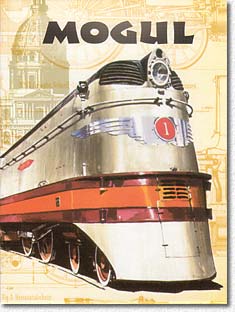
  2. MogulMogul - box

    Mogul is a stock trading and auctioning card game. Players start the game with one share
    and 6 money and their goal is to acquire victory points by selling shares.

    Auctioning is done in a very interesting though sometimes nerve wrecking way: the top
    share is drawn from the draw pile, revealed and put up for auction. The start player (the
    player who acquired a share in the previous turn) starts the auction by placing one coin
    in the middle of the table. The next player has the choice of continuing the bidding by
    also placing one coin or to drop out of the auction. Here the interesting bit starts:
    whenever a player drops out s/he collects the coins in the middle of the table into
    his/her own pocket. The next player then bids again (1 coin) to stay in or drops out as
    well (collecting 0 coins!).

    The last remaining bidder has the choice of either taking the share or to sell shares of
    the color indicated by the border color of the share currently up for auction. The last
    but one bidder then executes the option not taken by the last bidder.

    Selling shares is the only way to receive victory points and there is one victory point
    granted for every share of that stock on the table at the time of the sale, including the
    shares of the other players. Since at the end of the game unsold shares count no VPs at
    all and money is exchanged 5 coins for 1 point it is absolutely necessary to sell shares
    at the best possible time. The game ends immediately when the CRASH card is being drawn
    which has been shuffled into the draw pile among the last four cards.

    The bidding mechanism is so unusual that it does need some time to get used to it.
    Already in the first round I found myself in the position that Günther sitting in front
    of me decided to drop out and take the money and I had the choice to also drop out (for
    nothing) or placing the first coin again. I decided for the latter only to be faced with
    the situation that now Walter dropped out (now in front of me). Again I placed a coin and
    Peter dropped out and I decided to take the share since there was no possibility to sell
    shares. The result of the first round was that I owned two share now but only 4 coins,
    all others had one share with Peter owning 5 coins, Walter 7 coins and Günther 8 coins.
    Günther seemed to have liked the possibility to make easy money and he decided to drop
    out again when it was his turn in the second round, leaving him with 11 coins! Only too
    late did I realize that I would end up in the unfortunate situation that I had to drop
    out of the auction because of lack of money at a point in time when there where no coins
    in the pot!

    Fortunately, there is a rule which allows a player to exchange 2 victory points for 2
    coins at the beginning of a round. Since I was broke I had to take that option which, in
    the end, turned out to be so devastating that who ever has to do this will almost
    certainly lose the game. This insight came to late for me and I did not have a chance to
    even come close to the leader throughout the rest of the game.

    Although very much based on luck elements the game is full of suspense: will there be
    coins in the pot when it’s my turn to drop out of an auction? What is the right time
    to sell shares? Will there be another possibility at all to sell shares of a particular
    stock? Some of these questions can be answered by closely observing the number of shares
    of stock still in play. Other, like the possible reaction of the other players are much
    harder to determine or predict.

    As a fast paced, short (45 mins.) game with elements of “Schadenfreude” Mogul
    can be highly recommended.

    Westpark Gamers’ Score: 7.0

  3. ImperiumRome - box

    Anstatt den Spielabend mit 6-nimmt oder Bluff ausklingen zu lassen, nahmen wir uns auf
    Günthers Empfehlung noch eine Runde Imperium vor. Angeblich dauert ein Spiel 20 Minuten.
    Das war dreimal soviel Zeit, wie Peter bis zu seiner letzten U-Bahn übrig hatte. Bei den
    Westparkern geht aber auch ein triviales Auktionsspiel nicht so schnell über die Bühne.
    Peter hatte Glück, daß er sich nach 50 Minuten Spielzeit – als Sieger – auf den Weg
    machen konnte.

    Das Spielbrett läßt zunächst mal eine überlange Spieldauer befürchten: es ähnelt ganz
    dem klassischen “Civilisation”, das wir noch nie unter 4 Stunden beendet
    hatten. Auf einer Landkarte rund um das Mittelmeer sind Länder und Provinzen
    eingezeichnet, die von ferne ein bißchen die Vision des Geographieunterrichts in einer
    altrömischen Grundschule aufkommen lassen. Daß Athen ohne “h” geschrieben
    wurde, und daß das Dörflein “Cannae” zu einer ganz Unteritalien umfassenden
    Provinz aufgewertet wurde, ganz zu schweigen von der Plazierung Ägyptens an der lybischen
    Küste und ähnlichen Unschärfen, sollte einen großen Geist natürlich nicht stören.

    Das Spielgeschehen hätte man auch viel einfacher plazieren können, und es damit sogar
    noch durchsichtiger gemacht. Denn das geohistorische Brimborium verdeckt nur das doch
    recht lineare Spielprinzip. Man denke sich die Zahlen 1 bis 8 irgendwie zufällig in einem
    Kreis auf dem Tisch verteilt, und schon hat man die Aufgabenstellung hundertprozentig
    adaptiert. Es geht darum, möglichst viele, möglichst hohe und möglichst
    nebeneinanderliegende Zahlen (Länder) in Besitz zu bringen.

    Wie macht man das?

    Ganz einfach: Jeder Spieler ist mit einem Kartensatz mit den Zahlen 1 bis 8
    ausgestattet. Davon wählt jeder jeweils drei Karten, sprich Zahlen, aus und bestimmt
    damit die Zahlen im Kreis, auf die er einen Spielstein der eigenen Farbe zu legen
    gedenkt. Alle Spieler decken gleichzeitig die gewählten Karten auf und legen dann die
    entsprechenden Spielsteine auf die Zahlen im Kreis. Das wird bis zum Spielende wiederholt
    und so verteilen sich allmählich die Spielsteine der Mitspieler je nach Vorliebe oder
    Taktik unterschiedlich auf den Zahlen im Kreis.

    Nach jedem Setzenvorgang wird eine Zahl gewertet: Der Spieler mit den meisten
    Spielsteinen auf der Zahl im Kreis hat die Zahl in seinen Besitz gebracht, d.h. er erhält
    den Zahlenwert als Siegpunkte gutgeschrieben. Der Spieler mit den zweitmeisten
    Spielsteinen erhält, je nach Zahl, die es zu werten gilt, 1 bis 2 Punkte weniger, der
    dritte 2 bis 4 Punkte weniger und der vierte und letzte 3 bis 6 Punkte weniger. Es gilt
    also, auf der Zahl, die gerade gewertet wird, eine Mehrheit zu erringen. Das geht
    natürlich nur beschränkt. Jeder Spieler muß seine Auswahl auf bestimmte
    Zahlenkombinationen konzentrieren, um wenigstens dort dominieren zu können.

    Nach der Wertung wird das Zahlenfeld geräumt: alle Spieler müssen ihre Spielsteine
    wieder an sich nehmen. Nur der Spieler mit der Mehrheit darf einen Spielstein als
    “Prokonsul” auf der Zahl stehen lassen. Der steht dann schon mal für die
    nächste Wertung da, denn nachdem alle 8 Zahlenfelder gewertet wurden fängt die Wertung
    wieder bei der ersten Zahl an.

    Der “Prokonsul” hat aber noch eine weitere “einnehmende” Bedeutung.
    Der Spieler, der bei einer Zahlenwertung die Mehrheit errungen hat, bekommt zusätzlich
    noch einen Siegpunkt für jeden eigenen Prokonsul in einer benachbarten Provinz (Zahl).
    Dies ist ein Grund, warum man zusammenhängende Zahlen (Provinzen) favorisieren sollte.

    Peter hatte sofort erkannt, daß das unattraktive Zahlenfeld 1 neben dem maximal
    lukrativen Zahlenfeld 8 etwas unscheinbar an der afrikanischen Küste lag und so dem
    Blickpunkt der Mitspieler entgehen könnte. Er spekulierte darauf, daß er relativ
    unbehelligt die 1 belegen und sich mit Körpereinsatz dann auch noch die 8 aneignen könne.
    So kam es dann auch: Er konnte das 8er Feld dreimal erobern bzw. behalten und kassierte
    dafür noch zweimal mit seinen lausigen Prokonsul auf der 1 einen zusätzlich Siegpunkt.
    Das reichte insgesamt zum Sieg.

    Ich hatte mir die Zahlenreihe 3-7-2 an der illyrischen Küste ausgesucht. Es gelang auch,
    auf der 3 Fuß zu fassen und dann noch die 7 zu erobern. In den nächsten Runden mußte ich
    aber sehr viel zur Verteidigung der 7 investieren. Als ich dann noch mit Störmanövern auf
    der 8 versuchte, den Kriegsschauplatz auf Peters Besitztümer zu verlagen, hatte ich
    unnötig Pulver verschossen. Aaron machte mir mein 3er Feld wieder abspenstig und es
    reichte in der Endabwertung nur zum zweiten Platz.

    Obwohl Imperium im Grunde ein einfaches Auktionsspiel ist, hatten wird doch deutlich
    unsere Freude daran. Vielleicht lag es auch allgemein an der – durchaus nicht
    selbstverständlichen – allgemeinen Harmonie in unserer kleinen Vierer-Runde.

    Westpark Gamers Wertung: 5,5 (von 10)

Spielbericht 13.12.2002

Spielbericht 13.12.2002

Autor: Moritz

am Tisch: Andrea, Hans, Aaron, Basti, Moritz

auf dem Tisch: Advanced D&D First Edition: „The Tomb of
Horrors“

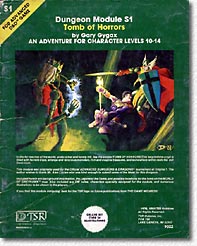
  1. The Tomb of HorrorsTomb of Horrors cover

    Nach dem Erfolg der letzten Rollenspielrunde war es diesmal relativ leicht, die
    Gruppenmitglieder zu einem weiteren Besuch in der Gruft der Schrecken zu bewegen. Diesmal
    sollte die Erforschung allerdings nicht so glatt vonstatten gehen wie letztesmal…

    Die Gruppe befand sich nach wie vor in einer langen Halle mit Wandmalereien, von denen
    einige als Geheimtür zu verschiedenen Gängen führten. Den einen Weg wollte man erst
    einmal nicht einschlagen – irgendwie machten einen die aus der Wand schiessenden
    Energiepfeile nervös. Den anderen hatte man schon erforscht (die 3 Truhen) und beim
    dritten war man misstrauisch (die Pforte der magischen Nebel). Blieb also nur der lange
    Gang, der in einer Wand endete – Bastis Magier Rizarden vermutete nicht zu Unrecht
    dort eine Geheimtür. Da man zu faul war, danach zu suchen, wurde wieder einmal kurzerhand
    die Wand in Schlamm verwandelt, dies riss jedoch Rizarden gleich selber durch die
    Schlammmassen in den nächsten Raum, ein mysteriöses Heiligtum mit Zombieszenen an den
    Wänden, jedoch auch guten Symbolen hier und dort. Ein Skelett wies mit der Hand auf ein
    weiteres Nebelportal, ausserdem lockte ein grosser Altar. Man machte sich allerdings
    zuerst an die Erforschung von zwei vollkommen langweiligen Urnen, so langweilig, daß
    Aarons Borsac sich kurzerhand auf den Altar schwang (warum, wissen nur die Götter). Dies
    löste einen Energieblitz von beträchtlichem Ausmass aus, der Borsac leicht versengte, für
    die 2 im Weg stehenden Fackelträger Kaspar und Bully jedoch den Desintegrationstod
    bedeutete.

    Die Gruppe war aber immer noch nicht vorsichtig genug geworden – man öffnete
    fröhlich die Betbänke und wurde von einer schwächenden Giftwolke überrascht. Hierauf
    sprangen Elrican und Darriell erst einmal vor Schreck in das Nebelportal….und tauchten
    geschlechtsumwandelt und böse wieder daraus auf!

    Das war erst mal wieder zuviel, die Gruppe musste erst einmal 2 Tage
    verschnaufen…weiteres Experimentieren mit dem Nebelportal ergab, das die
    Ausrichtungsänderung rückgängig zu machen war, die Geschlechtsänderung jedoch nicht.
    Elrican blieb also Elricana, konnte dafür aber wieder heilen (als gute Priesterin).
    Darriell(a) dagegen blieb lieber böse…und nervte fortan mit äusserst chaotischem
    Verhalten!

    Nach der Rast entdeckte man durch Andreas stets gut gezielte Suchsprüche einen Schlitz
    in der Wand – Hans war der Erste, der auf die Idee kam, diesen mittels des vorher
    gefundenen Ringes in eine zu öffnende Geheimtür umwandelte. Vorsichtig stieg man eine
    tiefe Treppe herab, und stiess auf eine Folge von drei Türen, jeweils mit einer fiesen
    Falltüre dahinter. Andrea misstraute dem langen, um die Ecke führenden Gang, und suchte
    die Gruben erst einmal ab- Bingo: Ein weiterer Geheimgang! In diesem stiess man zuerst
    auf einen recht ereignislosen Gang, der mittels einer weiteren Türe zu einem
    ereignislosen Raum mit 3 grossen Fässern führte. Nun, sieht man mal von der Riesenamöbe
    in einem der Fässer ab! Ausserdem fand man 2 Teile eines Schlüssels, die auch gleich
    zusammenpassten.

    Da man irgendetwas von ZWEI Schlüsseln ahnte (siehe Acereraks Gedicht vom letzten Mal),
    nahm man an, doch in dem langen Gang eventuell etwas zu verpassen. Dieser führte zu eine
    Tür, die Borsac kurzerhand zerhackte. Leichtfüssig schritt die Gruppe einem schrecklichen
    Schicksal entgegen, auf einem in einen Lavastrom kippenden Fussboden! Nicht alle konnten
    sich schnell retten – Wurgan kämpfte sich mühsam mit mehreren
    Geschicklichkeitswürfen wieder zum Eingang, während er den Tod hinter sich wusste!

    Nun, dann doch lieber den anderen Gang entlang!

    Hier stiess man ersteinmal auf unpenetrierbaren Nebel, der lustigerweise mit
    „Springerstiefeln“ (im wahrsten Sinne des Wortes) erforscht wurde. Eine Tür
    führte wiederum zu unpenetrierbaren Spinnweben, die nur durch Bastis Feuermagie
    vernichtet werden konnten (zusammen mit dem daranhängenden „10-foot-pole“,
    der vorher bei der Fallenerkennung gute Dienste geleistet hatte). In einer kleinen Kammer
    stiess man auf eine merkwürdige brüllende Mumie, die auch gleich angriff. War dies
    Acererak, das Lich? Die Mumie war auf jeden Fall schnell erledigt, sofort stürzte auch
    gleich JamesBond-mäßig die Decke ein. Alles Illusion, wie Andrea gleich darauf
    herausfand! Na, so leicht war man nicht von der Suche nach Acererak abzubringen. Sich
    erst in einer weiteren Sackgasse wähnend, fand man doch noch eine Geheimtür im
    Fässerraum. Wieder ein langer Gang – eine weite Fallgrube mit Speeren wurde recht
    locker mit den Spring(er)stiefeln überquert (man reichte diese ingeniös jeweils an den
    nächsten mit einem Seil weiter). Eine weitere Geheimtür (die einzige Fortbewegungsmethode
    in dem Dungeon), und man stand in einer kleinen Grabvorkammer. Diese hatte die
    unangenehme Eigenschaft alle paar Minuten zu wackeln, was in eine Art lustiges
    Zwergenkegeln ausartete. Dutzende von kleinen Truhen waren schnell durchsucht (ihr Inhalt
    immer Schlangen oder kleine Schätze). Andrea untersuchte mutig die seltsamen Vorhänge,
    als der Raum wiede mal wackelte. „Hältst Du Dich fest?“ „Ja“.
    „Wo?“ „Am Vorhang“. „Wirklich? Bist Du sicher?“.
    „Ja, ganz sicher“. Nun, der Vorhang riss, verwandelte sich in grünen Schleim
    und begrub Andreas arme Elricana unter sich. Erst Geschlechtsumwandlung, dann Schleimtod
    – wahrlich ein Freitag der 13.!

    Das war so shocking, daß die Gruppe von einer seltsamen Depression befallen wurde.
    Lustlos beschäftigte man sich mit dem Schleim, der sich auch gleich in wärmesaugenden
    Schimmel verwandelte, nachdem man mit Fackeln darin herumstocherte. Traurig suchte man
    das Verlies mal hier, mal da ab – es schien keinen Ausweg mehr zu geben! Fast
    stoisch begegnete Basti den Todesspeeren, die aus der untersuchten länglichen Fallgrube
    schossen, als er sie zum Durchsuchen betrat…

    Endlich entschloss man sich aber doch, doch der Serie von Geheimräumen mit
    Energiepfeilen nachzugehen, und voilà, es gab doch einen Ausweg! Schade nur, daß da auch
    ein ziemlich fieses Gargoyle stand – das bisher am schwersten zu besiegende
    Monster! Um den Hals herum hatte es eine Edelsteinkette…Edelsteine? Moment, da war doch
    noch das ANDERE Gargoyle, aus Stein, mit den seltsamen Dellen in den Händen. Ein paar
    statuenzerquetschte Edelsteine später war man in Besitz eines Magischen Auges, mit dem
    fröhlich alles abgesucht werden konnte. So stiess man auch endlich auf den Ausgang des
    Verlieses, direkt neben dem Gargoyleraum. Frühmorgens müde an die frische Luft stolpernd,
    war die Gruppe nun doch zu einer Art Happy End gelangt!

    Wie mag es wohl weitergehen?

Game Session Report 27.11.2002

Game Session Report 27.11.2002

Author: Hans

at the table: Peter, Moritz, Günther, Walter, Aaron, Hans

on the table: Age of Steam

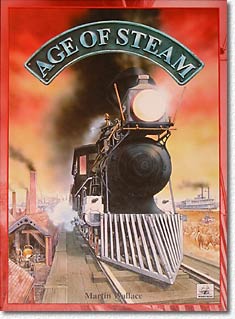
  1. Age Of SteamAge of Steam - box

    After considering and dismissing the option to play a new title, there was widespread
    acclaim in this evening’s round of six (Aaron, Günther, Hans, Moritz, Peter, Walter)
    to have another go at “Age of Steam”. Five of us had participated in WPGs first
    playing of this title on November 5. Aaron was the only one new to the game and, sadly,
    finished last. His income did not cover the costs until well into the game session, and
    victory never was in his grasp. Of the other five, all did well with differing
    strategies, and the outcome was not decided until the last two turns. Newbies beware!

    This time, we all had the impression that there was a fierce competition from the first
    game turn to the last, and we put a lot of thought in choosing actions, bidding for turn
    order, running trains, …

    With six players, the game covered the evening’s session, and we all very much needed
    the short, relaxed round of “Bluff” afterwards. Truly, “Age of Steam”
    is a rewarding experience, but you need to take it seriously – it is serious fun!

    At the beginning, all players except Hans (me) decided not to raise fresh money by
    distributing shares, not wanting to be burdened with dividends. This first decision of
    the game is already critical: A share is worth five money, and costs one money in
    dividends, per turn. Obviously, they are a net loss in the long run. On the other hand,
    if you want to build three tiles and also bid some amount for turn order, it is pretty
    much inevitable to do some deficit spending at some point.

    Peter followed a very “cheap” strategy from the beginning to the end, with
    only five shares distributed (two is the starting amount), and did surprisingly (to me)
    well. At the final count, he had only four track sections to his color, but finished
    runner-up. Hans did the opposite, building many tracks, transporting many goods, but
    facing a lot of costs and, decisively, the final VP reduction for distributed shares. The
    expansive (expensive) strategy was, however, only defeated in the last two rounds, when
    the goods became scarce and Hans’ tracks sections were no longer in demand.

    Bidding for turn order was cautious, Peter did well by using the
    “urbanization” option as a means to build free track (a minor city tile costs
    money, a major city tile placed during urbanization is for free). Hans grabbed important
    ground in the south center portion of the map with “first build”. Most track
    was built there, in the first turns.

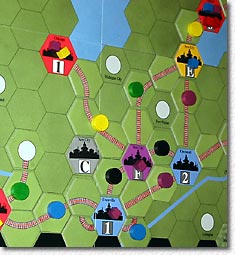
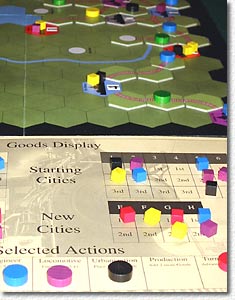
    Age of Steam - board We played with six players, so there were only six game
    turns, and I have the impression that the game was developing in three distinct phases:
    opening, mid- and endgame.

    During the opening game, in the first two turns, money is very much a problem. It seems
    necessary to increase your income by 2 per turn at least. To this end, you should try to
    cooperate with others on a 1-1 basis (as soon as there are “2” trains). Build
    opportunistic tracks and stay near the center. Watch closely where goods are about to
    appear that can be easily transported. Upgrade your train soon. Use the
    “Locomotive” option in order not to lose a transportation round while
    upgrading. This option becomes increasingly important with an expansive strategy. Use the
    “Turn Order” option if you want to run a “cheap” enterprise. Moritz,
    Hans and Günther made good progress in this phase. Aaron fell behind and did not recover
    until it was too late.

    In the mid-game, it is important to have a good train in order to break even with your
    enterprise and cash in on longer transport routes. “Urbanization” and
    “First Move” (of goods) become very important options. During this phase, the
    goods are depleted at a very high rate, and the game becomes somewhat unpredictable. With
    fewer than six players, it may be different, but we haven’t played with a smaller
    round, yet. It is necessary to rely more and more on transporting goods yourself, over
    your own tracks, to gain profit, as more and more competing routes are becoming
    available. It is now a good decision to issue shares and build always the full amount of
    tracks regardless of the terrain. Everyone did so, and even the most reluctant players
    gave out shares and competed for turn order with higher bids. At this point, Hans’
    expensive strategy netted the largest profit for the first time, with an impressive
    income which outweighed the high costs for his “4” train and eight shares.
    Moritz was handicapped by a slow “2” train, but still had the second best
    profit, due to small costs and due to the income base he had built up in the starting
    rounds. Günther was doing okay, participating with a track section in several often-run
    routes and in a 1-1 cooperation with Aaron who had very limited feasible transportation
    routes. Walter was exploring the western map and did not have the best returns on his
    investment so far, however had not lost money in turn order bids, thus keeping a sound
    financial basis. Peter kept a very low profile, giving out only one share above the
    starting two and concentrated on train upgrade and on building a few crucial tracks, thus
    creating a highly profitable transport route from the as yet unexplored east coast
    “city 3” to the board center. This was the decisive move for his outstanding
    endgame performance. Moritz was building for the endgame as well (in the west), but his
    slow train remained a problem.

    Age of Steam - board The endgame saw impressive upheavals of player
    performances. Goods remained in good supply only in the east coast cities and in the far
    west. This handicapped Hans very much who had not prepared for this foreseeable event and
    was building tracks here, there, and everywhere (giving out shares to cover building
    costs) which did not return the investment. In addition, Hans’ large income incurred
    the highest reduction penalties, a balancing mechanism of the game system. Peter was now
    cashing in in big chunks, running goods exclusively on his own few track sections.
    Günther wanted to do the same by linking the east cost to his track sections in the
    northern center, but he had to upgrade his train during a transportation round of the
    last game turn, which cost him second place, and he finished fourth, together with Hans.
    Walter finally linked the northwest to the center, and also had a track section which was
    often used by Peter, but it was too late in order to make more than third place. Moritz
    could maintain a continuous, if moderate, flow of goods, and got another win with a very
    even-paced, unspectacular strategy. As it seems, it was a good decision to connect his
    tracks with cities of many different colors, keeping open options for transportation
    throughout the game.

    It was an exciting, close game, and we put no little effort in playing it well. There
    remains, however, an amount of uncertainty as to whether the random availability of
    additional goods (which come in each game turn by rolling dice) doesn’t give luck a
    too big influence on the outcome (considering the amount of planning one has to do). I
    had this impression in the first game, three weeks ago, but this time I didn’t think
    so. Next time we’ll see! I look forward to it.

Spielbericht 24.11.2002

Spielbericht 24.11.2002

Autor: Moritz

am Tisch: Andrea, Hans, Aaron, Basti, Moritz

auf dem Tisch: Advanced D&D First Edition: „The Tomb of
Horrors“, „Die Schlacht der Dinosaurier“

  1. The Tomb of HorrorsTomb of Horrors cover

    Nach langer Überlegung war es mir gelungen, einige der Westpark Gamers zu einem
    ungewöhnlichen Abend zu überreden. Denn nachdem es inzwischen leicht geworden ist, einige
    der alten TSR-Rollenspiel-Module über das Internet zu finden, bekam ich einen
    Nostalgieschub und Lust, das legendärste der alten Abenteuer (noch aus Gary
    Gygax
    ’ Hand) zu spielen: „Die Gruft der Schrecken“.

    Fast 20 Jahre ist es her als ich selber die Gruft erforschte – damals starb die
    gesamte Abenteurergruppe bis auf mich, ich kämpfte mich mit einem einsamen Magier durch
    die letzten Räume, nur um dann…aber das wäre zu viel verraten.

    Wie auch immer: Auf der Spielemesse Essen rüstete ich mich mit einer Spielematte, neuen Würfeln und
    anderen Materialien aus, und es konnte endlich losgehen. Peter kneifte im letzten Moment
    – angeblich musste er arbeiten oder soetwas, wie auch immer: 4 Abenteurer fanden
    sich ein (angesichts der Schwierigkeit des Moduls wird empfohlen, daß jeder 2 Helden
    spielt, ich gab auch noch 2 Fackelträger dazu).

    Nach kurzer Einarbeitung in die alten D&D-Regeln (die sich, im Gegensatz zur 2nd und
    3rd Edition sehr gut für einen schnellen Einstieg eignen), konnte es losgehen. Besonders
    beschleunigt wurde der Ausrüstungsprozess durch die Tatsache, daß Basti schon
    „Baldur’s Gate“ durchgespielt hatte, und daher mit den Mechanismen der
    Zaubersprüche vertraut war.

    Die 8 Abenteurer plus 2 Fackelträger– die übliche Mischung aus Dieben, Zauberern,
    Priestern und Kämpfern, fanden sich also nach langer Reise durch den Totensumpf auf der
    Insel des Demi-Lichs Acererak wieder – welche grässliche Schrecken mochte seine
    Totenstatt enthalten?

    Die in Totenkopfform angeordneten schwarzen Steine auf dem Grabhügel schreckten
    zumindest keinen – also gruben die Abenteurer erst einmal – und gleich an der
    richtigen Stelle.

    Prompt eröffnete sich ein langer Gang mit seltsamen Mosaiken und Wandmalereien –
    der Eingang zur Gruft!
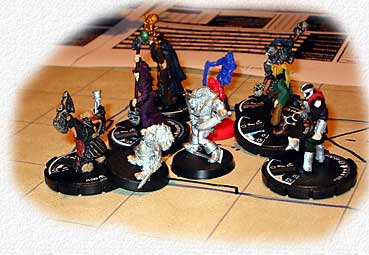
    Erstaunlicherweise stellten sich die eigentlich rollenspielunerfahrenen Spieler von
    Anfang an unheimlich geschickt an, fast wie kleine Indiana Joneses!

    Extrem vorsichtig arbeitete sich die Gruppe den Gang entlang – schnell merkte man,
    daß er von Fallen nur so gespickt war. Glücklicherweise konnten alle Fallen mit
    geschicktem Einsatz eines „10-foot-pole“ umgangen werden. Am Ende des Ganges
    fand sich eine Teufelsfratze und ein mysteriöses Portal, auch entdeckte man die
    Nachricht, die Acererak in dem Bodenmosaik an potentielle Eindringlinge hinterlassen
    hatte:

    ACERERAK GRATULIERT EUCH ZU EURER BEOBACHTUNGSGABE. BENUTZT WAS FOLGT WIE IMMER IHR ES
    WUENSCHT – AM ENDE SEID IHR MEIN, EGAL WAS PASSIERT!

    Zurueck zum Quaeler oder durch den Torbogen,

    und die zweite Halle ihr werdet finden.

    Meidet gruen wenn ihr koennt, aber die Nacht steht dem gut

    Der fuer seine Tapferkeit bekannt ist.

    Wenn die rote Schattierung steht fuers Blut

    Koennte der Weise erkennen, dass allein eine Schleife

    Magischen Metalls vonnoeten ist – ihr seid auf dem Weg!

    Zwei Gruben auf der Reise werden euch

    einen harten Fall bescheren – untersucht die Wand.

    Diese Schluessel und jene sind das Wichtigste,

    und huetet euch vor dem Zittern der Haende und dem, was zerfleischt.

    Wenn ihr das falsche findet, findet ihr das Wahre

    Und in die Saeulenhalle ihr werdet schreiten,

    denn dort ist der Thron, gleichsam Schluessel und verschluesselt.

    Die eisernen Maenner mit grimmiger Miene

    Machen mehr, als man sieht auf den ersten Blick.

    Link und Link seid ihr, ihr Grabraeuber

    Meine Gruft moegt ihr finden, eure Seele wird fuer immer schwinden

    Die Teufelsfratze war Allen unheimlich – schließlich war die hineingesteckte
    Fackel halb disintegriert worden! Also probierte man das Portal aus: Aarons dicker
    Zwergendieb verschwand erst einmal spurlos beim Durchschreiten, erst später entdeckte
    man, daß das Drücken bestimmter Steine im Portalbogen einen veränderten Teleporter
    schaltete. Der Rest der Gruppe, ohne Wurgan den Dieb!, fand sich nach dem Durchschreiten
    in einem winzigen Raum mit einer zerbrochenen Gargoyle-Statue wieder. Leider wusste man
    mit der gar nix weiter anzufangen, also ging es weiter in die „zweite Halle“
    mit weiteren Wandmalereien, die verschiedene Geheimtüren und Todesfallen verbargen.
    Leider (von Spieleleiterseite aus) wurden die zwei falschen Türen mit tödlichen
    Speerfallen vermieden (die Abenteurer öffneten auf kluge Anregung von Andreas Dieb
    Mugglin die Türen von der Seite, mit Seilen), dafür aber eine weitere Geheimtür die
    verschlossen blieb, und 2 seltsame Tunnel, die sich unter dem Raum in die Dunkelheit
    wanden, entdeckt. Und natürlich wieder ein Portal, das aber diesmal gar nicht auf
    Steinedrücken reagierte Auch hier war Borsak der Krieger, also ein Aaron-Charakter, der
    einzige Wagemutige, der die Tunnel fast im Alleingang erforschte. Leider endeten sie in
    Sackgassen! Inzwischen machte sich ein kläglicher Laut von hinten bemerkbar: Wurgan der
    Dieb hatte zur Gruppe zurückgefunden. Er erzählte von einem merkwürdigen Abenteuer: Erst
    hatte er sich in einem Raum ohne Ausgang wiedergefunden, nur mit 3 Hebeln an der Wand.
    Etwas misstrauisch (warum eigentlich?) hängte sich Wurgan als Klettermaxe an die Wand,
    bevor er die Hebel betätigte. Nicht schlecht: Als er alle drei auf einmal nach unten
    betätigte, öffnete sich ein 30 Meter tiefer Abgrund. Als er dasselbe nach oben versuchte,
    öffnete sich ein versteckter Ausgang in der Decke, durch den er entwischte. Irgendwann,
    nach langem Weg durch einen dunklen Tunnel, fand er zur Eingangshalle zurück und benutze
    das nun auf Gargoyle-Raum geschaltete Portal!
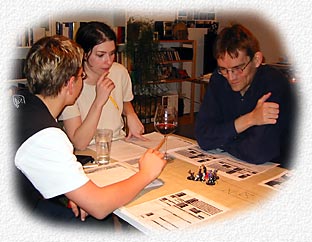
    Westpark Gamers Nur um Sekunden später am Ende des ersten Tunnels und einer leicht
    entdeckten Geheimtür in einen Raum mit drei Truhen zu purzeln – dies war überhaupt
    der erste Schaden, den irgendein Abenteuerer erlitt!

    Die drei Truhen beschäftigten alle auch erst einmal eine Weile- aus der ersten sprang
    ein Riesenskelett, das nicht leicht zu erledigen war, die zweite hatte eine gut
    versteckte Falle mit Pfeilen (und einen lächerlichen Schatz), und die dritte enthielt 12
    giftige Nattern, die einen äußerst lustigen Kampf verursachten: Die Nattern waren nämlich
    vergleichsweise harmlos im Vergleich zu dem Schaden den die Gruppe mit mehreren
    „Fumbles“ auf sich selber anrichtete (man denke an Dariel des Gnomes Axt!).
    Ein Versuch von Hans, mit den Schlangen in deren Sprache zu sprechen (Harry Potter,
    anyone?), kam etwas spät, die Schlangen waren nicht sehr gut gelaunt, da die Hälfte von
    ihnen sich schon im Blute wand!

    Der Truhenraum war also eine Art Ablenkung gewesen, das war klar!

    Zurück also zur hartnäckig verschlossen gebliebenen Geheimtür (der andere Gang erwies
    sich als Sackgasse, wie es schien). Basti verwandelte sie kurzerhand in Fleisch
    („stone to flesh“) worauf sie kurzerhand in wabernde Masse
    „verblubberte“, denn lebendig war die Wand vorher nicht! Wieder einmal eine
    Sackgasse – die Abenteurer starrten auf einen kleinen Raum ohne Ausgang! Eine
    Untersuchung dieser Passage brachte zumindest mal eines an den Tag: ein magischer Pfeil
    schoss jede Minute auf den Charakter der sich dort aufhielt! In unglaublicher Hektik
    rannte also immer mal wieder einer hinein, versuchte irgendetwas zu bewirken, und rannte
    dann wieder hinaus. Immerhin gelang es so, eine weitere Geheimtür zu öffnen und etwas
    weiter voranzudringen.

    Von dem ganzen Gerenne erschöpft entschlossen sich allerdings Alle, hier eine Pause zu
    machen (immerhin hatten sie ja auch schon einen guten Teil des Dungeons unbeschadet
    überstanden). Fortsetzung folgt also bald – wenn alle nochmal Lust haben!

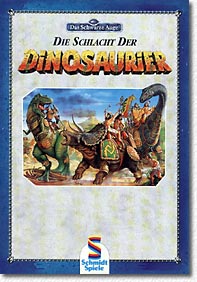
  2. Die Schlacht der DinosaurierSchlacht der Dinosaurier - box

    This game flopped badly when it came out in Germany. It was part of the “Das Schwarze
    Auge
    ” franchise (then “Schmidt-Spiele”) and was designed with a 10-year old audience in mind.
    The game material is fantastic: colourful and huge dinosaur figurines of various types
    mounted by human riders. In the middle of the huge game board is a huge volcano that
    spews “lava balls”. Lots of eye candy, but is there a game here?

    The 20 page-rules booklet is one of the clearest and over-explained rule-books
    I’ve ever read, full of illustrated examples for the mentally challenged. Basically
    all the rules would fit on half an A4 page!

    Each player (maximum 4) has a huge army of dinosaurs, with which he sets out to kill all
    other dinosaurs on the board. Movement and combat is governed by the play of action
    cards, which are linked to certain species of dinos – Stegosauri are slow and
    ponderous, pteranodons can fly far, but are weak fighters. You can either move or fight
    when a species is activated, although each single dinosaur can do either of these when
    activated. There are joker cards which can be used for any species, and also
    “extinction” cards, that let all dinosaurs of one species on the board roll
    for death. The rules unnecessarily state that you “shouldn’t do this, when
    you still own dinosaurs of that particular species”. Doh!

    Also, if you lose all dinosaurs of one species, their cards become joker cards as well,
    which helps weakened players who become increasingly fast through this rule.
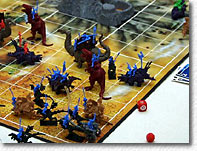
    Die Schlacht der Dinosaurier - boardFight is done using dice – each of
    them numbered zero, 1, 2, 5, 10, 15. The stronger the dino, the more dice he will use. Of
    course the distribution of numbers make for very variable results – a meek
    velociraptor is able to kill a Tyrannosaurus Rex for example, if lucky.

    The lava balls can be used to reroll combat dice, or to double the function of a card
    played. After they are used they are thrown into the volcano, where there is a 50% chance
    that they vanish from the game, otherwise they tumble out and can be brought into play
    again via “lava cards”. Of course lava supply quickly diminishes –you
    are using them all the time to fudge the damn dice rolls.

    That’s basically it – the game is a huge luck fest with very little tactic,
    but it succeeds in giving you the impression that your decisions were somehow influential
    to the outcome. And the dinosaurs are great, some of them are really huge!

    It would be easy to add a little chrome to this one – we immediately came up with
    variant combat and movement rules. As it is the game is a little on the light side, but
    an entertaining enough filler for grown-up kids. If you see this on sale, you might want
    to try it out!
Session Report 19.11.2002

Session Report 19.11.2002

Author: Aaron

at the table: Andrea, Hans, Moritz, Walter, Aaron

on the table: Trias, 6 nimmt, ZooSim, Anno Domini

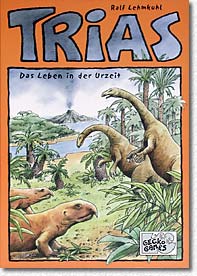
  1. TriasTrias box

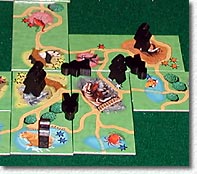
    38 hex-tiles form a large island of three different terrain types. Following the name of
    the game this large island will eventually break up into several smaller islands due to
    player actions which cause the tiles to “drift” into an outwards direction.
    Players start the game with a small group of four herds on the large island and their
    objective is to have a majority of herds on the soon to come smaller islands.

    A player’s turn consists of a mandatory “drift” of a tile followed by up
    to four actions of herd propagation, herd movement and optional tile drift.
    “Drifting” is performed by taking a tile that forms the shore of an island and
    placing it further away from the central vulcano tile of the central island. Removing
    tiles from the central islands shores eventually generated smaller islands. Whenever a
    new island is created by tile drifting scoring is triggered for the island where the
    drifted tiles has been placed. The player with the majority of herds on that island
    receives two victory points, the runner-up gets one VP.

    In the course of the main island breaking up players receive already some victory
    points. Since herds cannot move between islands players every now and then will try to
    join islands to gain majorities which otherwise would not be possible. Envisioning such
    moves, preventing other players to perform them while at the same time taking care that
    there are sufficient options open for oneself is the zest of Trias.

    Eventually the last round of the game starts when the “comet” card is drawn
    from the stack and each player is left with just two more actions. Once that round is
    completed the last, but decisive victory points are allocated: this time herd majorities
    on islands yield points depending on the number of tiles the island consists of. And just
    as in any previous victory point allocations, the main island (or fragments thereof) does
    not yield any VPs.

    Moritz wins After my misfortune last week when I had the majority on the largest
    island but did not get any victory points because it was still connected to the central
    vulcano tile I knew what to look out for this time. Although the optional tile drift
    action costs three of the available four actions it is the one option that prevents
    exactly this mishap. Some sort of diversification is also required in order to
    participate from other player’s moves and to build alliances. Sometimes this can be a
    bit of a problem as the number of possible good moves is fairly large and it is difficult
    to decide which are the ones that need to be played now and which can be postponed to a
    later turn. In comparison to last week, when we played Trias with only four players we
    found that planning ahead in a five player game is much more difficult and sometimes even
    impossible – just too many things change while it’s not your turn.

    Moritz managed to win the game by being present on nearly all of the islands present and
    thereby collecting an enormous amount of victory points by being at least the runner up
    in terms of herd majority. His diversification strategy definitely worked out.

  2. 6 nimmt

    Since Hans had to leave early tonight we decided to play a quick round of 6 nimmt, a game which had not been on the table for quite a
    while. Again we had a lot of “highest lowest” situations, a situation described
    by Walter in his German review of the game, and for
    whatever reason it was mostly I who had the “lowest highest” and consequently
    having to take lots of negative points. This game has a wonderful mechanism which makes
    you believe that you have some means of control where in fact most of the time it’s
    sheer luck which determines the result.

    Not having had a single round without taking at least five cards it was all too certain
    that a will lose the game. My only satisfaction was that our usual sure winner Moritz
    managed to only make second place.

  3. ZooSimZooSim box

    Like last year’s Essen release Titicaca, ZooSim also comes in a round box – the
    trademark of Cwali games. The objective of the two to four players is to create a zoo
    which attracts many visitors, a theme which is already known from various computer games
    (I guess that’s the reason for the game’s title). Unlike other Cwali games,
    ZooSim is a short game (less than 45 minutes) and is far more simpler to explain and
    play.

    The game consists of 25 tiles with zoo exhibits, paths and trees printed on them.
    Exhibits come in five color-coded categories (birds, apes, sea animals, reptiles and
    other mammals) and have a point value for attractiveness (one to three stars) printed on
    them. The objective of the players is to get the most attractive exhibits of a category
    as well as to boost attractiveness by having the most trees and circular pathways in
    their zoo.

    The game is played in five rounds and in each round five zoo tiles are revealed and
    auctioned one by one. Auctions are fast, with each player placing their bid in a closed
    fist and all revealing their bid at the same time. A clever mechanism has been selected
    to deal with ties: each player has a little flag marker next to a flag pole and the
    player with the flag at the higher position receives the tile in case of a tie. Then the
    flag marker is placed to the bottom of the markers.

    Won tiles must be placed so that paths line up with paths on existing tiles. Players
    will try to place tiles in such a way that exhibit categories are next to each other
    because only then the whole group counts as one exhibit for majority determination. As
    soon as the tile is properly placed the majority situation is re-evaluated. The player
    holding the majority in an animal category or trees places two visitor tokens on that
    exhibit and the runner up places one visitor on the some exhibit in his zoo. If a
    circular path has been created the player receives one visitor token for that as well.

    ZooSimOnce a set of five tiles has been auctioned a round finishes and players

    receive victory points depending on the number of visitors in their zoo. Each visitor
    equals one point multiplied with the round number, thus making round five, the final
    round, counting five times as much as the first round. Players then receive new money
    tokens equal to the number of tiles they have in their zoo and five new tiles are
    revealed before the next auctioning round commences. After five such rounds when all
    tiles have been auctioned, the player with the most victory points wins the game.

    ZooSim has some nice mechanisms which leave players with constant decision making and
    involving all players at anytime during the game. It’s important to decide which
    tile(s) to go for in the auctions – not all tiles have favorable paths or animal
    categories. Money is scarce with players starting the game with only eight tokens and
    receiving new tokens depending on the size of their zoo. Their is also an important
    tie-breaker on exhibit size: the player who equals the highest attraction value last
    takes the two visitors leaving the second place to the original leader. Together with the
    sometimes complex path layout this can lead to extended pondering at the beginning of an
    auction round. Latest after round three all animal categories are present in the zoos and
    from now on visitors are shifted between the zoos and new visitors only arrive for
    circular paths. This is where some long-term strategy of securing majorities pays off.

    Having played the game once before Walter and I had a good start in the first two rounds
    of the game, collecting most of the visitors for our exhibits. Round three turned out to
    be a disaster for Andrea when she lost most of her visitors to the other players. Walter
    managed to take two important majorities from me in round four but Moritz quietly had
    designed a clever path structure allowing him to build several circular paths in the last
    round and making him the winner of the game.

  4. Anno DominiAnno Domini box

    As often before, we decided to play this game as a quick closing game only to find out
    that it lasts a lot longer than one imagines. This time we found out that seeting order
    is of some relevance in this game when we saw that Moritz sitting in front of Andrea was
    very often successfully challenged by Andrea, who herself was in the position that she
    knew that Walter would challenge her if there are more than four cards on the table.

    Andrea soon had only three cards left and even our joint effort to make her getting new
    cards failed and she finally won the game.

ANNO DOMINI

Print this review

ANNO DOMINI

anno domini

Publisher: Fata Morgana/Abacusspiele

Author: Urs Hostettler

Tester: Aaron Haag

Game Tested: Abacusspiele release 1998

The Game: Interested in historic events? Fluent in German? And you know if the stone
named Yogi became a TV star before or after fishes fell from the sky in Singapore? Or are you just
good at bluffing? Two to eight players are dealt nine cards each that describe historic events on
one side of the card and provide the date of that event on the other side. Players are not allowed
to look at the side of the cards that carries the date. The game starts with one card on the table
describing an event. Players in sequence may now play one of their cards and place it either above
or below the card depending on whether they believe “their” event happened later or
earlier in time. As the players play their cards the sequence of cards on the table becomes longer
and longer and the probability that the cards are not in their correct order increases. As an
alternative action a player may, instead of playing a card, challenge the sequence and turn over
the cards thereby revealing the dates. If the sequence is in fact wrong the last player that placed
a card gets three new cards and the game continues with a new cards from the draw pile and the
challenger to play the next card. If, however, the sequence was correct the challenger gets two
cards from the draw pile. The sequence is also restarted with a new card from the draw pile and the
player left to the challenger plays next. The winner of the game is the player who is the first to
get rid of all his cards.

Playing Time: The game can easily be explained in 5 minutes and played in about 30
minutes.

Similar Games: Nobody’s Perfect (Ravensburger), Ein solches Ding (Fata Morgana)

Westpark Gamer’s Opinion: More than half of the events on the cards are things you
never heard of let alone know when they happened. So playing the game is a mixture of clever
bluffing, showing self-confidence and cleverly selecting the cards to play. Keep those you are sure
about until the very end – once you are down to two cards the other players will try everything to
prevent you from winning the game! The nice thing about this game is that it works so well – every
player is constantly involved in the game. It plays quickly and is an ideal starter/finisher for a
gaming evening. There are several packs of this game available, each with a different theme (e.g.
“Nature”, “Lifestyle”, “Sex & Crime”) and each pack holds 336
cards – more than enough for an excellent replay value.

Aaron’s Rating: 7 (out of 10)

Westpark Gamers’ Rating: 7.0