Candamir

Candamir

Candamir ist ein Spiel für zwei, drei oder vier Spieler. Warum ich es unter die 2PS
eingereiht habe, braucht eine gesonderte Begründung. Die lässt sich aber leichter geben,
wenn ich meine Sicht des Spiels erst einmal erklärt habe – ich komme also nachher noch
einmal darauf zurück.

Candamir heißt zwar mit Untertitel “Die ersten Siedler”, und oben auf der
Box prangt “Abenteuer Catan”, aber das Spiel hat herzlich wenig mit den
“Siedlern von Catan” zu tun. Dagegen ist es eng verwandt mit den
“Sternenfahrern von Catan”. Da aber unsere Rezension zu den
“Sternenfahrern” immer noch nicht geschrieben ist, muss ich jetzt bei Candamir
etwas weiter ausholen. Entweder lesen Sie nun meine Beschreibung oder, besser, Sie
beobachten eine Beispielpartie von Candamir bei Prof. Easy. Klaus Teuber kann gar
nicht genug gelobt werden für diese Art und Weise der Spielerklärung.

Zwar komm’ ich gegen Flash nicht an, aber hier mein Versuch der abstrakten
Erklärung: Die Spieler haben die Karte eines Fantasy-Landes vor Augen. In der Mitte ist
das Dorf, in dem alle Spieler starten. An bestimmten Stellen der Karte befinden sich
Zielmarker, die vor Beginn des Spiels zufällig gelegt werden. Eine typische Runde eines
Spielers beginnt damit, dass er sich heimlich zwei Zielmarker ansieht. Einen von beiden
(oder, wenn beide ziemlich mies waren: irgendeinen anderen) markiert er dann mit seinem
Zielpöppel.

Ein so markiertes Ziel gehört dem Spieler. Er muss es ansteuern, niemand
anderes darf es ansteuern. Es gibt keine Möglichkeit, einen fremden oder eigenen
Zielpöppel zu entfernen – außer man erreicht das Zielplättchen und hakt diese Aufgabe ab.
Diese Begrenzung macht Candamir sehr friedlich. Es ist im Gegensatz zu vielen
vergleichbaren Spielen nicht möglich, einem anderen Spieler etwas vor der Nase
wegzuschnappen.
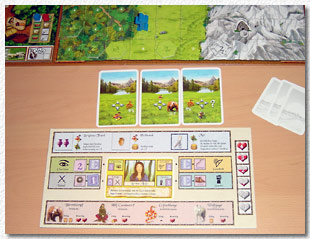
Candamir boardAber unser Spieler ist ja noch im Dorf, und irgendwo da
draußen hat ein er Zielplättchen markiert. Wie er kommt er hin? Schritt für Schritt.
Seine Zugweite (Zahl der Schritte) definiert sich über seine Ausdauer (und evtl.
Spezialfähigkeiten). Jeder Schritt bedeutet, eine Karte zu ziehen. Diese Karte stellt die
vier Wegrichtungen dar. Oft kann man “einfach so” in die Richtung ziehen, in
die man ohnehin wollte. Manchmal darf man sogar noch eine Naturalie (Pilz/Kraut/Honig)
aufsammeln. Wenn man Pech hat, steht Bär/Wolf/Schlange/Candamir im Weg, die man nur
Würfelwurf besiegen/zufrieden stellen kann. Immerhin gibt’s bei Bären zwei Felle, bei
Wölfen ein Fell als Siegespreis, und Candamir schenkt dem Holz-Hack-Helfer ein Holz. Der
Würfelwurf wird modifiziert mit Adventure-artigen Eigenschaften (Stärke, Geschicklichkeit
…) und evtl. gefundenen Gegenständen. Eine weitere Begegnungsart sind Abenteuer. Bei
Abenteuern kann man eines von dreien auswählen; Abenteuer sind meistens schwieriger als
Tiere, aber die Belohnung ist normalerweise auch höher. Zudem gibt es einen Siegpunkt für
die meisten bestandenen Abenteuer. Wohlgemerkt: Niemand muss zu Abenteuern oder Tieren
laufen. Wer sich aber stets davon abhalten lässt, in die richtige Richtung zu gehen,
verliert Züge (und außerdem die so erarbeitbaren Rohstoffe).

Das Zielplättchen beschenkt den Spieler mit Rohstoffen (Fell/Holz/Erz),
Erfahrungspunkten (zum Steigern der Charaktereigenschaften), Gegenständen oder direkten
Siegpunkten (Rind/Ziege). Wer sein Zielplättchen erreicht (egal, wo dies ist) wird ins
Dorf zurück teleportiert.

Zurück im Dorf, kann man wieder auf Abenteuer gehen oder “Bauen und Brauen”.
Bei B&B werden Rohstoffe in Siegpunkte und Naturalien in Tränke verwandelt. Tränke
dienen dazu, Würfelwürfe leichter zu bestehen, Ausdauer zu regenerieren oder die Ausdauer
der Mitspieler zu senken. Wer “baut und braut”, dessen Runde ist beendet.

Ziel des Spieles ist es, 10 Siegpunkte zu machen. Siegpunkte gibt es für: 1.
Rinder/Ziegen (direkte Siegpunkte), 2. Produkte (jeweils aus drei bestimmten Rohstoffen
herzustellen), 3. Mehrheiten (es gibt vier Abnehmer im Dorf, wo die Siegpunkte gelagert
werden; wer mindestens drei Siegpunkte bei bestimmten Abnehmern hat und eine Mehrheit
hat, kriegt einen Sonderpunkt), 4. Mehrheit bei bestandenen Abenteuern. Soweit der grobe
Schnelldurchlauf durch die Regeln.

Wie spielt sich Candamir? Wie gesehen, ist ein einmal fixiertes Ziel für alle anderen
Spieler tabu. Die Spieler haben zwar Kampfkraft, Ausdauer etc. Aber die kommt nur gegen
Bären und Abenteuer zum Tragen: Zwei Spielerfiguren können zwar auf dem selben Feld
stehen, aber sie können sich nicht “treffen” (geschweige denn miteinander
kämpfen…). Candamir ist also sehr friedlich; so friedlich, dass es eigentlich auch als
Solitärspiel durchgehen könnte.

Wo findet Interaktion statt? Die Spieler können miteinander handeln; im 2PS geschieht
dies aus verständlichen Gründen unter guten Spielern nie, bei mehr Spielern könnte dies
sogar Kingmaker-Züge annehmen (je nachdem, ob Spieler A mit B oder C handelt, die beide
hätten, was er braucht …). Die Spieler flößen einander Met ein; das geht nur mit
solchen Spielern, die gleich viel oder mehr Siegpunkte haben. Met ist lästig, aber kein
echtes Problem. Die Spieler kämpfen um Mehrheiten. Das ist bei zwei Spielern kein
Problem, aber bei drei oder vier Spielern könnte dies ebenfalls schnell zu
Kingmaker-Situationen führen. (Und jetzt weiß der werte Leser auch, warum Candamir von
uns nur zu zweit gespielt wird…). Sonst findet Interaktion nur dadurch statt, dass die
Spieler unter denselben Zielkärtchen und Abenteuerkarten wählen.

Verglichen mit den “Sternenfahrern” ist Candamir schwieriger und einfacher
zugleich. Schwieriger, weil es viel mehr Regeln und viel mehr zu erklären gibt.
Einfacher, weil das Spiel selbst nicht so anstrengend ist: Der Memory-Effekt von
Sternenfahrern (“Wo war nochmal dieser vermaledeite 5er Treibstoff-Planet?”)
entfällt fast ganz; die paar Plättchen von Candamir kann sich jeder merken. Bei
“Sternenfahrern” war man ständig in Not, ob man Rohstoffe für Siegpunkte
(Kolonieschiffe/Zentren) oder für die Verbesserung des Schiffs (Laser/Antrieb) oder für
den Handel ausgibt. Diese süße Qual entfällt bei Candamir: Rohstoffe sind für Siegpunkte
da, basta. Naturalien/Ehrfahrungspunkte sind für den Ausbau der eigenen
Leistungsfähigkeit, basta. Nur beim Losmarsch auf einen Zielmarker kann man sich evtl.
zwischen einem mit viel Naturalien oder einem mit einem Gegenstand unterscheiden; sobald
man das Zeugs einmal hat, ist einem die Entscheidung abgenommen.

Für kopflastige Spieler ist Sternenfahrer sicher das bessere Spiel. Candamir ist aber
friedlicher, plätschernder, gemütlicher. Und Candamir kann mit einer weiteren Eigenart
punkten: Dem Charaktergenerator. Hier lassen sich online Charaktere zusammenstellen. Der
Witz daran ist nicht, dass man sein eigenes Konterfei auf die Karte drucken kann (- wobei
das natürlich auch geht), sondern, dass man sich vor Spielbeginn eine (vermeintliche)
Killerkombination von Charakterpunkten/Sondereigenschaften zusammenstellen kann. Der
Editor bietet wesentlich mehr Sondereigenschaften als die mitgelieferten Charaktere
haben. Alle Eigenschaften sind im Editor bepreist; man hat 40 Punkte und kann daraus
machen, was man will. Auch extreme Ausrichtungen sind möglich (z. B. ein kampfkräftiger
Charakter mit Zusatzeigenschaften Bärentöter und Rohstoffhandel; der sammelt dann gar
keine Felle mehr bei Zielpunktmarkern, sondern tötet unterwegs Bären à 2 Felle; und 2
Felle tauscht er gegen einen beliebigen anderen Rohstoff – allerdings sind diese
Eigenschaften bereits so teuer, dass wenig Punkte für anderes bleibt).

Klaus Teuber hat in einem Interview selbst eine Reihe hochinteressanter Dinge zu Candamir gesagt.
Nachlesen lohnt.

Fazit: Candamir ist ein angenehmes, ruhiges Spiel. Spieler, die gerne ihren Spielabend
vorplanen, können neue Strategien mit dem Editor vorbereiten. Candamir mit drei oder vier
Spielern könnte Kingmaker-Probleme haben, doch zu zweit geben wir ihm hoch verdiente 4
Sterne.

Wertung:

Struggle of Empires

Struggle of Empires

reviewed by Moritz Eggert

The “master” (Martin Wallace) has struck again – fresh from Essen we played
his new labour of love, the ambitious “Struggle Of Empires”. In this game,
Wallace tries to meld some ideas from his earlier games and form a larger whole, and he
is, to keep it short, mostly successful.

“Struggle Of Empires” is a simulation of the Victorian Age, an age of
conquest and increasing European domination of the planet. The players play the Empires
of Britain, Prussia, Spain etc. and battle it out for world domination (=VP). The
relatively small board (for the amount of counters) depicts literally the whole world: We
find Europe and the “Colonies”, Africa, the Americas, East Indies… all
divided into a relatively small number of “areas”. The game is played in three
“wars”, consisting of up to six player “phases” which consist of up
to two actions. At the beginning of each “war” (and they are rightfully called
like that, because players will find it necessary to use their military force to win the
game) 10 country counters are drawn, which represent “opportunities” in the
different areas. Some of them can be won over by war (which involves dice rolling and the
elimination of the counter, to be replaced by a “control token”), some can be
won by other means (the “slave” counter can be exchanged into a control token
if the player has a fleet in Africa, for example). Control tokens can in turn be attacked
by other players, which will certainly happen after opportunities become sparse at the
end of the a “war”.

The heart of the game is the ingenious “alliance” system, which bases
alliances on a bidding mechanic at the beginning of each round. Basically, two
“sides” are determined, and you can never attack your ally once these sides are
determined. In the first “war” these alliances are of less importance than at
the end of the game, where it really helps to be on the same side as your worst
enemy/competitor. However, you will have to pay for being on his side!

The simple system works nicely as an anti-kingmaker mechanism. A clever player can
make it virtually impossible to suffer from “bash-the-leader” attacks in the
endgame, but at the same time he has to weigh the amount of cash he spends for this
privilege. Players can take unlimited cash, but they pay for it (and for the loss of
armies) with “Unrest” markers, which can only be lost by expending extra
actions. In addition, a certain number of “unrest” makes you lose the game in
the end, and the players with the highest unrest at the end will suffer VP penalties.

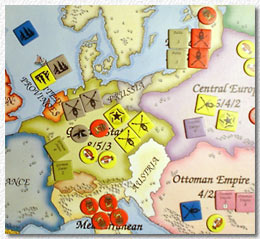
Struggle of Empires boardThe “meat” of the game is the
“upgrade tiles”, though. If you thought “Princes of the Renaissance”
was daunting in this respect, the possibilities (and number of different upgrades) will
overwhelm you in this game. Even our dauntless group went very silent in our first game,
while we desperately studied various playing aids with tiny writing. Everybody felt that
one would try out different combos in the next game, which is a good sign.

At the end of each “war” victory points are awarded for majorities in areas
in typical Wallace fashion (if both players have the same number of control tokens, each
gets the full amount of VP). After three “wars” the game ends.

The Warfrog rulebook is – as always – an eternal mystery. While you read the only 2-4
pages the rules usually have you think “hey, this is not too complex”, but when
you get to actually play the game one is always surprised at the sudden complexities and
abstract handling of certain aspects. Wallace tends to be a minimalist in his rules –
there is not one superfluous sentence in any of the rules – each sentence states
something very essential to the game, so that you often overlook the details. Whereas
“Euro” rules tend to be very verbose and filled with examples recently, even if
the rules are simple, Wallace takes exactly the opposite approach.

His games are also always full of unique mechanics, which often need a bit of getting
used to while usually making a lot of sense. But also here the Wallace fan (and I would
count myself as being one) recognizes certain elements, like the VP distribution.

The final question is if there is enough novelty here to demand a buy. I personally
find the not-too-recent “Princes of the Renaissance” more to my taste, but one
would be hard-pressed not to admit that “Struggle of Empires” is an excellent
game in its own right. It is one of Wallace’s more aggressive and bleaker games,
which has to do with the theme. Interestingly there has been no attempt to avoid certain
issues like the depiction of slavery for the sake of political correctness. The cover
even has a naked, sad-looking black slave on it – will it be published like this in the
US, I wonder? I can already see the discussions at “boardgamegeek” shift from
the silly anger about the brown colour of the population markers in “Puerto
Rico” to discussions about this game. Hey, it was even supposed to be called
“Birth of a Nation” once!

There is no question that players of this game have to play “evil” to win –
just like their historical counterparts, they exploit the world for their own devious
means, and the game has no intention to hide this sad historical fact about the history
of Europe.

If you can get along with that, you will be in for an intense gaming experience.
However, do not complain if you are backstabbed – it will happen!

Bootleggers

Bootleggers

reviewed by Moritz Eggert

“Eagle Games” is mostly known for “light” wargame-type games with
monstrous boards and tons of plastic figures. Not all of these games have been equally
successful, but so far the company has been willing to learn from it’s mistakes and
to constantly improve their designs. Their newest game, “Bootleggers”, is a
radical departure in many ways. Already “Age of Mythology” had some “Euro
Game” elements, but “Bootleggers” is their first game to be officially
presented as a “Euro-American-hybrid” game, purposely mixing the best of the
two worlds. But “Bootleggers” is also NOT a wargame. Although the game material
is lush as always with Eagle games, this time the map is only 1/3 as big (still big by
any account), and there are definitely no combat dice to be rolled. Instead players take
over the role of roaring 20’s gangsters, who try to make big bucks by selling illegal
whiskey in the speakeasies on the gameboard.

The rules are very extensive and include many pictured examples. One might think at
first glance that this is a complicated game, but it ain’t. In fact, the game
mechanics are very straightforward.

The game is played over 12 rounds. Each round’s turn order is decided by the play
of “muscle” cards (a “Euro” mechanic), of which none has exactly the
same number, but everybody gets a roughly equal distribution of high and low cards. This
is in fact one of the more ingenious ideas of the game, as “muscle” also
decides who places his trucks first and so on, so it is an interesting decision when to
play your high or low cards.

Players now select “action” cards (also a “Euro” mechanic), which
allow them to do various things like getting influence markers (represented by mean
looking guys with a Tommy gun; they are first placed on your distillery, then move to the
various speakeasies to gain influence). They are also used for upgrading your distillery
or the consumption of speakeasies, or come as “take that” or “thug”
cards, which usually mess with other players (an “American” mechanic). One can
also buy additional trucks, which are necessary to bring the whiskey to the speakeasies
(you start with a “4” truck, which can handle 4 crates of evil spirits).

Next, your distillery produces whiskey, the amount of which is determined by a die
roll (“American” mechanic) for each distillery or distillery upgrade you
have.

Some players will now want to trade, as they either have too much or too little
whiskey, and the game explicitly allows all kinds of deals and backstabbing.

Next, you load your whiskey on the trucks (the whiskey crates are represented by
wooden cubes, which fit nicely into the trucks) and line up at the various speakeasies.
Now your mobsters with Tommy guns come into play. You’ll either have a majority (more
influence than each other player, but not more than all other players combined),
controlling majority (more than each other player AND all other players combined), or a
simple minority, or no influence at all at a speakeasy. If you have the majority, you
will sell your crates first, which is very important because each speakeasy only has a
limited consumption capacity – they can only take THAT much of your vile illegal brew! If
you have controlling majority, you also get a bonus on EVERY whiskey sold, even by other
players.

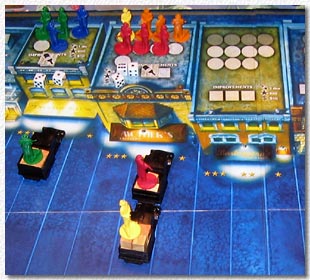
Bootleggers boardThe other players (minority) line up at the middle
dock, whoever comes first – determined again by muscle – will sell first (in fact it is
very cute to line up the trucks at the various speakeasies physically). The public dock
remains for players with no influence at that particular speakeasy, and they have to
grease the palm of the majority player to be allowed to sell there.

This is the only aspect of the game, which can create some confusion with newbie
players, as one, two, or three “stars” instead of a description represent the
various “docks”. Some players thought that only controlling players could line
up at the “3 star” dock, whereas in fact also the normal majority player can.
It might have been good to create a fourth dock for players who cash in the bonus, but
the game board is already pretty crowded as it is with the huge trucks and figurines.

All this majority/minority business is “very Euro”, as you can imagine!

AFTER placing the trucks, the consumption is rolled for each speakeasy
(“American” mechanic), which means that either all whiskey crates will be sold,
or only part of them. The players last in the row will suddenly have a very sad look on
their face (when the whiskey consumption is lower than expected), because all whiskey not
sold (or not put on a truck in the first place) will simply wither away, not to be
stored.

Selling whiskey will give you 1000-3000 bucks per crate, depending on the speakeasy,
and the bonus is always 1000$ a crate.

That is the core of the game, but of course many wild things happen through the play
of “thug” cards. It is for example possible to steal your opponent’s truck
and sell the whiskey as your own, or to remove influence markers from your opponents.
This somewhat “chaotifies” the “Euro” aspect of the game, but also
helps a bit against the staticness of the basic play.

In rounds 4 and 8 all players get free influence, the player with the least money more
than the others. Also from round four on, a “copper” appears, who always
threatens the most prolific distillery, shutting it completely down for one round when a
“5” is rolled (“American mechanic”).

The player who first amasses 100.000$ wins the game with “sudden death”, or
whoever has the most money at game end (the former is more likely in our opinion).

We liked our game of “Bootleggers”, the atmosphere is captured well and the
game mechanic doesn’t feel too abstract (an “American” aspect), but players
who expect a deep thought experience like “Puerto Rico” will certainly be a bit
disappointed, as the action cards mess a lot with who’s leading and who’s
not.

A very “wild” aspect of the game is the whiskey production. We had players
rolling strings of 1’s, and others strings of 6’s, and of course the latter will
have a big edge in income, even though the game partly tries to remedy that with the
introduction of the “copper”. But that so much is depending on a dice roll
might turn some players off, especially if they are used to games like “Puerto
Rico”. Winning or losing might only be a “pip” apart!

This is why Aaron Haag of our group thought of a variant for “Euro Gamers”
which links the production to the number of influence markers in the back room, and the
consumption to the number of influence markers in the speakeasy. For this, a ratio of two
should probably be introduced, and it also might mean that you should gain 2 instead of 1
influence marker per card. A more strategic game could be imagined, for those who find
the current game to random for their taste. Perhaps some players will be tempted to try
out such a variant and be willing to report their experience to us? (As an
alternative, Steve Gross suggests on Boardgamegeek the “Mensa” version of the
game where all die rolls are replaced by a constant “3” [ah])

But as it stands this is a valid and interesting effort, and might be the most
“playable” Eagle game yet. To explain the rules one should expect around 15
minutes, the actual playing time varies wildly with the ambition of the players. If they
tend to think deeply the game might drag on for 3 hours or more, but a relaxed round
might finish it in a much shorter time, more like 90 minutes or so. Fact is it is longer
than your typical family board game, but not as long as a fully-fledged wargame (and
therefore much shorter than any other “Eagle” game).

“Eagle Games” has taken an interesting path here, and we will look at their
next games with heightened interest. Now give me back my bottle, will you, buddy?

05.11.2004: Dancing Dice, Bootleggers

Gestern gab's ein
1) Dancing Dice,
das auch in anderer Runde nicht wirklich punkten konnte.

WPG-Wertung: Hans 3; Andrea 2; Moritz 3; Aaron 3; Günther 2.

2) Bootlegger
war da schon besser. Nachdem wir zu fünft mehr oder weniger erfolgreich 12 Runden lang illegal Whiskey verhöckert hatten, stand der Sieger fest: Günther. Eigentlich hatte Andrea bereits nach 9 Runden den Sieg errungen, da wir eine alternative Endebedingung überlesen hatten.

WPG-Wertung: Hans 6; Andrea 7; Moritz 7; Aaron 6; Günther 5.

Bootleggers ist leider für die lange Spieldauer zu glücksbetont (Beispiel: 1/3 meines Geldes habe ich in der allerletzten Runde verdient – durch Glück, nicht durch Planung). Hier ein Vorschlag zu Verringerung des Glücksfaktors, der gleichzeitig den Euro-Faktor dieses Euro-American Games erhöht:
Die Still-Produktionen und die Speakeasy-Abnahmen werden nicht mehr ausgewürfelt sondern ermitteln sich direkt aus dem Einfluss der Spieler und den Improvements.
Konkret:
Still-Production = Anzahl Einfluss im Backroom (oder wie das hiess) der Still multipliziert mit den Improvements der Still.
Speakeasy-Abnahme = Anzahl eigener Einfluss multipliziert mit Speakeasy Improvements.
Jetzt muss man allerdings noch ein bisschen tunen, da ja der Gesamteinfluss, den man max. hat so in der Größenordnung 10 liegen dürfte. Da muss man in der obigen Rechnung vermutlich noch einen Faktor zwichen 2 und 4 einführen, damit die Produktion und Abnahme halbwegs wieder in die gleiche Größenordnung kommen.
Das Ressourcenmanagement wird jetzt viel wichtiger, da man die gleiche Ressource für die Produktion und die Abnahme benötigt (irgendwie auch wirklichkeitsnäher, oder?). Vielleicht braucht man noch eine Regeländerung, die am Ende der Runde die Verschiebung des Einflusses zwischen Still und Speakeasy in moderatem Umfang ermöglicht. Oder eine paar zusätzliche Thug-Karten, die das erlauben.

Chariot Lords

Chariot Lords

reviewed by Peter Riedlberger

Chariot Lords is a Britannia clone situated in the
ancient Middle East. Like all Britannia games, Chariot Lords has each player lead a
“team” of different peoples which do not actually belong or work together (at
least not officially) but add up their victory points. So, the white player commands
Hittites as well as Nubians, Hebrews and others.

There are two rule sets for Chariot Lords (actually, there are even more, but those
are the most important): Those furnished with the game, which are in fact unplayable
(complicated battle system, complicated scoring conditions which are hard to keep track
of), and the so called short rules. We’ve always played the latter. You can download
them from Web-Grognards (beware, links to a doc). So everything I write is true for
the short rules – not for those rules which come in the game box.

Chariot Lords differs from other Britannia clones in three aspects: First, scoring is
quite straightforward. Every slain enemy unit is one point. Every country occupied at the
end of one’s turn is two points (most of the time, but there are a few exceptions,
e.g. mountain is one, and desert is zero). Every people has one (rarely two or even
three) special deeds to accomplish. Once achieved, you’ve got the extra score. Those
deeds can be very easy (Hittites: in any one turn control six hill areas north of Ugarit,
worth 20 points) or rather difficult (Assyria: in any one turn control Memphis, worth 30
points). Of course, the game is balanced in so far as every colour has its easy and its
hard challenges. Overall this means much less looking up of victory point conditions
compared to Birtannia or Hispania. This is neither an advantage nor a disadvantage – it
rather makes Chariot Lords different: Quicker and more straightforward, but less
complex.

The other main difference is that there is no fixed turn order of the peoples. The
fixed turn order is an extremely important mechanism for Britannia: This guarantees for
example that the Saxons move before the Normans, so Harold the Saxon loser is in play
when William arrives for the final showdown. The fixed turn order allows the game
designer to stake out the order of history (err… game play). In Chariot Lords it can
happen that Assur (most powerful people of all) moves last. Assur gets lots of new
counters in that particular turn and conquers half of the known world. Then, Assur count
victory points. In the next turn, the oppressed neighbours might strike back together,
dismembering the Assyrian empire. But surprise, surprise: The Assur chit is drawn first,
Assur conquers some additional areas and, worst of all, counts victory points
again. If this happens, the game might be decided.

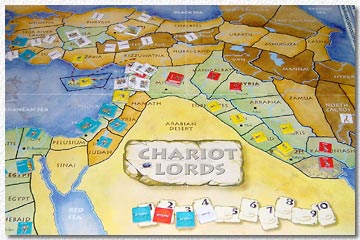
Chariot Lords boardIs this a design mistake? Many reviewers think so. I
do not agree. If you want to win Britannia you must know the victory condition of your
peoples and those of your enemies by heart. Therefore it can be very frustrating to play
Britannia with seasoned players if you aren’t one yourself. The random turn order
makes for different gameplay every time. Then, all Britannia clones allow for
unhistorical alliances (which are probably unintended by the designer). In Chariot Lords,
it’s not as easy as this. For example, Sumer needs the Babylon once as victory
condition but is usually too weak to conquer it single-handed. So Assur (same colour and
therefore player!) can do it for them. But if Assur conquers Babylon and withdraws, the
red player can’t be sure about the turn order. Perhaps the Elam chit is drawn first
and moves in …

Last major difference: There is no area-based population growth in Chariot Lords. For
each two counters you lose, you may revive one (and kill the other for ever). This makes
for much faster gameplay too.

Chariot Lords plays different from other Britannia clones. It can be frustrating if
one player just wins because he was once very lucky with the turn order. But the others
can still gang up and stop him after all. The additional random element of Chariot Lords
does really have it advantages. I’ve played Chariot Lords more often than any other
Britannia clone in the last couple of years simply because it’s a new experience
every time.

Appendix: The Nubian problem

Please forget what you could read earlier on this web page. In fact, the
rules are quite clear about this case too. 9.4 states:

“Certain nations
enter play by invading stated areas. Place the units in the chosen
areas and then move normally that turn (they are not required to leave
two units behind for every other nation’s unit in the area that they
invaded). If all invading units cannot enter the map, then they may
wait off-map.”

So the eight Nubians suddenly appear in Thebaid. They can move three
areas without hindrance, and so they threaten any Egyptian area
(Thebaid, Upper E., Lower E., Naucratis, On are all within 3 spaces
from Thebaid). If you take this rule litterally, only those units can
wait off-map which CANNOT enter. Therefore, no voluntary waiting for
Piye.

We’ve obviously always played this wrong (with other invasions as
well) but it’s probably mostly important for the Nubians. I do like
this rule and can’t wait to see it live in our next game of Chariot
Lords.

And thanks to Charles Vasey for all his patience with me till I
finally understood what he had clearly stated in the rules :-)

Spielbericht vom 3.11.2004

Spielbericht vom 3.11.2004

Autor: Walter

am Tisch: Aaron, Loredana, Peter, Walter

auf dem Tisch: “Reef Encounter”, “Dancing Dice”

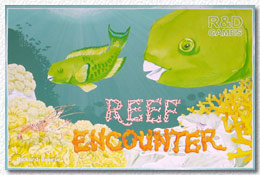
Reef Encounter cover
Autor Richard Breese
Verlag R&D Games
erschienen 2004
Spielerzahl 2-4
Spielzeit 90 Minuten

Reef
Encounter

Wir befinden uns in einem Korallenriff und müssen Kleinstlebewesen wachsen und sich
ausbreiten lassen, damit unser Korallenfisch möglichst reiche Beute für seine
Fress-Aktionen findet.

Auf den ersten Blick erinnert das Milieu an “Ursuppe“, auch da geht es um Fressen und
Gefressen-Werden in einer Unterwasserlandschaft weit weg von der Menschheit. Doch im
Grunde sind die beiden Spiele völlig verschieden.

Ich lasse das Thema jetzt weg und beziehe mich ausschließlich auf Plättchen, Klötzchen
und Figuren, die gelegt und versetzt werden können. Die eingebaute Geschichte mit Larven,
Polypen, Korallen, Algen, Krabben und Fischen hat mich nur verwirrt. Wer kann sich schon
auf Anhieb merken, wie der Autor das ausgelieferte Spielmaterial irgendwelchen Namen
seiner thematischen Umsetzung zugeordnet hat? Mir sind beim Regel-Erfassen und beim
Spielen die gegenständlichen Objekte lieber.

Damit will ich jetzt überhaupt nichts gegen die Umsetzung des Themas bei “Reef
Encounter” gesagt haben. Das Spiel braucht aber den ganzen Klimbim gar nicht. Auch
ohne die Einbildung eines Meeresmilieus funktioniert es vorzüglich und bietet eine schöne
Mischung von planbaren und von chaotischen Elementen.

Jeder Spieler hat pro Runde eine ganze Reihe von Zugmöglichkeiten zur Verfügung.
Einige darf er nur genau einmal ausführen, andere beliebig oft, solange seine Mittel dazu
ausreichen. Der Spieler kann:

  • ” 1-4 neue Plättchen einer Farbe als zusammenhängendes Gebiet
    (=”Koralle”) auf das Spielbrett legen. Er kann damit eine neue
    “Koralle” beginnen oder eine bereits bestehende “Koralle” erweitern.

    Beim Legen von Plättchen kann der Spieler bereits ausliegende Plättchen einer anderen
    Farbe entfernen, falls seine Farbe “stärker” ist als die Farbe auf dem Brett.
    (Welche Farbe stärker ist, bestimmen Farbdominanz-Anzeiger am Rande des Spielbrettes.)

  • einen oder mehrere Farbdominanz-Anzeiger umdrehen und damit die Stärke-Reihenfolge
    zweier Farben vertauschen. Mit diesem Umdrehen wird gleichzeitig die Punktwertung für die
    Farben in der Endabrechnung beeinflußt.

  • einen Schutzmarker (=”Krabbe”) auf eine freie Koralle legen. Die Koralle
    gehört damit ihm und kann im unmittelbaren Bereich des Schutzmarkers nicht von anderen
    Korallen abgefressen werden. (Ein Schutzmarker kann jederzeit beliebig versetzt werden,
    z.B. um den Freß-Schutz bewußt aufzuheben oder um damit eine günstigere ungeschützte
    Koralle zu besetzen.)

  • eine eigene Koralle von seinem Korallenfisch “abernten” lassen, d.h. der
    Spieler entfernt die Plättchen vom Brett, gibt einen festen Anteil davon zurück in den
    Vorrat und nimmt die übrigen in die Schatulle seiner Sieg-Plättchen.

  • eine Reihe von weiteren Aufnehme- oder Tauschaktionen durchführen, mit denen er seine
    materielle Basis und seinen Handlungsspielraum in Quantität und Qualität verbessert.

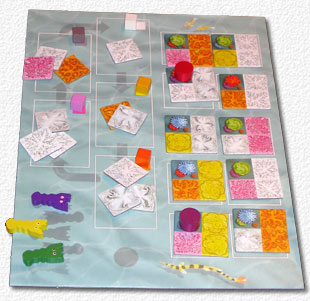
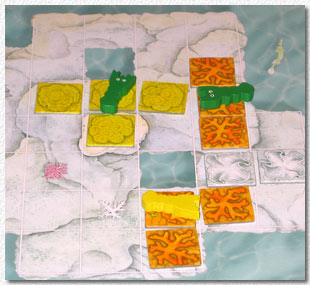
Reef Encounter board

Das Spiel ist so ausgelegt, daß es nicht unbedingt darauf ankommt, sich gleich am
Anfang mit möglichst vielen oder lukrativen Zügen einen Vorsprung zu erarbeiten. Man kann
genauso gut erst mal die notwendigen Betriebsmittel zusammensparen, und dann mit wenigen,
aber effektiven Zügen sein Punktekonto mächtig nach oben treiben.

Das Spiel besitzt überhaupt eine Menge von antagonistischen Mechanismen, es bietet
verschiedene gute Gewinnstrategien, die in allzu einseitiger Ausprägung angewandt
automatisch wieder Nachteile nach sich ziehen. Beispiele:

  1. Wer früh mit seinen Korallen-Gründungen beginnt, kann sich die besten Plätze
    aussuchen, fällt aber eher den Aggressionen seiner Mitspieler zum Opfer. Er kann auch
    nicht sicher sein, daß er beim späteren Nachziehen immer die passenden Angebote findet.

  2. Wer lange mit seinen Korallen-Gründungen wartet, um geschützte Plätze mit zügigem
    Ausbau sicher in den Griff zu bekommen, bleibt bei einem vorzeitigen Spielende auf seinen
    angesammelten Plättchen sitzen.

  3. Wer seine Korallen vor der Ernte allzu weit ausdehnen will, macht unweigerlich
    freßlustige Mitspieler auf sich aufmerksam. Außerdem wird seine Plättchenfarbe unbeliebt
    und von den Mitspielern beim Umdrehen der Farbdominanz-Anzeiger extra benachteiligt.

  4. Wer ein Risiko scheut und seine Korallen immer schon bei Minimal-Ausbau aberntet,
    kann nur geringe Ernten einfahren. Sein Gesamtertrag bleibt gering, zumal jeder überhaupt
    nur maximal 4 Ernten in die Scheuer bringen kann.

  5. Wer vorzugsweise darauf ausgeht, die Korallen seiner Mitspieler anzuknabbern,
    verzettelt sich in viele kleine Einheiten, aus denen er später nur wenig Gewinn erzielen
    kann.

  6. Wenn viele Spieler Plättchen der gleichen Farbe sammeln und einsetzen, dann kann
    jeder nur eine eng begrenzte Menge davon bekommen. Allerdings können sie dann gemeinsam
    dafür sorgen, daß die Farbe bei der Abrechnung hoch bewertet wird.

  7. Wer gezielt die Plättchen einer einzigen Farbe sammelt, dünnt damit die entsprechende
    Farbe im Vorratsbeutel aus und bekommt später immer schwerer noch weitere Plättchen
    dieser Farbe hinzu.

Reef Encounter boardIn diesem Spannungsfeld von konstruktiven und
destruktiven Zügen verläuft das Spiel. Beim ersten Mal kann man noch leicht den Eindruck
bekommen, daß überwiegend Chaos das Spiel bestimmt. Dann entdeckt man die kleinen feinen
Vorteile, die sich jedem bieten, die möglichen Optionen, die man sich offen halten soll,
die verschiedenen Gewinnpläne, die die Mitspieler verfolgen, die unausweichlichen
Ereignisse, die die eigene Position – meist zum Guten – beeinflussen werden, und auf die
man bewußt hinarbeiten kann. Auf einmal kommt einem alles geordnet und planbar vor.

Wir schätzen den Chaos-Faktor auf höchstens 30 % ein, die Planbarkeit dementsprechend
auf mindestens 70 %. Das sind für ein strategisches Mehrpersonenspiel ausgezeichnete
Werte.

Zum Schluß noch ein paar Tips für gutes Spiel, die aber keineswegs Anspruch auf
Vollständigkeit erheben:

  1. Sammele erst eine gehörige Portion Karten und die zugehörige Lege-Erlaubnis, bevor Du
    Dich auf den Ablagefeldern engagierst!

  2. Du kannst bestenfalls vier Ernten einbringen. Versuche damit auch eine ganz große
    Ernte einzufahren! Mehr als 10 Plättchen bei einer Ernte sind durchaus im Bereich des
    Möglichen.

  3. Fahre schon recht früh die erste Ernte ein! Auch wenn sie nicht überwältigend groß
    ist! Damit gewinnst Du gleich einigen wichtigen Einfluß auf die Farbdominanz-Anzeiger.
    Außerdem setzt Du Deine Mitspieler stärker unter Druck, schnell mal das Spielende
    herbeiführen zu können. Wenn Deine Mitspieler zu lange ohne richtigen Erfolg an zu vielen
    Riffen herumkrebsen, dann kannst Du durchaus auch mal mit vier kleinen Brötchen den Sieg
    davon tragen.

  4. Um Deine Plättchen gegen Angriffe der Mitspieler zu schützen, kannst Du nicht nur
    Deine Schutzmarker (=”Krabbe”) einsetzen. Auch günstige Brutplätze auf dem
    Spielbrett tragen dazu bei! Mit dem Rücken zur Wand, d.h. in den Randgebieten, bietest Du
    deutlich weniger Angriffsflächen für die Habgier oder Mißgunst der Konkurrenz.

  5. Auch durch eine kleine Sekundär-Kolonie kannst Du die Flanken Deines Hauptgebietes
    schützen. Überlege dann, über welche Wege Du später Deinen eigenen Hilfstruppen für eine
    lohnenswerte Super-Ernte auffressen kannst! Nur Du kannst den Schutzmerker entfernen und
    damit die Hilfetruppe abräumbar machen.

  6. Wenn es aufs Ende zugeht, dann mußt Du schnell noch mitnehmen, was auf dem Wege
    liegt! Hab’ immer im Hinterkopf, welche Kolonie Du noch abernten willst, wenn ein
    Mitspieler das Spielende ausgelöst hat!

  7. Habe einen Plan! Es gibt viele gute Strategien. Aber man muß sie auch gezielt
    anwenden und sich nicht von den zufällig gebotenen guten Zügen in zu viele verschiedene
    Richtungen verzetteln.

WPG-Wertung: 7,75

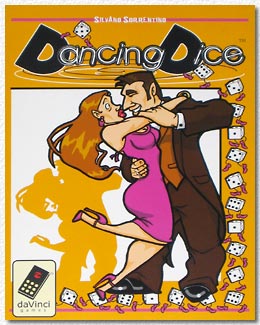
Dancing Dice cover
Autor Silvano Sorrentino
Verlag daVinci Editrice
erschienen 2004
Spielerzahl 2-6
Spielzeit 20 Minuten

Dancing Dice

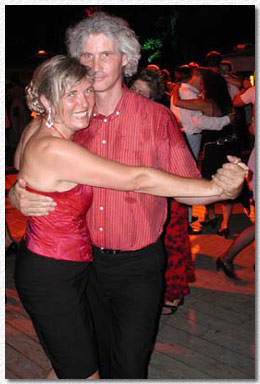
Tanzende Würfel, Mambo, Cha-cha-cha und vor allem Tango: welches Tänzerherz hüpft da
nicht höher, wenn diese Traumbegriffe angekündigt werden? Beim Auspacken der Schachtel,
beim Betrachten der zierlichen Tanzschritt-Muster auf den Würfeln hat mich schon eine
Vision überkommen, meine der Tango-Leidenschaft frönende Frau auch mal wieder an den
Spieltisch locken zu können.

Dann fingen wir zu spielen an und von der Euphorie blieb nichts mehr übrig. Wir
wendeten das Spielmaterial hin und her, wir durchsuchten die Spielregeln in allen
Sprachversionen, es blieb nichts übrig, was vor den kritischen Augen von Profil-Spielern
als Spielwitz, Spielvergnügen oder dergleichen Bestand haben könnte.

Nimmt man das Tanz-Motiv aus dem Spiel, bleiben für jeden Spieler 6 normale
Hexa-Würfel übrig, mit denen er einmal, und bei Nichtgefallen noch einmal nachwürfelt.
Alles verdeckt. Dann darf er seine Würfel – immer noch verdeckt – in zwei Reihen zu je
drei Würfel ordnen. (Mogeln ist selbstverständlich verboten, aber wer kann das
kontrollieren?) Alle Spieler decken ihre Ergebnisse gleichzeitig auf und vergleichen. Die
Spieler mit den besten Würfen kommen unbeschadet davon, alle anderen verlieren
Lebenspunkte und scheiden so nach und nach aus. Der Letzte macht das Licht aus.

Wo ist der Witz? Beim guten Würfeln? Beim Sortieren der Würfel nach optimalen
Kombinationen? Wir haben keinen gefunden. Ein bißchen Bluff, ein bißchen Taktik, ein
bißchen Fun, hätte man das nicht unterbringen können? 18 namentlich genannte Spieltester
haben nichts dergleichen vermißt. Wir schon.

Die Regelschreiber Roberto und Andrés haben eine gute Arbeit geleistet, die
Übersetzerin Ulrike ebenso. Aber Form ist nicht alles. Das neuartige Würfeldesign mit den
kleinen Schrittmustern, das auf den ersten Blick sogar ganz hübsch aussieht, ist für die
Funktion eher schädlich. 50 Jahre lang habe ich mich an die Standardmuster gewohnt und
kann eine 5 von einer 6 auch ohne Brille unterscheiden. Bei “Dancing Dice” muß
ich dafür zweimal hinschauen, und das für jeden der 6 Würfel. Ein teurer Mehrwert.

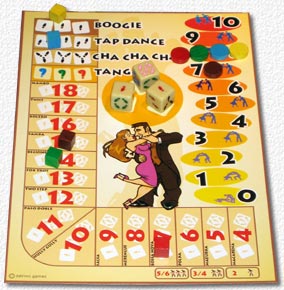
Dancing Dice boardGlücklicherweise ist ein Spiel nach 20 Minuten über
die Bühne. Ohne einen einzigen Lacher. Offensichtlich wird kein Lustspiel geboten. Na ja,
eine Tragödie ist es wohl auch nicht. Halt nur ein Würfelspiel.

Ich fürchte, meine Frau wird weiterhin in ihre Tango-Lession gehen, wenn wir unsere
WPG-Sessions abhalten. Wahrscheinlich sogar extra, wenn wieder ein “Dancing
Dice” angesagt wäre.

WPG-Wertung: 2,75

03.11.2004: Reef Encounter, Dancing Dice

1) Reef Encounter
gutes 7,75 Punkte Spiel über Leben und Leben-lassen am Korallenriff

2) Dancing Dice
mäßiges 3-Punkte Spiel mit vergeblichen Hoffnungen auf Tangofreuden. Bauchlandung mit schlechten Würfel-Ergebnissen.

Wenigstens können wir mit 2 neuen Berichten wir unsere Nach-Essen-Reviews fortsetzen.

Viele Grüße an die sexige Runde am Donnerstag

Ins Innere Afrikas

Ins
Innere Afrikas

by Peter Riedlberger

“Ins Innere Afrikas” (“Heart Of Africa”) is an eclectic piece of
game design meaning that it combines rather different gaming mechanisms. There are
purists who dislike eclectic designs per se. I definitely don’t belong to them as my
fondness for “Maya” shows.

A turn of “Ins Innere Afrikas” starts by auctioning off the right to use the
turn. The money paid by the high bidder is evenly distributed to the other players. Yes,
it’s the “Traumfabrik/Fabrik der Träume” mechanism. But there is one
difference: You can also bid with victory points if those little wooden cubes which are
used as money aren’t sufficient.

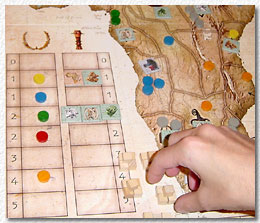
Ins Innere Afrikas board

Then the high bidder moves his army, oops…, trader counters on a map of Africa. He
engages in combat, oops…, palavers with natives and other players. The whole trading
background seems to be made up in order to calm German pacifist feelings. In fact, this
part of the game feels like any typical wargame. Just one point to support the case: if a
player loses a “palaver” his counters must leave the area. If no escape path is
available all counters disappear (in wargames, you’d call this: annihilated).

So, how’s the “palaver” fought? Against natives (or neutrals, as the
rules call them) you draw a chit by random. This chit decrees what you have to swallow if
you want to win the palaver. If you outnumber the natives you can draw several times in
the hope to get an easier chit.

Against other players, you use a modified “Kuhhandel” system: secret
bidding; both players open their hands at the same time. If both take their stand, the
highest bidder wins and everything that was used to bid is distributed to the other
players (well, to be exact: to everyone except the active player). If one player chooses
to flee, he gets all the counters of the other player’s bet.

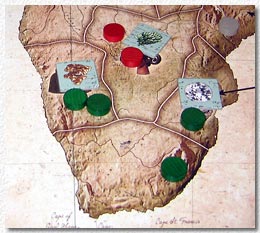
Heart of Africa boardAfter having resolved all
“palavers” the active player (and only he) counts victory points. This is one
of several “Vinci” aspects: first, during the initial auction, you not only get
the right to take your turn but also two “activity chits” which allow for
one-time special abilities. The second is that you can (also) bid with victory points.
The third is this victory point counting at the end of turn, and the fourth is the
corollary of all this and constitutes the main problem of “Vinci”. This mars
“Vinci” as it does “Ins Innere Africas”: The complete calculability
of the end game.

I owe to Moritz the wonderful expression “analysis paralysis”: You can
calculate exactly how many victory points you are able to obtain. So every player will
bet exactly as much as he can in order to get 42 victory points (the victory condition).
That means LOTS of calculations for everyone, LOTS of downtime. This also means that the
final winning order hasn’t much to do with the course of the game.

“Ins Innere Afrikas” isn’t a bad game. But it isn’t very good
either. Actually, I wouldn’t know for whom I should recommend it. It’s much too
complicated for a family environment. Think only about those many different mechanisms.
Playing it with hardcore games will result in “analysis paralysis” like in our
case: the box said 90 minutes, we played more than 3 hours.

A note on the gaming material: On the one hand it is well done (beautiful artwork,
material in “Kosmos quality”). However, the symbols are annoyingly confusing.
Some cases in point: One rainbow coloured counter means: One VP for every two
traders
. However, two rainbow coloured counters mean: Active player gets
two traders for free
. One grey counter means: Move all neutrals from one
area to an adjacent area
. Two grey counters with an arrow mean: Move all
your own traders from one area to an adjacent area
. That’s not what I call
intuitive.

Worse still, they even mixed up one symbol. Several “palaver” chits (those
you draw if you wage “palaver” against natives) make you lose
“reputation”. However, they don’t show the “reputation” symbol
but the “goods” symbol.

Westpark Gamers ranking: 5.8 (out of 10 points)

Players were: Loredana, Andrea, Hans, Moritz, Peter

Druids

Druids

by Moritz Eggert

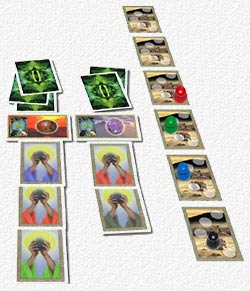
“Druids” ist ein schnelles und einfaches Kartenspiel von Leo Colovini. Die
Spieler verkörpern Magier, die die Kraft magischer Orte nutzen. Am Anfang des Spiels
werden diese Orte in einer Reihe ausgelegt, in verschiedenen zufälligen Farben. Jeder
Spieler nimmt nun ein Set von eigenen “Aktionskarten” (Zahlen von 1-x, je nach
Spieleranzahl) und “Steinkarten” auf die Hand (ebenfalls nummeriert, die Farben
korrespondieren mit den Orten). Nun kann man jede Runde Karten auf die verschiedenen
Steine ausspielen. Links spielt man (verdeckt) die Steinkarten, die man zu ergattern
hofft – jede beliebige Farbe kann hier gespielt werden, aber später bringen nur die
Steinkarten Punkte, die die Farbe des danebenliegenden Ortes haben. Rechts vom Ort spielt
man (ebenfalls verdeckt) die eigenen Aktionskarten. Jederzeit am Anfang seines Zuges darf
man auch die Karten an einem Ort aufdecken sobald eine Mindestzahl Aktionskarten dort
liegt. Dann passiert folgendes: alle nicht passenden Steinkarten werden abgeworfen (sie
dienten allein zum Bluffen) und die Aktionskarten werden von unten nach oben abgehandelt.
Der Spieler mit der niedrigsten Zahl auf der Karte darf genau diese Anzahl von noch
gültigen Steinkarten als Siegpunkte direkt verwerten (hierzu gibt es sogar eine kleine
Siegespunktleiste). Dann der Spieler mit der nächst höheren Zahl genau diese Anzahl der
übrig bleibenden Karten, usw.. Es ist nun einerseits möglich, dass nicht genügend
Steinkarten mehr aufgeteilt werden können und die höher gespielten Aktionskarten leer
ausgehen, andererseits ist es aber auch möglich, dass mehr Karten übrig sind als verteilt
werden dürfen, dann bekommt der zuletzt aufnehmende Spieler den Rest geschenkt.

Am Ende gewinnt der Spieler, der als erster die Ziellinie des Siegpunktparcours
überschreitet.

Druids cardsDies waren auch schon die kompletten Regeln des Spiels, es ist
erstaunlich, dass man sie in der kurzen, mehrsprachigen Anleitung erst einmal überhaupt
nicht versteht, wenn man sie liest. Vielleicht liegt es daran, dass hier umständlich von
Zauberamuletten etc. gesprochen wird, wenn es letztlich nur um das Umwandeln von
Zahlenwerten in Siegpunkte geht.

Natürlich merkt jeder Leser sofort, dass es sich hier trotz des Titels überhaupt nicht
um ein Fantasyspiel handelt, sondern um ein rein abstraktes Ablegespiel erster Güte. Als
dieses weiß es aber durchaus zu gefallen, denn der Auslegestrategien gibt es viele, und
man möchte nach der (normalerweise sehr kurzen) Partie eigentlich gleich noch mal
spielen, um seine Fehler zu korrigieren. Ein schöner Zug ist es auch, dass man die
Verteilung seiner auf ein Maximum festgelegten Kartenhand selber kontrollieren kann, in
dem man selber entscheidet, wie viele und welche Aktionskarten man hält und wie viele
Steinkarten man aufzieht.

Auch wenn es sich sicherlich um kein Bahn brechendes Design handelt, ist
“Druid” für Freunde schneller Ablege-und Sammelspiele a la z.B.
“coloretto” also durchaus zu empfehlen! Das Kartendesign ist schön, aber etwas
überkandidelt für den simplen Zweck, gerade bei schwierigeren Beleuchtungsstufen sind
bestimmte Farben kaum zu unterscheiden.

Zum Erklären des Spieles reichen 5 Minuten, eine Partie sollte um die 15 bis maximal
30 Minuten dauern.

Camelot Legends

Camelot Legends

by Moritz Eggert

The legend of King Arthur has been the theme of many games. From the now legendary
“role-playing-board-game” “Knights of Camelot” (TSR, Rahman brothers)
to the more recent card game “Quests Of The Round Table” (Gamesmiths) there
have been many attempts at creating a worthy gaming representation of the long-gone world
of chivalry, damsels in distress and dazzling tourneys. Even Knizia has done his version
of “King Arthur”, but it is one of his less successful attempts at an
electronic boardgame hybrid.

The King Arthur themed boardgames fall into two categories: Either ultra-complicated
fantasy simulations like the Rahman game, or rather flimsy affairs with dodgy rules like
“Quests Of The Round Table” (a game which we tried to “save” several
times). Until now there has never been a really satisfying game that does the theme
justice without either frying or underestimating your brains. With “Camelot
Legends” this gap might have been filled.

“Camelot Legends” is a card game, with very simply basic rules. There are
three places, represented by larger cards, which form the “adventure areas”:
Camelot, Cornwall and the Forest. Players collect knights, ladies and wizards (the
playing cards) and send them to the various places to fulfil quests/adventures which are
drawn regularly and placed on the adventure areas. These drawn quests can also sometimes
form new “areas” which can also be visited (it is for example possible to send
knights to Avalon where they can’t do anything but give extra victory points at the
end of the game).

Each player only has two actions each round. An action can be

  1. drawing a character card
  2. moving 1-2 cards from one location to another
  3. play a character card on a location.

After a certain number of quests have been drawn a “final” quest appears
which ends the game when it is solved. Each quest gives the solving player victory
points, as do certain titles or items like “High King”, “Excalibur”
or “Love Potion”, which can be acquired by various means (and lost as
well).

Each Knight (or Lady or King or magician) is rated in 6 “skills”, from 0 to
7. These skills are represented by icons which are a bit difficult to get used to, but
there is a player aid card which helps. To fulfil a quest you need to acquire a certain
number of “skill points” in one or more skills at the location where the quest
is to be solved. The random quests appear in equal fashion at each adventuring place, and
each adventuring place has predominant skills that are needed (although you never can be
sure). At the beginning of each player’s turn it is checked if s/he can fulfil any
quests, but only after the various special character card powers have been used.

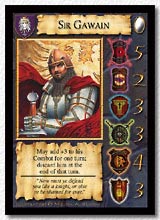
Camelot Legends cardThese special powers are the meat of the game.
There are a LOT of character cards, and the game designer has managed to give each of
these cards a unique set of skills and (always) a special ability that only pertains to
this very character, and which is also congruent with the “real” character in
the legends. So “Merlin” has magic powers that protect his party from attacks
of other cards, or “Tristan” is less powerful when “Isolde” is in
another adventuring group, but more powerful when he is together with her. One can tell
that a lot of work went into designing these special abilities, and the beautiful
character portraits together with the love for detail apparent throughout the game make
for a really nice representation of the myth, even though the game is basically quite
abstract. The characters even belong to different heraldic “factions” which
work better if played in a team. Many abilities influence other players’ characters –
it is possible to discard opponent characters or to charm them to bring them on your
side. In fact there are so many quite different and complex abilities that the game can
create analysis paralysis (at least if you make the mistake that we made: arrogantly
starting with the most advanced game which uses all cards and abilities).

Of course the luck of the draw is an important factor. If you continuously draw weak
knights you will certainly be at a disadvantage, as of course characters like
“Lancelot” or “King Arthur” are very powerful cards. It would have
been nice to have some kind of victory point/auctioning mechanism to balance this, but if
you’re not expecting a deeply tactical game this probably won’t create a problem.
Normally it is quite obvious which special abilities are best to use, but especially
later in the game there are a LOT of characters around, and keeping track of all their
abilities can be quite difficult. It is therefore good that the designer limited the
number of players to 4. The game is playable with 2 players, but works best with 3 or
4.

The rulebook is unusually well laid-out, and comes with a glossary of characters,
which certainly is a bonus for people interested in Arthurian legends. It also serves its
purpose to GET people interested.

As I already mentioned I would strongly recommend to start with the basic game for
inexperienced gamers and with the intermediate game (maximum) for experienced gamers. You
will understand what I mean when you first play!

“Camelot Legends” can be fully recommended for fans of Arthurian myth. It is
really one of the most beautiful and playable games around that abduct you into Arthurian
times. People looking for a good card game will not be disappointed, but they should like
games with special abilities. Collectors will love it for the great artwork (of high
quality even on the most unimportant cards). Fanatic “Eurogame” enthusiasts
might have to get used to the game mechanisms.

Explaining the game should not take more than 10 minutes, the actual playing time
should be between 45 and 90 minutes maximum. We liked it!

"Was lag auf den Tisch?"